
Attackers rarely strike during office hours. For most Caribbean organisations, the gap between an intrusion and its discovery is measured in weeks. A managed Security Operations Centre closes that gap at a cost that a full in-house team could never match.
Picture a typical Friday evening at a Caribbean hotel group, credit union or distribution company. The IT team has gone home. The finance team has approved the week’s payments. The building is quiet. Somewhere overseas, an attacker logs in to the company’s email system with a password bought on a criminal forum for a few dollars.
Over the weekend, the attacker reads emails, creates hidden forwarding rules, explores shared files and looks for a way into the servers. By Monday morning, nothing seems wrong. No alarm has sounded, because no one was there to hear it.
This scenario is not hypothetical. It describes how a large share of serious cyber incidents begin. Attackers choose nights, weekends and public holidays deliberately, because they know most organisations are not watching. The question every board should ask is simple: who is watching our systems at two o’clock in the morning?
The detection gap
Prevention tools such as firewalls, email filters and antivirus software stop most attacks. But no prevention is perfect. Stolen passwords, new malware and clever social engineering get through. When they do, what matters is how quickly you notice.
The time between an attacker getting in and an organisation discovering it is often called dwell time. During that period the attacker studies the network, steals credentials, copies data and prepares to strike. The longer the dwell time, the worse the outcome: more data stolen, more systems compromised and a harder, more expensive recovery.
For organisations without monitoring, dwell time is often measured in weeks or months. Many learn of an intrusion only when ransomware appears on every screen, when a customer reports fraud or when their data turns up for sale online. By then, the damage is done.
| Prevention tools stop most threats. A Security Operations Centre is there for the ones that get through. |
Why alerts alone are not enough
Most organisations already generate security alerts. Firewalls log blocked connections. Email platforms flag suspicious messages. Endpoint software reports unusual behaviour. Cloud services record sign-ins from unexpected countries.
The problem is volume and context. A mid-sized organisation can generate thousands of security events every day. Most are harmless. A few matter enormously. Telling them apart requires trained analysts who understand attacker behaviour, know what normal looks like for your environment and can act quickly when something is wrong.
In most Caribbean organisations, those alerts flow into an inbox that a busy IT manager checks when there is time, which is rarely. The signal is there, but no one is listening.
What a managed SOC does
A Security Operations Centre is a team of analysts, supported by technology and threat intelligence, whose job is to monitor your systems continuously and respond to threats. A managed SOC provides that team as a service, shared across many clients, so each organisation gets 24/7 cover for a predictable monthly fee.
A modern managed SOC monitors three critical areas:
- Endpoints, meaning laptops, desktops and servers, through a lightweight agent that watches for suspicious behaviour such as unusual processes, persistence techniques and ransomware activity.
- Networks, through firewall and network logs that reveal connections to known malicious addresses, unusual traffic and suspicious services.
- Cloud services, such as Microsoft 365, Google Workspace and cloud infrastructure, where account takeover and data exfiltration increasingly happen.
The SOC collects data from these sources, applies detection rules mapped to frameworks such as MITRE ATT&CK, and puts trained eyes on the alerts that matter.
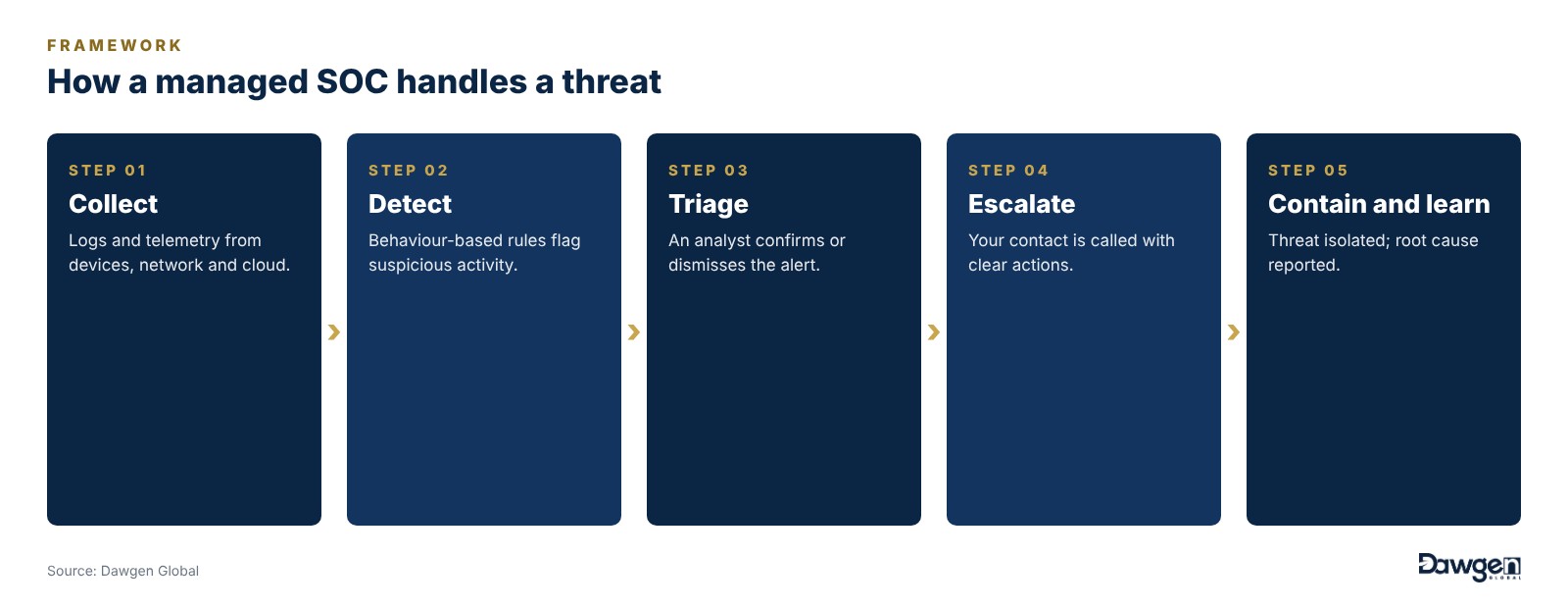
Figure 1. How a managed SOC handles a threat
When a genuine threat is confirmed, the SOC escalates to your nominated contact by phone, explains what has been found and guides immediate containment, such as disabling an account or isolating a device. Afterwards, it reports on what happened and how to prevent a repeat.
Building versus buying
Some large organisations build their own SOC. For most Caribbean organisations, that is not realistic. Covering every hour of every day requires a minimum of five or six analysts working shifts, plus managers, tools, threat intelligence subscriptions and ongoing training. Experienced security analysts are scarce in the region and often recruited away by international firms.
A managed SOC removes that burden. You gain access to a trained team, mature processes and enterprise-grade detection technology, without the recruitment, retention and tooling costs. Your IT team remains in control of your systems, but no longer carries the impossible task of watching them around the clock.
Choosing the right level of cover
Managed SOC services are usually offered in tiers. Understanding them helps you match cover to your risk and budget.
An SME package provides 24/7 monitoring, alerting and detection, with access to professional engineers when you need advice. It suits smaller organisations that need someone watching but have relatively simple environments.
An Enterprise package adds deeper data analysis, threat intelligence and more extensive investigation. It suits larger and regulated organisations with complex environments, multiple sites or significant cloud use.
A your-platform or co-managed option suits organisations that have already invested in security tools but lack the people to run them around the clock. The SOC’s engineers monitor and manage your existing platform, and your IT team keeps day-to-day control.
What good looks like
When evaluating a managed SOC provider, look beyond marketing claims. The questions that matter are practical:
- Does the service monitor endpoints, network and cloud, including remote staff?
- How quickly will you be called about a confirmed threat, and will the analyst explain what to do in plain language?
- Will the provider learn your environment and reduce false alarms, or will you be flooded with noise?
- Security of the service itself. Is agent communication encrypted and outbound only? Is access to the platform protected with multi-factor authentication?
- Will you receive monthly reports that show threats detected, actions taken and recommended improvements, written for management as well as IT?
- If a serious incident occurs, can the provider move straight into incident response and forensic investigation?
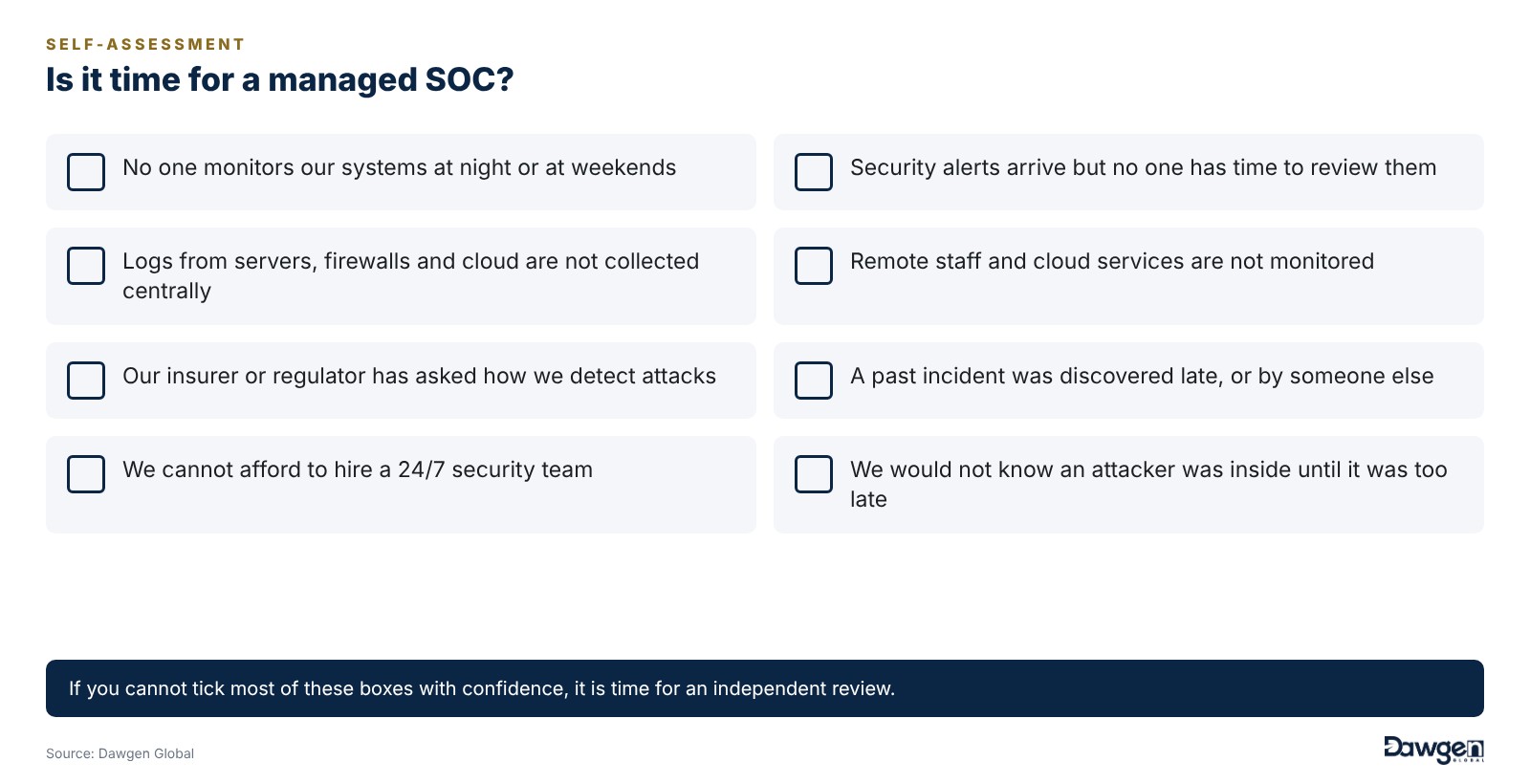 Figure 2. Is it time for a managed SOC?
Onboarding without disruption
A well-run onboarding takes weeks, not months. It begins with scoping: agreeing which devices, servers, firewalls, cloud services and locations will be monitored, and who should be called when a threat is found. The provider then deploys agents and connects log sources, usually with minimal disruption to staff.
The first few weeks are a tuning period, during which analysts learn what normal looks like in your environment and adjust detection rules. After that, the service settles into continuous monitoring, monthly reporting and regular service reviews.
The insurance and regulatory angle
Cyber insurers increasingly ask how organisations detect attacks, and some now expect endpoint detection and response with monitoring as a condition of cover. Financial regulators and data protection authorities also expect organisations to detect and respond to incidents in a timely way. A managed SOC provides clear evidence of both: continuous monitoring, documented escalation and regular reports.
Getting started
For organisations considering a managed SOC, a short readiness review is a sensible first step. It maps your current environment, identifies the log sources that matter most and confirms which package fits. From there, onboarding can begin quickly.
In the meantime, three actions improve your detection immediately: enable audit logging on your cloud email platform, enforce multi-factor authentication for every account and make sure someone is notified when administrator accounts sign in from unusual locations.
A night in the life of a SOC
It helps to see what continuous monitoring looks like in practice. Consider a composite of the kind of activity a SOC handles for Caribbean clients over a single night.
At 11:40 p.m., a sign-in to a client’s cloud email platform is recorded from a country where the organisation has no staff. On its own, this might be a traveller. But the account then creates an inbox rule that forwards messages containing the words “invoice” and “payment” to an external address. The analyst recognises the pattern of business email compromise, calls the client’s escalation contact and guides them to reset the password, revoke active sessions and remove the rule. Fraudulent payment instructions that might have gone out the next morning never do.
At 2:15 a.m., an endpoint agent on a server at another client reports a process attempting to disable security software and delete shadow copies, which are classic precursors to ransomware. The analyst isolates the server from the network through the agent, wakes the client’s IT lead and begins an investigation. The source turns out to be a remote access account belonging to a former contractor that was never disabled.
At 4:30 a.m., a firewall log shows repeated connections from a workstation to an address listed in threat intelligence feeds as a command-and-control server. The device is flagged for investigation at the start of the business day, and the client’s IT team removes a malicious browser extension.
None of these events would have been noticed until much later without someone watching. Each would have become far more expensive with every hour of delay.
Common objections, answered
“We already have antivirus software.” Antivirus software blocks known malware but is not designed to spot an attacker using stolen credentials or legitimate admin tools. A SOC looks for behaviour, not just known threats.
“We cannot share our data with an outside provider.” A well-designed service collects only security telemetry, not business documents, encrypts all communication and restricts access to authorised analysts. Your provider should be able to explain exactly what is collected, where it is stored and who can see it.
“Our IT provider watches our systems.” Ask whether they monitor security events around the clock, with trained analysts, and what happens when a threat is found at 3 a.m. on a public holiday. Many IT providers manage availability, not security.
“It is too expensive.” Compare the monthly cost with the cost of a single serious incident: lost revenue during downtime, recovery work, forensic investigation, regulatory exposure and reputational damage. For most organisations, the comparison is not close.
Conclusion
Attackers work around the clock, and they choose the hours when no one is watching. For Caribbean organisations, a managed SOC offers a practical answer: a trained team watching your systems every hour of every day, at a fraction of the cost of building one yourself.
The difference between an intrusion caught in an hour and one discovered after three weeks is often the difference between a minor incident and a crisis. Knowing who is watching at two o’clock in the morning is no longer optional.
| TAKE THE NEXT STEP
Put a team of analysts on watch, around the clock. Our Managed SOC & 24/7 Threat Detection brochure explains what we monitor, how onboarding works and how our SME, Enterprise and your-platform packages compare. Read the brochure: Managed SOC & 24/7 Threat Detection — https://www.dawgen.global/service-brochure/managed-soc/ Talk to us: Request a managed SOC proposal or a SOC readiness review. Write to info@dawgen.global, or to your territory desk at territory@dawgen.com. |
About Dawgen Global
Dawgen Global is an independent, integrated multidisciplinary professional services firm headquartered at 47 Trinidad Terrace, New Kingston, Jamaica, serving 35 territories across the Caribbean. Founded and led by Dr. Dawkins Brown, Executive Chairman, the firm is independent and not affiliated with any international network. It delivers a full suite of professional services under one roof: audit and assurance; tax advisory; IT and digital transformation; risk management; cybersecurity; actuarial and insurance regulatory advisory; HR advisory; mergers and acquisitions; corporate recovery; business advisory and strategy; accounting BPO and virtual CFO services; and legal process outsourcing.
The proposition is simple: big-firm capability without the big-firm price. Dawgen Global’s integrated approach is built for the specific complexities and opportunities of the Caribbean market, helping organizations make sharper, better-informed decisions that drive measurable progress.
To explore a partnership, reach out:
- Website: dawgen.global
- Email: info@dawgen.global
- WhatsApp (Global): +1 555-795-9071
- Caribbean offices: +1 876-665-5926 | +1 876-929-3670 | +1 876-926-5210
Related service: Explore how we can help →