
Skilled attackers do not always set off alarms. They log in with stolen passwords, use legitimate tools and wait. Threat hunting and compromise assessments start from a simple assumption: someone may already be inside. Then they set out to prove it, or rule it out.
Most organisations think about cybersecurity as a wall. Firewalls, filters and antivirus software keep attackers out, and alarms sound if something gets through. It is a comforting picture, and it is incomplete.
The most capable attackers do not break down walls. They walk through the front door with stolen keys. They log in with valid passwords, use the same administrative tools as your IT team and move slowly to avoid attention. Some install access that lies dormant for weeks before it is used. Many of these activities look so much like normal work that security tools raise no alarm at all.
This is why a growing number of organisations adopt a mindset known as “assume breach”. Instead of waiting for an alert, they go looking for evidence that an attacker is already present. The two main ways to do this are threat hunting and compromise assessment.
Why some attackers go unnoticed
Understanding how attackers avoid detection explains why hunting matters.
They use legitimate tools. Remote desktop, PowerShell, scheduled tasks and administrative utilities are part of everyday IT work. Attackers use the same tools, a practice sometimes called “living off the land”, so their activity blends in.
They use valid credentials. Passwords stolen through phishing or exposed in other breaches allow attackers to sign in like any employee. Security tools see a successful login, not an intrusion.
They hide in normal traffic. Command-and-control communications often use common ports and encrypted web traffic, and data can be smuggled out inside routine-looking connections.
They wait. Some malware spreads quickly and then goes quiet, waking later while defenders are focused elsewhere. Attackers may spend weeks mapping a network before taking any visible action.
They arrive through others. Suppliers, managed service providers and acquired companies can bring existing compromises into your environment through trusted connections.
| Threat hunting starts from one assumption: an attacker may already be inside. Then it sets out to prove or disprove it. |
What threat hunting is
Threat hunting is a proactive, hypothesis-led search for attackers who have evaded existing defences. Rather than responding to alerts, hunters form theories about how an attacker might behave in your environment, based on threat intelligence and knowledge of your systems, and then test those theories against your data.
A typical hypothesis might be: “If an attacker had compromised a staff account, we would expect to see sign-ins at unusual hours followed by access to file shares that user does not normally use.” Hunters then query authentication logs, endpoint activity and network connections to look for that pattern.
Hunters use several core techniques. Searching queries data for specific artefacts. Clustering groups similar data points to reveal outliers. Grouping looks for unusual combinations of artefacts appearing together, such as reconnaissance commands run within minutes of each other. Stack counting counts how often values occur across many machines and examines the rare ones, because attacker tools are often the odd ones out.
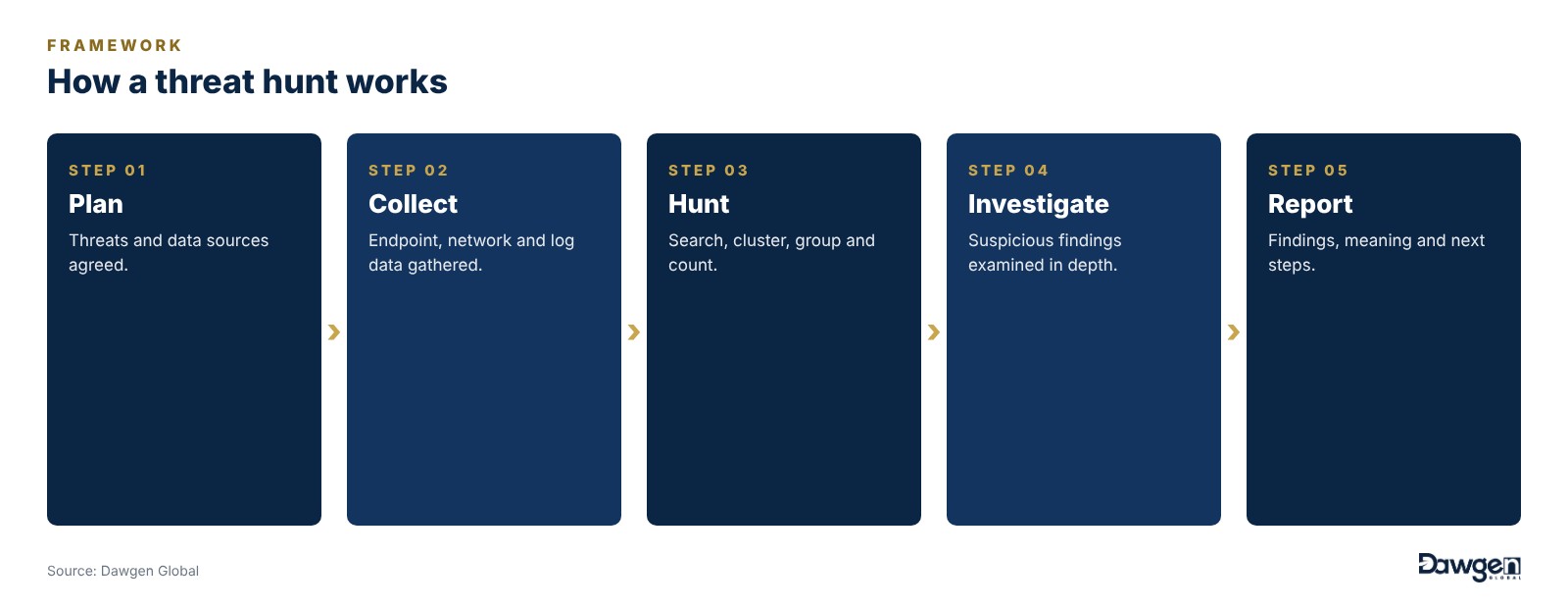
Figure 1. How a threat hunt works
What hunters look for
Attackers inside a network tend to follow a recognisable sequence, mapped in detail by the MITRE ATT&CK framework. Hunts target each stage.
Internal reconnaissance. Once inside, attackers enumerate the host they are on and the network around it, establishing what privileges they have and what other systems they can reach.
Persistence. Attackers want to survive reboots and simple fixes. Common methods include scheduled tasks, code injected into legitimate processes and additions to registry run keys that launch malware at start-up.
Credential abuse and lateral movement. Captured password hashes can be reused to authenticate without knowing the actual password. Remote desktop, shared web folders and hijacked file paths let attackers move between systems and escalate privileges.
Command and control. Attackers need to communicate with their tools. Some hide in plain sight using common protocols and ports. Others use unusual ports and protocols to avoid heavily monitored channels.
Exfiltration. Data can be smuggled out through DNS tunnelling, encrypted file transfers and other channels designed to bypass firewalls.
What a compromise assessment is
A compromise assessment is a focused, time-limited review designed to answer one question: is there evidence of an attacker in this environment, now or in the recent past?
Where threat hunting is often ongoing, a compromise assessment is a point-in-time sweep. Investigators examine systems for malware and suspicious files, unauthorised accounts and access, persistence mechanisms and unusual outbound connections. The output is clear: either a statement that no evidence of compromise was found, with the scope and limits of the work explained, or a set of findings with evidence and recommendations.
A clean result is valuable in its own right. It gives boards, insurers, auditors and buyers independent confirmation that an environment has been examined and found free of known indicators of compromise.
When to commission one
There are several situations where a hunt or compromise assessment is especially valuable.
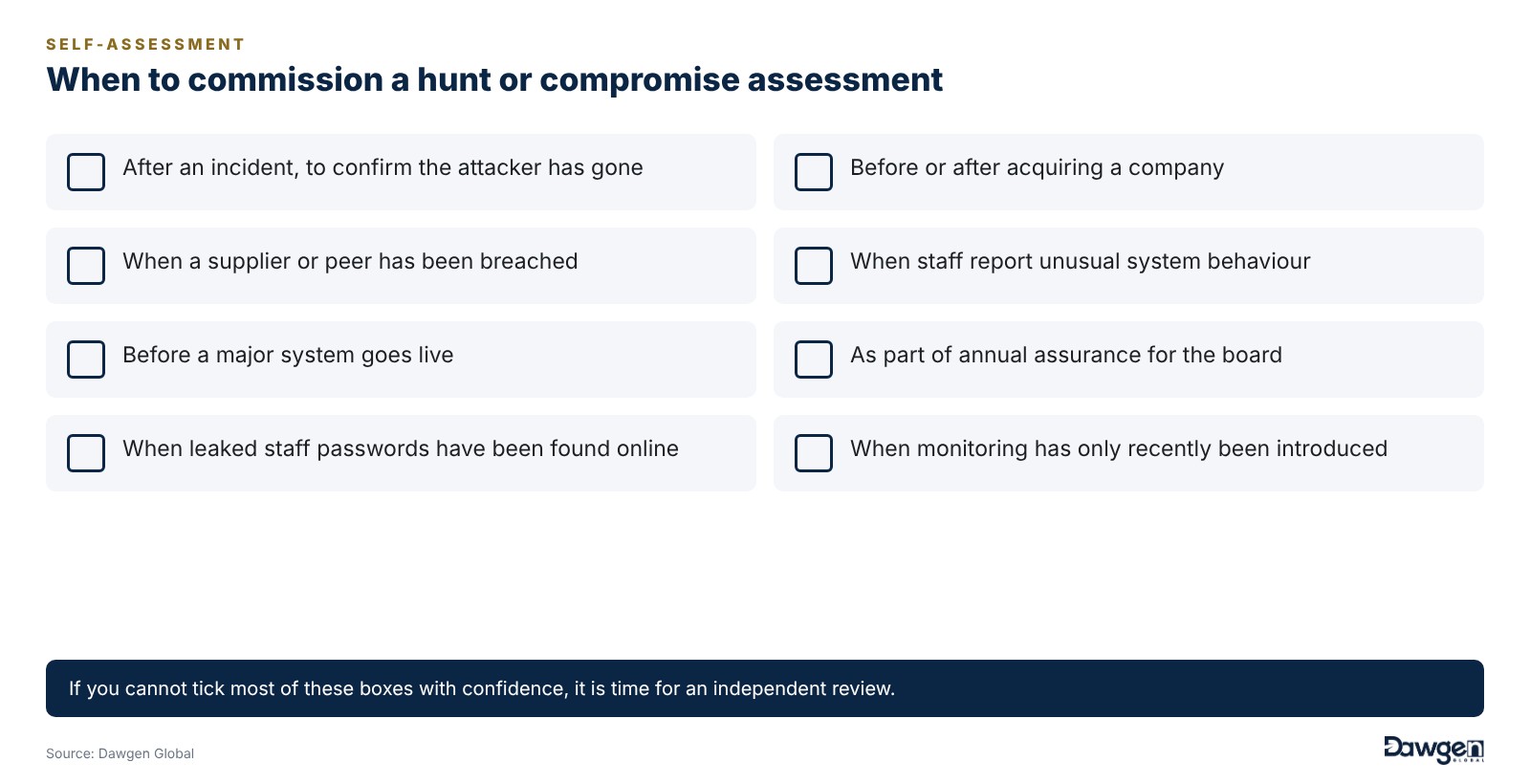
Figure 2. When to commission a hunt or compromise assessment
After an incident. Once an attack has been contained, organisations need confidence that the attacker has gone and has not left backdoors behind. Without that confidence, recovery is built on uncertain ground.
During mergers and acquisitions. Buying a company means inheriting its networks. A compromise assessment of the target, before or immediately after completion, avoids importing an existing intrusion into your environment. Cyber findings can also affect price, warranties and integration plans.
When a supplier or peer is breached. If a shared supplier, managed service provider or similar organisation in your sector has been attacked, it is prudent to check whether the same attackers reached you.
As annual assurance. Many boards now commission an independent compromise assessment each year, alongside penetration testing, to confirm that defences are working.
A composite case: the quiet intruder
Consider a scenario that reflects patterns seen across the region. A financial institution’s security tools showed no alerts. However, a peer organisation had recently been breached through a supplier that both institutions used for software support.
A compromise assessment hunted for persistence, unusual outbound connections and credential abuse across servers and staff devices. It found a dormant remote access tool on two servers, installed months earlier using the supplier’s legitimate access account. The tool had not yet been used for any visible attack, but it gave the attacker a way back in whenever they chose.
The tool was removed, the supplier’s access was redesigned to require approval and multi-factor authentication for every session, and a follow-up hunt confirmed the environment was clean. The board received a clear account of what had been found, what had been done and what had changed.
Hunting as an ongoing service
For organisations with continuous monitoring through a managed SOC, threat hunting can become a regular service rather than a one-off project. Monthly or quarterly hunts focus on new techniques as they emerge, on threats targeting your sector and on areas where automated detection is weakest. Each hunt that finds nothing still adds value, because the hypotheses and queries can be turned into new automated detections that strengthen monitoring permanently.
What makes a good hunt
When commissioning threat hunting, the questions that matter are:
- Are hunts driven by threat intelligence relevant to your sector and region, or are they generic sweeps?
- Which data sources will be used? Endpoint process data, authentication logs, DNS and network connections are all valuable.
- Are findings mapped to MITRE ATT&CK, so your team can see exactly which techniques were tested?
- Will data collection affect live systems? A lightweight, read-only approach should be the default.
- Will you receive a clear, board-ready summary as well as technical detail?
- Follow-through. If an attacker is found, can the provider move straight into incident response and eviction?
Getting started
For most organisations, a compromise assessment is the natural first step. It provides an independent baseline, answers the question of whether anyone is currently inside and identifies weaknesses that monitoring should focus on. From there, periodic hunts can be scheduled as part of a broader programme that includes monitoring, testing and incident readiness.
In the meantime, three simple checks can reveal obvious warning signs: review accounts with administrator rights and remove any that are no longer needed, check for accounts belonging to former staff and contractors, and look at remote access logs for sign-ins at unusual hours or from unexpected locations.
Common objections, answered
“Our security tools would have told us.” Security tools are designed to detect known threats and obvious behaviour. Attackers who use valid credentials and legitimate administrative tools are designed not to trigger them. A hunt tests the assumption that silence means safety.
“We have never been breached.” Many organisations that say this simply have not looked. Absence of evidence is not evidence of absence, particularly where logging and monitoring are limited. A compromise assessment replaces assumption with evidence.
“It will disrupt our systems.” Modern hunting uses lightweight, read-only data collection. It does not change configurations, interrupt services or require systems to be taken offline. Scope and methods are agreed in advance with your IT team.
“If they find something, it will become a crisis.” Finding an attacker early, before they have encrypted systems or stolen large amounts of data, is the best possible outcome. A quiet intruder discovered during a planned assessment is far easier and cheaper to remove than one discovered when ransomware appears on every screen.
Sector perspectives
For banks, credit unions and payment providers, hunts typically focus on credential abuse, access to payment environments and unusual data movements, reflecting the techniques used by financially motivated groups.
For public bodies, hunts often concentrate on remote access, supplier connections and persistence, given the long dwell times seen in attacks on government networks around the world.
For energy, utilities and telecoms providers, hunts extend to the boundary between corporate IT and operational systems, where attackers may seek a route towards critical infrastructure.
For groups that have recently acquired businesses, hunts focus on the newly connected networks, legacy systems and inherited accounts that often escape central oversight during integration.
Turning findings into lasting improvement
Every hunt, whether or not it finds an attacker, should leave an organisation stronger. Queries that proved useful become automated detections. Gaps in logging are identified and closed. Weaknesses that would have helped an attacker, such as excessive administrator rights or unmonitored remote access, are fixed. Over time, hunting raises the baseline of the whole security programme.
Conclusion
Waiting for an alarm assumes every attacker will trip one. The most capable attackers are designed not to. Threat hunting and compromise assessments flip the question from “Have we been alerted?” to “Can we prove we are clean?”
For Caribbean organisations facing determined attackers with limited internal resources, that shift in mindset is powerful. It turns uncertainty into evidence, and it gives boards, insurers and buyers confidence that is based on fact rather than hope.
| TAKE THE NEXT STEP
Find out whether someone is already inside. Our Threat Hunting & Compromise Assessment brochure explains how we hunt for hidden attackers, confirm whether an environment is clean and support acquirers with cyber checks. Read the brochure: Threat Hunting & Compromise Assessment — https://www.dawgen.global/service-brochure/threat-hunting/ Talk to us: Request a compromise assessment. Write to info@dawgen.global, or to your territory desk at territory@dawgen.com. |
About Dawgen Global
Dawgen Global is an independent, integrated multidisciplinary professional services firm headquartered at 47 Trinidad Terrace, New Kingston, Jamaica, serving 35 territories across the Caribbean. Founded and led by Dr. Dawkins Brown, Executive Chairman, the firm is independent and not affiliated with any international network. It delivers a full suite of professional services under one roof: audit and assurance; tax advisory; IT and digital transformation; risk management; cybersecurity; actuarial and insurance regulatory advisory; HR advisory; mergers and acquisitions; corporate recovery; business advisory and strategy; accounting BPO and virtual CFO services; and legal process outsourcing.
The proposition is simple: big-firm capability without the big-firm price. Dawgen Global’s integrated approach is built for the specific complexities and opportunities of the Caribbean market, helping organizations make sharper, better-informed decisions that drive measurable progress.
To explore a partnership, reach out:
- Website: dawgen.global
- Email: info@dawgen.global
- WhatsApp (Global): +1 555-795-9071
- Caribbean offices: +1 876-665-5926 | +1 876-929-3670 | +1 876-926-5210
Related service: Explore how we can help →