
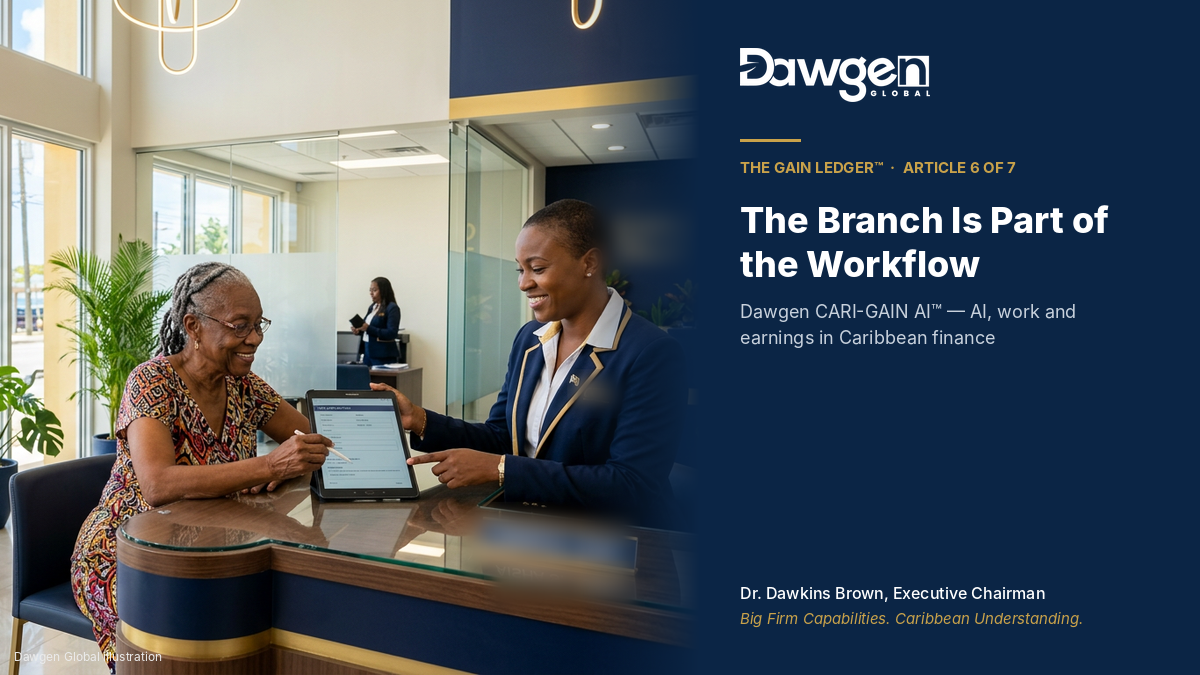
Why Inclusion is a design requirement in Caribbean financial transformation, not a courtesy, and how to measure whether every customer is still being served.
New to this series?
The GAIN Ledger™ is a seven-part series for boards and executives of Caribbean banks, credit unions, insurers, securities dealers, lenders and payment providers. It introduces Dawgen CARI-GAIN AI™, Dawgen Global’s method for applying AI to redesigned work and proving that the improvement reaches earnings. This article covers Inclusion: how to automate without shutting out customers who rely on branches, assisted service or patchy connectivity, and how to bring staff with you. You can read it on its own; everything you need to follow it is explained here.
There is a version of digital transformation that measures success by how many customers it moves out of the branch. Applications go online, enquiries go to the chatbot, documents go to the upload portal. The dashboards show faster processing and lower cost per transaction.
What the dashboards often do not show is who stopped coming. The pensioner in rural St. Elizabeth whose phone cannot run the app. The market vendor in Castries who has data on some days and not others. The farmer whose documents are handwritten. The member who simply prefers to speak to someone she knows. If a redesigned service is technically available but practically unusable for these customers, the institution has not transformed. It has withdrawn.
That withdrawal carries a cost that rarely appears in the business case. Customers who cannot complete a journey call the contact centre, return to the branch two or three times, or take their savings, loans and insurance to an institution that still knows their name. In small markets where reputations travel quickly, a service that feels closed to older or rural customers damages the franchise well beyond those customers.
The framework in brief
Dawgen CARI-GAIN AI™ treats the complete workflow, not the software tool, as the unit of transformation. It rests on two ideas.
First, four CARI tests apply at every step. Capture: can every material output be traced to reliable, permitted evidence? Accountability: does a named person own each decision, with a real route to escalate? Return: does the benefit survive the full cost of running it, and has finance verified it? Inclusion: can every customer still use the service, and are staff involved and supported?
Second, work moves through four GAIN phases containing seven stages: Gauge (Frame the problem and baseline), Align (Capture reliable inputs; Simplify the work), Integrate (Connect systems; Assist with AI where it adds value) and Net Results (Prove the result; Expand what works). Each stage ends at a gate with four permitted outcomes: proceed, repair, pause or stop.
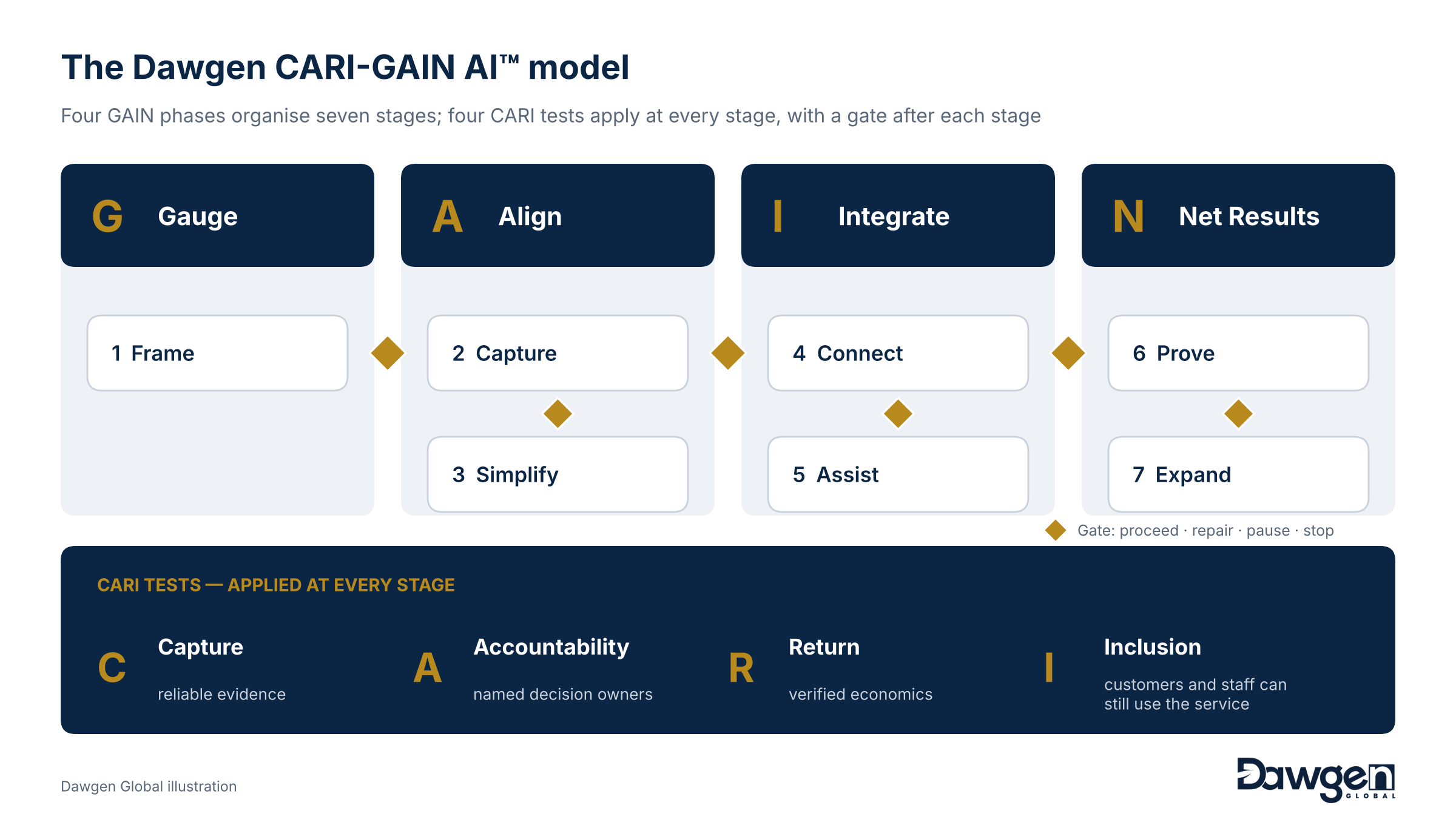
Figure 1 — The Dawgen CARI-GAIN AI™ model: four tests applied across four phases and seven stages. Dawgen Global illustration.
Inclusion is one of the four tests, and it is non-negotiable. The redesigned service must remain usable for customers without a modern phone, reliable data access or high digital confidence, and staff must be involved, trained and given a clear path. A move to digital must not make a previously accessible service practically unavailable.
Caribbean conditions are design inputs
Most AI frameworks were written for large markets with near-universal smartphone use, deep specialist teams and a single regulator. Caribbean institutions work under different conditions, and CARI-GAIN treats each one as a design input rather than an obstacle (Figure 2). Small volumes call for minimum viable scope. Paper and photographed documents call for assisted capture. Relationship banking calls for keeping an employee route. Concern about jobs calls for involving staff and planning redeployment. Informal handoffs call for observing the real work and writing it down as rules. Small teams call for separating approval authority without building a new department. Multiple currencies call for preserving source values. Weather and connectivity call for offline intake and tested recovery.
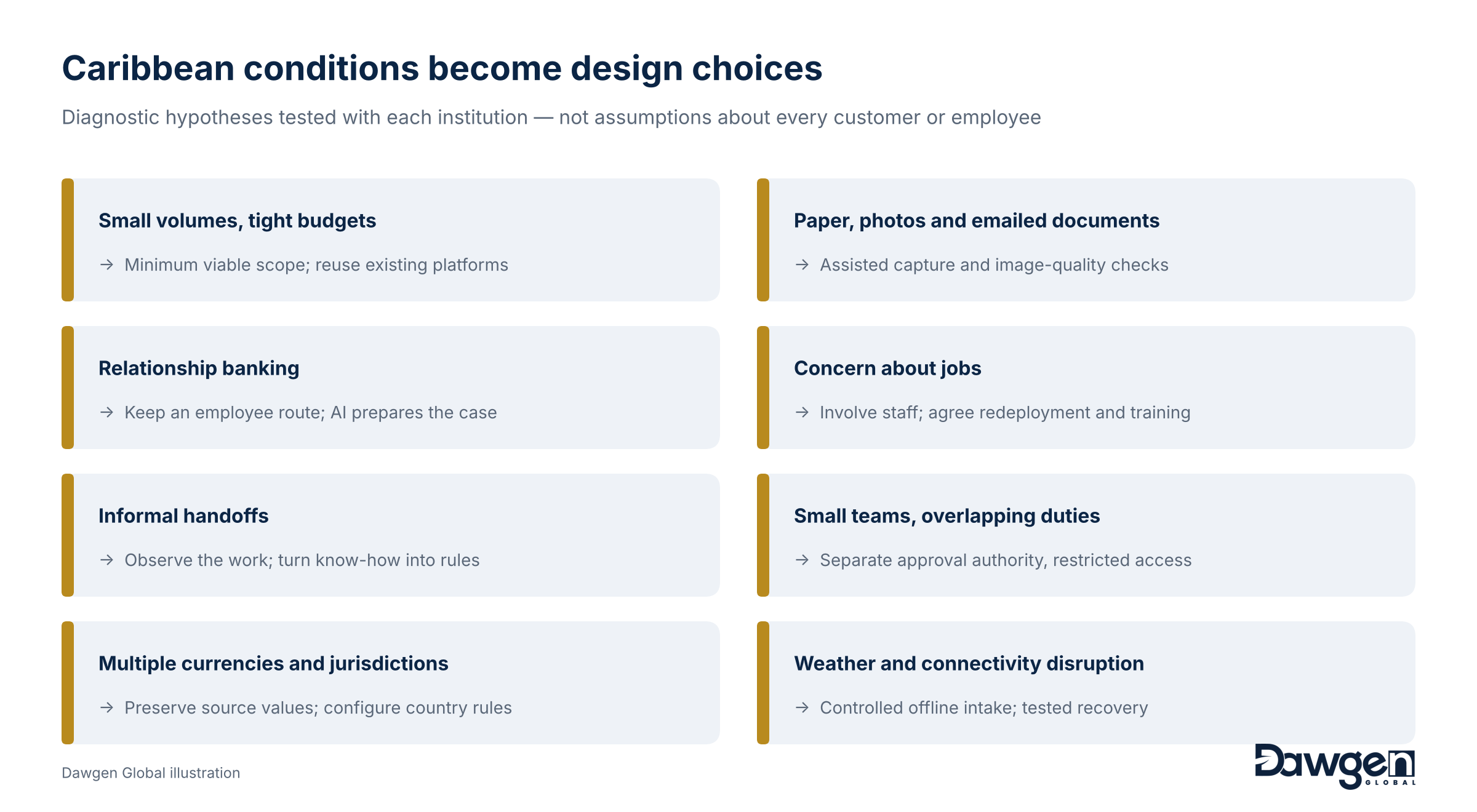
Figure 2 — Caribbean operating conditions and the design response each one calls for. Dawgen Global illustration.
These are hypotheses to test in each institution, not assumptions about every Caribbean customer. A Nassau insurer’s policyholders differ from a rural credit union’s members. The point is to look before designing.
Relationship banking is an asset to design around
In the Caribbean, relationships carry real commercial value. Customers stay with institutions where they are known. Credit union membership is often a family and community matter. Relationship managers resolve problems that no system could.
CARI-GAIN does not treat this as a barrier to automation. It treats it as a design requirement. The right pattern is often to use AI to prepare the case, assembling documents, checking completeness and summarising history, so that the employee can spend the interaction resolving the customer’s need rather than searching for information. The person stays at the front; the technology works behind them.
There is one firm boundary. Familiarity with a customer must never override identity checks or approval controls. A relationship manager may explain and assist; they may not waive verification because they “know” the customer. Fraud in our region frequently exploits exactly that trust. Inclusion and control are designed together, not traded against each other.
Test with the people who will actually use it
The Inclusion test begins in the first stage, Frame, when the actual work is observed. CARI-GAIN requires interviews across branch personnel, operations staff, compliance officers and customers, covering different age groups, service channels and locations. The questions are practical:
- Are document requirements understandable to the people who must meet them?
- Can a customer complete the journey without a modern phone or reliable data?
- Do language and voice interfaces work with the actual customer population, including local speech patterns, before deployment?
- Can customers correct captured information and easily request help?
The answers shape the Simplify stage. Sometimes the best inclusion measure is not technological at all: a clearer checklist, a single visit instead of three, an assisted completion option at the branch or by phone. These choices often reduce Capture Burden, the total work needed to turn what a customer submits into a usable record, at the same time.
Plain language matters more than it is usually given credit for. Document requirements written in regulatory or legal phrasing generate incomplete submissions, which generate exceptions, which generate cost. Locally appropriate examples, such as what an acceptable proof of address looks like for a customer without a utility bill in their own name, save time on both sides of the counter. Inclusion, designed well, is also efficiency.
Staff are part of the design, not its casualty
Concern about jobs and unfamiliar technology is entirely reasonable, and in small labour markets it is acute. An implementation that ignores it will meet quiet resistance: workarounds, slow adoption and the informal knowledge that never makes it into the new system.
CARI-GAIN addresses this directly. Staff are involved in redesigning the work they know best. Undocumented knowledge, such as the experienced officer’s understanding of an old product or the reconciler’s memory of a recurring problem, is converted into approved rules with their help. Redeployment and training plans are agreed before go-live, not after. Branch champions, named staff who test the new workflow early and support colleagues, are given paid time for training. People are told clearly how their performance will be assessed in the new workflow.
This is also an economic matter. Hours released by automation become value only when management decides what to do with them: remove a cost, or use the time to earn income. Redeploying experienced staff to advisory work, exception resolution or growth activity is often the most valuable decision available, and it depends on having brought those staff along.
Resilience is an inclusion issue too
Connectivity in our region is uneven, and severe weather can interrupt it for days. A service that works only when the network is up excludes customers precisely when they most need their institution: after a storm, when insurance claims, emergency withdrawals and loan deferrals spike. CARI-GAIN designs for this with controlled offline intake where feasible, encrypted queues that resubmit safely without creating duplicate transactions, tested recovery, and a manual route that staff have actually practised. The branch, once again, is part of the workflow.
Measure what speed alone conceals
Inclusion needs its own measures, reported beside speed and cost. CARI-GAIN pairs every efficiency measure with a partner that would reveal harm the efficiency measure hides (Figure 3). Turnaround time is reported with abandoned applications. Chatbot containment, the share of contacts the chatbot handles without an employee, is reported with repeat contacts and complaints. Straight-through completion, cases completed with no employee intervention, is reported with the assisted completion rate. Faster lending is reported with credit quality. Investigator time per case is reported with a sample of cases checked for missed problems.
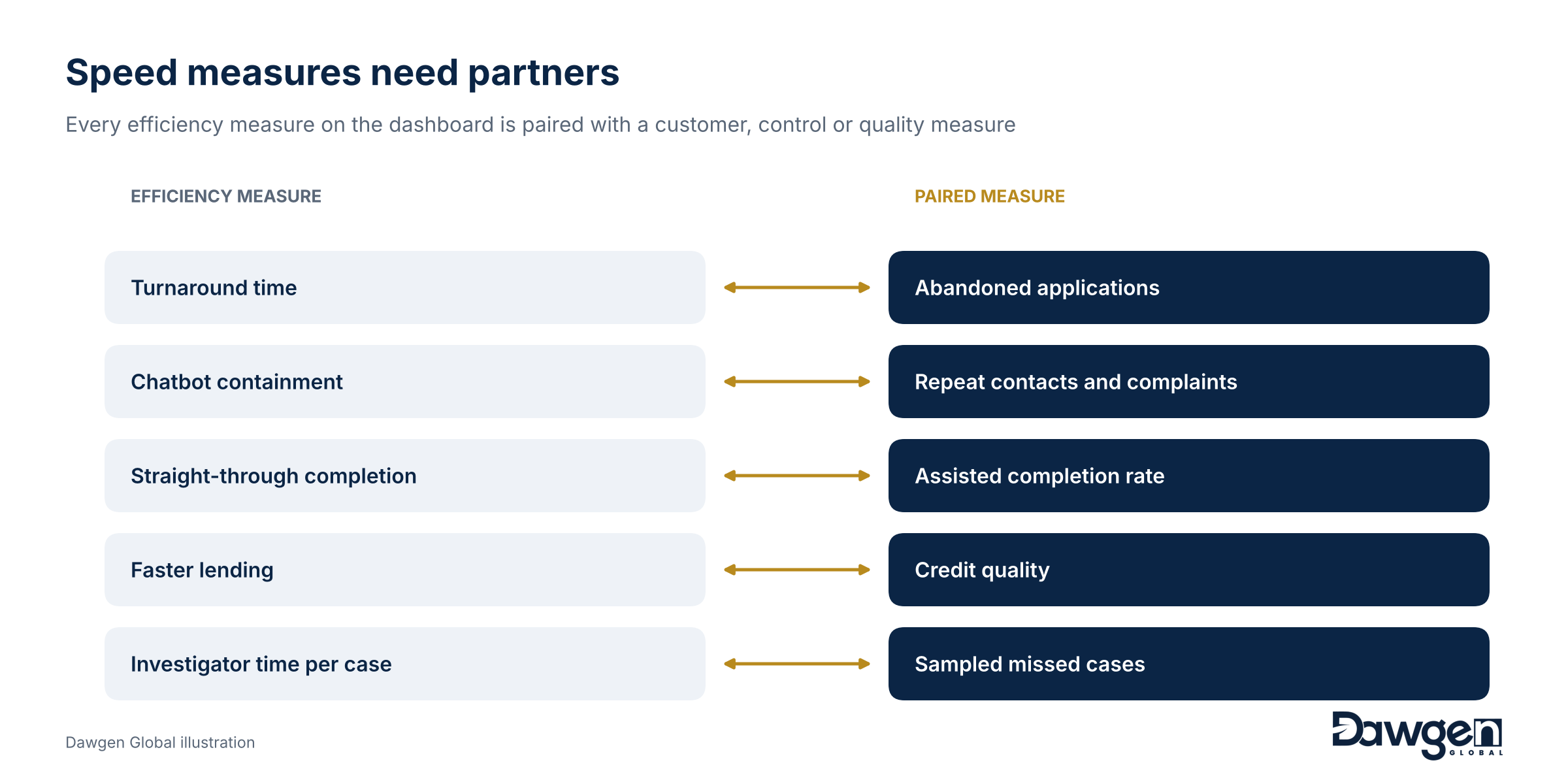
Figure 3 — Speed measures need partners: each efficiency measure is reported alongside the measure that would reveal hidden harm. Dawgen Global illustration.
A faster process with rising abandonment is not an improvement. A chatbot that appears to resolve contacts while customers give up on the channel is not an improvement. Paired measures keep the institution honest about who the transformation is serving, and they should be broken down by channel and customer segment so that a good average cannot hide a group being left behind.
An illustrative scenario: a loan journey for every member
Illustrative and fictional. A credit union with branches in rural St. Elizabeth and Manchester wants to move small-loan applications online. Today, members visit the branch, bring documents, and an officer keys in the application. The board approves a digital portal with automated document checks.
Step 1: observe before designing. In the Frame stage, the team watches applications at two branches and interviews members of different ages, including farmers and pensioners. It finds that many members use shared or older phones, that proof of income is often handwritten or seasonal, and that members value speaking to an officer they know before borrowing.
Step 2: simplify the requirement. Before building anything, the document checklist is rewritten in plain language with local examples, and two duplicate forms are merged. Return visits caused by missing documents fall during the pilot simply because members now know what to bring.
Step 3: design two doors to the same workflow. Members can apply through the portal or at the branch. At the branch, the officer uses the same system: AI checks completeness and prepares the file while the member is still present, so problems are fixed in one visit. The officer still verifies identity under the credit union’s approved process, even for long-standing members.
Step 4: plan for the storm. Branch tablets can capture applications offline and queue them securely, with duplicate-safe resubmission when connectivity returns. Staff rehearse the manual route.
Step 5: bring staff along. Two officers at each branch are named champions. Officers whose keying work falls are retrained to assist members and handle exceptions; the plan is shared before go-live.
Step 6: measure in pairs. The dashboard reports turnaround beside abandonment, portal completion beside assisted completion, and approval speed beside early arrears, each by branch and age group. When abandonment rises among members over sixty on the portal, the team adds a call-back option rather than declaring success on speed alone.
The credit union serves members faster without asking any of them to leave.
What to do this month
- Map who uses each channel today, by age group, location and product, before approving any channel change.
- Rewrite one document checklist in plain language with local examples, and measure the effect on return visits.
- Add paired measures to your transformation dashboard, broken down by channel and customer segment.
- Name branch champions for the next workflow change, with paid time for training.
- Agree redeployment and training plans with affected staff before any automation goes live.
- Rehearse an offline or manual service route for one critical workflow, as you would for hurricane season.
Questions for your leadership team
- Which customer groups would find our planned digital changes harder, and how have we tested this with them?
- Do we track abandoned applications, repeat visits and assisted completion by channel and segment?
- Have our branch and operations staff helped redesign the workflows they will work in?
- Do we have agreed redeployment and training plans before automation goes live?
- Could we keep serving customers through a three-day connectivity outage?
Key takeaways
- Inclusion is one of four non-negotiable CARI tests: a digital change must not make a previously accessible service practically unavailable.
- Use AI behind the relationship manager to prepare the case, but never let familiarity override identity checks or approvals.
- Involve staff early, convert their know-how into rules, and agree redeployment before go-live.
- Pair every speed measure with a measure that would reveal hidden harm, broken down by segment.
Start with the CARI-GAIN Scan
Make sure your transformation serves every customer you already have. The CARI-GAIN Scan is a fixed-scope diagnostic that observes real journeys across branches and channels, establishes a baseline, and delivers a ranked workflow portfolio and business case that applies the Inclusion test alongside capture, accountability and return.
info@dawgen.global | dawgen.global | US 855-354-2447 | (876) 926-5210
Big Firm Capabilities. Caribbean Understanding.
About Dawgen Global
Dawgen Global is an independent, integrated multidisciplinary professional services firm headquartered at 47 Trinidad Terrace, New Kingston, Jamaica, serving 35 territories across the Caribbean. Founded and led by Dr. Dawkins Brown, Executive Chairman, the firm is independent and not affiliated with any international network. It delivers a full suite of professional services under one roof: audit and assurance; tax advisory; IT and digital transformation; risk management; cybersecurity; actuarial and insurance regulatory advisory; HR advisory; mergers and acquisitions; corporate recovery; business advisory and strategy; accounting BPO and virtual CFO services; and legal process outsourcing.
The proposition is simple: big-firm capability without the big-firm price. Dawgen Global’s integrated approach is built for the specific complexities and opportunities of the Caribbean market, helping organizations make sharper, better-informed decisions that drive measurable progress.
To explore a partnership, reach out:
- Website: dawgen.global
- Email: info@dawgen.global
- WhatsApp (Global): +1 555-795-9071
- Caribbean offices: +1 876-665-5926 | +1 876-929-3670 | +1 876-926-5210
Related service: Explore how we can help →