

Exception Load: the arithmetic that decides whether automation helps your team or buries it.
The GAIN Ledger™ · Article 3 of 7
New to this series?
The GAIN Ledger™ is a seven-part series for boards and executives of Caribbean financial institutions. It introduces Dawgen CARI-GAIN AI™, Dawgen Global’s framework for redesigning financial operations so that artificial intelligence is used only where it measurably improves performance and earnings. This article deals with the cases that automation cannot complete on its own — the exceptions — and shows, with simple arithmetic, how to tell whether your team can absorb them. It can be read on its own; no earlier reading is assumed.
Every automation project has a moment of truth, and it rarely arrives on go-live day. It arrives about three weeks later, when the operations manager opens the exception queue on a Monday morning and finds it longer than it was on Friday.
The system processes most cases well. That was never in question. The question is what happens to the cases it cannot process: the partial payments, the missing references, the mismatched names, the unreadable pages, the amounts that look right but are not. Those cases land in front of people. If there are more of them than people can clear, the backlog grows, service slips and the business case quietly dies.
Boards are usually shown the share of work a system completes on its own — the straight-through rate, meaning cases completed with no employee intervention. They are far less often shown the arithmetic of what remains. This article is about that arithmetic.
The framework in brief
Dawgen CARI-GAIN AI™ combines what must always be true with the order in which work is done. CARI is four tests applied at every stage: Capture (every material output can be traced to reliable evidence), Accountability (a named person owns each decision), Return (the benefit survives the full cost and is verified by finance) and Inclusion (customers and staff can still use and support the service). GAIN is four phases containing seven stages: Gauge (Frame), Align (Capture, Simplify), Integrate (Connect, Assist) and Net Results (Prove, Expand). Each stage ends at a gate with four permitted outcomes: proceed, repair, pause or stop. Exception planning connects the Capture and Accountability tests and is decided in the Align and Integrate phases, before any AI is given live authority. Figure 1 shows the model.
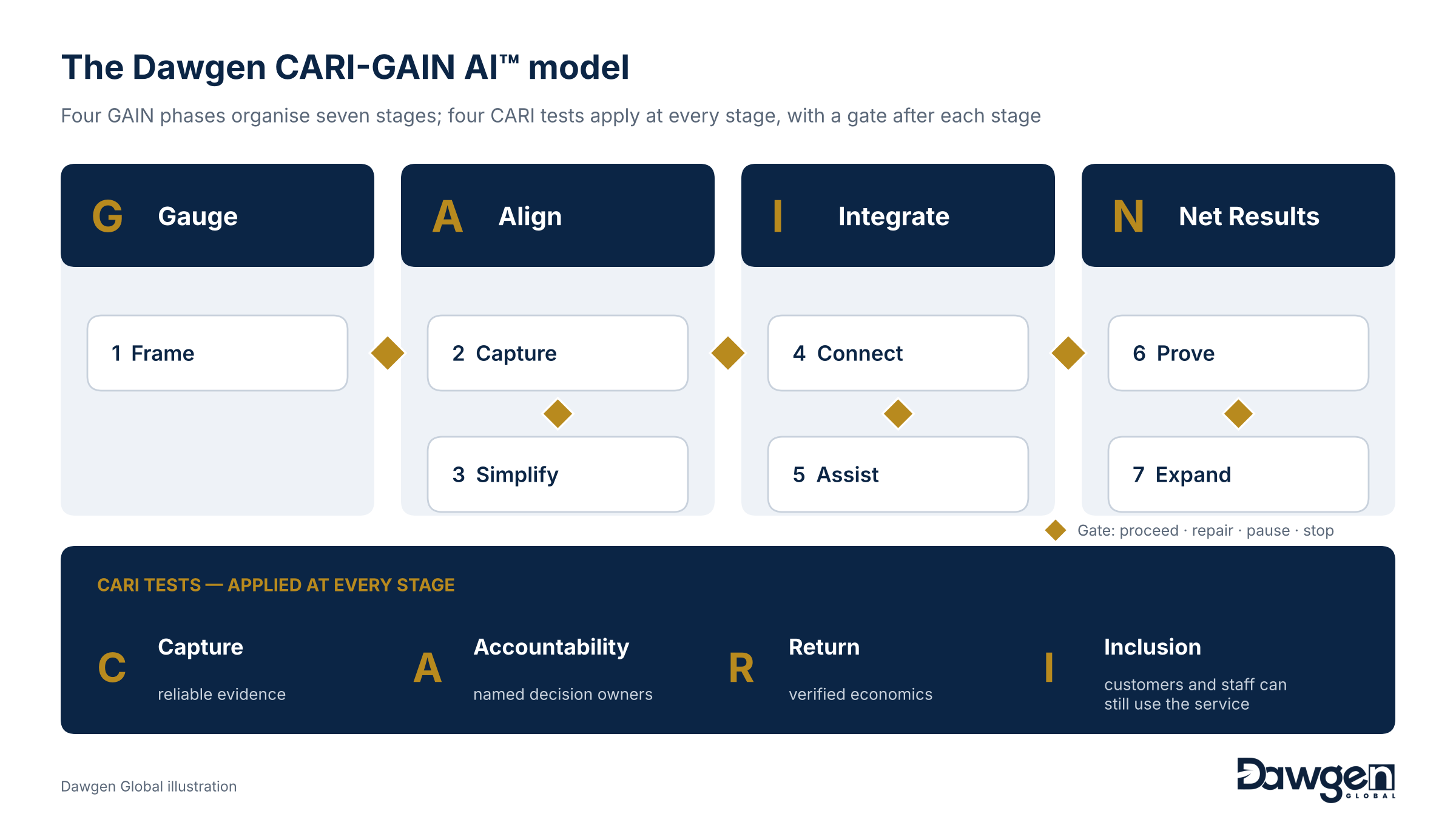
Figure 1 — The Dawgen CARI-GAIN AI™ model; exception planning links the Capture and Accountability tests. Dawgen Global illustration.
What an exception is, and why it matters
An exception is any case that the standard process cannot complete without a person’s intervention. In a payments business it might be a transaction with no matching reference. In lending it might be an application whose declared income does not match the statement. In customer service it might be an enquiry the system cannot answer from approved sources. Exceptions are not failures of the system; every real process has them. They become a problem only when nobody has planned the people, time and authority needed to clear them.
Exceptions are also where most of the risk sits. Routine cases rarely cause losses. The unusual payment, the inconsistent document and the case that “looks right but is not” are precisely where fraud, error and customer harm concentrate. An exception queue that is too long to work properly is therefore both an efficiency problem and a control problem.
The formula every board should see
In Dawgen CARI-GAIN AI™ we call the human effort involved Exception Load: the total employee effort needed to clear unresolved cases, including rework. Its planning formula is deliberately simple:
Daily review hours = daily cases × exception rate × mean review minutes ÷ 60, plus time for quality assurance and escalation.
Consider an illustration. A payment provider processes 2,000 cases a day. After automation, 12 per cent still need human review, and each review takes six minutes on average. That is 2,000 × 0.12 × 6 ÷ 60 = 24 review hours every day — before quality checks and escalations are added.
Twenty-four hours a day is roughly three full-time people on an eight-hour day doing nothing but clearing that queue to keep it level. Not reducing it. Keeping it level. If each reviewer in practice has closer to six productive hours once meetings, training and breaks are deducted, the same queue needs four people. If the project plan assumed that automation would free those people for other work, the plan was wrong on day one.
Figure 2 shows how quickly the load climbs as the exception rate rises, against the staffed capacity of two and three reviewers.
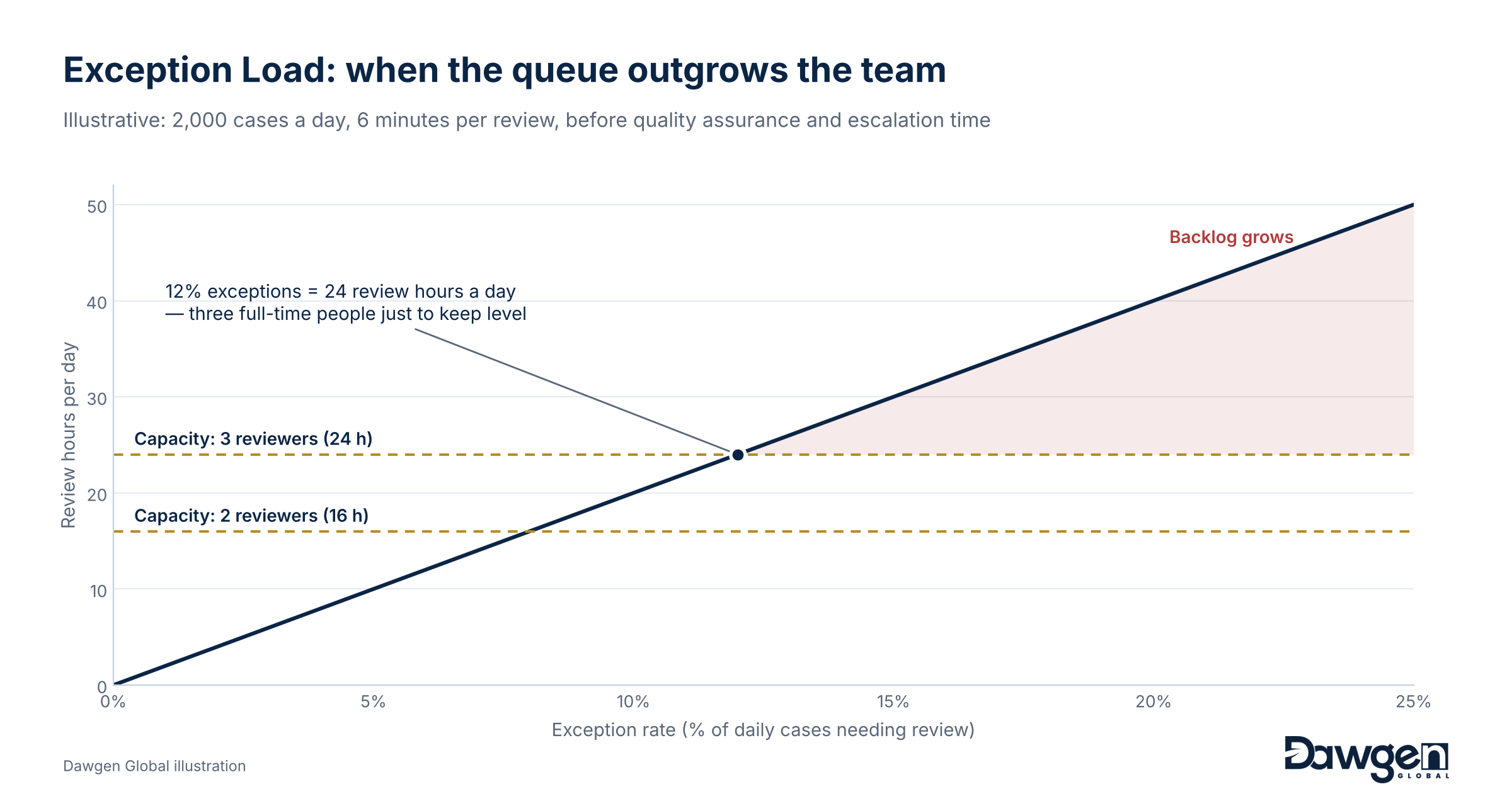
Figure 2 — Exception Load: daily review hours against exception rate for 2,000 cases a day at six minutes per review, compared with staffed capacity. Illustrative. Dawgen Global illustration.
Every ten percentage points of exception rate adds twenty review hours a day at these volumes. Now change one assumption. If poor document capture pushes the exception rate from 12 per cent to 20 per cent, the daily load rises to 40 hours. If those exceptions are also harder than expected and take ten minutes instead of six, it rises to about 67 hours — more than eight full-time reviewers. Small percentages compound into headcount.
Why exceptions weigh more in Caribbean operations
Vendors naturally describe performance in terms of what the system handles. Boards should ask about what it does not. Three features of Caribbean operations make this especially important.
Volumes are modest, so exceptions are proportionally expensive. A large international bank can spread a dedicated exceptions team across millions of transactions. An institution processing a few thousand cases a day cannot. Each exception reviewer is a meaningful share of the operating budget.
Peaks are sharp. Month-end, payday, back-to-school, Christmas and post-hurricane recovery all concentrate demand. An exception queue sized for an average Tuesday will fail on the last Friday of the month.
Expertise is concentrated. Many exceptions can only be resolved by the two or three experienced staff who understand the institution’s history, its old products and its informal workarounds. Their time is the scarcest resource in the building, and their leave or departure can stall a queue entirely.
The CARI-GAIN response: fix the inflow before speeding the line
Exception Load forces five disciplines.
Compare demand with real capacity. Plan against productive staffed hours, not headcount, accounting for leave, public holidays, training, meetings and peak days. If projected exceptions exceed capacity, the workflow is not ready for more automation.
Reduce the exception rate at source. The cheapest exception is the one that never happens. Better capture, clearer customer instructions and simpler forms usually reduce exceptions more reliably than a more sophisticated model. In the Align phase of CARI-GAIN, capture is fixed and the process simplified before the Integrate phase adds AI assistance.
Narrow the scope if necessary. It is better to automate a smaller, cleaner segment well than a large, messy population badly. Start with the transactions that carry reliable unique references; leave the difficult cases with people until the evidence supports extending further.
Classify exceptions by type. A timing difference, a missing record, a duplicate, an amount discrepancy and a potential misconduct case each need a different owner and a different response. Lumping them into one queue guarantees that the urgent cases wait behind the trivial ones.
Give reviewers what they need. Accountability is real only when the reviewer has the information, time and authority to change the outcome. A reviewer facing 300 AI-suggested matches with no supporting evidence and a closing deadline is not exercising judgement. They are clicking “approve”. CARI-GAIN requires every AI suggestion to show its supporting fields, the competing candidates and the reasons for uncertainty.
An illustration: settlement reconciliation in Port of Spain
The following scenario is illustrative and fictional.
A payment provider in Port of Spain settles card and mobile payments for several hundred merchants. Each day it receives gateway reports, bank settlement files and internal ledger extracts. A reconciliation break — an item on one record that cannot be matched to the other — arises whenever settlement timing, fees, reversals or incomplete references prevent a clean match. Staff currently investigate breaks through spreadsheets and email, and month-end close regularly slips.
A vendor proposes an AI matching engine that “resolves 95 per cent of items automatically”. Before accepting, management applies Exception Load to its own data. It processes about 2,000 items a day; a sample shows that clean, deterministic rules could match most of them, but roughly 12 per cent would still need review at around six minutes each. That is 24 review hours a day, and the reconciliation team has two analysts — 16 hours of capacity on a good day, less at month-end.
The redesigned workflow follows the six steps in Figure 3.
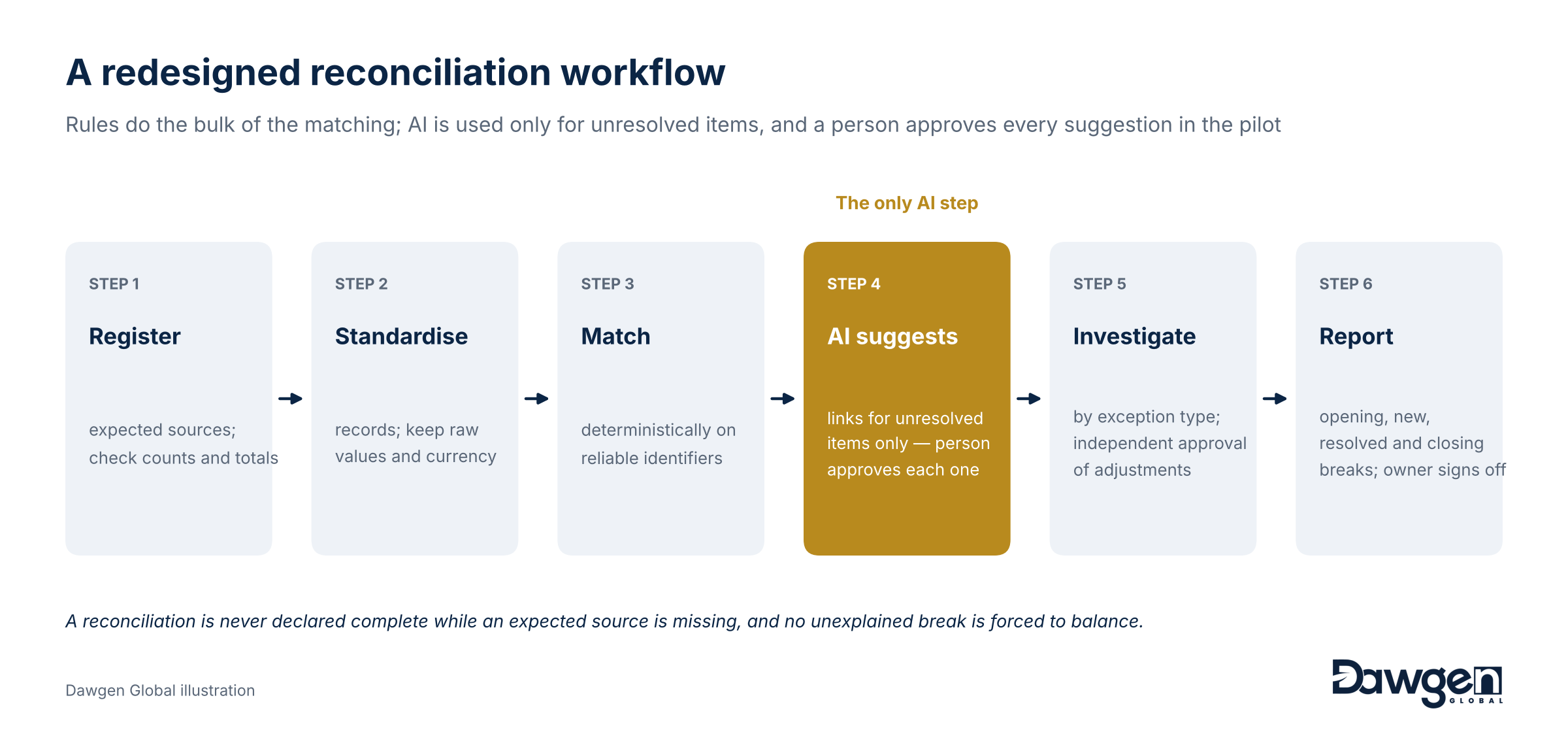
Figure 3 — A redesigned reconciliation workflow; AI is used only at step 4, for items the rules cannot resolve. Dawgen Global illustration.
First, every expected source file is registered, with arrival, record counts and totals checked; a reconciliation cannot be declared complete while a source is missing. Second, all records are standardised into one format that keeps original amounts, Trinidad and Tobago and US dollar values, fees, reversals and dates. Third, deterministic rules match items with reliable unique identifiers and handle fees and partial settlements. Fourth — and only now — AI suggests possible links for the unresolved items where references are incomplete, showing its supporting fields and competing candidates; during the pilot, an analyst approves every suggestion. Fifth, remaining breaks are investigated by type, with owners and deadlines, and any adjustment receives independent approval. Sixth, a controlled daily report shows opening unresolved items, new breaks, items resolved and the closing backlog, by value and age, and the process owner signs it off.
Two further changes bring the load within capacity. The provider works with its two largest merchants to include a consistent reference on every transaction, which reduces exceptions at source, and it temporarily leaves one complex product line outside the automated scope. The pilot is run first in shadow mode — the new workflow runs alongside the existing process without affecting live results, so its outputs can be compared safely — before limited live operation is approved.
A faster intake that overwhelms investigators has not improved anything
This is the principle in a sentence. Speed at the front of a workflow is worthless if it creates a pile at the back. The relevant measures are end-to-end: manual minutes per completed case, exception backlog by age and type, and cost per completed case. Intake speed on its own is a vanity metric, and so is a match rate reported without the backlog beside it.
When we work through Exception Load with management teams, the result is frequently a better project, not a cancelled one. The scope becomes realistic, the staffing plan becomes honest, and the benefit case rests on cases that actually complete.
What to do this month
- Write down the exception rate assumed in each current or planned automation project, and the evidence behind it.
- Time a sample of real exceptions to establish an honest average review time, including look-ups and escalations.
- Calculate daily review hours with the formula above for an average day and for your busiest day of the month.
- Compare the result with productive staffed hours, not headcount, and identify the gap.
- Split your exception queue by type and age so that urgent and high-value cases are visible.
- Identify the one or two upstream fixes — a required reference, a clearer form — that would remove the most exceptions.
Questions for your leadership team
- For our current or planned automation, what exception rate has been assumed, and on what evidence?
- Who will review the exceptions, how many productive hours do they actually have, and what happens on peak days?
- Is our exception backlog reported by age and type, or only as a total?
- Do our reviewers have the evidence, time and authority to reject a system’s suggestion?
- Could we narrow the first release to the cleanest segment of work and still make the business case?
Key takeaways
- Exceptions — cases a process cannot complete without a person — are where both workload and risk concentrate.
- Daily review hours = cases × exception rate × minutes ÷ 60: at 2,000 cases, 12 per cent and six minutes, that is 24 hours a day.
- Reduce exceptions at source and narrow scope before adding automation; plan against productive hours and peak days.
- Judge success end to end — backlog by age, minutes per completed case — not by intake speed or match rate alone.
Start with the CARI-GAIN Scan
Know your Exception Load before you commit to automation. The CARI-GAIN Scan is a fixed-scope diagnostic that establishes a finance-approved baseline, models review demand against your real staffing capacity and peak periods, and produces a ranked workflow portfolio and business case built on a scope your team can sustain. Talk to Dawgen Global’s advisory team.
info@dawgen.global | dawgen.global | US 855-354-2447 | (876) 926-5210
Big Firm Capabilities. Caribbean Understanding.
About Dawgen Global
Dawgen Global is an independent, integrated multidisciplinary professional services firm headquartered at 47 Trinidad Terrace, New Kingston, Jamaica, serving more than 15 territories across the Caribbean. Founded and led by Dr. Dawkins Brown, Executive Chairman, the firm is independent and not affiliated with any international network. It delivers a full suite of professional services under one roof: audit and assurance; tax advisory; IT and digital transformation; risk management; cybersecurity; actuarial and insurance regulatory advisory; HR advisory; mergers and acquisitions; corporate recovery; business advisory and strategy; accounting BPO and virtual CFO services; and legal process outsourcing.
The proposition is simple: big-firm capability without the big-firm price. Dawgen Global’s integrated approach is built for the specific complexities and opportunities of the Caribbean market, helping organizations make sharper, better-informed decisions that drive measurable progress.
To explore a partnership, reach out:
- Website: dawgen.global
- Email: info@dawgen.global
- WhatsApp (Global): +1 555-795-9071
- Caribbean offices: +1 876-665-5926 | +1 876-929-3670 | +1 876-926-5210
Related service: Explore how we can help →