

Why the size of Caribbean businesses, so often described as a weakness, can be an advantage in the age of AI, and what it takes to use it
Caribbean business leaders are used to hearing that they are too small. Too small for the big software vendors to pay attention to. Too small to afford data science teams. Too small to justify the systems that large international companies install. On AI, the same story is told: the global giants will move first and furthest, and regional companies will follow at a distance.
There is some truth in it. But it misses something important. A multinational with fifty thousand employees cannot redesign itself as a whole. It changes in pieces, department by department and country by country, because no single group of people can see, agree and act on the entire business at once. A Caribbean company with two hundred or two thousand employees can. The people who own every part of the business can sit around one table, make a decision once, and carry it through the whole company.
This eleventh article of Hours Into Earnings™ argues that this is the region’s real advantage in the age of AI, and that most regional companies have not yet used it. It sets out the evidence, explains why large companies are forced to redesign in pieces, introduces a method for redesigning a smaller company whole, and is candid about what smaller firms must get right for the advantage to turn into earnings.
Smaller firms carry the region. Larger firms lead on AI, for now.
Smaller businesses are not a niche in the Caribbean; they are most of the economy. The Caribbean Development Bank has described micro, small and medium-sized enterprises as contributing about 50% of the region’s GDP and about 45% of its jobs. Even the region’s largest companies are mid-sized by global standards.
On AI, larger organizations are currently ahead, and the gap is widening. McKinsey’s The state of AI in 2026 found that 54% of respondents from organizations with at least US$1 billion in annual revenue were scaling AI across the enterprise, against one-third of those from smaller organizations. For AI agents, the share of larger organizations scaling them in at least one function rose from 27% to 40% in a year, while smaller organizations stayed flat at 22%.
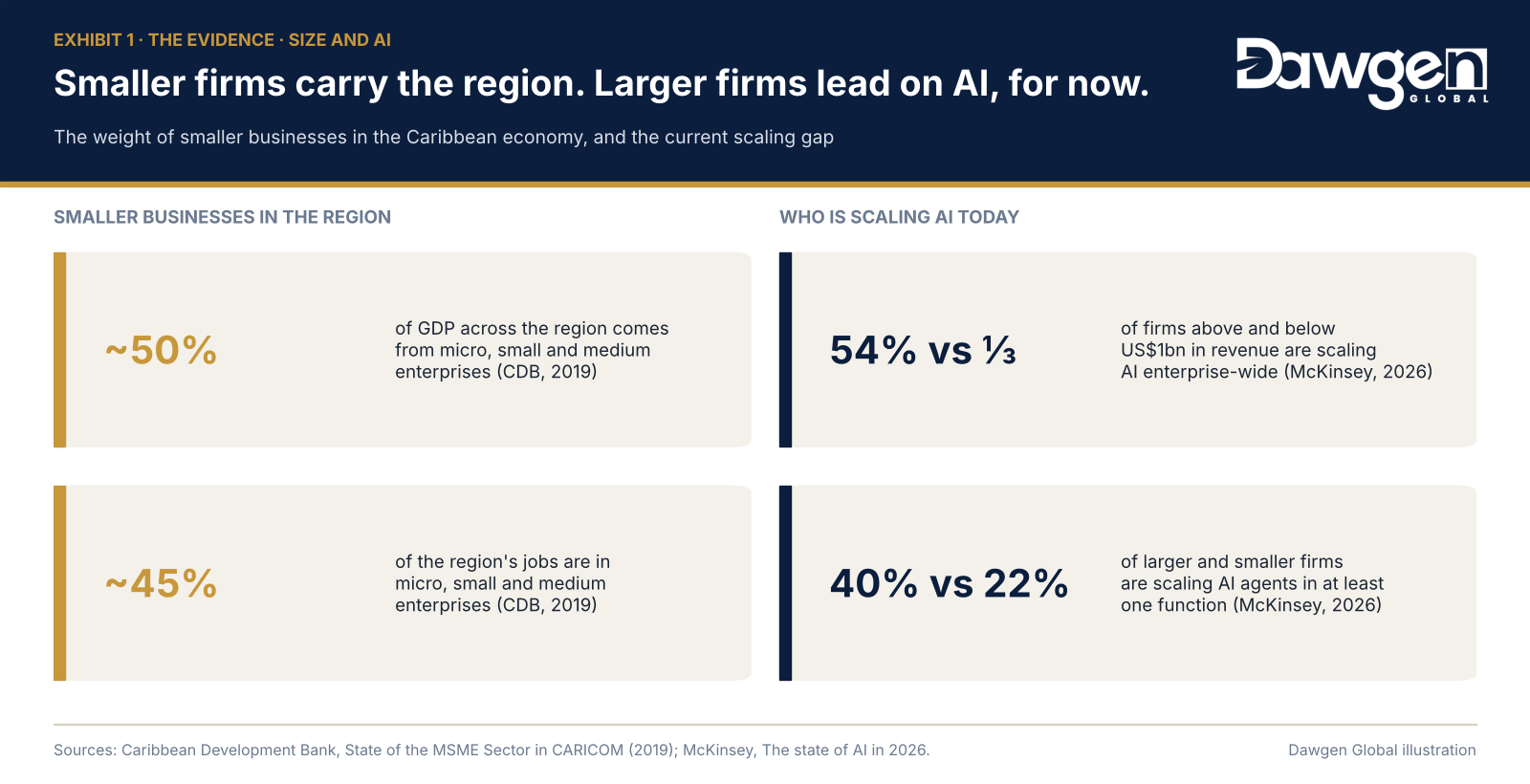
Those figures should be read honestly. Size is not, today, giving smaller firms an advantage on AI; most of them are behind. The argument of this article is that their advantage is structural, not automatic. It exists in how they are organized, and it becomes real only when they choose to use it. Larger firms lead because they have the budgets, the specialists and the programmes. Smaller firms can overtake them in their own markets only by doing something larger firms find very hard: redesigning the business as a whole.
Why large companies redesign in pieces
Large companies do not redesign in pieces by choice. Their size forces it, in four ways.
No one can see the whole. In a large organization, an end-to-end process such as taking an order and collecting the cash may cross a dozen departments, several countries and many systems. No single manager understands all of it, and mapping it can take months.
Every change needs many approvals. A redesign that touches sales, warehousing, finance and customer service needs agreement from four executives, their teams, the IT function, risk and often a regional or global head office. Each can slow or narrow the change.
Legacy systems are deep and many. Large companies run many systems built up over decades, often a different one in each country or division. Changing a process means changing several of them, which is slow and expensive, so the process is changed only where the systems allow.
Budgets and targets are owned by departments. Each department funds its own AI projects and is measured on its own results. A redesign whose benefit falls in finance but whose cost falls in operations is hard to fund.
The result is predictable: departmental tools, departmental gains, and hand-offs between departments that stay exactly as slow as before. Article 10 showed that this is the main reason AI programmes stall. In a large company, it is often the only way change can happen at all.
A smaller company faces few of these barriers. The owner or chief executive can see the whole business. The heads of every function fit around one table. There are usually only one or two core systems. And the person who signs the budget sees both the cost and the benefit, wherever in the business they fall.
The One-Table Method™: five decisions, made once for the whole company
The One-Table Method™ is how The Dawgen Earnings Crossing™ turns a smaller company’s size into an AI advantage. It takes its name from its starting condition: the people who own every part of the business sitting at one table, with the authority to decide for the whole company. It has five moves, each a decision made once rather than department by department.
| Move | The decision | Why a smaller company can make it |
| 1. One page | Put the whole business on one page: the four or five flows that actually run it, such as taking an order to collecting the cash, buying to paying, recording to reporting, hiring to paying people, and serving customers | The leadership team already knows the whole business; it can be mapped in days, not months |
| 2. One spine | Choose the single flow that crosses every department and carries the most value, usually order-to-cash in a trading business | One person can weigh every department’s interest and choose |
| 3. One redraw | Redraw that spine end to end in one programme, using the Workflow Redraw™ from Article 10, across every department it touches at once | Every owner of every step is at the table |
| 4. One platform | One data foundation, one AI register, one set of agents licensed under the Agent Licence Test™ from Article 9, shared by every department | There are few systems to connect and one budget to fund them |
| 5. One re-cut | Redesign roles once, around the new flow, rather than team by team | The whole organization chart fits on one page too |
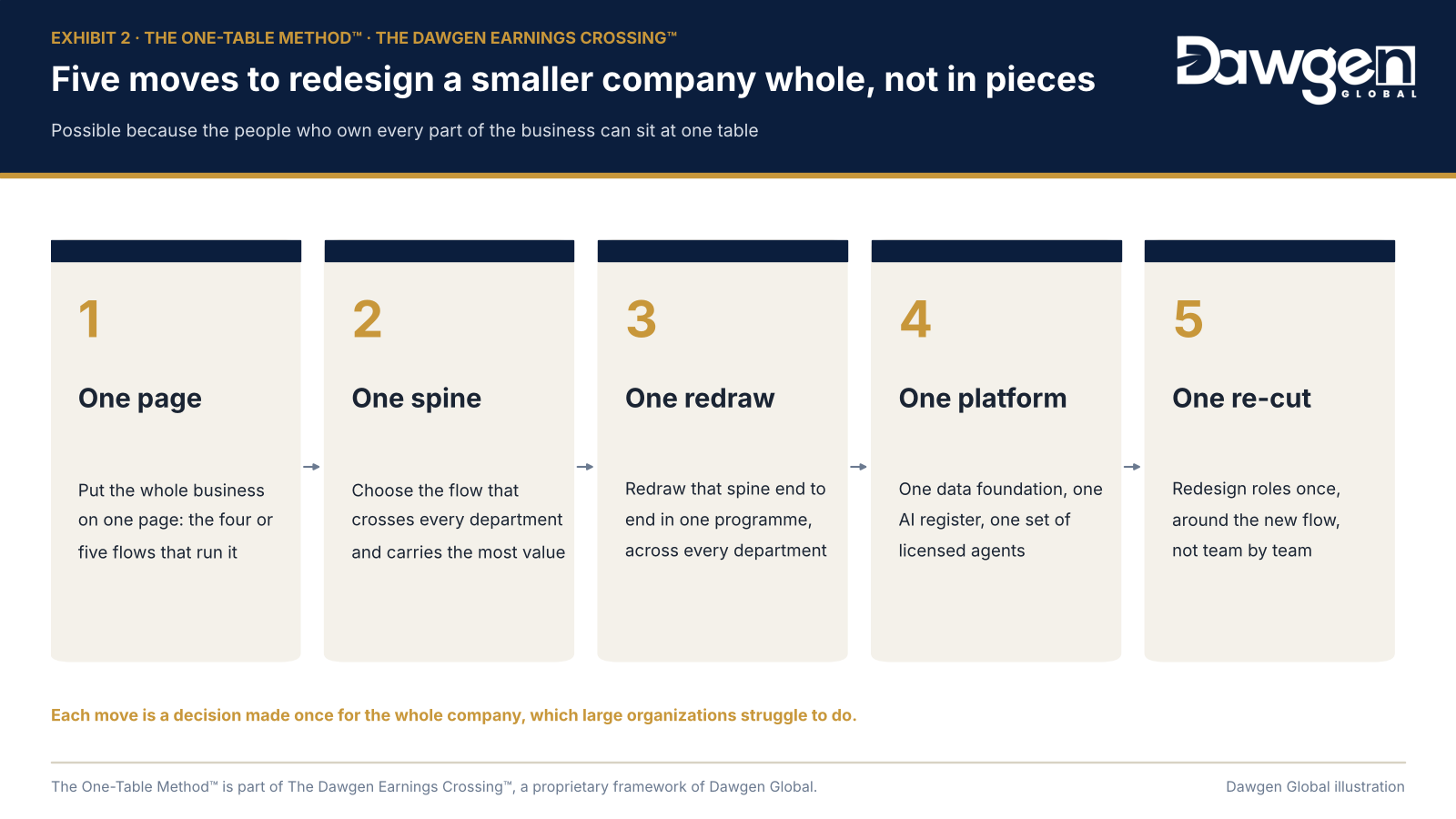
The method’s power comes from the spine. Most of the value AI releases sits at the hand-offs between departments, where orders wait, information is re-keyed and errors are corrected. A department-by-department programme leaves those hand-offs untouched. A whole-spine redesign removes them. Once the first spine is redrawn and running on one platform, the second and third flows are faster and cheaper, because the foundation is already in place.
The arithmetic: later to start, far ahead by year two
Consider an illustrative composite: a family-owned Caribbean distributor of building and hardware supplies with six branches, about 240 staff and annual sales of J$8 billion. Its operating profit (EBIT) is about J$560 million. The family and its five senior managers meet around the same boardroom table every Monday.
Department by department. The company could follow the path most larger companies take: three separate AI projects, each chosen and funded by a department. Credit control adds a collections tool in the first year, purchasing adds a forecasting tool in the second, and sales adds a quoting assistant in the third. Each works. But the hand-offs between them remain: quotes are re-keyed into orders, orders wait for credit checks, deliveries wait for paperwork, invoices wait for proof of delivery. After three years, the three projects together are adding about J$60 million a year to EBIT.
Redesigned whole. Instead, the leadership team uses the One-Table Method™. In its first meeting it puts the business on one page and chooses the order-to-cash spine, which crosses sales, credit, warehousing, delivery, invoicing and collections. A single programme redraws that spine end to end over nine months.
- A quote becomes an order without re-keying, with credit checked automatically at the moment of quoting.
- Stock is reserved and picking lists produced the moment an order is confirmed.
- Proof of delivery is captured on a phone at the customer’s site, and the invoice is issued the same hour.
- AI ranks overdue accounts each morning and drafts the reminders, as in Article 6.
- Price overrides above set limits need approval, closing the margin leaks described in Article 4.
- Every agent in the flow is licensed, and every gain is recorded in one AI Earnings Register™.
Nothing is gained during the nine months of redesign. But within six months of going live, the redrawn spine is adding about J$110 million a year to EBIT: about J$70 million from capacity converted across six departments and about J$40 million from tighter pricing. The faster flow from order to cash also releases about J$300 million of working capital, once, which is not included in the EBIT figures.
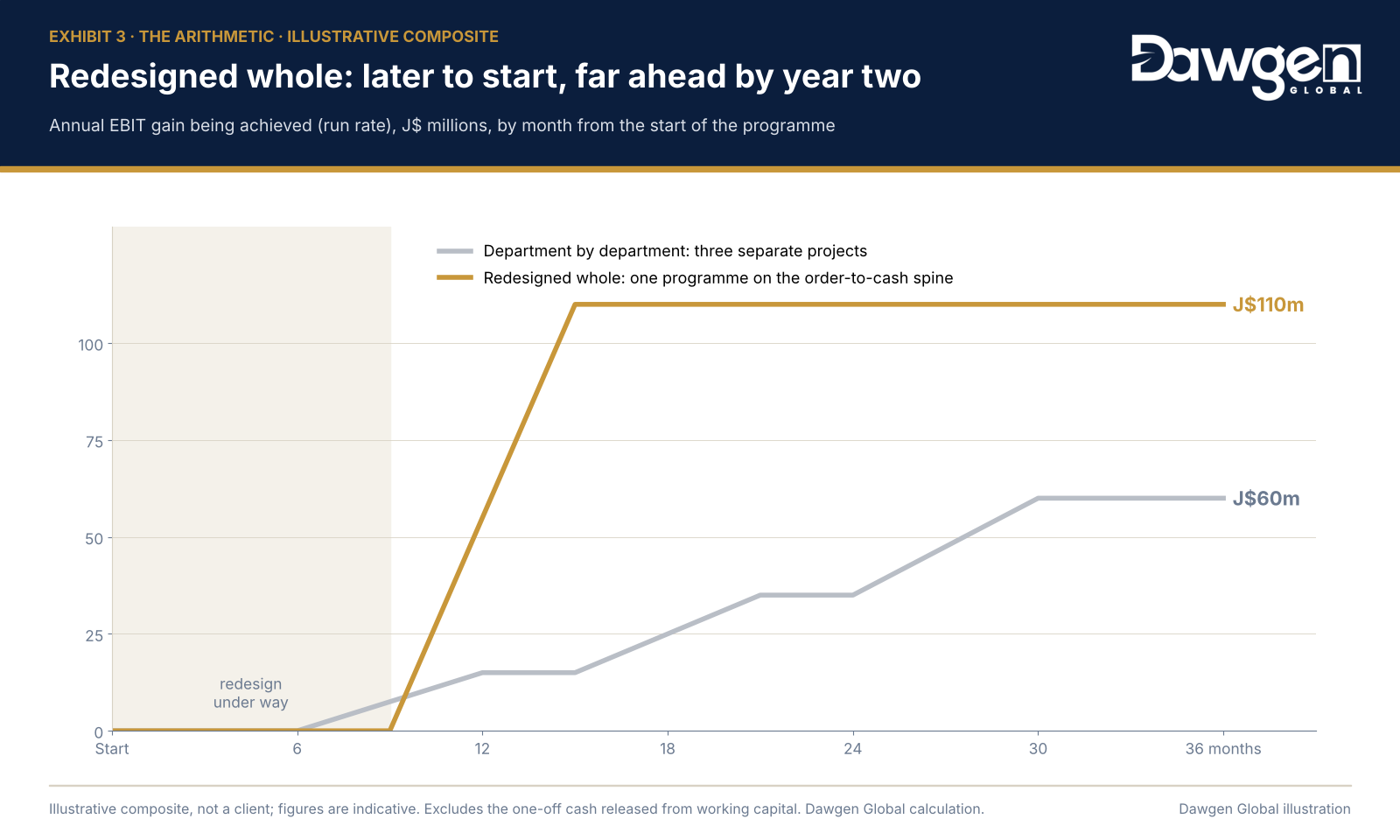
Over the first three years, the department-by-department path delivers a cumulative EBIT gain of about J$85 million. The whole-spine redesign delivers about J$225 million, plus the cash, and starts year four adding almost twice as much each year. The second spine, buying to paying, will be faster and cheaper still, because the platform is already built.
The composite is illustrative and does not describe any client. Figures are indicative.
What smaller firms must get right
The advantage is real, but it is not automatic. Smaller firms that try to redesign whole must manage four risks that larger firms handle with scale.
Concentration. Redesigning the whole spine at once means more is at stake if it goes wrong. The answer is the Prove step: run the new flow in one or two branches, or for one group of customers, before switching the whole company over.
Thin specialist benches. Few regional companies employ process designers, data engineers and AI specialists together. The design capability can be brought in for the length of the programme, as Article 10 described, provided the company’s own people are trained to run what is built.
Founder dependence. In many family and founder-led businesses, decisions rest with one or two people. That speeds the redesign, but it can also stall it if those people are busy or unconvinced. The table works only if the people at it have the time and mandate to decide.
Data foundations. A single platform depends on clean, consistent data: one customer list, one product list, one price list. In many smaller firms these live in spreadsheets and the memories of experienced staff. Cleaning them is unglamorous, but it is usually the first piece of work, and it pays for itself.
None of these is a reason to wait. Each is a reason to plan the redesign properly, with the same discipline, measurement and controls this series has described throughout.
Three questions for owners and boards
Put three questions to your leadership team at its next meeting:
- Can we draw the four or five flows that run our business on one page, and do we agree on which one crosses the most departments and carries the most value?
- Are our current AI projects each owned by a department, or does any of them redesign a flow from end to end?
- If we decided today to redraw that one flow across the whole company, who around this table would need to say yes, and what would stop us?
If the answer to the third question is “nobody else”, the company has an advantage most multinationals would envy. The only question is whether it will use it.
The final article of the series, The Board’s AI Question Is a Capital Allocation Question, brings the eleven articles together for the people who must decide: how a board should weigh, fund and hold management to account for AI, as it would any other use of shareholders’ capital.
Where should your company’s redesign begin?
Dawgen Global’s Earnings Crossing Diagnostic™ is a whole-company view designed for owner-led and mid-sized businesses. Working with your leadership team, we put the business on one page, identify the spine that carries the most value, size the EBIT, cash and risk opportunity across the full Dawgen Earnings Crossing™, check your data foundations and controls, and set out a sequenced plan for redesigning the company whole. It draws on our business advisory, accounting, risk management, IT and AI transformation specialists across the Caribbean. Fees are customized to each client’s circumstances and agreed deliverables.
Request a scoping conversation: info@dawgen.global · (876) 926-5210 · US 855-354-2447 · dawgen.global
Dawgen Global — Big Firm Capabilities. Caribbean Understanding.
About Dawgen Global
Dawgen Global is an independent, integrated multidisciplinary professional services firm headquartered at 47 Trinidad Terrace, New Kingston, Jamaica, serving more than 15 territories across the Caribbean. Founded and led by Dr. Dawkins Brown, Executive Chairman, the firm is independent and not affiliated with any international network. It delivers a full suite of professional services under one roof: audit and assurance; tax advisory; IT and digital transformation; risk management; cybersecurity; actuarial and insurance regulatory advisory; HR advisory; mergers and acquisitions; corporate recovery; business advisory and strategy; accounting BPO and virtual CFO services; and legal process outsourcing.
The proposition is simple: big-firm capability without the big-firm price. Dawgen Global’s integrated approach is built for the specific complexities and opportunities of the Caribbean market, helping organizations make sharper, better-informed decisions that drive measurable progress.
To explore a partnership, reach out:
- Website: dawgen.global
- Email: info@dawgen.global
- WhatsApp (Global): +1 555-795-9071
- Caribbean offices: +1 876-665-5926 | +1 876-929-3670 | +1 876-926-5210
Related service: Explore how we can help →