
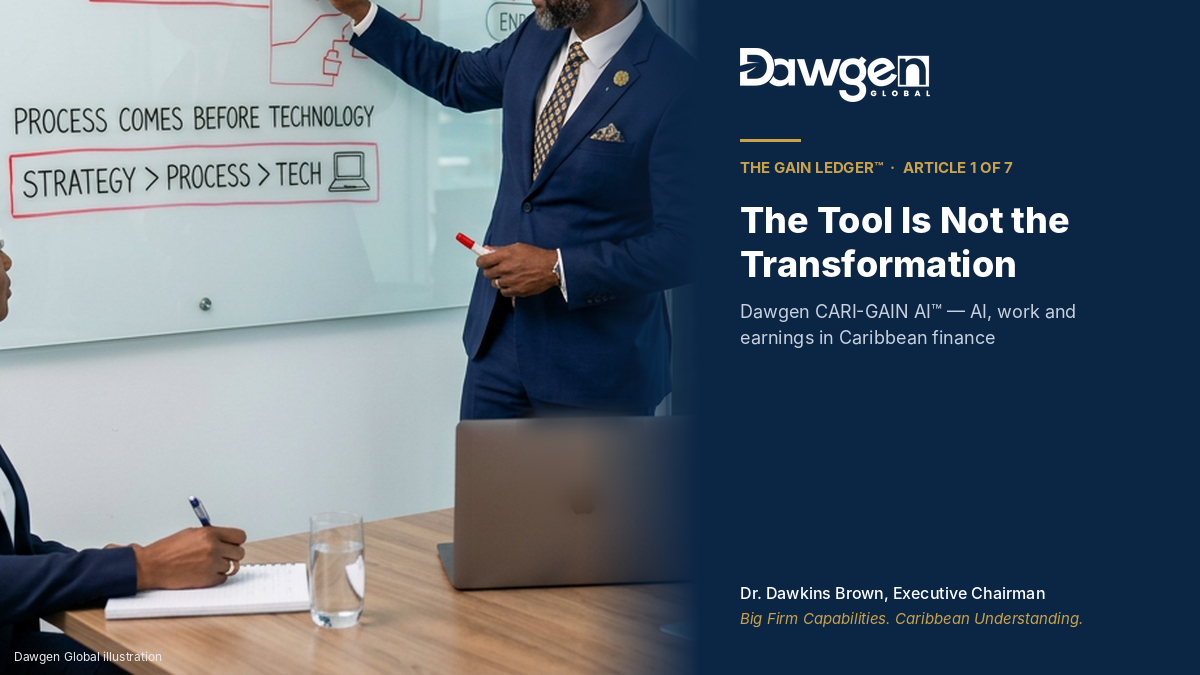
Why Caribbean financial institutions need to redesign work before they buy intelligence, and how Dawgen CARI-GAIN AI™ makes that practical.
New to this series?
The GAIN Ledger™ is a seven-part series for boards and executives of Caribbean banks, credit unions, insurers, securities dealers, lenders and payment providers. It introduces Dawgen CARI-GAIN AI™, Dawgen Global’s framework for redesigning financial operations so that artificial intelligence is used only where it measurably improves performance and earnings. This opening article explains why so many AI investments disappoint, sets out the framework in full and shows how it changes the decision in front of a board. It can be read on its own; no earlier reading is assumed.
Somewhere in the region this week, a financial institution will sign for an AI product. The demonstration was impressive. The document reader pulled names, amounts and dates from a loan application in seconds. The chatbot answered balance enquiries in friendly language. The business case promised hours returned to the operations team.
Six months later, many of these same institutions will discover something the demonstration did not show. The work did not disappear. It moved. Staff who once keyed data now correct it. Supervisors who once approved files now investigate why the system matched the wrong payment. Customers who once called the branch now call the branch to ask why the app rejected their documents. The hours went into correction queues, and the cost went up.
This is not a failure of the technology. It is a failure of where the technology was placed.
Why the question has become urgent
The pressure to act is real and rising. Supervisors across the region have placed artificial intelligence high on their agendas. The Caribbean Group of Banking Supervisors made the impact of AI on the financial sector a central theme of its May 2026 annual conference. The Centrale Bank van Curaçao en Sint Maarten has built AI and advanced analytics into its 2026–2028 strategic plan for supervision. Larger institutions in the region have announced AI-assisted lending and service programmes. International bodies, including the Bank for International Settlements, have drawn attention to the data quality, privacy, security and third-party risks that accompany AI in financial services.
At the same time, most of the region has no AI-specific statute. Institutions are expected to apply existing data protection law, outsourcing rules and sector supervision to a new technology. That combination — strong commercial pressure, closer supervisory interest and principles-based rules — rewards institutions that can explain clearly what their AI does, why it is there and how its results are evidenced.
No board can responsibly ignore AI. But the useful question is not “which AI tool should we buy?” It is “which piece of work is consuming value, and what would it take to make it reliable, faster and cheaper?”
The unit of transformation is the workflow
A workflow is the complete path of a piece of work: how a request enters the institution, how its information becomes trustworthy, who decides, how systems act and how the result is evidenced. A mortgage application is a workflow. A daily settlement reconciliation — the matching of what the bank says was paid against what the institution’s own ledger recorded — is a workflow. A fraud alert is a workflow.
When AI is dropped into one step of a broken workflow, it inherits every weakness upstream and creates new ones downstream. If documents arrive incomplete, the AI reads incomplete documents faster. If approvals are duplicated, the AI prepares files for two people who should have been one. If nobody owns the cases the system cannot handle — the exceptions — they accumulate in a queue that nobody planned to staff.
When the workflow itself is redesigned, AI becomes one option among several, and often not the cheapest one. Figure 1 summarises the four patterns that explain most disappointing AI investments in financial operations, and the response to each.
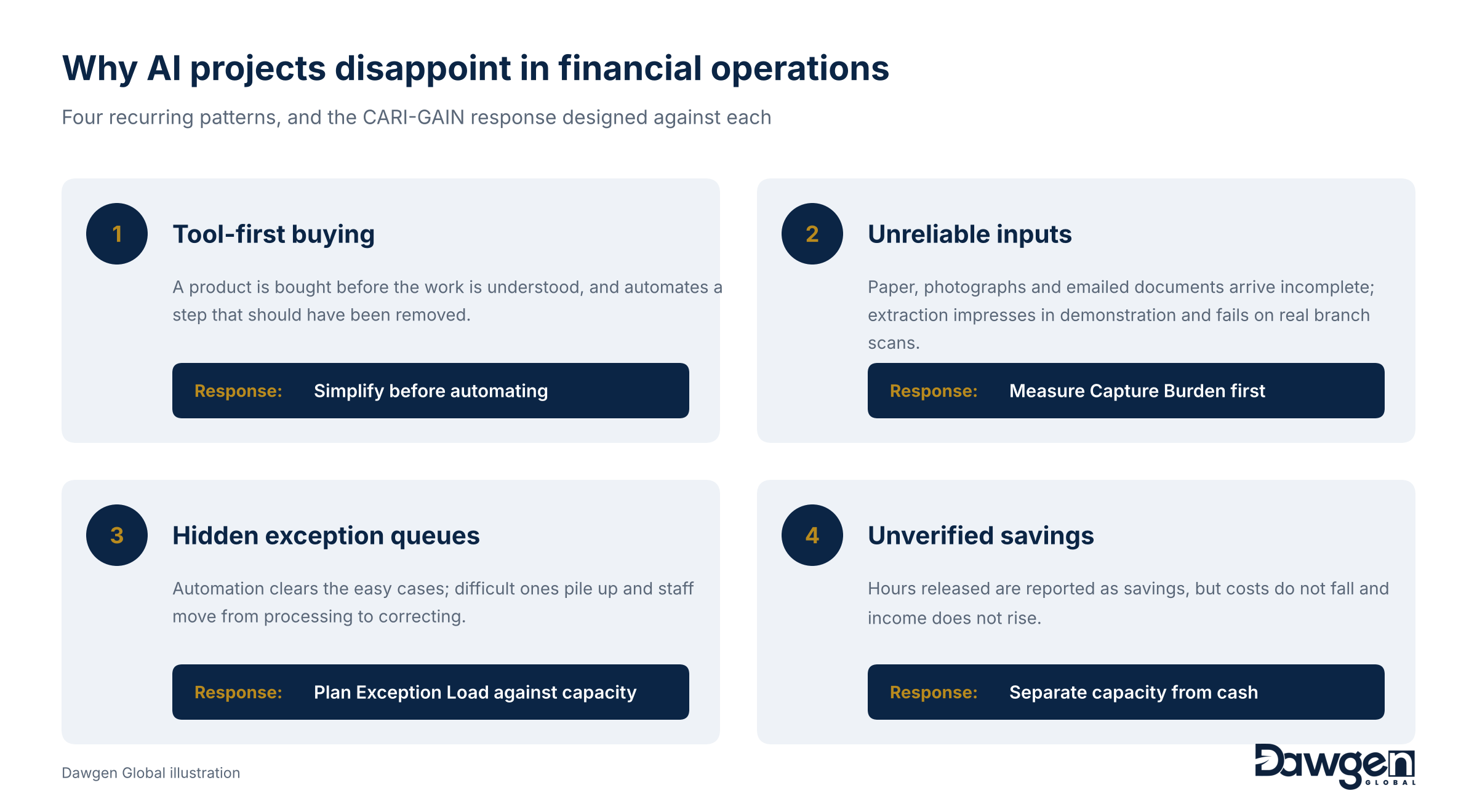
Figure 1 — Four patterns behind disappointing AI investments, and the CARI-GAIN response to each. Dawgen Global illustration.
Tool-first buying. A product is purchased before the workflow is understood, and it automates a step that should have been removed. The response is to simplify before automating.
Unreliable inputs. Paper, photographs and forwarded documents arrive incomplete or unreadable. Extraction looks impressive in a demonstration and fails on real branch scans. The response is to measure the cost of turning received information into a usable record before automating anything.
Hidden exception queues. Automation handles the easy cases; the difficult ones pile up and staff move from processing to correcting. The response is to plan the human review workload against real staffing capacity.
Unverified savings. Hours released are reported as savings, but costs do not fall and income does not rise. The response is to separate capacity from cash and have finance confirm each benefit.
The framework in brief
Dawgen CARI-GAIN AI™ combines what must always be true with the order in which work is done. CARI is four tests applied at every stage: Capture (every material output can be traced to reliable evidence), Accountability (a named person owns each decision), Return (the benefit survives the full cost and is verified by finance) and Inclusion (customers and staff can still use and support the service). GAIN is four phases containing seven stages: Gauge (Frame), Align (Capture, Simplify), Integrate (Connect, Assist) and Net Results (Prove, Expand). Each stage ends at a gate with four permitted outcomes: proceed, repair, pause or stop. Figure 2 shows the complete model.
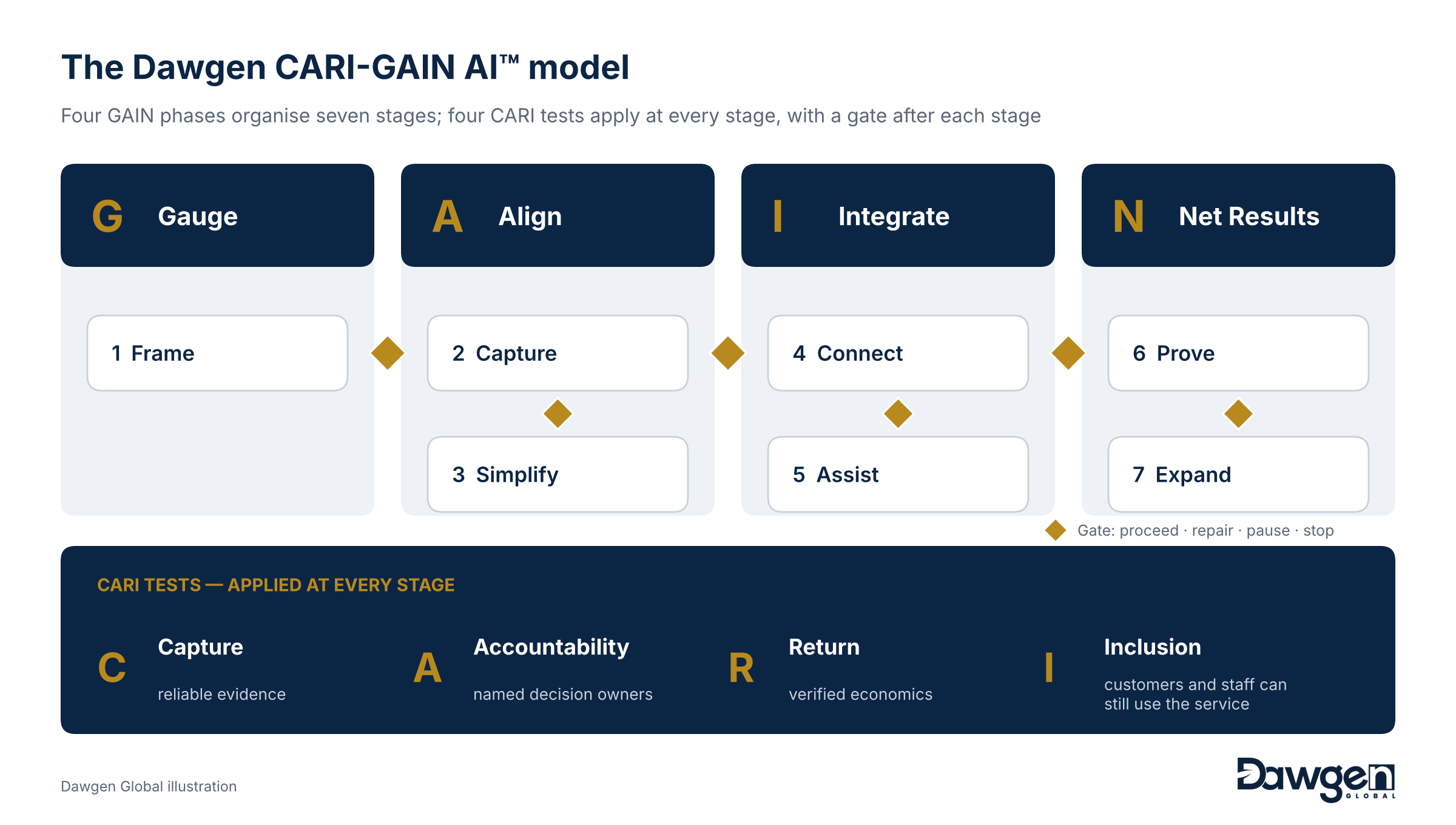
Figure 2 — The Dawgen CARI-GAIN AI™ model: four tests applied across four phases and seven stages. Dawgen Global illustration.
The four tests, explained
C — Capture. Can every material output be traced to a permitted source, a verified field and the rule or model version that produced it? A plausible answer without evidence does not pass. This test matters because AI systems can produce confident, fluent and wrong results; the institution must be able to show where each answer came from.
A — Accountability. Is a named person responsible for each decision, with a defined limit on what the system may do alone and a real route for escalation? Human review counts only if the reviewer has the information, time and authority to change the outcome. A reviewer who approves three hundred suggestions an hour is not reviewing.
R — Return. Does the benefit survive the full cost of capture, exceptions, integration, supervision and technology, and has finance verified it? The framework measures contribution to EBITA — earnings before interest, tax and amortisation — and, for deposit-takers and lenders, also looks at net interest income, impairment and the cost-to-income ratio.
I — Inclusion. Can customers without a modern phone, reliable data or high digital confidence still use the service? Have staff been involved, trained and given a clear path? Digital service must not make a previously accessible service practically unavailable. In a region where relationship banking remains a genuine strength, this is a design requirement, not a courtesy.
The seven stages and their gates
The seven stages give the work its order, and each answers one management question. Figure 3 sets them out with the gate that closes each stage.
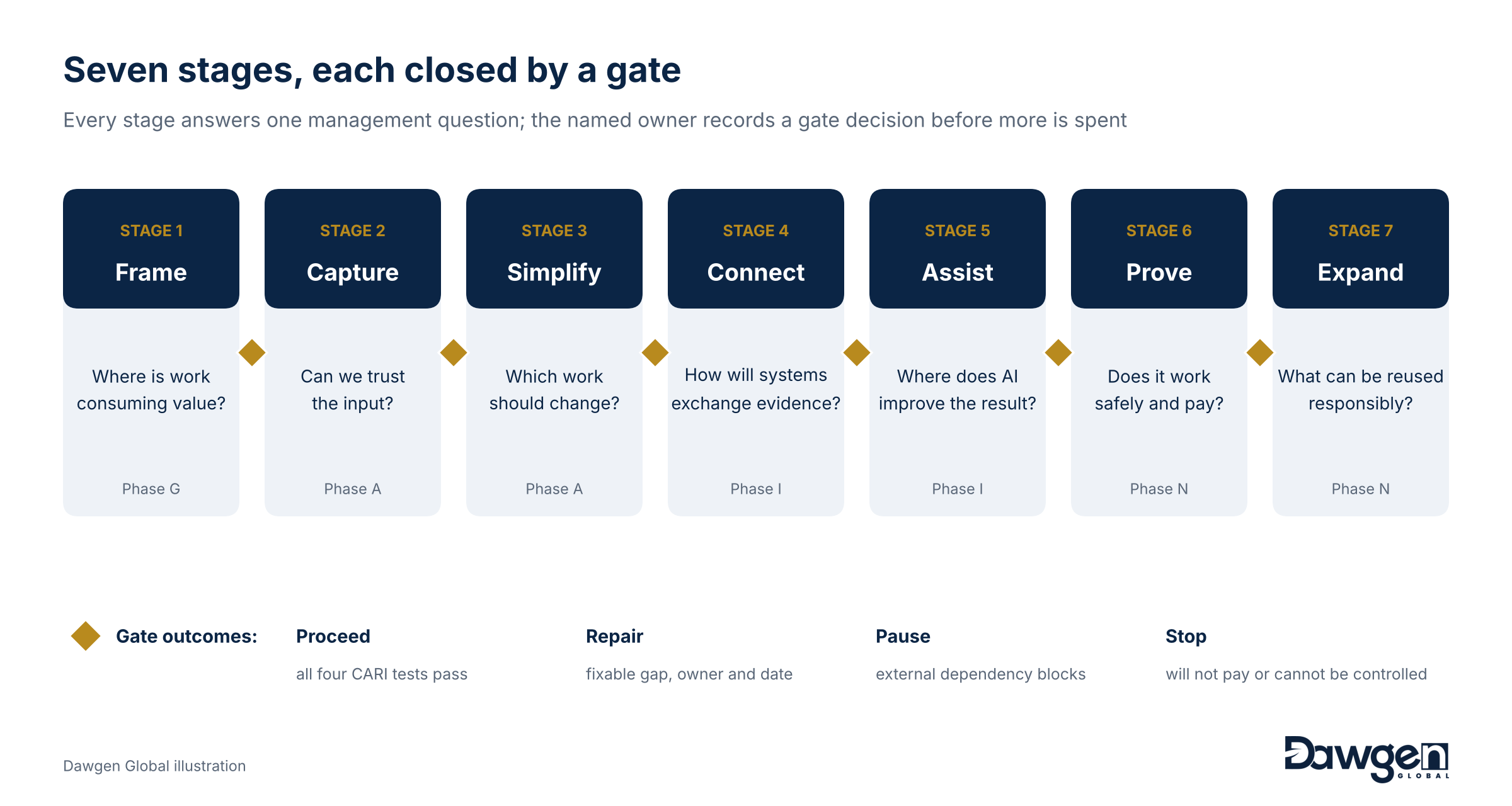
Figure 3 — The seven CARI-GAIN stages, the management question each answers and the four gate outcomes. Dawgen Global illustration.
- Frame — Where is work consuming value? Observe the real work and agree a baseline that the business owner and finance owner both sign.
- Capture — Can we trust the input? Define the required record, the checks and the correction route.
- Simplify — Which work should change? Remove duplicate data collection and unnecessary hand-offs while keeping required controls.
- Connect — How will systems exchange evidence? Agree data mappings, permissions and recovery, and reconcile totals through every interface.
- Assist — Where does AI improve the result? Assign each task to rules, AI assistance or people, and validate before granting authority.
- Prove — Does it work safely and pay? Test results, controls, adoption and cost against the baseline in a controlled pilot.
- Expand — What can be reused responsibly? Extend only what has been proven, revalidating local documents, regulations and economics.
The four gate outcomes are as important as the stages. Proceed means all four tests pass. Repair means a specific gap must be fixed. Pause means an outside dependency — procurement, a regulator, a core-system change — blocks progress and spending stops until it clears. Stop means the evidence shows the workflow will not pay or cannot be controlled. A framework that cannot stop a project is a sales process, not a methodology. Stopping early, with a baseline and a redesigned process in hand, is a successful use of the method.
AI is one option, not the default
CARI-GAIN deliberately compares AI with simpler alternatives. Figure 4 shows the spectrum, from options that handle little variation but are cheap to control, to options that handle more variation but demand more validation and oversight.
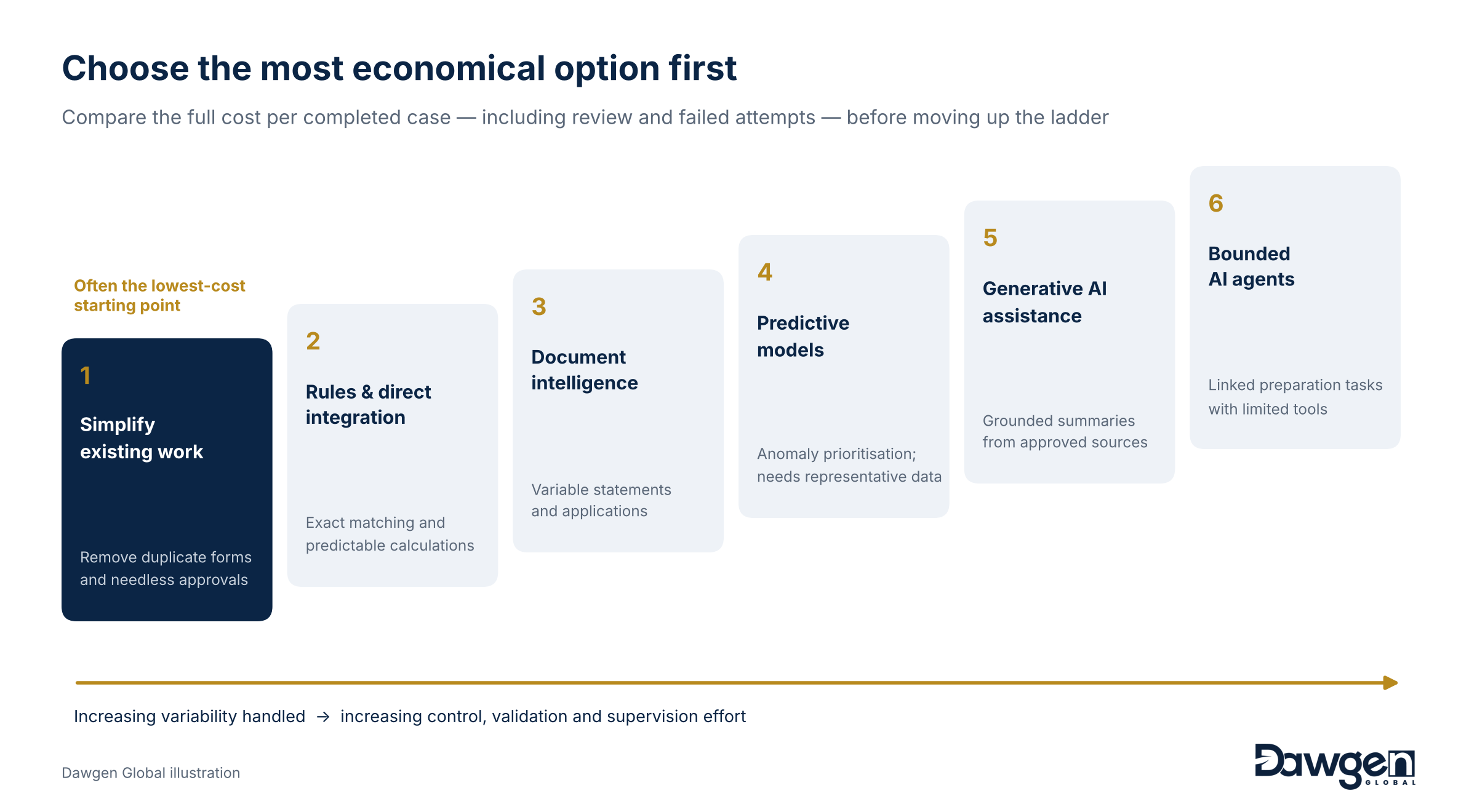
Figure 4 — Choose the most economical option first: from simplifying existing work to bounded AI agents. Dawgen Global illustration.
Simplifying existing work — removing a duplicated form or an unnecessary approval — is often the lowest-cost starting point. Rules and direct integration suit structured records and exact matching; where an institution’s systems offer no modern interface, a controlled secure file exchange may be enough. Document intelligence earns its cost on variable statements and supporting evidence. Predictive models help prioritise anomalies but need representative local data, which smaller institutions with sparse fraud histories may not yet have. Generative AI assistance can summarise evidence and draft responses from approved sources. Bounded AI agents, which carry out several linked preparation tasks, need the tightest limits of all. The framework compares these on one measure: the full cost per successfully completed case at the institution’s real volumes, including failed attempts and human review.
An illustration: one credit union, two paths
The following scenario is illustrative and fictional.
A credit union with around forty thousand members and a six-person lending operations team receives roughly a thousand loan applications a month. Turnaround averages nine working days. The board approves a budget for an AI document reader after an impressive demonstration.
Path one: tool first. The reader is installed and connected to the shared mailbox. On clean uploads it performs well. But a large share of applications arrive as photographs of job letters taken at an angle, scans of faded pay slips and statements where the currency is not stated. Officers now check every extracted field because they cannot tell which ones to trust. Missing documents are still chased by telephone. Turnaround barely moves, a licence fee has been added, and staff morale falls because the “time-saving” system created more checking.
Path two: CARI-GAIN. In the Frame stage, the team observes twenty applications end to end and finds that more than half of officer time is spent on obtaining and correcting documents, not on credit assessment. Finance signs a baseline. In Capture, a clear document checklist, an image quality check at upload and a rule that every amount must carry its currency are introduced, and the share of applications usable first time is measured by branch. In Simplify, a duplicate income verification step and a second sign-off for small loans that added no control value are removed, with risk’s approval. In Connect, the origination system receives data through a controlled file import, with record counts reconciled daily. Only in Assist is document extraction applied — to the document types where testing on the credit union’s own files shows it is reliable — with officers reviewing low-certainty fields. In Prove, a ninety-day pilot compares results with the baseline, including how many members abandon applications. The gate decision is to expand to two more branches; one document type is left with people because the evidence did not support automation.
The second path is slower to begin. It is far faster to value, and the board knows exactly what it bought.
What changes for leadership
The practical effect of CARI-GAIN is a different conversation in the boardroom. Instead of approving a technology purchase, the board approves a workflow portfolio. Instead of a promised percentage saving, it sees a baseline, a benefit hypothesis and the conditions under which that benefit will be recognised. Instead of a vendor’s accuracy claim, it sees performance measured on the institution’s own difficult documents and peak days.
The framework is also built for Caribbean scale. The World Bank has identified small markets, uneven connectivity and differing regulations as practical constraints on financial digitalisation in our region. A framework designed for a market of fifty million customers and a dedicated AI department does not translate well to an institution with a six-person operations team. CARI-GAIN scales down: shared case queues, controlled file imports, managed extraction services and independent review that does not require a new department. Its tests stay the same regardless of size.
That conversation is harder at the start. It is far easier at month six.
What to do this month
- List your five most labour-intensive workflows and the approximate staff hours, overtime and complaints each generates.
- Pick one and observe it end to end. Follow ten real cases from receipt to completion and note every hand-off, correction and wait.
- Ask finance to co-sign a baseline for that workflow: volumes, handling minutes, cost per completed case, turnaround and error rate.
- Review any AI project already in flight against the four CARI tests, and write down where the exceptions will go and who is staffed to handle them.
- Agree in advance what would cause you to stop a current or planned AI initiative, and record it.
Questions for your leadership team
- Which three workflows consume the most staff time, and do we have a baseline for any of them that finance would sign?
- In our current or planned AI projects, where will the corrected, rejected and escalated cases go — and who is staffed to handle them?
- Have we compared each AI proposal with the simpler options of removing work or using rules?
- Could we stop an AI project at a gate today without embarrassment, or have we already committed to the outcome?
- Which customers would find our next digital change harder, not easier?
Key takeaways
- AI placed into a broken workflow moves work into correction queues; redesign the workflow first.
- Dawgen CARI-GAIN AI™ applies four tests — Capture, Accountability, Return, Inclusion — at every one of seven stages.
- Every stage ends at a gate, and “stop” is a legitimate, valuable outcome.
- Compare AI with simpler options on the full cost per completed case, measured on your own work.
Start with the CARI-GAIN Scan
Before your next AI purchase, find out which of your workflows can actually pay. The CARI-GAIN Scan is a fixed-scope diagnostic that observes your real work, establishes a finance-approved baseline, applies the four CARI tests and produces a ranked workflow portfolio with a business case your finance team can challenge. Speak with Dawgen Global’s advisory team.
info@dawgen.global | dawgen.global | US 855-354-2447 | (876) 926-5210
Big Firm Capabilities. Caribbean Understanding.
About Dawgen Global
Dawgen Global is an independent, integrated multidisciplinary professional services firm headquartered at 47 Trinidad Terrace, New Kingston, Jamaica, serving 35 territories across the Caribbean. Founded and led by Dr. Dawkins Brown, Executive Chairman, the firm is independent and not affiliated with any international network. It delivers a full suite of professional services under one roof: audit and assurance; tax advisory; IT and digital transformation; risk management; cybersecurity; actuarial and insurance regulatory advisory; HR advisory; mergers and acquisitions; corporate recovery; business advisory and strategy; accounting BPO and virtual CFO services; and legal process outsourcing.
The proposition is simple: big-firm capability without the big-firm price. Dawgen Global’s integrated approach is built for the specific complexities and opportunities of the Caribbean market, helping organizations make sharper, better-informed decisions that drive measurable progress.
To explore a partnership, reach out:
- Website: dawgen.global
- Email: info@dawgen.global
- WhatsApp (Global): +1 555-795-9071
- Caribbean offices: +1 876-665-5926 | +1 876-929-3670 | +1 876-926-5210
Related service: Explore how we can help →