
The CARI-GAIN Earnings Bridge: how to tell capacity from cash before you promise EBITA to your board.
The GAIN Ledger™ · Article 4 of 7
New to this series?
The GAIN Ledger™ is a seven-part series for boards and executives of Caribbean financial institutions. It introduces Dawgen CARI-GAIN AI™, Dawgen Global’s framework for redesigning financial operations so that artificial intelligence is used only where it measurably improves performance and earnings. This article tackles the most common error in AI business cases — treating staff hours released as money saved — and sets out a practical tool, the Earnings Bridge, for telling capacity from cash. It can be read on its own; no earlier reading is assumed.
The most common error in AI business cases is not a technical one. It is an accounting one. A project releases a thousand staff hours a month, someone multiplies by an hourly rate, and the board is told that the institution will save J$1.8 million a month.
It will not. Not unless something else happens. Released hours are capacity: time that is now available. They become earnings only when management removes a cost that was actually being paid, or uses the capacity to earn income that would not otherwise have been earned. Until then, the hours are still on the payroll, and the salaries are still being paid.
This matters because business cases built on hours tend to be approved, implemented and then quietly forgotten when the savings fail to appear in the management accounts. The board loses confidence, and the next proposal — perhaps a genuinely good one — meets justified scepticism.
The framework in brief
Dawgen CARI-GAIN AI™ combines what must always be true with the order in which work is done. CARI is four tests applied at every stage: Capture (every material output can be traced to reliable evidence), Accountability (a named person owns each decision), Return (the benefit survives the full cost and is verified by finance) and Inclusion (customers and staff can still use and support the service). GAIN is four phases containing seven stages: Gauge (Frame), Align (Capture, Simplify), Integrate (Connect, Assist) and Net Results (Prove, Expand). Each stage ends at a gate with four permitted outcomes: proceed, repair, pause or stop. This article concerns the Return test, which is set at the Frame stage through a finance-approved baseline and verified in the Net Results phase. Figure 1 shows the model.
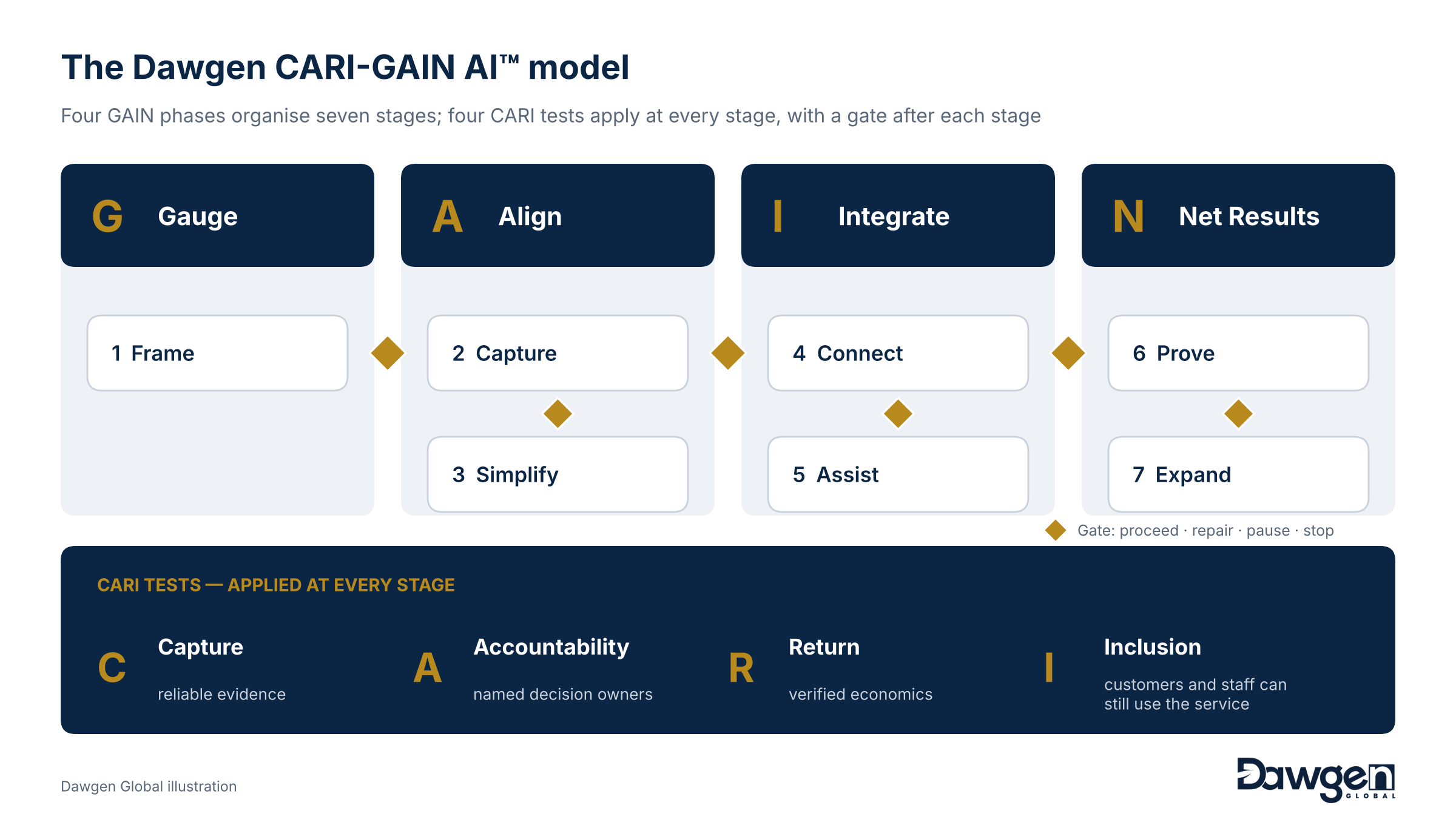
Figure 1 — The Dawgen CARI-GAIN AI™ model; this article focuses on the Return test. Dawgen Global illustration.
What we mean by earnings
The framework measures contribution to EBITA — earnings before interest, tax and amortisation. In plain terms, it is operating profit before financing costs, taxes and the write-down of intangible assets such as acquired software licences or goodwill. Depreciation, the spreading of the cost of physical equipment over its useful life, remains an expense in this measure, so new hardware still counts against the benefit. The exact definition should be agreed with each institution’s finance team and reconciled to its management accounts.
For banks, credit unions and other deposit-takers, interest is not a financing cost; it is the business. For them, EBITA is never enough on its own. It must sit alongside net interest income (interest earned on loans and investments less interest paid to depositors), impairment (the provision for loans that may not be repaid), the cost-to-income ratio and risk-adjusted returns. A workflow that speeds up lending can lift volume while weakening credit quality. Faster loans that default are not an efficiency gain.
The Earnings Bridge
The CARI-GAIN Earnings Bridge is the tool we use to make this discipline routine. It separates six things that business cases routinely blend together:
- Capacity released — staff time freed, reported in hours, not money.
- Expenditure removed — cost actually eliminated, such as overtime or temporary staffing that stops.
- Incremental contribution — additional income earned because of the workflow change, net of servicing costs, funding cost and expected losses.
- Verified leakage removed — duplicate charges or processing losses that demonstrably stop.
- Recurring costs — licences, support, capture, controls and training that continue every month.
- Depreciation — the cost of any equipment, spread over its life.
The Bridge prevents the same staff time from being counted twice: once as a saving and again as the source of new income. Each line also carries a recognition condition — the evidence finance needs before the benefit is counted.
An illustration: a lender in Kingston
The following illustration is fictional. All figures are planning assumptions in Jamaican dollars per month, not a forecast or a benchmark.
A consumer lender in Kingston processes 24,000 records a month across loan applications, payments and customer updates. A redesigned workflow — better capture, fewer hand-offs and AI assistance for document checking — reduces average total handling time, including capture corrections, exceptions and routine quality checks, from four minutes to one and a half minutes per record. That releases 2.5 minutes × 24,000 records ÷ 60 = 1,000 hours a month. At a planning rate of J$1,800 an hour, the capacity is “worth” J$1.8 million.
Now apply the Bridge. Figure 2 shows the result as a waterfall, beginning with the benefits that genuinely reach earnings and subtracting the costs that continue every month.
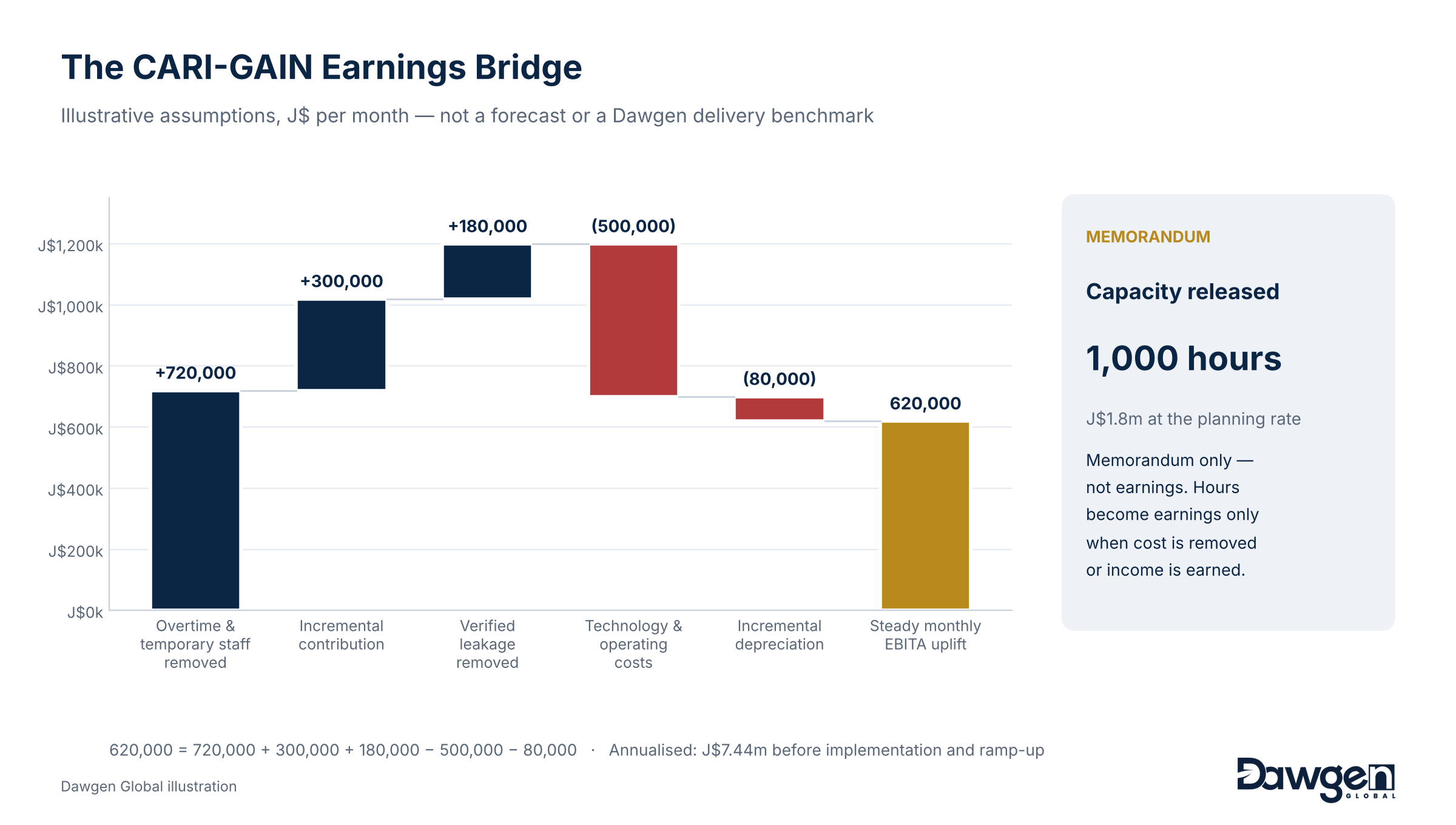
Figure 2 — The CARI-GAIN Earnings Bridge: from released capacity to a steady monthly EBITA uplift of J per month. Dawgen Global illustration.
| Monthly item (illustrative) | J$ | Recognition condition |
| Overtime (J$450,000) and temporary staffing (J$270,000) actually removed | 720,000 | Payroll shows the spend has stopped |
| Incremental contribution from faster turnaround and fewer abandoned applications | 300,000 | Net of servicing, funding cost and expected losses |
| Verified leakage removed | 180,000 | Duplicate charges or processing losses demonstrably eliminated |
| Recurring technology and operating costs | (500,000) | Licences, support, capture, controls, training |
| Incremental depreciation | (80,000) | J$960,000 equipment over twelve months |
| Steady monthly EBITA uplift | 620,000 |
Look closely at the hours. The removed overtime and temporary spend account for 400 of the 1,000 hours released. The other 600 hours carry zero earnings in this illustration, as Figure 3 shows.
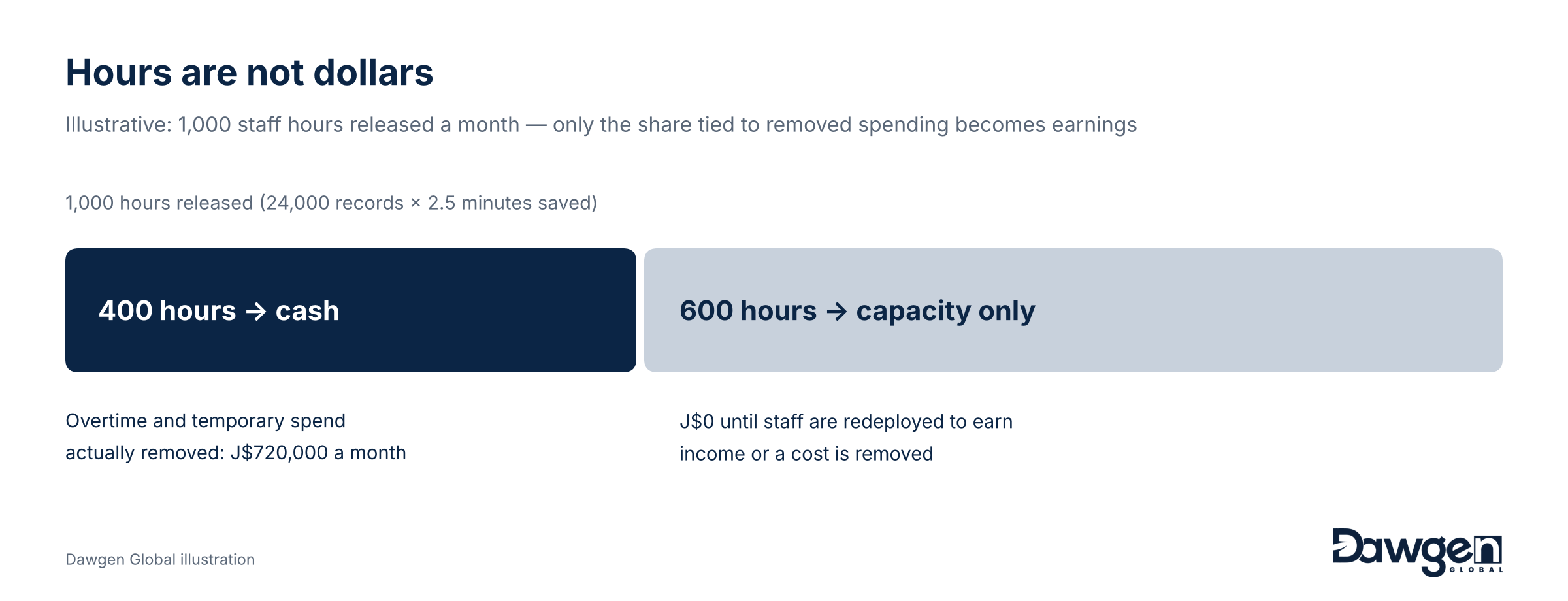
Figure 3 — Capacity versus cash: of 1,000 hours released, 400 become cash savings and 600 remain capacity until management acts. Illustrative. Dawgen Global illustration.
Those 600 hours are real. Management may use them to absorb growth without hiring, to shorten queues or to improve service. But they are not money until a decision makes them so, and when that happens the benefit is added as a separate, evidenced line. Note too that the incremental contribution comes from customers completing their applications faster and fewer abandoning the process, not from redeploying the released hours. If it did, those hours could not also be counted elsewhere.
On these assumptions, the steady annual uplift is J$7.44 million. With upfront cash of J$4.8 million, the steady monthly cash contribution — the EBITA uplift plus the non-cash depreciation, or J$700,000 — gives a simple cash payback of approximately 6.9 months once full performance begins. That is a respectable case. It is also a fragile one.
The sensitivity a board must see
Figure 4 shows what happens when the assumptions do not hold.
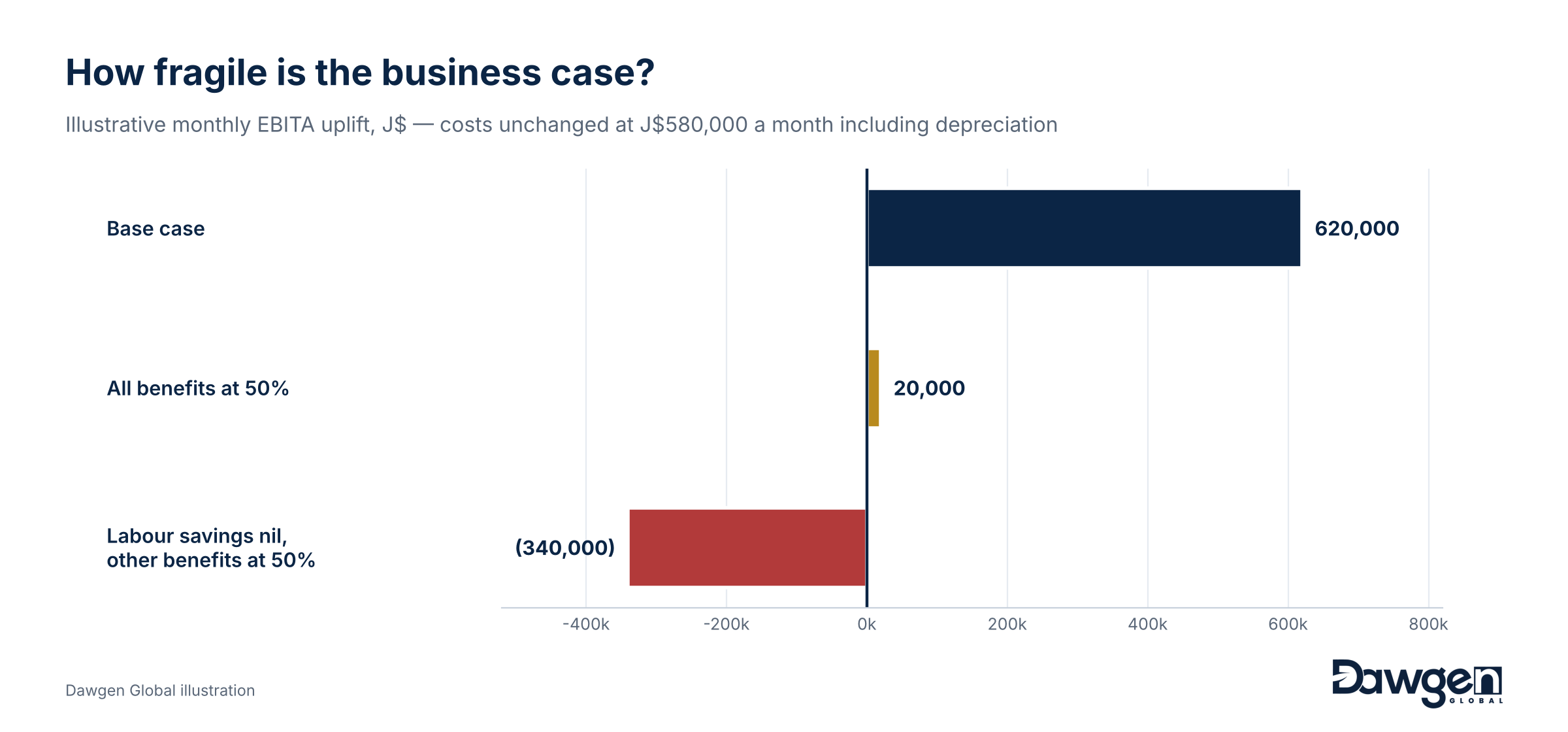
Figure 4 — Sensitivity of monthly EBITA uplift: base case, all benefits at 50 per cent, and labour savings nil with other benefits at 50 per cent. Illustrative. Dawgen Global illustration.
Halve all three benefit lines and keep costs unchanged, and the monthly uplift falls from J$620,000 to J$20,000 — benefits of J$600,000 against continuing costs, including depreciation, of J$580,000. If the overtime and temporary staffing savings do not materialise at all and the other benefits halve, benefits fall to J$240,000 and the result becomes a loss of J$340,000 a month.
The accounting treatment deserves equal care. Suppose J$960,000 of the upfront cash is equipment, depreciated over twelve months, and the remaining J$3.84 million is implementation cost expensed as incurred. Twelve full operating months would then produce J$3.60 million of EBITA uplift after that one-time expense — and actual first-year performance will be lower once go-live timing and ramp-up are reflected. The institution’s accounting policy applies; capitalising costs cannot be used to manufacture value. Vendor contracts priced in US dollars add exchange-rate exposure, which should be modelled separately, as should capture failure rates, tax and working capital in a full client business case.
This is not an argument against the project. It is an argument for knowing, before approval, which assumption carries the case, and for building the pilot to test that assumption first. In this illustration the removal of overtime and temporary spend is the load-bearing beam. If management is not prepared to make that decision, the project should not be presented as earnings-positive.
Every efficiency measure needs a partner
The same logic applies across workflows. A fraud tool can cut investigation time while increasing missed losses. A chatbot can appear to resolve contacts while customers quietly abandon the channel. Faster lending can increase volume while impairment rises. CARI-GAIN therefore pairs every efficiency measure on the management dashboard with a control or customer-outcome measure, so that a gain in one cannot hide a loss in the other. Turnaround time sits beside abandoned applications; investigator time per case sits beside sampled missed cases; straight-through completion sits beside the share of customers who needed assisted completion. When both measures in a pair improve together, the board can be confident that value has been created rather than moved. When one improves and its partner worsens, the Earnings Bridge should be revisited before any expansion is approved.
There is also a fair comparison to make. Before AI is costed, CARI-GAIN asks what simpler options would achieve: removing a duplicated form, cutting an unnecessary approval, or a rules-based integration through secure file exchange where no modern interface exists. These often deliver much of the benefit at a fraction of the recurring cost, and the Earnings Bridge should show them side by side.
Verified, not modelled
Finally, CARI-GAIN tracks the Verified Earnings Ratio: finance-verified EBITA uplift divided by the uplift in the approved business case. It is a simple honesty check. A ratio well below one tells the board that the case was optimistic and that the next one should be discounted. A ratio near one builds the credibility to expand. In the framework, a ratio below 0.8 for two consecutive months triggers a repair review. Over time, the ratio becomes the institution’s own evidence of what transformation is really worth.
What to do this month
- Re-cut one current AI business case into the six Earnings Bridge lines, and label every benefit as either cash or capacity.
- Name the finance owner who will sign off each benefit line, and agree the evidence required.
- Identify the load-bearing assumption and calculate the result if it is halved and if it is nil.
- Decide explicitly what will happen to released hours — cost removed, growth absorbed or service improved — and record the decision.
- For lending workflows, add impairment and credit quality to the same report as turnaround time.
- Ask for the simpler alternative to be costed beside any AI proposal.
Questions for your leadership team
- In our AI business cases, which benefits are cash removed and which are hours released?
- Who in finance signs off that a benefit has actually materialised, and how often?
- What happens to our case if the largest benefit assumption is halved, or does not occur?
- For lending workflows, are we tracking impairment, net interest income and credit quality alongside speed?
- What is the Verified Earnings Ratio of the last technology investment we approved?
Key takeaways
- Released hours are capacity; they become earnings only when a cost is removed or new income is earned.
- The Earnings Bridge separates six lines so that nothing is counted twice and every benefit has a recognition condition.
- Always show the sensitivity: in our illustration, J$620,000 a month falls to J$20,000, or a J$340,000 loss, if key benefits fail.
- Track the Verified Earnings Ratio so that future cases are judged on evidence, not optimism.
Start with the CARI-GAIN Scan
Put your AI business case through the Earnings Bridge before your board does. The CARI-GAIN Scan is a fixed-scope diagnostic that establishes a finance-approved baseline for your priority workflows, separates capacity from cash, and produces a ranked workflow portfolio and business case that shows exactly which assumptions must hold. Contact Dawgen Global to begin.
info@dawgen.global | dawgen.global | US 855-354-2447 | (876) 926-5210
Big Firm Capabilities. Caribbean Understanding.
About Dawgen Global
Dawgen Global is an independent, integrated multidisciplinary professional services firm headquartered at 47 Trinidad Terrace, New Kingston, Jamaica, serving 35 territories across the Caribbean. Founded and led by Dr. Dawkins Brown, Executive Chairman, the firm is independent and not affiliated with any international network. It delivers a full suite of professional services under one roof: audit and assurance; tax advisory; IT and digital transformation; risk management; cybersecurity; actuarial and insurance regulatory advisory; HR advisory; mergers and acquisitions; corporate recovery; business advisory and strategy; accounting BPO and virtual CFO services; and legal process outsourcing.
The proposition is simple: big-firm capability without the big-firm price. Dawgen Global’s integrated approach is built for the specific complexities and opportunities of the Caribbean market, helping organizations make sharper, better-informed decisions that drive measurable progress.
To explore a partnership, reach out:
- Website: dawgen.global
- Email: info@dawgen.global
- WhatsApp (Global): +1 555-795-9071
- Caribbean offices: +1 876-665-5926 | +1 876-929-3670 | +1 876-926-5210
Related service: Explore how we can help →