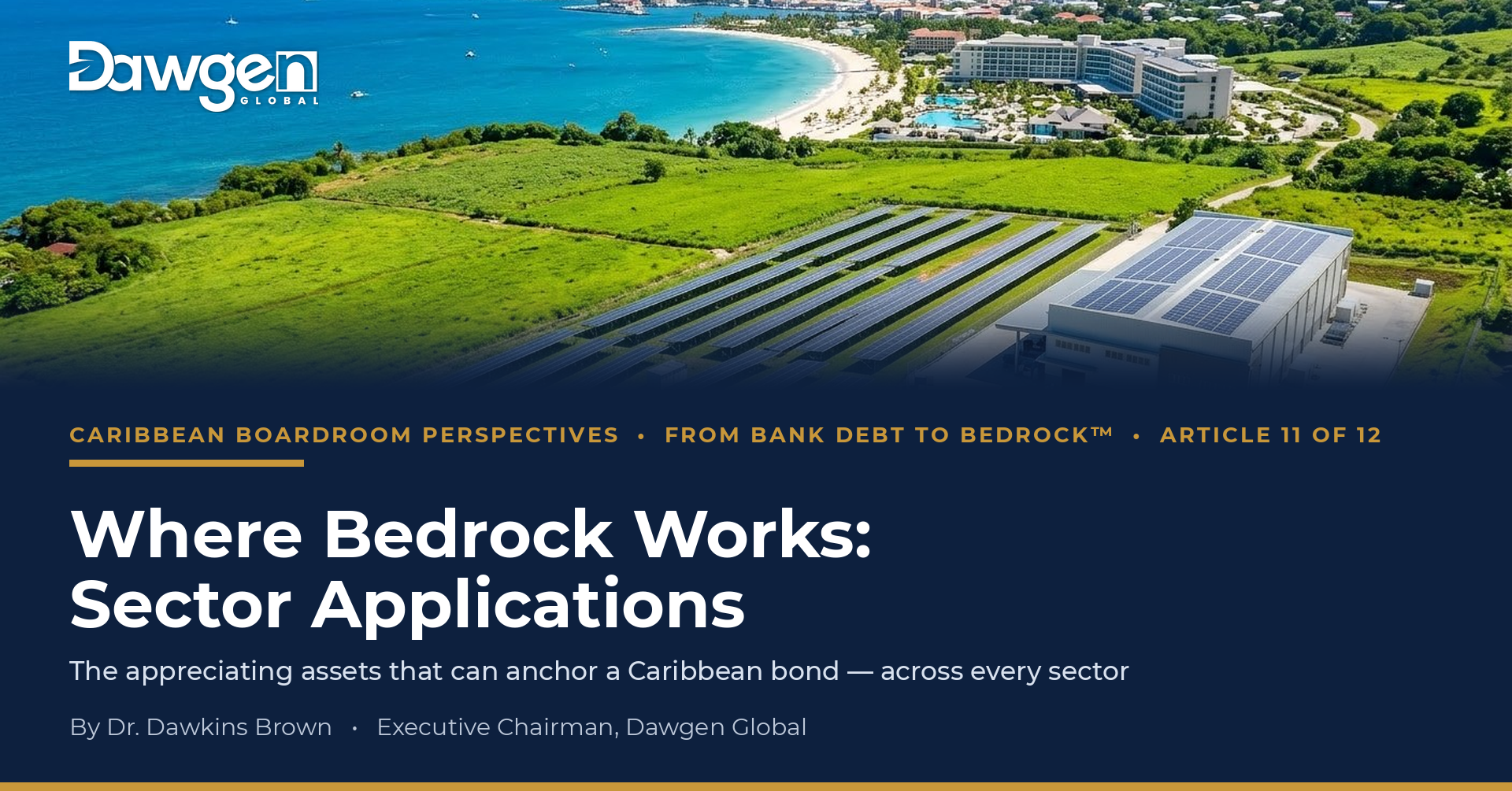
The appreciating assets that can anchor a Caribbean bond — across tourism, energy, logistics, agriculture, and beyond
This series has built an instrument, mapped its demand, and addressed the market that must carry it. One question remains on the supply side, and it is the most concrete of all: where, across the Caribbean economy, do the appreciating assets that can anchor these bonds actually lie? The framework is general; its application is specific. This article walks the sectors where the asset-anchored bond fits most naturally — not to prescribe transactions, but to show how the Backing tests of Article 2 translate into real categories of Caribbean enterprise.
A note on method governs everything that follows. The illustrations in this article are of two kinds only: broad sector characteristics drawn from the published, observable features of Caribbean industries, and stylised hypothetical models — invented enterprises with invented numbers, created solely to show how a structure would work. Nothing here describes, references, or alludes to any actual company, transaction, or engagement. The recurring “Blue Harbour” model returns as the tourism illustration, joined by sector cousins built on the same basis. The purpose is to map the territory, not to point at any enterprise within it.
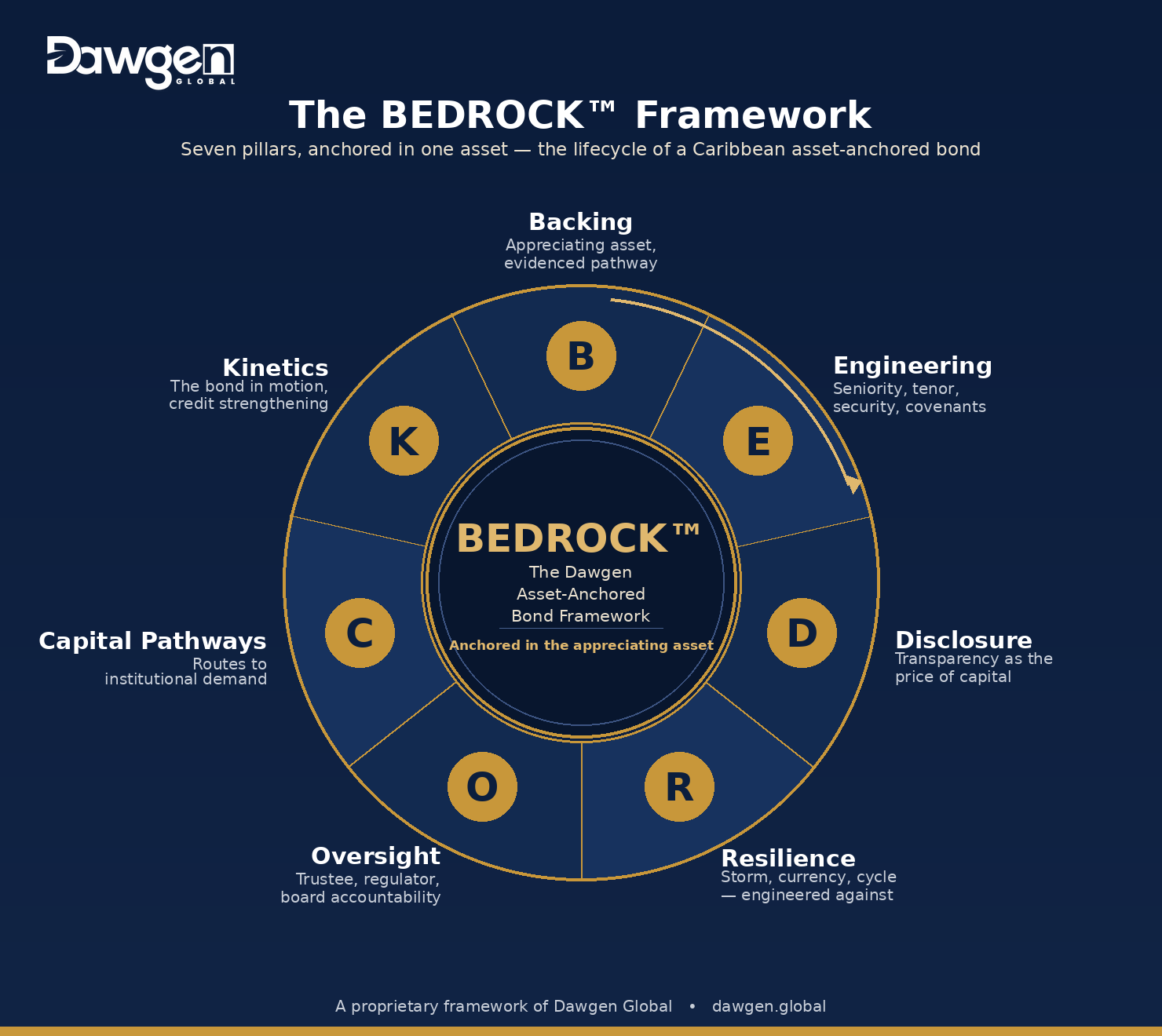
Recall the four Backing tests an asset must pass to anchor a bond: a long economic life, evidenced appreciation, independent valuability, and income alignment. As we walk the sectors, watch how each is satisfied differently — because the art of the framework lies in recognising the appreciating asset within each industry’s particular form.
Tourism and Hospitality Real Estate
Tourism is the Caribbean’s signature industry, and its real estate is the framework’s flagship application. A beachfront resort, a branded hotel, a well-located hospitality property sits on something close to irreplaceable: scarce coastal land in a destination of enduring global demand. The land beneath a successful resort has appreciated across decades and, barring catastrophe, will continue to — satisfying the appreciation test through genuine scarcity rather than speculation. The property generates foreign-currency income through occupancy, aligning revenue with hard-currency debt service and addressing the currency dimension of Article 5.
The stylised Blue Harbour Resorts Ltd. model of the earlier articles is the type specimen: a US$80 million beachfront property anchoring a US$40 million fifteen-year senior secured bond at a 50% issuance loan-to-value (LTV), with assigned catastrophe insurance, a six-month debt service reserve, and a coupon that steps down as revaluation confirms the land’s appreciation. The sector’s structuring imperatives are equally characteristic: catastrophe resilience is non-negotiable (Article 5), seasonality must be reserved against, and the management agreement that drives occupancy must be assigned into the security perimeter (Article 3). Tourism real estate is where the framework was, in a sense, designed to live.
Renewable Energy Infrastructure
Where tourism offers appreciating land, renewable energy offers contracted cash flow — and a different expression of the Backing thesis. A solar installation, a wind facility, or a battery-storage asset built to serve a long-term power purchase agreement (PPA) generates predictable, often inflation-linked, long-dated income from a creditworthy offtaker. The asset’s value lies less in land appreciation than in the durability and contractual security of its revenue, and in the region’s structural, policy-backed shift away from imported fossil fuel — a transition that gives well-sited renewable assets a long and strengthening economic life.
Consider a stylised model: “Trade Wind Power Ltd.,” a fictional independent power producer with a twenty-year PPA with a national utility. Here the income-alignment test is satisfied most strongly of all — the contracted tariff is the security — and the structure naturally favours an amortising profile (Article 3) matched to the PPA term, with the assignment of the PPA itself as the core of the security perimeter. The international analogue is well established: renewable-energy project bonds are a mature global asset class, and the Caribbean’s energy transition makes the region a natural setting for their adaptation. For institutional investors, a long-dated, contracted, inflation-aware energy bond is close to an ideal liability match.
Logistics, Ports, and Industrial Real Estate
The Caribbean’s geography — astride major shipping lanes, between the Americas — gives its logistics and port infrastructure a locational value that is difficult to replicate and tends to appreciate with trade. A container terminal, a bonded warehouse complex, a logistics park near a port or airport sits on strategically scarce land and generates income from the movement of goods that a trading region cannot do without. The appreciation test is met through locational scarcity; the income-alignment test through long-term tenancy, concession, or throughput agreements.
A stylised illustration: “Island Gateway Logistics Ltd.,” a fictional operator of a bonded warehouse and distribution park on long leases to established tenants. The structuring centre of gravity here is the assignment of the lease or concession income (Article 3) and careful attention to the counterparty concentration the offering document must disclose (Article 4). Industrial and logistics real estate is, internationally, among the most financeable of all asset classes precisely because its income is contractual and its land is scarce — and the Caribbean’s position in global trade gives the regional version of this asset a durable underpinning.
Agriculture and Agribusiness
Agriculture is the subtlest application, and an important one for a region seeking food security and rural development. The appreciating asset is rarely the crop; it is the productive land and the processing infrastructure. Well-managed agricultural land in a region of finite arable area appreciates over time, and the processing, storage, and distribution assets that convert raw produce into traded goods carry durable, often export-earning, value. The framework’s discipline matters especially here: not all farmland qualifies, and the Backing tests do real work in separating genuinely appreciating, independently valuable agricultural assets from those whose value depends entirely on a single uncertain harvest.
A stylised model: “Green Valley Agro Ltd.,” a fictional agribusiness whose backing asset is a combination of titled productive land and a modern processing and cold-storage facility serving export markets. The structuring emphasis falls on the resilience pillar — weather and commodity-cycle stress-testing (Article 5) — and on the independent valuation of land and facilities separately from the volatility of any one season’s output. Agriculture demonstrates the framework’s range: with disciplined structuring, even a sector long considered too risky for long-dated finance contains assets that can anchor a sound bond.
And Beyond: The Pattern That Repeats
These four sectors are illustrations, not an exhaustive list. The same pattern recurs wherever a Caribbean enterprise controls a genuinely appreciating, independently valuable, income-aligned, long-life asset. Commercial and mixed-use real estate in growing urban centres; healthcare and education facilities serving durable demand; telecommunications and digital infrastructure; water and utility assets — each can, with the right asset and disciplined structuring, satisfy the Backing tests.
The framework does not ask what industry you are in. It asks one question: do you control an appreciating, independently valuable, income-aligned, long-life asset? Wherever the answer is yes, Bedrock works.
This is the liberating generality of the framework. It is not a tourism-finance technique or an energy-finance technique; it is a discipline for recognising and financing the appreciating asset wherever it occurs in the Caribbean economy. The sectors differ in how they satisfy the Backing tests — land scarcity here, contracted cash flow there, locational value elsewhere — but the underlying logic is one. What unites a beachfront resort, a solar farm, a logistics park, and an agribusiness is not their industry but their structure: a durable asset whose value supports, and is expected to strengthen relative to, the debt raised against it.
Sector Applications, at a Glance
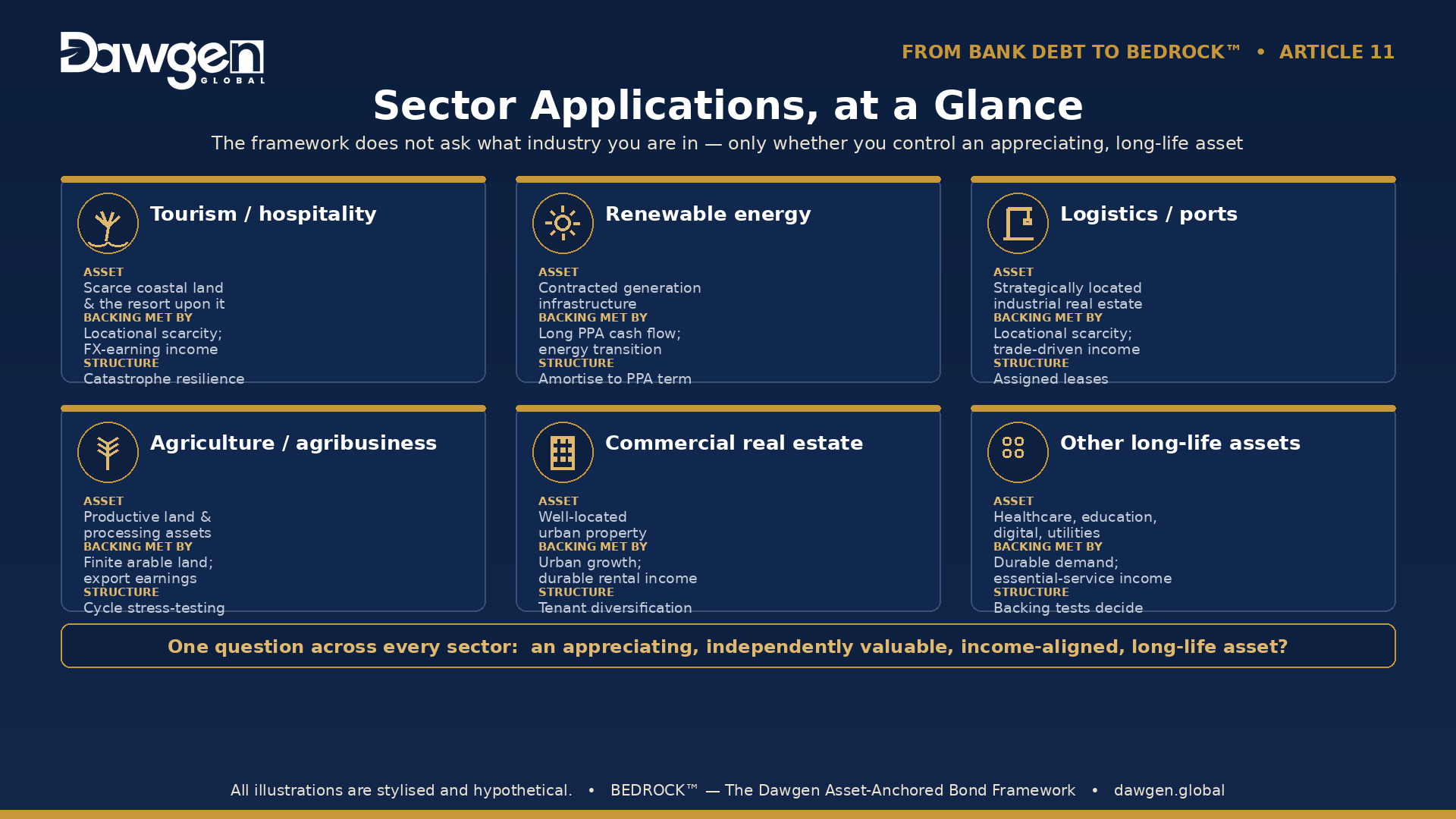
How the Backing thesis expresses itself across sectors, with the characteristic structuring emphasis for each. All illustrations are stylised and hypothetical:
| Sector | The Appreciating Asset | Backing Met By | Structuring Emphasis |
| Tourism / hospitality | Scarce coastal land and the resort upon it | Locational scarcity; FX-earning income | Catastrophe resilience; assigned management agreement |
| Renewable energy | Contracted generation infrastructure | Long PPA cash flow; energy transition | Amortisation to PPA; assigned offtake |
| Logistics / ports | Strategically located industrial real estate | Locational scarcity; trade-driven income | Assigned leases; counterparty disclosure |
| Agriculture / agribusiness | Productive land and processing assets | Finite arable land; export earnings | Weather / cycle stress-testing; separate valuation |
| Commercial real estate | Well-located urban property | Urban growth; durable rental income | Lease assignment; tenant diversification |
| Other long-life assets | Healthcare, education, digital, utilities | Durable demand; essential-service income | Asset-specific — the Backing tests decide |
All enterprises named in this article — Blue Harbour Resorts, Trade Wind Power, Island Gateway Logistics, and Green Valley Agro — are fictional, created solely for illustration. All values and structures are invented for the models, are not forecasts or recommendations, and do not reference any actual company, transaction, or engagement.
Defined Terms
This article adds two terms to the series vocabulary:
Sector application. The translation of the general Backing tests into a specific category of Caribbean enterprise — recognising how a given industry’s particular asset (scarce land, contracted cash flow, locational value) satisfies the appreciating-asset thesis.
Asset-form recognition. The discipline of identifying the genuinely appreciating, independently valuable, income-aligned, long-life asset within an enterprise — which may be land, infrastructure, contracts, or location — rather than assuming the asset is the business as a whole.
From Where to Whether
We have now walked the framework from end to end. We built the instrument across seven pillars; we mapped the demand that awaits it and the market that must carry it; and in this article we have seen where, across the Caribbean economy, the appreciating assets that can anchor it actually lie. The territory is wide — wider than tourism, wider than any single sector — because the framework is a discipline of recognition, not a technique for one industry.
Which brings the series to its final and most practical question. We have answered what an asset-anchored bond is, why it suits the Caribbean, who would buy it, where the market must deepen, and in which sectors the assets lie. The only question left is the one each enterprise must answer for itself: is mine ready? Is my asset, my structure, my disclosure, my governance — measured against the seven pillars — at the standard this capital requires? That question deserves a structured answer, and providing one is the work of the series’ finale: Article 12, Are You Bond-Ready? The BEDROCK™ Bond Readiness Index.
Across tourism, energy, logistics, agriculture and beyond, the question for any Caribbean enterprise with a substantial long-life asset is whether that asset could anchor a bond — and whether the enterprise is ready to bring one. Dawgen Global’s Corporate Finance, Advisory and Restructuring teams help issuers identify the appreciating asset within their business and build toward bond readiness. The BEDROCK™ Bond Readiness Index, introduced in Article 12, offers a structured assessment of where an enterprise stands. Enquiries: [email protected].
Next in the series — the finale: Article 12 — Are You Bond-Ready? The BEDROCK™ Bond Readiness Index. Caribbean Boardroom Perspectives publishes Thursdays; companion editions appear in The Caribbean Advisory Brief on Saturdays.
BEDROCK™ — The Dawgen Asset-Anchored Bond Framework is a proprietary framework of Dawgen Global. © 2026 Dawgen Global. All rights reserved. dawgen.global
About Dawgen Global
Dawgen Global is an independent, integrated multidisciplinary professional services firm headquartered at 47 Trinidad Terrace, New Kingston, Jamaica, serving more than 15 territories across the Caribbean. Founded and led by Dr. Dawkins Brown, Executive Chairman, the firm is independent and not affiliated with any international network. It delivers a full suite of professional services under one roof: audit and assurance; tax advisory; IT and digital transformation; risk management; cybersecurity; actuarial and insurance regulatory advisory; HR advisory; mergers and acquisitions; corporate recovery; business advisory and strategy; accounting BPO and virtual CFO services; and legal process outsourcing.
The proposition is simple: big-firm capability without the big-firm price. Dawgen Global’s integrated approach is built for the specific complexities and opportunities of the Caribbean market, helping organizations make sharper, better-informed decisions that drive measurable progress.
To explore a partnership, reach out:
- Website: dawgen.global
- Email: [email protected]
- WhatsApp (Global): +1 555-795-9071
- Caribbean offices: +1 876-665-5926 | +1 876-929-3670 | +1 876-926-5210


