Executive Summary
Something genuinely encouraging is happening in Caribbean cybersecurity: the region is building watchtowers. Security operations centres are opening, managed detection services are multiplying, telecom providers and security groups are investing in around-the-clock monitoring, and governments are applauding — rightly, because the capability gap these investments address is real. This series argued in its seventh article that the quiet phase before an attack detonates is the single highest-value detection window an organisation has, and for years most Caribbean organisations had no one watching it. That is changing, and every executive should welcome it.
And yet the arrival of the watchtower raises a question the watchtower cannot answer about itself: is it working? Monitoring is an operational capability — it sits in the first and second lines of the model this series has used throughout — and the standing rule of this series applies to it with full force: the builder is never the checker. A board that subscribes to a SOC has bought vigilance; it has not yet bought proof of vigilance. This article — the first beyond the series’ twelve-part launch arc — explains what monitoring services genuinely provide and where their self-reporting reaches its limit, sets out the five questions a SOC cannot answer about itself, describes what independent SOC assurance looks like in practice, and closes with eight questions for any organisation buying, renewing or already relying on monitoring services. The theme is not scepticism of the region’s new capabilities. It is the discipline this series has applied to every control: trust it enough to invest in it — and verify it like everything else you depend on.
The Watchtower Era: Good News, Honestly Stated
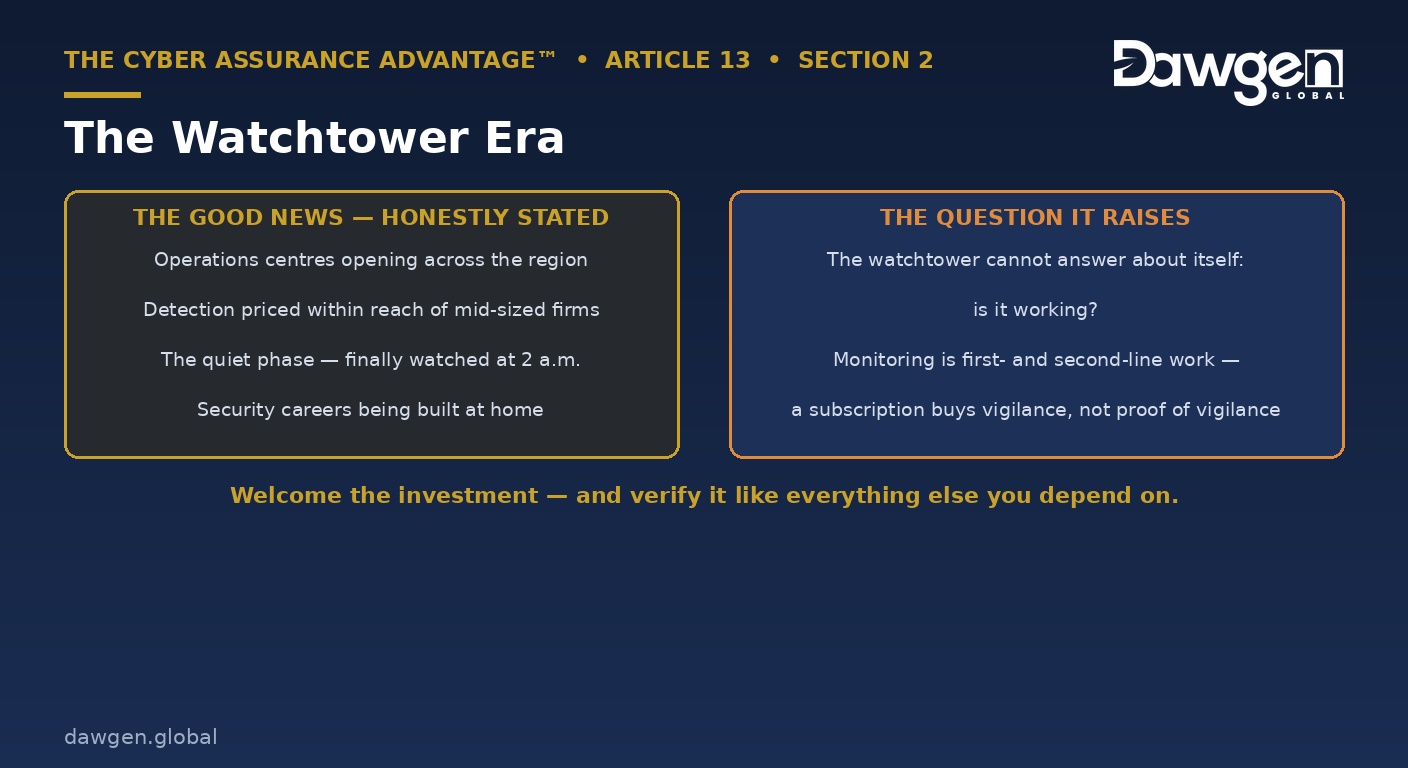
Let the good news be stated without reservation. The emergence of regional monitoring capability — operations centres staffed around the clock, detection services priced within reach of mid-sized organisations, security talent building careers at home rather than abroad — addresses precisely the weaknesses this series has catalogued. Quiet-phase detection, the discipline that decides ransomware outcomes, requires someone watching at 2 a.m. on a Sunday; most organisations cannot staff that alone, and now they need not. Regional providers understand regional realities — the vendor concentrations, the talent market, the sector mix — in ways distant providers do not. And the visibility of these investments has done the market a service no white paper could: it has made monitoring a boardroom topic across the Caribbean.
Precisely because the investment is real and the marketing is loud, boards now need the vocabulary to govern it. A monitoring service is an operator: it watches, alerts, and — depending on the contract — responds. It is not, and cannot be, the source of independent comfort about its own effectiveness, any more than a security guard company can audit its own patrols or a finance team can audit its own accounts. The distinction is not a criticism of operators; it is the three-lines architecture this series has used from its first article, applied to its newest arrival.
What a SOC Is — and What It Cannot Be
A security operations centre, in-house or subscribed, performs first- and second-line work: operating detection technology, watching telemetry, triaging alerts, escalating incidents and, in fuller arrangements, responding to them. Done well, it is one of the most valuable controls an organisation can hold — this series said as much when it placed quiet-phase detection among the six disciplines that decide ransomware outcomes. What a SOC is not is assurance. The eleventh article of this series answered the question directly in its FAQ, and the sentence bears repeating now that watchtowers are multiplying: an organisation can have excellent monitoring and no assurance at all. Monitoring answers “who is watching?”; assurance answers “does the watching work — and can we prove it to anyone entitled to ask?”
The confusion to guard against is a familiar one. Article 6 of this series described how vulnerability scans were sold and filed as penetration tests; the emerging equivalent is the monitoring report filed as assurance. A monthly PDF of alerts triaged and tickets closed is an activity report — valuable operational information, produced by the party being paid for the activity. It tells a board what the operator says the operator did. It does not tell the board what the operator missed, whether coverage matches what actually matters, or whether the whole arrangement would catch a competent intruder — and no operator, however excellent, can be the independent source of those answers about itself.
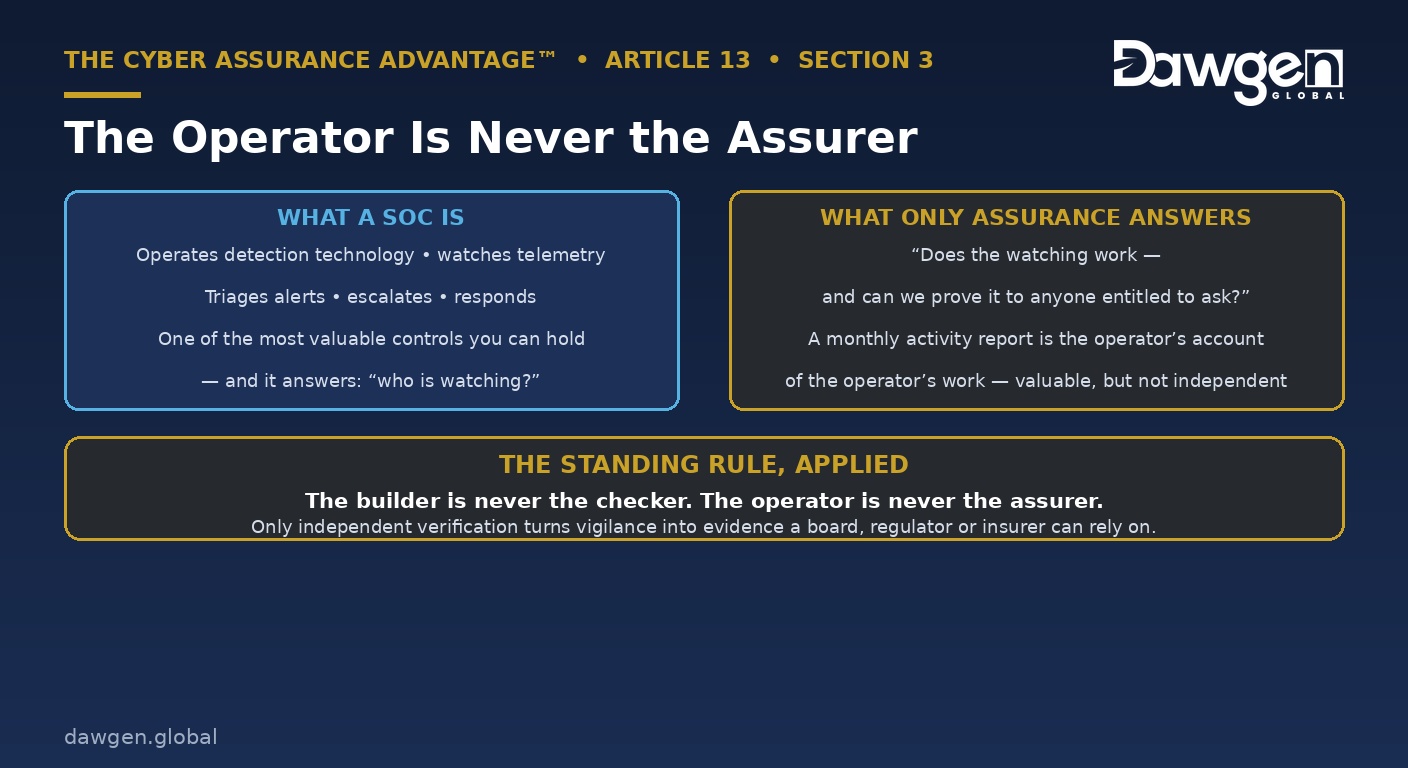
| THE STANDING RULE, APPLIED
The builder is never the checker. The operator is never the assurer. A SOC subscription buys vigilance; only independent verification turns vigilance into evidence a board, regulator, insurer or correspondent can rely on. |
Five Questions a SOC Cannot Answer About Itself
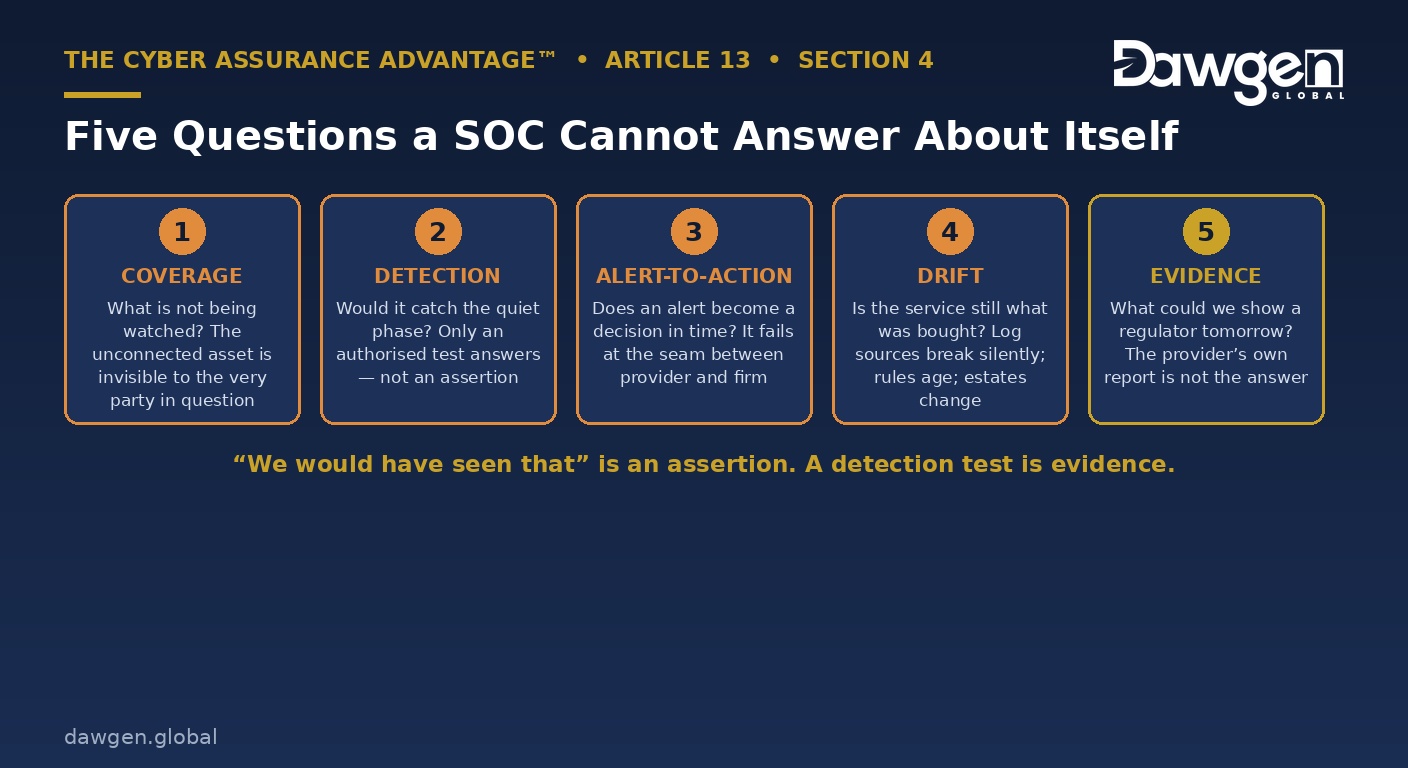
- Coverage: what is not being watched? Monitoring sees the systems and log sources connected to it. The assets outside its scope — the forgotten server, the new cloud workload, the acquisition’s network, the OT environment — are invisible precisely to the party whose visibility is in question. Coverage must be validated against the organisation’s assurance map, not against the provider’s connection list.
- Detection efficacy: would it catch the quiet phase? The only honest answer comes from authorised testing — skilled people attempting, under the safety controls this series has described, the movement and escalation a real intruder would attempt, and observing what the monitoring actually flags. “We would have seen that” is an assertion; a detection test is evidence.
- Alert-to-action: does an alert become a decision in time? Detection that ends in an unread email has not defended anything. The path from the operator’s alert into your organisation — who is called, who decides, in what hours, with what authority — is a joint process neither party can certify alone, and it fails at the seam more often than at either end.
- Configuration drift and scope creep: is the arrangement still what was bought? Environments change, log sources break silently, detection rules age, and the estate the contract described two years ago is not today’s estate. The gap between the service as contracted and the service as operating is exactly the kind of quiet decay only periodic independent examination surfaces.
- The evidence question: what could we show a regulator tomorrow? Supervisors, insurers and correspondents — the four audiences of this series’ eighth article — increasingly ask not “do you have monitoring?” but “how do you know it is effective?” A provider’s own report answers the first question. Only independent verification answers the second.
What Independent SOC Assurance Looks Like in Practice
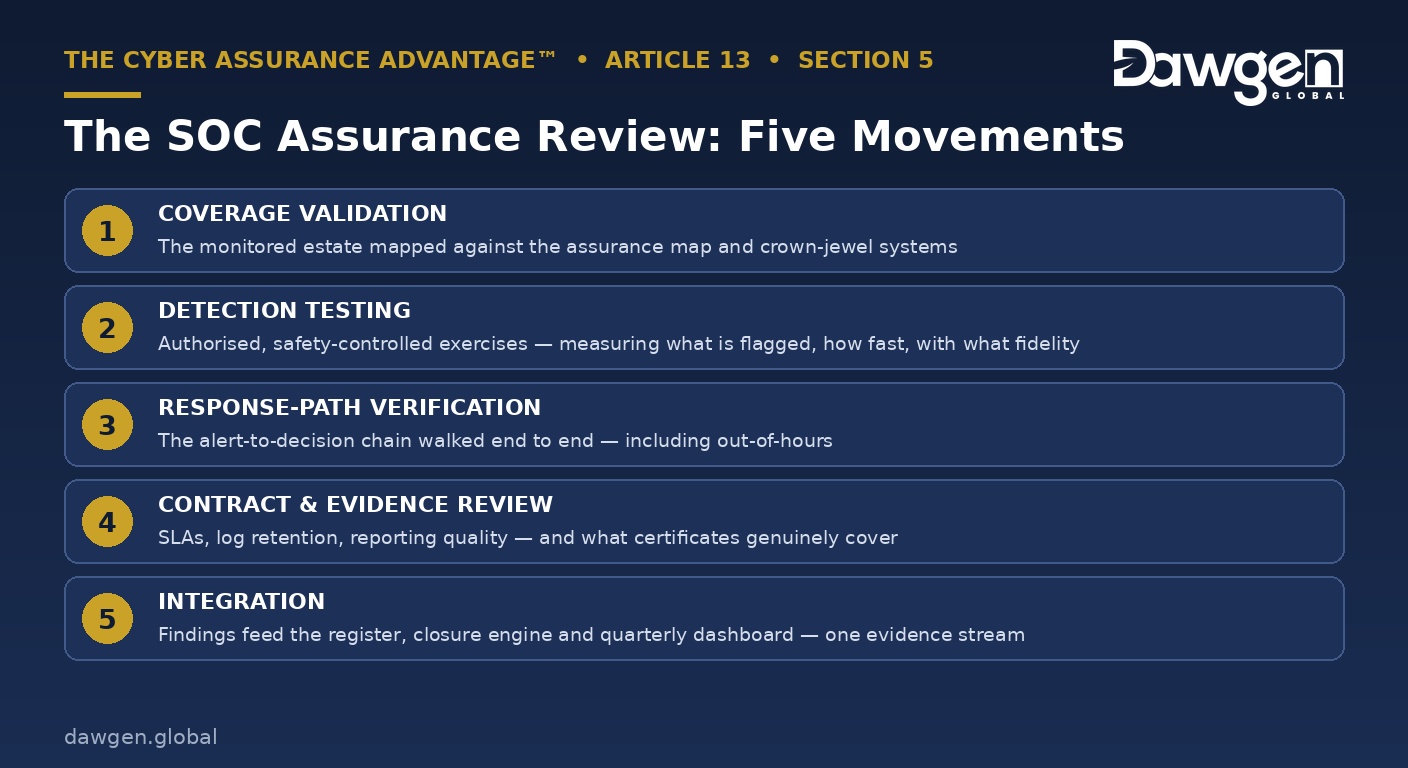
None of this requires adversarial relationships with providers — the best operators welcome verification, because it evidences their value with an independence their own reports cannot carry. A proportionate SOC assurance review has five movements, all of them familiar to readers of this series. Coverage validation: the monitored estate mapped against the assurance map and crown-jewel systems of Articles 2 and 9, so the board knows what is watched, what is not, and whether the difference is a decision or an accident. Detection testing: authorised, safety-controlled exercises — from targeted technical simulations to full purple-team engagements — measuring what the monitoring flags, how fast, and with what fidelity, under the rules-of-engagement disciplines of Articles 4 and 6. Response-path verification: the alert-to-decision chain walked end to end, including out-of-hours, against the escalation protocol of Article 3. Contract and evidence review: SLAs, log-retention, reporting quality and the provider’s own certifications examined for what they genuinely cover — remembering Article 2’s rule that a vendor’s certificate describes the vendor’s controls, not your configuration of them. And integration: SOC findings and detection-test results feeding the register, closure engine and quarterly dashboard of Articles 10 and 11, so monitoring becomes part of the organisation’s standing evidence rather than a parallel paper stream.
Cadence follows the continuous-assurance logic of Article 11: coverage and response-path checks annually or on major change; detection testing on a rotating cycle; the whole arrangement revisited whenever the estate, the provider or the threat picture moves materially. For organisations running the ninety-day roadmap of Article 12, the SOC review slots naturally into the third phase — it is, after all, simply the verification discipline applied to one more critical control.
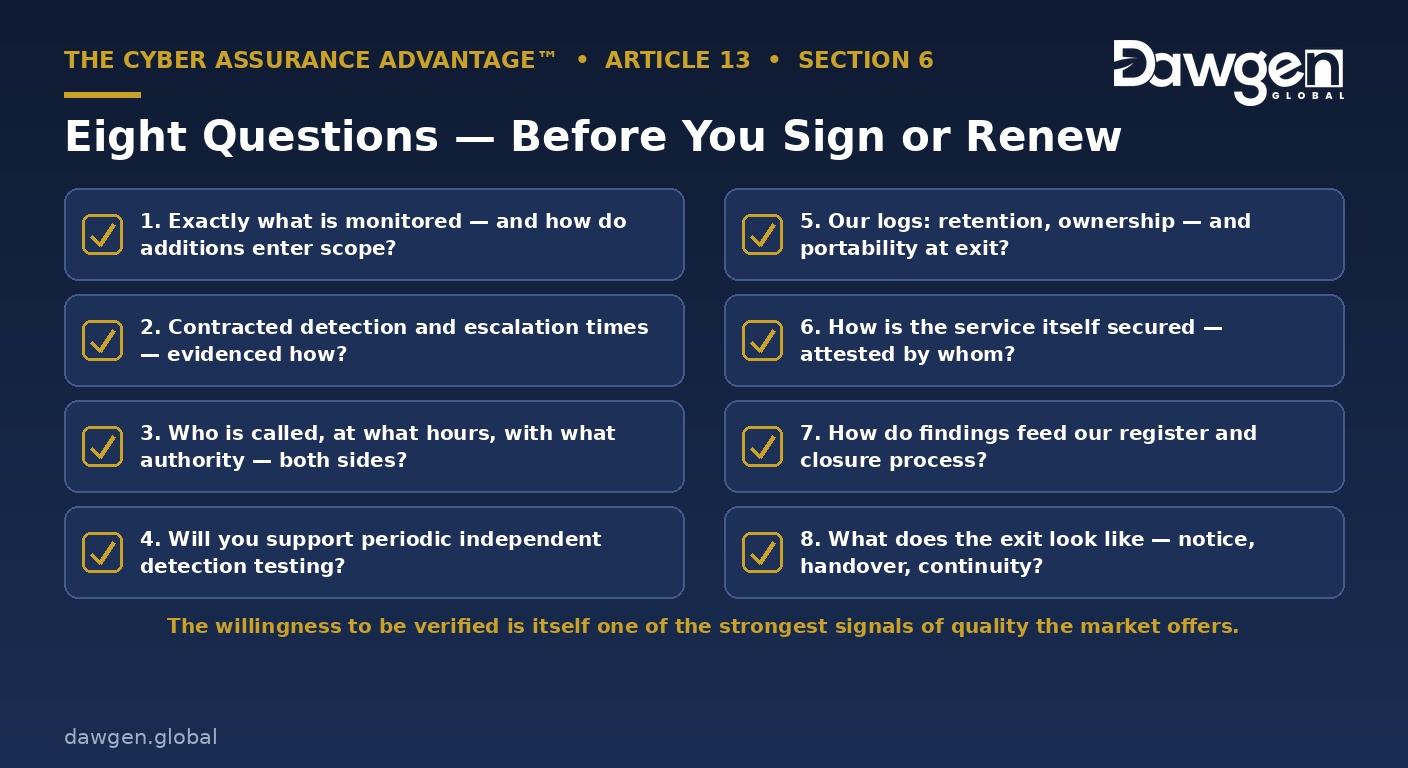
Eight Questions Before You Sign — or Renew — a Monitoring Arrangement
- Exactly which systems, networks and log sources will be monitored — and how will additions to our estate enter scope?
- What are the contracted detection and escalation times — and what evidence of performance against them will we receive?
- Who is called, at what hours, with what authority — on our side and yours — when a serious alert fires?
- Will the arrangement permit and support periodic independent detection testing — and how are its results handled?
- What happens to our logs and evidence: retention, ownership, access — and portability if we change providers?
- How is the service itself secured — and what independent attestations cover the provider’s own environment?
- How will findings from monitoring feed our findings register and closure process — rather than a separate report stream?
- What does the exit look like — notice, handover, and continuity of visibility while we transition?
A provider that answers these questions readily is a provider worth having — and the willingness to be verified is itself one of the strongest signals of quality the market offers.
The Dawgen Global Perspective
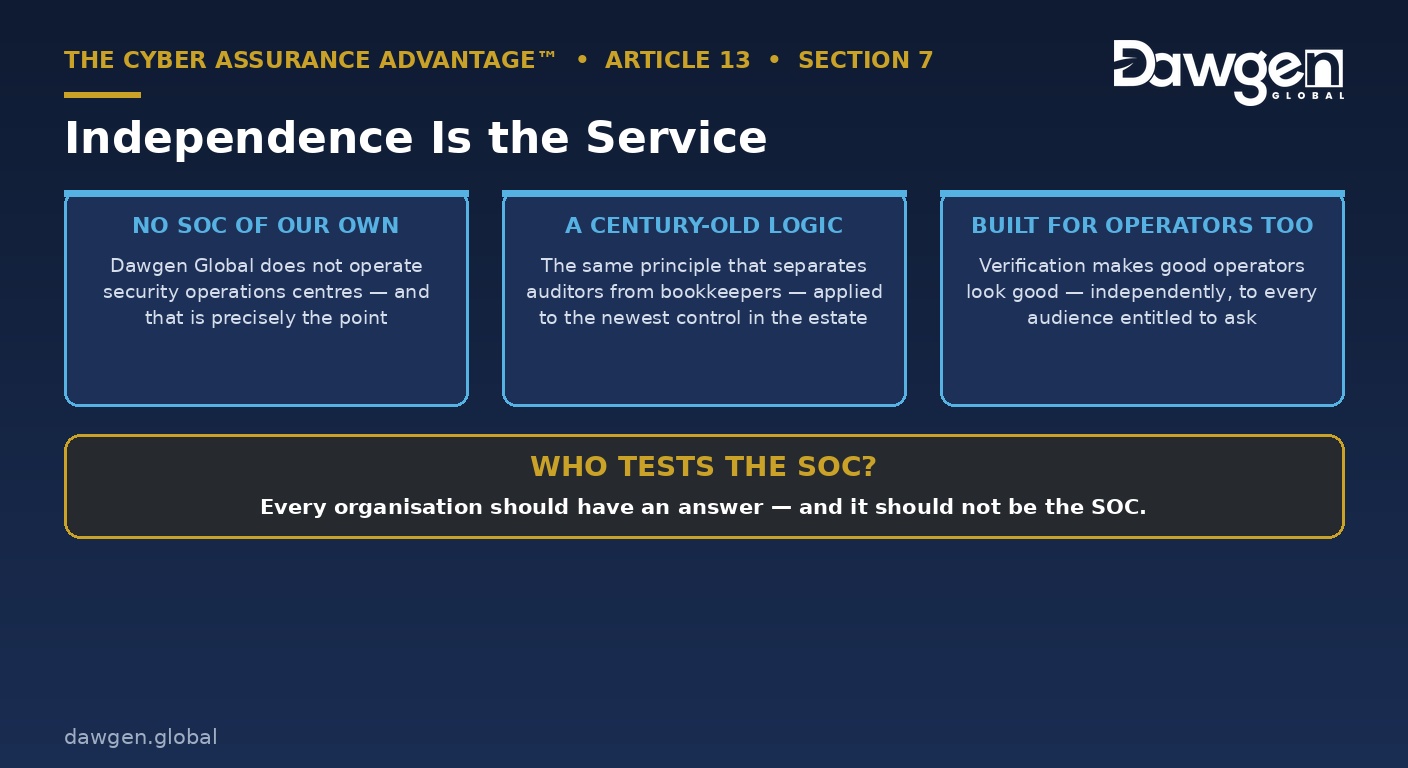
Dawgen Global’s position in the watchtower era is deliberately chosen: the firm does not operate security operations centres, and that is precisely the point. Independence is not a gap in the service line; it is the service. As monitoring capability multiplies across the region — a development this firm welcomes and has argued for since the launch series began — the scarce commodity is no longer vigilance but verified vigilance: coverage validated, detection tested, response rehearsed, evidence filed. That work can only be done credibly by a party with no stake in the monitoring contract — the same logic that has separated auditors from bookkeepers for a century, applied to the newest control in the estate.
The firm’s SOC assurance reviews are built from the disciplines this series established — the assurance map, safety-controlled technical validation, the closure engine, the standing evidence file — and they are designed to make good operators look good: independently, demonstrably, to every audience entitled to ask. In a region rightly proud of its new watchtowers, the question that protects the investment is the one this article set out to normalise: who tests the SOC? Every organisation should have an answer — and it should not be the SOC.
Frequently Asked Questions
Our provider sends detailed monthly reports. Is that not assurance?
It is valuable operational reporting — and it is management assertion by another name, produced by the party being paid for the activity it describes. Assurance requires independence from the thing being assured. Keep the reports; add periodic independent verification of coverage, detection and response, and the reports themselves become more credible.
Will asking to test the SOC insult our provider?
The good ones are flattered. Serious operators know their own reports carry limited independent weight and welcome verification that evidences their performance to your board and your regulator. A provider that resists independent testing of its effectiveness is answering a different and more important question than the one you asked.
We are too small for a SOC. Does any of this apply to us?
Yes — in proportionate form. Smaller organisations increasingly buy monitoring through managed-service bundles or telecom offerings, and the same five questions apply at smaller scale: what is covered, would it detect, does an alert reach a decision-maker, has anything drifted, and what could you show an insurer. The verification is lighter; the principle is identical.
Does this apply to an in-house SOC as much as an outsourced one?
Entirely. An internal SOC is management’s own operation — first and second line — and self-review is self-review whether the operator invoices you or reports to you. Internal audit, supported where needed by specialist testing under the co-sourced model this series described, owes the board the same independent answer about the in-house watchtower as about any external one.
Move From Cybersecurity Assumptions to Independent Cyber Assurance
Dawgen Global combines cyber governance, risk-based internal audit, penetration testing, resilience assessment and remediation validation to help Caribbean organisations determine whether their cybersecurity controls are properly designed and operating effectively. To establish what your monitoring arrangement actually covers, detects and proves — and to convert vigilance into evidence — request a confidential SOC assurance review or detection validation scoping discussion.
About Dawgen Global
Dawgen Global is an independent, integrated multidisciplinary professional services firm headquartered at 47 Trinidad Terrace, New Kingston, Jamaica, serving more than 15 territories across the Caribbean. Founded and led by Dr. Dawkins Brown, Executive Chairman, the firm is independent and not affiliated with any international network. It delivers a full suite of professional services under one roof: audit and assurance; tax advisory; IT and digital transformation; risk management; cybersecurity; actuarial and insurance regulatory advisory; HR advisory; mergers and acquisitions; corporate recovery; business advisory and strategy; accounting BPO and virtual CFO services; and legal process outsourcing.
The proposition is simple: big-firm capability without the big-firm price. Dawgen Global’s integrated approach is built for the specific complexities and opportunities of the Caribbean market, helping organizations make sharper, better-informed decisions that drive measurable progress.
To explore a partnership, reach out:
- Website: dawgen.global
- Email: [email protected]
- WhatsApp (Global): +1 555-795-9071
- Caribbean offices: +1 876-665-5926 | +1 876-929-3670 | +1 876-926-5210


