Executive Summary
Every industry has cyber risk. Financial services has something more: an industry whose entire product is trust. A distributor that loses a week of operations loses a week of revenue; a bank, credit union or insurer that loses its members’ confidence can lose the institution — because in finance, the crisis of systems and the crisis of confidence are the same event, separated by hours. That is why the arguments this series has built across seven articles land nowhere harder than in the Caribbean’s financial sector, and why the sector now finds cyber assurance expectations converging on it from four directions at once: regulators sharpening technology-risk supervision, correspondent banks embedding cyber evidence in the due diligence that keeps the region connected to global finance, insurers and reinsurers pricing to demonstrated controls, and members and customers whose digital adoption raises both the exposure and the expectation.
This article applies the series’ framework — the assurance map, the integrated audit, the mandatory internal audit baseline, technical validation and ransomware resilience — to the institutions where the stakes are highest. It examines why financial institutions carry a categorically different burden, what each of the four converging expectation streams actually demands, what an assurance programme looks like when calibrated to a bank, credit union or insurer, and the particular position of the region’s credit union movement. It closes with a practical annual assurance cycle and ten questions calibrated for financial institution boards.
Why Financial Institutions Carry a Different Burden
Three features make cyber risk categorically different inside a financial institution. The first is concentration: an FI holds, in one place, the two things attackers monetise fastest — money in motion and identity at rest. The payments pathway, the core banking platform and the member database are not systems that support the business; in an operational sense they are the business, which is why this series’ discipline of scoping assurance from loss scenarios needs so little translation here. The second is contagion: in small economies, financial institutions are systemic by default. An outage at a single institution strands payrolls, remittances and merchants across an island; a data breach at one credit union taxes confidence in the movement as a whole. The third is the confidence dynamic itself: finance is the one sector where the perception of insecurity can produce losses as real as insecurity itself — a queue outside a branch is a cyber consequence no firewall vendor mentions.
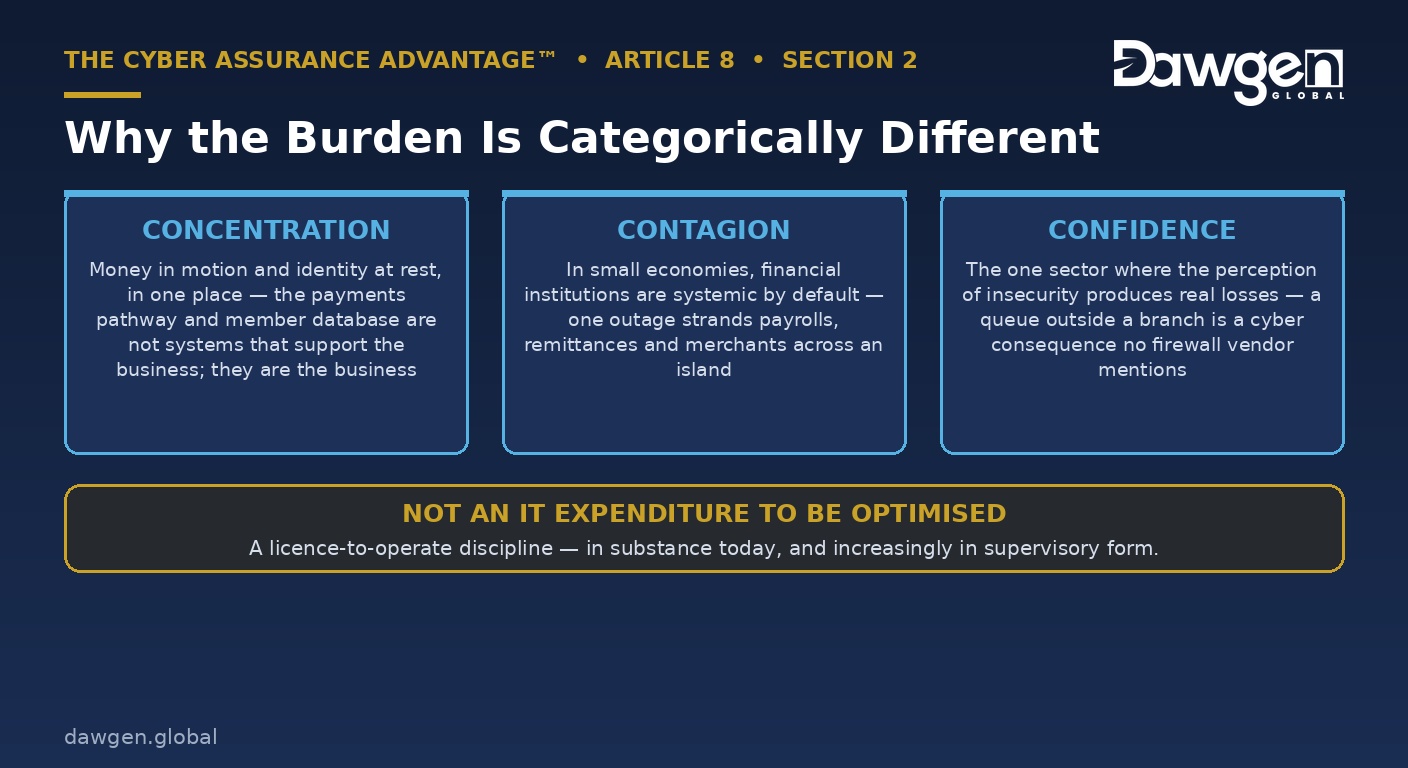
Add the region’s structural realities — heavy dependence on a small number of core-platform vendors serving many institutions, lean internal teams, and the digital channel growth this series described in its first article — and the conclusion is unavoidable: for Caribbean financial institutions, cyber assurance is not an IT expenditure to be optimised. It is a licence-to-operate discipline, in substance today and, increasingly, in supervisory form.
Four Expectation Streams, One Direction
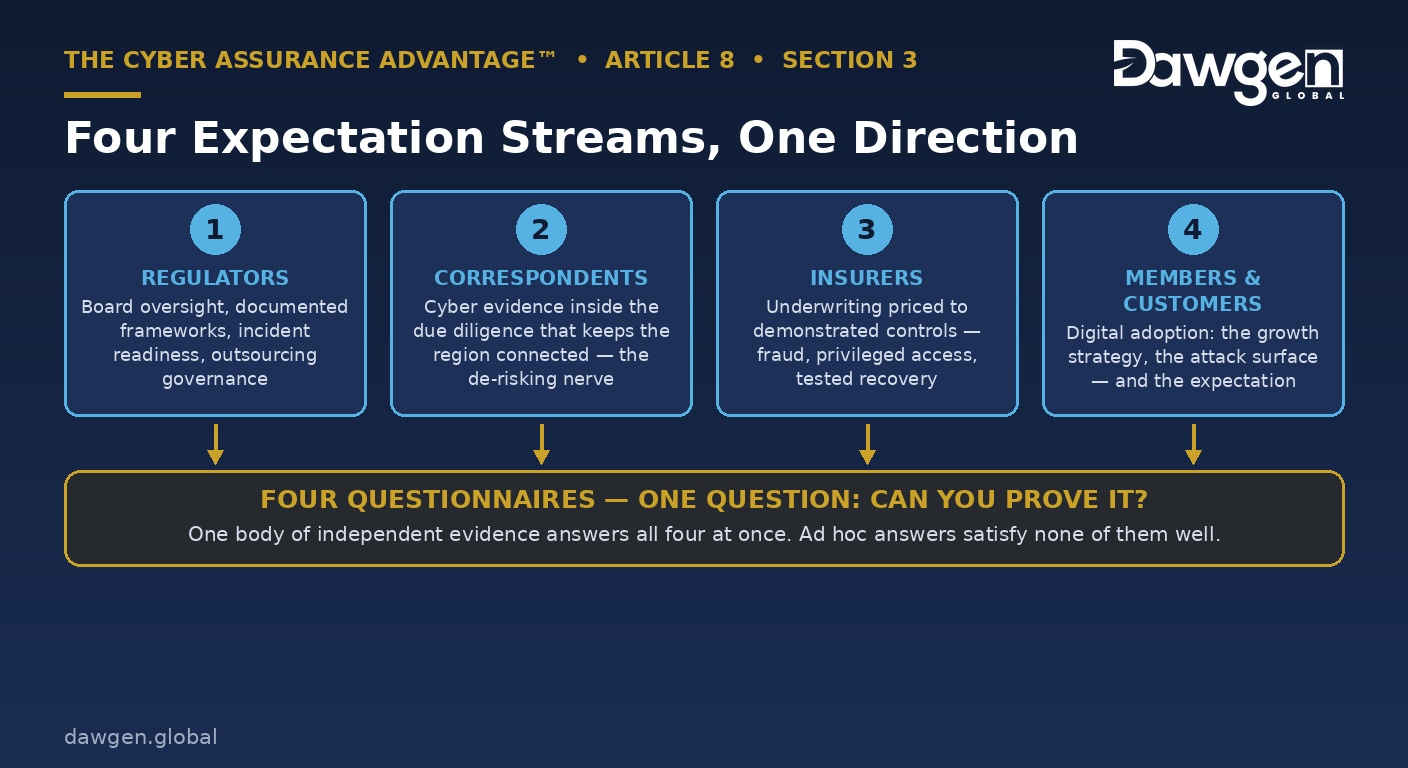
The pressure on FI boards is easiest to understand as four streams converging. Regulators come first: central banks and financial services commissions across the region are progressively sharpening expectations for technology and cyber risk management in licensed institutions — board-level oversight, documented risk frameworks, incident readiness and reporting, and outsourcing governance for the vendors on which institutions depend. The direction of supervisory travel is unmistakable even where detailed rules are still maturing, and institutions that build the evidence now will meet the formal requirements standing still.
Correspondent banks form the second stream — and the one Caribbean bankers feel most viscerally, because the region has lived the pain of de-risking. Cyber and operational-resilience questions now sit inside the due-diligence questionnaires on which correspondent relationships depend, and “we have a firewall” answers invite exactly the scrutiny no institution wants. The third stream is insurance and reinsurance: as Article 7 described, underwriters now price to demonstrated controls, and for institutions the questions are sharper still — payment-fraud controls, privileged access, tested recovery. The fourth stream is the quietest and largest: members and customers, whose adoption of digital channels is both the growth strategy and the expanding attack surface, and whose loyalty — particularly in the credit union movement — is built on a promise of safekeeping that a single breach can spend in an afternoon.
| THE CONVERGENCE
Regulator, correspondent, insurer, member: four different questionnaires, one underlying question — can this institution prove its controls work? Institutions that build one body of independent evidence answer all four at once. Institutions that answer each ad hoc answer none of them well. |
What the Assurance Map Looks Like Inside a Financial Institution
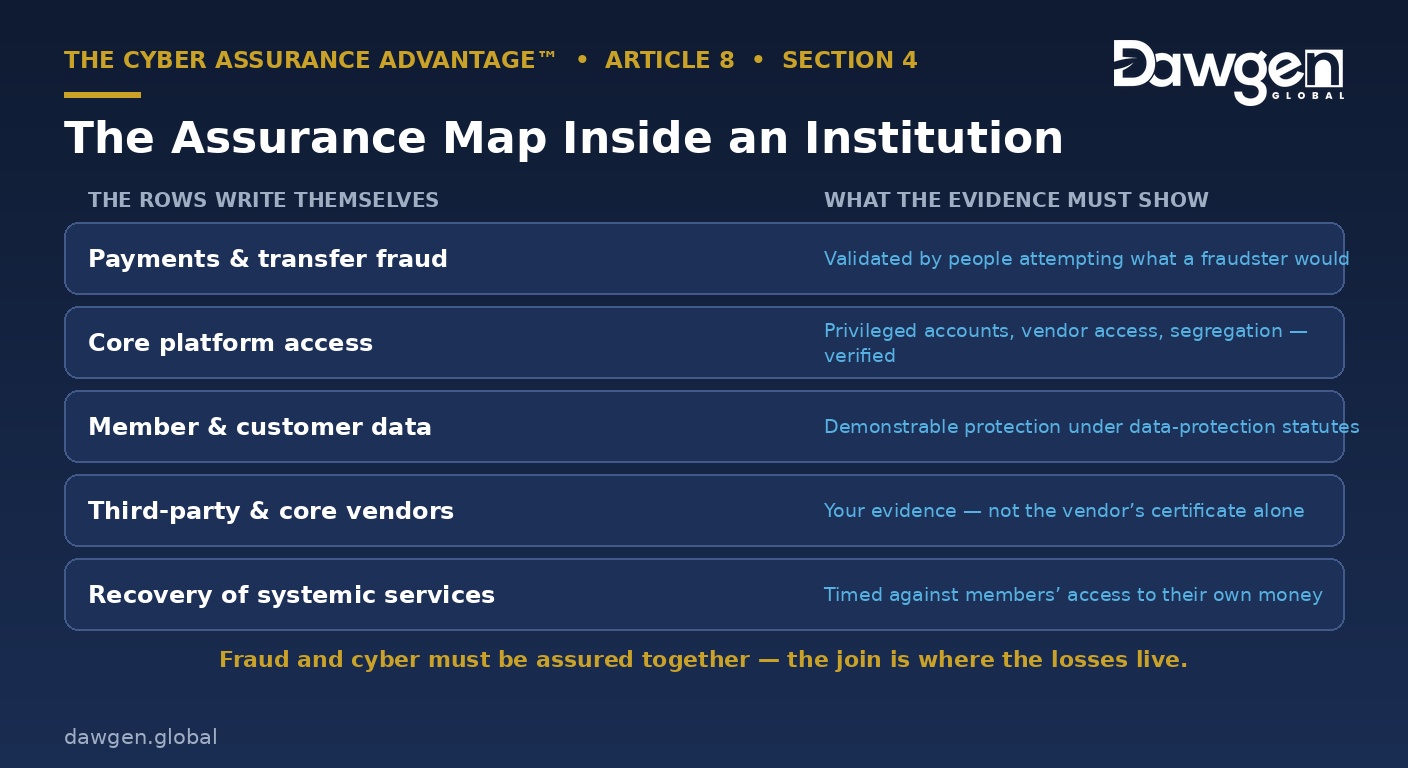
Article 2 introduced the cyber assurance map — each material risk, who assures it, at what depth, when last obtained. Inside a financial institution the rows write themselves, and their familiarity is precisely the point. Payment and transfer fraud: the controls over instruction, approval and change of payee — validated by people attempting what a fraudster would attempt, per Article 6. Core platform access: privileged accounts, vendor access and segregation on the system where every balance lives. Member and customer data: the protection and, under the region’s data-protection statutes, the demonstrable protection of the sector’s most regulated asset. Third-party and core-vendor risk: independent evidence about the platforms and processors the institution depends on — remembering, per Article 2, that a vendor’s certificate describes the vendor’s controls, not the institution’s configuration and use of them. And recovery of systemic services: the ransomware disciplines of Article 7, held to the harder standard a payments institution demands, where recovery time is measured against members’ access to their own money.
Two sector-specific disciplines complete the map. Fraud and cyber must be assured together, because the modern payments fraud is a cyber event and the modern cyber event monetises through payments — institutions that assure them in separate silos leave the join unexamined, and the join is where the losses live. And vendor concentration deserves explicit board attention: where one core-platform provider serves much of a market, an institution’s assurance map must cover not only “is the vendor sound?” but “what is our evidence, and what is our recovery position if the shared platform has a very bad day?”
The Credit Union Question: Proportionate Does Not Mean Optional
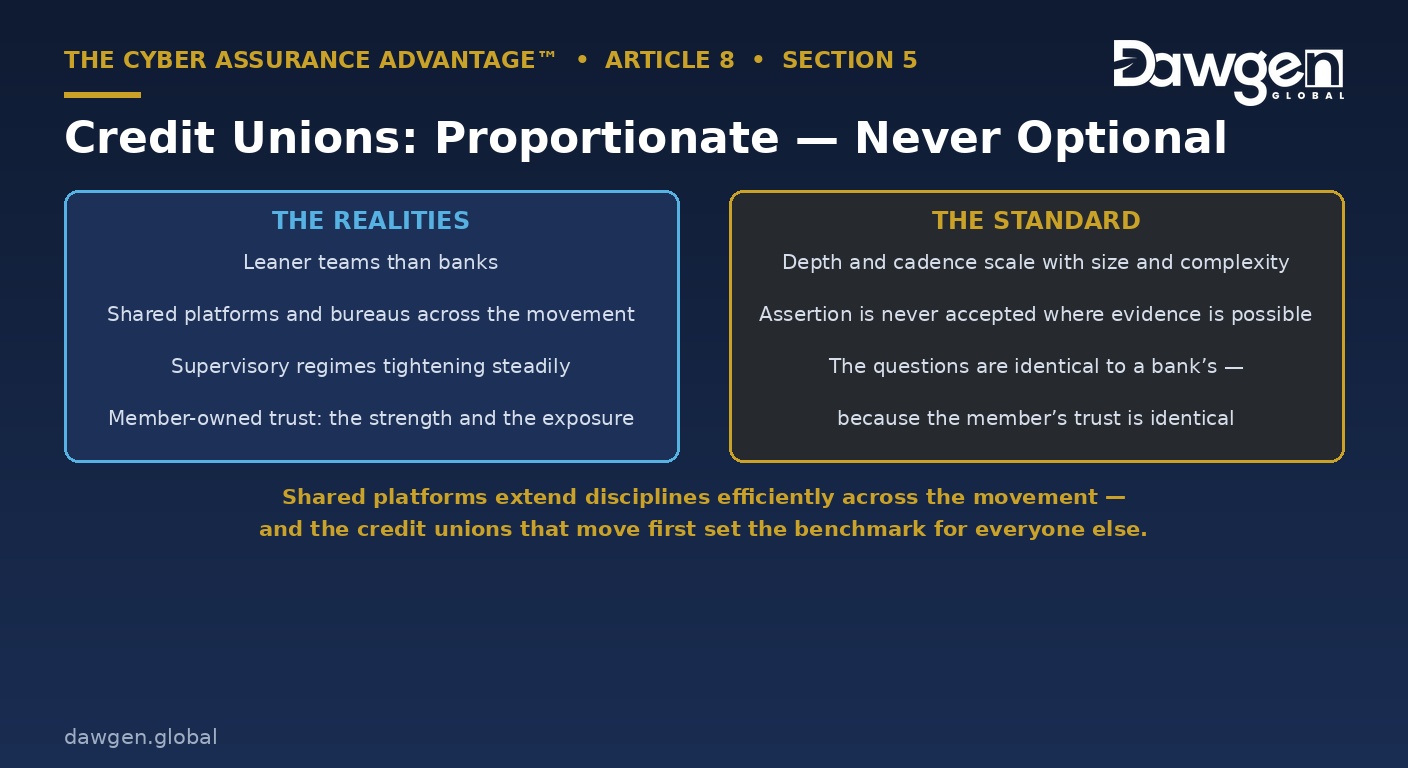
The Caribbean credit union movement holds a special place in this discussion — millions of members, deep community trust, and institutions whose member-owned character is both their strength and their exposure. Credit unions typically run leaner teams than banks, share platforms and bureaus across the movement, and answer to supervisory regimes that are tightening steadily. None of that reduces the standard; it changes how the standard is met. Proportionality in assurance means scaling the depth and cadence of independent evidence to the institution’s size and complexity — it never means accepting assertion where evidence is possible. A credit union’s diagnostic may be leaner than a bank’s; its restoration rehearsal may be simpler; but the questions of this series — can we prove the controls work? would the backups survive? has the board seen independent evidence? — are identical, because the member’s trust is identical.
The movement also holds a structural advantage worth stating: shared platforms and league structures mean that assurance disciplines, once established, can be extended across many institutions efficiently — shared tabletop exercises, common control baselines for shared systems, coordinated testing. The credit unions that move first will not only protect their own members; they will set the benchmark the rest of the movement is measured against.
Governance and Internal Audit in the Regulated Institution
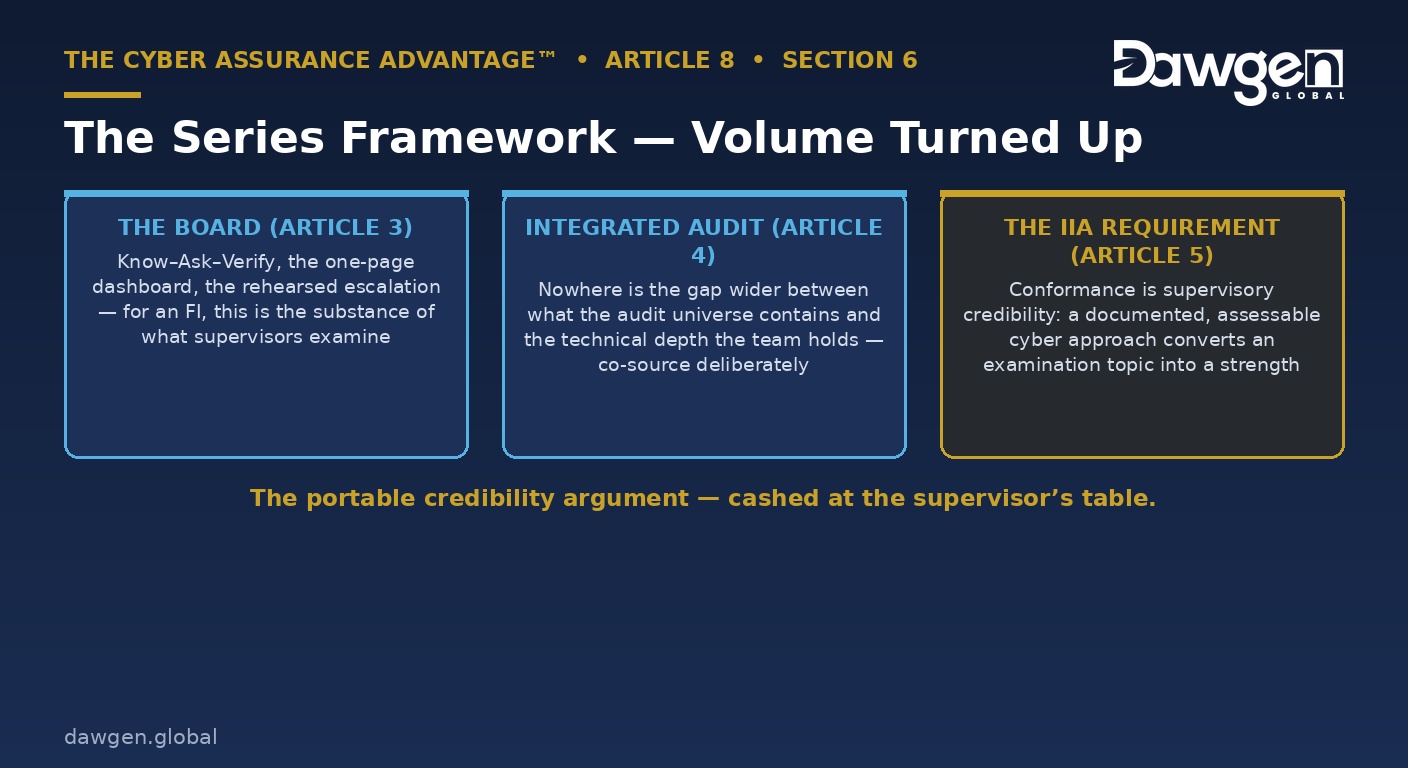
Everything this series has said about boards and internal audit applies in financial institutions with the volume turned up. The board disciplines of Article 3 — Know, Ask, Verify; the one-page dashboard; the rehearsed escalation protocol — are, for an FI board, not merely good governance but the substance of what supervisors examine when they assess board effectiveness on technology risk. The integrated audit model of Article 4 matters more here than anywhere, because FI internal audit functions face the region’s widest gap between what their audit universe contains (payments, core platforms, digital channels) and the technical depth their teams hold. And the IIA Cybersecurity Topical Requirement of Article 5 carries a sector-specific dividend: conformance is supervisory credibility. An internal audit function that can hand a regulator a documented, framework-mapped, externally assessable cyber assurance approach converts an examination topic into an examination strength — the portable credibility argument, cashed at the supervisor’s table.
The Financial Institution Assurance Cycle: One Year, One Body of Evidence
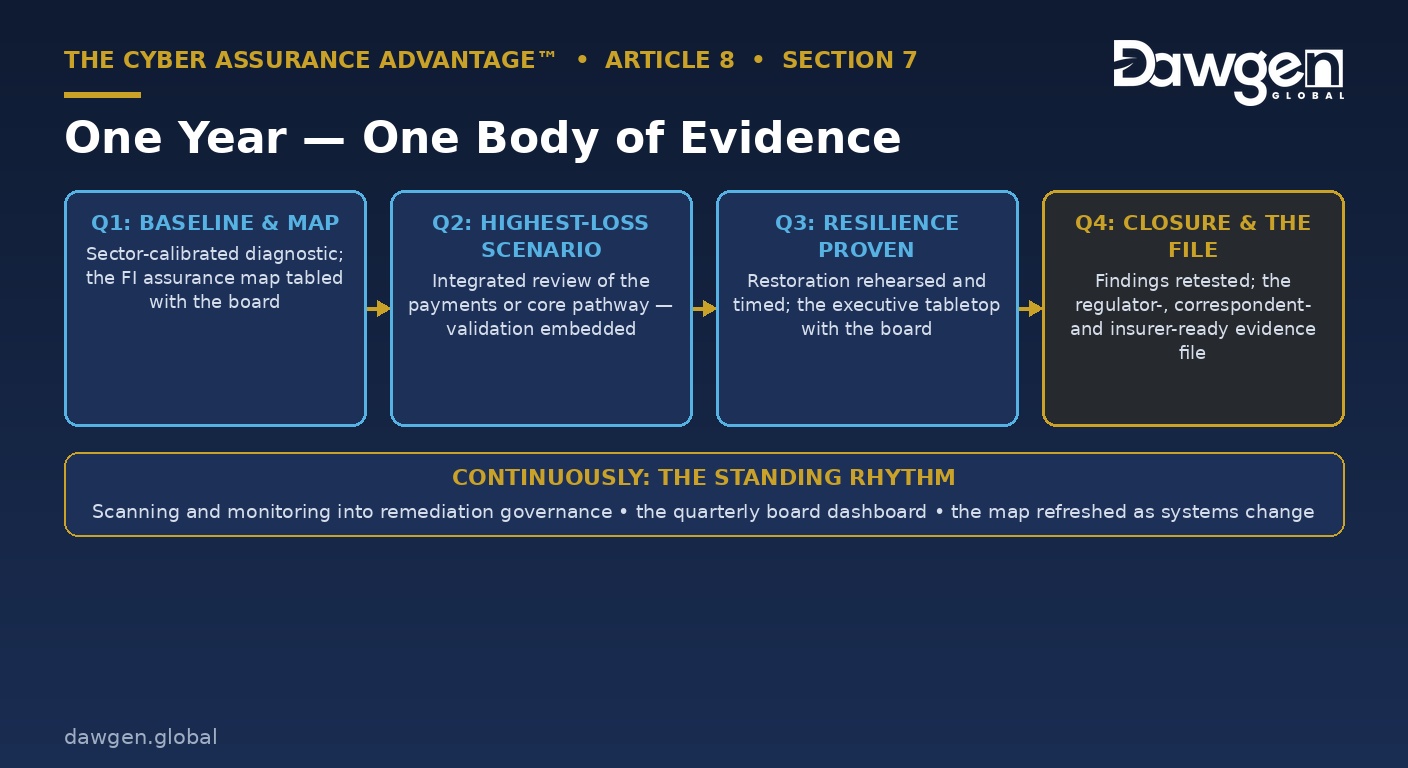
- Quarter one — baseline and map. A sector-calibrated diagnostic against NIST CSF 2.0 and the institution’s supervisory expectations; the FI assurance map built and tabled with the board.
- Quarter two — the highest-loss scenario, end to end. An integrated review of the payments or core-platform pathway: control evaluation with embedded technical validation, dual-rated findings, one report for committee and technicians.
- Quarter three — resilience proven. The ransomware disciplines assessed and exercised: restoration of core services rehearsed and timed, the executive tabletop run with the board’s participation, the ransom framework agreed.
- Quarter four — closure and the evidence file. Findings independently retested and closed; the year’s evidence assembled into one regulator-ready, correspondent-ready, insurer-ready file — the single body of proof that answers every questionnaire.
- Continuously — the standing rhythm. Scanning and monitoring feeding remediation governance; the quarterly board dashboard; the assurance map refreshed as systems, vendors and channels change.
The Dawgen Global Perspective
Dawgen Global’s conviction about this sector is simple: Caribbean financial institutions do not have an awareness problem — their boards name the risks fluently. They have an evidence problem: the gap between controls believed and controls proven, at the precise moment when four external audiences have begun demanding the proof. Closing that gap is not primarily a technology programme; it is an assurance programme — sequenced, proportionate, and producing one coherent body of independent evidence that serves the regulator, the correspondent, the insurer and the member simultaneously.
That is what the firm’s financial services cyber assurance practice delivers: sector-calibrated diagnostics and assurance maps, integrated reviews of payments and core-platform pathways, credit-union-proportionate programmes including movement-level shared exercises, Topical Requirement conformance for FI internal audit functions, and the annual evidence file that converts scattered good practice into demonstrable trust. The next article in this series widens the lens beyond finance to the sectors that keep the region’s economies moving — and shows how the same assurance disciplines calibrate to distribution, tourism, utilities and government.
Ten Questions for Financial Institution Boards
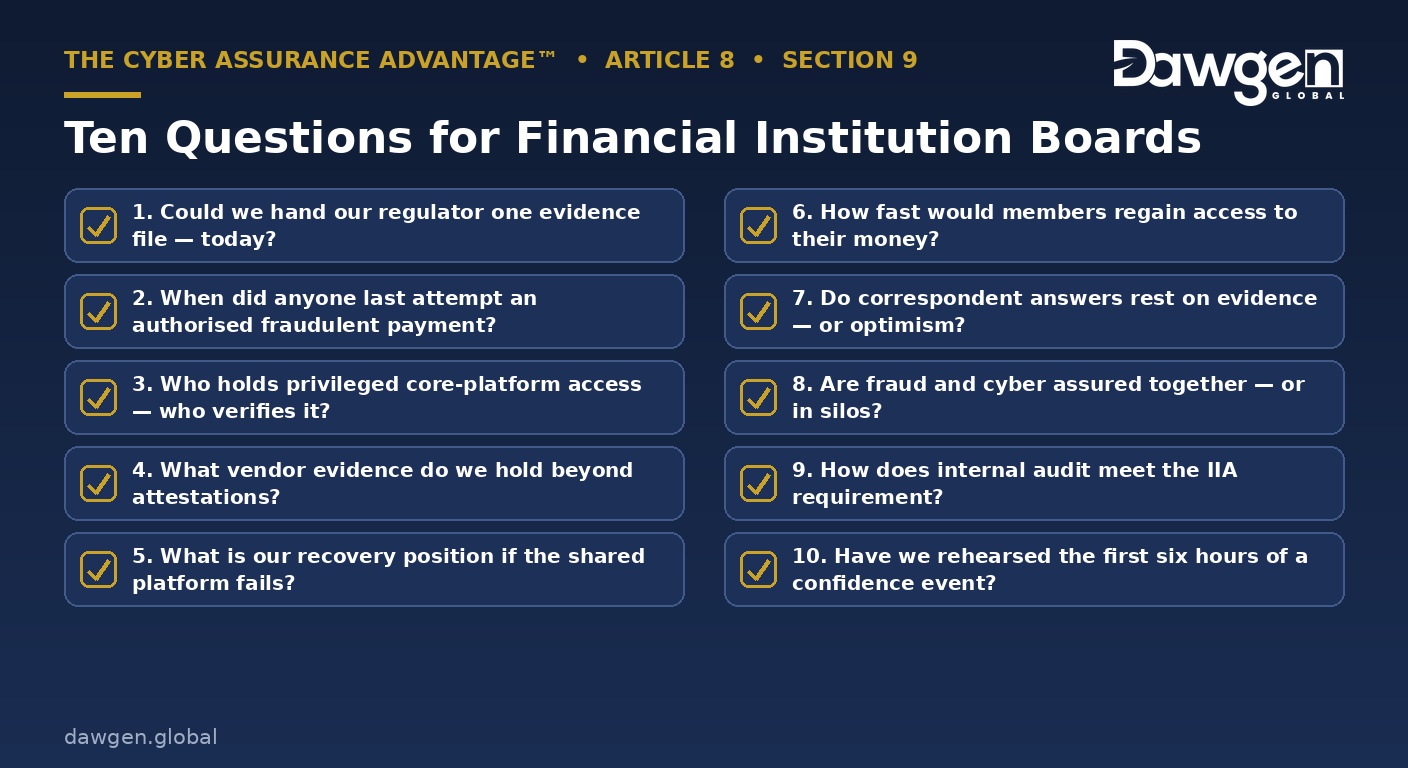
- Could we hand our regulator, today, one file of independent evidence that our cyber controls work?
- When did an independent party last attempt — with authorisation — to generate a fraudulent payment instruction?
- Who holds privileged access to the core platform, including our vendors — and who independently verifies it?
- What evidence do we hold about our core-platform vendor beyond its own attestations?
- If the shared platform failed tomorrow, what is our demonstrated recovery position?
- How quickly would members regain access to their money after a ransomware event — rehearsed, not estimated?
- Do our correspondent-bank questionnaire answers rest on independent evidence — or on optimism?
- Are fraud risk and cyber risk assured together — or in silos with the join unexamined?
- How does our internal audit function conform to the IIA Cybersecurity Topical Requirement?
- Has this board rehearsed the confidence dimension — what we say to members in the first six hours?
Frequently Asked Questions
Do Caribbean regulators actually require penetration testing?
Expectations vary by jurisdiction and are evolving, but the supervisory direction is consistent: boards are expected to demonstrate that technology risks are managed and controls are effective — and independent testing is the strongest evidence of effectiveness that exists. Institutions that wait for the rule to be spelled out will build under deadline what they could have built under strategy.
Our core banking platform is run by a vendor. Isn’t cyber largely their problem?
The vendor operates the platform; the institution owns the risk — and the regulator, the correspondent and the member all hold the institution accountable, not the vendor. Vendor assurance is one row of your map, not a substitute for it: your configurations, your access, your fraud controls, your recovery position and your evidence remain yours.
Are credit unions really held to the same bar as banks?
The depth and cadence of assurance can be proportionate to size and complexity; the principle cannot. Members’ trust, data-protection obligations and the movement’s shared-platform exposure do not scale down with headcount — and supervisory regimes for credit unions across the region are tightening in exactly this direction.
What do correspondent banks actually ask about cyber?
Due-diligence questionnaires increasingly probe governance and oversight, control frameworks, testing and its results, incident history and response readiness, and third-party risk. The pattern mirrors this series: they are asking for evidence, not assertions — and an institution with the annual evidence file described above answers from strength rather than scrambling.
Move From Cybersecurity Assumptions to Independent Cyber Assurance
Dawgen Global combines cyber governance, risk-based internal audit, penetration testing, resilience assessment and remediation validation to help Caribbean organisations determine whether their cybersecurity controls are properly designed and operating effectively. To discuss a sector-calibrated assurance programme for your bank, credit union or insurer — and the single body of evidence that answers every audience — request a confidential financial institution briefing.
About Dawgen Global
Dawgen Global is an independent, integrated multidisciplinary professional services firm headquartered at 47 Trinidad Terrace, New Kingston, Jamaica, serving more than 15 territories across the Caribbean. Founded and led by Dr. Dawkins Brown, Executive Chairman, the firm is independent and not affiliated with any international network. It delivers a full suite of professional services under one roof: audit and assurance; tax advisory; IT and digital transformation; risk management; cybersecurity; actuarial and insurance regulatory advisory; HR advisory; mergers and acquisitions; corporate recovery; business advisory and strategy; accounting BPO and virtual CFO services; and legal process outsourcing.
The proposition is simple: big-firm capability without the big-firm price. Dawgen Global’s integrated approach is built for the specific complexities and opportunities of the Caribbean market, helping organizations make sharper, better-informed decisions that drive measurable progress.
To explore a partnership, reach out:
- Website: dawgen.global
- Email: [email protected]
- WhatsApp (Global): +1 555-795-9071
- Caribbean offices: +1 876-665-5926 | +1 876-929-3670 | +1 876-926-5210


