 Executive Summary
The previous article in this series examined the sector where trust is the product. This one is for everyone else — the distributors and manufacturers whose ERP systems move goods across islands, the hotels and attractions on which whole economies balance, the utilities and telecoms whose product is availability itself, and the government bodies that hold more citizen data than any bank. In boardrooms across these sectors lives the region’s most dangerous sentence: “we’re not a bank, so we’re not really a target.” The premise is false and the conclusion is expensive. Attackers do not check licences; they check defences — and the sectors that believed themselves uninteresting have supplied a steady share of the region’s worst cyber weeks precisely because they were defended accordingly.
The good news carried by this series is that the disciplines do not change from sector to sector: the assurance map, the integrated audit, technical validation, the six ransomware disciplines, verified closure. What changes is calibration — which systems are the crown jewels, which loss scenario leads, and how fast the recovery clock runs. This article calibrates the framework to four sectors in turn, identifies the common core that stays constant across all of them, and closes with eight questions that work in any boardroom in the region, whatever the industry on the letterhead.
“We’re Not a Bank”: The Region’s Most Dangerous Sentence
The reasoning fails on three counts. First, targeting: as Article 7 explained, modern cyber crime is a volume business that prices its demands to the victim — and a mid-sized distributor with thin defences and an operational dependence on its systems is a better commercial prospect than a hardened bank. Second, value: every sector in this article holds assets attackers monetise readily — payment flows to divert, personal data to sell or extort over, and above all operations that stop, because interruption is the universal currency of extortion. Third, obligation: the expectations documented across this series — data-protection statutes, insurers pricing to controls, enterprise customers and franchise partners demanding evidence — apply across the economy, not merely inside its regulated corner.
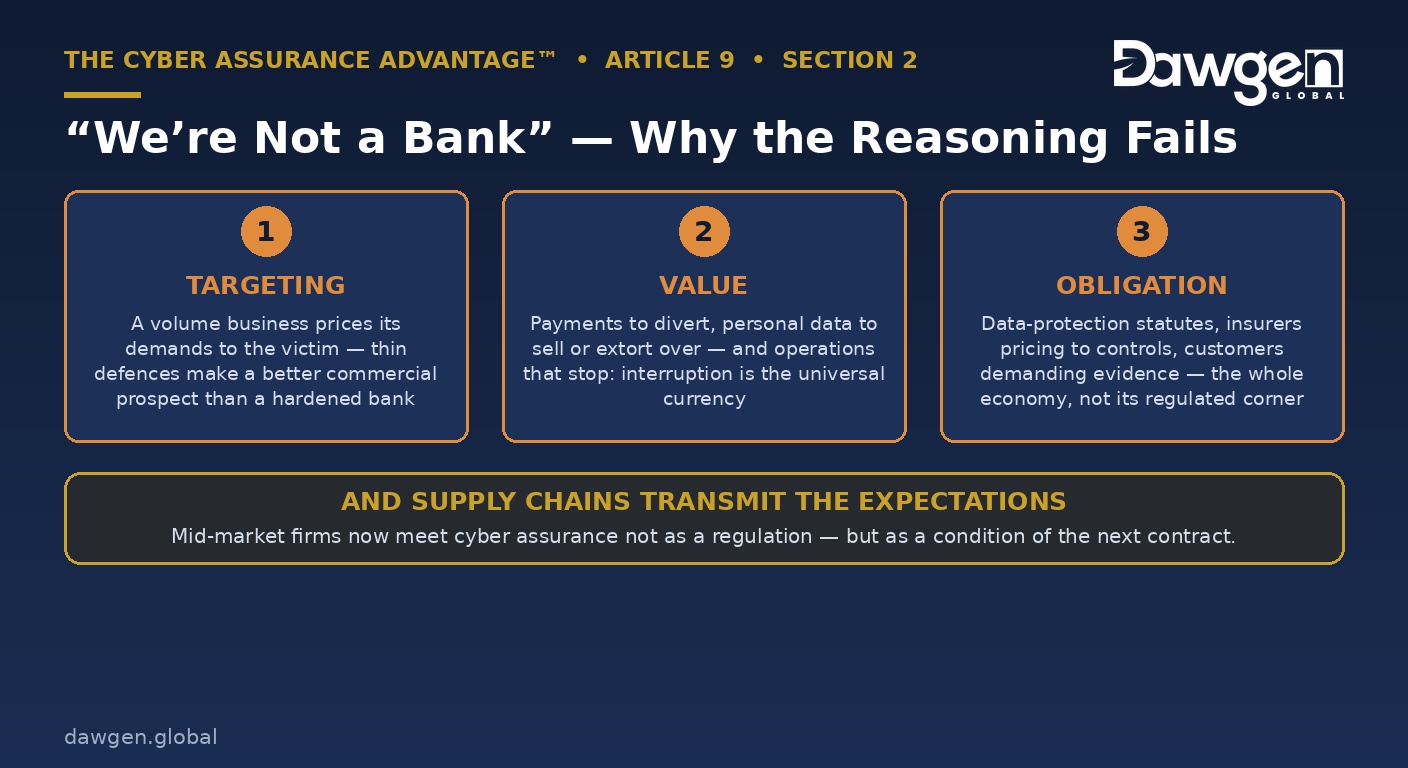
There is also a quieter mechanism carrying the expectations outward: supply chains transmit them. The enterprise customer that demands security evidence from its bank now demands it from its distributor; the international hotel brand passes its standards down to every property and platform partner; the utility’s procurement now asks bidders the questions its regulator asks it. Mid-market Caribbean firms are increasingly encountering cyber assurance not as a regulation but as a condition of the next contract — which makes the evidence file this series has described a commercial document long before it is a compliance one.
What genuinely differs by sector is not whether the framework applies but where it bites: which systems constitute the crown jewels, which loss scenario leads the assurance map, and what the tolerable recovery time actually is. That calibration is the subject of the next four sections — and readers will notice how naturally each sector’s story maps onto the disciplines this series has already built.
Distribution and Manufacturing: When the ERP Stops, the Island Feels It
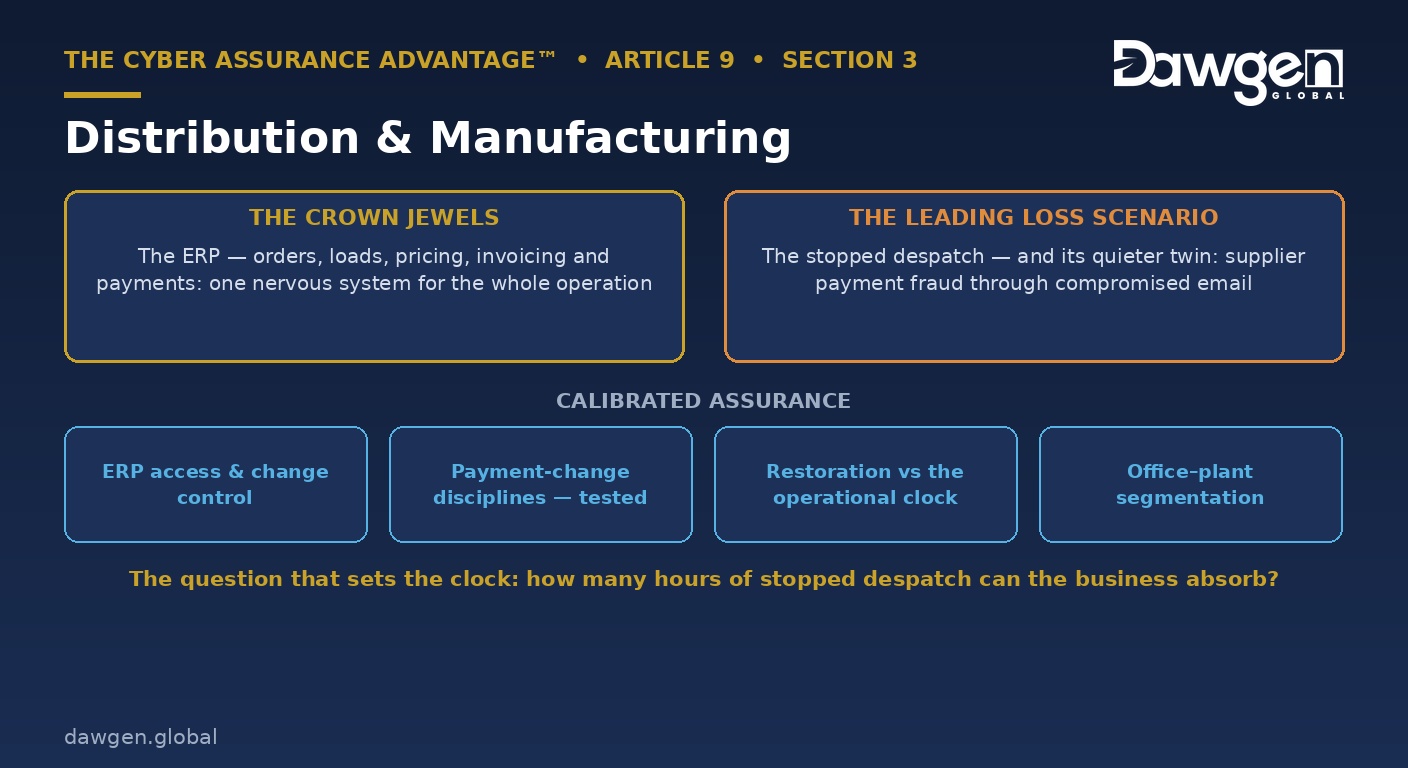
The regional distributor or manufacturer runs on one nervous system: the ERP that takes orders, schedules loads, prices, invoices and pays. The leading loss scenario is therefore the one Article 7 opened with — trucks that do not move — joined closely by its quieter twin, payment-instruction fraud through compromised supplier correspondence, because the sector’s high volume of supplier payments makes it the natural home of business email compromise. Calibrated assurance for this sector concentrates on ERP access and change control, the payment-change disciplines validated by people attempting what a fraudster would attempt, backup and restoration proven against the operational clock — how many hours of stopped despatch can the business absorb? — and, where production systems touch plant and machinery, sensible segmentation between the office network and the operational one, so that a phishing click in accounts cannot reach the production line.
Tourism and Hospitality: Guest Trust at Island Scale
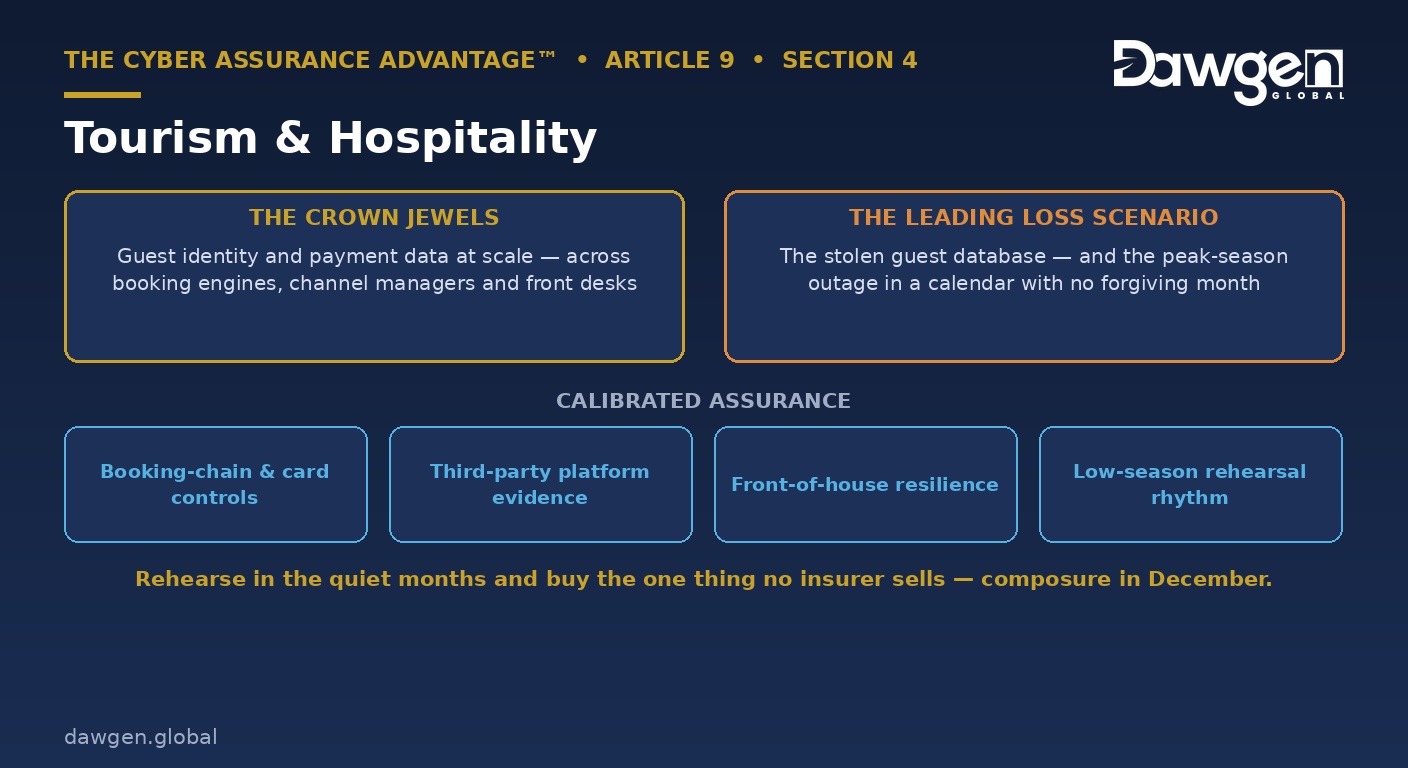
Tourism concentrates two exposures the sector rarely prices together: guest data at scale — identities, travel documents, payment cards flowing through booking engines, channel managers and front desks — and an operational calendar with no forgiving season, because the outage that is an inconvenience in a warehouse is a lobby full of arriving guests in high season. The sector’s third pressure is contractual: brand standards, franchise agreements and online travel platforms increasingly demand demonstrated security, making evidence a commercial requirement before it is a regulatory one. Calibrated assurance here leads with payment-card and guest-data controls across the whole booking chain — including the third-party platforms that touch every reservation — tested resilience of front-of-house operations, and the double-extortion readiness of Article 7, because a stolen guest database is reputational dynamite in a sector whose product is confidence in a good experience.
The sector’s calendar shapes its assurance rhythm in a way boards should make explicit: assessments, restorations and tabletop exercises belong in the low season, so that the high season opens with the disciplines proven rather than pending. A property that rehearses its front-desk continuity and booking-chain recovery in the quiet months buys itself the one thing no insurer can sell — composure in December.
Utilities and Telecoms: Where Availability Is the Product
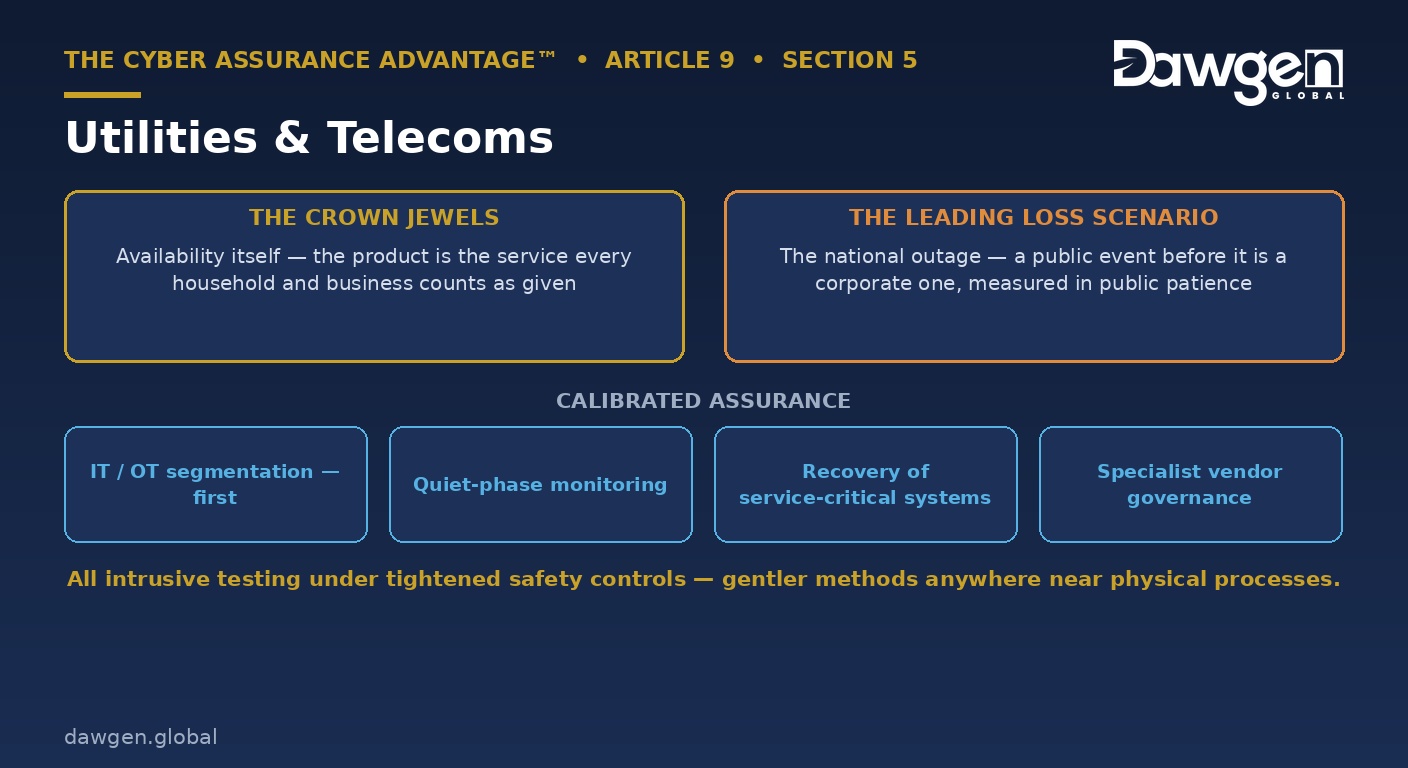
For power, water and telecommunications providers, the confidence dynamic that Article 8 described for banks applies with a physical edge: the product is availability, the customer is everyone, and an extended outage is a national event before it is a corporate one. These organisations also live the region’s clearest version of a distinction this series has treated carefully — the boundary between the corporate IT environment and the operational technology that actually runs the service. Calibrated assurance for this sector puts segmentation between those worlds at the top of the map, alongside monitoring capable of noticing an intruder before the quiet phase ends, recovery of service-critical systems rehearsed against a clock measured in public patience, and disciplined governance of the specialist vendors who maintain operational systems — with all intrusive testing scoped under the safety controls of Articles 4 and 6, tightened further where physical processes are anywhere near the work.
Government and the Public Sector: The Largest Data Holder of All
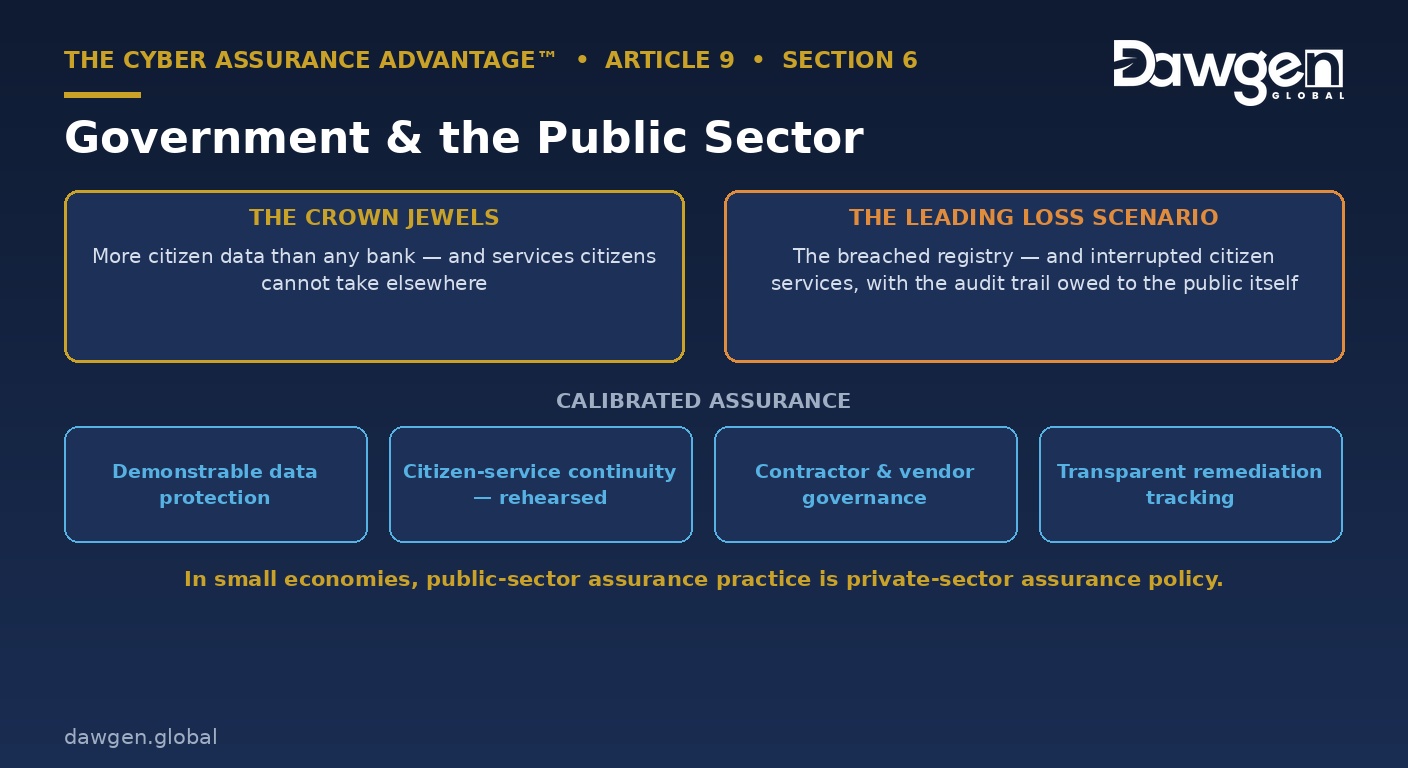
No institution in any Caribbean territory holds more personal data than the state — tax records, health records, identity registries, benefits histories — and none carries a heavier duty of continuity, because citizens cannot take their custom elsewhere. The digital-government momentum this series noted in its first article multiplies both the service and the surface, while procurement cycles and legacy systems make remediation slower than anywhere in the private sector — which raises, rather than lowers, the value of knowing precisely where the exposures are. Calibrated assurance for public bodies leads with demonstrable data protection — the region’s statutes bind the state as they bind the private sector — continuity of citizen-facing services rehearsed like the essential services they are, vendor governance across the contractors who build and run digital government, and transparent remediation tracking, because in the public sector the audit trail is not merely good practice; it is accountability to the public itself.
Public bodies also carry a leadership opportunity the private sector lacks: the state sets the tone. Ministries and agencies that adopt the disciplines of this series — published resilience standards for their vendors, rehearsed continuity for citizen services, transparent remediation reporting — do more than protect their own operations; they normalise the expectation across every contractor and, ultimately, every boardroom that sells to the government. In small economies, public-sector assurance practice is private-sector assurance policy.
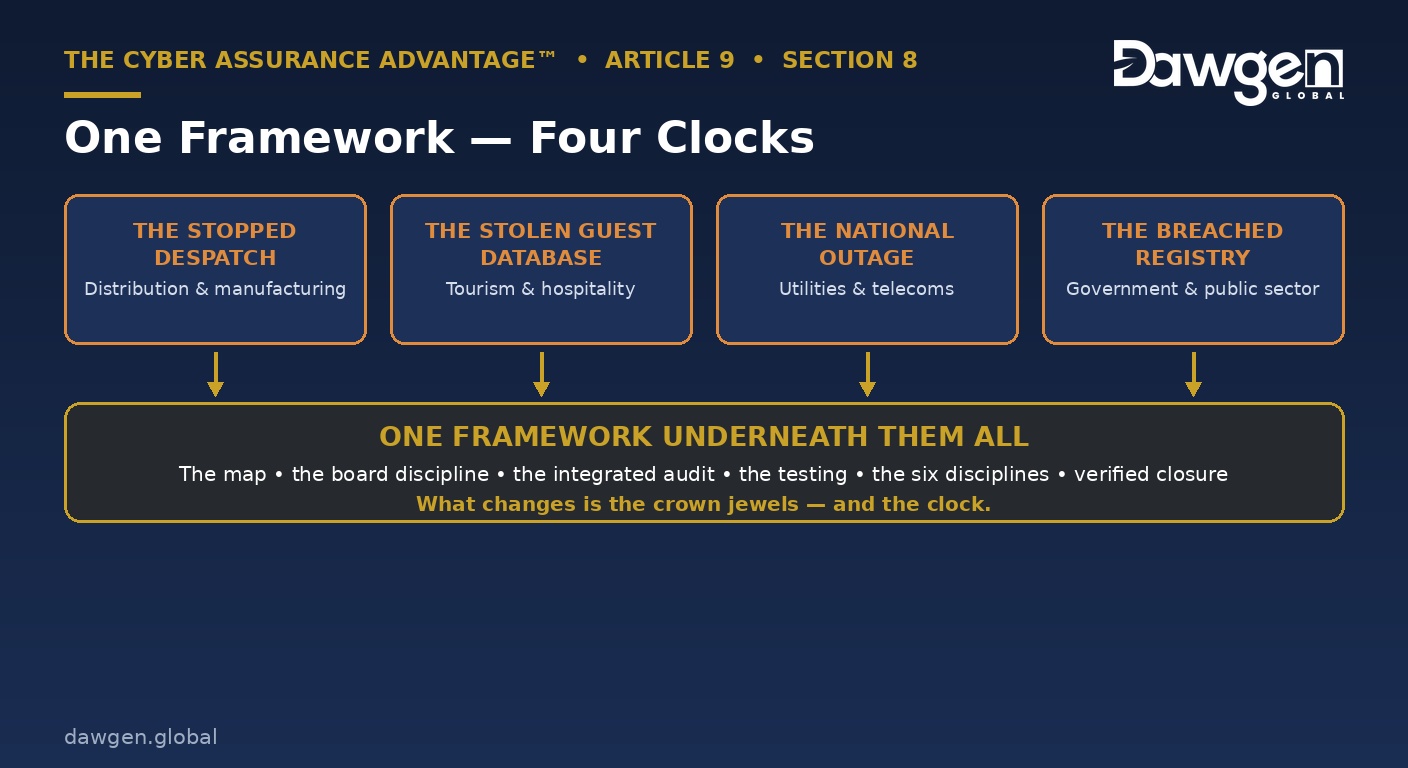
| THE CALIBRATION PRINCIPLE
Four sectors, four leading loss scenarios: the stopped despatch, the stolen guest database, the national outage, the breached registry. One framework underneath all of them — what changes is the crown jewels and the clock. |
The Common Core: What Stays the Same in Every Sector
Strip away the calibration and the constant machinery of this series remains, unchanged from the bank to the bottling plant. Every organisation needs the assurance map of Article 2 — its material risks listed against the independent evidence held for each, with the blank spaces setting the agenda. Every board owes its organisation the Know–Ask–Verify discipline of Article 3, whatever is on the letterhead. Every audit or assurance arrangement gains from the integrated model of Article 4 and, where an internal audit function exists, owes conformance to the standard of Article 5. Every sector needs Article 6’s honesty about what its testing reports actually are, and Article 7’s six disciplines against the loss scenario that attackers price for everyone: interruption. And every finding, in every industry, is worth nothing until it is closed and the closure independently verified — the discipline to which this series turns next.
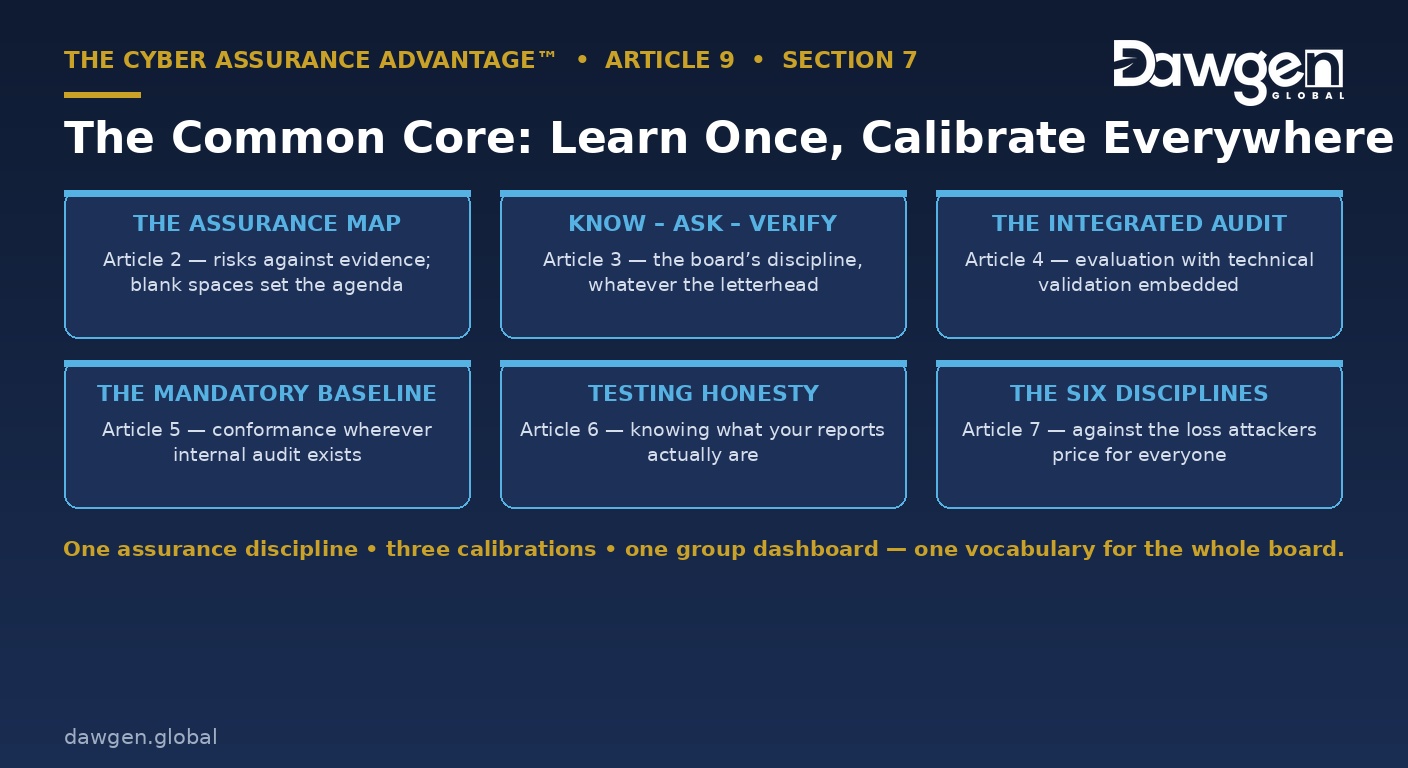
This constancy is the practical comfort for resource-constrained organisations: the framework is learn-once, calibrate-everywhere. A conglomerate spanning distribution, hospitality and financial services — a familiar Caribbean corporate shape — does not need three cyber philosophies; it needs one assurance discipline and three calibrations, which is also why group boards can govern the whole with a single dashboard and a single vocabulary.
The Dawgen Global Perspective
Dawgen Global built its cyber assurance practice deliberately for this breadth, because the Caribbean’s corporate reality is diversified groups, interconnected supply chains and economies where a single sector’s bad week is everyone’s bad week. One methodology — the integrated model this series has described — calibrated by sector specialists who understand what a stopped despatch, an emptied lobby, a dark feeder or a breached registry actually means, delivers assurance that travels across a group and scales across an economy. The firm’s multidisciplinary character is the quiet advantage here: the same organisation that audits the financial statements, advises on the ERP and supports the tax function can scope cyber assurance from a genuine understanding of where the business would bleed.
The next article in this series addresses the discipline every sector shares and most organisations shortchange — what happens after the report: why findings die in trackers, why “remediated” so often is not, and how verified closure turns assurance from an annual document into a permanent condition.
Eight Questions for Any Board, Any Sector
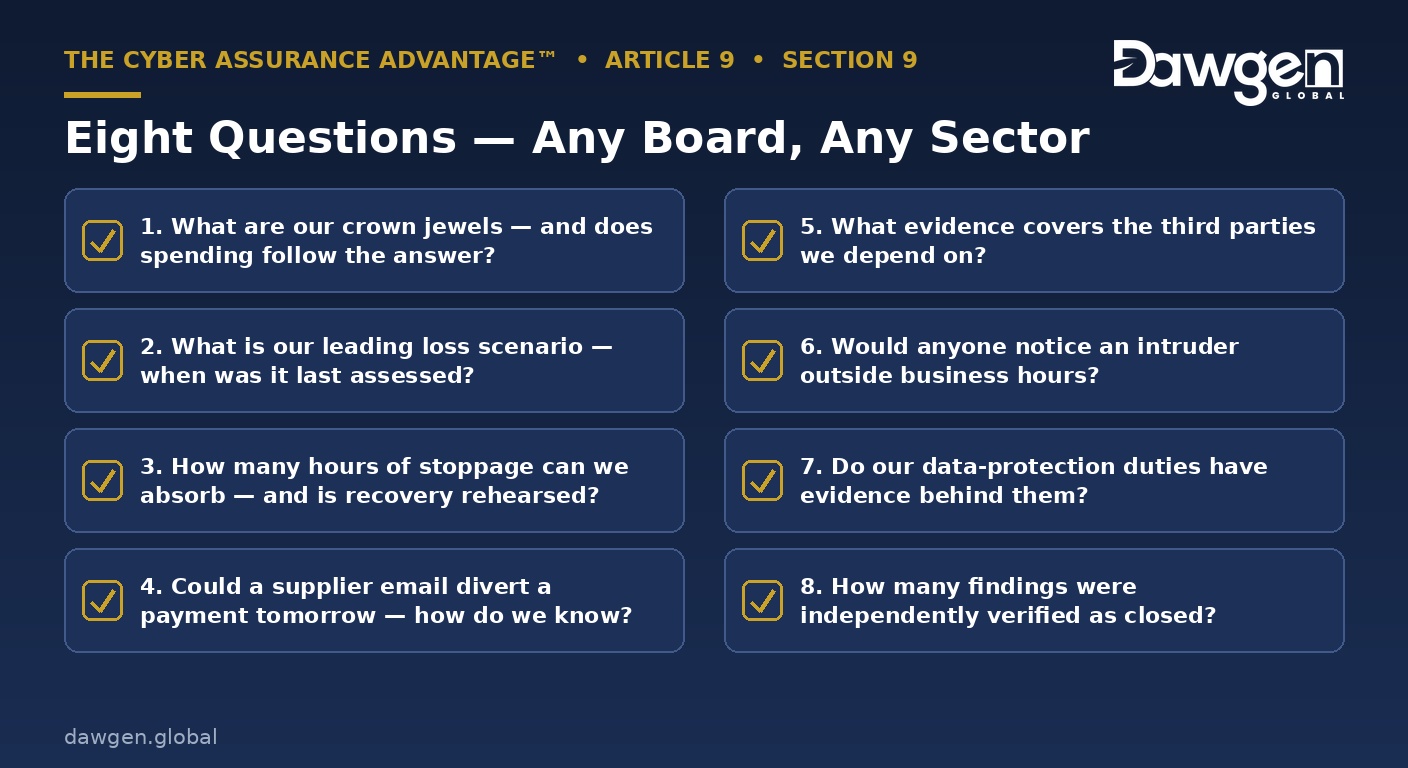
- What are our crown jewels — the systems and data whose loss would genuinely hurt — and does our protection spending actually follow that answer?
- What is our leading loss scenario — and when was it last independently assessed, end to end?
- How many hours of full operational stoppage can this business absorb — and has recovery been rehearsed against that number?
- Could a compromised supplier email divert a payment tomorrow — and how do we know?
- What independent evidence do we hold about the third parties our operations depend on?
- Would anyone notice an intruder in our systems during the quiet phase — including outside business hours?
- Do the data-protection obligations we carry have evidence behind them — or assumptions?
- Of the findings from our last assessment, how many have been independently verified as closed?
Frequently Asked Questions
We are a mid-sized distributor. Where should we realistically start?
With the diagnostic and the map: a fixed-scope assessment against your two leading loss scenarios — operational stoppage and payment fraud — which typically surfaces a short list of high-value fixes, and a restoration rehearsal of the ERP, because nothing changes a distributor’s real position faster than a proven recovery time. Everything else sequences from what those two exercises reveal.
Is security for operational technology really different from ordinary IT security?
Different enough to respect: operational systems prize availability and safety above all, often run long-lived specialist equipment, and demand gentler assessment methods and stricter safety controls. The governing disciplines — segmentation, monitoring, recovery, vendor governance — are the same family this series has described; their application requires specialists who know the territory.
Our agency falls under national cyber arrangements. Do we still need our own assurance?
Yes. National incident-response capability is a vital safety net, not a substitute for institutional assurance — it answers the question “who helps when it happens?”, not “are our controls effective and our data protected?”. Accountability for the second question remains with each body’s own leadership, and the statutes make that explicit.
Our hotel meets brand and payment-card standards. Is that not sufficient?
Those standards are genuine and necessary — and they are the compliance floor Article 2 described, scoped to cards and brand risk rather than to your whole business. The booking chain beyond the card data, the operational resilience of the property, and the double-extortion scenario all sit outside that floor. Meet the standards; then assure the business.
Move From Cybersecurity Assumptions to Independent Cyber Assurance
Dawgen Global combines cyber governance, risk-based internal audit, penetration testing, resilience assessment and remediation validation to help Caribbean organisations determine whether their cybersecurity controls are properly designed and operating effectively. To see the framework calibrated to your sector — distribution, tourism, utilities, public sector or the group that spans them — request a confidential sector-calibrated diagnostic.
About Dawgen Global
Dawgen Global is an independent, integrated multidisciplinary professional services firm headquartered at 47 Trinidad Terrace, New Kingston, Jamaica, serving more than 15 territories across the Caribbean. Founded and led by Dr. Dawkins Brown, Executive Chairman, the firm is independent and not affiliated with any international network. It delivers a full suite of professional services under one roof: audit and assurance; tax advisory; IT and digital transformation; risk management; cybersecurity; actuarial and insurance regulatory advisory; HR advisory; mergers and acquisitions; corporate recovery; business advisory and strategy; accounting BPO and virtual CFO services; and legal process outsourcing.
The proposition is simple: big-firm capability without the big-firm price. Dawgen Global’s integrated approach is built for the specific complexities and opportunities of the Caribbean market, helping organizations make sharper, better-informed decisions that drive measurable progress.
To explore a partnership, reach out:
- Website: dawgen.global
- Email: [email protected]
- WhatsApp (Global): +1 555-795-9071
- Caribbean offices: +1 876-665-5926 | +1 876-929-3670 | +1 876-926-5210


