Two Caribbean public services, a thousand miles apart, with no shared pay policy and no common consultant, have built the same salary band. Not a similar one. Thirteen incremental points, a step of two and a half per cent, and a spread of 1.3449 — identical to five decimal places. A third jurisdiction, Barbados, has done something quite different, and the difference decides what an officer earns twelve years from now.
What a pay structure actually is
Most discussion of public sector pay concerns levels: whether a nurse is paid enough, whether a permanent secretary is paid too much. Almost none concerns structure — the architecture within which those levels sit. Yet structure determines a great deal that levels alone cannot explain: how long someone can stay in a job before their pay stops moving, whether experience is rewarded without promotion, whether the gap between a supervisor and the person they supervise widens or narrows over time, and what the whole thing will cost the treasury in a decade.
A pay structure has four components. There are grades, sometimes called pay bands, into which posts of comparable weight are placed. Each grade contains a scale running from a minimum to a maximum. That scale is divided into incremental points, along which an officer normally advances one step a year. And there is a method by which each step is calculated.
That last component is the least discussed and the most consequential, and it is where the three jurisdictions in this article part company.
| THE TWO METHODS
A GEOMETRIC scale increases each point by a fixed percentage of the point before it. Every officer receives the same proportional rise regardless of where they sit. An ARITHMETIC scale increases each point by a fixed cash amount. Every officer receives the same dollar rise — which is proportionally larger at the bottom of the band and smaller at the top. Neither method is wrong. They produce measurably different careers. |
Jamaica: one increment, three ladders
Jamaica restructured public sector compensation with effect from 2022. The system it replaced carried approximately 325 separate salary scales and roughly 185 allowances, a structure the government itself described as unmanageable and lacking transparency. The core civil service now runs sixteen pay bands.
Every one of those sixteen bands contains thirteen incremental points. The maximum of each band is 1.3449 times its minimum. That ratio is constant from Pay Band 1, which covers the weekly-paid manual grades at the base of the service, through to Pay Band 16, occupied by the Financial Secretary, the Cabinet Secretary and the Auditor General. Thirteen points means twelve steps, and 1.025 raised to the twelfth power is 1.34489. The band spread is not a policy choice made separately from the increment. It follows arithmetically from two decisions: use a 2.5 per cent step, and use thirteen points.
What makes Jamaica interesting is that it did not stop there. The health families — the professional, technician and support categories covering registered nurses, allied health staff, environmental health officers and others — do not sit on the core pay bands at all. They run on a separate ladder of their own. So do the disciplined services. And both of those ladders are built from the same 2.5 per cent step. They simply use a different number of points.
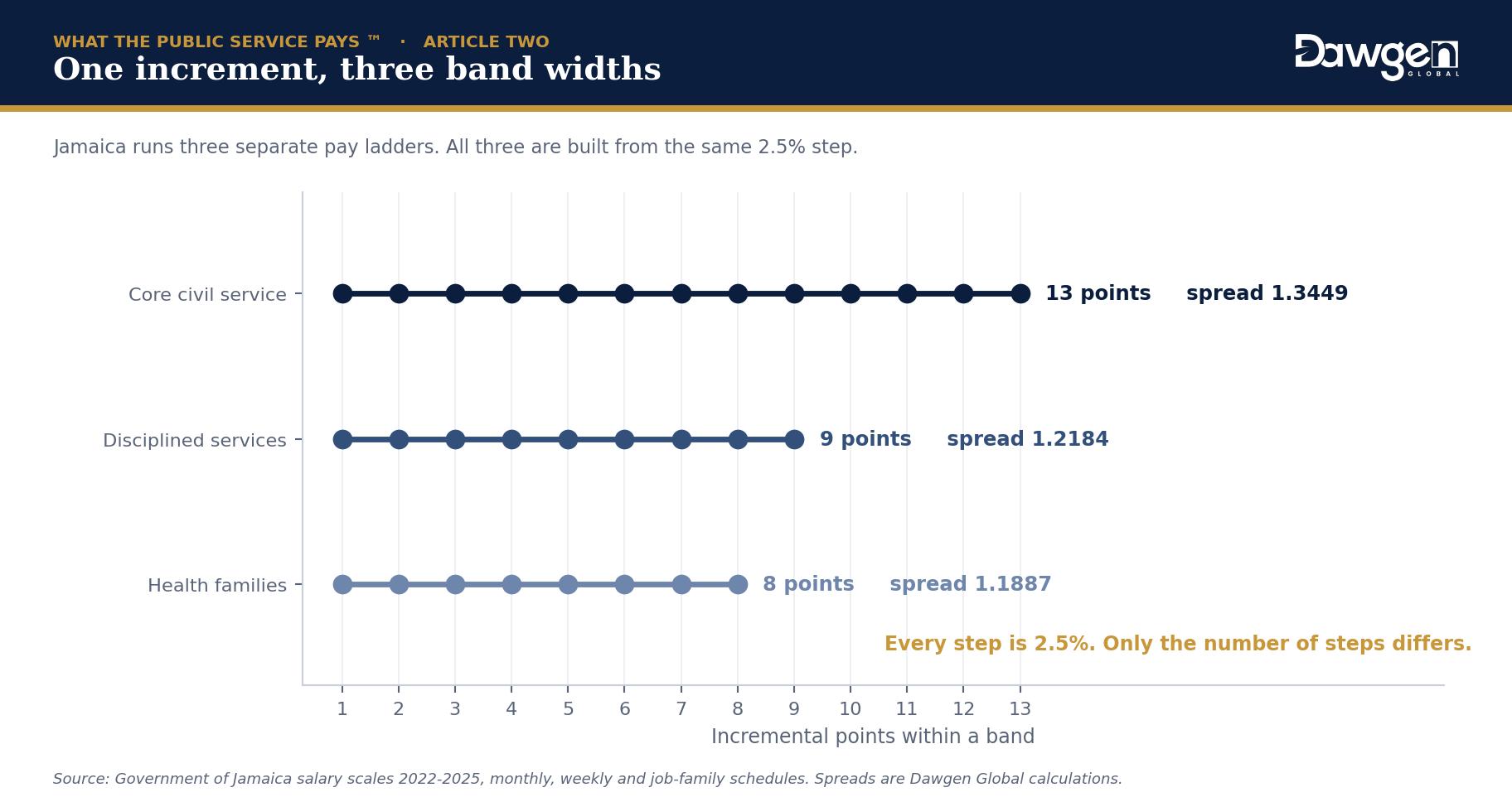
Exhibit 1. Three separate pay ladders within one public service, all built from a single increment.
The health ladder uses eight points, giving a spread of 1.1887 — which is 1.025 to the seventh power. The disciplined services use nine points, giving 1.2184, which is 1.025 to the eighth. A public service that once carried 325 scales now runs on one increment expressed at three widths.
This regularity has a practical consequence that is easy to miss. Because every band in the core service shares the same spread, a promotion from one band to the next always represents the same proportional step forward, wherever it occurs in the structure. In a system where band widths vary arbitrarily, promotion is worth more in some parts of the organisation than others, for no reason anyone designed.
Cayman: the same ladder, cut shorter at the top
The Cayman Islands Government operates a structure that looks quite different on first inspection. It has eighteen grades, lettered A through R. Posts are allocated to them not by job title but by job evaluation points — Grade A covers roles evaluated at between 1,366 and 1,502 points, Grade Q covers those at 114 points or fewer. There is no obvious institutional connection to Jamaica, no shared consultant of record, and no channel through which one design would have influenced the other.
Measure the grades and they are the same object. Grades F through R — thirteen of the eighteen — each contain thirteen incremental points with a spread of 1.3449.
The five senior grades are shorter, and this is where the design becomes genuinely elegant. Grade E has twelve points and a spread of 1.3120, which is 1.025 to the eleventh. Grade D has eight points and 1.1888, which is 1.025 to the seventh. Grade C has seven points, Grade B six, Grade A five. Each is a truncation of the identical 2.5 per cent ladder, simply cut shorter.
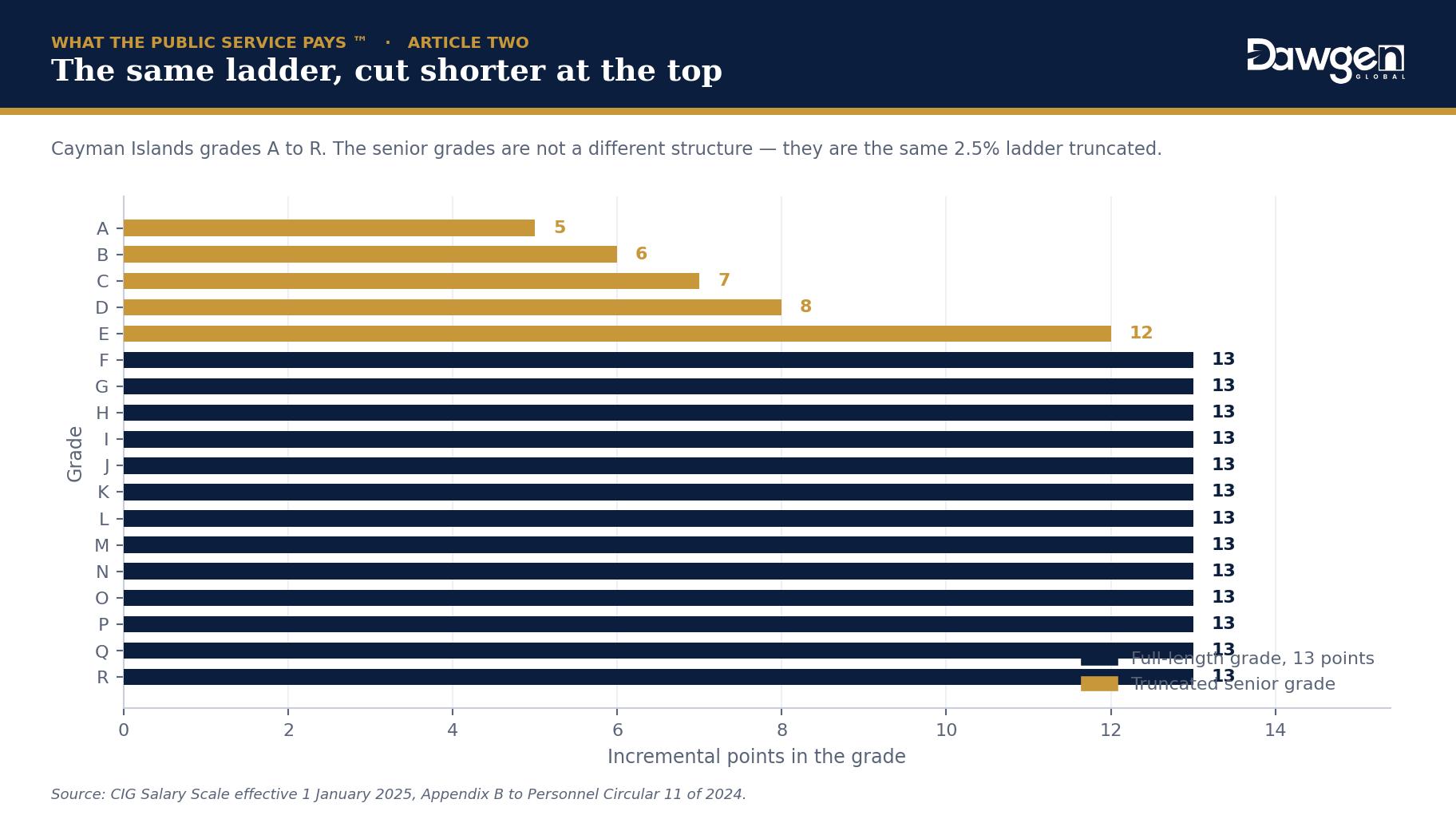
Exhibit 2. Cayman’s eighteen grades. The senior grades are not a separate structure but the same ladder shortened.
There is a design logic to shortening senior bands. A junior officer may reasonably spend twelve years growing within a grade. A chief officer is unlikely to, and a long scale at that level commits the employer to substantial automatic cost growth for people who are already at the top of the organisation. Truncating the senior grades caps that exposure while leaving the junior structure intact.
| A DETAIL THAT CHANGES THE NUMBERS
From December 2022 the Cayman scale carries a Point 1 restriction: the bottom point of Grades E through R is closed to new entrants, and for Grade Q the closure extends through Point 6. The published minimum is therefore not the entry rate for fifteen of eighteen grades. Anyone reading the scale as printed — including any benchmarking exercise that takes the first column as the band floor — will understate entry pay across most of that service. |
Barbados went the other way
Convergence is not a Caribbean norm, and Barbados demonstrates that plainly.
A Barbados public service vacancy circular published in August 2023 sets out the scale attaching to a post in the following terms: $47,361.26 by $1,253.03 to $48,614.29, then by $1,604.99 to $59,849.21 per annum. That notation — a starting figure, a step size, a point at which the step changes, and a maximum — is the traditional Westminster form, and it describes an arithmetic scale.
The increments are cash amounts, not percentages. Nine points, a spread of 1.2637. But the proportional value of each step falls steadily as the officer moves up.
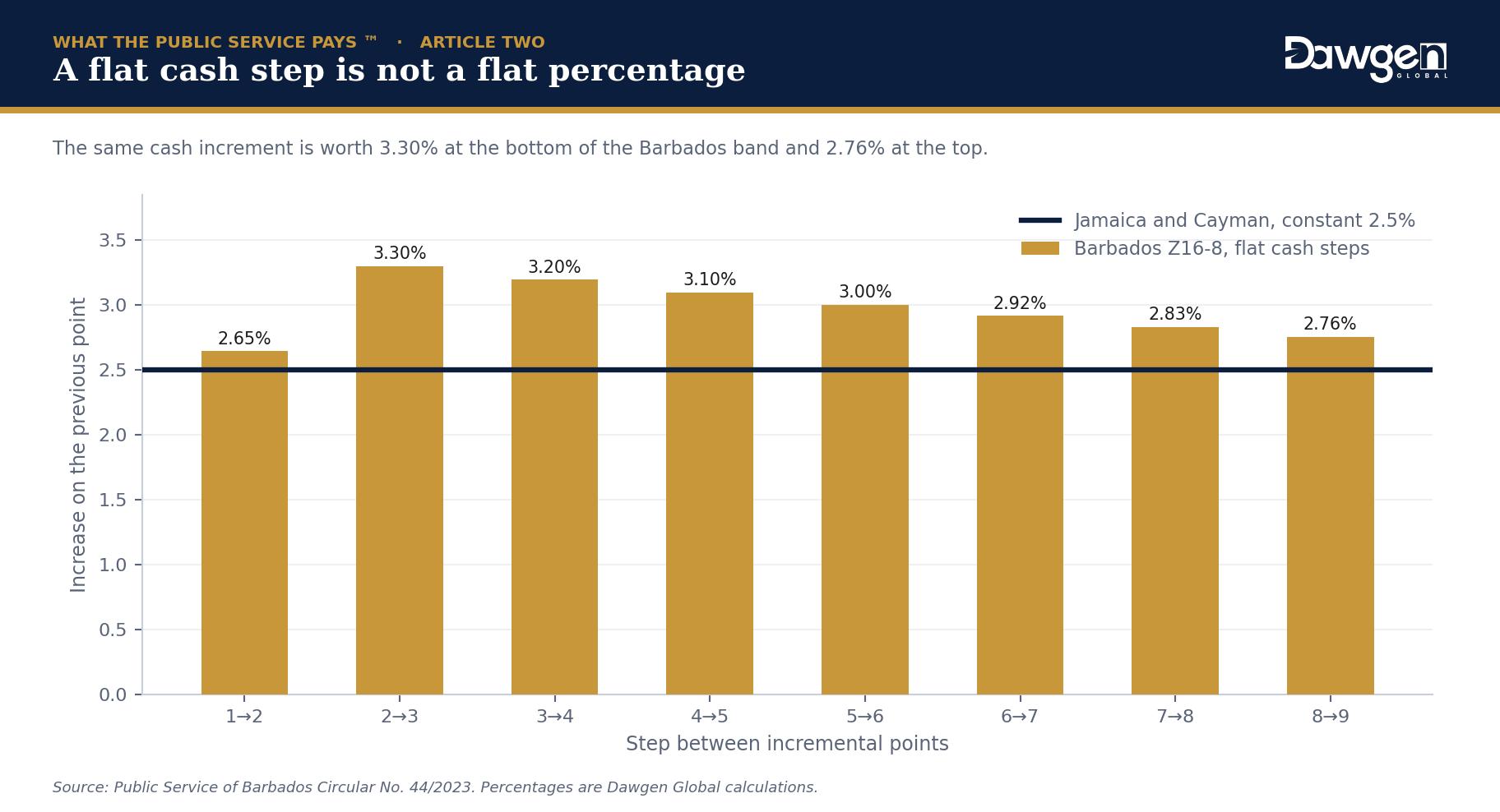
Exhibit 3. What a fixed cash increment is worth, expressed as a percentage, at each step of a Barbados scale.
The second step is worth 3.30 per cent. The last is worth 2.76 per cent. The officer receives exactly the same $1,604.99 each year, and it buys them progressively less relative to their own salary. Under the Jamaican or Cayman method the line would be flat at 2.5 per cent throughout.
How to read a scale notation
The Westminster notation used in Barbados is compact, and once decoded it tells you everything about a scale in a single line. It is worth being able to read, because it appears in vacancy notices across the region and is frequently quoted without explanation.
Take the example above. The first figure, $47,361.26, is the band minimum — the point at which a new entrant starts. The next figure, $1,253.03, preceded by the multiplication sign, is the size of the first increment. The figure after the dash, $48,614.29, is the point at which that increment size changes. The second $1,604.99 is the new increment size, and $59,849.21 is the band maximum.
From that line alone you can derive everything: the number of points, by dividing each segment by its step size and adding one; the spread, by dividing maximum by minimum; and the years to the top, which is the number of points minus one. A scale reading $47,361.26 x 1,253.03 – $48,614.29 x 1,604.99 – $59,849.21 has nine points, a spread of 1.2637, and takes eight years to traverse.
Where a notation shows a double slash or the word ‘bar’ partway along, that marks an efficiency bar or qualification bar — a point beyond which an officer cannot progress without meeting a stated condition, typically a professional qualification or a performance assessment. Guyana’s 1973 classification uses the double-slash convention, and it appears in several Caribbean scales still. A bar materially changes the value of a band to an officer who cannot pass it, and any benchmarking exercise that ignores bars will overstate the effective maximum.
Compa-ratio: where people actually sit
One further concept makes structures usable in practice. The compa-ratio is an individual’s salary expressed as a proportion of their band midpoint. An officer paid exactly at the midpoint has a compa-ratio of 1.00; one at the minimum of a band with a spread of 1.3449 sits at about 0.87; one at the maximum at about 1.17.
The measure matters because a structure describes what an employer COULD pay, while compa-ratios describe what it actually does. An organisation whose average compa-ratio is 0.90 has a young or high-turnover workforce and a large amount of committed future cost as those people progress. One averaging 1.10 has a long-serving workforce, little remaining headroom, and a retention problem waiting to appear when people reach their maximum and their pay stops moving.
This is also why an establishment schedule and a salary scale answer different questions. The Barbados schedules show what each post holder is currently paid — a set of compa-ratios. The scale shows the structure those payments sit within. Neither substitutes for the other, and confusing them is among the more common errors in reward analysis.
Which is better?
Neither, and the choice is not primarily technical. It is a statement about what the employer is trying to achieve, and each method has a defensible case.
| Consideration | Geometric, percentage step | Arithmetic, cash step |
| Relativities | Preserved. The gap between two officers stays proportionally constant as both progress. | Compressed. The proportional gap narrows as both progress up the band. |
| Perceived fairness | Everyone gets the same percentage, which reads as equal treatment. | Everyone gets the same dollars, which also reads as equal treatment. The two intuitions genuinely conflict. |
| Effect on lower grades | Neutral by design. | Relatively generous. A fixed sum is worth more to a lower-paid officer. |
| Cost predictability | Cost grows in proportion to the paybill, so it scales predictably. | Cost is a fixed sum per officer, which is easier to budget in a single year. |
| Behaviour at the top | Automatic cost growth continues at full rate to the band maximum. | Automatic cost growth decelerates in proportional terms toward the top. |
An employer designing a structure should choose deliberately between these, and should be able to say why. In our experience of grading reviews, the method is more often inherited than chosen — the structure was set decades ago, the reasoning was not recorded, and nobody has revisited it since.
Why bands overlap, and why that is deliberate
One feature of these structures reliably surprises people encountering them for the first time. The bands overlap. The maximum of Pay Band 7 in Jamaica is JMD 4,709,163. The minimum of Pay Band 8 is JMD 4,266,270. An experienced officer at the top of the lower band earns more than a newcomer to the band above them.
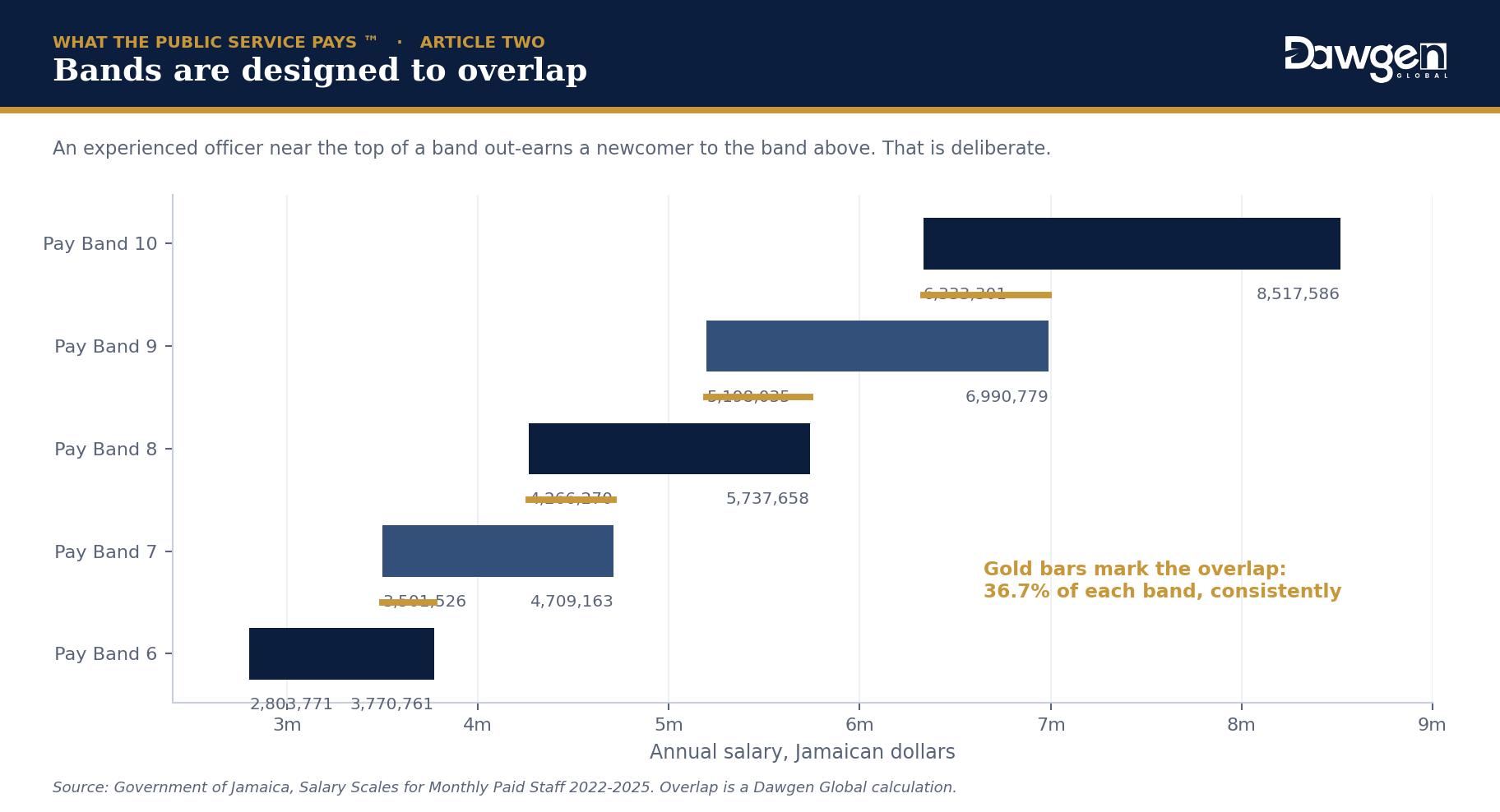
Exhibit 4. Adjacent pay bands in the Jamaican core service, showing the overlap between them.
This is not a defect. It is one of the most important decisions in structure design, and Jamaica has made it with unusual consistency: the overlap is 36.7 per cent of the band, and it is the same from Pay Band 7 upward.
Overlap exists to separate two things that are easily conflated — the weight of the job, and the experience of the person doing it. A grade reflects the first. Progression along the scale reflects the second. If bands did not overlap, the only way to reward a highly experienced officer would be to promote them into a job they may not want and may not be suited to, which is how organisations end up with excellent practitioners running teams badly.
The amount of overlap is a genuine design decision with consequences either way. Too little, and promotion becomes the only route to meaningful reward, generating grade inflation as managers create senior posts to retain people. Too much, and promotion loses its meaning: if the top of your current band pays more than most of the band above, taking on greater responsibility looks financially pointless.
How posts get into grades: job evaluation
None of this works unless there is a defensible way of deciding which grade a post belongs in. That method is job evaluation, and it is worth explaining properly, because it is the machinery underneath every structure discussed here and it is routinely misunderstood.
Job evaluation assesses the content of a job in order to establish its relative weight within an organisation. It evaluates the job, not the person occupying it and not the market rate for it. Those are separate exercises answering separate questions.
The points-factor method
The dominant approach in public services is the points-factor method. A set of factors is agreed — typically knowledge and skill required, the complexity of problem solving involved, the accountability carried, the degree of supervision exercised, and sometimes working conditions. Each factor is divided into levels, each level carries a score, and the factors are weighted according to what the organisation considers important. Every post is assessed against every factor. The scores are summed. The total determines the grade.
This is precisely what the Cayman grade bands describe. They are not salary ranges. They are ranges of evaluation points.
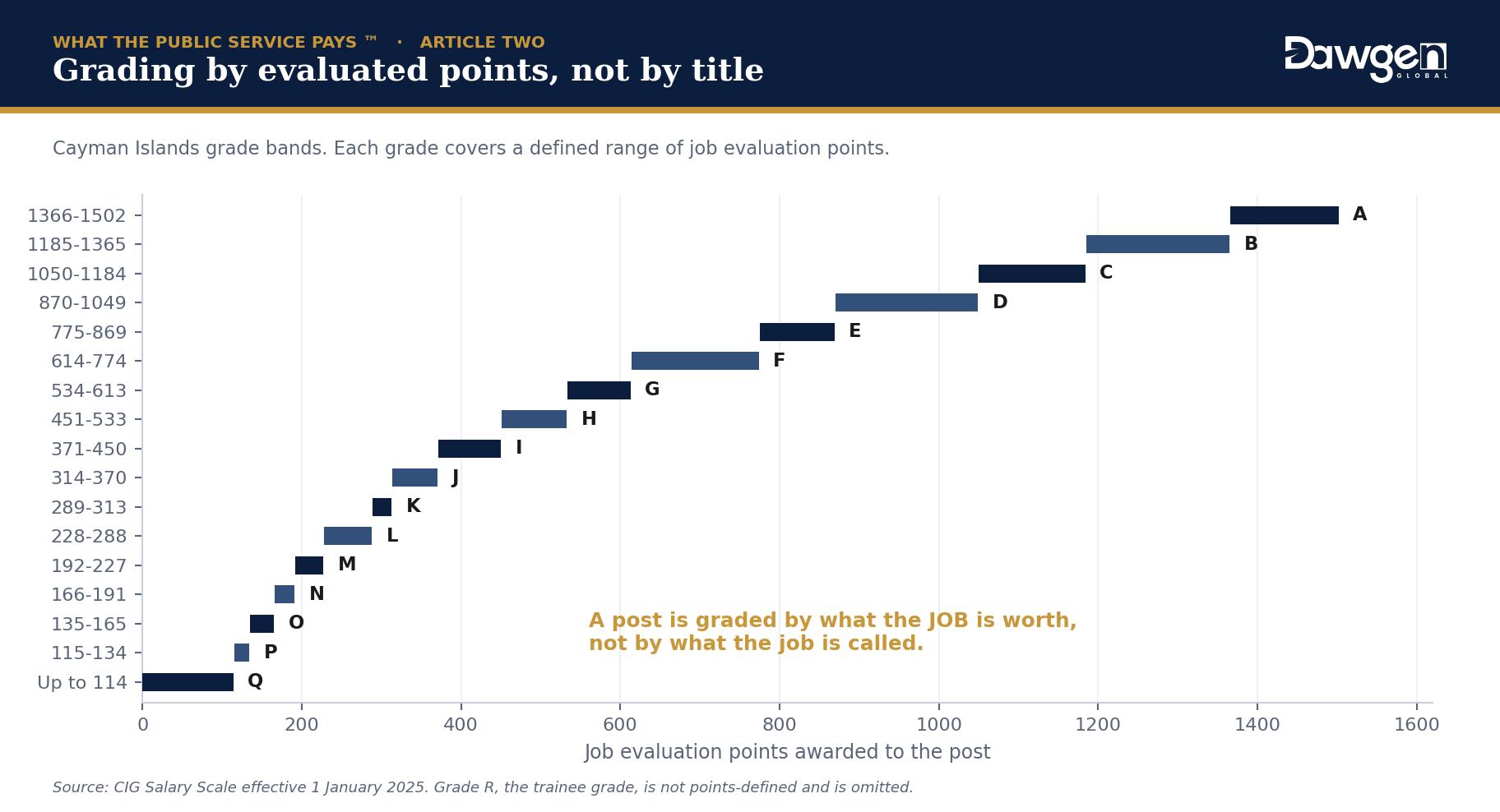
Exhibit 5. Cayman Islands grades expressed as what they actually are — bands of job evaluation points.
Three of the five jurisdictions we examined have conducted formal job evaluation. Cayman grades explicitly by evaluated points. Jamaica’s restructuring introduced what it termed a New Public Service Job Evaluation Factor Plan, intended to replace the multiplicity of classification systems then in use and to align job evaluation to international standards. Trinidad and Tobago’s Salaries Review Commission based its most recent review on a Cabinet-approved Job Evaluation Exercise together with a compensation survey of comparable private sector jobs.
| WHY THIS MATTERS COMMERCIALLY
A grading decision that cannot be explained is a grading decision that will be challenged — in a grievance, in a tribunal, or simply in the corridor. The value of a points-factor exercise is not the arithmetic; it is that the reasoning is recorded, consistent and capable of being defended two years later by someone who was not in the room. Every organisation grades its jobs somehow. The question is whether it can say how. |
The most common failure
In our work on grading reviews, the recurring failure is not methodological sophistication but drift. An organisation evaluates its jobs properly, builds a defensible structure, and then over five or ten years allows posts to be regraded one at a time in response to individual pressure — a retention case here, a restructuring there. Each decision is reasonable on its own. The cumulative effect is a structure that no longer reflects any consistent logic, and in which the original relativities have quietly dissolved.
Jamaica’s 325 scales did not arrive by design. They accumulated.
Six decisions in designing a structure
Bringing this together, an organisation building or reviewing a pay structure faces six decisions. They interact, which is why changing one in isolation rarely produces the intended result.
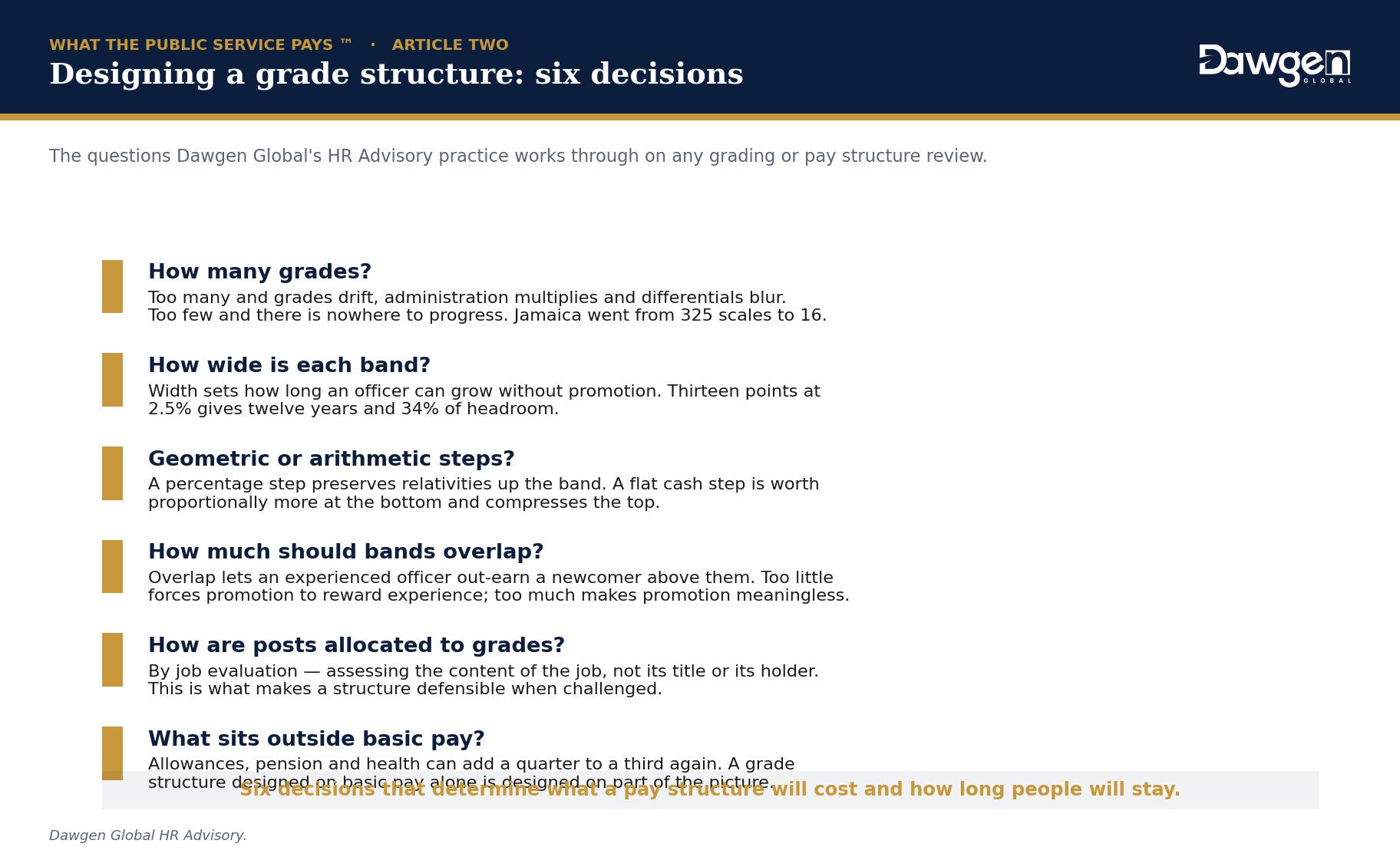
Exhibit 6. The six decisions, and what each of them determines.
The interaction is worth dwelling on. Suppose an organisation decides its bands are too wide, because people are taking too long to reach the maximum. Narrowing the bands reduces headroom, which increases pressure for promotion, which — unless the number of grades is also reduced — produces grade inflation and a more expensive structure than the one it replaced. The presenting problem was band width. The effective problem was the relationship between band width, grade count and overlap.
What a private employer should take from this
Three things, none of which requires access to public sector data.
- Know the shape of your own structure. A surprising number of Caribbean employers cannot state their band spreads, their overlap, or whether their increments are geometric or arithmetic. Those three numbers describe the pay experience of every person in the organisation over their entire tenure.
- Understand that you compete on structure, not just on starting salary. A public service band offering twelve years of automatic progression to a maximum 34 per cent above the entry point is a retention proposition. Matching the entry salary with no incremental structure is competitive on the day of hire and materially behind by year five.
- Grade the job, not the person. When a valued employee is retained by regrading their post rather than by paying them a market supplement, the organisation has permanently changed its structure to solve a temporary problem. Do it four or five times and the structure is no longer describing anything.
A note on our work
This research sits within Dawgen Global’s HR Advisory practice, which advises on job evaluation, grading reviews, pay structure design and reward benchmarking across the Caribbean. The analysis in this article uses exactly the techniques we apply on client assignments: read the structure rather than the headline rate, measure the spread and the overlap, establish how posts were allocated to grades, and find out whether the increment method was chosen or inherited. Applied to sixteen public services, those questions produced a finding nobody had noticed. Applied to a single organisation, they usually produce two or three.
Next in this series
Article three turns from the shape of the band to the shape of the whole service: compression, the distance between the top of a public service and the bottom. It varies across the region by a factor of nearly four, and the widest gap between jurisdictions is not at the top but at the floor.
| AN INVITATION
Eleven of the sixteen jurisdictions in this study have not yet been collected, and in several of the five that have, documents remain outstanding. Public service ministries, personnel departments and statistical offices wishing to supply information, or to correct anything published in this series, are invited to contact the firm. Corrections received will be acknowledged and reflected. |
SOURCES
Government of Jamaica, Salary Scales for Monthly Paid Staff for the period April 1, 2022 to March 31, 2025; Salary Scales for Weekly and Daily Paid Employees; and the job-family salary schedules, Ministry of Finance and the Public Service. Cayman Islands Government Salary Scale effective 1 January 2025, Appendix B to Personnel Circular 11 of 2024. Public Service of Barbados Circular No. 44/2023, Ministry of the Public Service, 31 August 2023. Republic of Trinidad and Tobago, 120th Report of the Salaries Review Commission, 24 October 2024. Band spreads, increment percentages and overlap figures are Dawgen Global calculations from those published scales.
This article is the second in What the Public Service Pays™, a Dawgen Global series drawn from research across sixteen Caribbean jurisdictions. Dawgen Global is an independent, integrated multidisciplinary professional services firm serving the Caribbean. Enquiries: [email protected] | dawgen.global
About Dawgen Global
Dawgen Global is an independent, integrated multidisciplinary professional services firm headquartered at 47 Trinidad Terrace, New Kingston, Jamaica, serving more than 15 territories across the Caribbean. Founded and led by Dr. Dawkins Brown, Executive Chairman, the firm is independent and not affiliated with any international network. It delivers a full suite of professional services under one roof: audit and assurance; tax advisory; IT and digital transformation; risk management; cybersecurity; actuarial and insurance regulatory advisory; HR advisory; mergers and acquisitions; corporate recovery; business advisory and strategy; accounting BPO and virtual CFO services; and legal process outsourcing.
The proposition is simple: big-firm capability without the big-firm price. Dawgen Global’s integrated approach is built for the specific complexities and opportunities of the Caribbean market, helping organizations make sharper, better-informed decisions that drive measurable progress.
To explore a partnership, reach out:
- Website: dawgen.global
- Email: [email protected]
- WhatsApp (Global): +1 555-795-9071
- Caribbean offices: +1 876-665-5926 | +1 876-929-3670 | +1 876-926-5210


