
A group that starts in October 2026 can finish a disciplined readiness programme before Jamaica’s planned digital tax commencement in early 2027. Here is what each month should deliver, who owns what, and how the board will know it worked.
Executive summary
Digital tax readiness is not a legal memorandum. It is an owner, a decision and a tested process for every material digital transaction a group buys or sells. Ninety days is enough to get there for the transactions that matter most.
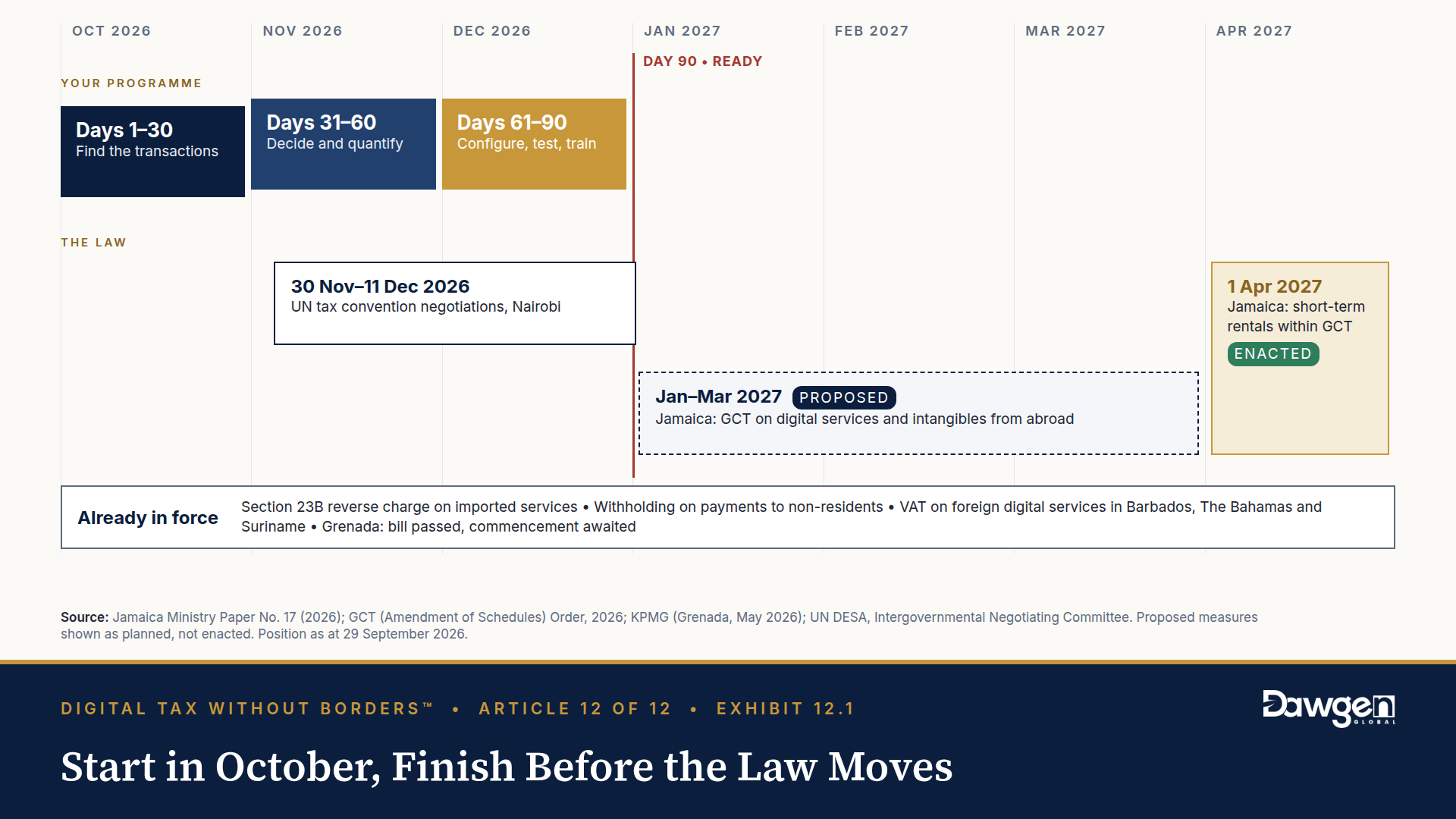
The timing is favourable. Jamaica’s proposed General Consumption Tax (GCT) on digital services and intangibles supplied from abroad is planned for the fourth quarter of fiscal year (FY) 2026/27, that is January–March 2027. Grenada’s value added tax (VAT) amendment on non-resident digital suppliers passed Parliament on 7 May 2026 and awaits commencement. Jamaica brings short-term rental accommodation into GCT from 1 April 2027. A group that begins in the first week of October finishes at the end of December, with its map, decisions and controls in place before any of these dates.
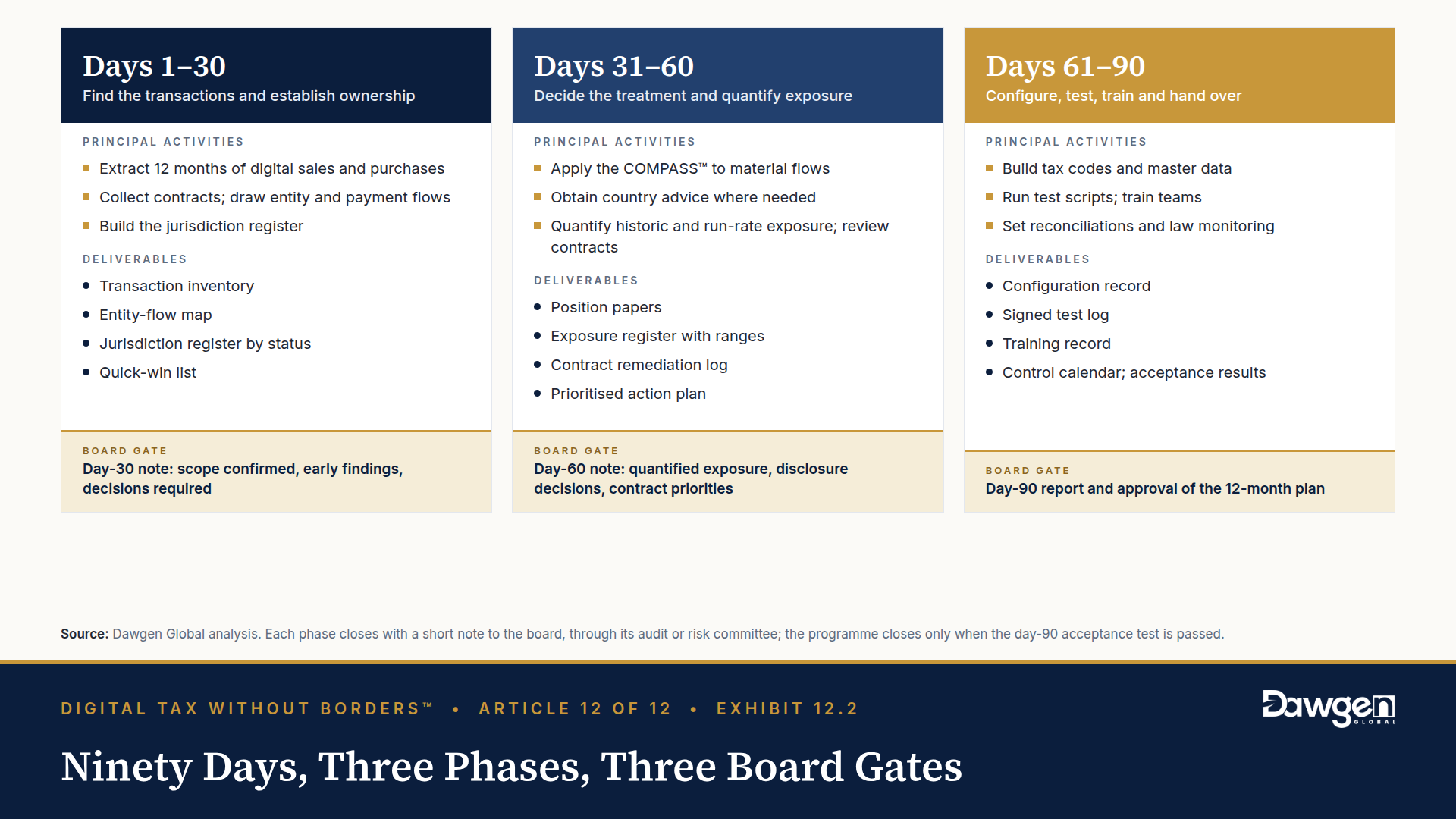
The plan runs in three phases. Days 1–30 find the transactions and fix ownership. Days 31–60 decide the treatment and quantify exposure. Days 61–90 configure systems, test, train and hand over. It closes with a day-90 acceptance test performed by people who did not build the process, and it establishes a 12-month monitoring rhythm and a board reporting format that separates law in force from proposals.
Why October 2026 is the right moment
Most groups will be tempted to wait for Jamaica’s enabling legislation and the Tax Administration Jamaica (TAJ) guidance. That is a mistake, for three reasons.
First, much of the exposure is already law. Registered Jamaican businesses have been required since the operational framework of 2014 to self-account for GCT on imported services under section 23B of the GCT Act [4]. Payments of royalties and service fees to non-residents attract withholding at 33⅓ per cent under domestic law, or 15 per cent under the Caribbean Community (CARICOM) Double Taxation Agreement [5][6]. A readiness programme that starts with those obligations produces value regardless of when the new measure commences.
Second, the new measure will reach unregistered entities and consumer-facing products. Budget 2026/27 projects J$300 million in FY2026/27 and about J$4.2 billion a year from FY2027/28 [1][2][3]. A group with small subsidiaries below the J$15 million registration threshold, or with digital products sold to Jamaican consumers, needs its data in order before the first return, not after it.
Third, the region is moving at once. Barbados, The Bahamas and Suriname already tax foreign digital services to consumers; Grenada is close behind [7]; Trinidad and Tobago signalled a VAT review in its FY2026 Budget [8]; the Dominican Republic’s tax authority said in May 2026 that a new proposal on digital platforms was being prepared [9]. When CARICOM and the Caribbean Organisation of Tax Administrators (COTA) hosted officials from 13 countries on 4 March 2026, securing VAT on cross-border digital transactions was the agenda [10].
Law in force vs proposal. In force in Jamaica: section 23B reverse charge on imported services; withholding on payments to non-residents; short-term rentals within GCT from 1 April 2027 under the Amendment of Schedules Order approved on 29 April 2026. Proposed: GCT on digital services from abroad, planned for January–March 2027, with collection mechanism, threshold and business-to-business (B2B) treatment not yet announced. Grenada: bill passed, awaiting commencement.
Before day 1: scope and sponsorship
The programme needs an executive sponsor, usually the chief financial officer (CFO), with authority to resolve disputes between tax, procurement, sales and technology. It needs a tax lead who owns legal positions. And it needs a written scope: which entities, which jurisdictions, which transaction types, and what is deliberately excluded from the first wave, with a trigger for bringing it in. A group with a dozen entities might start with Jamaica, Barbados, Trinidad and Tobago and Grenada and screen the rest for urgent filings only.
The plan at a glance
Days 1–30: find the transactions
Revenue data come first. Export 12 months of sales by product, channel and customer location, including platform gross sales, refunds and commissions rather than net settlements. Then find the purchases, which is where most groups are surprised. Foreign digital spend hides in accounts payable, corporate card statements, employee expense claims and intercompany accounts: advertising, cloud software as a service (SaaS), hosting, data subscriptions, online travel agency (OTA) commissions, payment processing and intellectual property (IP) licences.
For each material flow, record the contract, counterparty, legal entity, currency, gross value, customer or supplier location and available evidence. Classify provisionally as goods, digital service, other service, IP licence, platform fee or bundle, and mark uncertainty rather than guessing. Draw the flow for a sample of high-value transactions: who contracts, who invoices, who pays, and where the cash lands.
In parallel, build the jurisdiction register. For each market, record the consumption tax, withholding and income tax nexus rules, the source, its status and the date last checked. Status matters more than rates. Canada’s digital services tax (DST) shows why: enacted in June 2024, rescinded in June 2025 and repealed with refunds by legislation that received Royal Assent in March 2026 [11][12]. A register without a status column and a review date is a liability.
By day 30, the quick wins are visible: imported services not self-accounted, subscriptions with no invoices, marketplace statements booked net, gross-up clauses never assessed. Fix them now rather than waiting for the full analysis.
Days 31–60: decide and quantify
Applying the analysis
Each material flow is taken through the seven COMPASS™ lenses described below and given a position: the characterisation, the jurisdiction, the tax mechanism, the accountable party and the relief available. Business-to-consumer (B2C) and B2B treatment are analysed separately. Platform responsibility is tested against statute and contract, not assumed. Where a conclusion is material and uncertain, country advice is obtained and recorded.
Quantification
Exposure is expressed in five parts: historic tax potentially due, annual run-rate cost, penalties and interest where relevant, amounts recoverable as input tax or treaty relief, and the cost of fixing the process. Ranges are appropriate where law is unsettled. Jamaica’s proposed measure is modelled as a scenario with an assumed commencement date, never booked as a liability on the strength of a Budget announcement.
Decision thresholds
The sponsor should approve four thresholds at the start of this phase. A value threshold above which a flow receives a written position paper; a lower threshold below which a standard documented treatment applies. An uncertainty trigger: any position rated “Unresolved” above the value threshold goes to the sponsor with a recorded interim decision. A disclosure trigger: any historic under-declaration above a set amount goes to the board with a recommendation on voluntary correction. And a contract trigger: any recurring foreign digital contract above a set annual value is reviewed for tax clauses at the next renewal or sooner.
Illustrative prioritisation
The figures are illustrative and describe no actual group. A Kingston-headquartered group with entities in Jamaica, Barbados and Grenada finds five material flows.
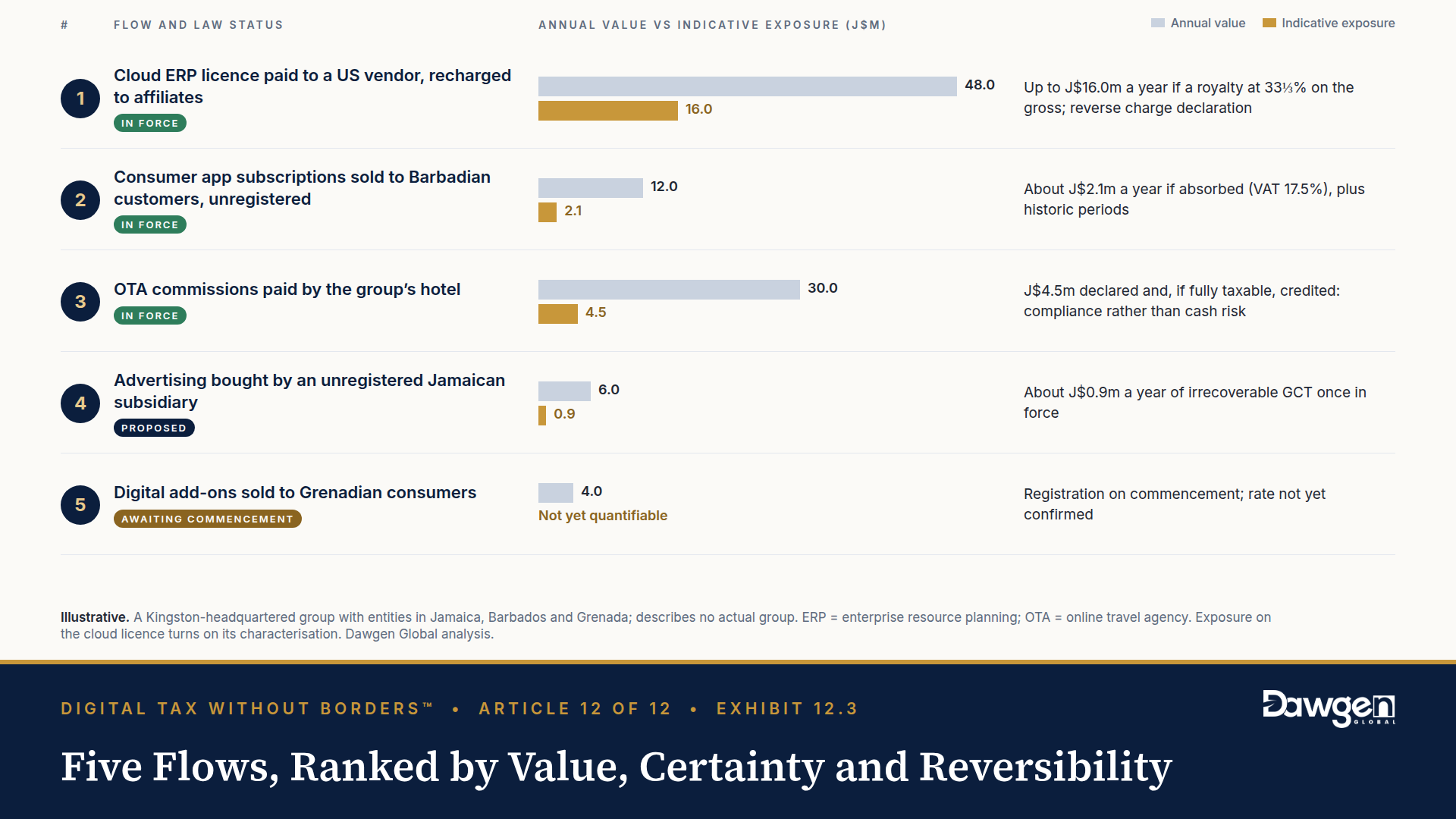
The ranking weighs value, legal certainty and difficulty of reversal. A low-value, uncertain scenario does not consume the team while a high-value, settled obligation remains unfixed.
Days 61–90: configure, test, train
Approved positions become product tax mappings, tax codes and master data fields, each recorded with its source and effective date. Test scripts are written with expected results approved by tax, not by the system vendor. For sales, include a domestic consumer, a foreign consumer, a registered business, a platform sale, a refund, a bundle and a transaction with conflicting location indicators. For purchases, include a foreign SaaS invoice, an advertising invoice, an OTA commission and an intercompany recharge. Each test is reconciled from order to invoice, payment, ledger and return.
Training is targeted. Procurement learns to flag new foreign digital contracts. Customer service learns to explain invoice changes. Finance learns the monthly reconciliation of platform statements to gross sales and returns. A control fails if the people operating it do not know when to escalate.
The monthly control calendar is set: reconciliation of gross orders to invoices, platform reports, bank, ledger and returns; an exception queue for missing location evidence, unknown supplier status, double collection and unmatched refunds; and a filing calendar with a named deputy for every registration.
Who does what: the RACI matrix
A RACI matrix assigns, for each activity, who is Responsible for doing the work, who is Accountable for the outcome and signs it off, who must be Consulted, and who must be kept Informed.
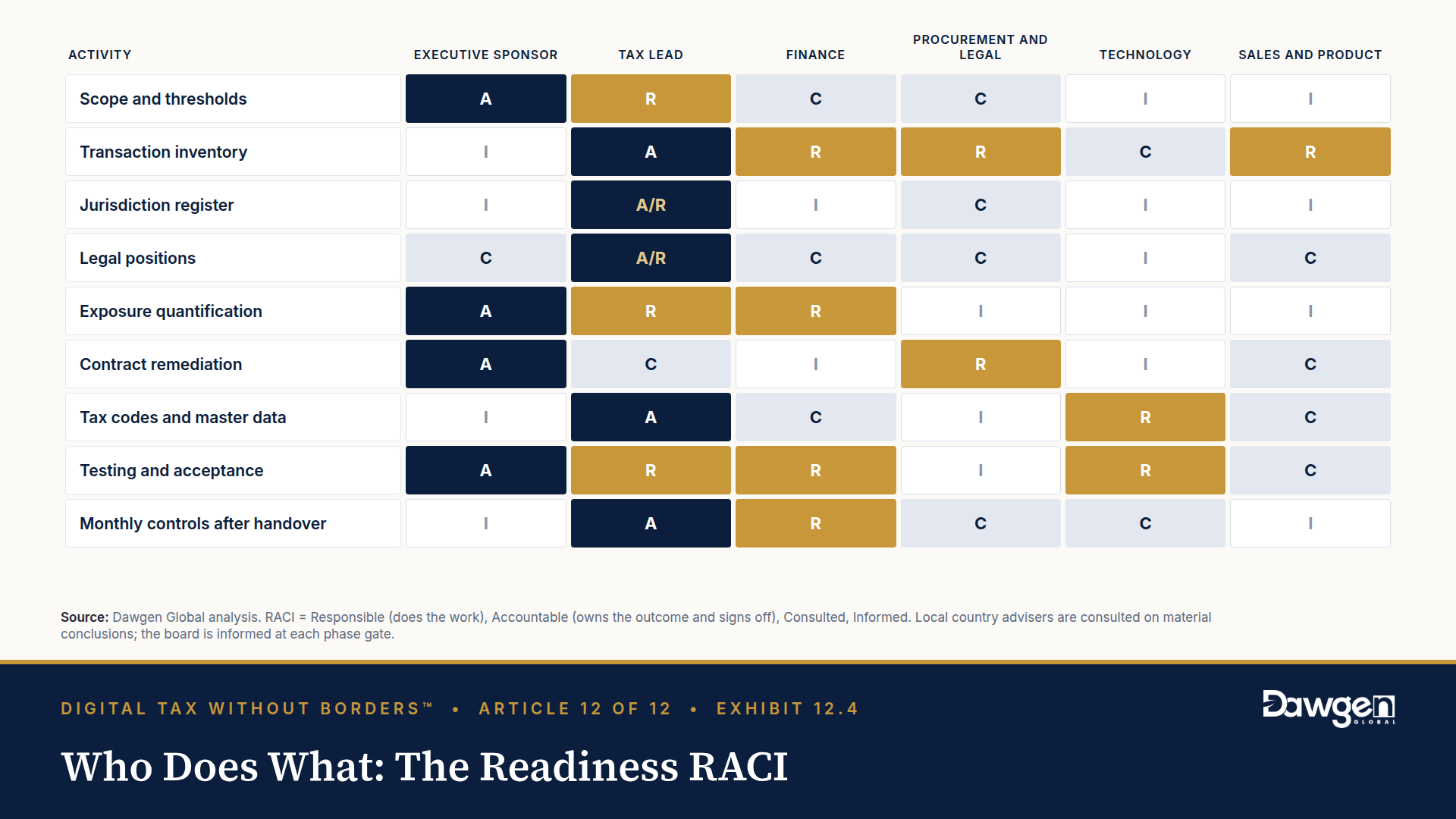
Local country advisers are consulted on material conclusions in their jurisdiction. The board, through its audit or risk committee, is informed at each phase gate and approves the 12-month plan.
The day-90 acceptance test
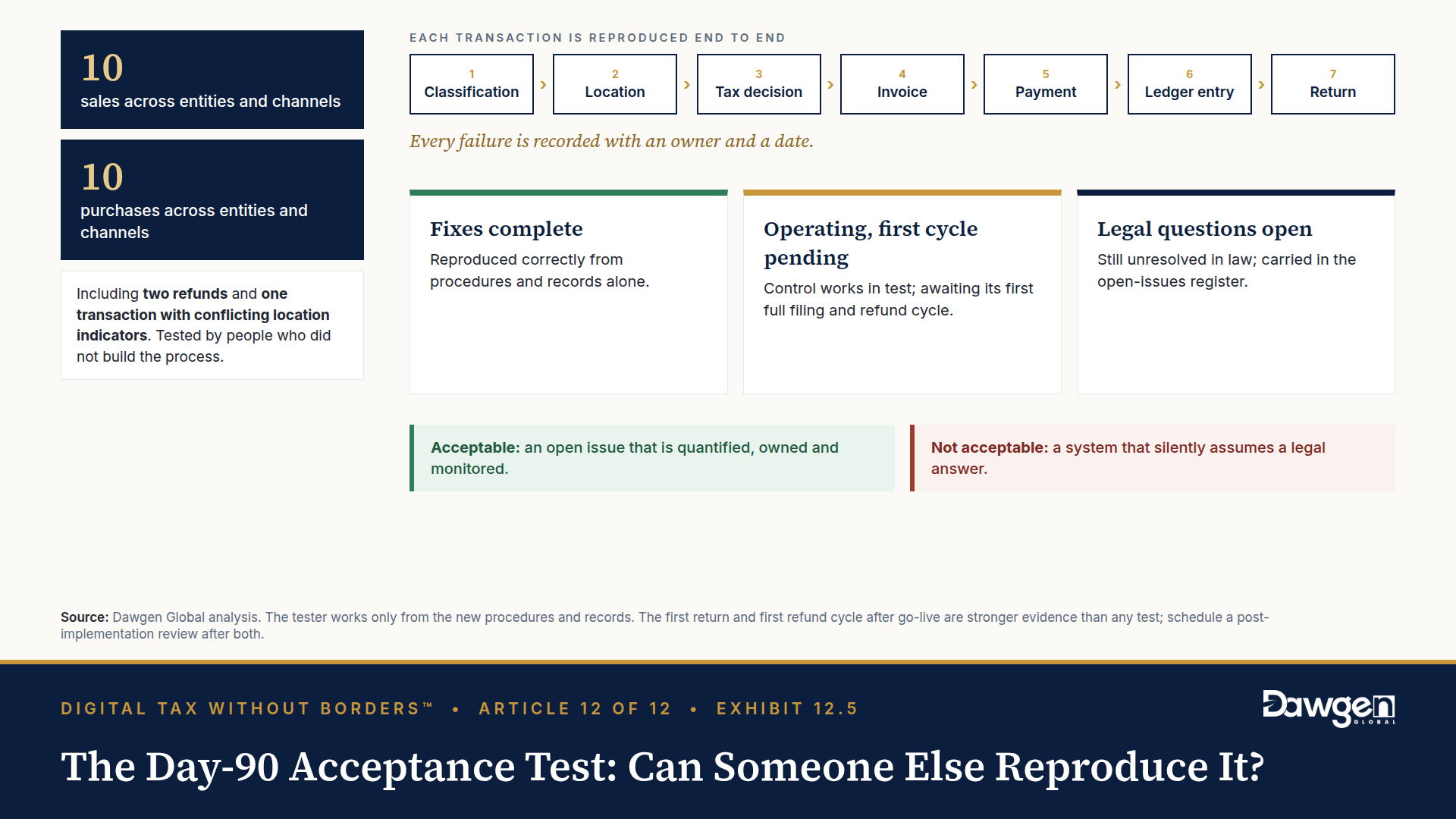
The programme does not close because a report was delivered. Select ten sales and ten purchases across entities and channels, including two refunds and one transaction with conflicting location indicators. Ask someone outside the programme team to reproduce each: classification, location, tax decision, invoice, payment, ledger entry and return treatment, using only the new procedures and records. Record every failure with an owner and a date.
The open-issues register is reviewed at the same time. An unresolved issue is acceptable if it is quantified, owned and monitored; it is not acceptable if a system silently assumes a legal answer. The final report distinguishes fixes complete, controls operating but awaiting their first full filing cycle, and legal questions still open. The first return and the first refund cycle after go-live are stronger evidence than any test, so a post-implementation review is scheduled after both.
The next 12 months
Day 90 is the start of steady operation. Quarterly, the jurisdiction register is refreshed and business changes are reviewed: new products, markets, platforms and contracts. Annually, the end-to-end sample test is repeated and contract templates updated. Specific triggers are monitored and each produces a recorded decision:
- Jamaica: enabling legislation and TAJ guidance for the digital services measure, including collection mechanism, threshold and B2B treatment [1][3].
- Jamaica: first GCT returns for short-term rental accommodation after 1 April 2027 [13].
- Grenada: Gazette notice of commencement and the transition period [7].
- Trinidad and Tobago: the outcome of the VAT review [8].
- Dominican Republic: any new proposal from the Dirección General de Impuestos Internos (DGII) to apply the Impuesto sobre Transferencias de Bienes Industrializados y Servicios (ITBIS) to digital services [9].
- United Nations (UN): the Framework Convention on International Tax Cooperation, whose Protocol 1 concerns taxation of income from cross-border services; negotiations resume in Nairobi from 30 November to 11 December 2026, with final texts due to the UN General Assembly in September 2027 [14][15].
Digital tax is also written into acquisition due diligence and new-market approval, so the questions are asked before the commitment, not after.
Reporting to the board
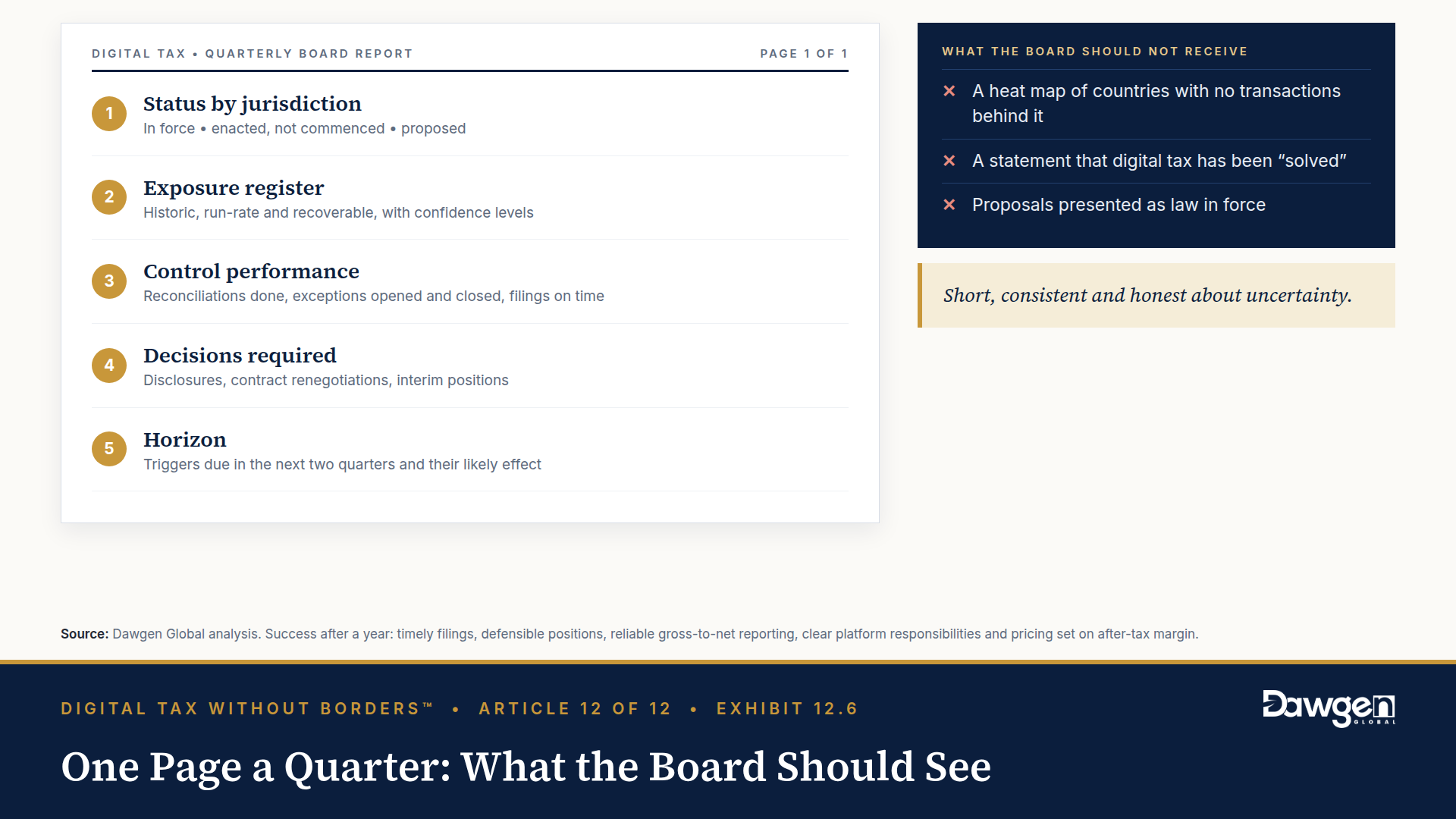
Board reporting should be short, consistent and honest about uncertainty. A single page each quarter serves most groups, structured in five parts. First, status by jurisdiction, separating law in force, law enacted but not commenced, and proposals. Second, the exposure register: historic, run-rate and recoverable amounts, with confidence levels. Third, control performance: reconciliations completed, exceptions opened and closed, and filings made on time. Fourth, decisions required: disclosures, contract renegotiations and interim positions on unresolved law. Fifth, horizon: triggers expected in the next two quarters and their likely effect.
What the board should not receive is a heat map of countries without transactions behind it, or a statement that digital tax has been “solved”. Success after a year looks like timely filings, defensible positions, reliable gross-to-net reporting, clear platform responsibilities, and pricing decisions made on after-tax margin.
The Dawgen Digital Tax COMPASS™
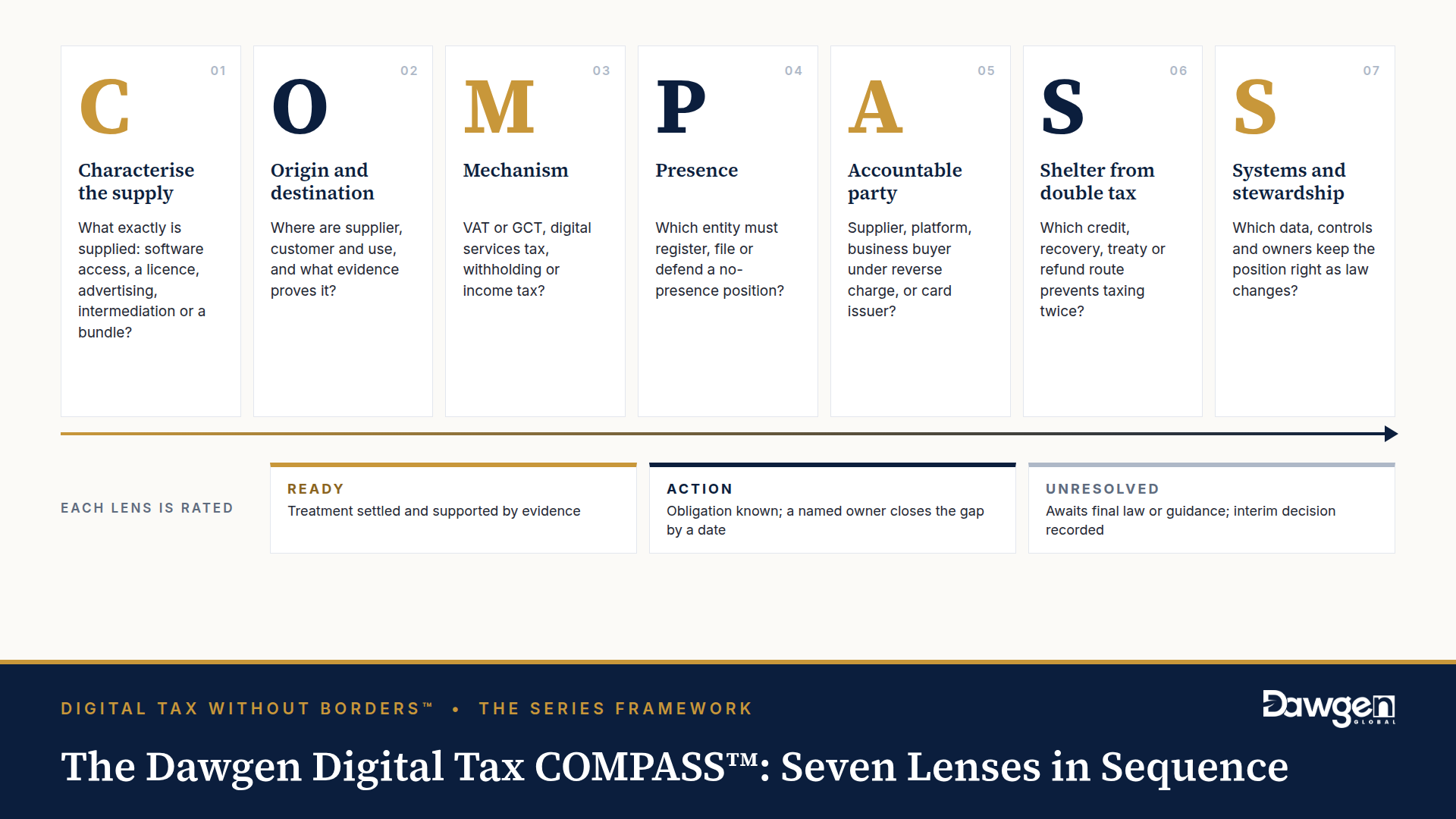
The Dawgen Digital Tax COMPASS™ is the method Dawgen Global uses to turn the broad phrase “digital tax” into specific, answerable questions. It works transaction by transaction, and it applies equally to what a business buys and what it sells. Seven lenses are applied in sequence, because each answer depends on the one before it.
- C — Characterise the supply. What exactly is supplied: access to software, a licence of intellectual property, advertising, intermediation, a professional service delivered remotely, or a bundle of several? The contract and the actual performance decide, not the invoice description.
- O — Origin and destination. Where are the supplier, the customer and the place of use or consumption, and what evidence proves it? Billing address, card country, IP address and contract terms often disagree.
- M — Mechanism. Which tax is in play: VAT or GCT on consumption, a gross-revenue digital services tax, withholding tax on the payment, or income tax on profits? Each has a different taxpayer, base and remedy.
- P — Presence. Which entity has a taxable connection with which jurisdiction, and must it register, file or defend a no-presence position?
- A — Accountable party. Who must actually charge, collect or remit: the supplier, a platform deemed to be the supplier, the business customer under a reverse charge, or a payment intermediary?
- S — Shelter from double taxation. Which credit, input tax recovery, treaty provision or refund route prevents the same value being taxed twice, and is it documented?
- S — Systems and stewardship. Which data fields, controls, owners and monitoring routines keep the position right as volumes grow and the law changes?
Each lens is rated on a simple three-tier scale. Ready means the treatment is settled and supported by evidence. Action means the obligation is known and a named owner is fixing a gap by a date. Unresolved means the answer depends on law or guidance that is not yet final, and an interim commercial decision has been recorded. The output is a transaction-level exposure map and an action plan with owners, not a list of countries. The COMPASS™ identifies and prioritises the questions; each material conclusion is then supported by the law of the jurisdiction concerned.
Applying the COMPASS™ to a 90-day programme
| Lens | What to ask in this context | Evidence to hold |
| Characterise | Has every material flow in the inventory been classified, with uncertainty marked rather than guessed? | Transaction inventory with classification and contract reference |
| Origin and destination | Do we hold location evidence for customers and residence evidence for suppliers? | Location fields in master data; supplier residence certificates |
| Mechanism | Is each exposure labelled by tax type: reverse charge, foreign VAT, withholding, income tax? | Exposure register by tax type |
| Presence | Which entities must register where, and which no-presence positions are documented? | Registration map; position papers |
| Accountable party | For each platform and marketplace, who collects and who files? | Platform terms reviewed; test results |
| Shelter | Are input tax, treaty relief and refunds claimed and supported? | Relief workings; treaty forms; certificates |
| Systems and stewardship | Did the day-90 acceptance test pass, and are monthly controls and law triggers owned? | Signed test log; control calendar; trigger register |
Questions for the board
- Who is the executive sponsor of digital tax readiness, and who owns each legal position?
- Have we inventoried foreign digital purchases from card and expense data, not just accounts payable?
- Which of our current exposures arise under law already in force, and what are they worth?
- What is our modelled cost of Jamaica’s proposed measure, and which entities bear it as irrecoverable?
- Which historic under-declarations have we found, and what is our decision on correcting them?
- Will our systems capture customer location and supplier residence before January 2027?
- Did the day-90 acceptance test pass when run by people outside the programme team?
- Which legal triggers are we monitoring, who watches each one, and when will we next hear about them?
How Dawgen Global can help
Dawgen Global’s Caribbean Tax Advisory practice helps boards, finance leaders and owner-managers plan and complete a focused digital tax readiness programme ahead of the 2027 changes. Using the Dawgen Digital Tax COMPASS™, we map digital transactions across the jurisdictions in which you operate, separate law in force from proposals, quantify exposure and help your team put in place the contracts, systems and controls to stay compliant as the rules change. To discuss your organisation’s position, contact us at [email protected] or visit www.dawgen.global/contact-us.
This article concludes the Digital Tax Without Borders™ series.
This article provides general information and does not constitute tax or legal advice. The application of tax law depends on specific facts and on the law in force at the relevant date; readers should obtain advice before acting.
Abbreviations used
- B2B — business-to-business
- B2C — business-to-consumer
- CARICOM — Caribbean Community
- CFO — chief financial officer
- COTA — Caribbean Organisation of Tax Administrators
- DGII — Dirección General de Impuestos Internos (Dominican Republic tax authority)
- DST — digital services tax
- ERP — enterprise resource planning
- FY — fiscal year
- GCT — General Consumption Tax
- IP — intellectual property (in “IP address”, internet protocol)
- ITBIS — Impuesto sobre Transferencias de Bienes Industrializados y Servicios (Dominican Republic VAT)
- OTA — online travel agency
- RACI — Responsible, Accountable, Consulted, Informed
- SaaS — software as a service
- TAJ — Tax Administration Jamaica
- UN — United Nations
- VAT — value added tax
Sources
- Ministry of Finance and the Public Service (Jamaica), Revenue Measures (including Ministry Paper No. 17, “Revenue Measures for Financial Year 2026/2027”, 12 February 2026, and amended measures, 28 April 2026). https://www.mof.gov.jm/resources-revenue-measures/
- Jamaica Information Service, “Gov’t projects $29.4B from new revenue measures in fiscal year 2026/27”, February 2026. https://jis.gov.jm/govt-projects-29-4b-from-new-revenue-measures-in-fiscal-year-2026-27/
- EY, “Jamaica proposes extending General Consumption Tax to digitally supplied services and intangibles from abroad”, Tax Alert, 25 February 2026. https://www.ey.com/en_gl/technical/tax-alerts/jamaica-proposes-extending-general-consumption-tax-to-digitally-supplied-services-and-intangibles-from-abroad
- Tax Administration Jamaica, Technical Bulletin, “Accounting for GCT on Imported Services”, 23 April 2020. https://www.jamaicatax.gov.jm/documents/10181/17838406/Technical+Bulletin+(2020)+-+GCT+Imported+Services_23042020.pdf/547fce5a-fa9c-1481-ec55-6d8e40456f08
- PwC, Worldwide Tax Summaries, “Jamaica: Corporate — Withholding taxes”, accessed September 2026. https://taxsummaries.pwc.com/jamaica/corporate/withholding-taxes
- Caribbean Community, CARICOM Double Taxation Agreement, 1994. https://caricom.org/treaties/double-taxation-agreement/
- KPMG, “Grenada: Nonresident digital services providers subject to VAT”, TaxNewsFlash, May 2026. https://kpmg.com/us/en/taxnewsflash/news/2026/05/grenada-nonresident-digital-services-vat.html
- Ministry of Finance (Trinidad and Tobago), Budget Statement Fiscal Year 2026, October 2025. https://www.finance.gov.tt/wp-content/uploads/2025/10/Budget-Statement-FY-2026-2.pdf
- Diario Libre, “La DGII trabaja propuesta de ITBIS para plataformas digitales”, 20 May 2026. https://www.diariolibre.com/economia/finanzas/2026/05/20/la-dgii-trabaja-propuesta-de-itbis-para-plataformas-digitales/3538742
- Caribbean Community, “Coordinated approach necessary for consistent application of VAT systems — tax officials”, March 2026. https://caricom.org/coordinated-approach-necessary-for-consistent-application-of-vat-systems-tax-officials/
- Department of Finance Canada, “Canada rescinds digital services tax to advance broader trade negotiations with the United States”, 29 June 2025. https://www.canada.ca/en/department-finance/news/2025/06/canada-rescinds-digital-services-tax-to-advance-broader-trade-negotiations-with-the-united-states.html
- Parliament of Canada, LEGISinfo, Bill C-15, Budget 2025 Implementation Act, No. 1 (Royal Assent 26 March 2026). https://www.parl.ca/legisinfo/en/bill/45-1/c-15
- The Gleaner, “Airbnb and short-term rentals to face GCT from April 2027”, 30 April 2026. https://jamaica-gleaner.com/article/news/20260430/airbnb-and-short-term-rentals-face-gct-april-2027
- EY, “UN releases draft Framework Convention on International Tax Cooperation and two early protocols”, Tax Alert, 27 July 2026. https://www.ey.com/en_gl/technical/tax-alerts/un-releases-draft-framework-convention-on-international-tax-cooperation-and-two-early-protocols
- United Nations Department of Economic and Social Affairs, Intergovernmental Negotiating Committee on the UN Framework Convention on International Tax Cooperation. https://financing.desa.un.org/inc/fifthsession
About Dawgen Global
Dawgen Global is an independent, integrated multidisciplinary professional services firm headquartered at 47 Trinidad Terrace, New Kingston, Jamaica, serving more than 15 territories across the Caribbean. Founded and led by Dr. Dawkins Brown, Executive Chairman, the firm is independent and not affiliated with any international network. It delivers a full suite of professional services under one roof: audit and assurance; tax advisory; IT and digital transformation; risk management; cybersecurity; actuarial and insurance regulatory advisory; HR advisory; mergers and acquisitions; corporate recovery; business advisory and strategy; accounting BPO and virtual CFO services; and legal process outsourcing.
The proposition is simple: big-firm capability without the big-firm price. Dawgen Global’s integrated approach is built for the specific complexities and opportunities of the Caribbean market, helping organizations make sharper, better-informed decisions that drive measurable progress.
To explore a partnership, reach out:
- Website: dawgen.global
- Email: [email protected]
- WhatsApp (Global): +1 555-795-9071
- Caribbean offices: +1 876-665-5926 | +1 876-929-3670 | +1 876-926-5210


