
Yes, and in three different ways. A Caribbean software or services firm selling into neighbouring islands and Latin America can owe consumption tax, income tax or a special digital levy in a market where it has never signed a lease.
Executive summary
“We have no office there” is the commonest answer Caribbean businesses give on foreign tax exposure, and it is the wrong test. Taxable presence, or nexus, comes in three distinct forms. Indirect tax nexus requires a non-resident supplier to register for value added tax (VAT) on sales to local consumers, as Barbados, The Bahamas and Suriname already require for digital services. Income tax nexus usually depends on a permanent establishment (PE), which can arise through a fixed place of business, a dependent agent, or services performed in the country for long enough, without any office in the conventional sense. Special digital nexus rules, of which Colombia’s significant economic presence (SEP) regime is the regional example, tax non-residents on the basis of market engagement alone.
With Amount A of the Organisation for Economic Co-operation and Development (OECD) Pillar One stalled, market-based rules are spreading country by country.
This article explains each form, offers a market entry map for a Jamaican or Barbadian firm expanding across the region, and lists the change triggers that should send a market back for review.
Three kinds of nexus, three different questions
A Bridgetown-based software as a service (SaaS) company sells to businesses and consumers in Jamaica, Trinidad and Tobago, Guyana, The Bahamas and now Colombia. It has no office outside Barbados. Its finance director asks one question: “Are we taxable anywhere else?” The honest answer is that there are three questions, and each has a different trigger, taxpayer and consequence.
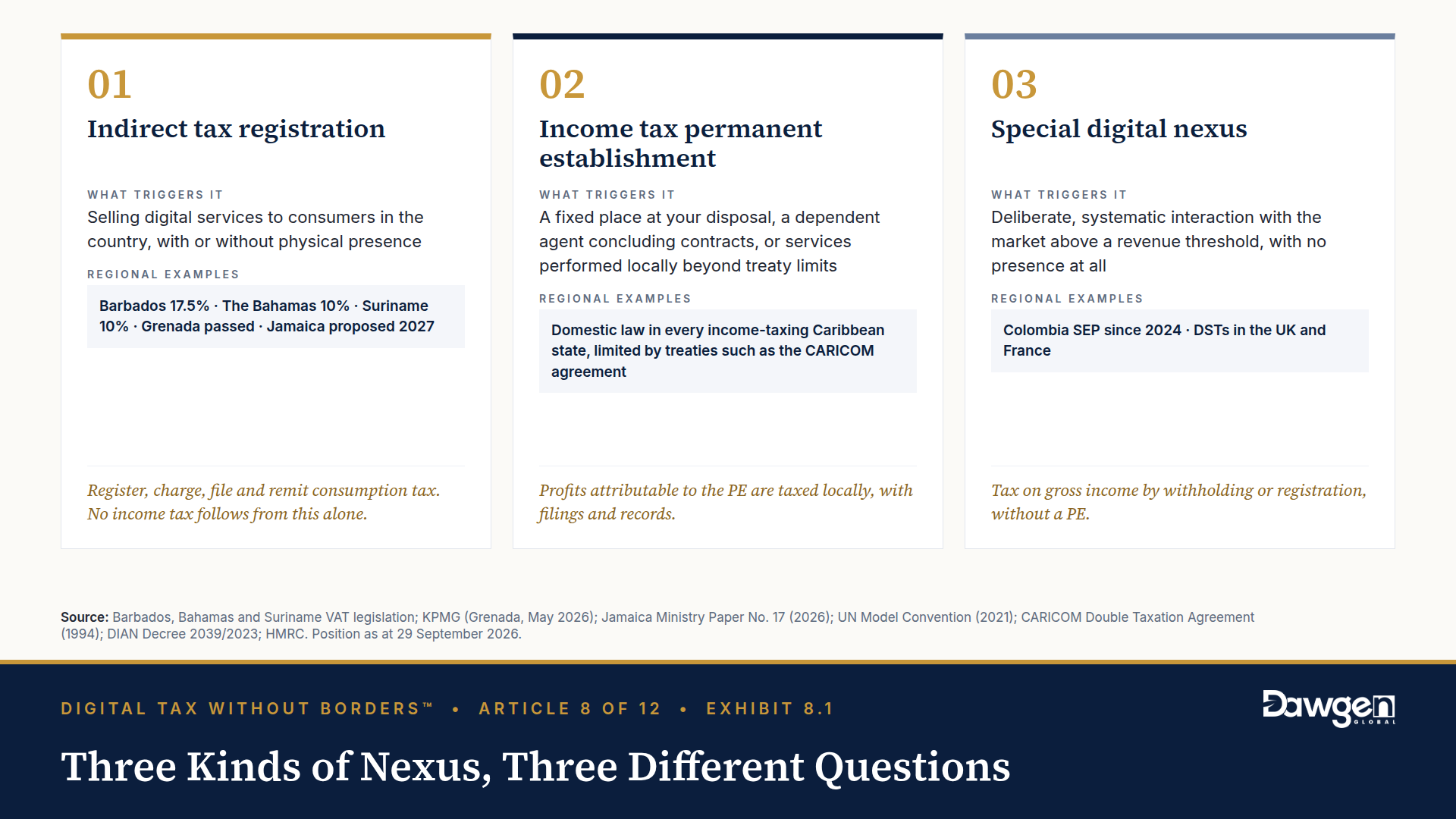
The three do not imply one another: a Barbados VAT registration concedes no income tax PE, and having no PE in Colombia does not settle the SEP question. Board reporting should never say “we have nexus” without naming the tax and the legal basis [1][2][3].
Indirect tax nexus is where most Caribbean firms meet foreign obligations first, on business-to-consumer (B2C) sales. For business-to-business (B2B) supplies the burden usually shifts to the customer: Guyana, for example, requires recipients to self-account for VAT at 14 per cent on imported services [4], and Jamaica’s reverse charge on imported services operates the same way for GCT-registered buyers.
Permanent establishment: the rules that apply without an office
Fixed place of business
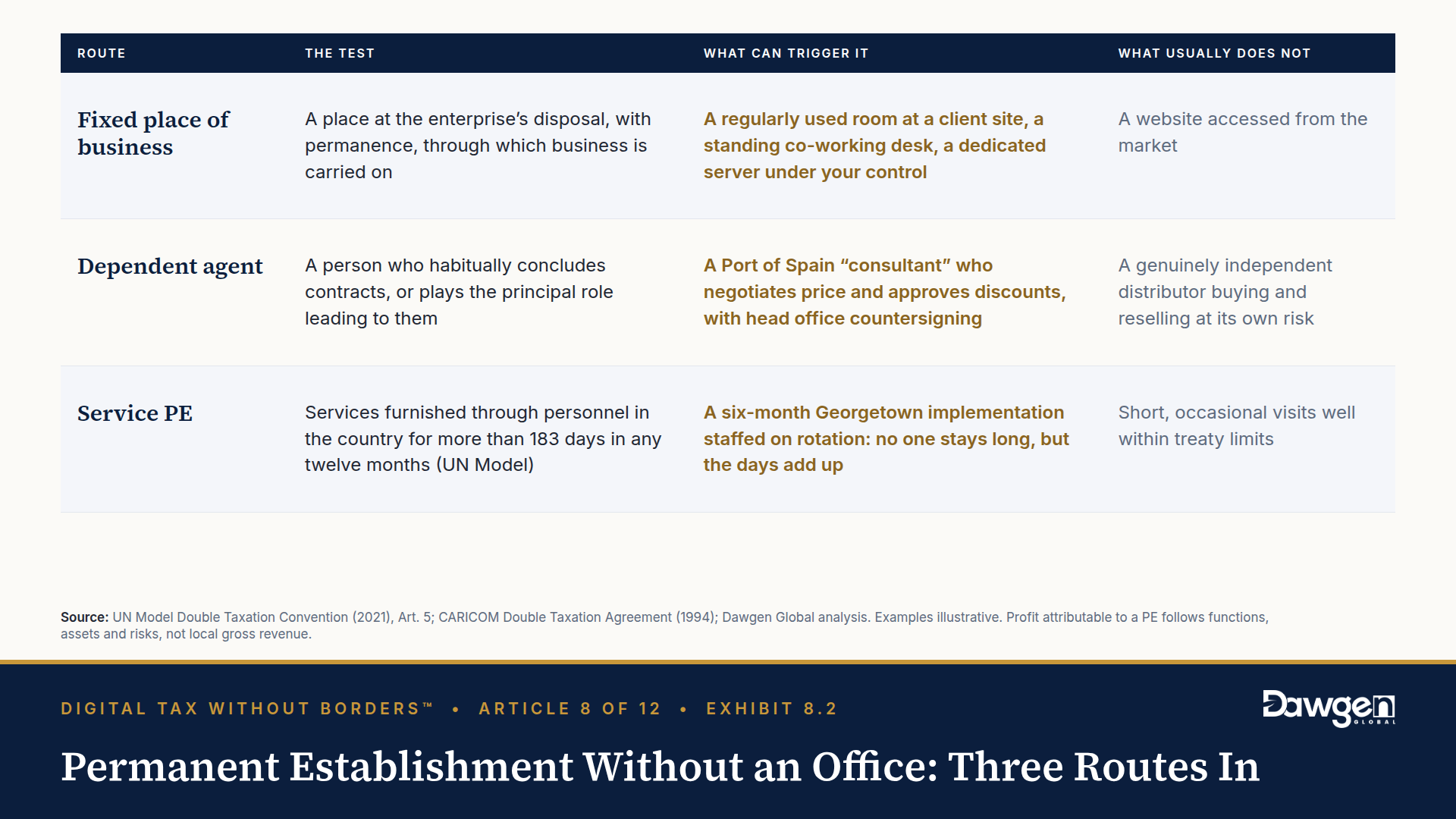
A fixed place PE requires a place of business at the enterprise’s disposal, with a degree of permanence, through which its business is carried on. Beyond an office, a room at a client’s premises used regularly by the firm’s staff, a standing co-working desk or a dedicated server under the firm’s control can qualify. A website is not a place of business; accessing it from Kingston does not put its Barbadian owner in Jamaica.
Dependent agent
The dependent agent rule catches the business that operates through people rather than premises. Where a person in the market habitually concludes contracts on the enterprise’s behalf, or habitually plays the principal role leading to contracts that are routinely concluded without material modification by the enterprise, a PE arises even if the final signature happens abroad. A “consultant” in Port of Spain who negotiates price and approves discounts, leaving head office to countersign, is exactly what the rule targets.
Service PE
Source-oriented treaties go further. The United Nations (UN) Model Double Taxation Convention treats the furnishing of services, including consultancy services, through employees or other personnel as a PE where the activities continue in the country for more than 183 days in any twelve-month period [5]. The CARICOM agreement is itself source-based in design, and treaties in that tradition give the market country a stronger claim over services performed on its soil. For implementation teams, days on the ground are the metric: a six-month project in Georgetown staffed on rotation can cross the threshold though no individual stays long.
Attributable profit
Establishing a PE is half the answer; the profit attributed to it follows the functions, assets and risks there, not local gross revenue. The same functional facts should drive the transfer pricing of any local affiliate, so that the two analyses tell one story.
The quiet triggers: remote staff, home offices and resellers
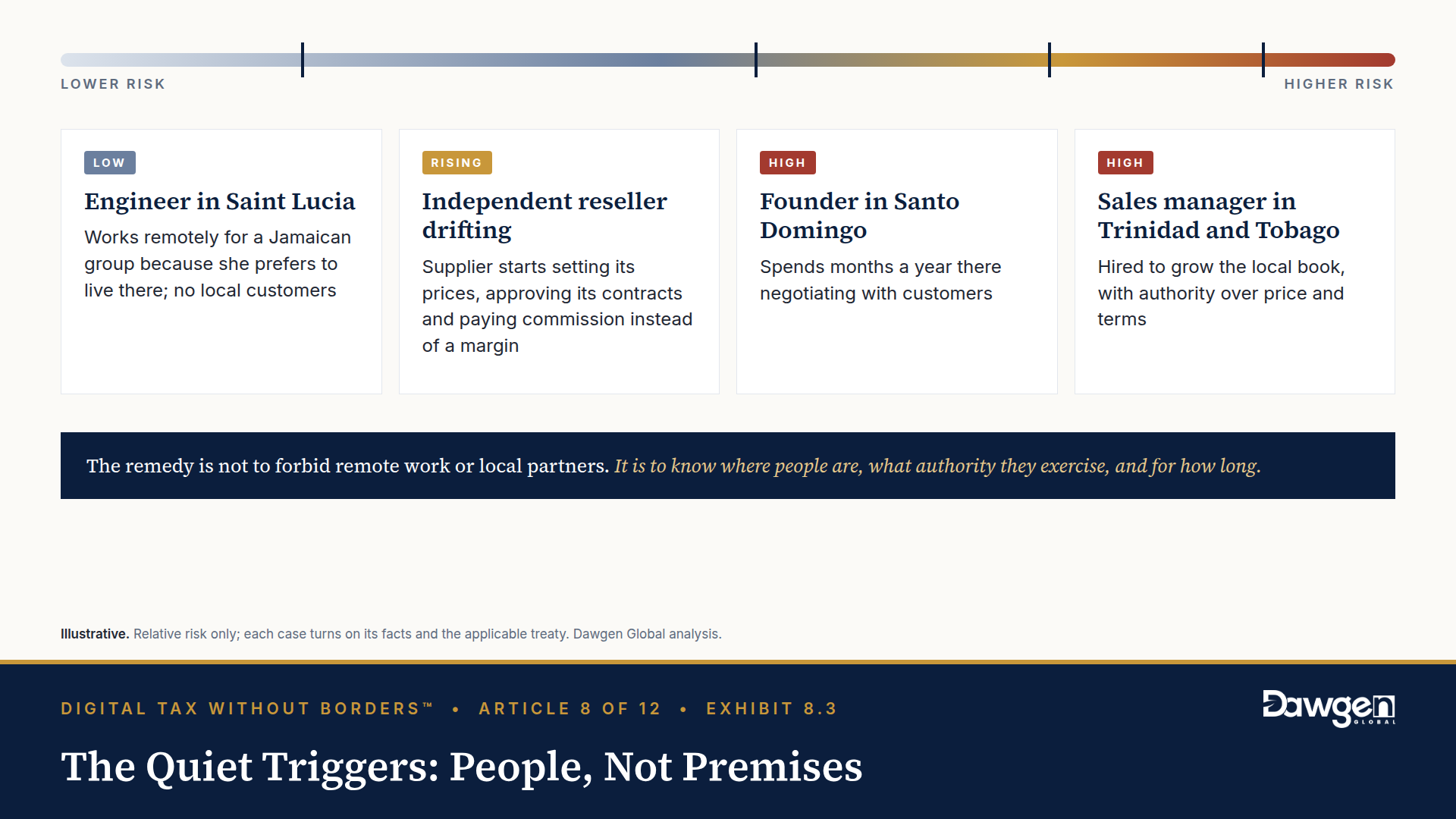
The PE cases we see most often in the region are caused not by strategy but by human resources decisions and sales incentives nobody reported to tax.
Remote employees are the first. A home office in another island is not automatically a PE, but it can become one. The international view weighs whether the home is effectively at the enterprise’s disposal, how much working time is spent there, and whether the enterprise has a commercial reason for the person to be there, such as serving local customers. An engineer in Saint Lucia working for a Jamaican group because she prefers to live there is a low risk. A sales manager in Trinidad and Tobago hired to grow the local book is a much higher one.
Founders are the second: a managing director who spends months a year in Santo Domingo negotiating with customers can create a PE through his own conduct.
Resellers are the third. An independent distributor that buys subscriptions in its own name and resells them at its own risk is not a PE of the supplier; it is a customer. But arrangements drift. Once the supplier sets the reseller’s prices, approves its contracts, pays it a commission rather than allowing a margin, and lets it present itself as the supplier’s local team, the reseller begins to look like a dependent agent. The contract rarely changes with it.
The remedy is not to forbid remote work or local partners, but to know where people are, what authority they exercise and for how long.
Colombia’s SEP and the spread of market-based nexus
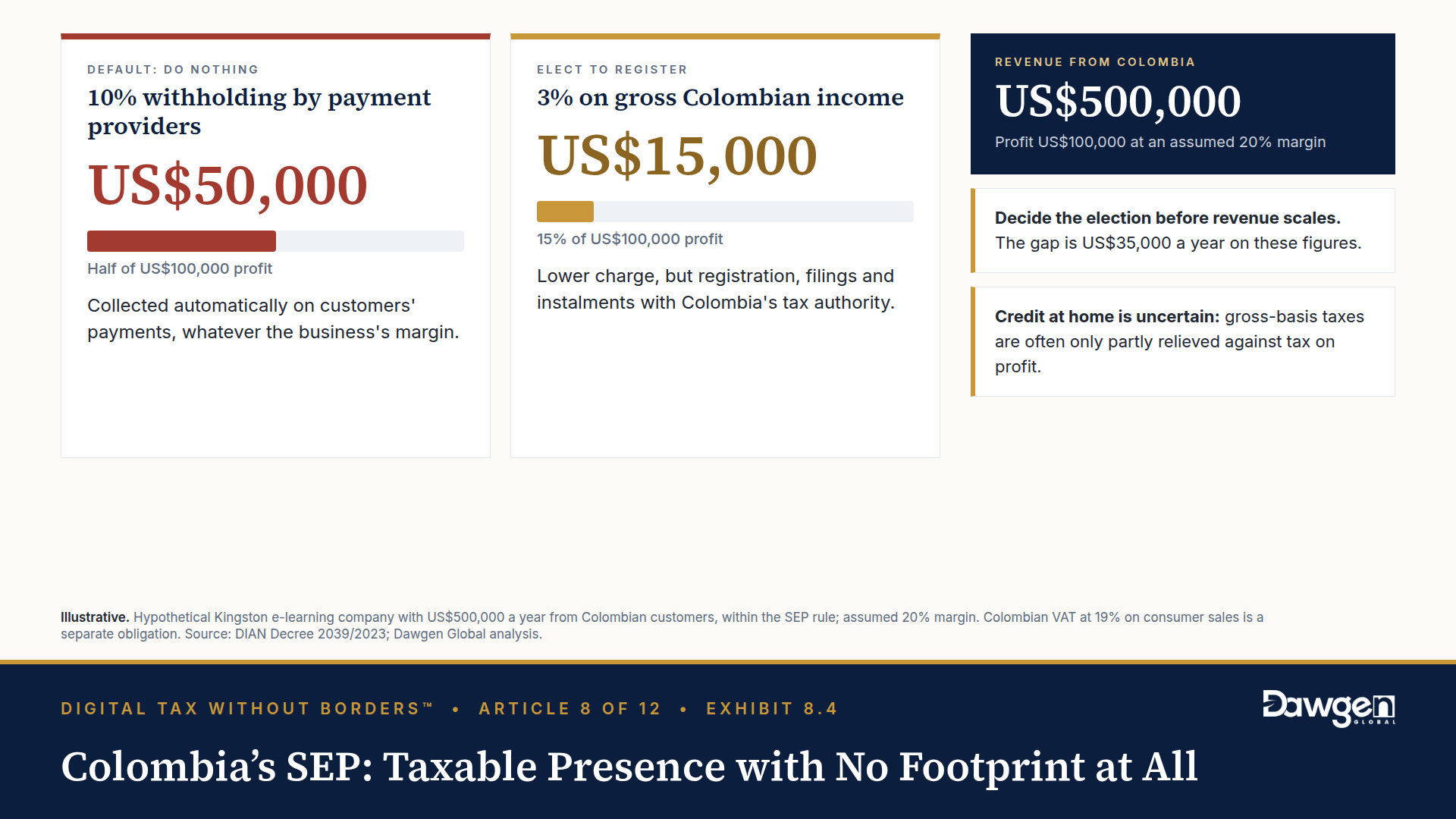
Colombia offers the clearest regional example of nexus without any physical footprint. From 1 January 2024, non-residents that have a significant economic presence in Colombia, broadly deliberate and systematic interaction with the Colombian market combined with revenue from Colombian customers above a set threshold, are subject to income tax on that revenue [6]. They choose between 10 per cent withholding by the payment providers processing their customers’ payments and registering with Colombia’s tax authority and paying 3 per cent on their gross Colombian income.
An illustrative comparison shows why the choice matters. Assume a Kingston-based e-learning company earning US$500,000 a year from Colombian customers falls within the rule. If it does nothing, payment providers withhold 10 per cent, or US$50,000. If it registers for the 3 per cent regime, it pays US$15,000 and takes on filings. On an assumed 20 per cent margin, profit is US$100,000: the elective charge takes 15 per cent of it, default withholding half. Whether either is creditable at home is a separate question; gross-basis taxes are often only partly relieved. Consumer sales also attract Colombian VAT at 19 per cent, a different nexus entirely.
DSTs apply similar logic to the largest groups. The United Kingdom charges 2 per cent on search, social media and marketplace revenue from United Kingdom users above group thresholds [11], and France charges 3 per cent. Canada enacted a DST and then repealed it in March 2026, with effect from 20 June 2024, refunding the tax paid [12]. These taxes do not reach a typical Caribbean firm, but they show the direction of policy: where multilateral agreement fails, market countries legislate alone [7].
Law in force vs proposal. Amount A of OECD Pillar One, designed to give market countries a share of the residual profit of the largest groups without physical presence, has stalled. The Multilateral Convention text was released on 11 October 2023 but has never opened for signature, and the Inclusive Framework co-chairs reported in January 2025 that there had been no further developments since June 2024. The live negotiation on source taxation of services has moved to the UN Framework Convention on International Tax Cooperation, whose draft Protocol 1 on cross-border services was released in July 2026 [8].
A market entry map
The practical question for a Jamaican or Barbadian software or services firm is how to enter each neighbouring market without creating obligations it has not priced. The exhibit sets out the main nexus points by market as at September 2026. It is a starting map, not a substitute for local law on the facts.
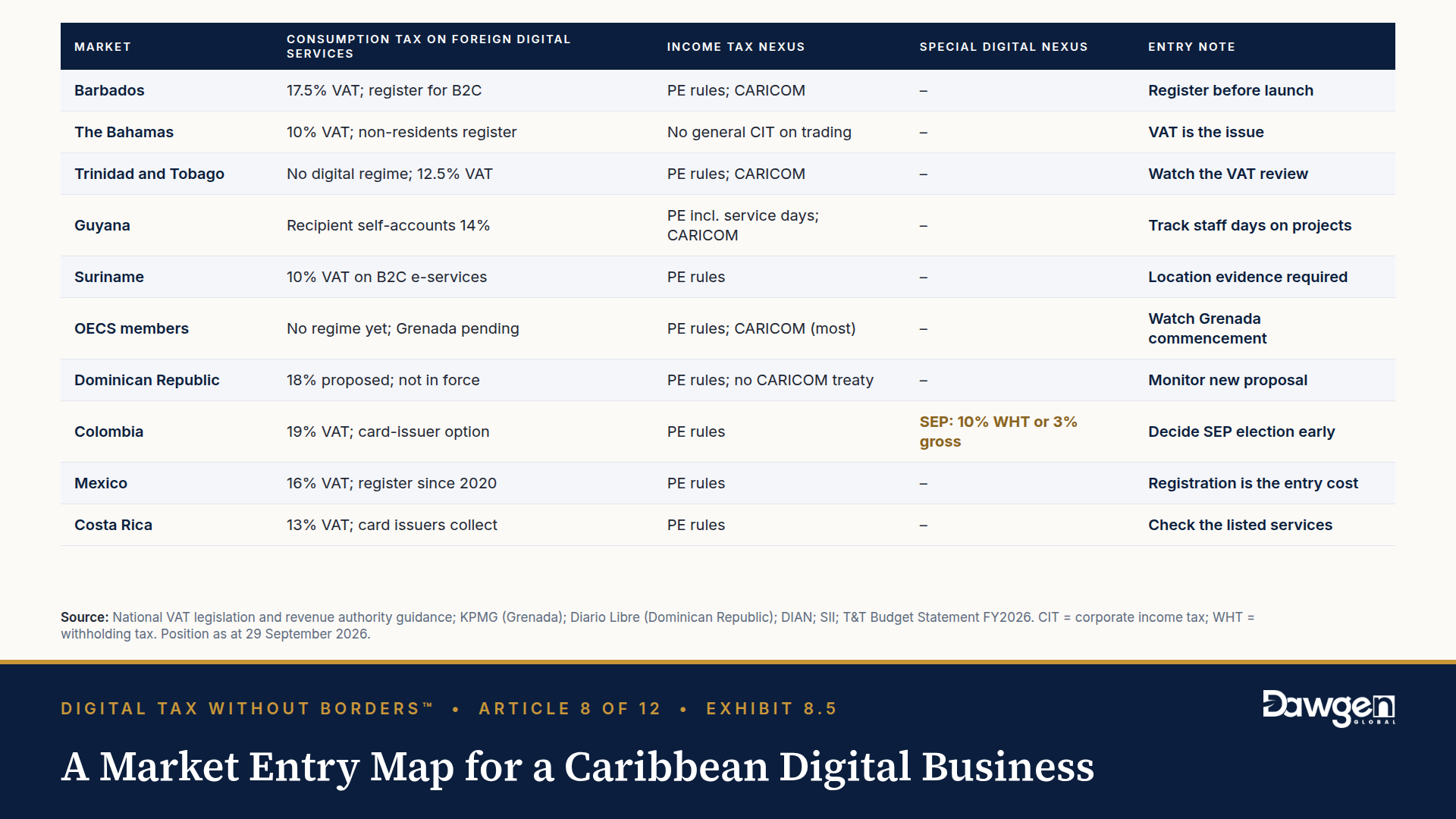
The route matters as much as the market. Remote selling keeps income tax nexus low and concentrates the burden in indirect tax. An independent reseller shifts obligations to a third party but must stay genuinely independent. A local employee or agent with contracting authority is the fastest way to create a PE. A subsidiary removes PE uncertainty for the parent but brings payroll, filings and transfer pricing. The right route is the one the business can operate honestly and document.
Change triggers: keeping the conclusion current
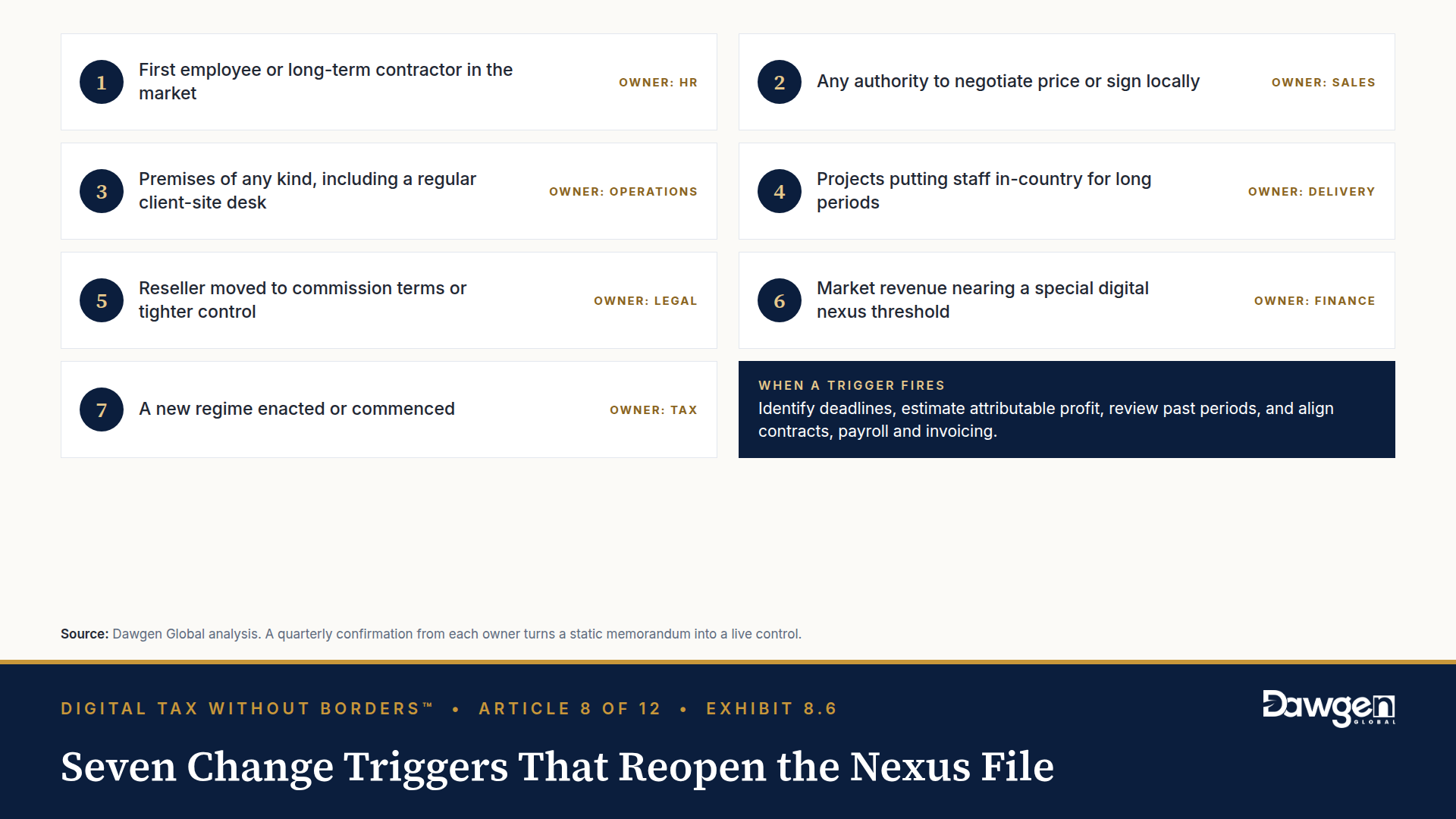
A nexus conclusion is correct only for the facts on which it rests, and those facts change faster than the law. Every market entry decision should list the events that send it back for review, each with an owner:
- the first employee or long-term contractor located in the market, including a remote worker;
- any grant of authority to negotiate price or terms, or to sign, in the market;
- premises of any kind, including a regularly used desk at a client site or co-working space;
- implementation or consulting projects expected to put staff in the country for extended periods;
- conversion of a reseller to commission terms, or any increase in the supplier’s control over its pricing and contracts;
- revenue from the market crossing a level that may bring in a special digital nexus rule, such as Colombia’s SEP;
- enactment or commencement of a relevant regime, such as Grenada’s VAT amendment or Jamaica’s digital GCT measure;
Human resources, sales and legal will see these triggers first; a quarterly confirmation from each turns a static memorandum into a live control. A website advertising “our Port of Spain team” when the tax file says all operations are in Kingston invites exactly the wrong question.
When a review finds likely presence, act: identify deadlines, estimate attributable profit, consider past periods, and align contracts, payroll and invoicing with the actual operation.
The Dawgen Digital Tax COMPASS™
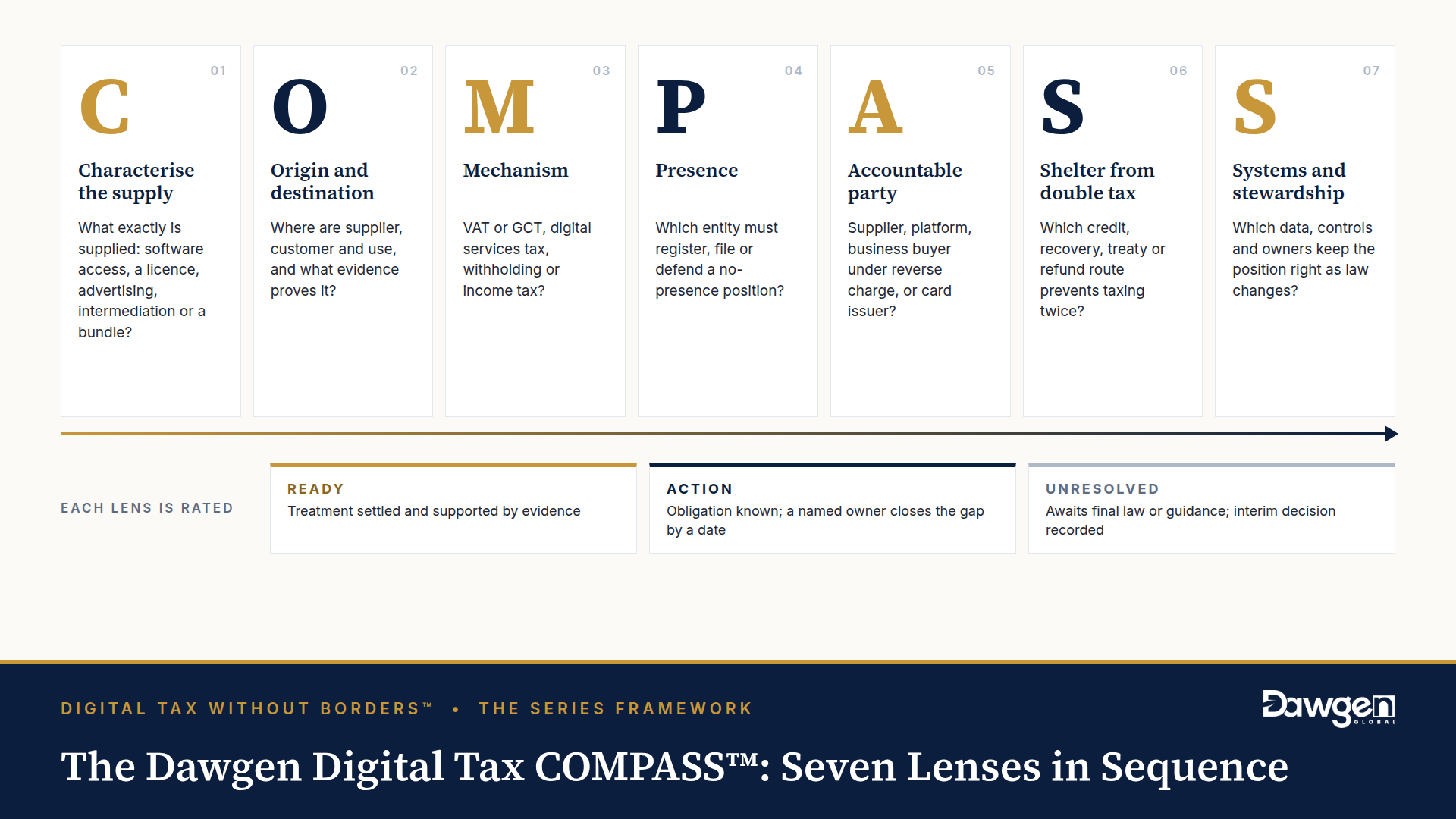
The Dawgen Digital Tax COMPASS™ is the method Dawgen Global uses to turn the broad phrase “digital tax” into specific, answerable questions. It works transaction by transaction, and it applies equally to what a business buys and what it sells. Seven lenses are applied in sequence, because each answer depends on the one before it.
- C — Characterise the supply. What exactly is supplied: access to software, a licence of intellectual property, advertising, intermediation, a professional service delivered remotely, or a bundle of several? The contract and the actual performance decide, not the invoice description.
- O — Origin and destination. Where are the supplier, the customer and the place of use or consumption, and what evidence proves it? Billing address, card country, IP address and contract terms often disagree.
- M — Mechanism. Which tax is in play: VAT or GCT on consumption, a gross-revenue digital services tax, withholding tax on the payment, or income tax on profits? Each has a different taxpayer, base and remedy.
- P — Presence. Which entity has a taxable connection with which jurisdiction, and must it register, file or defend a no-presence position?
- A — Accountable party. Who must actually charge, collect or remit: the supplier, a platform deemed to be the supplier, the business customer under a reverse charge, or a payment intermediary?
- S — Shelter from double taxation. Which credit, input tax recovery, treaty provision or refund route prevents the same value being taxed twice, and is it documented?
- S — Systems and stewardship. Which data fields, controls, owners and monitoring routines keep the position right as volumes grow and the law changes?
Each lens is rated on a simple three-tier scale. Ready means the treatment is settled and supported by evidence. Action means the obligation is known and a named owner is fixing a gap by a date. Unresolved means the answer depends on law or guidance that is not yet final, and an interim commercial decision has been recorded. The output is a transaction-level exposure map and an action plan with owners, not a list of countries. The COMPASS™ identifies and prioritises the questions; each material conclusion is then supported by the law of the jurisdiction concerned.
Applying the COMPASS™ to taxable presence
| Lens | What to ask in this context | Evidence to hold |
| Characterise | What is sold in each market, and does it involve services performed locally or purely remote delivery? | Product and service catalogue, statements of work, implementation plans |
| Origin and destination | Where are customers located, and where are our people when they serve them? | Customer location data, staff location and travel records, remote work register |
| Mechanism | Is the exposure VAT or GCT registration, income tax on a PE, or a special digital levy such as the SEP? | Market-by-market nexus memorandum naming each tax and legal basis |
| Presence | Do we have a fixed place, a dependent agent or service days approaching treaty limits? | Premises register, sales authority matrix, day counts per project |
| Accountable party | Who files and remits in each market: us, a reseller, a card issuer, or the business customer? | Registration certificates, reseller contracts, payment provider withholding statements |
| Shelter | Does a treaty limit the market’s taxing right, and is foreign tax creditable at home? | Treaty analysis, residence certificates, foreign tax credit computation |
| Systems and stewardship | Who monitors the change triggers, and how often? | Trigger list with owners, quarterly confirmations, review log |
Questions for the board
- In which markets do we earn revenue, and for each, have we identified separately our indirect tax, income tax and special digital nexus position?
- Where do our employees and long-term contractors actually live and work, and does tax know about every remote worker outside our home jurisdiction?
- Who in our business has authority to negotiate or agree terms with customers in foreign markets, and where are they when they do it?
- Which implementation or consulting projects will put our staff in another country for extended periods in the next twelve months?
- Are any of our resellers or distributors operating in a way that makes them look like our agents rather than our customers?
- How much revenue do we earn from Colombia and other markets with market-based rules, and have we made a deliberate election rather than accepting default withholding?
- Do our website, proposals and marketing describe a local presence that our tax filings deny?
- Who owns the change trigger list for each market, and when did we last receive a confirmation that nothing has changed?
How Dawgen Global can help
Dawgen Global’s Caribbean Tax Advisory practice helps boards, finance leaders and owner-managers decide how to enter and grow in neighbouring Caribbean and Latin American markets without creating tax presence they have not priced or planned for. Using the Dawgen Digital Tax COMPASS™, we map digital transactions across the jurisdictions in which you operate, separate law in force from proposals, quantify exposure and help your team put in place the contracts, systems and controls to stay compliant as the rules change. To discuss your organisation’s position, contact us at [email protected] or visit www.dawgen.global/contact-us.
This article provides general information and does not constitute tax or legal advice. The application of tax law depends on specific facts and on the law in force at the relevant date; readers should obtain advice before acting.
Abbreviations used
- B2B — business-to-business
- B2C — business-to-consumer
- CARICOM — Caribbean Community
- DST — digital services tax
- FY — fiscal year
- GCT — General Consumption Tax
- IP address — internet protocol address
- OECD — Organisation for Economic Co-operation and Development
- OECS — Organisation of Eastern Caribbean States
- PE — permanent establishment
- SaaS — software as a service
- SEP — significant economic presence
- UN — United Nations
- VAT — value added tax
Sources
- PwC, “Barbados: Corporate – Other taxes”, Worldwide Tax Summaries, accessed September 2026. https://taxsummaries.pwc.com/barbados/corporate/other-taxes
- The Bahamas Department of Inland Revenue, Value Added Tax Act (consolidated), 2024. https://inlandrevenue.finance.gov.bs/wp-content/uploads/2024/11/Value-Added-Tax-Act.pdf
- VATcalc, “Suriname 10% VAT on foreign digital service providers 2023”. https://www.vatcalc.com/suriname/suriname-10-vat-on-foreign-digital-service-providers-2023/
- Guyana Revenue Authority, “Imported Services”. https://www.gra.gov.gy/tax-services/vat-services/imported-services/
- United Nations, “United Nations Model Double Taxation Convention between Developed and Developing Countries”, 2021 update. https://financing.desa.un.org/sites/default/files/2023-05/UN%20Model_2021.pdf
- Dirección de Impuestos y Aduanas Nacionales (Colombia), Decree 2039 of 2023. https://normograma.dian.gov.co/dian/compilacion/docs/decreto_2039_2023.htm
- Tax Foundation, “Digital Taxation Around the World”, April 2024. https://taxfoundation.org/research/all/global/digital-taxation-around-the-world-2024/
- EY, “UN releases draft Framework Convention on International Tax Cooperation and two early protocols”, Tax Alert, 27 July 2026. https://www.ey.com/en_gl/technical/tax-alerts/un-releases-draft-framework-convention-on-international-tax-cooperation-and-two-early-protocols
- KPMG, “Grenada: Nonresident digital services VAT”, May 2026. https://kpmg.com/us/en/taxnewsflash/news/2026/05/grenada-nonresident-digital-services-vat.html
- Grant Thornton, “Indirect tax guide: Trinidad and Tobago”. https://www.grantthornton.global/en/insights/indirect-tax-guide/indirect-tax—Trinidad_and_Tobago/
- HM Revenue and Customs, “Check if you need to register for Digital Services Tax”. https://www.gov.uk/guidance/check-if-you-need-to-register-for-digital-services-tax
- Finance Canada, “Canada rescinds digital services tax to advance broader trade negotiations with the United States”, 29 June 2025. https://www.canada.ca/en/department-finance/news/2025/06/canada-rescinds-digital-services-tax-to-advance-broader-trade-negotiations-with-the-united-states.html
- Diario Libre, “La DGII trabaja propuesta de ITBIS para plataformas digitales”, 20 May 2026. https://www.diariolibre.com/economia/finanzas/2026/05/20/la-dgii-trabaja-propuesta-de-itbis-para-plataformas-digitales/3538742
About Dawgen Global
Dawgen Global is an independent, integrated multidisciplinary professional services firm headquartered at 47 Trinidad Terrace, New Kingston, Jamaica, serving more than 15 territories across the Caribbean. Founded and led by Dr. Dawkins Brown, Executive Chairman, the firm is independent and not affiliated with any international network. It delivers a full suite of professional services under one roof: audit and assurance; tax advisory; IT and digital transformation; risk management; cybersecurity; actuarial and insurance regulatory advisory; HR advisory; mergers and acquisitions; corporate recovery; business advisory and strategy; accounting BPO and virtual CFO services; and legal process outsourcing.
The proposition is simple: big-firm capability without the big-firm price. Dawgen Global’s integrated approach is built for the specific complexities and opportunities of the Caribbean market, helping organizations make sharper, better-informed decisions that drive measurable progress.
To explore a partnership, reach out:
- Website: dawgen.global
- Email: [email protected]
- WhatsApp (Global): +1 555-795-9071
- Caribbean offices: +1 876-665-5926 | +1 876-929-3670 | +1 876-926-5210


