Digital tax compliance is won or lost in the data captured at checkout and in accounts payable. Caribbean businesses that cannot reproduce the tax treatment of a single transaction are not ready for Jamaica’s 2027 changes or the region’s new registration regimes.
Executive summary
Every digital tax position rests on a handful of data points: what was sold, by which entity, to whom, where that customer was, whether they were a business or a consumer, what was charged, who collected the tax, and how the sale later changed. Those facts are scattered. The checkout knows the card, the customer platform knows the account, the marketplace knows the tax it collected, and the finance team often sees only a net bank deposit.
The region’s rules make the gaps expensive. Suriname requires foreign sellers to prove customer location from indicators such as internet protocol (IP) address, subscriber identity module (SIM) country, card and billing address. Grenada’s new law requires two non-conflicting indicators. Barbados and The Bahamas already expect non-resident suppliers to charge value added tax (VAT). Jamaica plans General Consumption Tax (GCT) on imported digital services from early 2027 and on short-term rental accommodation from 1 April 2027.
This article sets out a minimum viable tax data set, the location evidence to keep, four reconciliations, product mapping governance, a lineage test, exception management, the e-invoicing lessons from Latin America, and the metrics a board should see. The test of readiness is simple: pick any transaction and reproduce its tax treatment from source to return.
A transaction has a life after checkout
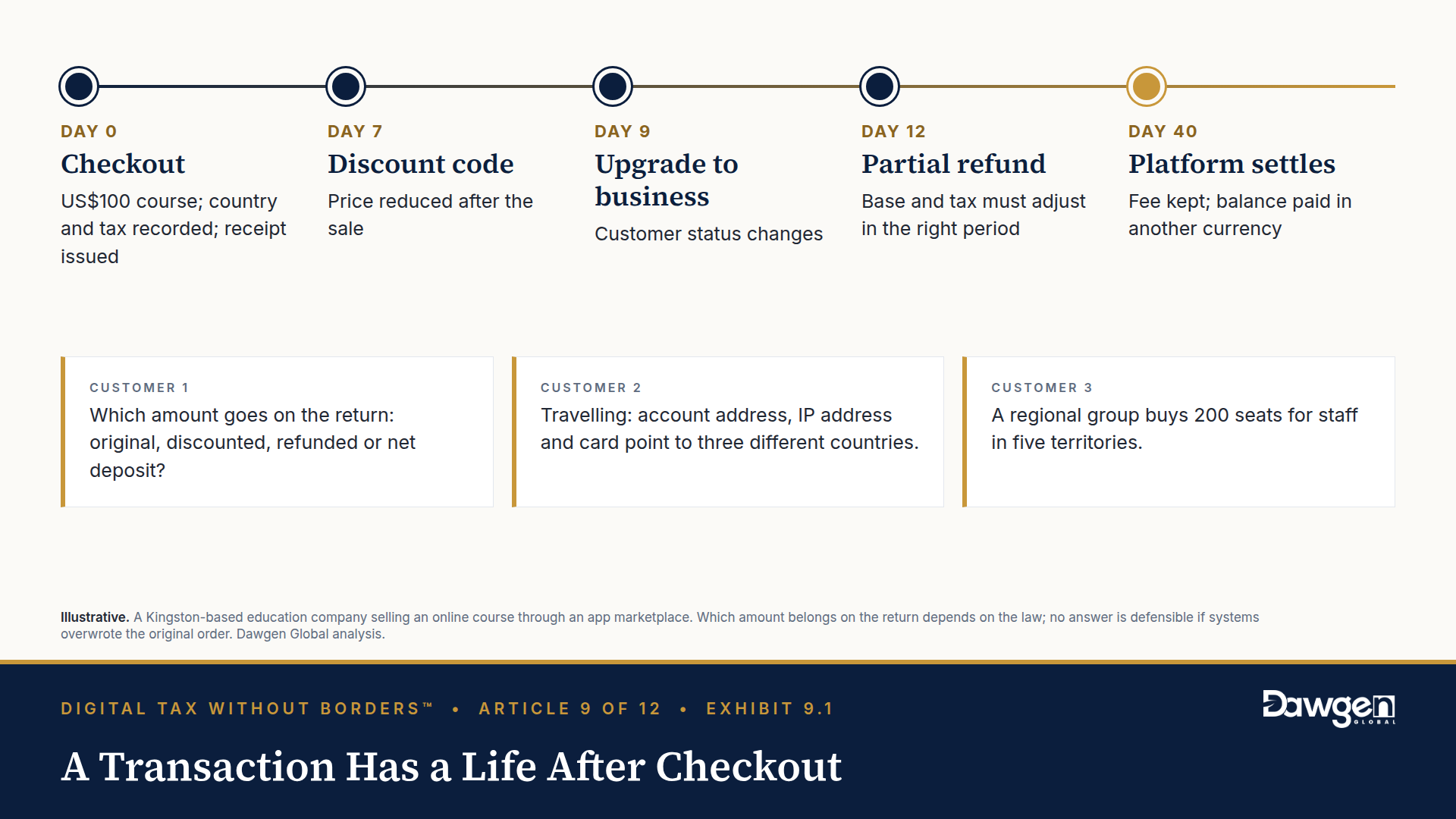
A Kingston-based education company sells an online course for US$100. The checkout records a country and a tax, and issues a receipt. A week later the customer applies a discount code, upgrades to a business account and receives a partial refund. The course was sold through an app marketplace, which kept its fee and settled the balance in another currency a month later.
Which amount belongs on the tax return: the original price, the discounted price, the refunded balance or the net deposit? The answer depends on the governing law, but no answer is defensible if the systems overwrote the original order and kept no audit trail.
A second customer buys the same course while travelling: account address, IP address and card point to three different countries. A third is a regional group buying 200 seats for staff in five territories. These are not edge cases. For a Caribbean digital business, mobile customers and multi-island buyers are the normal book. The tax logic needs a written policy for conflicting indicators and a human review when the standard rule fails.
The Organisation for Economic Co-operation and Development (OECD) international guidelines on VAT and goods and services tax rest on the destination principle: tax follows the place of consumption [1]. The practical consequence is that the tax result depends on evidence the tax team does not capture itself. Product and engineering teams decide what is recorded, and when. Location evidence that was not captured at the moment of sale cannot be recovered later.
The minimum viable tax data set
The exhibit sets out the fields every digital transaction should carry, why each matters and where it usually lives. It applies to sales and, with adaptation, to purchases of foreign digital services.
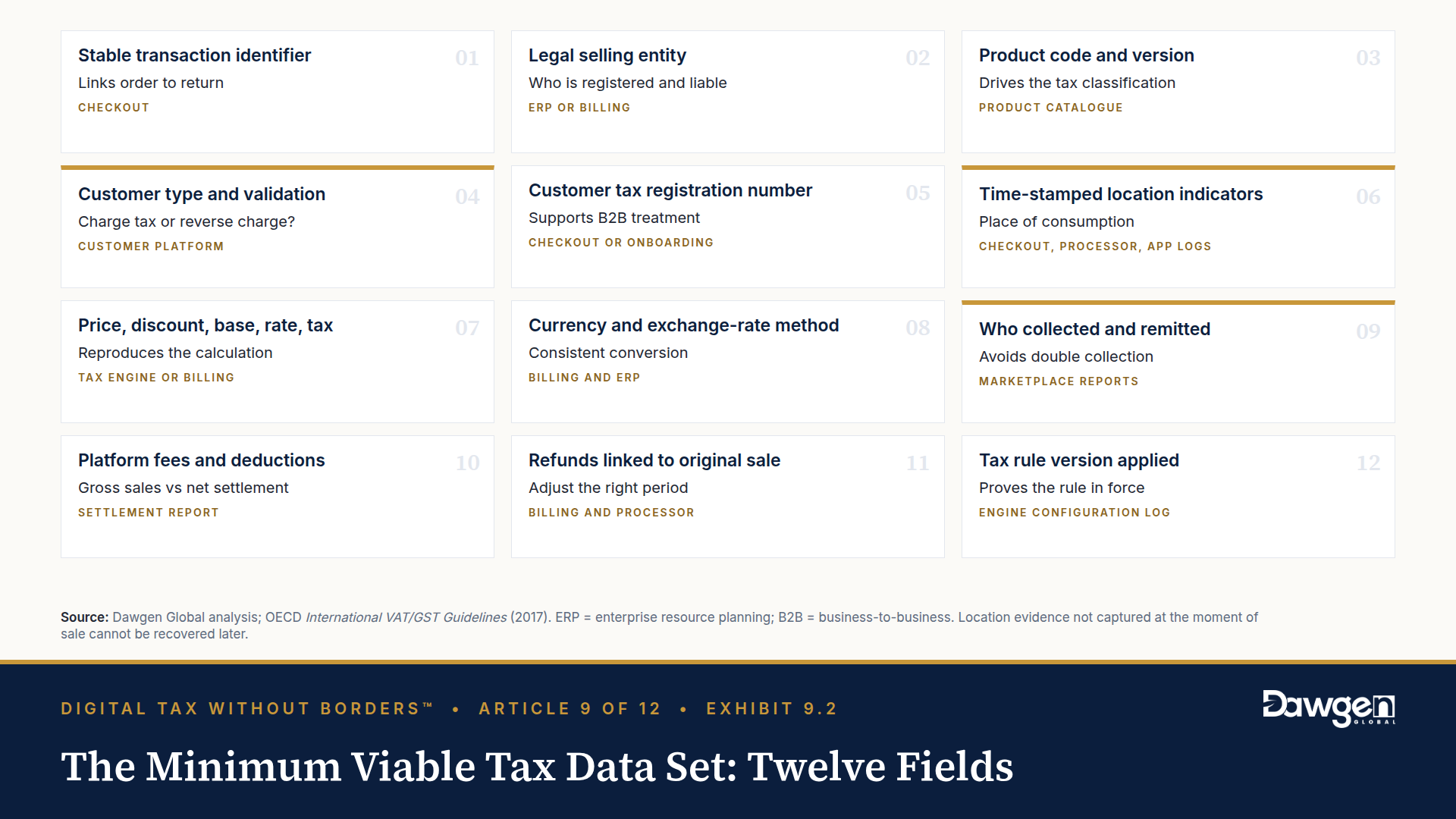
A tax code is an output of the legal analysis, not a substitute for it. A code such as “DIGITAL 15” can hide a mixture of taxable local sales, imported services, reverse charge items and exempt supplies. Each stock-keeping unit (SKU) or service line should map to a documented classification, with bundled treatment explained.
Proving where the customer is
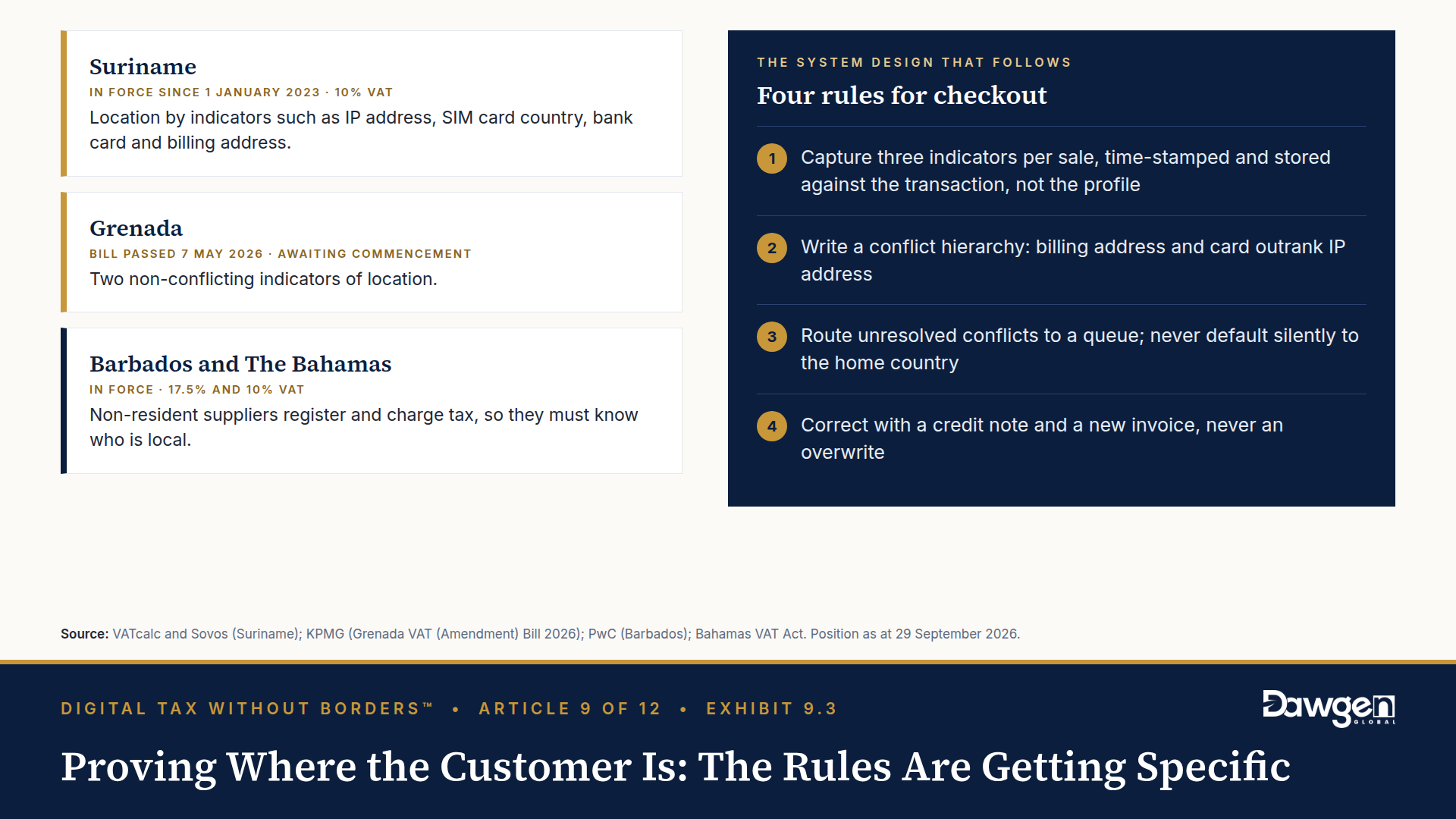
Location evidence is where Caribbean rules are becoming specific, and where most systems are weakest.
Suriname, which introduced VAT at 10 per cent on 1 January 2023 including foreign business-to-consumer (B2C) electronic services, determines customer location by indicators such as IP address, SIM card country, bank card and billing address [2]. Grenada’s VAT (Amendment) Bill 2026, passed by Parliament on 7 May 2026 and awaiting commencement, determines customer location by two non-conflicting indicators [3]. Barbados, which has charged VAT at 17.5 per cent on digital services from foreign suppliers since 1 December 2019, and The Bahamas, at 10 per cent, both require non-resident suppliers to register and charge tax [4][5][9].
The practical design follows directly:
- capture at least three independent indicators at the point of sale, time-stamped and stored against the transaction, not against the customer profile, which will change;
- write a hierarchy for conflicts, for example billing address and card country outranking IP address, and apply it consistently;
- route unresolved conflicts to a queue rather than defaulting silently to the supplier’s home country;
- validate business status at onboarding, and decide in advance what happens when a registration number fails validation or a customer changes status after the sale.
A correction to customer type or location should produce a credit note and a new invoice, not an overwrite. The historical record is the evidence.
Four reconciliations and a lineage test
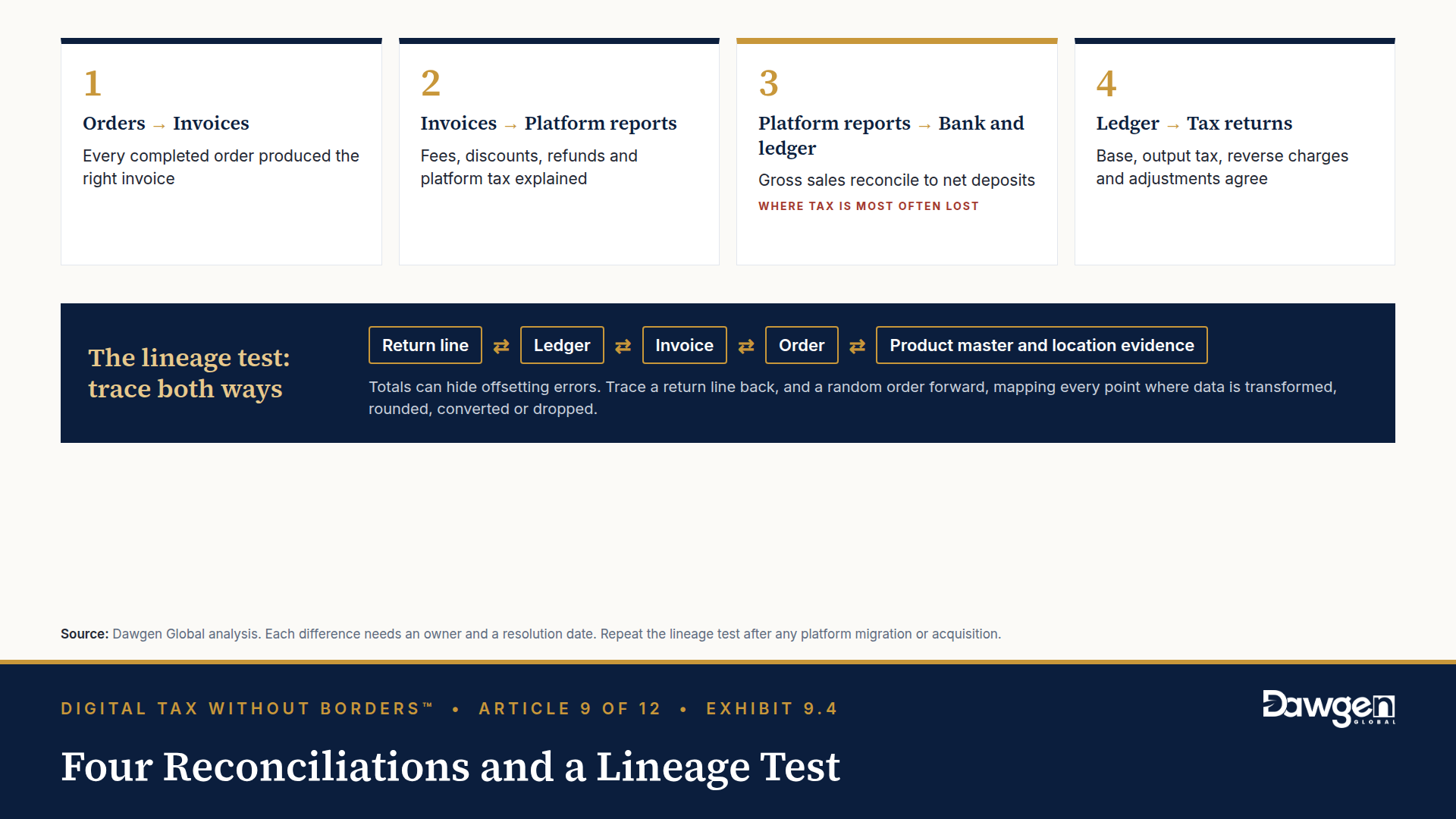
Four reconciliations catch most errors, provided each difference has an owner and a resolution date.
- Orders to invoices: every completed order produced the correct invoice, and cancelled orders left taxable sales.
- Invoices to platform reports: fees, discounts, refunds and platform-collected tax are explained.
- Platform reports to bank and ledger: gross sales reconcile to net deposits after fees, currency movements and chargebacks.
- Ledger to returns: taxable base, output tax, reverse charges, input claims and adjustments reconcile to each filed return.
The third reconciliation is where tax is most often lost. Consider an illustrative month for a small Caribbean app developer selling through a global marketplace.
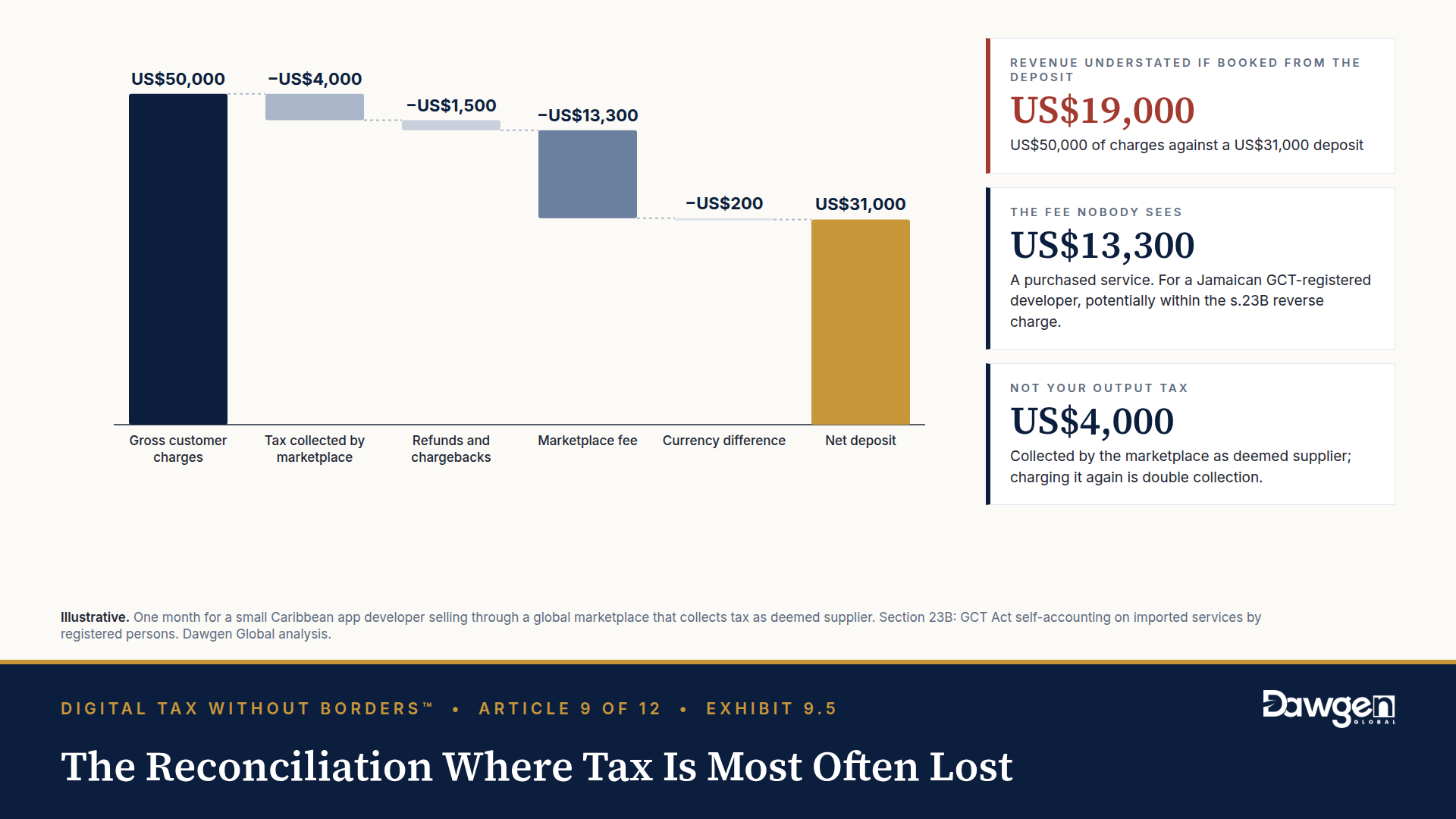
A team working from the US$31,000 deposit understates revenue by US$19,000 and never sees the marketplace fee as an imported service. A Jamaican GCT-registered developer would ordinarily need to consider self-accounting for that fee under section 23B of the GCT Act [6].
Reconciling totals is not enough, because errors can offset. The lineage test works in both directions. Take a return line and trace it back through the ledger, invoice and order to the product master and location evidence. Then take a random order and trace it forward to the return. Map every point where data is transformed, rounded, converted or dropped. Repeat the test after any platform migration or acquisition, when two systems often use the same code name for different treatments.
Product mapping and change control
Digital products change faster than tax codes. A software company adds live support, training or downloadable content without renaming the product; a retailer bundles an app with a device. Tax should sit in the product approval process at the point where the commercial promise changes. The product owner supplies the functionality and contract, tax supplies the classification, and finance tests the resulting invoice.
The mapping must be versioned. Historical invoices must remain reproducible under the rule in force when they were issued, so an ERP tax code overwritten with a new rate destroys the audit trail. Every change should carry a legal source, effective date, test cases run in a non-production environment, approver and first live transaction.
Law changes need the same discipline. A jurisdiction register should record, for each measure, whether it is a proposal, enacted legislation awaiting commencement, or in force with guidance. Grenada is enacted but awaiting commencement. Jamaica’s digital GCT measure is announced but, as far as public sources show, its enabling legislation and Tax Administration Jamaica (TAJ) guidance have not been published [7]. The Dominican Republic has proposed and withdrawn VAT on digital services several times. A static rate table cannot hold those distinctions; a dated register can.
Exceptions, e-invoicing and readiness for Jamaica’s 2027 changes
No tax engine can resolve every mixed contract or conflicting location. The answer is an exception queue with defined categories: missing location evidence, unclassified product, failed business validation, platform tax mismatch, unmatched refund, foreign vendor without contract, and law change pending. Each category needs an owner, a release authority and an ageing target. A documented, timely manual review is a control. An undocumented override is not.
Latin America shows where this is heading. Mexico requires invoices to be validated through authorised providers and reported to the tax authority as they are issued. Chile’s electronic tax documents are transmitted to its tax authority, which sees transactions in close to real time. Costa Rica requires electronic vouchers validated by its Ministry of Finance. In each case the tax authority receives structured transaction data directly, so the reconciliation that a Caribbean business performs once a month becomes, in effect, one the authority can perform at will. The same countries also tax foreign digital services: Mexico at 16 per cent, Chile at 19 per cent and Costa Rica at 13 per cent, the last collected by card issuers on listed services [8]. Regional tax administrations are studying these models, supported by the OECD, World Bank, Inter-American Center of Tax Administrations and Inter-American Development Bank VAT Digital Toolkit for Latin America and the Caribbean [10]. Caribbean businesses that build clean transaction data now will find any future e-invoicing requirement an interface project, not a rebuild.
Jamaica’s 2027 timetable makes readiness concrete. Ministry Paper No. 17, tabled on 12 February 2026, proposes GCT on digital services and intangibles supplied from abroad and consumed in Jamaica, with implementation in the last quarter of fiscal year (FY) 2026/27, January to March 2027, and an expected yield of about J$4.2 billion a year at full implementation [7][11]. Separately, the General Consumption Tax (Amendment of Schedules) Order, 2026 brings short-term rental accommodation into GCT from 1 April 2027 [12].
Key figure. The Jamaican digital GCT measure is projected to raise J$300 million in FY2026/27 and about J$4.2 billion a year from FY2027/28 [11]. The collection mechanism, registration threshold and B2B treatment had not been announced by late September 2026, so systems should be designed to answer whichever model is adopted.
In practice, readiness for Jamaica means being able to identify, for every sale, whether the customer is in Jamaica, whether they are GCT-registered, and whether a platform in the chain may be the liable party. For north coast villa owners and property managers, it means separating accommodation charges from cleaning, tours and other services in booking data before April 2027, and knowing which bookings a platform already handles.
Security, privacy and the metrics that matter
Tax evidence is personal data. Location indicators, account details and card information must be retained for the legally required period, but not collected indiscriminately, and access should be restricted to those who need it. Tax, privacy and cybersecurity owners should agree the design together: capture what the law requires, secure it, and delete it on schedule. Where a platform report is the only record of a transaction, secure a reliable export and back it up. A tax requirement is not a licence to hoard data, and a data breach of tax evidence is still a data breach.
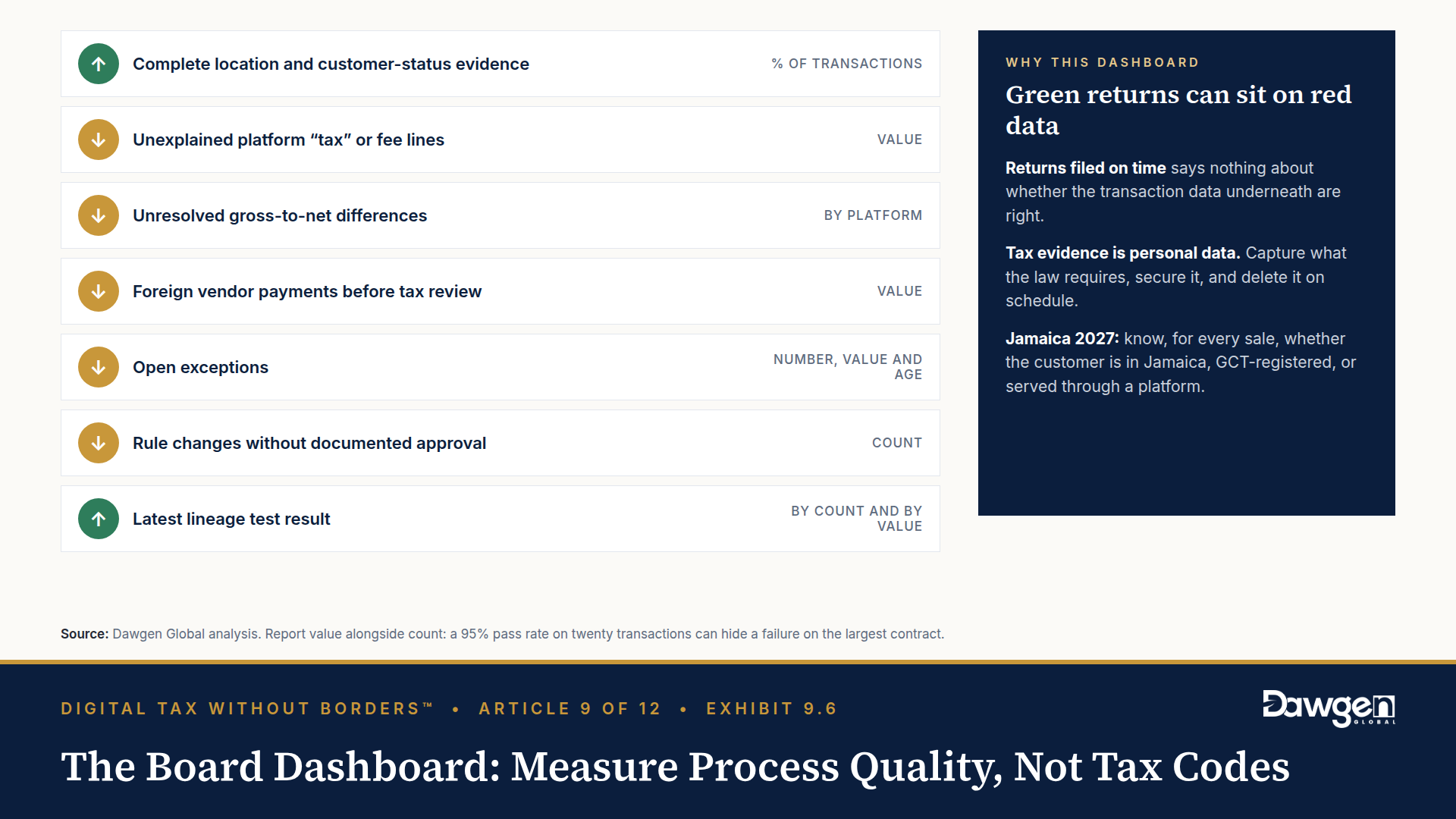
A board dashboard should not show every tax code. It should show process quality:
- the share of transactions with complete location and customer-status evidence;
- the value of unexplained platform “tax” or fee lines;
- unresolved gross-to-net differences by platform;
- payments to foreign digital vendors made before tax review;
- the number, value and age of open exceptions;
- tax code or rule changes made without documented approval;
- the result of the latest lineage test, by count and by value.
A 95 per cent pass rate on a twenty-transaction sample can hide a serious problem if the single failure is the largest enterprise contract, so report value alongside count. A dashboard that shows only returns filed on time can be green while the transaction data underneath are wrong.
The Dawgen Digital Tax COMPASS™
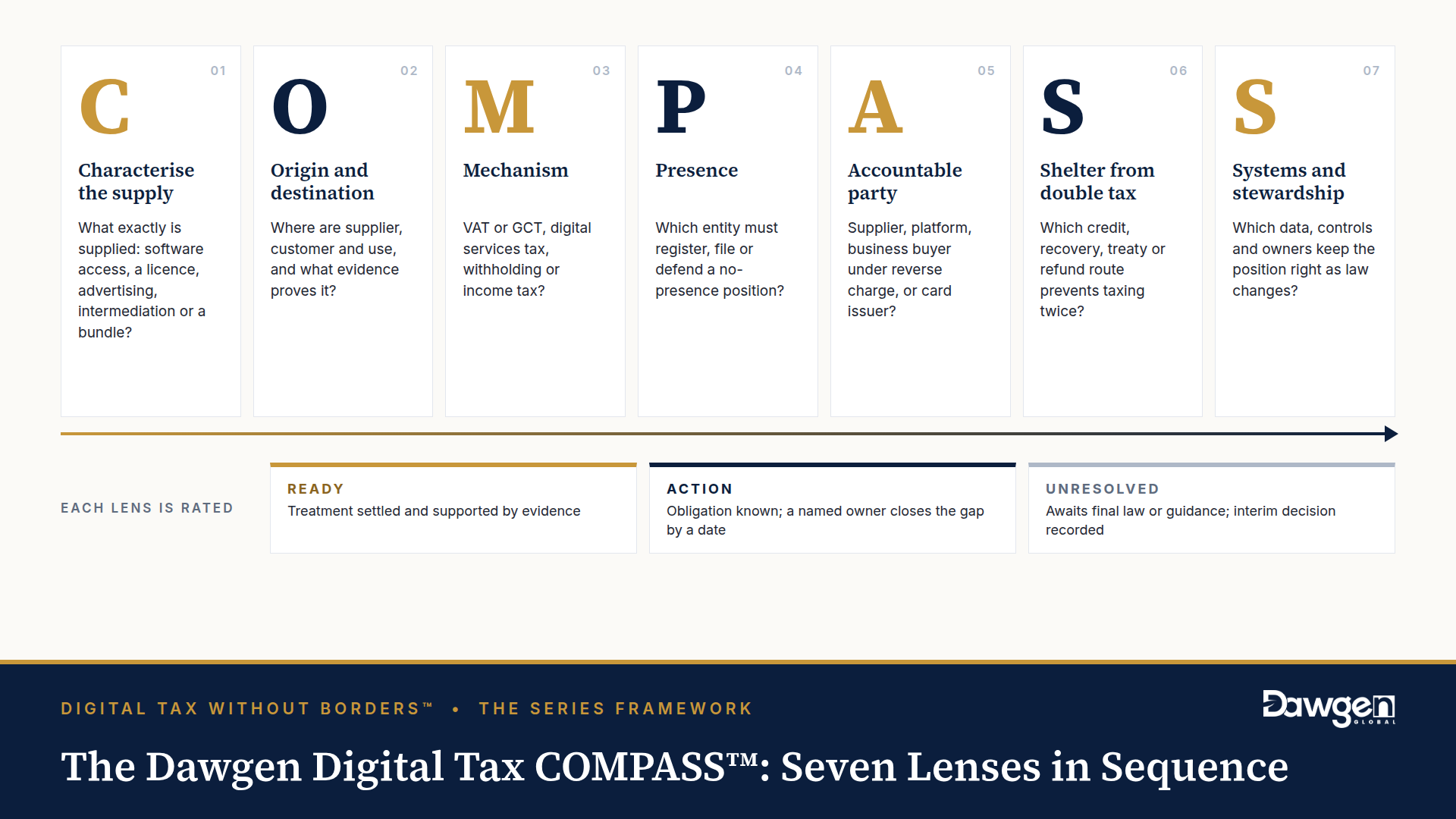
The Dawgen Digital Tax COMPASS™ is the method Dawgen Global uses to turn the broad phrase “digital tax” into specific, answerable questions. It works transaction by transaction, and it applies equally to what a business buys and what it sells. Seven lenses are applied in sequence, because each answer depends on the one before it.
- C — Characterise the supply. What exactly is supplied: access to software, a licence of intellectual property, advertising, intermediation, a professional service delivered remotely, or a bundle of several? The contract and the actual performance decide, not the invoice description.
- O — Origin and destination. Where are the supplier, the customer and the place of use or consumption, and what evidence proves it? Billing address, card country, IP address and contract terms often disagree.
- M — Mechanism. Which tax is in play: VAT or GCT on consumption, a gross-revenue digital services tax, withholding tax on the payment, or income tax on profits? Each has a different taxpayer, base and remedy.
- P — Presence. Which entity has a taxable connection with which jurisdiction, and must it register, file or defend a no-presence position?
- A — Accountable party. Who must actually charge, collect or remit: the supplier, a platform deemed to be the supplier, the business customer under a reverse charge, or a payment intermediary?
- S — Shelter from double taxation. Which credit, input tax recovery, treaty provision or refund route prevents the same value being taxed twice, and is it documented?
- S — Systems and stewardship. Which data fields, controls, owners and monitoring routines keep the position right as volumes grow and the law changes?
Each lens is rated on a simple three-tier scale. Ready means the treatment is settled and supported by evidence. Action means the obligation is known and a named owner is fixing a gap by a date. Unresolved means the answer depends on law or guidance that is not yet final, and an interim commercial decision has been recorded. The output is a transaction-level exposure map and an action plan with owners, not a list of countries. The COMPASS™ identifies and prioritises the questions; each material conclusion is then supported by the law of the jurisdiction concerned.
Applying the COMPASS™ to tax data and systems
| Lens | What to ask in this context | Evidence to hold |
| Characterise | Does every product and service line map to a documented, versioned tax classification? | Product-to-tax-code mapping with change history |
| Origin and destination | Do we capture enough time-stamped location indicators to meet Suriname and Grenada standards, and do we resolve conflicts consistently? | Stored indicators per transaction, written conflict hierarchy, exception log |
| Mechanism | Do our systems distinguish output tax, reverse charge items, platform-collected tax and exempt sales? | Tax code design, return reconciliation |
| Presence | Does our jurisdiction register show where we are registered, where we are approaching obligations, and what is pending? | Dated jurisdiction register with status for each measure |
| Accountable party | Can we see, transaction by transaction, whether we or a platform collected the tax? | Platform settlement reports reconciled to invoices |
| Shelter | Are reverse charge and input tax entries on foreign purchases supported by invoices and linked to taxable activity? | Accounts payable tax file, input tax workpapers |
| Systems and stewardship | Can we reproduce any transaction end to end, and who owns each reconciliation and exception category? | Lineage test results, reconciliation sign-offs, exception ageing report |
Questions for the board
- If a tax authority selected one of our digital transactions at random tomorrow, could we reproduce its tax treatment from source evidence to filed return?
- What share of our online sales carry complete, time-stamped customer location and business-status evidence?
- How much of our revenue arrives through platforms, and do we reconcile gross sales, platform tax and fees, or only net deposits?
- Who approves changes to tax codes and product mappings, and can we show the rule that applied on any historical date?
- Are our systems ready to identify Jamaican customers, their GCT status and any liable platform before the planned 2027 commencement?
- How many tax exceptions are open, what are they worth, and how long have the oldest been waiting?
- How is the personal data we hold as tax evidence secured, who can see it, and when is it deleted?
- If a Latin American-style e-invoicing requirement arrived in our markets, would it be an interface project or a rebuild?
How Dawgen Global can help
Dawgen Global’s Caribbean Tax Advisory practice helps boards, finance leaders and owner-managers build the transaction data, reconciliations and controls that make digital tax positions provable, from checkout and accounts payable to the filed return. Using the Dawgen Digital Tax COMPASS™, we map digital transactions across the jurisdictions in which you operate, separate law in force from proposals, quantify exposure and help your team put in place the contracts, systems and controls to stay compliant as the rules change. To discuss your organisation’s position, contact us at [email protected] or visit www.dawgen.global/contact-us.
This article provides general information and does not constitute tax or legal advice. The application of tax law depends on specific facts and on the law in force at the relevant date; readers should obtain advice before acting.
Abbreviations used
- B2B — business-to-business
- B2C — business-to-consumer
- ERP — enterprise resource planning
- FY — fiscal year
- GCT — General Consumption Tax
- IP — internet protocol
- OECD — Organisation for Economic Co-operation and Development
- SIM — subscriber identity module
- SKU — stock-keeping unit
- TAJ — Tax Administration Jamaica
- VAT — value added tax
Sources
- Organisation for Economic Co-operation and Development, “International VAT/GST Guidelines”, 2017. https://www.oecd.org/en/publications/international-vat-gst-guidelines_9789264271401-en.html
- VATcalc, “Suriname 10% VAT on foreign digital service providers 2023”. https://www.vatcalc.com/suriname/suriname-10-vat-on-foreign-digital-service-providers-2023/
- KPMG, “Grenada: Nonresident digital services VAT”, May 2026. https://kpmg.com/us/en/taxnewsflash/news/2026/05/grenada-nonresident-digital-services-vat.html
- PwC, “Barbados: Corporate – Other taxes”, Worldwide Tax Summaries, accessed September 2026. https://taxsummaries.pwc.com/barbados/corporate/other-taxes
- The Bahamas Department of Inland Revenue, Value Added Tax Act (consolidated), 2024. https://inlandrevenue.finance.gov.bs/wp-content/uploads/2024/11/Value-Added-Tax-Act.pdf
- Tax Administration Jamaica, Technical Bulletin, “Accounting for GCT on Imported Services”, 23 April 2020. https://www.jamaicatax.gov.jm/documents/10181/17838406/Technical+Bulletin+(2020)+-+GCT+Imported+Services_23042020.pdf/547fce5a-fa9c-1481-ec55-6d8e40456f08
- EY, “Jamaica proposes extending General Consumption Tax to digitally supplied services and intangibles from abroad”, Tax Alert, 25 February 2026. https://www.ey.com/en_gl/technical/tax-alerts/jamaica-proposes-extending-general-consumption-tax-to-digitally-supplied-services-and-intangibles-from-abroad
- Servicio de Impuestos Internos (Chile), “VAT on digital services: frequently asked questions”. https://www.sii.cl/vat/faq1_esp.html
- VATcalc, “Bahamas VAT on foreign digital services”. https://www.vatcalc.com/bahamas/bahamas-vat-on-foreign-digital-services/
- Inter-American Center of Tax Administrations, “New toolkit to strengthen value-added taxes on e-commerce in Latin America and the Caribbean”, 23 June 2021. https://www.ciat.org/new-toolkit-to-strengthen-value-added-taxes-on-e-commerce-in-latin-america-and-the-caribbean/?lang=en
- Jamaica Information Service, “Gov’t projects $29.4B from new revenue measures in fiscal year 2026/27”, February 2026. https://jis.gov.jm/govt-projects-29-4b-from-new-revenue-measures-in-fiscal-year-2026-27/
- The Gleaner, “Airbnb and short-term rentals to face GCT from April 2027”, 30 April 2026. https://jamaica-gleaner.com/article/news/20260430/airbnb-and-short-term-rentals-face-gct-april-2027
About Dawgen Global
Dawgen Global is an independent, integrated multidisciplinary professional services firm headquartered at 47 Trinidad Terrace, New Kingston, Jamaica, serving more than 15 territories across the Caribbean. Founded and led by Dr. Dawkins Brown, Executive Chairman, the firm is independent and not affiliated with any international network. It delivers a full suite of professional services under one roof: audit and assurance; tax advisory; IT and digital transformation; risk management; cybersecurity; actuarial and insurance regulatory advisory; HR advisory; mergers and acquisitions; corporate recovery; business advisory and strategy; accounting BPO and virtual CFO services; and legal process outsourcing.
The proposition is simple: big-firm capability without the big-firm price. Dawgen Global’s integrated approach is built for the specific complexities and opportunities of the Caribbean market, helping organizations make sharper, better-informed decisions that drive measurable progress.
To explore a partnership, reach out:
- Website: dawgen.global
- Email: [email protected]
- WhatsApp (Global): +1 555-795-9071
- Caribbean offices: +1 876-665-5926 | +1 876-929-3670 | +1 876-926-5210


