The finding
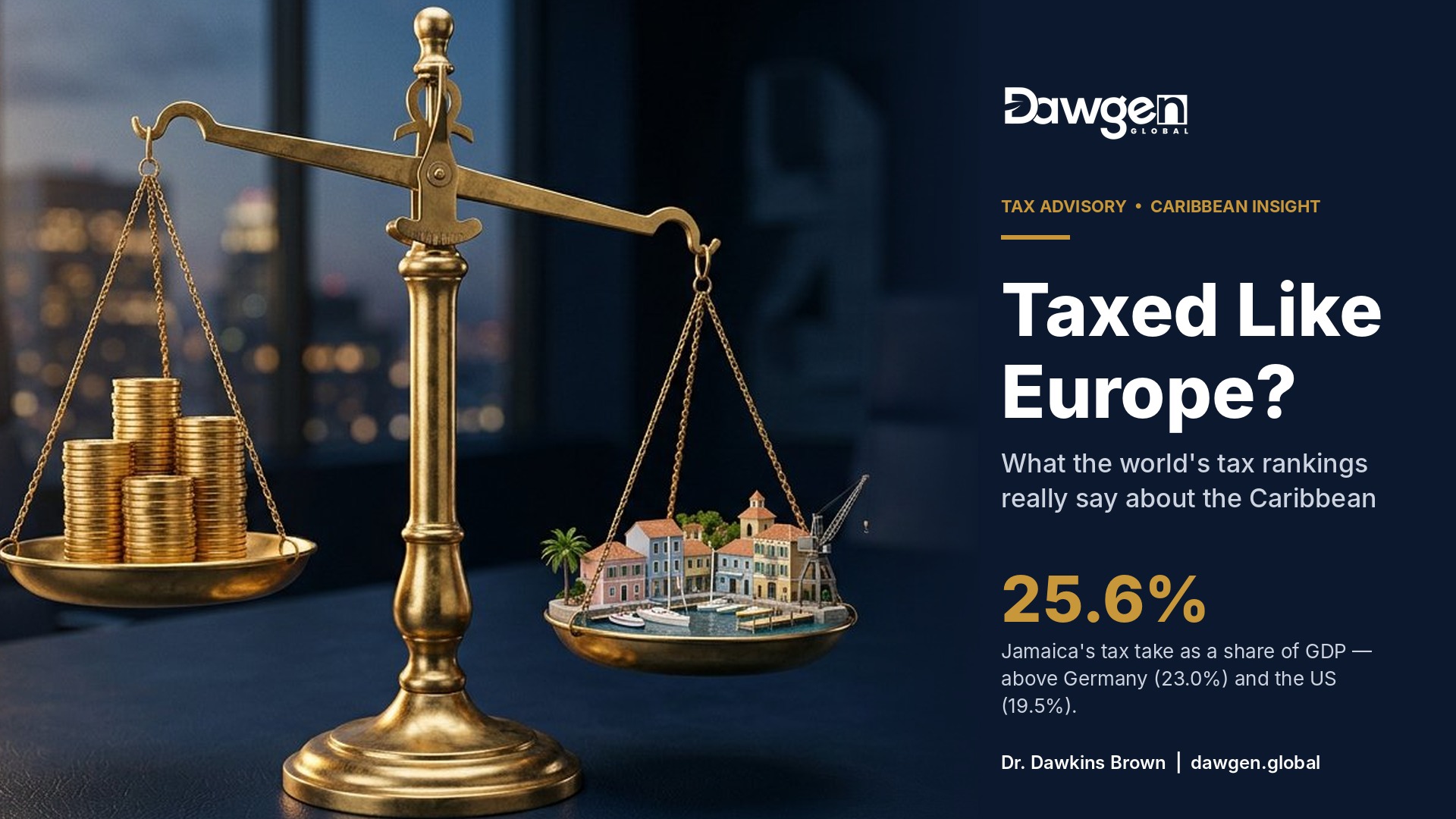
Jamaica collects tax equal to 25.6% of its GDP — more, as a share of its economy, than the United States (19.5%), Germany (23.0%), Japan (20.2%) or Switzerland (20.0%). Barbados, at 27.8%, collects more than Greece and sits on the global top-20 list beside the Nordic welfare states. That is the Caribbean story hidden inside Visual Capitalist’s new ranking of the world’s most and least taxed countries, built on IMF data for 2024.
The headline chart is about Europe. Denmark leads the world at 45.3%, more than double the US share, and seven of the top ten are European. At the other end, Libya (1.2%), Kuwait (1.4%) and Iraq (1.7%) barely tax at all. The global average is 17.6%; the US ranks 80th.
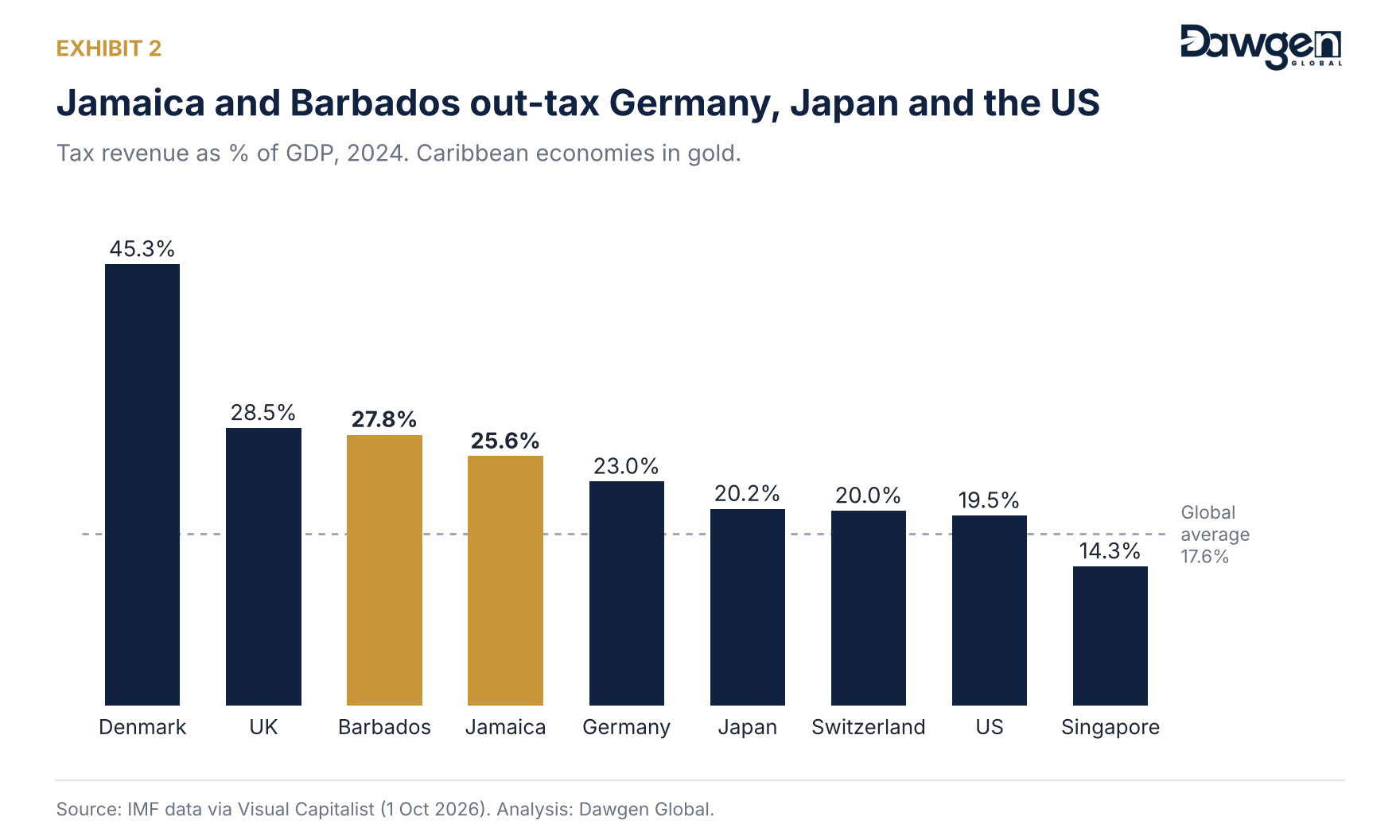
But look past the two lists and the Caribbean appears at both ends of the spectrum. Barbados is in the global top 20. Haiti, at 5.0%, is in the bottom 20. Between them sit fourteen more regional economies whose ratios range from Guyana’s 8.2% to Jamaica’s 25.6% — a spread almost as wide as the gap between Denmark and America.
For boards, finance directors and investors in this region, the ranking raises three practical questions. Is the Caribbean over-taxed or under-taxed? Who actually carries the load? And what does it mean for decisions in 2027 and beyond? This article answers each, and closes with six moves for Caribbean boardrooms.
What the chart measures — and what it leaves out
The ratio is simple: total tax revenue collected by government in 2024, divided by the size of the economy. It counts income, corporate, property, sales and other taxes. It deliberately excludes social security contributions, and it says nothing about who pays.
Three things the number does not tell you matter more to a Caribbean reader than the ranking itself:
- It excludes social security. Denmark funds its welfare state largely through general taxes, so it scores high. France and Germany fund theirs heavily through payroll contributions, which this chart leaves out. In the Caribbean, NIS, NHT, HEART and Education Tax-type levies are real costs to employers but may sit outside or inside the figure depending on classification.
- It ignores non-tax revenue. Oil profit shares, canal fees, citizenship-by-investment receipts and dividends from state enterprises fund governments without appearing as tax. A low ratio can mean a rich state, not a weak one.
- It is an average, not a burden. The ratio spreads collections across the whole economy, formal and informal. Where the tax base is narrow, the compliant taxpayer carries far more than the headline suggests.
Definitions also move the number. Jamaica’s own fiscal papers put tax revenue at roughly 27–28% of GDP on a fiscal-year basis, against the IMF’s 25.6% for calendar 2024. The difference is timing, GDP revisions and coverage, not a contradiction — but it is a reminder to compare like with like.
The Caribbean row the chart leaves out
The global graphic shows only Barbados and Haiti. Pulling every Caribbean economy from the full IMF table gives a fuller picture: nine of sixteen collect a larger share of GDP than the United States, and three fall below the IMF’s 15% development benchmark.
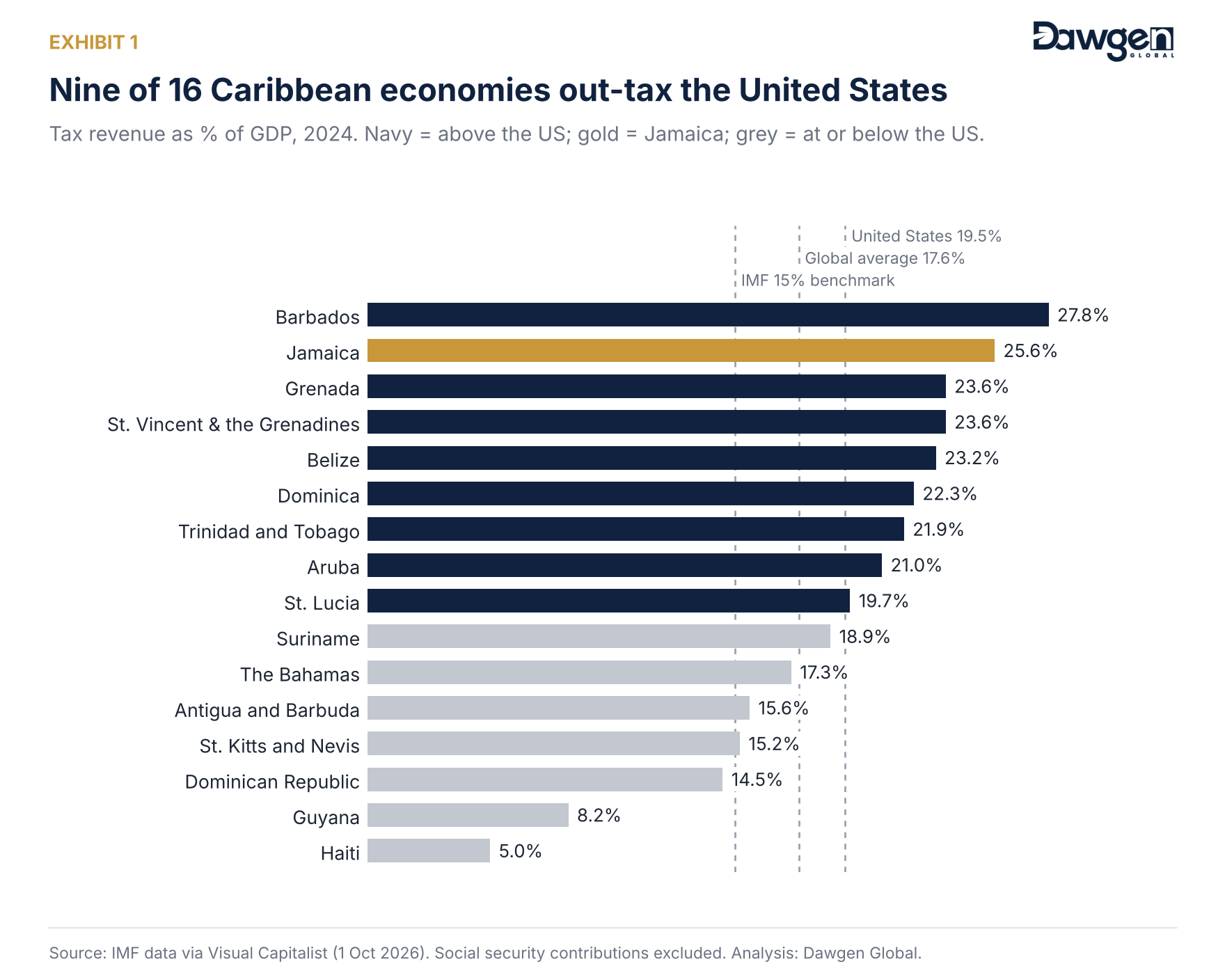
The region’s simple average is 19.0% — above the 17.6% global average. Strip out the two special cases, oil-funded Guyana and fragile Haiti, and the remaining fourteen average 20.7%, close to Japan and Switzerland.
Same ratio, different stories
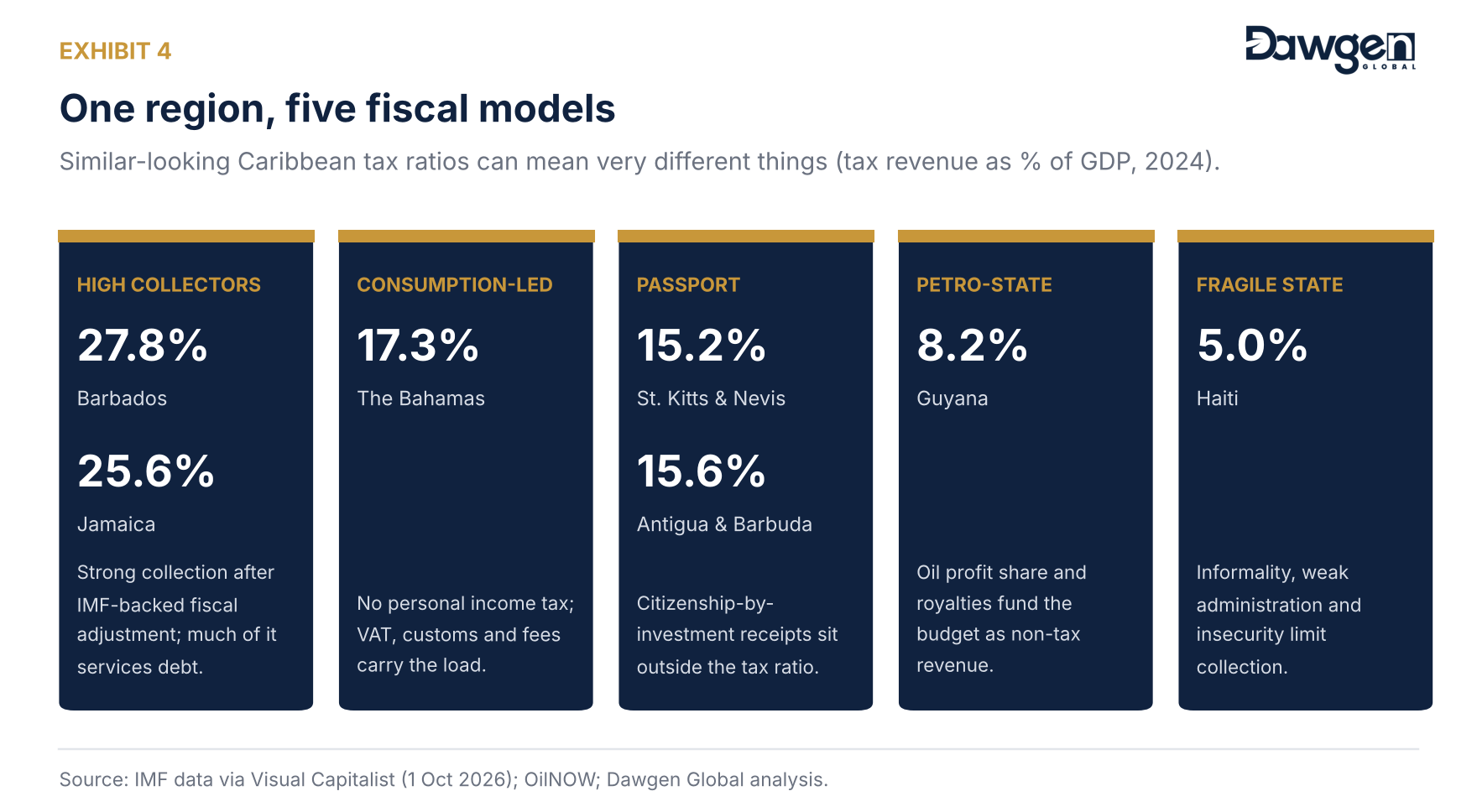
Visual Capitalist makes the key point about the bottom of its list: oil states and fragile states can post identical tax ratios for opposite reasons. The Caribbean contains every one of those stories inside a single region.

The oil story — Guyana (8.2%). Guyana’s low ratio does not signal a weak state; it signals a new petro-state. In 2024 its Natural Resource Fund received about US$2.6 billion in profit oil and royalties, none of which counts as tax. Withdrawals from the fund were budgeted to cover about 29% of the 2024 national budget. Guyana sits in the same statistical neighbourhood as the Gulf, for the same reason.
The passport story — St. Kitts and Nevis (15.2%) and Antigua and Barbuda (15.6%). Both run citizenship-by-investment programmes whose receipts are recorded as non-tax revenue. Their tax ratios understate what government actually collects, and they overstate how much room exists to cut taxes if that non-tax stream weakens.
The fragility story — Haiti (5.0%). Haiti’s ratio puts it alongside Somalia, South Sudan and Yemen. This is the textbook low-capacity case: a large informal economy, limited administration and insecurity that makes collection physically difficult. It is the only Caribbean state on the global bottom-20 list.
The no-income-tax story — The Bahamas (17.3%). The Bahamas levies no personal income tax and relies on VAT, customs and fees. Its ratio lands almost exactly on the global average, but the burden falls almost entirely on consumption and imports.
The Panama contrast (6.7%). Panama, the lowest-taxed economy in the Americas outside Haiti, shows how a territorial tax system and large canal revenues can fund a state with very little conventional tax.
The high-collection story — Barbados (27.8%) and Jamaica (25.6%). These are the region’s strongest tax collectors, ranking joint-19th and joint-28th respectively among the roughly 190 economies in the dataset. Both reached that position through hard fiscal adjustment under IMF-supported programmes, not through European-style social spending.
The ratio is not the burden
A 25.6% ratio in Jamaica and a 23.0% ratio in Germany describe very different experiences for the businesses that pay them. Two features of Caribbean tax systems explain why.
First, the base is narrow. Large informal sectors, generous exemptions and sector incentives remove a big slice of economic activity from the tax net. When the same total is collected from a smaller formal base, each compliant company and salaried worker carries more than the national average implies. The headline ratio therefore understates the effective load on the formal private sector.
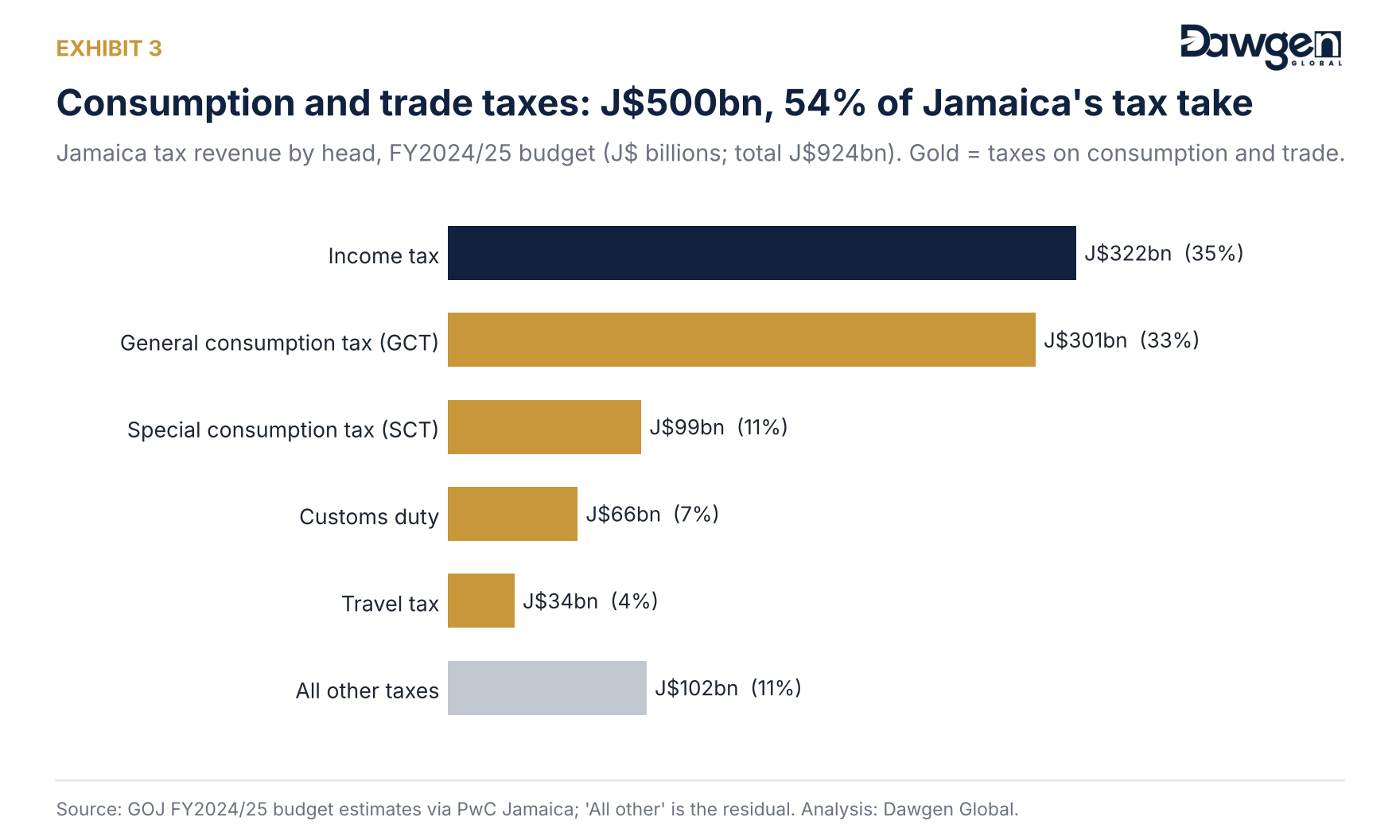
Second, the mix leans on consumption. OECD revenue statistics show that in 2023 value added tax (in Jamaica, GCT) was the single largest source of Jamaica’s tax revenue, at about 30%, with other taxes on goods and services adding about 24%. More than half of all tax therefore comes from what people and firms buy, not what they earn. Jamaica’s 2024/25 budget estimates tell the same story: GCT of about J$301 billion sat almost level with all income taxes combined, at about J$322 billion.
Consumption-heavy systems have real strengths. They are harder to evade, less damaging to investment and quick to collect. But they bring three costs that matter at board level:
- Cash flow. Taxes paid at the border and in advance — Jamaica adds a 5% advance GCT on commercial imports — tie up working capital long before a sale is made.
- In import-dependent island economies, consumption taxes flow straight into the shelf price, and so into wage demands and margins.
- Lower-income households spend a larger share of income, so they carry a larger share of a consumption-led system. That shapes political pressure for exemptions, which narrows the base again.
A Caribbean company should never benchmark its tax position off the national ratio.
The right measures are its own effective tax rate, its total tax contribution (including indirect taxes and payroll levies) and the cash cost of the timing of those payments.
What the money buys
A tax ratio is only half of a fiscal bargain; the other half is what citizens and businesses get back. Denmark’s 45.3% buys broad public healthcare, education and pensions, so households spend less privately on them. The United States collects less but leaves families to buy more healthcare and retirement provision themselves. Neither is “cheaper” — the cost simply sits on a different line.
The US also shows the risk of a gap between collections and commitments. Congressional Budget Office projections cited by Visual Capitalist put 2026 federal spending at 23.3% of GDP against revenue of 17.5%, with net interest set to more than double to about US$2.1 trillion by 2036.
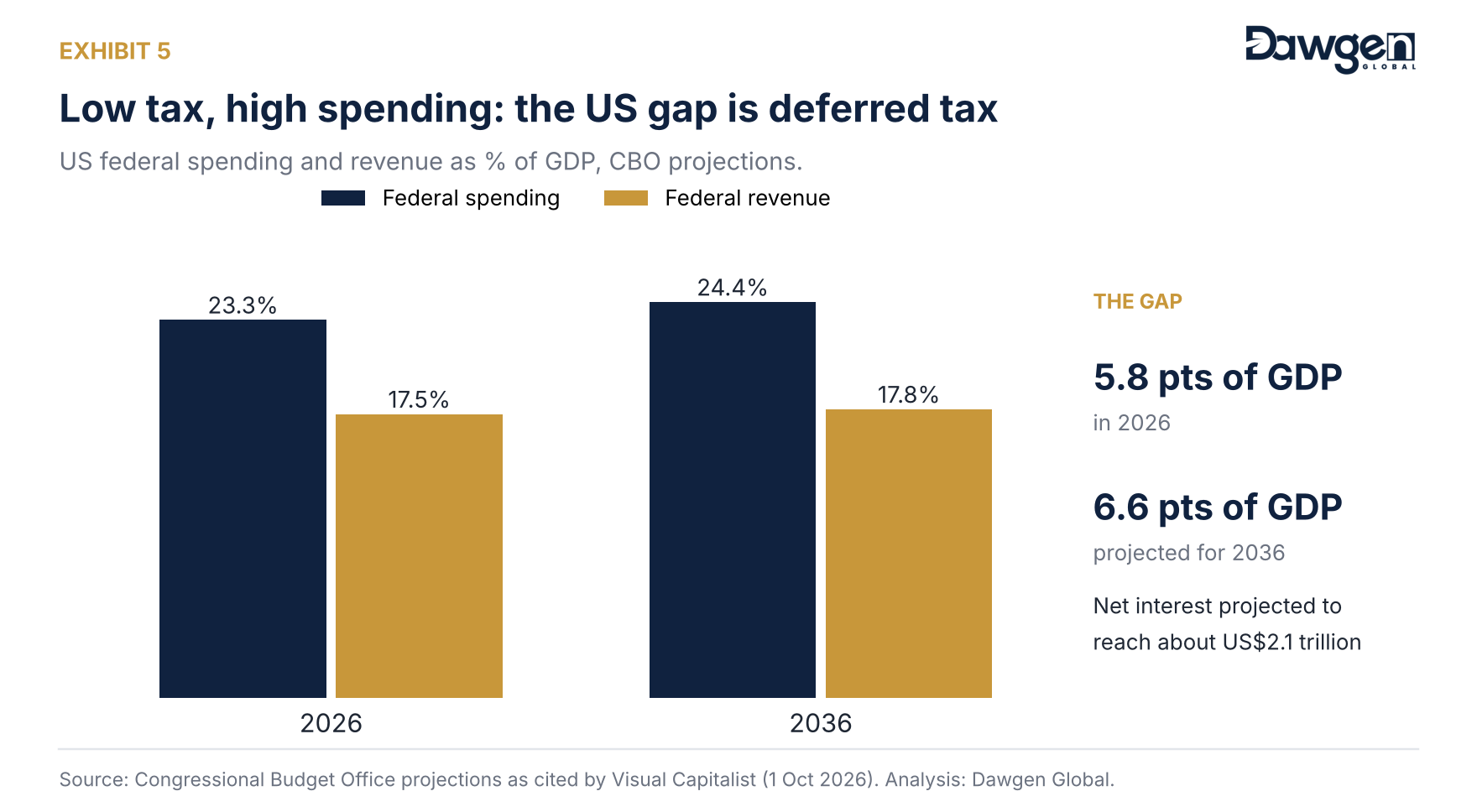
A low tax ratio paired with high spending is not low tax; it is deferred tax, paid through borrowing.
The Caribbean lesson cuts the other way. Jamaica and Barbados collect European-level shares of GDP, but much of that has been needed to service public debt built up over decades. Taxpayers have paid for fiscal credibility rather than for expanded public services. That credibility is valuable — it lowers borrowing costs for everyone — but it explains why a Jamaican business can feel taxed like Europe while still paying privately for security, power backup, water storage and staff healthcare.
For boards, this reframes the question. The useful test is not “how high is our national tax ratio?” but “what return does the jurisdiction deliver on the tax we pay — in infrastructure, skills, security and predictability?” That test belongs in every location and expansion decision.
Two 15% floors that matter more than the ranking
Two different 15% thresholds now shape Caribbean tax policy, and both are more useful to a board than a global league table.
The IMF tipping point — 15% of GDP. IMF research argues that a tax-to-GDP ratio of at least 15% is a practical benchmark for development; below it, government effectiveness, financial development and growth tend to stall. The Fund notes that more than 70 developing economies still fall short. In this dataset three regional economies sit below the line: the Dominican Republic (14.5%), Guyana (8.2%) and Haiti (5.0%). St. Kitts and Nevis (15.2%) and Antigua and Barbuda (15.6%) sit just above it. Expect continued pressure — from lenders, rating agencies and multilateral partners — for these economies to widen their bases, and expect that pressure to land first on formal businesses.
The global minimum tax — 15% effective rate. Under the OECD/G20 Pillar Two rules, large multinational groups with revenue above €750 million face a 15% minimum effective rate in each jurisdiction. Barbados moved early: from 1 January 2024 it set a 9% standard corporation tax rate and introduced a qualified domestic minimum top-up tax to bring in-scope groups to 15%. Low-rate and incentive-heavy regimes elsewhere in the region face the same choice: collect the top-up at home, or let another country collect it. A January 2026 “side-by-side” arrangement that largely carves US-parented groups out of Pillar Two adds a new layer of complexity for Caribbean subsidiaries of American companies.
The common thread: both floors push the region away from competing on headline rates and toward competing on administration, certainty and the quality of what tax buys.
Six moves for Caribbean boardrooms
- Measure your total tax contribution, not just corporate income tax. Add GCT/VAT, customs, special consumption taxes, payroll levies, property tax and stamp duties. For many Caribbean firms, income tax is the smaller part of the bill.
- Put tax timing on the treasury agenda. Advance GCT, import duties and statutory deductions are cash costs before they are accounting costs. Model them in working-capital forecasts and pricing, especially when import costs or exchange rates move.
- Map your effective tax rate by territory. Groups operating across several islands should know their effective rate in each, how close any entity sits to the 15% Pillar Two floor, and whether a domestic top-up tax applies.
- Plan for base-broadening, not rate cuts. Governments under the IMF benchmark, and those under debt pressure, will widen the base through digital services taxes, e-invoicing, tighter exemptions and stronger data matching. Compliance systems built for today’s audit rate will not be enough.
- Test incentives before relying on them. Tax holidays and concessions are the first casualties of a minimum tax and of fiscal consolidation. Any investment case that depends on an incentive should be stress-tested for its removal.
- Judge jurisdictions on return, not rate. In location and expansion decisions, weigh what the tax buys — infrastructure, skills, security, dispute resolution and predictability — alongside what it costs.
The bottom line
The world’s tax ranking places Denmark at the top and Libya at the bottom, but its most useful lesson for this region sits in the middle. Jamaica and Barbados already collect European-level shares of GDP; Guyana and the passport economies fund themselves in other ways; Haiti cannot yet collect enough to function. One region, five fiscal models.
For most established Caribbean economies, the question is no longer whether governments can raise tax. It is whether the tax raised is collected fairly across a wider base, spent on what businesses and citizens actually need, and administered with the certainty that investment requires. Boards that understand their own total tax position — and the direction of policy around them — will be better placed than those still reading the headline ratio.
ABOUT DAWGEN GLOBAL’S TAX ADVISORY PRACTICE
Dawgen Global’s Tax Advisory practice works with businesses across 15+ Caribbean territories on tax strategy, total tax contribution reviews, indirect tax, Pillar Two readiness and tax risk. To discuss what these trends mean for your organisation, contact [email protected] or visit dawgen.global.
Big Firm Capabilities. Caribbean Understanding.
Method notes and sources
All country ratios are IMF figures for 2024 as published by Visual Capitalist on 1 October 2026; tax revenue excludes social security contributions. The Caribbean panel covers 16 economies with a figure in the dataset (Cuba and territories such as the Cayman Islands and Turks and Caicos have no figure in the dataset); its simple average is 19.0% and its median 20.4%, computed by Dawgen Global. The published graphic and its table differ by 0.1 point for a few countries (Barbados shows 27.7% on the graphic, 27.8% in the table; also Luxembourg and Oman); this article uses the table. Ranks are counted from the table, with ties shared. Exhibit 3 uses budget estimates for the main tax heads; “all other taxes” is the residual to the J$924 billion total. All exhibits are original Dawgen Global builds.
- Ranked: The World’s Most and Least Taxed Countries — Visual Capitalist, 1 Oct 2026
- IMF World Revenue Longitudinal Database
- Revenue Statistics in Latin America and the Caribbean 2025: Jamaica — OECD
- Jamaica 2024/25 Budget Commentary — PwC Jamaica
- Fiscal Policy Paper FY2024/25 Interim Report — Ministry of Finance, Jamaica
- Jamaica corporate other taxes (GCT) — PwC Worldwide Tax Summaries
- Building Tax Capacity for Growth and Development — IMF, 2025
- The Art of Taxation — IMF Finance & Development, March 2026
- Guyana earned US$2.57 billion from oil in 2024 — OilNOW
- Guyana oil fund to fund 29% of 2024 budget — OilNOW
- Barbados corporate tax rates and QDMTT — PwC Worldwide Tax Summaries
- OECD/G20 Inclusive Framework — overview
About Dawgen Global
Dawgen Global is an independent, integrated multidisciplinary professional services firm headquartered at 47 Trinidad Terrace, New Kingston, Jamaica, serving more than 15 territories across the Caribbean. Founded and led by Dr. Dawkins Brown, Executive Chairman, the firm is independent and not affiliated with any international network. It delivers a full suite of professional services under one roof: audit and assurance; tax advisory; IT and digital transformation; risk management; cybersecurity; actuarial and insurance regulatory advisory; HR advisory; mergers and acquisitions; corporate recovery; business advisory and strategy; accounting BPO and virtual CFO services; and legal process outsourcing.
The proposition is simple: big-firm capability without the big-firm price. Dawgen Global’s integrated approach is built for the specific complexities and opportunities of the Caribbean market, helping organizations make sharper, better-informed decisions that drive measurable progress.
To explore a partnership, reach out:
- Website: dawgen.global
- Email: [email protected]
- WhatsApp (Global): +1 555-795-9071
- Caribbean offices: +1 876-665-5926 | +1 876-929-3670 | +1 876-926-5210


