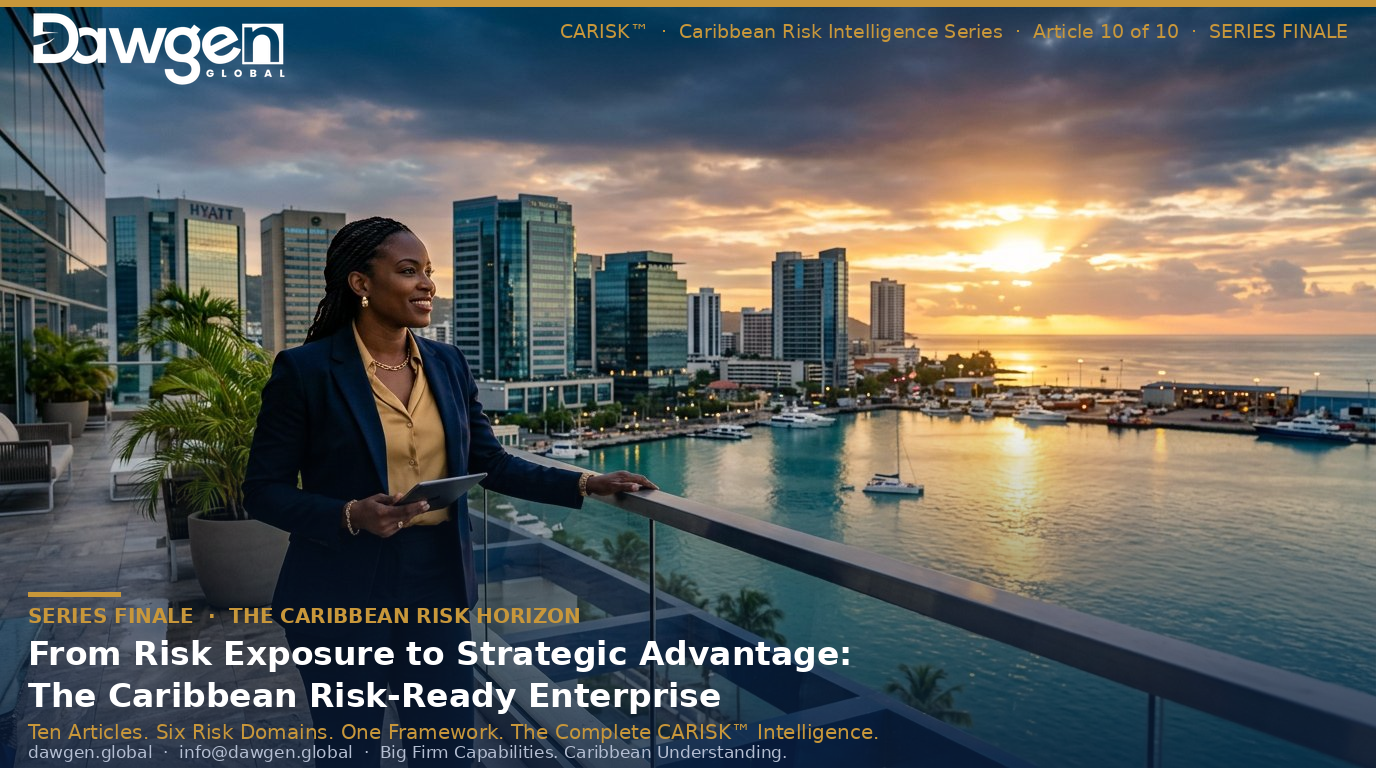
Ten articles. Six risk domains. Fifteen territories. One framework. This is the synthesis — what it means to be a genuinely risk-ready Caribbean enterprise, and how the organisations that achieve that standard convert risk intelligence not merely into protection against harm but into the most durable competitive advantage available in the Caribbean market.
THE CARIBBEAN RISK HORIZON — COMPLETE SERIES INTELLIGENCE SUMMARY
| # | Article | Core Insight | Primary Enterprise Action |
| 1 | Why Every Caribbean Board Needs a Risk Intelligence Strategy | Risk is managed by intelligence, not instinct. Caribbean boards govern without structured risk frameworks at their peril. | Implement a formal risk governance framework with board mandate and risk appetite statement. |
| 2 | Jamaica’s Risk Profile: What the Data Is Telling Your Business | Jamaica’s security (HIGH) and climate (HIGH) risks — anchored by Hurricane Melissa’s US$8.8bn impact — demand active, structured management. | Post-Melissa insurance review; security risk mapping; macroeconomic scenario planning. |
| 3 | Trinidad & Tobago: Energy Dependency, Fiscal Stress, and What Comes Next | T&T’s macroeconomic HIGH risk is structural, not cyclical — production decline, FX constraint, and energy transition. | FX risk management strategy; energy dependency assessment; post-hydrocarbon scenario planning. |
| 4 | Barbados, the Eastern Caribbean, and the Small Island Risk Premium | Barbados’s regulatory benchmark versus OECS existential climate risk — a 26-point composite risk gap. | IBC substance compliance; post-Melissa insurance adequacy; CBI revenue concentration scenario. |
| 5 | The Regulatory Risk Explosion: Why Compliance Is Now a Strategic Function | FATF, OECD, EU, and domestic regulators tightening simultaneously. Compliance is a strategic asset, not a cost centre. | AML/CFT effectiveness review; transfer pricing documentation; data protection gap assessment. |
| 6 | Climate Risk Is Business Risk: Quantifying Caribbean Exposure | Post-Melissa, the Caribbean insurance market has reset. Physical climate risk is a current-period board governance responsibility. | TCFD disclosure preparation; climate scenario analysis; sector-specific physical risk mapping. |
| 7 | Cyber Threats in the Caribbean: A Risk Matrix Every Leader Must See | BEC (CRITICAL) and ransomware (CRITICAL) are Caribbean’s costliest and most preventable cyber threats. | MFA deployment; BEC verification protocols; annual cybersecurity gap assessment against NIST/ISO 27001. |
| 8 | Political Risk, Social Instability, and the Board’s Blind Spot | Caribbean political risk is governance quality risk — the gap between formal rules and informal operating reality. | Political scenario planning; government contract concentration assessment; talent strategy as risk response. |
| 9 | Building Your Enterprise Risk Matrix: The CARISK™ Methodology | The six-phase EORM converts intelligence into a governing instrument: context, CRI integration, identification, scoring, controls, roadmap. | Commission CARISK™ EORM engagement; implement board risk dashboard; establish annual EORM cycle. |
| 10 | From Risk Exposure to Strategic Advantage: The Caribbean Risk-Ready Enterprise | Risk intelligence is the Caribbean’s most underutilised source of competitive advantage. The risk-ready enterprise wins. | Request your CARISK™ proposal at [email protected]. |
The image that has opened every article in this series — the Caribbean island building standing firm on a cliff above a storm-lit bay, darkness arriving from one side and golden light holding on the other — was chosen deliberately. It captures, in a single frame, the condition of every Caribbean enterprise in 2026: operating in an environment of genuine and intensifying risk, with the strategic question being not whether the storms will come but whether the organisation is built to stand when they do.
Nine articles have mapped the storms: political and governance risk, macroeconomic and fiscal stress, the regulatory explosion, social instability and the brain drain, the climate reckoning anchored by Hurricane Melissa, the cyber threat escalation, and the full CARISK™ EORM methodology for converting that intelligence into a governing instrument. This tenth and final article turns from mapping the storms to describing the building — what a genuinely risk-ready Caribbean enterprise looks like, what it is capable of that its less-prepared competitors are not, and how the process of building it begins.
The argument of this series has been straightforward from the first article: risk is not managed by intuition. It is managed by intelligence — structured, scored, and acted upon with the same rigour that Caribbean organisations bring to their financial and operational planning. The Caribbean Risk Horizon series has provided that intelligence across every material risk domain. This article provides the synthesis: what the organisation that has absorbed and applied that intelligence looks like in practice.
What the Caribbean Risk-Ready Enterprise Actually Looks Like
Risk-ready is not a binary state. It is a governance maturity level — a point on a continuum between organisations that govern risk reactively (discovering risks after they materialise into losses) and organisations that govern risk proactively (identifying risks before they materialise, assessing them systematically, and managing them with documented discipline). The Caribbean Risk-Ready Enterprise sits firmly in the proactive category, and its distinguishing characteristics are observable, measurable, and reproducible.
At the Board Level
The risk-ready Caribbean board has formally approved a Risk Appetite Statement — not a philosophical aspiration but a governing document with quantitative thresholds, qualitative boundaries, and explicit risk limits. Every material decision that comes before the board — capital allocation, market entry, major contract commitment, significant financing — is assessed against the risk appetite before it is approved. The board does not make significant decisions in a risk vacuum; it makes them in the context of a documented understanding of what risk it is willing to accept in pursuit of the relevant opportunity.
The board receives a structured risk report at every meeting. Not a summary that everything is under control, but a report that presents the current risk register, flags risks trending above appetite, tracks the progress of active mitigation actions, and surfaces new or emerging risk developments relevant to the organisation’s operating environment. The board asks questions, challenges management, and holds the risk function accountable for performance against measurable standards.
The board has governed at least one CARISK™ EORM cycle — a structured, facilitated, six-phase risk assessment that produced an Enterprise Risk Matrix, a control gap analysis, and a Mitigation Roadmap that the board approved and is actively monitoring. The board does not simply know that a risk exists; it knows the risk’s current score, the adequacy of its controls, the progress of mitigation actions, and the name of the person responsible for each.
At the Management Level
The risk-ready management team owns the risk register operationally. Risk owners — named individuals at the appropriate level of seniority — are accountable for monitoring their risks, implementing mitigation actions, and reporting progress to the board. Risk ownership is not a title; it is a genuine accountability for outcomes. Risk owners are evaluated in part on the basis of their risk management performance, not only their operational metrics.
The management team has integrated risk intelligence into its operational planning processes. Cash flow projections include stress-tested scenarios for adverse macroeconomic conditions. The procurement process includes a supplier risk assessment. The IT investment cycle includes a cybersecurity impact assessment. The property renewal process includes a post-Melissa coverage adequacy review. Risk is not a separate process that runs parallel to management; it is embedded in the management processes through which decisions are made.
Management maintains a regulatory watch list — a structured monitoring of regulatory developments across all territories in which the organisation operates — and ensures that changes in the regulatory environment are assessed for enterprise impact before compliance deadlines arrive. The organisation discovers regulatory requirements from the watch list, not from enforcement notices.
At the Operational Level
The risk-ready Caribbean enterprise has tested its Business Continuity Plan within the past twelve months — not reviewed it, but tested it, through a simulation exercise that revealed gaps and drove improvements. It has rehearsed its cyber incident response plan through a tabletop exercise at which the board and executive team participated. It knows what it will do in the first four hours after a Category 5 hurricane makes landfall on its operating territory, because it has planned those four hours in detail.
Staff at every level of the organisation understand the risk dimensions most relevant to their role. Finance staff understand BEC and know the verification procedures that protect against it. Customer-facing staff understand data protection obligations and know how to respond to a data subject request. Operations staff understand the business continuity plan and know their role in it. Security awareness is not a once-per-year training event; it is embedded in the operating culture through regular communication, clear expectations, and visible leadership commitment.
“Risk-ready is not a destination. It is a governance discipline — practised continuously, tested regularly, and improved relentlessly. The Caribbean enterprise that sustains that discipline over time builds something that no competitor can quickly replicate: institutional resilience.”
The Four Competitive Advantages of the Risk-Ready Caribbean Enterprise
The argument for structured risk management is most often made in terms of loss prevention — the risks avoided, the crises prevented, the enforcement actions that never arrived. These are genuine and material benefits. But the more powerful argument — and the one that Caribbean boards most consistently undervalue — is the competitive advantage that risk-readiness creates. The risk-ready Caribbean enterprise does not simply manage downside risk better. It wins opportunities that its competitors cannot reach.
Advantage 1: Superior Access to Capital
International development finance institutions, green bond markets, international private lenders, and institutional investors are all applying progressively more demanding governance standards to the organisations they fund. The CARISK™ framework’s integration with these standards — through TCFD-aligned climate disclosure, ISO 27001-aligned cybersecurity posture, AML/CFT programme effectiveness, and board-governed enterprise risk management — positions risk-ready Caribbean enterprises as preferred borrowers in a capital market that is becoming increasingly governance-selective.
The practical consequence is measurable: risk-ready Caribbean enterprises access capital at better terms, from a broader range of sources, with fewer conditions and covenants than their less-governed peers. In an environment where Caribbean organisations are competing for international capital to fund growth, this financing advantage compounds over time into a structural competitive advantage that begins with governance quality and ends with a materially stronger balance sheet.
Advantage 2: Preferred Partner Status in International Value Chains
International hotel brands, retail buyers, franchise networks, tour operators, BPO clients, and corporate joint venture partners are all cascading governance requirements down their Caribbean value chains with increasing stringency. A Caribbean enterprise that cannot demonstrate AML/CFT compliance, data protection programme adequacy, cybersecurity baseline controls, environmental performance credentials, and board-governed risk management is systematically disadvantaged in the competition for premium international partnerships.
Conversely, a Caribbean enterprise that can demonstrate these standards — through documented frameworks, independent assessments, and board-level governance commitment — becomes a preferred partner in markets where governance quality is a differentiation criterion. This is not a niche advantage; as international supply chain governance requirements intensify across every sector in which Caribbean enterprises participate, it is becoming a baseline requirement for participation in premium international markets. The risk-ready enterprise meets that requirement; the risk-complacent enterprise does not, and loses market access as a consequence.
Advantage 3: Talent Attraction and Retention
The Caribbean’s most capable professionals — in finance, technology, law, medicine, engineering, and management — have globally competitive options. They can work remotely for international employers at compensation levels that most Caribbean organisations cannot match. What some of them want, alongside or instead of maximum compensation, is an organisation whose culture and governance they are proud to be associated with; an employer whose risk management, ethical standards, and governance quality signal that their professional reputation is safe in its hands.
The risk-ready Caribbean enterprise is a more attractive employer for this category of talent than one that operates in governance ambiguity. The compliance professional who understands what effective AML/CFT governance looks like will not build their career in an organisation where that governance is performative. The technology professional who understands cybersecurity will not accept responsibility for systems that their organisation refuses to adequately protect. Governance quality is a talent magnet for the professionals whose skills Caribbean enterprises most need and least frequently retain. The risk-ready enterprise attracts and keeps them; others lose them to emigration or to remote work for international employers.
Advantage 4: Strategic Decisiveness Under Uncertainty
Perhaps the most underappreciated advantage of the risk-ready Caribbean enterprise is its capacity for strategic decisiveness — the ability to move quickly and confidently when opportunities arise, because the organisation’s risk landscape is well understood and its risk capacity is clearly defined.
Caribbean enterprises that govern risk well know, at any given moment, what their risk appetite is, how much of that appetite is currently consumed by existing exposures, and what additional risk capacity they have available to pursue new opportunities. When a market entry opportunity, an acquisition target, or a major contract appears, the risk-ready enterprise can assess it rapidly against a structured risk framework and make a governance-informed decision with confidence. Its less-prepared competitor must either move slowly while it attempts to assess risks it has never systematically mapped, or move quickly and accept risks it does not fully understand.
In markets where speed and decisiveness create competitive advantage — and the Caribbean’s competitive market dynamics in financial services, tourism, real estate, and professional services reward both — the risk-ready enterprise wins more opportunities precisely because it has done the foundational governance work that enables it to evaluate and accept risk deliberately, rather than discovering it accidentally.
“The Caribbean enterprise that manages risk with intelligence does not simply avoid harm. It creates the governance conditions under which it can pursue opportunity with confidence. That is the strategic advantage that risk-readiness delivers.”
The Caribbean Risk-Ready Enterprise: Self-Assessment
The following assessment framework allows Caribbean boards and executives to evaluate their organisation’s current position on the risk-readiness continuum. It is not a substitute for a full CARISK™ EORM engagement, but it provides an immediate indication of where the most significant governance gaps lie and where investment in risk management capability will deliver the greatest return.
| Governance Standard | Achieved | Not Yet Achieved |
| Board has formally approved a written Risk Appetite Statement | YES | NO — Priority Action |
| Board receives a structured risk report at every meeting | YES | NO — Priority Action |
| A CARISK™ or equivalent EORM has been conducted in the past 24 months | YES | NO — Commission Now |
| An active Mitigation Roadmap is tracked at every risk committee meeting | YES | NO — Priority Action |
| AML/CFT programme has been assessed for effectiveness (not just existence) in past 12 months | YES | NO — Urgent Action |
| Property and business interruption insurance has been reviewed at post-Melissa pricing | YES | NO — Urgent Action |
| Multi-factor authentication is deployed across all critical systems | YES | NO — Implement Now |
| BEC payment verification protocol is in place for all transfers above threshold | YES | NO — Implement Now |
| A climate risk scenario analysis has been conducted for strategic planning purposes | YES | NO — Commission |
| A data protection gap assessment has been conducted against applicable frameworks | YES | NO — Commission |
| A political risk scenario exercise has been conducted in the current election cycle | YES | NO — Schedule |
| A talent strategy addressing brain drain risk has been formally adopted by the board | YES | NO — Develop |
| The Business Continuity Plan has been tested (not just reviewed) in the past 12 months | YES | NO — Test Now |
| A cyber incident response plan exists and has been rehearsed through a tabletop exercise | YES | NO — Priority Action |
| ESG reporting capability is being developed in line with lender and partner requirements | YES | NO — Begin Now |
An organisation that achieves fewer than eight of these fifteen standards has significant risk governance gaps that require urgent attention. An organisation that achieves eight to twelve is making meaningful progress but has material gaps in specific domains. An organisation that achieves all fifteen is operating at the level of risk-readiness that the Caribbean’s current operating environment demands — and is positioned to convert that governance quality into the competitive advantages described above.
The Path Forward: What Risk-Readiness Requires
For Caribbean boards and executives who have read this series and recognise that their organisation is not yet where it needs to be on the risk-readiness continuum, the path forward is clear, achievable, and does not require the resources of a large multinational corporation. It requires governance discipline, appropriate external advisory support, and the willingness to be honest about where the gaps are.
The Immediate Actions — Within 90 Days
Three actions should be initiated within ninety days of reading this article. First, commission a post-Melissa insurance adequacy review with your broker. This is the single most immediately material risk management gap for the majority of Caribbean enterprises with physical assets, and the cost of addressing it is modest relative to the cost of discovering it inadequately covered during the next major climate event. Second, implement multi-factor authentication across all critical systems and deploy a BEC payment verification protocol for all transfers above a defined threshold. These two cyber controls prevent the majority of the most costly cyber incidents affecting Caribbean organisations and can be implemented in weeks. Third, schedule a board-level discussion of risk appetite — even a preliminary, unstructured board conversation about the types and levels of risk the organisation is willing to accept in pursuit of its current strategy is the beginning of the governance discipline that the Risk Appetite Statement formalises.
The Medium-Term Programme — Within 12 Months
Within twelve months, the board should have commissioned and received a full CARISK™ EORM engagement — the six-phase process described in Article 9 that produces an Enterprise Risk Matrix, a control gap analysis, and a Mitigation Roadmap. This engagement is the foundation from which all subsequent risk governance operates. Without it, the other governance disciplines described in this series lack the structured intelligence base they require to be effective.
Within twelve months, the organisation should also have implemented a structured regulatory watch list for all territories in which it operates, conducted an AML/CFT programme effectiveness assessment, and initiated the development of a data protection compliance programme. These three regulatory compliance disciplines represent the most material areas of compliance risk facing Caribbean enterprises in 2026 and the areas where the gap between required standards and current practice is most consistently large.
The Long-Term Commitment — Sustained Over Time
Risk-readiness is not an initiative with a completion date. It is a governance commitment that must be sustained over time through the annual CARISK™ EORM cycle, the ongoing Board Risk Dashboard reporting, the regular testing of business continuity and incident response plans, and the continuous development of the organisation’s risk management capability as the risk landscape evolves.
The Caribbean’s risk landscape will continue to intensify. Climate risk will escalate. Cyber threats will grow in sophistication. Regulatory requirements will tighten. Social and political pressures will evolve. The organisations that have built the governance foundations described in this series will navigate that intensification from a position of genuine preparedness. The organisations that have not will continue to discover risks after they materialise into losses — paying a premium in financial cost, operational disruption, and strategic opportunity forgone.
The choice between these two trajectories is available to every Caribbean enterprise, regardless of its size, sector, or current governance maturity level. It requires a decision — a board-level commitment to govern risk with the intelligence and discipline that the Caribbean operating environment demands. That decision is the beginning of the risk-ready enterprise.
“The Caribbean Risk Horizon is not a stable one. But the organisations that navigate it with intelligence, discipline, and genuine governance commitment are the ones that will be standing when the next storm passes — and positioned to lead when the gold light breaks through.”
A Note on Dawgen Global’s CARISK™ Service
The Caribbean Risk Horizon series has introduced the CARISK™ framework — the Caribbean Operational Risk Intelligence System — as a conceptual and analytical structure. Behind that framework is Dawgen Global’s full Operational Risk service: a professional advisory capability delivered by experienced Caribbean risk practitioners across eleven integrated service disciplines, operating across 15+ Caribbean territories under the tagline that has defined the firm since its founding: Big Firm Capabilities. Caribbean Understanding.
CARISK™ services available to Caribbean enterprises and institutions include: full EORM engagement (six-phase, board-ready report and mitigation roadmap); Country Risk Intelligence subscriptions (quarterly CRI updates with real-time event alerts across selected territories); Board Risk Governance Reviews; AML/CFT Programme Effectiveness Assessments; Post-Melissa Insurance Adequacy Reviews; Cybersecurity Gap Assessments (ISO 27001 and NIST framework); Data Protection Compliance Gap Assessments; TCFD Climate Disclosure Support; Political Risk Scenario Planning; and the ongoing Board Risk Dashboard advisory service.
Every CARISK™ engagement begins with a complimentary sixty-minute Risk Intelligence Briefing — a substantive, expert-led conversation about the risks facing your organisation and how structured risk intelligence can help you manage them. No obligation. No generic sales presentation. A genuine advisory conversation with a Dawgen Global senior partner.
| PLAN EFFECTIVELY WITH DAWGEN GLOBAL
REQUEST YOUR CARISK™ RISK INTELLIGENCE BRIEFING Plan effectively with Dawgen Global’s expert analysis and data on the risk factors affecting your strategy. From detailed Caribbean country risk assessments across crucial operational categories to customisable risk matrices and real-time event analysis, our Operational Risk service provides you with the tools needed to confidently anticipate and mitigate risk. Request your complimentary 60-minute CARISK™ Intelligence Briefing today.
|
About the Author & the CARISK™ Series
Dr. Dawkins Brown is the Executive Chairman and Founder of Dawgen Global, the Caribbean’s leading multidisciplinary professional services firm. With decades of advisory experience spanning audit and assurance, risk management, tax advisory, corporate governance, digital transformation, and legal process outsourcing, Dr. Brown leads Dawgen Global’s thought leadership programme and is the creator of the CARISK™ framework. He publishes the Caribbean Boardroom Perspectives newsletter every Thursday on LinkedIn and the Caribbean Advisory Brief every Saturday on the Dawgen Global company page. Dawgen Global operates across 15+ Caribbean territories under the tagline: “Big Firm Capabilities. Caribbean Understanding.” The CARISK™ framework — introduced through this ten-article series — represents Dawgen Global’s proprietary Caribbean Operational Risk Intelligence System, available to Caribbean enterprises and institutions through the firm’s Risk & Advisory Practice.
About the Caribbean Risk Horizon Series
The Caribbean Risk Horizon is a ten-part thought leadership series introducing CARISK™ — the Caribbean Operational Risk Intelligence System — Dawgen Global’s proprietary framework for country-level and enterprise-level risk assessment across the Caribbean. Published April 2026 under Dr. Brown’s Caribbean Boardroom Perspectives newsletter on LinkedIn and cross-published on the Dawgen Global company page and the Caribbean Advisory Brief. The complete series and the CARISK™ Framework Document are available to enterprises and institutions upon request at [email protected].
About Dawgen Global
“Embrace BIG FIRM capabilities without the big firm price at Dawgen Global, your committed partner in carving a pathway to continual progress in the vibrant Caribbean region. Our integrated, multidisciplinary approach is finely tuned to address the unique intricacies and lucrative prospects that the region has to offer. Offering a rich array of services, including audit, accounting, tax, IT, HR, risk management, and more, we facilitate smarter and more effective decisions that set the stage for unprecedented triumphs. Let’s collaborate and craft a future where every decision is a steppingstone to greater success. Reach out to explore a partnership that promises not just growth but a future beaming with opportunities and achievements.
 Email: [email protected]
  Visit: Dawgen Global Website

 WhatsApp Global Number : +1 555-795-9071
Caribbean Office: +1876-6655926 / 876-9293670/876-9265210  WhatsApp Global: +1 5557959071
USA Office: 855-354-2447
Join hands with Dawgen Global. Together, let’s venture into a future brimming with opportunities and achievements


