
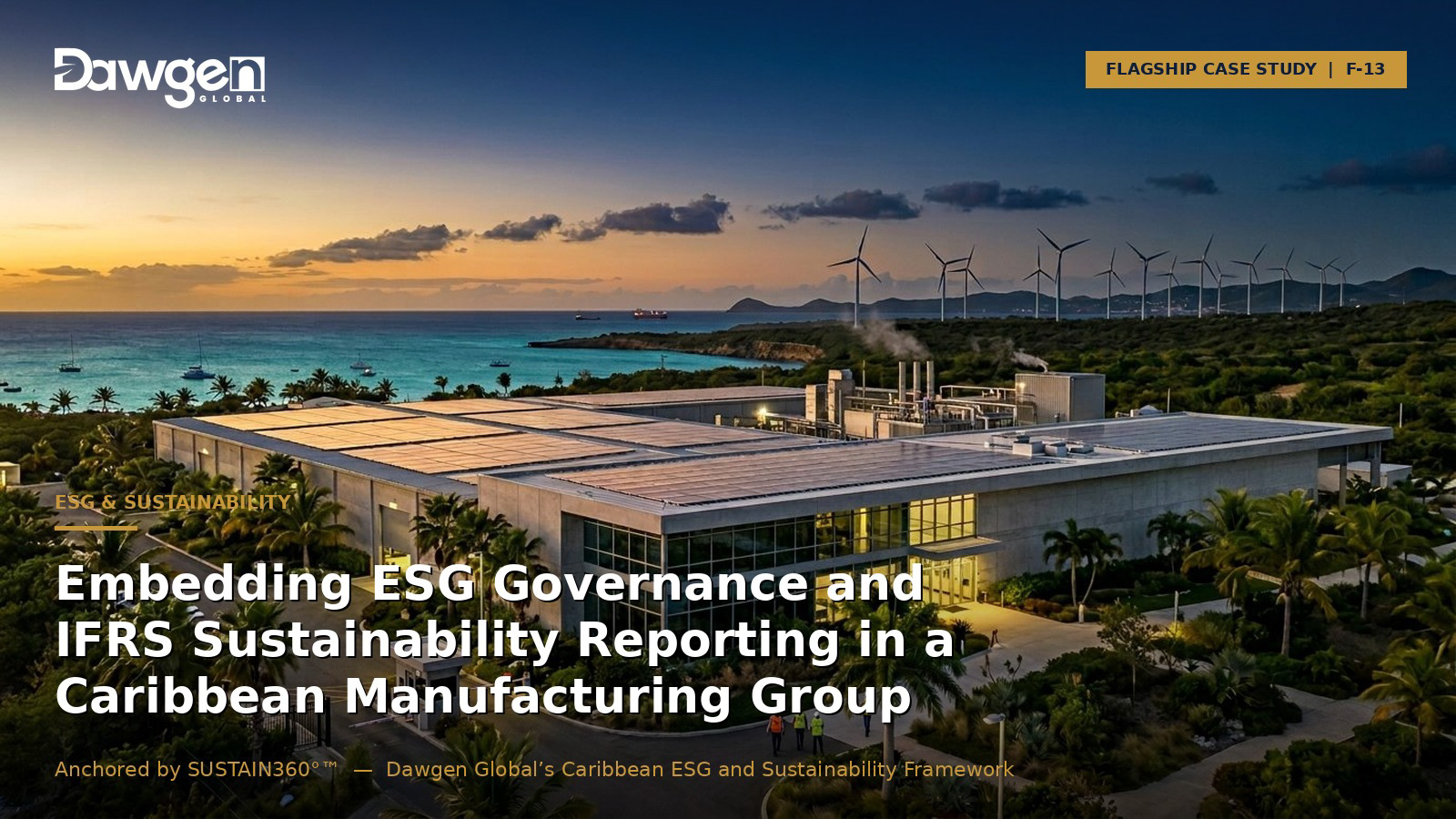
Anchored by SUSTAIN360°™ — Dawgen Global’s Caribbean ESG and Sustainability Framework

C | Context
A Caribbean manufacturing group, with operations across four jurisdictions and meaningful export exposure, had reached the point at which ESG was no longer an optional reputational topic but a convergence of material commercial, regulatory, and capital-access pressures. International customers, particularly those supplying European and North American retail channels, had begun requiring supplier sustainability disclosures as a condition of renewed purchasing contracts. The group’s principal lender, a regional commercial bank, had signalled that its next credit review cycle would include questions on climate risk exposure and transition planning. The jurisdiction’s stock exchange, on which the group was listed, had published draft guidance aligning to IFRS S1 and S2 sustainability disclosure standards, with a phased mandatory reporting pathway that would reach the group within two reporting cycles.
Internally, the picture was fragmented. The group had, over the preceding years, produced several commendable sustainability narratives — largely driven by corporate communications — but these narratives were not anchored in a governed data environment, were not aligned to any specific reporting framework, and would not withstand assurance from a reasonable third party. Scope 1 emissions were estimated rather than measured. Scope 2 emissions were not tracked consistently across the four territories. Scope 3 emissions had not been addressed at all. Physical climate risk — a first-order concern for energy-intensive manufacturing operations in a hurricane-exposed region — had been noted in the enterprise risk register but not quantified or stress-tested. The group was, in short, at the point at which good intentions had to be converted into governed capability.
Dawgen Global was retained to design and operationalise a comprehensive ESG and sustainability reporting capability for the group, aligned to IFRS S1 and S2, capable of supporting assurance engagements, and integrated with the group’s existing governance, risk, and reporting architecture. The mandate period was ten months, timed to culminate in the group’s first IFRS-aligned sustainability disclosure accompanying its annual financial statements.
A | Introducing SUSTAIN360°™
Dawgen Global deployed SUSTAIN360°™, its proprietary ESG and Sustainability framework. SUSTAIN360°™ is built for Caribbean enterprises navigating an inflection point: moving from voluntary, narrative-led sustainability communication to governed, assurance-ready, IFRS S1- and S2-aligned disclosure. Its architecture follows the seven-letter SUSTAIN acronym, with a wraparound 360° layer that situates ESG across the enterprise rather than in a standalone corporate affairs silo.
The SUSTAIN360°™ framework — seven operational pillars
| S — Strategy & Materiality
Board-approved ESG strategy, double-materiality assessment calibrated for Caribbean realities, and value-creation thesis. |
U — Understanding Climate Risk
Physical and transition risk analysis: Caribbean-specific exposures including hurricanes, sea-level rise, energy dependency, and tourism linkage. |
S — Stakeholder & Governance
Board oversight architecture, ESG committee structure, stakeholder engagement, and regulator-facing dialogue. |
| T — Targets & Transition Planning
Science-informed targets, decarbonisation roadmap, capital allocation architecture, and transition milestones. |
A — Assurance-Ready Data
Controls over non-financial data, data lineage, measurement methodologies, and audit-ready evidence register. |
I — IFRS S1 & S2 Disclosure
Report architecture aligned to IFRS Sustainability Disclosure Standards, with interoperability to GRI and other frameworks. |
| N — Navigating Reporting & Regulation
Jurisdictional mapping of reporting obligations, mandatory-disclosure timelines, and international customer requirements. |
The wraparound 360° layer ensures that ESG is not treated as a separate reporting function but is integrated across strategy, risk, finance, operations, people, technology and communications — with each function carrying accountability for the ESG performance it influences.
S | Solution
Strategy & Materiality — the double-materiality assessment
The engagement opened with the first disciplined double-materiality assessment in the group’s history. Single-materiality (financial materiality) was assessed by identifying the ESG topics whose evolution could reasonably affect the group’s cash flows, access to capital, or cost of capital — the lens around which IFRS S1 is constructed. Double-materiality added the outward-facing dimension: the ESG topics where the group’s operations have material impact on environment, society, or governance, regardless of whether those impacts feed back into the group’s financial position. The output was a formal materiality matrix that identified approximately a dozen ESG topics as material to the group, including energy intensity, imported input dependency, waste streams, workforce development, local community employment, governance resilience, and climate adaptation.
The materiality matrix was approved at board level and became the foundation of every subsequent workstream. Importantly, non-material topics were explicitly de-scoped — a discipline that distinguished the group’s sustainability programme from the more common pattern of trying to report on everything and consequently reporting on nothing with depth.
Understanding Climate Risk — physical and transition analysis
The Understanding Climate Risk pillar delivered the group’s first structured climate risk analysis. Physical risk was assessed across the group’s four jurisdictions, with particular attention to hurricane exposure, storm surge, saline intrusion of groundwater, and heat-stress impacts on energy-intensive operations. Scenarios were modelled on plausible climate pathways, with distinct short-, medium- and long-term horizons. Transition risk was assessed separately: the implications of decarbonisation on imported input costs, on customer product specifications, on the group’s access to capital, and on the cost-competitiveness of energy-intensive products relative to lower-carbon substitutes.
The output of this pillar was a quantified climate risk register with defined financial-impact ranges, integrated into the group’s enterprise risk management system. For several facilities, adaptation investments were identified with clear net-present-value justification — converting climate risk analysis from narrative to investment decision.
Stakeholder & Governance — the ESG oversight architecture
The Stakeholder & Governance pillar re-architected how ESG was governed. A dedicated ESG Committee was established at management level, chaired by the Chief Executive and including the Chief Financial Officer, the Chief Operating Officer, the Chief People Officer, and the heads of manufacturing operations in each jurisdiction. Board-level oversight was added as a standing agenda item at the audit committee, with an annual deep-dive at the full board. Stakeholder engagement — a pillar often treated as a corporate affairs exercise — was structured as an analytical input to materiality, with defined engagement cadences for each priority stakeholder group. A regulator-engagement protocol was established, recognising that in jurisdictions adopting IFRS S1 and S2, early constructive dialogue with the regulator is a strategic advantage.
Targets & Transition Planning
The Targets & Transition Planning pillar converted materiality into commitments. Science-informed emissions reduction targets were adopted for Scope 1 and Scope 2, with interim milestones aligned to the group’s capital investment cycles. Scope 3 was addressed with proportionate care: given the group’s imported-input dependency, Scope 3 measurement methodology had to be defensible but not so demanding that it became a reason to avoid the topic. A decarbonisation roadmap was produced — facility by facility, process by process — identifying energy efficiency, renewable generation, process change, and product reformulation as the four principal decarbonisation pathways. Capital allocation to support the transition was integrated into the group’s multi-year capital plan, rather than sitting as a parallel sustainability budget.
Non-climate targets were addressed in parallel: workforce development commitments were linked to PEOPLE360°™ capability architecture; governance commitments were linked to the group’s internal audit and risk management infrastructure; local-community commitments were structured around measurable employment and supplier development metrics.
Assurance-Ready Data — the non-financial control environment
The Assurance-Ready Data pillar — arguably the most operationally demanding of the seven — built the non-financial control environment that had not previously existed. ESG data sources were catalogued. Measurement methodologies were documented for every disclosed metric. Data lineage was traced from source system to reported disclosure. Controls over data capture, aggregation, and reporting were designed and tested, replicating — for non-financial data — the kind of control environment that the group’s finance function had long operated over financial data. An evidence register was established, documenting the source evidence for each reported disclosure, such that a reasonable-assurance engagement could be supported in a subsequent reporting cycle if the group chose to pursue one.
The IT & Digital Transformation team supported this pillar with the deployment of a sustainability data platform that integrated ESG data capture with the group’s existing ERP environment, closing the gap between financial and non-financial reporting infrastructure.
IFRS S1 & S2 Disclosure — the report architecture
The IFRS S1 & S2 Disclosure pillar produced the group’s first IFRS-aligned sustainability disclosure, structured around the four pillars of the IFRS framework — governance, strategy, risk management, and metrics and targets. IFRS S1 general disclosures covered all material sustainability topics; IFRS S2 climate-specific disclosures provided the detailed climate risk, metrics, emissions, and scenario analysis required under the topic-based standard. Interoperability with GRI was maintained, recognising that several of the group’s international customers continued to request GRI-aligned data points. The resulting disclosure was published as a dedicated section of the annual report, integrated with the group’s financial statements, and prepared to a standard that would support an assurance engagement in a subsequent cycle.
Navigating Reporting & Regulation — the jurisdictional map
The final pillar mapped the group’s regulatory reporting landscape across its operating and export territories. Several jurisdictions were aligning to IFRS S1 and S2 on phased pathways. Several export markets had customer-driven disclosure expectations that ran ahead of their home regulators. A structured calendar was produced, identifying for each disclosure pathway the group’s compliance posture, gaps, and lead times. This calendar transformed regulatory reporting from an ad-hoc reactive activity into a planned, forward-looking capability.
E | Effect

The group published its first IFRS-aligned sustainability disclosure in tandem with its annual financial statements. The disclosure was sufficiently rigorous to withstand scrutiny from international customers, from the principal lender, and from analysts covering the group’s securities. The double-materiality matrix, the climate risk register, and the decarbonisation roadmap became standing elements of the group’s strategic planning and capital allocation cycle. The data platform established to support ESG reporting subsequently served as the foundation for broader non-financial management reporting across the group. The group’s principal lender, at its next credit review, explicitly recorded the group’s sustainability architecture as a positive factor in its credit assessment. An international retail customer, whose renewal was approaching, formally accepted the group’s sustainability disclosure in satisfaction of its supplier-sustainability requirement, avoiding the need for a separate bespoke questionnaire. The group is now approaching the first IFRS-aligned reporting cycle of its jurisdictional peers from a position of established capability rather than compliance scramble.
Insight Lens — From the Engagement Partner
| The ESG lesson for Caribbean enterprise
ESG in the Caribbean is being reshaped by a convergence few boards have yet fully priced: international customers are demanding disclosure, lenders are pricing it into credit, and regulators — following the IFRS Foundation’s lead — are turning voluntary narratives into mandated reports. The enterprises that treat sustainability as a communications exercise will, in the next two reporting cycles, discover that their narratives cannot withstand assurance. The enterprises that build governed capability now will find that capability is a commercial asset, not a compliance cost. SUSTAIN360°™ exists because the Caribbean context — hurricane exposure, imported-input dependency, small-market capital access — requires an ESG framework built for Caribbean realities, not one downloaded from a European template. The 360° layer matters because ESG fails in every organisation where it is treated as a separate function rather than as a lens across the enterprise. |
Cross-disciplinary Footprint
- Audit & Assurance — non-financial control environment design and assurance-readiness build.
- Risk Management — climate risk register and integration with enterprise risk management.
- HR Advisory (PEOPLE360°™) — workforce development and social-dimension materiality.
- IT & Digital Transformation — sustainability data platform deployment and ERP integration.
- Tax Advisory — tax implications of transition capital investments and carbon-related fiscal regimes.
- Legal Process Outsourcing — regulator engagement and customer-contract ESG clause review.
Take the next step with Dawgen Global
| THE SIGNAL
If you are a board director, Chief Executive, Chief Financial Officer, Chief Sustainability Officer, or Investor Relations lead of a Caribbean enterprise — listed or unlisted — and your organisation has not yet assessed its position against IFRS S1 and S2, or is still producing ESG narrative rather than governed disclosure, the runway is shorter than many boards assume. The first IFRS-aligned sustainability disclosure in your jurisdictional peer group will be produced within the next two reporting cycles; the question is whether yours will be among them. THE OFFER Dawgen Global offers a confidential SUSTAIN360°™ ESG Readiness Diagnostic: a structured six-week engagement that assesses your organisation’s ESG and sustainability reporting maturity across all seven pillars of SUSTAIN360°™, produces a double-materiality-informed gap analysis, and delivers a prioritised roadmap to first IFRS-aligned disclosure. The diagnostic is delivered under confidentiality and without obligation to proceed. THE CHANNEL Email [email protected]
|
About Dawgen Global
“Embrace BIG FIRM capabilities without the big firm price at Dawgen Global, your committed partner in carving a pathway to continual progress in the vibrant Caribbean region. Our integrated, multidisciplinary approach is finely tuned to address the unique intricacies and lucrative prospects that the region has to offer. Offering a rich array of services, including audit, accounting, tax, IT, HR, risk management, and more, we facilitate smarter and more effective decisions that set the stage for unprecedented triumphs. Let’s collaborate and craft a future where every decision is a steppingstone to greater success. Reach out to explore a partnership that promises not just growth but a future beaming with opportunities and achievements.
 Email: [email protected]
  Visit: Dawgen Global Website

 WhatsApp Global Number : +1 555-795-9071
Caribbean Office: +1876-6655926 / 876-9293670/876-9265210  WhatsApp Global: +1 5557959071
USA Office: 855-354-2447
Join hands with Dawgen Global. Together, let’s venture into a future brimming with opportunities and achievements


