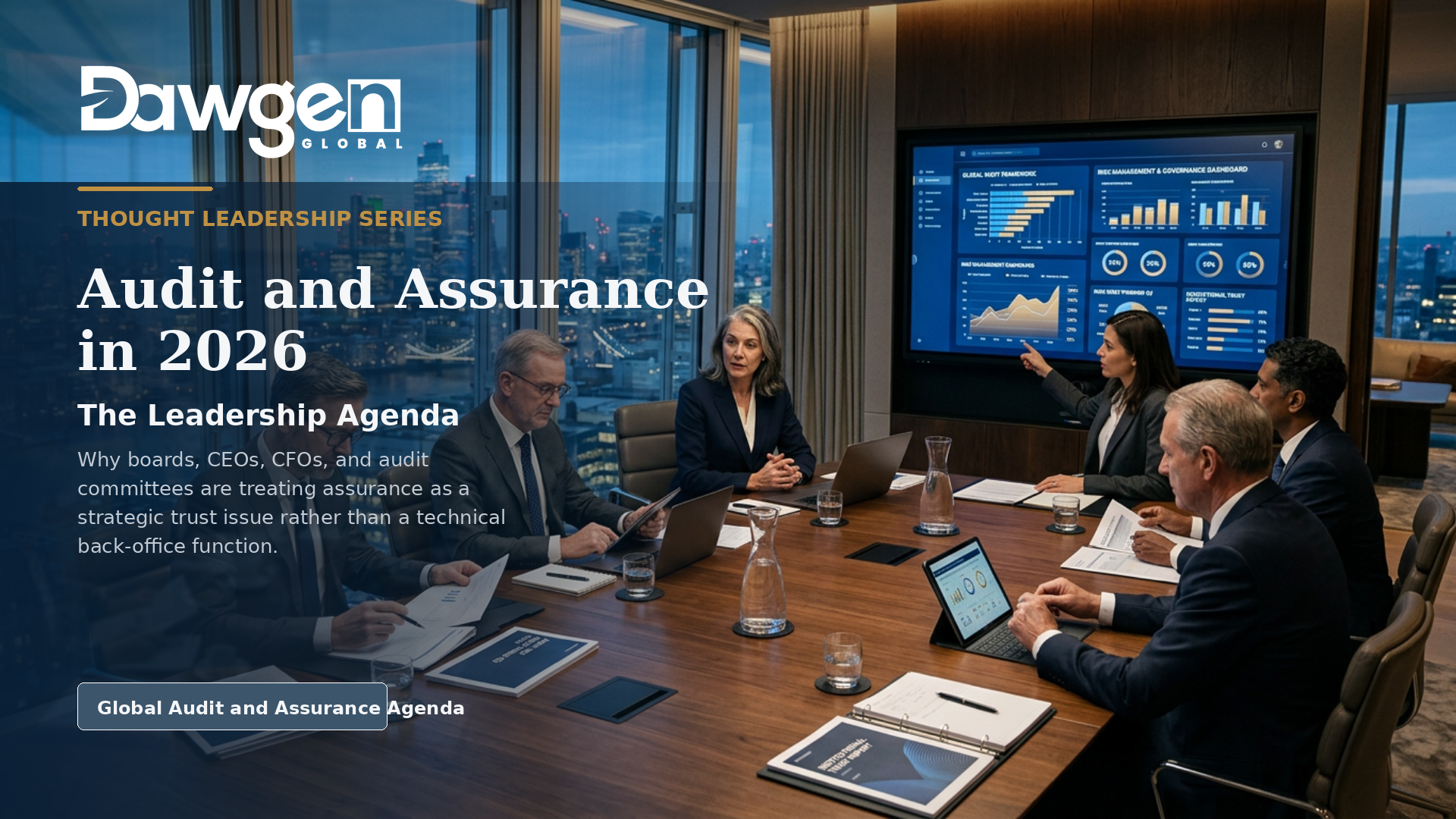
Why boards, CEOs, CFOs, and audit committees are treating assurance as a strategic trust issue rather than a technical back-office function.
| 2026 is emerging as a hinge year for audit and assurance. Sustainability assurance is moving into operational reality, regulators remain dissatisfied with core audit quality, and firms are being pushed to prove that technology adoption strengthens rather than weakens professional judgment. For senior executives, the central question is no longer whether assurance matters, but whether the organization is ready for a more integrated and more demanding assurance environment. |
The year the agenda changed shape
For much of the past decade, audit and assurance conversations at leadership level tended to follow separate tracks. Financial statement audit was viewed as an annual requirement. Sustainability reporting was often treated as a specialist disclosure exercise. Technology was discussed as a cost and productivity enabler. In 2026 those tracks are colliding. Leaders are now being asked to think about trust, reporting integrity, resilience, data quality, and oversight in one joined-up conversation.
That shift matters because the pressure on assurance is no longer coming from only one constituency. Regulators want better quality. Investors want more reliable reporting beyond the financial statements. Audit committees want sharper insight into fraud risk, going concern, and control effectiveness. Management teams want audits that keep pace with digital business models and faster reporting cycles. None of those demands can be answered with a narrow, compliance-only view of assurance.
The implication is simple but profound. Assurance has moved from being a downstream check on reporting to an upstream influence on how companies govern information, evidence, and accountability. That makes the 2026 agenda a leadership agenda.
Why confidence is under pressure
Confidence in reporting systems has been tested from several directions at once. Macroeconomic volatility has made estimates more judgment-heavy. Supply chain changes and geopolitical disruption have complicated revenue recognition, inventory valuation, impairment assessment, and scenario planning. Meanwhile, stakeholders increasingly expect consistency between what a company says in its annual report, sustainability disclosures, investor presentations, and public narrative.
This is one reason recurring inspection themes remain stubborn. Revenue, estimates, internal controls, data completeness, group audit coordination, and fraud procedures still attract findings because they sit where business complexity and audit execution meet. The problem is not that companies and auditors are unaware of these areas. It is that the underlying business model, systems architecture, and governance environment often make reliable assurance materially harder than policy manuals suggest.
Senior leaders should read the persistent nature of these findings as a business signal. When the same topics recur globally, year after year, they are usually revealing structural weaknesses in how organizations generate and defend evidence.
Sustainability assurance becomes mainstream
The move toward formal sustainability assurance is one of the clearest reasons 2026 feels different. What was once framed as ESG storytelling is now being recast as a matter of reportable evidence, controls, methodologies, and independence. The introduction of global assurance and ethics frameworks is accelerating that change and forcing organizations to confront whether their non-financial data can stand up to scrutiny.
This matters well beyond sustainability teams. Once an organization subjects climate, workforce, supply chain, or governance metrics to assurance, questions quickly surface about ownership, systems, audit trails, estimation methods, and board oversight. In many businesses, those capabilities remain uneven. Data may be scattered across functions, definitions may vary by geography, and the people closest to the narrative may not be the people closest to the evidence.
For leadership teams, sustainability assurance is therefore less a reporting add-on than a rehearsal for how the company handles credibility in a wider sense. The discipline it requires often exposes broader operating realities that deserve attention.
The technology test
Technology has become one of the most misunderstood parts of the audit and assurance debate. On one hand, advanced analytics, automation, and AI offer obvious advantages: faster population testing, better anomaly detection, richer risk assessment, and more targeted review. On the other hand, technology can create a false sense of confidence if leaders assume that more data or more automation automatically produces stronger assurance.
The real question is not whether tools are sophisticated. It is whether the organization understands the provenance of the data, the logic of the tool, the limits of the output, and the point at which human judgment must intervene. Weakness in any of those areas can turn a productivity gain into a governance problem. That is why regulators increasingly view AI use, documentation standards, model oversight, and IT control integrity as assurance-quality issues.
Executives should be careful not to delegate this topic entirely to technologists. Technology in audit is now inseparable from risk governance, evidence reliability, and the board’s confidence in management representations.
What the boardroom should do now
Boards and executive teams do not need to become auditing experts, but they do need to ask better questions. Is management clear on the evidence chain for material disclosures? Are fraud and going-concern discussions grounded in current business realities rather than legacy templates? Does the organization know where control reliance depends on fragile spreadsheets, manual reconciliations, or poorly governed source data? Is sustainability reporting being built with assurance in mind, or only with communications in mind?
These questions help move the conversation from annual audit mechanics to strategic readiness. They also create the conditions for better collaboration across finance, legal, risk, internal audit, operations, tax, technology, and sustainability teams. In a more demanding assurance environment, leadership value often comes from forcing those groups into the same room before a reporting issue becomes a market issue.
The strongest organizations in 2026 will not necessarily be those with the most polished messaging. They will be those that can evidence, defend, and govern what they say.
The Dawgen Global view
From our perspective, the defining feature of the 2026 agenda is convergence. Audit quality, sustainability assurance, technology governance, fraud risk, and board oversight can no longer be managed as isolated topics. The businesses responding well are building integrated assurance capability rather than reacting to each issue one at a time.
That is why the leadership agenda for 2026 is not simply about keeping up with standards. It is about strengthening institutional trust. Companies that treat assurance as a strategic capability are more likely to navigate regulatory scrutiny, investor expectations, cross-border complexity, and transformation pressure with credibility intact.
Seen that way, audit and assurance are not just control topics. They are instruments of confidence, and confidence has become one of the most valuable assets a leadership team can protect.
What this means for chief executives and chief financial officers
Chief executives should recognize that assurance now shapes external confidence in the strategy itself. When a business talks about resilience, growth quality, transition readiness, or transformation delivery, stakeholders increasingly expect those claims to be supported by governed information. A CEO who treats assurance only as the external auditor’s concern may find that confidence in broader leadership messaging begins to erode when questions arise around the evidence base beneath key disclosures.
For chief financial officers, the challenge is equally significant but more operational. The finance function is still the natural home for reporting discipline, yet it can no longer carry the assurance burden by itself. CFOs now need to orchestrate a wider ecosystem that includes technology teams, operational data owners, legal advisers, internal audit, tax specialists, treasury, sustainability leaders, and business unit executives. The sophistication of the orchestration often determines whether assurance feels strategic or chaotic.
Both roles also need to be realistic about capacity. More expectations are being placed on the reporting process without a proportionate reduction in complexity elsewhere. That means leadership must make choices about investment, sequencing, and priorities rather than assuming existing teams can simply absorb more.
The organizations likely to lead
The organizations most likely to lead in this environment are not those with the loudest market narrative, but those that build institutional habits around evidence. They know which metrics matter most, where their data remains immature, how quickly problems escalate, and where board oversight is strongest or weakest. They also understand that assurance readiness is cumulative: each improvement in controls, definitions, and governance strengthens more than one disclosure area at a time.
These organizations also tend to be more honest internally. They do not confuse the absence of visible failure with the presence of strong control. They are willing to identify fragile workarounds, overdependence on individuals, inconsistent regional practices, and the hidden cost of late-stage reporting repair. That candor allows them to improve before issues become public or regulatory.
Ultimately, the leadership winners in 2026 will be those that understand assurance as part of enterprise resilience. They will treat it as a core management capability, build it deliberately, and use it to reinforce strategic credibility in a period where credibility is under constant test.
What leaders should do now
- Reassess how reporting, controls, governance, and evidence connect across the enterprise rather than managing each issue in isolation.
- Use assurance discussions to surface operational weakness early, especially where judgment, systems, or cross-border coordination are involved.
- Treat audit, sustainability reporting, technology governance, and board oversight as linked trust issues that need an integrated response.
| How Dawgen Global Can Help
Organizations that need stronger assurance readiness, sharper board reporting, or better coordination across finance, risk, technology, tax, legal, operations, and sustainability teams can contact Dawgen Global at [email protected]. Our multidisciplinary approach and borderless delivery model help clients solve audit, assurance, governance, reporting, and transformation challenges as connected business issues rather than isolated workstreams. |
About Dawgen Global
“Embrace BIG FIRM capabilities without the big firm price at Dawgen Global, your committed partner in carving a pathway to continual progress in the vibrant Caribbean region. Our integrated, multidisciplinary approach is finely tuned to address the unique intricacies and lucrative prospects that the region has to offer. Offering a rich array of services, including audit, accounting, tax, IT, HR, risk management, and more, we facilitate smarter and more effective decisions that set the stage for unprecedented triumphs. Let’s collaborate and craft a future where every decision is a steppingstone to greater success. Reach out to explore a partnership that promises not just growth but a future beaming with opportunities and achievements.
 Email: [email protected]
  Visit: Dawgen Global Website

 WhatsApp Global Number : +1 555-795-9071
Caribbean Office: +1876-6655926 / 876-9293670/876-9265210  WhatsApp Global: +1 5557959071
USA Office: 855-354-2447
Join hands with Dawgen Global. Together, let’s venture into a future brimming with opportunities and achievements


