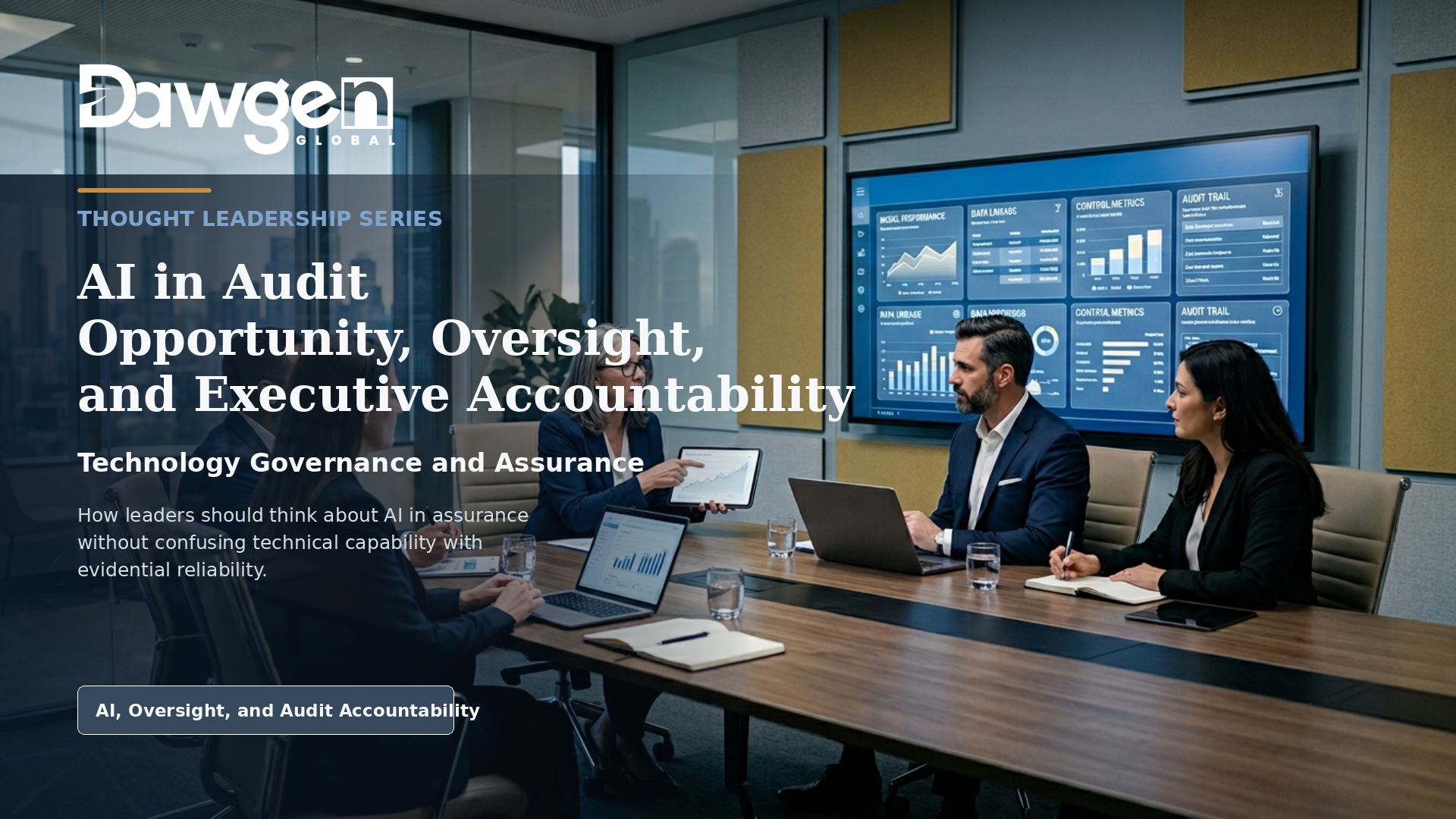
How leaders should think about AI in assurance without confusing technical capability with evidential reliability.
| AI is changing how audit and assurance work is performed, but it also raises questions about evidence quality, model governance, documentation, and accountability. Executives need a governance lens, not just a productivity lens. |
The promise and the temptation
AI has entered the audit conversation with understandable force. Large data sets can be reviewed more quickly, exceptions can be surfaced more intelligently, documentation can be organized faster, and risk signals can be identified in patterns that human reviewers might miss. For leadership teams under pressure to modernize, the appeal is obvious. AI appears to offer a route to better coverage, better insight, and lower friction at the same time.
The temptation is to treat that promise as self-proving. If a tool can process more information than a human team, some executives assume the output must also be more reliable. That is the wrong conclusion. The usefulness of AI in audit depends on the quality of the inputs, the appropriateness of the use case, the rigor of the controls around the tool, and the clarity with which human professionals interpret and challenge the output.
In assurance, productivity gains matter, but evidential confidence matters more.
Why governance is the real differentiator
The organizations that will benefit most from AI in audit are not necessarily those deploying the flashiest tools. They are those building strong governance around them. Governance means knowing which tools are approved for which purposes, what data they rely on, how outputs are reviewed, how exceptions are resolved, how use is documented, and who is accountable when a tool influences a material conclusion.
This is a board and executive issue because AI tools can affect the basis on which directors take comfort over reporting, controls, and risk. If management cannot explain the logic and limits of a tool in plain language, that is already a governance concern. Likewise, if an assurance provider cannot show how human judgment remained central where judgment was required, confidence in the work should decline rather than rise.
Effective governance reduces the risk that AI becomes a black box disguised as innovation.
Data quality still wins
One of the most overlooked truths in AI adoption is that weak data governance cannot be solved by stronger computation. If source systems are inconsistent, master data is poorly maintained, access controls are weak, or manual adjustments are undocumented, AI can scale the noise as efficiently as it scales the insight. In some cases, it may amplify false confidence because the output appears precise.
This is why executives should see AI in audit as a mirror. It reflects the maturity of the underlying information environment. Companies with strong data lineage, disciplined control frameworks, and clear process ownership are more likely to gain from advanced analytics and AI. Companies with fragmented data and improvised workarounds are more likely to discover those weaknesses in uncomfortable ways.
Before asking how far AI can go, leaders should ask how sound the data foundations are.
Professional judgment cannot be automated away
Some audit tasks are highly amenable to automation. Others are not. Assessing the reasonableness of management assumptions, evaluating contradictory evidence, understanding the business significance of a control deficiency, and judging whether an anomaly is benign or indicative of a broader issue all require context and experience. AI can inform these judgments, but it cannot replace accountability for them.
This distinction matters because assurance quality depends on who owns the conclusion. If teams lean on AI outputs without understanding the basis of the result, the quality risk is not merely technical; it is professional. The issue becomes especially serious when documentation does not show how human challenge was applied or why a particular output was considered reliable enough to influence testing or conclusions.
Leaders should therefore resist narratives that present AI as a substitute for expertise. In assurance, it is better understood as a force multiplier for disciplined teams.
The executive questions that matter
Executives do not need to become machine learning specialists to govern this topic well. They do need to ask concrete questions. What decisions or procedures are AI tools influencing? What validation has been performed? How are outputs challenged? What data is being used, and under what controls? Are there any legal, privacy, security, or cross-border data transfer implications? How is independence protected when external tools or providers are involved?
These questions encourage a mature posture. They also help distinguish between meaningful adoption and performative adoption. In many organizations, the risk is not that AI will be used too cautiously. It is that it will be showcased before its governance is credible enough for assurance-sensitive work.
A serious executive agenda on AI in audit is therefore less about enthusiasm than about discipline.
What responsible adoption looks like
Responsible adoption usually begins with clear use cases, constrained pilots, strong documentation, and visible oversight. It grows through iterative validation rather than grand declarations. The goal is not to prove that AI can do everything. It is to prove that in specific areas it can improve quality, insight, coverage, or timeliness without eroding accountability.
For many boards and executive teams, this is the most useful lens: AI in audit should be judged the way any critical business capability is judged. Does it strengthen confidence? Does it reduce fragility? Does it improve decision-useful information? If the answer is unclear, the rollout is not ready.
The opportunity is real. So is the oversight burden. In 2026, credible leadership means being clear-eyed about both.
How audit committees should supervise the transition
Audit committees should ask management and assurance providers to classify AI use by materiality and risk. A tool that assists with administrative summarization creates a different governance burden than one influencing sampling logic, exception ranking, or judgmental risk assessment. By distinguishing uses clearly, the committee can apply proportionate oversight and avoid both complacency and overreaction.
Committees should also seek evidence of control over change. AI tools evolve, vendors update models, data sources shift, and internal teams may expand use cases over time. A tool that was low risk at launch can become more significant later. Governance therefore needs ongoing review, not just an initial approval. This is especially important when models are embedded in broader digital transformation programs.
Good committee supervision does not slow innovation unnecessarily. It creates the conditions under which innovation can scale without undermining assurance credibility.
The broader leadership lesson
The wider lesson of AI in audit is that leadership responsibility expands whenever technology starts shaping what the organization treats as reliable evidence. That is not a technical side issue. It goes to the heart of how trust is produced inside modern institutions. Executives who understand this will govern AI with the same seriousness they bring to treasury, legal exposure, or financial reporting controls.
They will also recognize that the reputational risk lies not only in a tool failing, but in leadership being unable to explain how the tool was governed. In an environment where regulators and stakeholders increasingly expect transparency, opacity itself becomes a risk factor.
The long-term winners will be those that adopt AI pragmatically, govern it rigorously, and keep professional judgment visibly at the center of assurance.
What leaders should do now
- Reassess how reporting, controls, governance, and evidence connect across the enterprise rather than managing each issue in isolation.
- Use assurance discussions to surface operational weakness early, especially where judgment, systems, or cross-border coordination are involved.
- Treat audit, sustainability reporting, technology governance, and board oversight as linked trust issues that need an integrated response.
| How Dawgen Global Can Help
Organizations that need stronger assurance readiness, sharper board reporting, or better coordination across finance, risk, technology, tax, legal, operations, and sustainability teams can contact Dawgen Global at [email protected]. Our multidisciplinary approach and borderless delivery model help clients solve audit, assurance, governance, reporting, and transformation challenges as connected business issues rather than isolated workstreams. |
About Dawgen Global
“Embrace BIG FIRM capabilities without the big firm price at Dawgen Global, your committed partner in carving a pathway to continual progress in the vibrant Caribbean region. Our integrated, multidisciplinary approach is finely tuned to address the unique intricacies and lucrative prospects that the region has to offer. Offering a rich array of services, including audit, accounting, tax, IT, HR, risk management, and more, we facilitate smarter and more effective decisions that set the stage for unprecedented triumphs. Let’s collaborate and craft a future where every decision is a steppingstone to greater success. Reach out to explore a partnership that promises not just growth but a future beaming with opportunities and achievements.
 Email: [email protected]
  Visit: Dawgen Global Website

 WhatsApp Global Number : +1 555-795-9071
Caribbean Office: +1876-6655926 / 876-9293670/876-9265210  WhatsApp Global: +1 5557959071
USA Office: 855-354-2447
Join hands with Dawgen Global. Together, let’s venture into a future brimming with opportunities and achievements


