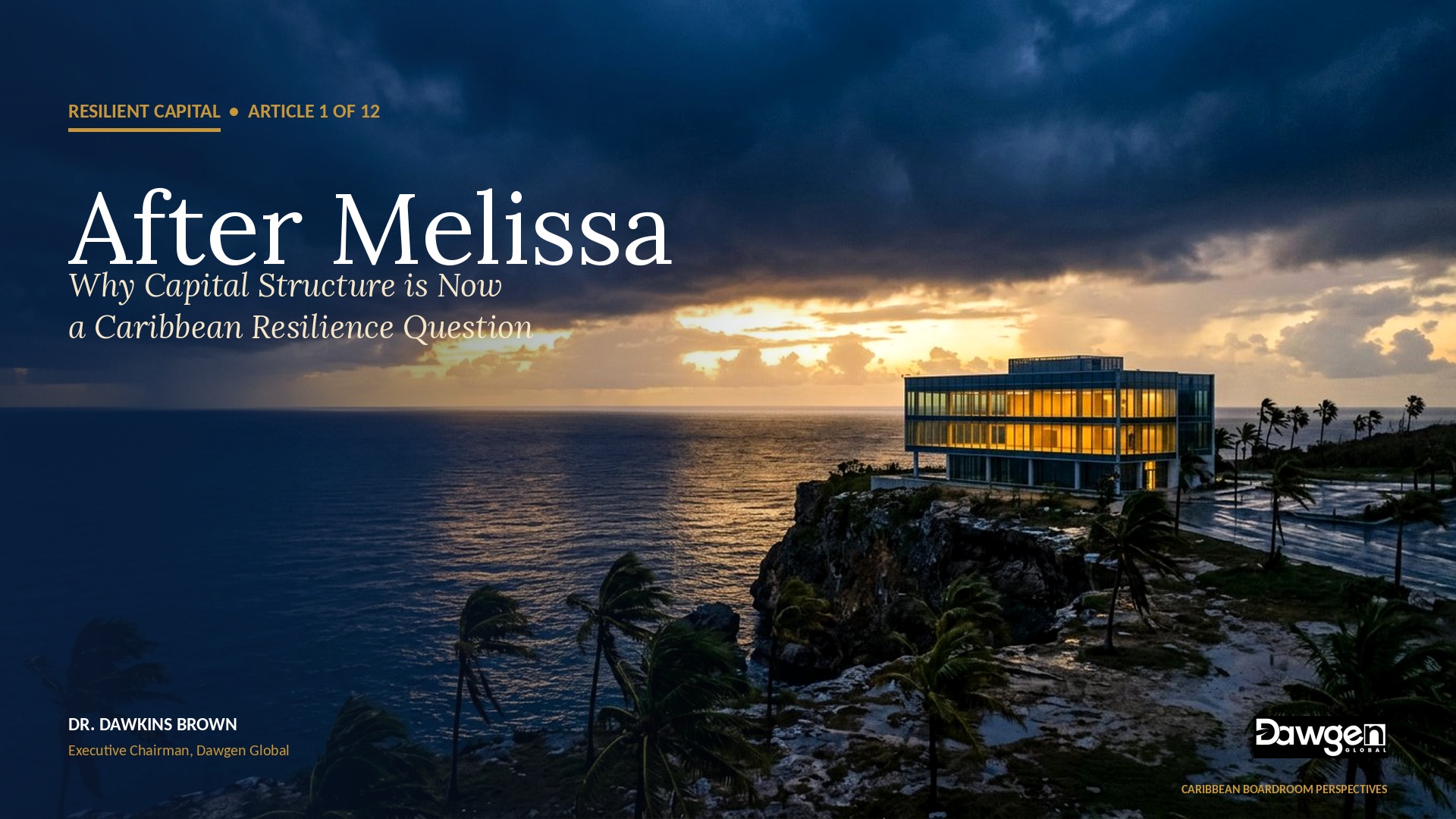
On the morning of 28 October 2025, Hurricane Melissa made landfall over Jamaica with sustained winds of 185 miles per hour. Its central pressure was the lowest ever recorded for an Atlantic hurricane at the moment of landfall. It was the most powerful storm ever to strike the island. Roofs were torn off, ground floors flooded, power lines snapped, ports were closed, and at least 25,000 tourists were on the island when the storm crossed the coast. By the time the wind had calmed, the World Bank’s preliminary estimate of damage to Jamaica had reached approximately US$8.8 billion — equivalent to roughly 41 percent of the country’s 2024 gross domestic product. Insured losses, according to Moody’s RMS Event Response, were expected to range between US$3 billion and US$5 billion.
In the weeks that followed, three things happened at the level of the Jamaican balance sheet that should permanently change how every Caribbean board, every CFO, every founder and every audit committee thinks about capital structure.
First, the Caribbean Catastrophe Risk Insurance Facility (CCRIF SPC) confirmed a US$70.8 million parametric tropical cyclone payout to the Government of Jamaica — the largest single payout in CCRIF’s eighteen-year history. The cash was confirmed within three days of landfall, on the basis of the storm’s parametric characteristics, not the slow and contested process of physical damage assessment. A second CCRIF payout of US$21.1 million followed under the excess rainfall policy, taking total CCRIF Melissa-related payouts to approximately US$91.9 million — about J$14.8 billion.
Second, on 7 November 2025, the World Bank confirmed that Jamaica’s US$150 million catastrophe bond, issued in 2024 through the International Bank for Reconstruction and Development, had triggered a 100 percent payout. Independent calculation by AIR Worldwide confirmed that Hurricane Melissa met the bond’s pre-agreed parametric thresholds for both central pressure and storm track. It was the first weather-related sovereign catastrophe bond to fully redeem since Hurricane Ian in 2022.
Third — and this is the part most easily missed in the headlines — within months, the Government of Jamaica had returned to the capital markets through the World Bank to issue a fresh US$150 million IBRD CAR Jamaica 2026 catastrophe bond, replacing the triggered cover ahead of the next hurricane season. The architecture did not collapse. It absorbed a generational shock, paid out, and restored itself.
| THE GENERATIONAL QUESTION
If the Government of Jamaica has invested more than a decade building a multi-layered, parametric, capital-markets-backed disaster financing architecture — and that architecture demonstrably worked under the worst storm on record — why does the typical Caribbean private enterprise still rely on a single bank, a single facility, a single insurance policy, and a single hope that nothing breaks? |
A Discontinuity, Not a Bad Year
It is tempting to file Hurricane Melissa under the heading of “a bad year” — the kind of severe-but-survivable event that any seasoned Caribbean operator has lived through before. That framing is comfortable. It is also wrong. Climate science makes Melissa a marker of a discontinuity, not an outlier within a familiar distribution. World Weather Attribution analysis confirmed that Melissa’s extreme wind speeds were five times more likely and 7 percent more intense because of climate change. The same warming ocean and wetter atmosphere that produced Melissa will produce more Melissas. The 2024 season had already given the region Hurricane Beryl — a Category 4 storm that caused approximately US$32 billion in regional infrastructure and revenue losses but, importantly, narrowly missed the parametric trigger on Jamaica’s catastrophe bond. The lesson of these two events together is sharper than either taken alone: economic loss and parametric trigger are not the same thing, and Caribbean enterprises must design for the gap between them.
If a senior executive sits down today and runs a simple thought experiment — what would a Melissa-equivalent event do to my balance sheet? — the answers are usually uncomfortable. The roof gets fixed by insurance, eventually. The business interruption claim is filed, eventually. The bank covers the overdraft, conditionally. The shareholders are asked for a top-up, awkwardly. The covenants come under pressure, predictably. Payroll runs out somewhere between week two and week six. By the time the indemnity insurance settlement arrives, the working capital position has deteriorated, the customers have moved to competitors, and the cash damage is far greater than the physical damage.
This is the gap that the Government of Jamaica has spent more than a decade closing — at the sovereign level. It is the gap that Caribbean private enterprises have not yet closed at the corporate level. The question is no longer whether the gap exists. The question is what serious boards, CFOs and entrepreneurs will do about it now that the gap has been measured, in real time, in front of the world.
From “Should We Take a Loan?” to a Different Conversation
For most of the last twenty-five years, the Caribbean capital structure conversation in the typical boardroom or owner-manager’s office has been remarkably narrow. It has revolved around three or four recurring questions. Should we take on a bank loan? Which bank offers the best rate? How much can we borrow against the property? Should we extend the overdraft? Occasionally, in the more sophisticated environments, the conversation reaches a fifth question: should we issue a corporate bond? But the architecture of the conversation is overwhelmingly bank-centric, collateral-centric and short-tenor.
This conversation was never adequate, but it was workable in a stable climate, in slow-changing capital markets, and in an environment where the Caribbean disaster risk financing architecture was nascent. None of those conditions still hold. The climate is no longer stable. The capital markets are no longer shallow. The disaster risk financing architecture is no longer nascent. The result is that the conversation has not kept up with the environment, and Caribbean balance sheets have inherited a structural fragility that was tolerable a generation ago and is unsustainable today.
The new conversation has to be built around a different question altogether. Not “should we take a loan?” but rather: what combination of equity, bank debt, bonds, parametric insurance, traditional insurance, debt service reserves, contingent credit, guarantees, supplier finance, ESG-linked capital and shareholder support gives this enterprise the best chance to grow in good years, survive in shock years, and recover faster than its competitors?
That question cannot be answered with a single instrument. It cannot be answered by a single banker. It cannot be answered through a single insurance policy. It requires a framework. It requires a system. It requires the discipline that the public sector has applied at the sovereign level, translated into the language and scale of corporate capital structure design. That is the discipline this twelve-article series exists to articulate.
| THE CENTRAL PROPOSITION OF THE SERIES
For Caribbean enterprises, capital structure is no longer only a financing decision. It is a resilience, ESG, governance, succession and survival decision — and the discipline of designing it deliberately is now a fiduciary responsibility, not a finance department preference. |
Introducing the Dawgen Resilient Capital Structure Framework™
Over the course of this twelve-article series, I will set out, in detail, a structured advisory framework that Dawgen Global has developed for Caribbean enterprises facing exactly this question. We call it the Dawgen Resilient Capital Structure Framework™ — DRCS-F™ for short. It rests on ten interconnected pillars, supported by five proprietary diagnostic tools, with a five-level Capital Resilience Rating™ that allows any enterprise to locate itself honestly on a single ladder, regardless of size.
The ten pillars are not invented out of theory. They are observed from advisory work across more than fifteen Caribbean territories, from the post-event experience of Hurricane Beryl and Hurricane Melissa, from the financial behaviour of resilient and fragile Caribbean businesses across multiple cycles, and from the structural lessons of the regional disaster risk financing architecture that has now been tested in real time. They are designed to be remembered, applied and tracked — not merely admired in a framework diagram.
The Ten Pillars at a Glance
| # | Pillar | Core Question |
| 1 | Purpose-of-Capital Alignment | Does each financing instrument match the purpose for which it was raised? |
| 2 | Duration Matching | Does the tenor of each liability match the cash-flow profile of the asset it funds? |
| 3 | Shock Absorption Capacity | Can the enterprise survive 3, 6 and 12 months of revenue interruption? |
| 4 | Debt Flexibility & Covenant Design | Are debt agreements designed for Caribbean shock conditions, not only normal-times conditions? |
| 5 | Liquidity Layering | Does the enterprise have multiple, sequenced sources of emergency liquidity? |
| 6 | ESG & Resilience Integration | Is capital actually allocated to climate adaptation, or only reported on? |
| 7 | Investor & Lender Diversification | Is the enterprise dependent on one bank, one lender, one type of capital? |
| 8 | Recovery Speed & Continuity Capacity | How quickly can operations, payroll and supply restart after a major shock? |
| 9 | Currency, FX & Pricing Resilience | Can the enterprise withstand a 15–25% currency depreciation without breaching covenants or losing pricing power? |
| 10 | Succession & Generational Capital | Will the capital structure survive the founder, the founder’s guarantee, and the founder’s exit? |
Each of these pillars will be explored in depth in a dedicated article over the remainder of the series. Several articles will combine pillars where the conceptual link is direct — for example, when we examine why Caribbean covenant design was never built for hurricanes, we will draw on Pillar 4 and the Covenant Stress Heat-Map™ together. Others will integrate proprietary diagnostic tools as the central operating mechanism — the Liquidity Layering Stack™, the Recovery Velocity Score™, the Capital Source Mix Wheel™, and the Capital Resilience Index™. The objective is not theoretical completeness. It is operational usefulness. By the end of the series, a Caribbean board, CFO or founder should have, in their hands, a structured method for diagnosing their own capital structure resilience and a clear pathway to improve it.
A Tiered Conversation: Entrepreneurs and Boards
One of the most consistent observations from advisory work across the Caribbean is that resilience finance is too often presented as a topic for large, listed, regulated enterprises. The implicit message — sometimes stated, more often implied — is that catastrophe bonds, parametric instruments, sustainability-linked debt and covenant heat-maps are the preserve of multi-billion-dollar balance sheets. That message is wrong, and it does material harm to Caribbean enterprise.
The framework we will explore over these twelve articles is tiered. Every pillar will be presented in two registers. The Entrepreneur Track speaks to founders, owner-managers, family business principals and SME finance leads. It is action-oriented, time-bound, and focused on what can be done in the next twelve to thirty-six months. The Boardroom Track speaks to boards, audit committees, CFOs and treasurers of mid-market and listed enterprises. It is policy-oriented, governance-focused, and structured for three-to-five-year horizons. The same pillar, the same core question, the same diagnostic discipline — calibrated to two distinct audiences.
This tiering matters because the resilience gap is not concentrated at the top of the Caribbean enterprise pyramid. It is concentrated at the bottom and middle. The Inter-American Development Bank has estimated the SME financing gap in Latin America and the Caribbean at between US$210 billion and US$250 billion. The International Finance Corporation has estimated the global formal MSME financing gap at approximately US$5.7 trillion. These are not abstract numbers. They translate, in the Caribbean context, into a regional private sector that is structurally under-financed, structurally under-diversified, and structurally exposed when shocks arrive. The ten-pillar framework is built to be useful at every level of that pyramid — and the Entrepreneur Track exists precisely so that a J$50 million family distributor can locate itself on the same maturity ladder as a J$50 billion listed financial institution, even though the instruments they will use to climb that ladder differ.
The Sovereign Model as a Corporate Blueprint
There is a deep insight available to Caribbean private enterprise in 2026 that was not fully available even five years ago. The Government of Jamaica did not invent its disaster risk financing architecture in October 2025. It assembled it deliberately, over more than a decade, instrument by instrument, layer by layer. CCRIF parametric coverage from 2007. The first World Bank-arranged catastrophe bond in 2021. Renewal in 2024. A National Natural Disaster Risk Financing Policy that organises the entire stack. Pre-arranged credit lines. Reserves. The result, when Melissa arrived, was not luck — it was the predictable outcome of a deliberate multi-year capital structure programme.
Every element of that sovereign architecture has a private-sector analogue. Parametric tropical cyclone cover is now available, increasingly, to private utilities, hotels, and agricultural producers. Contingent credit lines are available, in different forms, through commercial banks and DFIs. Debt service reserve accounts are a standard feature of any well-structured corporate bond. Sustainability-linked instruments, blue and green bonds, and resilience-linked pricing are increasingly available to Caribbean issuers — including under capacity-building partnerships between IDB Invest and regional stock exchanges. The Jamaica Stock Exchange has already begun building local guidelines and capacity for green, blue and sustainability bond issuance in collaboration with IDB Invest. IDB Invest’s new Green Climate Fund-backed Caribbean facility seeks to mobilise up to US$400 million to strengthen private-sector climate resilience. The CDB, IDB and CAF are advancing a Caribbean Multi-Guarantor Debt-for-Resilience Joint Initiative. The architecture is being built around Caribbean enterprises faster than most boards realise.
The implication is striking. The sovereign disaster risk financing model is not only relevant to governments. It is, in effect, a corporate blueprint waiting to be adopted. The instruments are here. The market is here. The donor support is here. The regional capacity-building is here. What is missing — at the level of most Caribbean private enterprises — is the framework, the discipline and the governance commitment to assemble these instruments deliberately rather than reactively. That is the gap this series addresses.
What This Series Will Cover
The remaining eleven articles in the series will each take one core element of the framework and make it operational. The arc is deliberate, building from individual diagnostic disciplines toward a fully integrated capital structure programme.
In the next article, we will examine why so many Caribbean enterprises are what we call “single-thread borrowers” — concentrated on one bank, one signature, one collateral pool — and how a hurricane, a regulatory change, or a single relationship breakdown can therefore unwind decades of operating excellence in a quarter. We will then turn to the silent killer of Caribbean balance sheets: maturity mismatch — long-life assets financed by short-tenor debt — and how to structure a maturity ladder that survives refinancing windows.
Three articles in the middle of the series will go to the heart of resilience finance. We will stress-test the Caribbean enterprise through a six-months-without-revenue scenario and introduce the Capital Resilience Index™. We will examine why Caribbean covenants were not designed for hurricanes and introduce the Covenant Stress Heat-Map™. And we will set out the Liquidity Layering Stack™ — the six layers of defence that every Caribbean enterprise should have between operating cash and capital markets.
Two further articles will tackle the integration of capital structure with broader corporate strategy. We will argue that ESG that is not financed is a press release, and explore how capital must be allocated to climate adaptation rather than merely reported on. We will then look at the new Caribbean capital stack — bank-plus-bond-plus-guarantees — and introduce the Capital Source Mix Wheel™ as a structured diversification tool.
The final stretch of the series turns to operational and human dimensions of capital structure that are too often neglected. We will examine recovery velocity — how fast a business can restart after a shock — and introduce the Recovery Velocity Score™. We will explore the silent twin of duration risk: foreign-exchange exposure and the way it interacts with covenant headroom. We will confront the question that few Caribbean family businesses want to confront: whether the capital structure depends on the founder’s signature, and what generational succession means for resilience. And in the closing article, we will synthesise the entire framework into a single integrated maturity model — five levels, named archetypes, a clear pathway from “Fragile” to “Transformational”.
A Note to the Reader
This series is written for three audiences in particular. It is written for the Caribbean board director who has been asked, perhaps for the first time, to provide oversight on capital structure resilience as a fiduciary matter — and who suspects, correctly, that the management pack does not yet contain the right disclosures. It is written for the Caribbean CFO or treasurer who has built a competent finance function and now needs to elevate it from compliance to architecture — designing capital structure as a strategic asset rather than administering it as a back-office function. And it is written for the Caribbean entrepreneur or family business principal who has built something real, something that has survived storms before, and who recognises — perhaps after Melissa, perhaps before — that the next storm should not be allowed to undo what has been built.
Each article will end with a structured advisory takeaway — a specific question to take to the next board meeting, a specific action to test in the next quarter, a specific conversation to start with a lender, an investor, an insurance broker or a co-shareholder. The series is not designed to be read passively. It is designed to be applied.
There is one final point to make about timing. The Caribbean hurricane season runs annually from June through November. Every year, in May, every Caribbean enterprise has a window of approximately thirty days in which to assess, redesign and reinforce its capital structure before the next storm arrives. This series has been timed deliberately to coincide with that window. By the time the season closes, every reader who has worked through the framework should have a structured Capital Resilience Rating™, a tested Liquidity Layering Stack™, a refreshed Covenant Stress Heat-Map™, and a board-approved capital structure programme. That is an ambitious goal. It is also a realistic one.
| THE ULTIMATE TEST
The ultimate test of a Caribbean capital structure is not how it performs in normal times, but how quickly the enterprise can pay its people, restart its operations, restore its supply chains, retain its customers and protect its shareholders after a major shock. By that test, most Caribbean balance sheets fail today. The point of this series is to make sure that fewer of them fail tomorrow. |
From Melissa to Method
The single most important thing about Hurricane Melissa was not the wind speed, not the central pressure, not the World Bank damage estimate, and not even the historic CCRIF and catastrophe bond payouts. The single most important thing was that the layered architecture worked — and worked publicly, transparently, and on a timeline that was the result of deliberate prior design. It was, in the truest sense, a proof of concept for resilient capital structure. The Caribbean private sector has now been given a working demonstration of what can be achieved when capital structure is treated as a multi-year discipline rather than an annual financing decision.
The DRCS-F™ exists to translate that demonstration into a method that any Caribbean enterprise — from a J$50 million family business to a J$50 billion listed institution — can apply to its own balance sheet. Over the next eleven articles, we will walk through that method together, pillar by pillar, tool by tool, archetype by archetype. The goal is not to admire the method. The goal is to use it. By the time the series closes, no serious Caribbean board, CFO or founder should have to wonder whether their capital structure is fit for the next storm. They should know — because they will have measured it.
The next storm will come. The next currency shock will come. The next cycle of refinancing will come. The next generational transition will come. Every one of those events is a test of the capital structure that exists today. The work of designing the capital structure that will pass those tests has to begin before the events arrive — which means it has to begin now.
| YOUR FIRST ADVISORY ACTION
Before the next board meeting, take a single sheet of paper and answer two questions in writing. First: what is the longest period of revenue interruption this enterprise could survive without breaching covenants, missing payroll or distressing its lender? Second: how do I know the answer is correct, and when was it last tested? If either answer is uncomfortable, the work of resilient capital structure design has already begun. |
About This Series
“Resilient Capital: The Caribbean Capital Structure Imperative” is a twelve-article flagship series by Dawgen Global, published through Caribbean Boardroom Perspectives and The Caribbean Advisory Brief on LinkedIn, the Dawgen Global blog, and partner channels across the region. The series is anchored on the Dawgen Resilient Capital Structure Framework™ (DRCS-F™), Edition 1.0, May 2026, available to Dawgen Global advisory clients and partner institutions.
About the Author
Dr. Dawkins Brown is the Executive Chairman and Founder of Dawgen Global, an independent, integrated multidisciplinary professional services firm headquartered in New Kingston, Jamaica, operating across more than fifteen Caribbean territories. With Big Four heritage and decades of regional advisory experience, Dr. Brown leads Dawgen Global’s strategic positioning across audit, tax, advisory, ESG, governance, cybersecurity, and digital transformation services. He writes the weekly Caribbean Boardroom Perspectives newsletter on LinkedIn.
DRCS-F™, Capital Resilience Index™, Capital Resilience Rating™, Liquidity Layering Stack™, Covenant Stress Heat-Map™, Recovery Velocity Score™ and Capital Source Mix Wheel™ are trademarks of Dawgen Global Group.
About Dawgen Global
“Embrace BIG FIRM capabilities without the big firm price at Dawgen Global, your committed partner in carving a pathway to continual progress in the vibrant Caribbean region. Our integrated, multidisciplinary approach is finely tuned to address the unique intricacies and lucrative prospects that the region has to offer. Offering a rich array of services, including audit, accounting, tax, IT, HR, risk management, and more, we facilitate smarter and more effective decisions that set the stage for unprecedented triumphs. Let’s collaborate and craft a future where every decision is a steppingstone to greater success. Reach out to explore a partnership that promises not just growth but a future beaming with opportunities and achievements.
 Email: [email protected]
  Visit: Dawgen Global Website

 WhatsApp Global Number : +1 555-795-9071
Caribbean Office: +1876-6655926 / 876-9293670/876-9265210  WhatsApp Global: +1 5557959071
USA Office: 855-354-2447
Join hands with Dawgen Global. Together, let’s venture into a future brimming with opportunities and achievements


