
In the seven previous articles of this series, we have constructed the Digital Asset Governance and Assurance Framework — DAGAF™ — pillar by pillar. We have established the case for a Caribbean-anchored framework, mapped the foreign and regional regulatory regimes Caribbean enterprises must operate within, set out the architecture of the framework as a whole, and worked through Pillar 1 (Governance), Pillar 3 (Tax), Pillar 4 (Audit and Assurance), and Pillar 5 (Custody, Cyber, and Operational Risk) in detail.
That body of work has been deliberately structural. A framework that has not been tested against a real, contested, complex use case is theoretical. So we now turn from architecture to application.
Over the four remaining articles in this series, we will apply DAGAF™ to four of the most consequential use cases for the Caribbean region: tokenized resort real estate (this article), credit union member share digitisation, tokenized alternatives for Caribbean family offices, and the implications for regulators and policy makers across CARICOM. The conclusion of the series will then return to the framework as a whole and articulate what we have learned.
There is a reason we begin with resort real estate. No other asset class is as unmistakably Caribbean. Tourism is the defining industry of much of the region — it accounts for the dominant share of GDP and employment in Jamaica, Barbados, the Bahamas, Antigua and Barbuda, St. Lucia, the Cayman Islands, and most of the OECS. Resort real estate is the asset class through which Caribbean territories have been monetising their geography for over half a century. And fractional ownership of resort property — the structural cousin of tokenization — has existed in the region in various forms (timeshare, fractional interests, residence club memberships) for decades.

This article works through that test. It treats the use case in five parts: why this asset class matters; what tokenization actually changes about it; the governance contradictions it surfaces; the seven-pillar DAGAF™ application; and the deal architecture decisions that determine whether a tokenized resort real estate transaction is defensible or reckless.
- Why Tokenized Resort Real Estate Matters for the Caribbean
Three structural facts make this asset class the natural first application of DAGAF™.
First — capital scarcity meets capital intensity.
Caribbean resort development is one of the most capital-intensive activities in the regional economy. A single full-service resort project of credible scale typically requires hundreds of millions of US dollars in committed capital, against a development cycle of three to seven years and an operating ramp of a further three to five. The traditional financing stack — domestic bank debt, regional bond markets, foreign direct investment, and developer equity — has structural limits, and those limits are now binding. Domestic banks face concentration limits on hospitality exposure. Regional bond markets are deepening but remain shallow relative to the projects on the table. FDI inflows to the Caribbean tourism sector have not kept pace with the region’s pipeline. Tokenization offers a credibly different access route to capital, particularly to the global pool of investors who want Caribbean real estate exposure but cannot or will not deploy at the ticket sizes traditional structures require.
Second — the asset has the right characteristics for fractionalisation.
Not every asset class fractionalises well. Resort real estate does. The asset has a defensible underlying valuation (the property and its operating cash flows). The income stream is observable and auditable (room revenue, food and beverage, ancillary revenue, and net operating income). The legal title can be held by a special-purpose vehicle, with token holders holding economic interests in that vehicle. And the existing fractional ownership and timeshare industry has already established the legal templates, the marketing channels, and the consumer protection frameworks within which tokenized variants can be developed. The asset class is not having to invent its own legal architecture from nothing.
Third — the use case sits at the intersection of every Caribbean policy priority.
Tokenized resort real estate touches foreign exchange management, tourism investment promotion, financial sector deepening, AML and CFT compliance, consumer protection, and the broader question of how Caribbean territories present themselves to global capital. There is no other tokenization use case that engages the public-policy interest of Caribbean ministries of finance, ministries of tourism, central banks, securities regulators, and investment promotion agencies as comprehensively. Done well, it is a flagship for the region’s financial sophistication. Done badly, it is a reputational liability that can take years to repair.
- What Tokenization Actually Changes — and What It Does Not
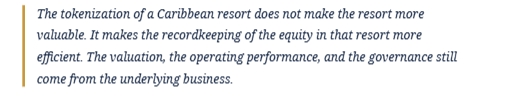
It is important to be precise about what tokenization adds to, and does not add to, the resort real estate proposition. Tokenization is not, by itself, a fundraising solution. It is not a substitute for credible underwriting, defensible operating projections, or competent management. A tokenized bad project is still a bad project.
What tokenization changes is recordkeeping, settlement, and access — and through those, three things follow.
| What Changes | What That Means in Practice |
| Investor reach | Minimum ticket sizes can fall meaningfully below traditional fractional or syndicated equity structures, expanding the accessible investor pool — provided the underlying offering remains compliant with the relevant securities regimes in every jurisdiction the offering touches. |
| Secondary liquidity | Tokenized interests can, in principle, be transferred more efficiently than traditional fractional interests — but the practical reality of secondary liquidity depends entirely on the regulated venue available to do so, and on the depth of demand from compliant counterparties. |
| Distribution economics | The cost of distribution can fall substantially relative to traditional placement structures, but only where the regulatory architecture of the offering allows direct distribution. Most tokenized real estate offerings still flow through registered intermediaries. |
| Operational transparency | On-chain recordkeeping enables continuous, verifiable reporting of distributions, ownership shifts, and corporate actions — which strengthens investor trust if the off-chain governance and audit framework is equally robust, and undermines it if it is not. |
| Settlement efficiency | Distributions to token holders, capital calls, and exit proceeds can settle in hours or days rather than weeks, with materially lower administrative cost — provided the AML, sanctions, and tax-reporting framework around each transfer is automated to the same standard. |
Notice what is missing from this list. Tokenization does not change the quality of the underlying asset. It does not relax securities laws. It does not eliminate the need for institutional-grade custody, audit, and conduct standards. It does not, by itself, create a deeper market — only a more efficient one in which markets that were already going to exist can clear at lower friction.
- The Governance Contradictions This Use Case Surfaces
Resort real estate tokenization is the use case that surfaces every fault line a Caribbean DAGAF™ engagement has to manage. Five contradictions in particular are worth setting out plainly, because boards considering this use case will encounter all of them.
Contradiction one — the local development entity versus the global investor base.
The asset and its operating company are typically domiciled and regulated in a single Caribbean jurisdiction. The investor base — by design — is global. The legal characterisation of the token, the licensing regime applicable to its issuance and distribution, and the consumer protection framework that protects investors are all jurisdiction-dependent, and rarely consistent across the territories the offering touches. This is a Pillar 2 problem (Regulatory and Legal Compliance) of the highest order.
Contradiction two — the financial-investment characterisation versus the experiential-use characterisation.
Caribbean resort fractional structures often combine an investment return with a usage entitlement — token holders receive distributions, but they also have rights of stay or use. That dual character creates ambiguity for regulators (is this a security, a consumer product, or both?) and for tax authorities (is the usage benefit a distribution in kind, a fringe benefit, or a separate consumer transaction?). Most early Caribbean offerings will need to choose one characterisation cleanly, even where the structure could plausibly support both.
Contradiction three — the sponsor’s financing imperative versus the investor’s protection imperative.
Sponsors pursuing tokenization are typically doing so to access capital on terms more favourable to them than traditional structures permit. Investors require a governance architecture that protects them. The two interests are not always aligned. DAGAF™ Pillar 6 (Investor and Market Conduct) exists precisely to make sure that a sponsor’s commercial preferences cannot quietly degrade the investor protection framework.
Contradiction four — the operational reality of the resort versus the audit expectation of the tokenized vehicle.
A working Caribbean resort is, in many cases, a complex operating business with several thousand line items in its general ledger, varied revenue streams, intercompany relationships, foreign-exchange exposures, and seasonal operating dynamics. The audit and assurance expectation around a tokenized vehicle holding interests in that resort is institutional-grade, on a calendar that may not align with how the underlying business is actually managed. Pillar 4 (Audit and Assurance) and Pillar 5 (Custody, Cyber, and Operational Risk) sit on top of that operational reality and have to be reconciled with it.
Contradiction five — the foreign-exchange premise versus the local employment and procurement premise.
Caribbean resort projects are normally pitched to foreign capital with foreign-exchange returns. The local development obligation — employment, local procurement, social investment commitments — is denominated in domestic currency. A tokenized capital stack adds a further layer of foreign-currency obligation to a local operating business. That foreign-currency exposure has to be managed, hedged, and disclosed to investors honestly, and the social licence around the project has to be preserved through the change in capital structure.
- Applying DAGAF™ Across the Seven Pillars
With those contradictions on the table, what does it actually look like to apply DAGAF™ to a tokenized resort real estate transaction? Below we work through the seven pillars in the order a board considering such a transaction should engage them.
| # | Pillar | What the Pillar Requires for Tokenized Resort Real Estate |
| 1 | Governance & Board Oversight | Board-approved use case rationale, written risk appetite, defined escalation thresholds, dedicated audit committee oversight of the tokenized structure, and conflict-of-interest disclosure where directors hold token interests. |
| 2 | Regulatory & Legal Compliance | Token classification analysis (security, consumer product, hybrid), licensing position in the issuer jurisdiction, distribution-jurisdiction perimeter mapping, AML/CFT framework calibrated to investor profile, FATF Travel Rule compliance, and an explicit cross-border counterparty regime mapping. |
| 3 | Tax Treatment & Reporting | Issuer-level tax characterisation, withholding tax mapping for distributions, GCT/VAT analysis on usage entitlements, transfer pricing on management fees, information-reporting obligations to local and foreign tax authorities, and a clear position on stamp duty and transfer taxes for secondary token transfers. |
| 4 | Audit & Assurance | Annual audited financial statements at the SPV level under IFRS, NAV reporting on a defined cycle, independent valuation of the underlying asset, reserves and capital adequacy attestation, smart contract code review at deployment and on each material upgrade, and ISA-compliant audit procedures over the on-chain register of token holders. |
| 5 | Cyber, Custody & Operational Risk | Qualified-custodian model as the default. Documented key management programme. Smart contract risk assessment including upgrade and pause governance. Third-party concentration analysis across custody, registry, and oracle providers. Operational resilience plan addressing cyber and physical disruption to the underlying resort. |
| 6 | Investor & Market Conduct | Plain-language offering documentation, suitability framework calibrated to investor categorisation, conflict-of-interest disclosures, complaints framework, marketing standards aligned to securities regulator expectations, and explicit treatment of the investor-versus-user distinction where the structure includes usage rights. |
| 7 | Strategic Use Case Selection | Documented analysis of why this asset, this jurisdiction, this token structure, and this investor base — and what alternatives were considered. Defined gating criteria for proceeding versus standing down. Articulated exit framework in case the structure does not perform. |
Notice that no single pillar carries the use case alone. A Caribbean resort developer who treats tokenization as a Pillar 2 (regulatory) problem and discharges the others to legal counsel will fail. A developer who treats it as a Pillar 5 (technology) problem and assigns it to IT will fail more spectacularly. A defensible tokenized resort transaction requires all seven pillars to be addressed in writing, by the right accountability holders, before token issuance.
- The Deal Architecture Decisions That Determine Defensibility
Beyond the pillar-by-pillar application, six architectural decisions made early in the structuring process determine whether the resulting transaction is defensible or reckless. We set them out here as decision points, not as recommendations — the right answer to each depends on the specific deal, the specific jurisdiction, and the specific investor base. But each has to be made deliberately, not by default.
| # | Decision | What the Choice Determines |
| 1 | Issuer jurisdiction | Determines the regulatory perimeter, the licensing regime, the tax treatment of the issuer, and the legal architecture of investor protection. The right answer is rarely ‘wherever the asset is located’ — it is wherever the regulatory framework most credibly supports the structure being proposed. |
| 2 | Token classification | Security token, consumer-utility token, or hybrid — the classification cascades through licensing, marketing, suitability, distribution, secondary-market access, and tax treatment. Most institutional Caribbean offerings will choose a security-token characterisation cleanly. |
| 3 | Investor categorisation | Institutional only, accredited only, retail-eligible — this choice determines marketing standards, suitability obligations, ticket sizes, and the regulatory perimeter the offering operates within. Retail eligibility multiplies obligations across every other pillar. |
| 4 | Custody model | Qualified custodian, hybrid, or self-custody — see DAGAF™ Article 7 for the full architecture. For tokenized resort real estate offered to non-professional investors, the qualified custodian model is the appropriate default. |
| 5 | Secondary-market venue | Regulated trading venue, broker-only OTC, peer-to-peer with whitelist — determines the realistic liquidity profile of the token and the conduct framework around secondary trading. Liquidity should not be promised in offering documents beyond what the chosen venue can actually deliver. |
| 6 | Distribution and usage architecture | Pure investment, pure usage entitlement, or hybrid — settled at the structuring stage, documented in offering materials, and reflected consistently in tax and accounting treatment. Hybrid structures are permissible but require disciplined disclosure of the dual character. |
Each of these decisions has to be made by the issuer’s board with the benefit of legal, tax, audit, and regulatory advice — and each has to be capable of being defended to a regulator, an investor representative, or a court if the structure is later examined. None of them can be left implicit.
- The Test the Use Case Sets for the Framework
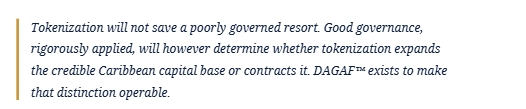
Tokenized resort real estate is a useful test of DAGAF™ because it does not let the framework’s gaps hide. If a single pillar of the framework is treated superficially — Pillar 2 over-relied on a single jurisdiction, Pillar 4 deferred to a non-specialist auditor, Pillar 5 assumed self-custody where qualified custody was the right default, Pillar 6 collapsed the investor and user characterisation into a single ambiguous category — the consequences will be visible to investors, regulators, and the regional reputation within twenty-four months.
That is the discipline this asset class imposes. It is also the reason it is the right place to begin the application phase of this series. If DAGAF™ holds up here — under the weight of capital scarcity, capital intensity, dual investor-user characterisation, cross-jurisdictional complexity, foreign-exchange asymmetry, and the social licence of Caribbean tourism — it will hold up across the use cases that follow.
Closing
In the next article, we move to the second of our four use case applications — credit union member share digitisation. Credit unions are the second-largest source of household financial intermediation in much of the Caribbean, and their member-share architecture is a natural test of how DAGAF™ handles cooperatively-owned, dividend-bearing, statutorily-protected interests in a way that the resort case does not require.
Article 9 — *Credit Union Member Share Digitisation: Tokenization Inside the Cooperative Movement* — follows in the next edition of this series.
About the Author
Dr. Dawkins Brown is the Executive Chairman and Founder of Dawgen Global, an independent, integrated multidisciplinary professional services firm headquartered in New Kingston, Jamaica, operating across more than fifteen Caribbean territories. Dawgen Global’s Digital Asset Governance and Assurance Framework — DAGAF™ — is the firm’s proprietary framework for the governance, assurance, tax, and risk management of tokenized real-world assets across the Caribbean.
This is Article 8 of 12 in the firm’s series The Caribbean Tokenization Imperative. Articles 1 through 8 are now published; the series concludes in Q3 2026. The 57-page DAGAF™ First Edition White Paper is available on request.
REQUEST THE DAGAF™ FIRST EDITION WHITE PAPER: Email: [email protected]
About Dawgen Global
“Embrace BIG FIRM capabilities without the big firm price at Dawgen Global, your committed partner in carving a pathway to continual progress in the vibrant Caribbean region. Our integrated, multidisciplinary approach is finely tuned to address the unique intricacies and lucrative prospects that the region has to offer. Offering a rich array of services, including audit, accounting, tax, IT, HR, risk management, and more, we facilitate smarter and more effective decisions that set the stage for unprecedented triumphs. Let’s collaborate and craft a future where every decision is a steppingstone to greater success. Reach out to explore a partnership that promises not just growth but a future beaming with opportunities and achievements.
 Email: [email protected]
  Visit: Dawgen Global Website

 WhatsApp Global Number : +1 555-795-9071
Caribbean Office: +1876-6655926 / 876-9293670/876-9265210  WhatsApp Global: +1 5557959071
USA Office: 855-354-2447
Join hands with Dawgen Global. Together, let’s venture into a future brimming with opportunities and achievements


