

Article 5 of THE NEW BOTTOM LINE™, Dawgen Global’s series on IFRS 18 across the Caribbean. For the region’s banks, insurers and investment companies, one judgement shapes the entire income statement.
For most companies, IFRS 18’s categories are intuitive. Interest earned on a deposit is investing. Interest paid on a loan is financing. Everything else in the business is operating.
For a bank, an insurer or an investment company, that logic breaks down. Interest earned on loans to customers is the business. So are the returns on an insurer’s investment portfolio and the rent on a property company’s buildings. If these items were classified as investing or financing, operating profit would show only a bank’s overheads and an insurer’s claims, which would tell readers nothing useful.
IFRS 18 deals with this through a single concept: the specified main business activity. Whether an entity invests in assets, or provides financing to customers, as a main business activity decides where much of its income and expense is presented. For Caribbean financial institutions, which make up a large share of the region’s listed companies, this is the most important judgement in the entire transition.
The test
IFRS 18 recognises two specified main business activities:
- investing in particular types of assets, such as financial investments or investment property, which generate a return individually and largely independently of the entity’s other resources; and
- providing financing to customers, such as lending to individuals and businesses.
An entity may have one, both or neither. A commercial bank provides financing to customers. An insurer typically invests in financial assets as a main business activity. An investment company or a property company invests in assets. A bank with a large securities portfolio may do both.
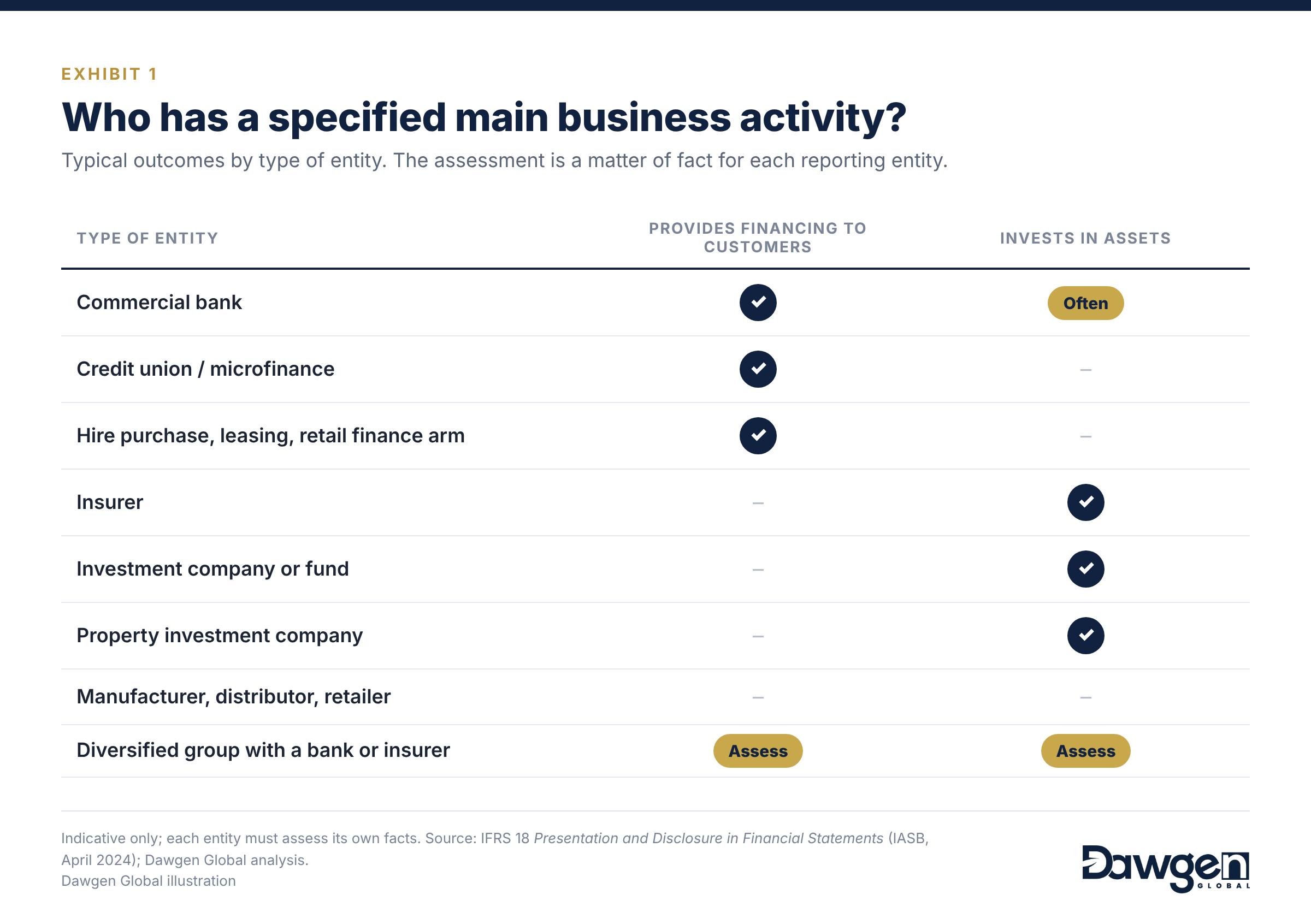
The assessment is a matter of fact, not of preference. IFRS 18 points to evidence that management already holds. The most useful indicator is how the business measures itself: a company that tracks net interest income, investment return or rental margin as a key performance indicator is likely to have that activity as a main business activity. Segment reporting is another strong indicator, especially where a reportable segment consists of a single activity such as lending or investment management.
The assessment is made for the reporting entity as a whole, and it is not fixed forever. If the facts change, for example after an acquisition or a disposal, the classification changes prospectively from the date of the change, with disclosure. Comparatives are not restated.
What changes for banks and lenders
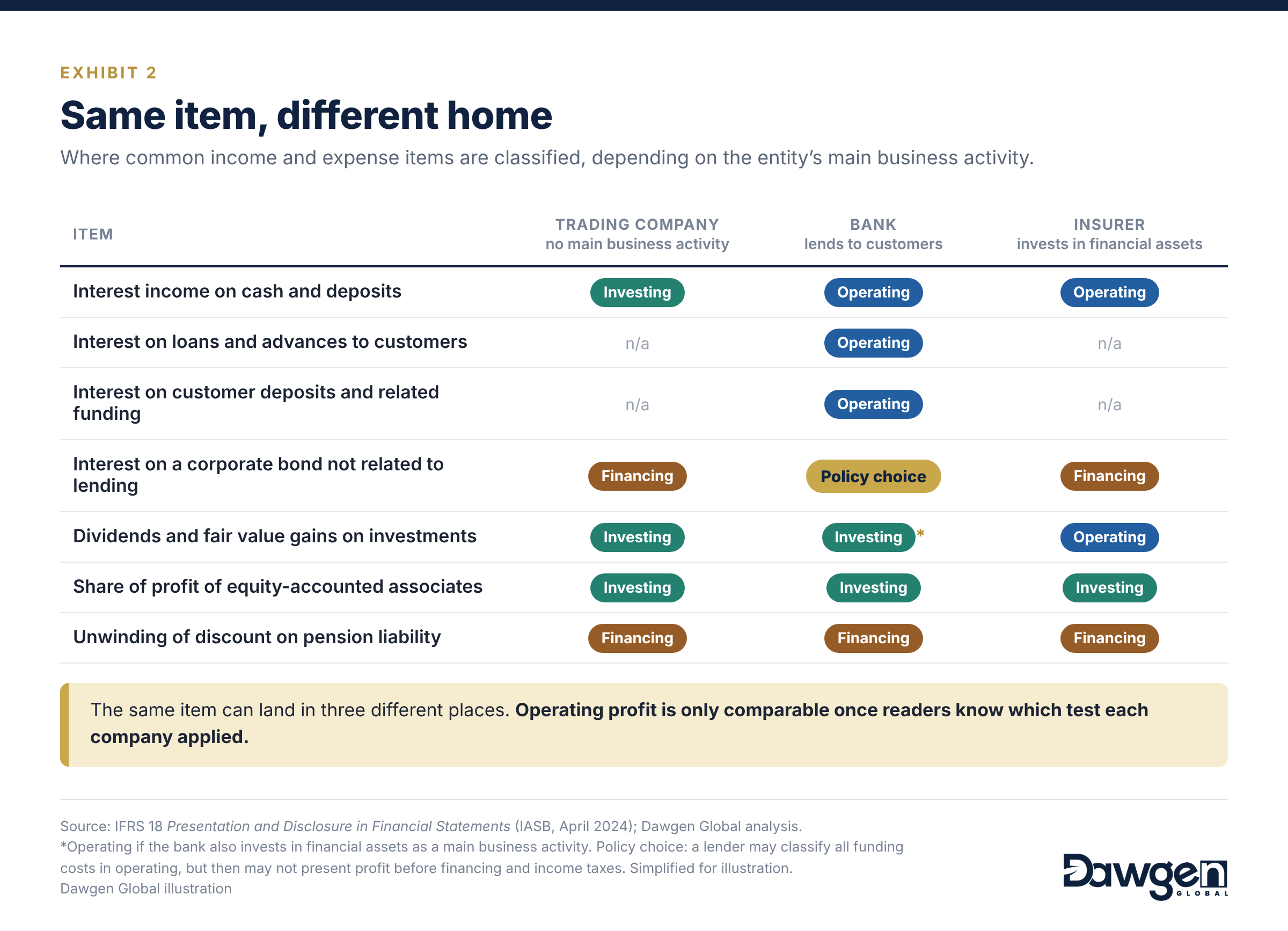
For an entity that provides financing to customers as a main business activity, the income and expenses of that activity are classified in the operating category. Interest income on loans and advances, and income from cash and cash equivalents, sit in operating profit. So does the interest expense on the deposits and other funding raised to finance customer lending.
That raises the question of funding that is not related to lending, such as a corporate bond issued to fund a head office or an acquisition. IFRS 18 gives these entities an accounting policy choice:
- classify only the funding costs that relate to customer lending in operating, leaving other funding costs in financing; or
- classify all such funding costs in operating.
The second option is simpler to apply, but it has a consequence. An entity that takes it may not present the subtotal profit before financing and income taxes. For banks that already report net interest income as their headline measure, that may be an acceptable trade. For diversified financial groups it needs careful thought, because the choice applies across the group and shapes what analysts can compare.
Not every interest-like item moves. Items that do not arise from raising finance, such as the unwinding of the discount on a pension liability or a provision, stay in the financing category regardless.
This matters well beyond commercial banks. Credit unions, microfinance institutions, building societies, hire-purchase companies, leasing companies and the finance arms of retailers and motor dealers may all provide financing to customers as a main business activity.
What changes for insurers, investment entities and property companies
For an entity that invests in assets as a main business activity, the income and expenses from those assets are classified in operating rather than investing. In practice:
- Insurers present the returns on the investment portfolio that backs their insurance contracts, including interest, dividends and fair value gains and losses, within operating profit. Where the main business activity is investing in financial assets, income from cash and cash equivalents is operating too. Insurers should also check how their IFRS 17 insurance finance income and expenses will be presented alongside those returns, so that the two sides of the investment result sit together.
- Investment companies and funds present dividends, interest and fair value movements on their portfolios in operating.
- Property companies whose main business is investing in investment property present rental income and fair value gains and losses in operating.

Two items need particular care.
Associates and joint ventures. The share of profit of associates and joint ventures accounted for using the equity method stays in the investing category, even for entities whose main business is investing. Only investments measured at fair value through profit or loss under the IAS 28 election can be classified in operating where investing in them is a main business activity. IFRS 18’s transition provisions allow some entities, including eligible insurers, to revisit that election.
Assets that are not part of the main activity. Rental income from a small investment property held by an insurer whose main investing activity is in financial assets, or a lender’s minority stake in an unrelated business, may still fall into investing. The classification follows the asset, not the type of company.
Groups and conglomerates
The assessment is made at the level of the reporting entity. For a Caribbean conglomerate with manufacturing, distribution and retail businesses alongside a bank, an insurer or an investment arm, that creates a real question: is lending or investing a main business activity of the group?

The answer may differ from the answer for the subsidiary. A banking subsidiary will present its own financial statements with lending in operating. The group may conclude that lending is not one of its main business activities, in which case the same interest income moves to investing in the consolidated statements. Alternatively, the group may conclude that it has several main business activities, and present all of them in operating.
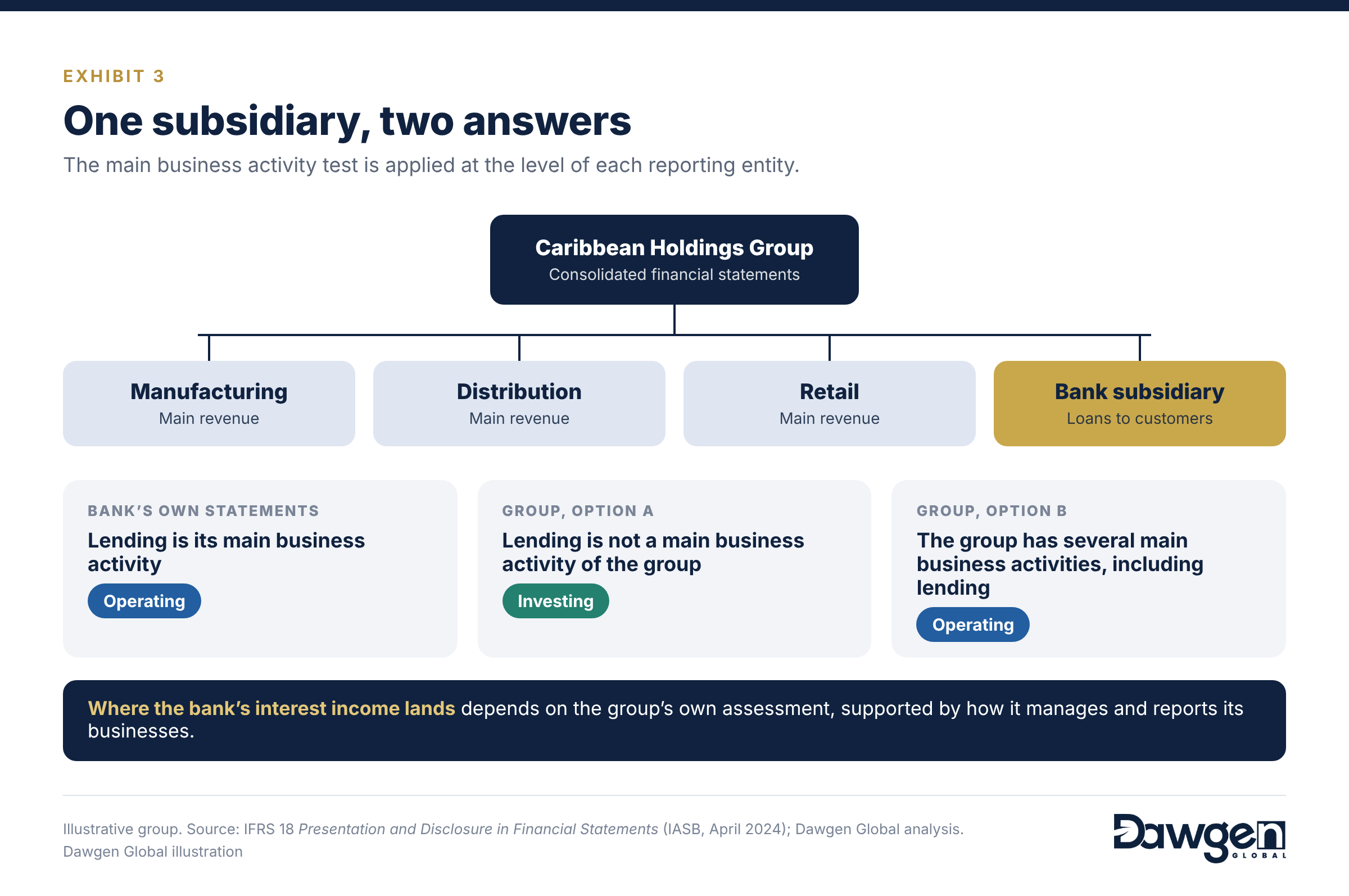
Either answer can be right. What matters is that it is supported by how the group actually manages and reports its businesses, applied consistently, and explained. Groups should expect analysts to compare their consolidated operating profit with both pure financial institutions and pure trading companies, so the reasoning deserves a clear explanation in the financial statements and the commentary.
Questions for the board
Because the main business activity assessment changes what operating profit means, it should be taken by the board or audit committee, not left to the finance team alone. Five questions frame the decision:
- Do we invest in assets, or provide financing to customers, as a main business activity, at group level as well as in each subsidiary?
- What evidence supports that conclusion: our KPIs, our segment reporting, how management is rewarded?
- If we lend as a main business activity, which accounting policy choice will we make for funding costs, and do we accept losing the profit before financing and income taxes subtotal?
- Which of our income streams fall outside the main activity, and will stay in investing?
- How will our new operating profit compare with our peers’, and how will we explain the difference to investors and regulators?
How Dawgen Global can help
Dawgen Global works with banks, credit unions, insurers, pension and investment entities, property companies and diversified groups across more than 15 Caribbean territories.
- Main Business Activity Assessment. A documented, evidence-based assessment at group and subsidiary level, ready for the audit committee and your auditors.
- Financial Institution Income Statement Redesign. Mapping of interest, investment, insurance and fee income and expenses into the new categories, including the funding cost policy choice and the effect on subtotals.
- Group Consolidation Mapping. Reconciling subsidiary and group classifications so consolidated statements are consistent and explainable.
- Board and Audit Committee Briefing. A focused session for directors of financial institutions on the decisions IFRS 18 asks them to make.
For the region’s financial institutions, the main business activity test is the decision that shapes everything else. It deserves to be made deliberately.

Book your IFRS 18 Readiness Clinic today.
Email [email protected] or call (876) 926-5210 | US 855-354-2447 | dawgen.global
Previously in this series: Ten Weeks to IFRS 18 · 2026 Is Already Your Comparative Year · Your First IFRS 18 Interim Will Be Public · Your “EBITDA” Now Needs a Footnote. Next: When the Subtotal Moves, So Do the Covenants.
Dawgen Global is an independent, integrated multidisciplinary professional services firm serving businesses across more than 15 Caribbean territories. Big Firm Capabilities. Caribbean Understanding.
About Dawgen Global
Dawgen Global is an independent, integrated multidisciplinary professional services firm headquartered at 47 Trinidad Terrace, New Kingston, Jamaica, serving more than 15 territories across the Caribbean. Founded and led by Dr. Dawkins Brown, Executive Chairman, the firm is independent and not affiliated with any international network. It delivers a full suite of professional services under one roof: audit and assurance; tax advisory; IT and digital transformation; risk management; cybersecurity; actuarial and insurance regulatory advisory; HR advisory; mergers and acquisitions; corporate recovery; business advisory and strategy; accounting BPO and virtual CFO services; and legal process outsourcing.
The proposition is simple: big-firm capability without the big-firm price. Dawgen Global’s integrated approach is built for the specific complexities and opportunities of the Caribbean market, helping organizations make sharper, better-informed decisions that drive measurable progress.
To explore a partnership, reach out:
- Website: dawgen.global
- Email: [email protected]
- WhatsApp (Global): +1 555-795-9071
- Caribbean offices: +1 876-665-5926 | +1 876-929-3670 | +1 876-926-5210