
How long should it take to close monthly accounts?
Nine working days is achievable. Thirty to seventy-five is what most Caribbean businesses actually run. This article sets out where the difference comes from, what the delay costs, and how a digitally delivered finance function closes the gap.
IN SHORT
| A monthly close should take nine working days from period end to an issued management pack. In the Caribbean mid-market it commonly takes thirty to seventy-five days, and the gap is caused almost entirely by manual transaction capture rather than by the accounting itself. The cost of the delay is not accounting error — most delayed accounts are eventually accurate — it is the decisions made without information during the waiting period, and the margin, cash and credit terms given away while the numbers were being assembled. |
SECTION 1
The pattern
There is a particular silence in a Caribbean boardroom in the second week of March.
The audited accounts for the year just ended are being discussed. The revenue number is agreed. The margin has moved, and somebody asks why. There follows a discussion in which four capable people reconstruct, from memory, a set of pricing and purchasing decisions taken between eight and fourteen months earlier. Somebody eventually says: we should have seen that earlier.
They should have. The information existed. It existed in September, in the form of invoices, purchase orders, bank entries and payroll records. What did not exist was any mechanism for turning it into a readable statement while there was still time to act on it.
This is the defining failure of the accumulated finance function, and it is worth being precise about what the failure is. It is not inaccuracy. Given enough time, most of these functions produce accounts that are perfectly correct. It is not diligence, either — the people involved are usually working hard, and often working late. The failure is latency: the interval between the period a number describes and the date the number becomes readable.
| Where the interval is nine days, the finance function is a management instrument. Where the interval is sixty or ninety days, the same finance function is a compliance instrument — and the two cost roughly the same to run. |

A margin slip in September is visible in the first week of October, while the contract is still live, the supplier is still negotiable and the price list has not yet been reprinted. On a ninety-day cycle, the same slip satisfies the tax authority, eventually satisfies the auditor, and tells the board what happened in a period during which nothing can now be changed.
Sometimes the slow function costs more, because delay generates rework: queries raised months after the transaction, when nobody remembers the answer and the supporting document has to be found rather than simply opened.
SECTION 2
The Caribbean variant

The pattern is global. Six conditions make it sharper here.
Thin finance teams carrying wide scope. A regional business of eighty staff often runs finance with two or three people, who are simultaneously responsible for processing, payroll, statutory filing, credit control and management reporting. When the close falls behind, it falls behind because the same two people were doing four other things that could not wait either. There is no bench.
Multi-currency as an everyday condition, not an exception. Most businesses of any size here buy in one currency, sell in another and bank in a third. Where revaluation is handled manually at period end, it becomes a discrete project each month — and the first thing to be deferred when the month is busy.
Import lead times that stretch the cut-off. Goods ordered in one period, shipped in a second and invoiced in a third make cut-off genuinely difficult rather than merely tedious. Where landed costing is done on a spreadsheet after the fact, inventory is not agreed until well after the month has closed, and nothing downstream of inventory can be finalised until it is.
Statutory deadlines that pull effort away from management reporting. Monthly GCT or VAT, payroll deductions and annual returns all have fixed dates, and they are dates with penalties attached. The management pack has no penalty attached. It is therefore, entirely rationally, the thing that slips.
Seasonality that concentrates the load. Tourism, agriculture, construction and distribution all have pronounced peaks in this region. The months in which the numbers matter most are precisely the months in which the finance team has least capacity to produce them.
A relationship economy in which documents arrive late. Supplier invoices follow the goods by weeks. Contracts are agreed verbally and papered afterwards. The finance function is frequently waiting on documents that exist only in somebody else’s intention.
None of these is an argument that a fast close is impossible here. They are an argument that a fast close will not happen by effort alone, because effort is already being fully applied.
SECTION 3
What it costs
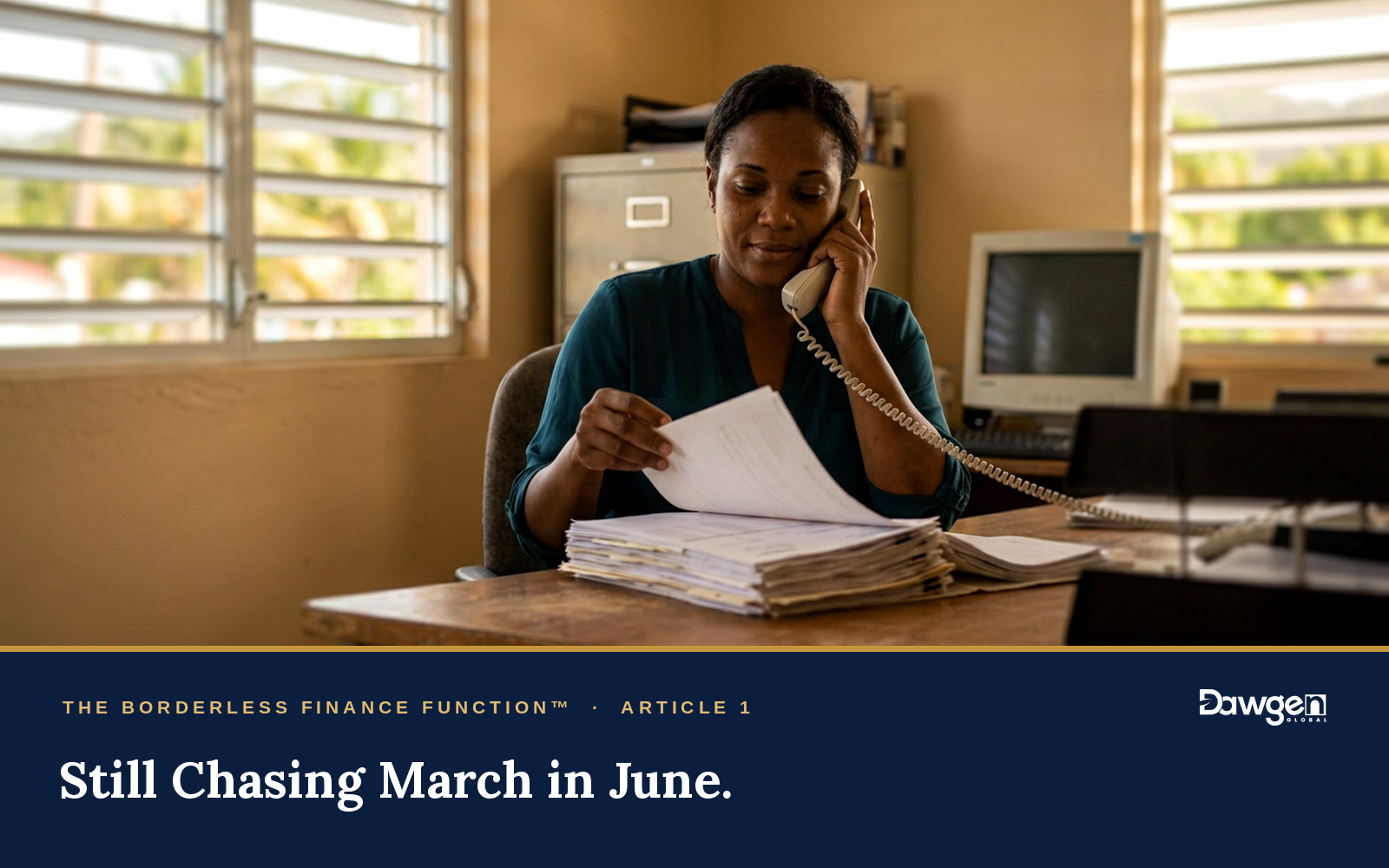
The costs of latency are real but rarely measured, because they appear as ordinary business outcomes rather than as accounting problems. Four are worth naming. The figures below are indicative, drawn from advisory experience across the region rather than from survey.
Margin given away while waiting. A product line or contract that has slipped into loss continues to be sold at the old price for as long as it takes the numbers to surface. On a sixty-day close, that is at least one full quarter of loss-making volume, and often two, because the first month’s variance is treated as noise and only confirmed by the second.
Cash consumed unnecessarily. Where receivables ageing is produced monthly and late, collection begins late. A structural slip of thirty days in the collection cycle on a business with ninety days of receivables is a material and permanent increase in working capital — funded, in practice, by the overdraft.
Credit priced against you. Lenders price uncertainty. Where management information is late, inconsistent or unavailable between year-ends, the facility is reviewed more often, secured more heavily and priced wider — commonly by 1.5 to 3.5 percentage points against an otherwise comparable borrower. That is a cash cost every month, paid for an information problem.
Transactions that stall. Where a business is being sold, refinanced or brought into a joint venture, the first request is always for management accounts and the reconciliations behind them. As many as four in ten private transactions stall or reprice in diligence, and the most common single cause is not a bad number — it is the inability to produce a good one quickly.
| To which should be added the cost that never appears anywhere: the decisions not taken. Nobody records the acquisition not pursued, the line not discontinued, or the price not raised, because the case could not be made in time. |
SECTION 4
What the capability actually does

Here is the part that gets skipped in most discussions, so it is worth setting out mechanically.
A ninety-day close is not ninety days of accounting. It is typically three to five days of accounting sitting behind eighty-five days of capture — getting transactions, in a coded and matched form, into the ledger at all. Compress the capture stage and the close compresses with it. Almost everything below is capture.
Direct bank and card feeds. The bank already publishes every transaction in machine-readable form. A connected feed pulls it into the ledger daily. What was a monthly re-keying exercise of several hundred lines becomes a daily review of exceptions. The reconciliation is not performed at month end because it was never allowed to fall behind.
Rules-based categorisation. Once a payee has been coded a few times, the platform proposes the coding thereafter — account, tax treatment, cost centre, and where relevant the department or job. The work moves from data entry to review, which is both faster and materially more accurate, because a human reviewing a proposed code catches things a human typing a code does not.
Digital document capture. A photograph of a receipt, or a supplier invoice forwarded to a dedicated address, is read, the key fields extracted, and the image attached permanently to the transaction. The bill is in the system on the day it arrives rather than when the folder is delivered — and the supporting document is attached to the entry forever, which is what makes a query answerable in thirty seconds instead of thirty minutes, and what makes an audit file assemble itself.
Automated receivables. Invoices are raised from the platform, delivered electronically, and chased on a defined schedule without anybody remembering to do it. Ageing is live rather than periodic. Collection stops being a monthly campaign and becomes a continuous process, which is the single largest lever on the cash cycle in most businesses.
Multi-currency handled at transaction level. Rates are applied when the transaction is entered and revaluation runs automatically at period end. What was a month-end project becomes a report you run.
Automated recurring entries. Depreciation, prepayment releases, accruals of known recurring costs and standing journals post to a schedule. The adjustment stage stops being a rebuild and becomes a review of the exceptions.
Permissions, approval workflow and audit trail. Approvals are enforced by the system rather than remembered. Every entry carries who created it, who approved it and when. Nothing is waiting on a signature that is on a desk in another parish, and the trail exists whether or not anyone thinks to create it.
Live reporting rather than assembled reporting. Because the ledger is current, cash, receivables, payables and margin are readable on any day of the month rather than only after a close. The formal pack still matters — it carries the adjustments, the commentary and the decisions — but the business is no longer blind between packs.
At the integrated tier, the same logic across departments. Where finance, payroll, HR and operations sit on one database, labour hours flow into job cost without a reconciliation, sales orders flow into the receivables forecast, and consolidation across entities and currencies is a report rather than a spreadsheet. The categories of month-end work that vanish are precisely the ones that involve moving data between systems — which, in a multi-entity group, is most of them.
| The pattern is consistent. None of these capabilities makes an accountant faster at accounting. Each removes a category of work that was never accounting in the first place. |
SECTION 5
How the Accounting Services BPO Division delivers it
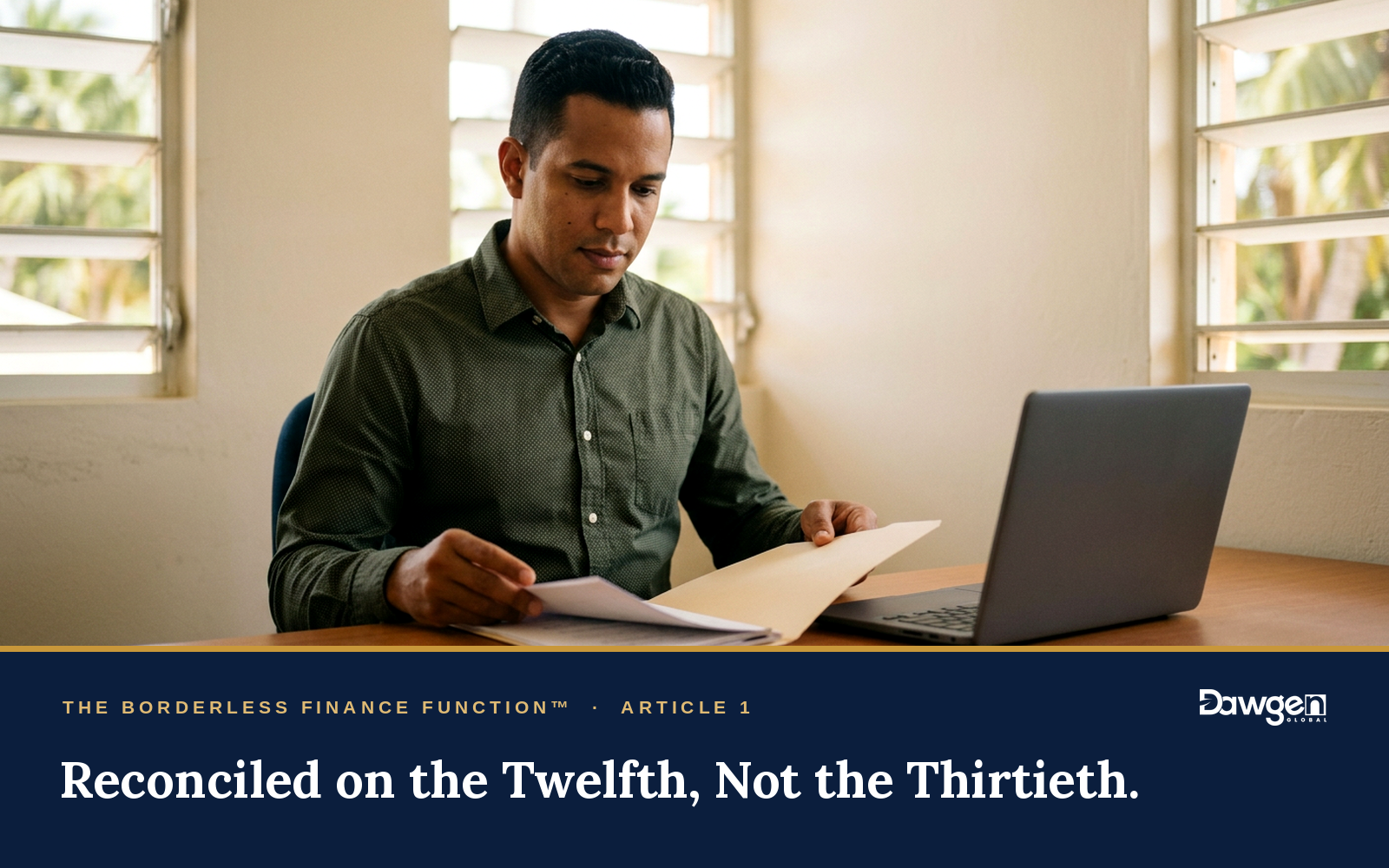
Capability is not delivery. A platform configured and then left to an already-overloaded team produces a faster version of the same backlog. What changes the outcome is that somebody is contractually responsible for the calendar.
A defined division of labour, agreed in writing before anything moves. Your office retains approval of payments and payroll, pricing and credit decisions, authorisation of new customers and suppliers, banking mandates and signing authority. The division performs processing, coding and document capture; bank, supplier, customer and control-account reconciliations; payables and receivables cycles; payroll computation and statutory filings; and the close itself. We do the work; you make the decisions; the platform records who decided what and when.
Continuous processing rather than a month-end event. Feeds are reviewed daily, bills are captured on arrival, and reconciliations are maintained rather than performed. By day one of the close, the ledger is already substantially current — which is why nine days is achievable rather than heroic.
A fixed close calendar. Days one to three, capture and match. Days four to six, adjust and review. Days seven to nine, report and advise. The dates do not move for a busy month, because the capacity is ours to manage rather than yours.
A defined output. A nine-page management pack every month: the month in one page; income statement with prior-year and budget variance; balance sheet with movement commentary; cash flow and a rolling thirteen-week forecast; gross margin by product, service or division; receivables ageing and collection performance; payables ageing and supplier commitments; payroll and headcount cost; and key ratios, covenants and the decisions arising.
A conversation, not a delivery. The pack is reviewed with a virtual CFO in the second week — margin movements, cash, funding and the decisions the numbers are pointing to. A pack that is issued and not discussed is a filing exercise with better typography.
Stated service levels. Nine days to close and issue. Forty-eight hours maximum response on any finance query. A named engagement manager and a named reviewer. Quarterly scope and service review.
Fixed monthly fees by scope. Volume, entities, users and cadence — never billed by the hour, because an hourly arrangement rewards exactly the manual effort the platform is supposed to remove.
SECTION 6
Where to start

In the next thirty days. Establish the actual number: count working days from period end to the date the last management report was issued, not the date the accounts were eventually agreed. Most businesses are surprised, and some cannot answer at all — which is itself the answer. Then identify the single largest capture bottleneck. In four cases out of five it is bank reconciliation or supplier invoice entry, and both are solvable in weeks rather than months.
In thirty to ninety days. Connect the bank feeds and build the coding rules. Move document capture to digital. Set the recurring journals to a schedule. Do not attempt a platform migration in the same window as a first attempt at a faster close — one is a project, the other is a habit, and combining them tends to produce neither.
Beyond ninety days. Fix the calendar and publish it internally, so that the close is a commitment rather than an aspiration. Move the review conversation to the second week of the month. Then, and only then, consider whether the operating model warrants the integrated tier — a decision that turns on entities, costing and enforced approvals, not on transaction volume.
| The test is simple. If the numbers for last month arrive early enough that somebody changes something because of them, the finance function is working. If they arrive and everybody nods, it is not — however accurate they are. |

REFERENCE
Frequently asked questions
How long should a monthly close take?
Nine working days from period end to an issued management pack is a reasonable standard for most mid-market businesses. Thirty to seventy-five days is common in the Caribbean mid-market. The difference is almost entirely in transaction capture rather than in accounting work.
Why does our month-end close take so long?
In most cases the accounting takes three to five days and everything before it takes the rest. Manual bank reconciliation, supplier invoices entered from paper, spreadsheet-based multi-currency revaluation and manually rebuilt accruals are the four usual causes, in roughly that order.
Is a nine-day close realistic for a small business?
Yes, and often easier than for a large one, because there are fewer entities to consolidate and fewer approvals to route. The constraint is whether transaction capture has been automated, not how many transactions there are.
What is the difference between closing the books and producing management accounts?
Closing the books means the ledger is complete, reconciled and adjusted for the period. Management accounts are the readable statement of what that ledger means, with variance, margin and cash commentary. A business can close and still have no management information, which is a common and expensive situation.
Will a faster close mean less accurate accounts?
The opposite, usually. Most error in delayed accounts comes from reconstructing transactions months after the fact from incomplete memory and missing documents. Capturing transactions as they occur, with the supporting document attached, is both faster and more accurate.
Do we need to change accounting software to close faster?
Not necessarily. Connected bank feeds, rules-based coding and digital document capture deliver most of the improvement, and several established platforms support all three. A platform change is warranted when the operating model has outgrown the ledger — multiple entities, job costing, enforced approvals — not simply because the close is slow.
| NEXT STEP
Request the Finance Function Diagnostic A 45-minute scoping conversation covering volumes, systems, entities, close cycle and reporting needs; a written recommendation on tier, scope, division of labour and transition plan; and a fixed-scope service proposal priced by process, with service levels and exit terms stated. Contact us: Dawgen Global · Accounting Services BPO Division: [email protected] · dawgen.global/contact-us Caribbean 876-929-3670 | 876-665-5926 · United States 855-354-2447 |
Continue reading: “You are not hiring an accountant. You are buying a finance function.” · “Nine days to close, not ninety.” · “The monthly management pack, page by page.”
About Dawgen Global
Dawgen Global is an independent, integrated multidisciplinary professional services firm headquartered at 47 Trinidad Terrace, New Kingston, Jamaica, serving more than 15 territories across the Caribbean. Founded and led by Dr. Dawkins Brown, Executive Chairman, the firm is independent and not affiliated with any international network. It delivers a full suite of professional services under one roof: audit and assurance; tax advisory; IT and digital transformation; risk management; cybersecurity; actuarial and insurance regulatory advisory; HR advisory; mergers and acquisitions; corporate recovery; business advisory and strategy; accounting BPO and virtual CFO services; and legal process outsourcing.
The proposition is simple: big-firm capability without the big-firm price. Dawgen Global’s integrated approach is built for the specific complexities and opportunities of the Caribbean market, helping organizations make sharper, better-informed decisions that drive measurable progress.
To explore a partnership, reach out:
- Website: dawgen.global
- Email: [email protected]
- WhatsApp (Global): +1 555-795-9071
- Caribbean offices: +1 876-665-5926 | +1 876-929-3670 | +1 876-926-5210


