
Why Caribbean organisations that operate across islands should stop buying laptops one shipment at a time — and start buying a managed outcome.
Rethinking how Caribbean organisations equip their people — a three-part series from Dawgen Global.
A new hire, a sealed box and a customs warehouse
A regional distributor hires a sales manager for its new office in Bridgetown. Her start date is Monday. Her laptop was ordered three weeks ago, shipped through Miami, and is now sitting in a customs warehouse waiting for a broker to clear it. When it finally arrives in Kingston, the company’s senior systems administrator will spend most of a day installing software, applying security settings, connecting it to the network and testing it. Then it goes back into a box and onto a courier to Barbados.
She will spend her first week borrowing a colleague’s machine and working around missing access. Her manager will lose a week of selling. The most expensive technical person in the business will have spent his time as a logistics clerk. And when the laptop is eventually retired, nobody will be quite sure who is responsible for wiping the client data on it.
None of this appears in the board pack. The budget line simply says “IT equipment”, and the number beside it is the invoice price.
This is not an unusual story. For many Caribbean organisations, it is the normal way people are equipped to work. It is also one of the most overlooked sources of cost, delay and control weakness in the business.
The purchase price is the smallest part of the bill
When boards approve a technology budget, they see what the device costs to buy. They rarely see what it costs to put that device into a working employee’s hands, keep it working for three or four years, and retire it safely.
A full picture of the lifecycle cost usually includes six layers:
- Landed cost. This covers freight, insurance, import duties, consumption taxes and brokerage. These differ from territory to territory and are often booked to different ledgers from the device itself.
- Preparation time. This is imaging, software installation, security configuration, account set-up and testing by internal IT staff.
- This means shipping devices between offices and islands, chasing deliveries, and keeping track of who holds which machine.
- Support and repair. This includes helpdesk time, spare parts, out-of-warranty repairs, loan machines and the cost of sending devices away for repair.
- These are the productive hours lost while a person waits for a new device, a replacement or a repair.
- This covers data wiping, disposal, and the risk of an old laptop leaving the building with client information still on it.
Only the first part of the first layer is usually visible to the people approving the spend. The rest is spread across payroll, courier accounts, petty cash, overtime and lost sales, where nobody recognises it as a technology cost at all.
What the full bill can look like
The table below is an illustrative model for one business laptop over a four-year life in a Caribbean organisation with offices in more than one territory. The figures are assumptions for discussion, not benchmarks; every organisation’s numbers will differ. The point is the shape of the bill, not the precise amounts.
| Cost layer | Illustrative assumption | Illustrative cost (US$) |
| Device purchase | Mid-range business laptop | 1,200 |
| Landed cost | Freight, duty, taxes and brokerage at about 20% of price | 240 |
| Preparation | 4 hours of IT time at US$35 per hour | 140 |
| Movement between sites | Courier, tracking and handling | 60 |
| Support and repair over 4 years | Helpdesk time, parts and one out-of-warranty repair | 300 |
| Downtime over 4 years | 16 lost working hours at US$25 per hour | 400 |
| Retirement | Data wiping, collection and disposal | 50 |
| Total lifecycle cost | 2,390 |
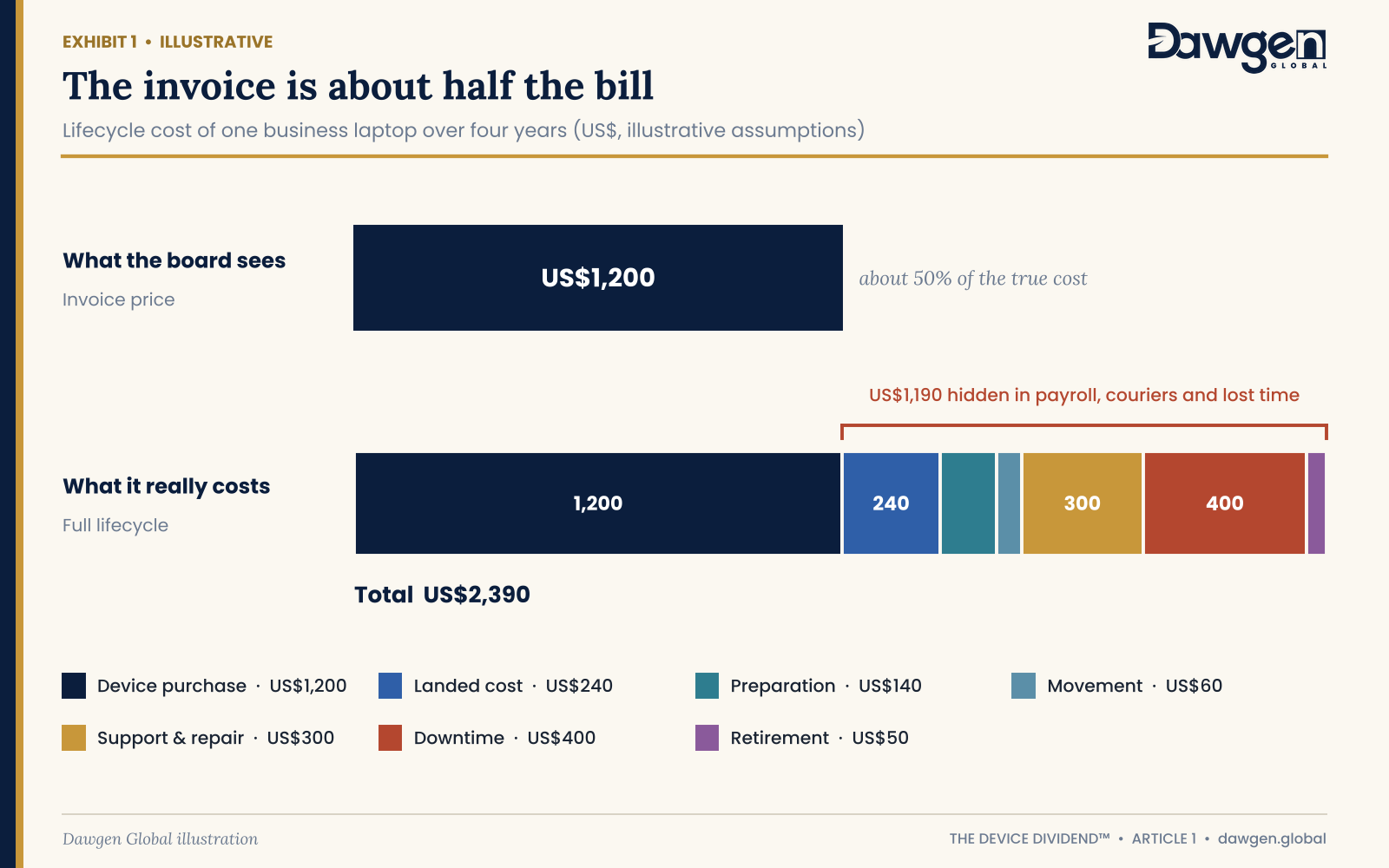
Exhibit 1. On these illustrative assumptions, the invoice is about half of what a laptop really costs over four years.
On these assumptions, the invoice price is roughly half of what the device really costs. In our experience, organisations that have never added these layers up are routinely surprised by the answer. The surprise is usually larger in groups that operate across several islands.
Fifteen islands, fifteen procurement problems

Caribbean groups face a challenge that large mainland companies rarely do. A business with offices in Jamaica, Trinidad and Tobago, Barbados and the Eastern Caribbean is dealing with several customs regimes, several tax rules, different suppliers and, often, different currencies. Shipping routes are thinner. Lead times are longer. Local stock of business-grade equipment can be limited.
The usual response is to let each territory buy its own equipment. Within a few years the group owns a mixture of brands, models, ages and warranty terms. Every office is configured slightly differently. Security policies set in head office are applied unevenly in the satellite offices. Software licences are bought locally and tracked in spreadsheets, if at all. Nobody can say with confidence how many devices the group owns, where they are, or who holds them.
That fragmentation is not just untidy. It is a control weakness. An asset register that does not match reality is an audit finding waiting to happen. A device in a branch office without current security settings is an entry point for an attacker. And a group that cannot see its own estate cannot negotiate effectively with suppliers.
The obsolescence trap
Buying hardware outright also locks an organisation into today’s technology for the life of the asset. A laptop bought in 2026 and depreciated over four years will still be in service in 2030. By then, operating systems, security standards and artificial-intelligence features will have moved well beyond it.
The pace of change is accelerating. New generations of business computers are being designed around on-device AI capabilities, stronger hardware security and longer battery life. Software vendors are steadily raising the minimum specifications they support. Equipment that was perfectly adequate when it was bought can become a bottleneck well before it is fully written off.
Organisations then face a choice nobody enjoys. They can keep staff on ageing equipment that slows them down and frustrates them, or they can replace assets early and absorb the write-off. Neither is a strategy. Both are the consequence of treating devices as things you own, rather than as a service your people consume.
There is also a hidden cost to IT itself. Some technology teams spend their days as an expensive shipping department, receiving boxes, imaging machines and filling in courier forms. That time is not going into the projects that move the organisation forward: automation, data, cybersecurity and customer systems.
What “device as a service” actually means

Device as a service replaces the cycle of buy, configure, ship, repair and dispose with a single managed arrangement. In a well-designed programme:
- One contract covers the whole lifecycle. The hardware, the software that runs on it, and the services that keep it working sit under one agreement rather than a stack of separate purchase orders and warranties.
- Devices arrive ready to work. They are configured to the organisation’s standard image, applications and security policies before they leave the fulfilment centre, so the employee can log on and start working on day one.
- The organisation pays a predictable monthly amount per user. This replaces a large capital outlay every three or four years.
- Support and repairs are part of the service. Agreed response times and replacement arrangements replace the hunt for a technician.
- Refresh is built in. At the end of the term, devices are replaced with current technology without a fresh capital battle.
- Retirement is handled properly. Old devices are collected, data is securely erased, and equipment is refurbished or recycled responsibly.
- The estate is visible. The organisation receives reporting on what devices it has, who holds them and where they are in their lifecycle.
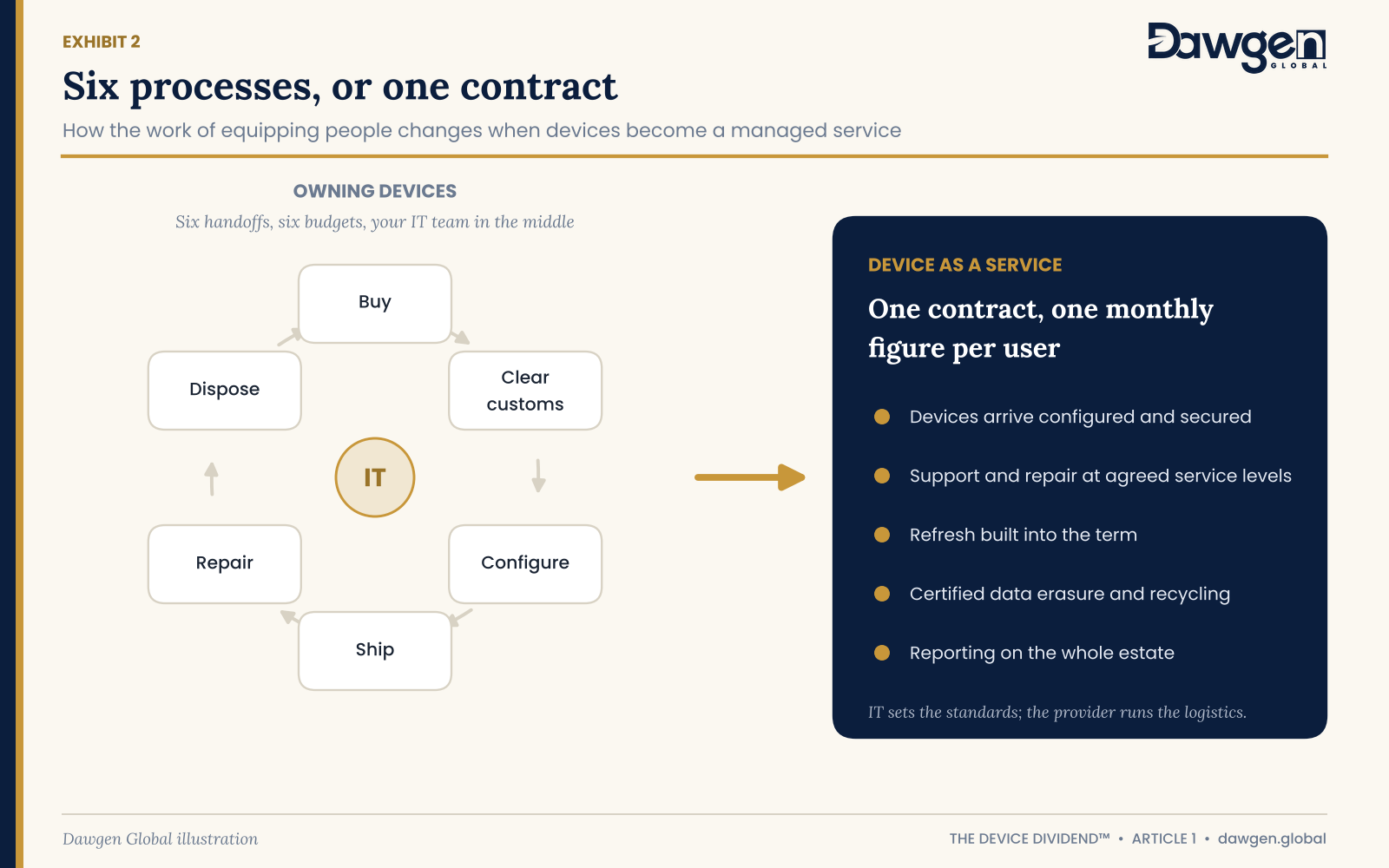
Exhibit 2. Owning devices means running six separate processes; a managed service puts them under one contract.
The result is that the internal IT team gets out of the business of configuring, shipping and tracking laptops, and back into the business of making technology serve the organisation’s strategy.
The invoice is the visible part. The rest is spread across payroll, courier accounts, petty cash and lost time, where nobody sees it as a technology cost at all.
What it is not
Device as a service is not simply a lease with a new name. A lease finances an asset; the configuration, support, logistics and disposal problems remain yours. A managed service transfers those problems to a provider that is equipped to solve them at scale.
Nor does it mean giving up control. The organisation still decides which devices suit which roles, which software is installed, and which security standards apply. It still owns its data and its user accounts. What it gives up is the administrative burden of executing those decisions one box at a time.
And it is not a one-size-fits-all bundle. The best programmes are designed around role profiles, each with its own software and security standard and priced per user. A front-office tablet, a finance workstation, a field engineer’s rugged laptop and an executive’s lightweight machine would each be a separate profile.
How it plays out across sectors
The principles are the same everywhere, but the benefits show up differently by sector.
Hotels and resorts. Front desk, reservations, point-of-sale and back-office staff all depend on devices that work at 2 a.m. in peak season. Properties are often spread across parishes or islands, and seasonal hiring creates sharp peaks in demand. A managed programme lets the group add devices for the season and standardise configuration across properties, so a manager moving between resorts finds the same tools in each.
Schools and colleges. Teachers and administrators need reliable equipment, but institutions rarely have large IT teams or large capital budgets. Predictable per-user costs fit better with grant funding and annual budgets, and built-in refresh avoids classrooms full of ageing machines.
Credit unions and financial institutions. Member data and regulatory expectations make consistent security across every branch essential. A standard configuration applied before devices leave the fulfilment centre, combined with secure data erasure at end of life, gives boards and regulators evidence rather than assurances.
Manufacturing and distribution. Plants, warehouses and sales teams spread across territories need devices that survive harsh conditions and reach new hires quickly. Taking logistics off the internal IT team lets it focus on the operational systems that actually drive margin.
Is it right for your organisation?
Device as a service is not the answer for every business. It tends to deliver the strongest results where several of these are true:
- You operate in more than one territory or from several sites.
- You hire regularly, or expect headcount to grow in the next two years.
- Your IT team is small and spends significant time on device logistics.
- You have a mix of device brands, ages and warranty terms.
- Large technology purchases compete with other capital priorities.
- You cannot say quickly how many devices you own and who holds each one.
- Your auditors or regulators have raised questions about IT asset control or data disposal.
If three or more of these apply, the numbers are worth running.
From decision to day one: a practical roadmap
Moving to a managed model does not require a big-bang replacement. Most organisations follow five steps:
- Establish what devices exist, who uses them, what they cost across all six layers, and when they are due for replacement.
- Define role profiles, software and security standards, service levels and the territories to be served.
- Price and compare. Model the managed programme against continuing to buy, so the decision rests on evidence.
- Start with one team, one site or the next wave of new hires, and measure the experience.
- Roll out and refresh. Transition the rest of the estate as existing devices reach end of life, avoiding early write-offs.
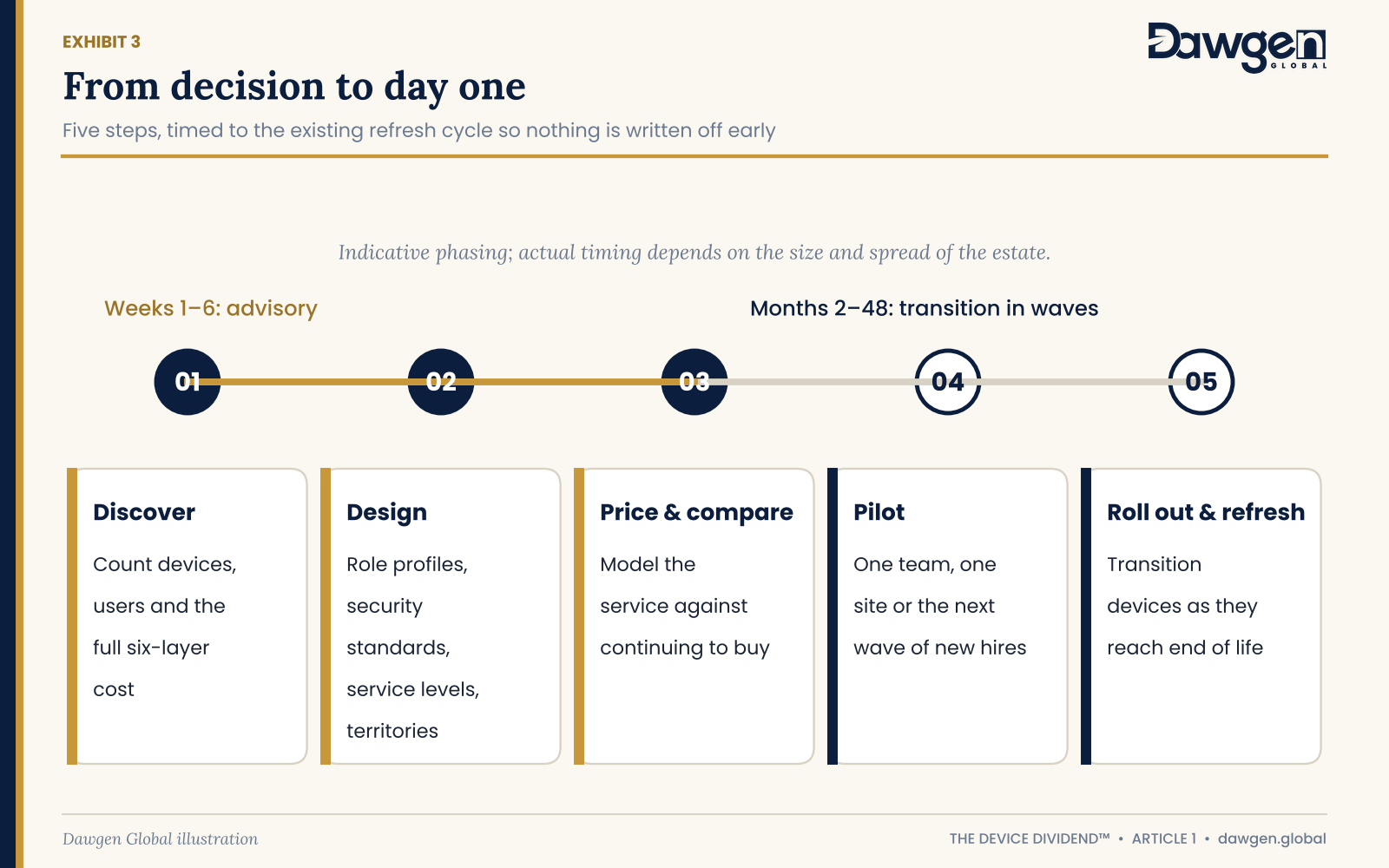
Exhibit 3. A phased move, timed to the existing refresh cycle, avoids early write-offs.
Timed this way, the transition can be largely self-funding: devices are replaced when they would have been replaced anyway, but under a model that is easier to manage and budget.
Questions leaders often ask
Will we be tied to one brand of device? Not necessarily. A well-designed programme starts from what your people need. The device mix should follow the role profiles, not the other way round.
What happens to the devices we already own? They can usually stay in service until they reach the end of their useful life, then transition into the programme. In some cases, existing equipment can be collected, wiped and recycled as part of the arrangement.
Do we lose our IT team? No. You redeploy it. The team stops doing logistics and starts doing the work only an internal team can do well.
Is our data safe with a provider handling devices? Your data stays yours. Security standards are set by you and applied before devices ship, and certified data erasure at end of life should be a contractual requirement.
How Dawgen Global helps
Dawgen Global approaches this as advisers first. We start with your people, your operations and your numbers, not with a product.
We establish what your current device estate really costs, across every layer of the lifecycle. We then design a programme around how your people work: which roles need which devices, what software and security each role requires, and which territories need to be served. Through our global technology partners, we configure that programme using enterprise-grade quoting, configuration, financing and fulfilment capabilities, so the solution you receive is built for you rather than chosen from a brochure.
Dawgen Global also provides audit, tax, risk and cybersecurity services. That means we can test the business case, the accounting treatment and the control environment in the same engagement. We manage the programme centrally from our Caribbean headquarters across the territories where you operate.
| CALL TO ACTION
Book a Device Lifecycle Cost Review Find out what your laptops, desktops and tablets really cost you, and what a managed monthly alternative would look like. What you receive ✓ A total-cost-of-ownership analysis of your current device estate, across landed, preparation, movement, support, downtime and retirement costs ✓ A device and role profile showing who needs what, by territory ✓ A tailored device-as-a-service design, configured for your roles, territories and security standards ✓ An indicative monthly per-user cost, compared side by side with your current approach ✓ A transition roadmap timed to your existing refresh cycle How it works: A short discovery call, a scoping discussion, then the review itself. Fees are agreed after scoping, once we understand the size and spread of your estate. Contact [email protected] · |
About Dawgen Global
Dawgen Global is an independent, integrated multidisciplinary professional services firm headquartered at 47 Trinidad Terrace, New Kingston, Jamaica, serving more than 15 territories across the Caribbean. Founded and led by Dr. Dawkins Brown, Executive Chairman, the firm is independent and not affiliated with any international network. It delivers a full suite of professional services under one roof: audit and assurance; tax advisory; IT and digital transformation; risk management; cybersecurity; actuarial and insurance regulatory advisory; HR advisory; mergers and acquisitions; corporate recovery; business advisory and strategy; accounting BPO and virtual CFO services; and legal process outsourcing.
The proposition is simple: big-firm capability without the big-firm price. Dawgen Global’s integrated approach is built for the specific complexities and opportunities of the Caribbean market, helping organizations make sharper, better-informed decisions that drive measurable progress.
To explore a partnership, reach out:
- Website: dawgen.global
- Email: [email protected]
- WhatsApp (Global): +1 555-795-9071
- Caribbean offices: +1 876-665-5926 | +1 876-929-3670 | +1 876-926-5210


