
A standing guide for owner-managed businesses, their boards and their advisers
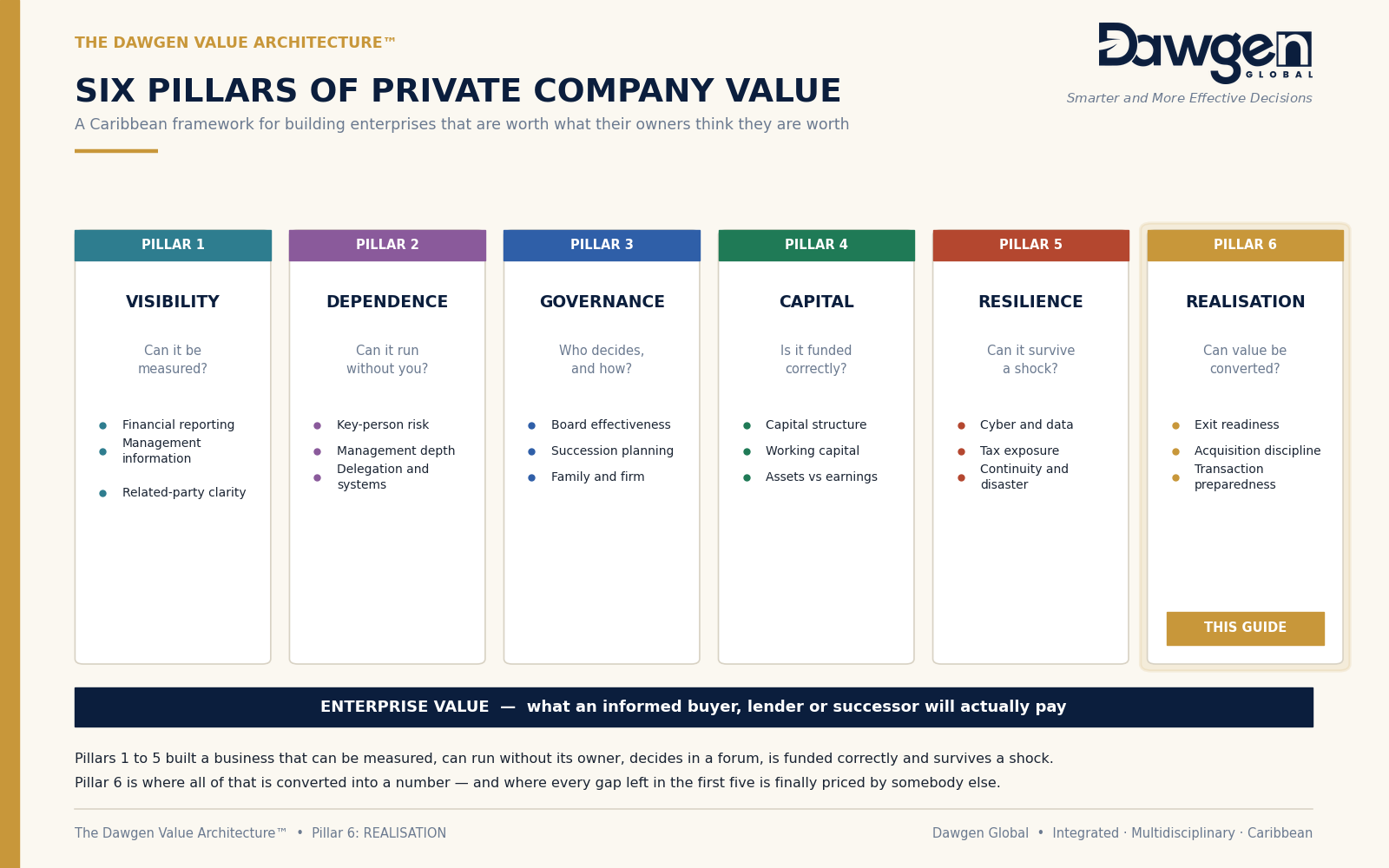
The Dawgen Value Architecture™ — six pillars of private company value. This guide addresses Pillar 6.
The Dawgen Value Architecture™
Most owner-managed businesses in the Caribbean are worth less than the people who built them believe. That is not a comment on the quality of those businesses. It is a comment on the difference between value that exists and value that can be demonstrated to a lender, a buyer, a regulator or a successor. The gap between the two is rarely closed by trading harder. It is closed by building the conditions under which value becomes visible, transferable and durable.
The Dawgen Value Architecture™ is the framework we use to name those conditions. It holds that what a private company is actually worth is determined by six things, each of which can be assessed, scored and improved. The framework was developed from patterns that recur across private company advisory engagements in this region, and it is set out here in full so that owners and boards can apply it to their own businesses without engaging anyone at all.
The six pillars
PILLAR 1 · VISIBILITY Can it be measured?
PILLAR 2 · DEPENDENCE Can it run without you?
PILLAR 3 · GOVERNANCE Who decides, and how?
PILLAR 4 · CAPITAL Is it funded correctly?
PILLAR 5 · RESILIENCE Can it survive a shock?
PILLAR 6 · REALISATION Can value be converted?
The order is deliberate, but it is an order of diagnosis rather than an order of importance. This is the sixth and final guide, and it is where the preceding five are settled. Pillar 6 does not introduce a new discipline so much as present the account: everything left undone in VISIBILITY, DEPENDENCE, GOVERNANCE, CAPITAL and RESILIENCE is discovered here, by somebody else, and converted into a number the owner does not control.
How each guide is built
Every guide in the series follows the same structure, so that a reader who has worked through one will know exactly where to look in the next. Each begins with the pattern as it presents itself in practice, then examines the Caribbean conditions that make the pattern harder to resolve here than elsewhere. It then sets out what the problem costs in cash terms, why owners nonetheless leave it unaddressed, and a staged remedy organised into the first ninety days, months three to twelve, and beyond. Each guide closes with a scored diagnostic the reader can complete unaided, and a short section on where to begin.
The guides are written as standing reference documents rather than articles. They are intended to be returned to, worked through with a management team, and used as the basis for a board conversation. Figures presented as ranges are indicative of what we observe in practice and in the published international literature; they are not the output of a survey, and they are labelled as such wherever they appear.
| Where this guide sits
This is Pillar 6 of 6. It addresses exit readiness, acquisition discipline and transaction preparedness — whether the value built by the first five pillars can actually be converted into cash, into a successful family transfer, or into outside investment. It also closes the series: the final section of this guide sets out the Private Company Value Scorecard, which consolidates all six diagnostics into a single view of how much of what a business is worth can be demonstrated to somebody who was not there while it was being built. |
SECTION 1
The Pattern

An owner receives an approach. It may be a competitor, a regional group, a private investor, or simply the moment a son or daughter asks the question directly. A number is discussed. It is usually the number the owner has carried privately for years, and for a short period everything proceeds warmly.
Then the requests begin. Three years of signed accounts. The share register. Board minutes. The lease. The related-party arrangements. And the business discovers, item by item, that what it holds is not a file but a memory — that the accounts are two years old, that the register was never updated after the last transfer, that the minutes were written by the accountant at year end, and that the building is owned by the company but the arrangement with the owner’s other entity was never put in writing.
The price is agreed in principle. It is decided in diligence.

Why this is Pillar 6
This guide comes last because it is where the other five are examined. Every question a buyer asks is an output of a preceding pillar: the accounts belong to VISIBILITY, the management team to DEPENDENCE, the minutes and the register to GOVERNANCE, the facilities and security to CAPITAL, the insurance and claims to RESILIENCE. A company that has built the first five has already produced everything a transaction requires, as a by-product of running itself properly.
A company that has not built them experiences diligence as an ordeal, because it is being asked to construct in six weeks what should have accumulated over six years. That is the whole of the preparation discount, and it is charged for the reconstruction rather than for anything the business did wrong.
The test that settles it
A buyer asks for roughly eleven things in the first week. Take the list, sit with the management team, and mark honestly how many could be on a desk by Friday — not eventually, not after somebody calls the auditor, but by Friday.
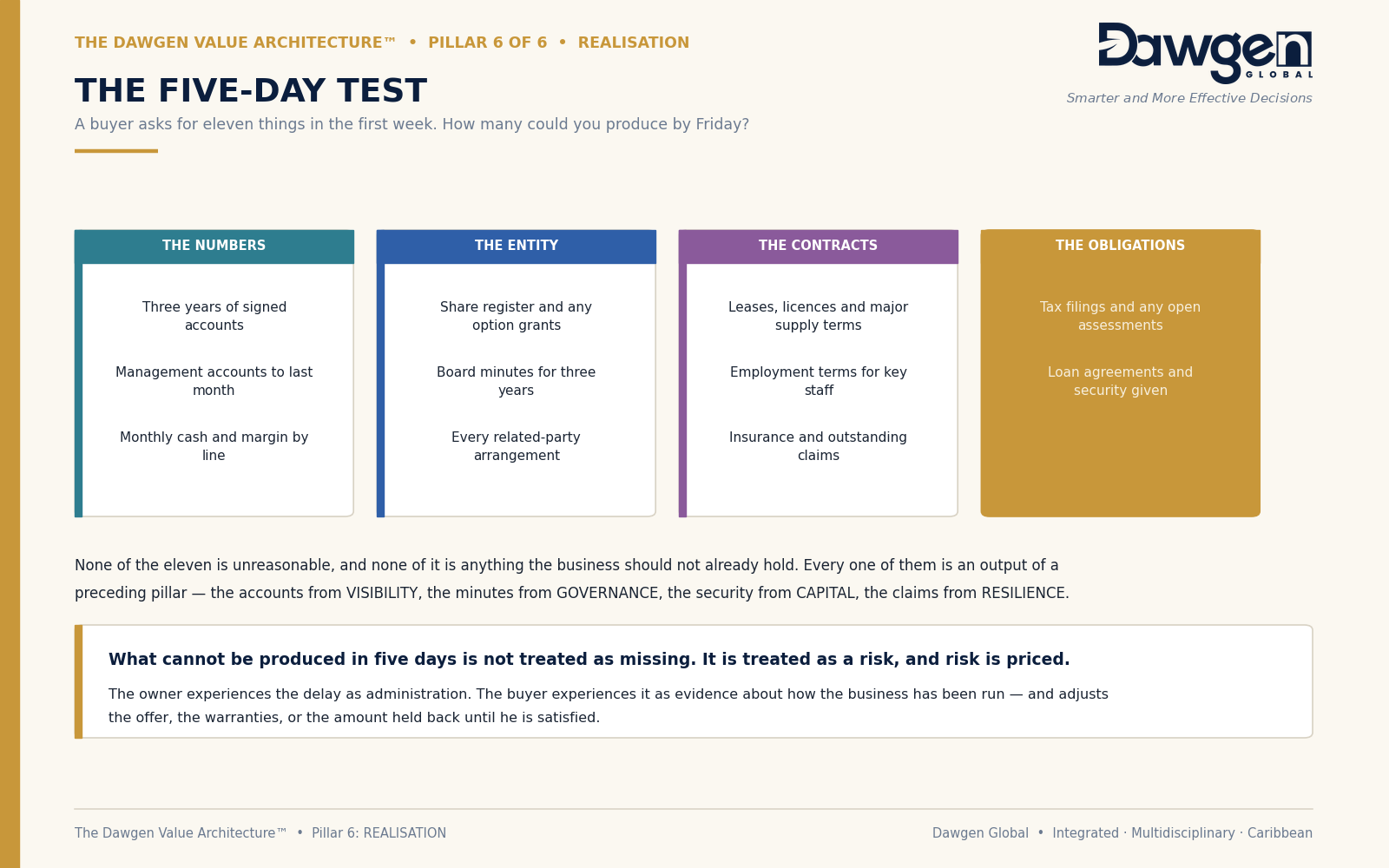
None of the eleven is unreasonable and none of it is anything a well-run business should not already hold. What cannot be produced in five days is not recorded by the buyer as missing. It is recorded as risk — and risk is priced, in a lower offer, in a wider set of warranties, or in a larger share of the consideration held back until he is satisfied.
The asymmetry is worth stating plainly. The owner experiences the delay as administration and assumes it will be forgotten once the papers arrive. The buyer experiences it as evidence about how the business has been run, and does not forget it at all.
SECTION 2
The Caribbean Variant

Transaction difficulty is universal. What is regional is that a Caribbean private company cannot rely on a competitive process to correct for poor preparation. Six conditions recur with enough regularity to be treated as structural.
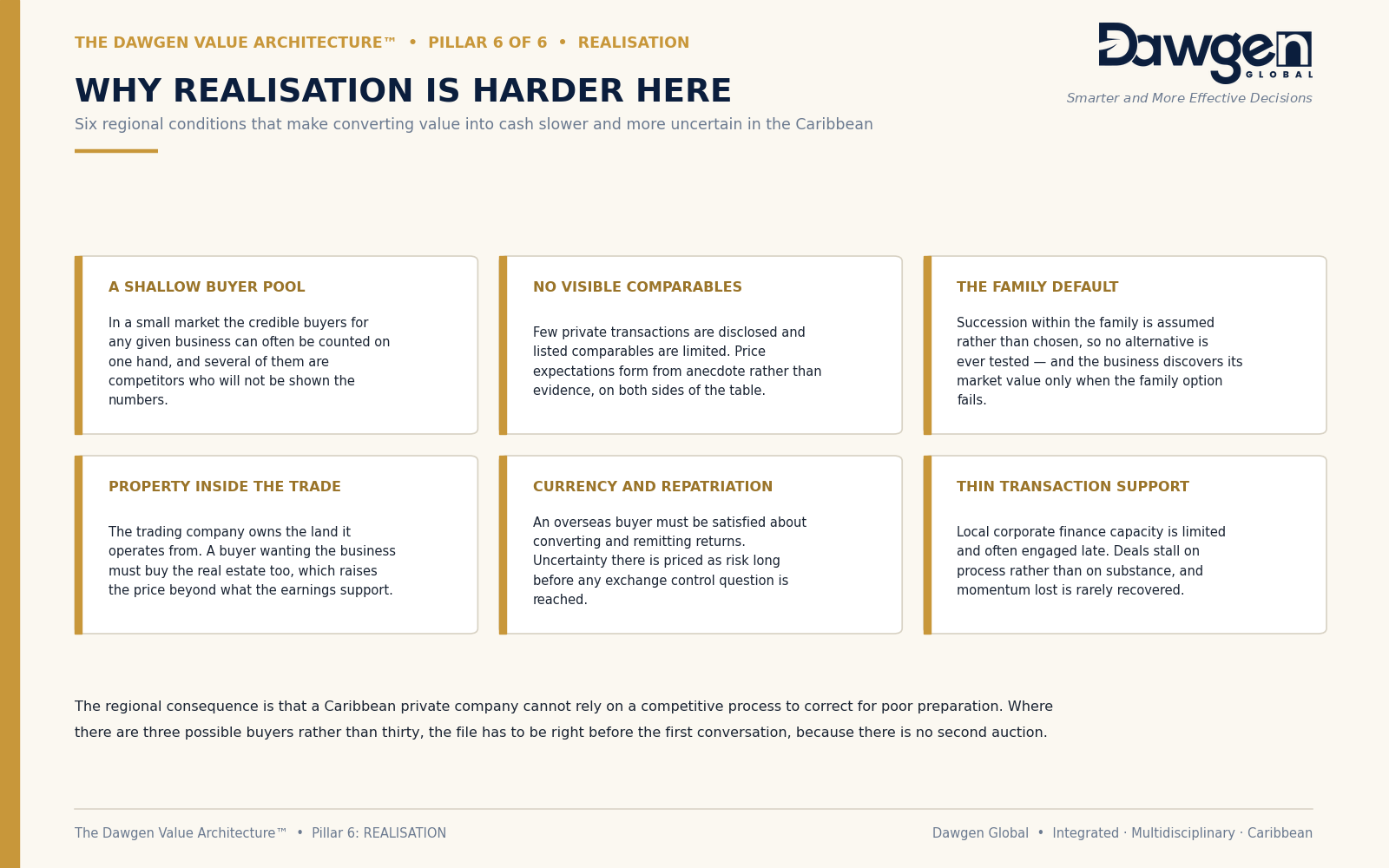
The first is the shallowness of the buyer pool. In a small market the credible acquirers of any given business can often be counted on one hand, and several of them are direct competitors who will not be shown the numbers. Where a business elsewhere might run a process among thirty potential buyers and let competition correct for a weak file, here there may be three — and if the file disappoints the first, there is no auction to recover the position.
The second is the absence of visible comparables. Few private transactions are disclosed and the listed universe is limited, so price expectations form from anecdote on both sides. An owner hears what a business sold for at a function and applies the multiple to his own; a buyer does the same in the opposite direction. Neither is anchored to evidence, and the gap between them is frequently what ends the conversation.
The third is the family default. Succession within the family is very often assumed rather than chosen — never discussed with the family, never tested, and never compared against any alternative. The business discovers its market value only when the family option fails, which is usually the worst possible moment to be discovering anything.
The fourth is property held inside the trading company. Where the company owns the premises it operates from, a buyer who wants the business must buy the real estate with it, at a price the trading earnings alone will not support. Many otherwise sound transactions fail on this single structural point — and it is the direct consequence of the land-as-store-of-value instinct described in Pillar 4.
The fifth is currency and repatriation. An overseas acquirer must satisfy himself that returns can be converted and remitted. Whatever the actual position in a given territory, uncertainty on the point is priced as risk long before any technical question is reached, and it is answered by clean documentation rather than by assurance.
The sixth is the thinness of local transaction support. Corporate finance capacity in the region is limited and is frequently engaged after heads of terms rather than before. Deals then stall on process rather than on substance, and momentum lost in a small market is rarely recovered, because there is no queue of alternative buyers waiting behind the first.
| Why the standard prescription fails here
International guidance assumes a deep buyer pool, disclosed comparables and a competitive process that punishes a weak file only at the margin. None of those hold. The sequence therefore inverts: the file has to be right before the first conversation rather than assembled during it, because in a market of three possible buyers the first impression is frequently the only one. |
SECTION 3
What It Costs
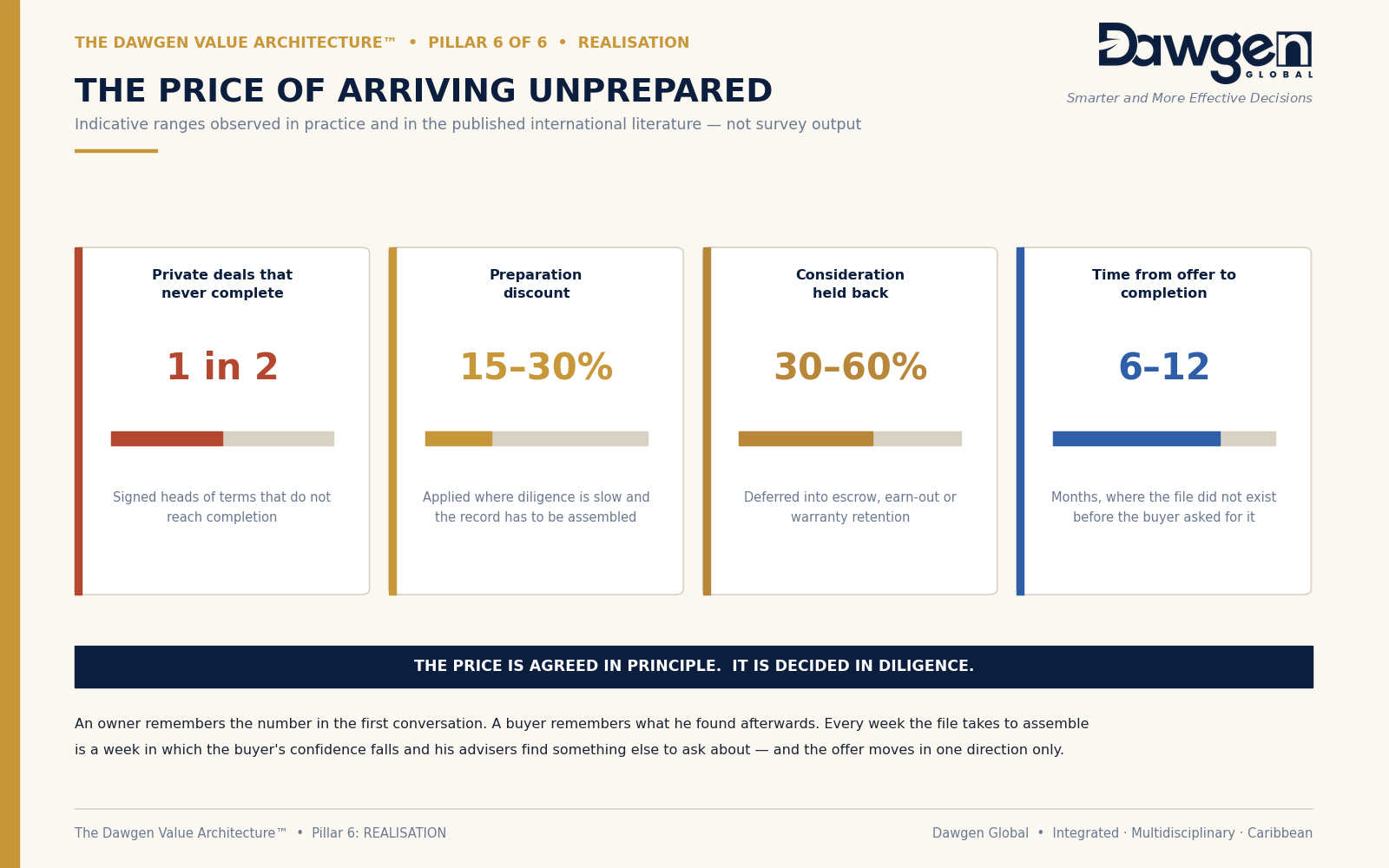
The cost of arriving unprepared is paid in three currencies: price, certainty and time. The ranges below are indicative of what we observe in practice and in the published international literature. They are not the output of a survey, and they should be read as orders of magnitude.
It is paid in the price
The preparation discount is charged for uncertainty rather than for any identified problem. Where the record has to be assembled while diligence proceeds, the buyer must assume that what has not yet surfaced is worse than what has, and he prices accordingly. This is the same mechanism that operates in Pillar 3 and for the same reason: a buyer who cannot see how the business was run must assume the worst about the parts he cannot see.
It is paid in certainty
A substantial proportion of private transactions that reach signed heads of terms never complete. The most common causes are not disagreements about price but discoveries during diligence — an unfiled return, a lease that expired, a guarantee nobody disclosed, a related-party arrangement that cannot be evidenced. Each is individually small. Collectively they exhaust the buyer’s patience, and the transaction ends without anybody having decided to end it.
It is paid in time, and time compounds
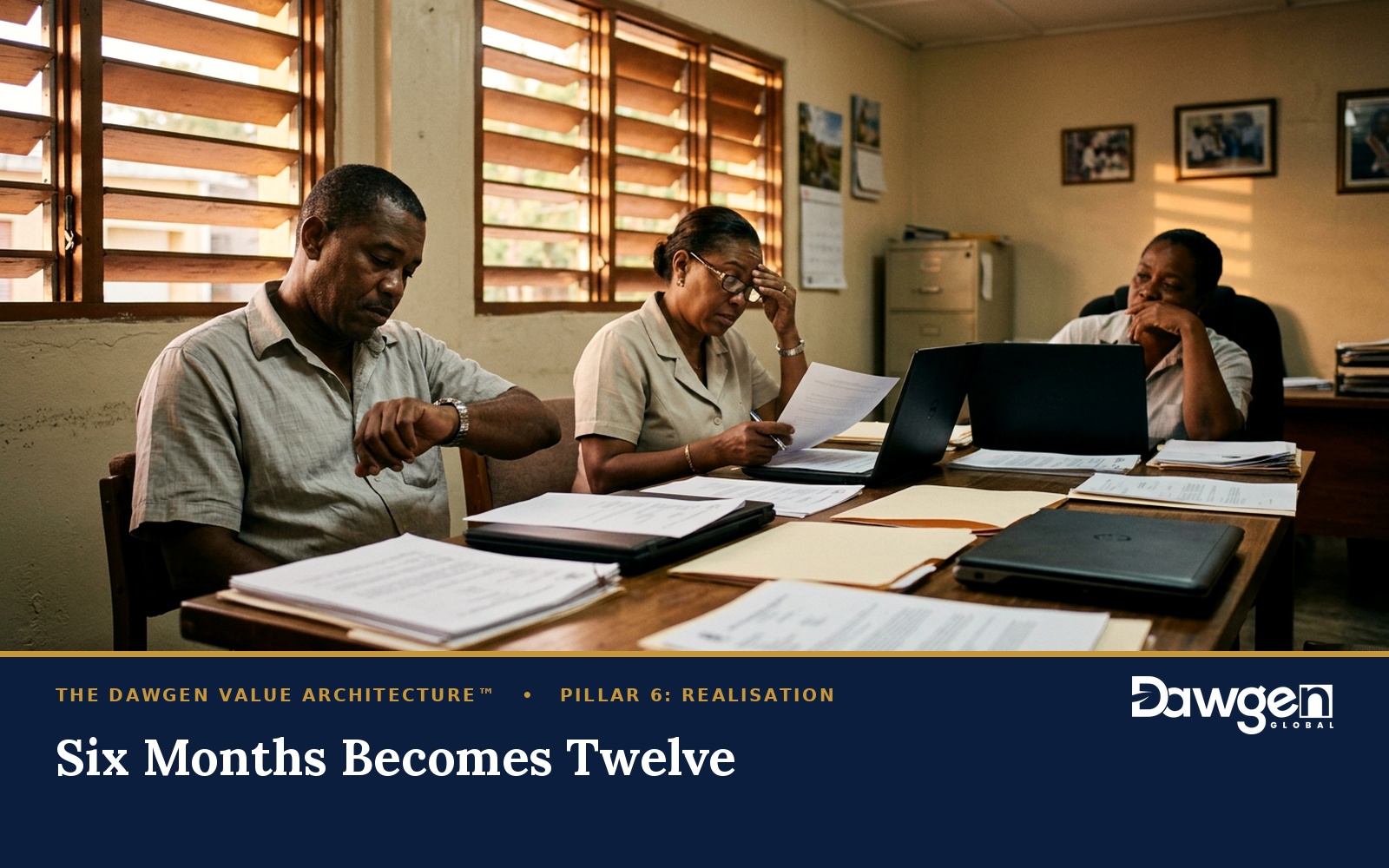
Every week the file takes to assemble is a week in which confidence falls and the buyer’s advisers find something else to ask about. Six months becomes twelve; the business is being run by people distracted by the process; and trading performance during diligence — which the buyer is watching closely — softens at precisely the wrong moment. The offer moves in one direction only.
An owner remembers the number in the first conversation. A buyer remembers what he found afterwards.
SECTION 4
Why Owners Do Not Fix It

The reasons here are more emotional than in any other pillar, and they deserve to be treated as reasons rather than as failings.
The first is that preparing to sell feels like deciding to sell. Owners who have no intention of leaving avoid the work because beginning it seems to concede something — to the family, to the staff, and to themselves. The framing that resolves this is simply true: a prepared business is worth more to its own successor and to its own bank than an unprepared one, whether or not it is ever offered to anybody.
The second is that the number is personal. Thirty years of work has produced a figure the owner carries privately, and testing it against evidence risks learning that it is wrong. It is more comfortable to keep an untested number than to hold a smaller one that is real — until the untested number meets an actual offer, which is the most expensive moment at which to be corrected.
The third is that the work looks like housekeeping. Updating a share register, documenting a related-party loan and chasing an expired lease are unglamorous tasks with no visible return, and they lose every contest for attention against trading. They are also, almost exactly, the items that will later cost multiples of their trouble.
The fourth is the assumption that advisers will handle it later. They will — at transaction rates, under time pressure, with the buyer already waiting and the cost of every delay falling on the seller. Work that is inexpensive when done calmly becomes expensive when done urgently, and the urgency is entirely avoidable.
The fifth is that the family conversation has never happened. Where nobody has asked the next generation whether they want the business, the answer is assumed. Owners frequently discover at the worst possible time that the successor they had in mind has a career elsewhere and no intention of returning — and by then the alternative routes have not been prepared either.
| The correct diagnosis
Realisation failure is a preparation problem, not a marketing problem. The businesses that transact well are almost never the ones that found a better buyer; they are the ones that could answer the questions. That is why this pillar has no sales content in it at all — the entire remedy consists of assembling, in advance and calmly, what a serious counterparty will ask for anyway. |
SECTION 5
The Remedy
The instrument is a single file in six sections, each with a named owner who keeps it current. It is the last of the one-page instruments this series has built — the monthly management pack of Pillar 1, the delegation register of Pillar 2, the reserved matters schedule of Pillar 3, the funding match of Pillar 4, the recovery register of Pillar 5, and now the readiness file, which is largely assembled from the other five.
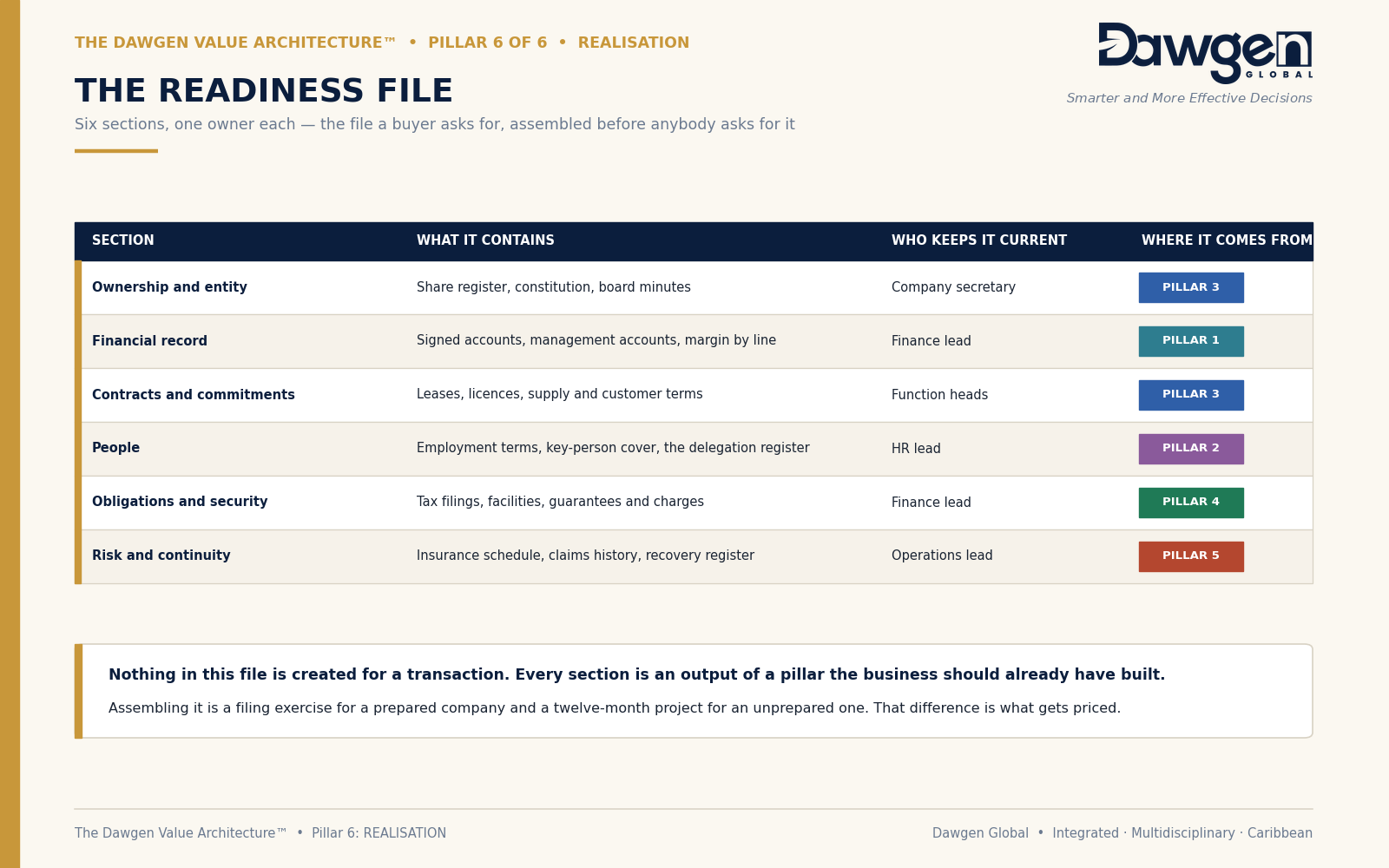
Nothing in the file is created for a transaction. Every section is an output of a pillar the business should already have built, which is why assembling it is a filing exercise for a prepared company and a twelve-month project for an unprepared one. That difference is precisely what gets priced.
Phase one: the first ninety days
The objective of the first ninety days is to know the position. None of it commits the business to any transaction.
- Run the five-day test with the management team and record honestly what could not be produced.
- Open the readiness file with its six sections and name one person accountable for each.
- Fix the share register and confirm, with evidence, who legally owns what.
- List every related-party arrangement and put each one on written, commercial terms.
- Identify the assets sitting in the company that a buyer would not want to buy.
Phase two: months three to twelve
The second phase makes the business explicable to somebody who was not there while it was built.
- Normalise the earnings: separate owner drawings, personal costs and genuinely one-off items so that maintainable profit is visible.
- Take advice on whether property should be separated from the trading company, and on the tax and stamp consequences of doing so.
- Resolve the open items — the unfiled return, the expired lease, the undocumented loan, the licence in the wrong name.
- Have the accounts audited or independently reviewed if they are not already.
- Test the value expectation against evidence, so the number the owner carries is one he can defend.
Phase three: beyond twelve months
The third phase turns readiness into a standing condition rather than a project.
- Keep the readiness file current quarterly, as a standing item on the board agenda established under Pillar 3.
- Decide the route deliberately — sale, family transfer on commercial terms, or outside investment — rather than allowing circumstance to decide it.
- Appoint advisers before a buyer appears, so that the first professional conversation is not held under time pressure.
- Agree with the family, in writing, what is intended, so that succession is a choice rather than an assumption.
- Return to Pillar 1 and score the framework again — each pass through the six raises the number.
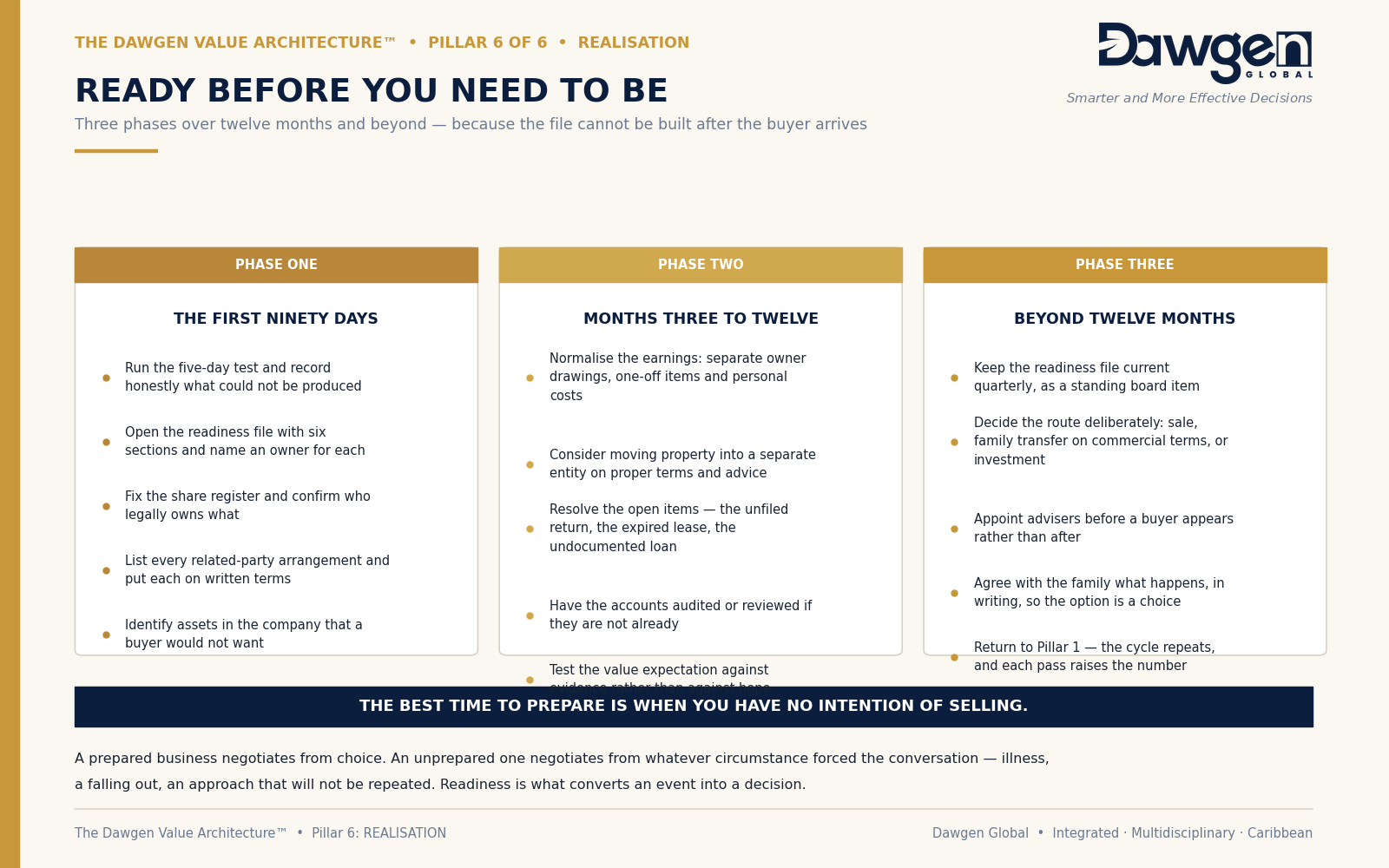
The best time to prepare is when you have no intention of selling. A prepared business negotiates from choice; an unprepared one negotiates from whatever circumstance forced the conversation.
SECTION 6
The Diagnostic
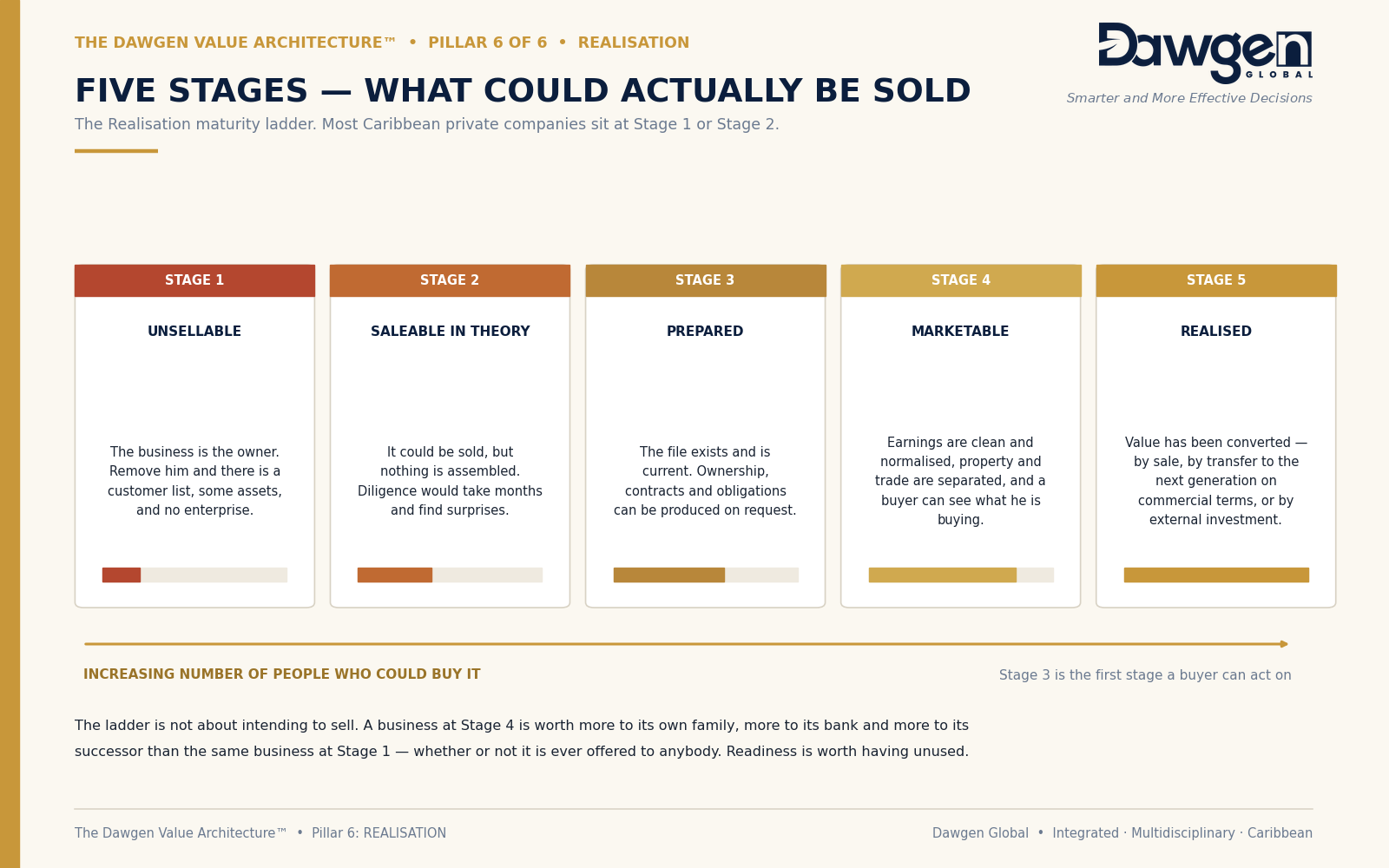
Locate the business honestly on the realisation ladder. The ladder is not about intending to sell: a company at Stage 4 is worth more to its own family, its own bank and its own successor than the same company at Stage 1, whether or not it is ever offered to anybody.
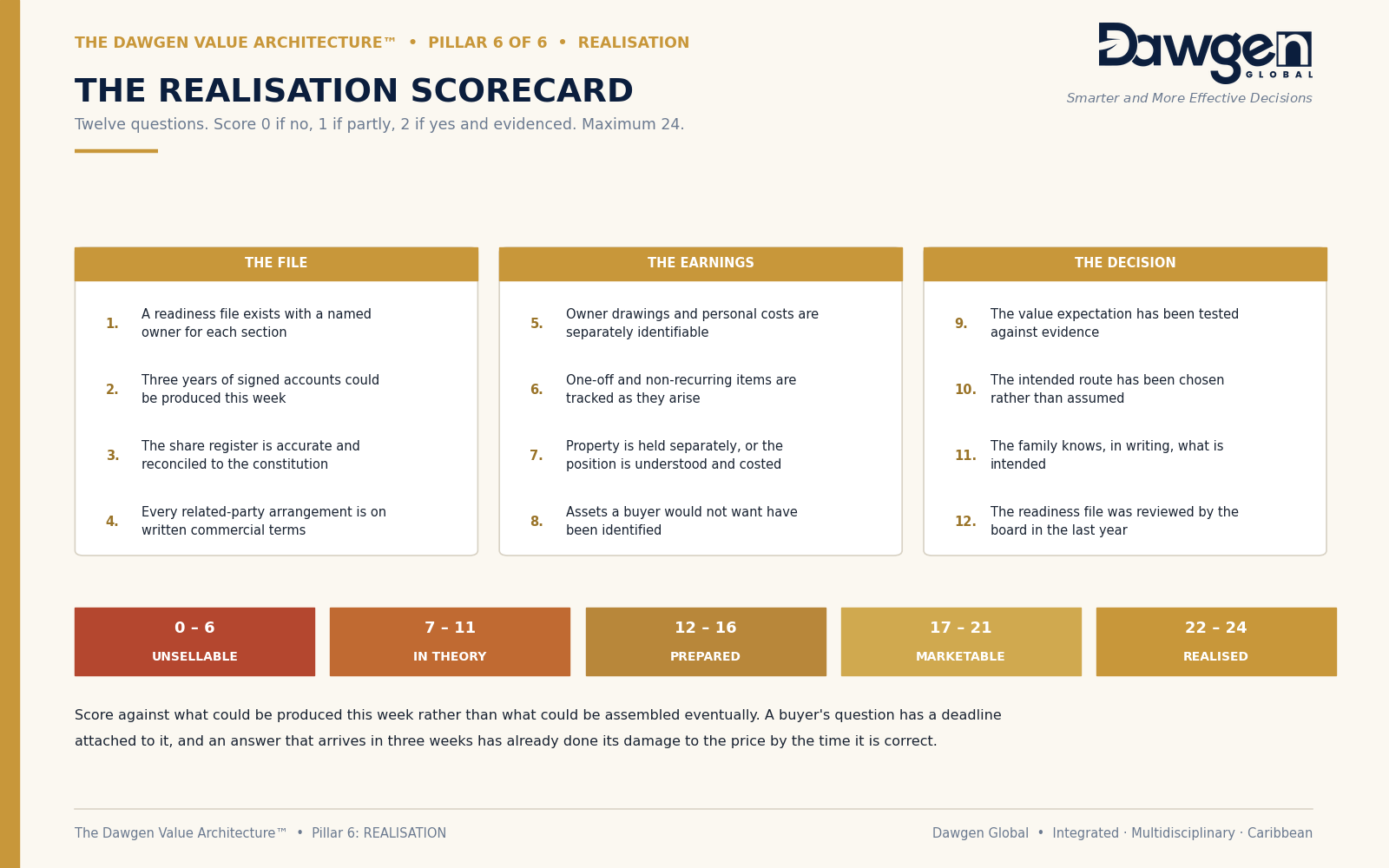
The scorecard converts that judgement into a number. Twelve questions, scored zero for no, one for partly, and two for yes and evidenced. Score against what could be produced this week rather than what could be assembled eventually.
| The test that matters
Apply one question to the whole result: if a credible buyer made an approach on Monday, would the next six months be a negotiation or an excavation? A negotiation is a conversation about price between two parties who can both see the business. An excavation is the seller assembling evidence while the buyer watches him do it — and the price falls a little with every week it continues. |
SECTION 7
Where to Start

If you scored between zero and six, do not think about buyers. Run the five-day test and open the file. The exercise is uncomfortable and it is the only one that matters, because everything else in this pillar assumes a file exists to put things in.
If you scored between seven and eleven, the material exists in fragments across the business and in several people’s heads. The work is assembly rather than creation: six sections, six names, and a quarterly review.
If you scored between twelve and sixteen, the file is sound and the earnings are not yet explicable. Normalise the profit, resolve the property question, and test the value expectation against evidence rather than against hope.
If you scored above seventeen, the work is the conversation nobody has had. Decide the route, tell the family in writing, and appoint advisers before you need them. A business at this level has options, and options expire when they are not exercised deliberately.
| The one exercise to run this week
If nothing else in this guide is acted on, run the five-day test. Take the eleven items, give the management team five working days, and see what arrives. It costs nothing, it commits the business to nothing, and it produces the single most useful number in this series: the proportion of your own company you could currently prove to somebody else. |
THE CAPSTONE
The Private Company Value Scorecard

This is the final guide in the series, and the six diagnostics can now be read together. Each pillar carries twenty-four points, giving one hundred and forty-four in total. The exercise takes an afternoon with a management team and requires no adviser.
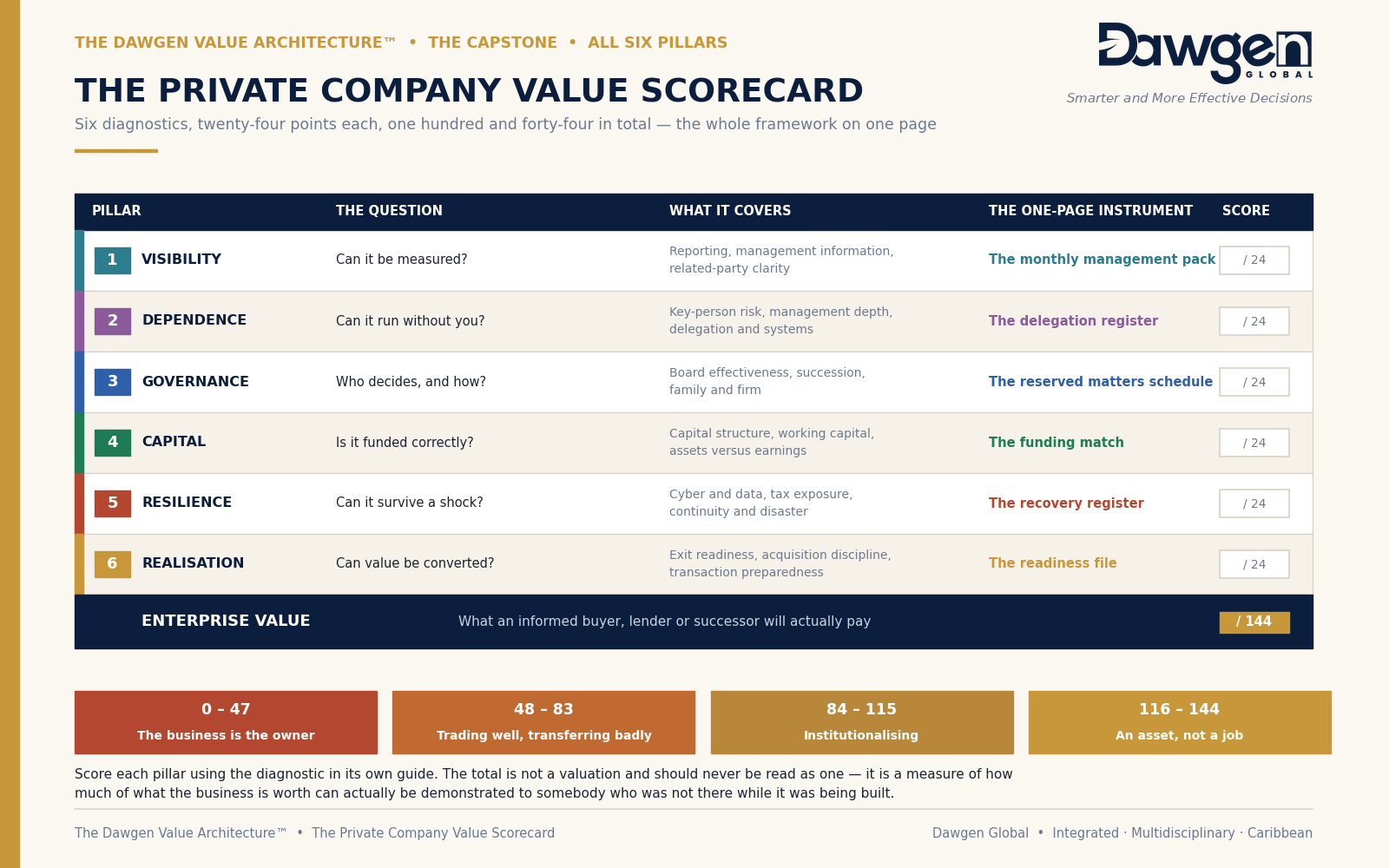
The total is not a valuation and should never be presented as one. It is a measure of something different and, for most owners, more useful: how much of what the business is worth can actually be demonstrated to somebody who was not there while it was being built. Two companies with identical earnings and very different scores will receive very different offers, and the difference between them is not performance. It is evidence.
The pattern across the six is consistent. Every pillar is fixed by the same kind of thing — a single page, written once, owned by a named person, and reviewed by a board. The monthly management pack, the delegation register, the reserved matters schedule, the funding match, the recovery register and the readiness file are, between them, the entire practical content of this framework. None of them requires software, a consultant or capital. All of them require somebody to sit down and write what is currently held in one person’s head.
| What the series has argued
That the gap between what a Caribbean private company is worth and what its owner believes it is worth is not, in most cases, a performance problem. It is a demonstration problem — and demonstration is built, deliberately, one page at a time, in the years before anybody asks to see it. |
ABOUT THIS SERIES
The Dawgen Value Architecture™ is a proprietary Dawgen Global framework addressing the six conditions that determine what a private company is actually worth. The series is now complete: VISIBILITY, DEPENDENCE, GOVERNANCE, CAPITAL, RESILIENCE and REALISATION. The guides are written for Caribbean owner-managed businesses, their boards and their advisers, and are intended to be used without engaging anyone at all.
This series addresses patterns observed across private company advisory engagements and published international evidence. It does not comment on any listed issuer or any specific client, and no company referred to or resembled in these guides is intended to be identifiable.
Take the diagnostic further
The Dawgen Private Company Value Review applies all six scorecards inside your business, tests the record as an acquirer’s advisers would, and delivers a consolidated maturity rating, the six drafted instruments, and a board-ready summary of what would move the number most.
At Dawgen Global, we help you make Smarter and More Effective Decisions.
About Dawgen Global
Dawgen Global is an independent, integrated multidisciplinary professional services firm headquartered at 47 Trinidad Terrace, New Kingston, Jamaica, serving more than 15 territories across the Caribbean. Founded and led by Dr. Dawkins Brown, Executive Chairman, the firm is independent and not affiliated with any international network. It delivers a full suite of professional services under one roof: audit and assurance; tax advisory; IT and digital transformation; risk management; cybersecurity; actuarial and insurance regulatory advisory; HR advisory; mergers and acquisitions; corporate recovery; business advisory and strategy; accounting BPO and virtual CFO services; and legal process outsourcing.
The proposition is simple: big-firm capability without the big-firm price. Dawgen Global’s integrated approach is built for the specific complexities and opportunities of the Caribbean market, helping organizations make sharper, better-informed decisions that drive measurable progress.
To explore a partnership, reach out:
- Website: dawgen.global
- Email: [email protected]
- WhatsApp (Global): +1 555-795-9071
- Caribbean offices: +1 876-665-5926 | +1 876-929-3670 | +1 876-926-5210


