
A standing guide for owner-managed businesses, their boards and their advisers
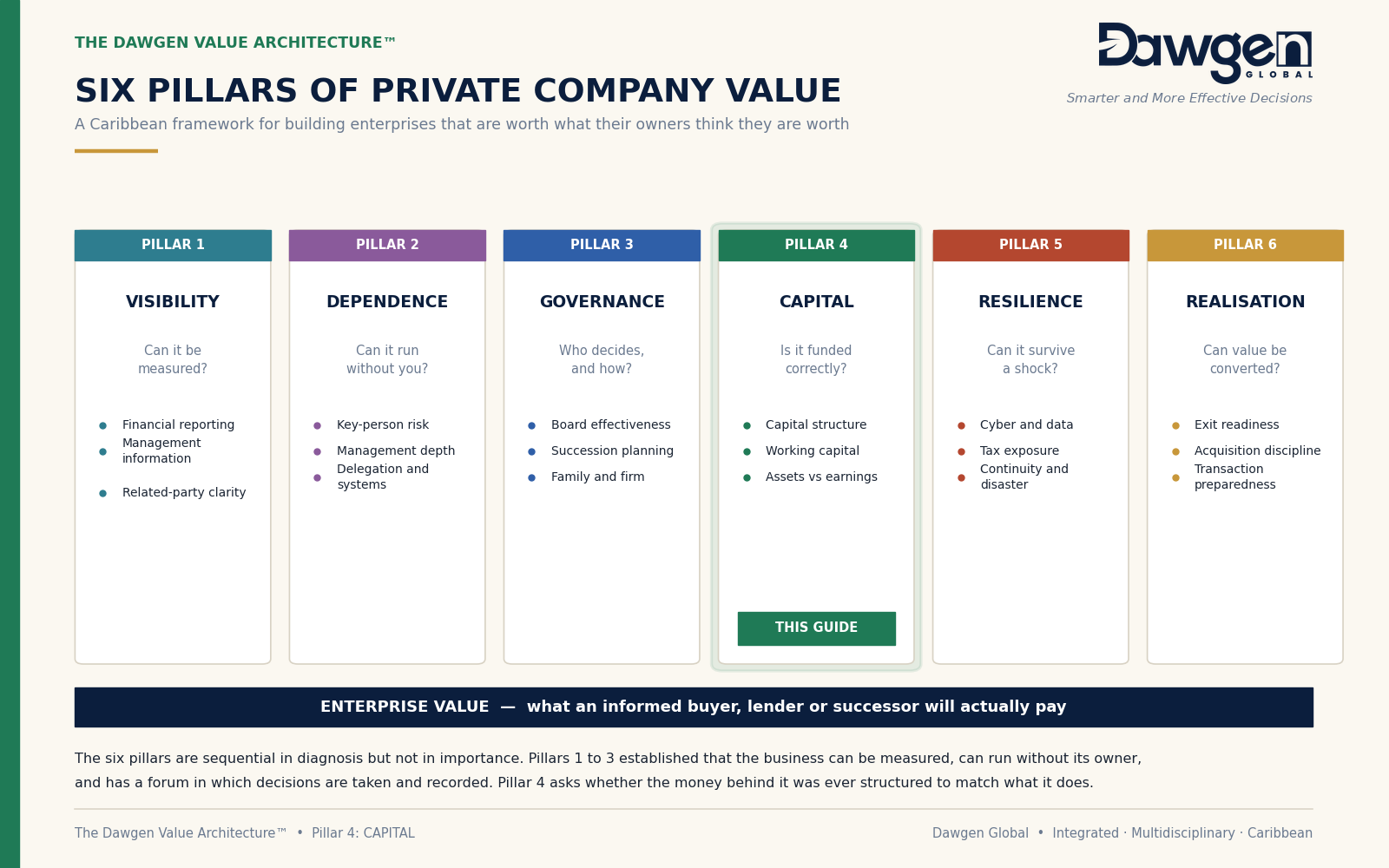
The Dawgen Value Architecture™ — six pillars of private company value. This guide addresses Pillar 4.
The Dawgen Value Architecture™
Most owner-managed businesses in the Caribbean are worth less than the people who built them believe. That is not a comment on the quality of those businesses. It is a comment on the difference between value that exists and value that can be demonstrated to a lender, a buyer, a regulator or a successor. The gap between the two is rarely closed by trading harder. It is closed by building the conditions under which value becomes visible, transferable and durable.
The Dawgen Value Architecture™ is the framework we use to name those conditions. It holds that what a private company is actually worth is determined by six things, each of which can be assessed, scored and improved. The framework was developed from patterns that recur across private company advisory engagements in this region, and it is set out here in full so that owners and boards can apply it to their own businesses without engaging anyone at all.
The six pillars
PILLAR 1 · VISIBILITY Can it be measured?
PILLAR 2 · DEPENDENCE Can it run without you?
PILLAR 3 · GOVERNANCE Who decides, and how?
PILLAR 4 · CAPITAL Is it funded correctly?
PILLAR 5 · RESILIENCE Can it survive a shock?
PILLAR 6 · REALISATION Can value be converted?
The order is deliberate, but it is an order of diagnosis rather than an order of importance. Pillar 1 asked whether the business can be measured. Pillar 2 asked whether it can run without its owner. Pillar 3 asked where decisions go once they leave his desk, and what survives to prove they were taken properly. Pillar 4 asks the question those three make it possible to answer honestly for the first time: whether the money behind the business was ever structured to match what the business actually does.
How each guide is built
Every guide in the series follows the same structure, so that a reader who has worked through one will know exactly where to look in the next. Each begins with the pattern as it presents itself in practice, then examines the Caribbean conditions that make the pattern harder to resolve here than elsewhere. It then sets out what the problem costs in cash terms, why owners nonetheless leave it unaddressed, and a staged remedy organised into the first ninety days, months three to twelve, and beyond. Each guide closes with a scored diagnostic the reader can complete unaided, and a short section on where to begin.
The guides are written as standing reference documents rather than articles. They are intended to be returned to, worked through with a management team, and used as the basis for a board conversation. Figures presented as ranges are indicative of what we observe in practice and in the published international literature; they are not the output of a survey, and they are labelled as such wherever they appear.
| Where this guide sits
This is Pillar 4 of 6. It addresses capital structure, working capital, and the difference between owning assets and earning returns. Pillars 1 to 3 precede it: a funding decision cannot be taken well without reliable numbers, a management team able to execute it, and a forum in which it is approved and recorded. Pillars 5 and 6 follow, and the capstone across the whole framework is the Private Company Value Scorecard, which consolidates the six diagnostics into a single view of what a business would be worth to an informed buyer, lender or successor. |
SECTION 1
The Pattern
There is a conversation that recurs in Caribbean advisory practice at the end of good years. The company has traded well. The accounts show a profit, the order book is strong, and the owner has spent thirty years building something substantial — premises, vehicles, land, stock on the shelves. And there is no money. The overdraft is at its limit in the third week of every month, a supplier is waiting, and the owner cannot understand how a profitable business can be this tight.
He has usually concluded that the problem is sales, or the bank, or the economy. It is none of those. It is that the business has been funded by accident. Nobody ever decided how long the money should last, what it was for, or what it would cost. Each facility was arranged in a particular week to solve a particular problem, and the accumulated result is a structure nobody designed and nobody reviews.
Profit is an opinion about a period. Cash is a fact about a date. A business can be right about the first and destroyed by the second.

Why this is Pillar 4
The first three pillars make this question answerable. Without reliable reporting, the cash cycle cannot be measured. Without management depth, the disciplines that shorten it — credit control, inventory review, collections — have nobody to own them. Without a board, the funding decision is taken alone, under time pressure, and never recorded. Capital comes fourth because a company that has not built the first three has no reliable way to know it has a capital problem at all.
It also comes fourth because the characteristic error is not extravagance. These owners are rarely reckless; most are conservative to a fault. The error is one of matching. Money that should have been borrowed for seven years was taken on an overdraft repayable on demand. Profit that should have funded stock was converted into land. The instruments are ordinary and the intentions are sound. The lives simply do not line up.
The test that settles it
One calculation exposes the whole condition, and it can be done in an hour from figures the business already has. Count the days between paying a supplier for stock and being paid by the customer who eventually buys it.
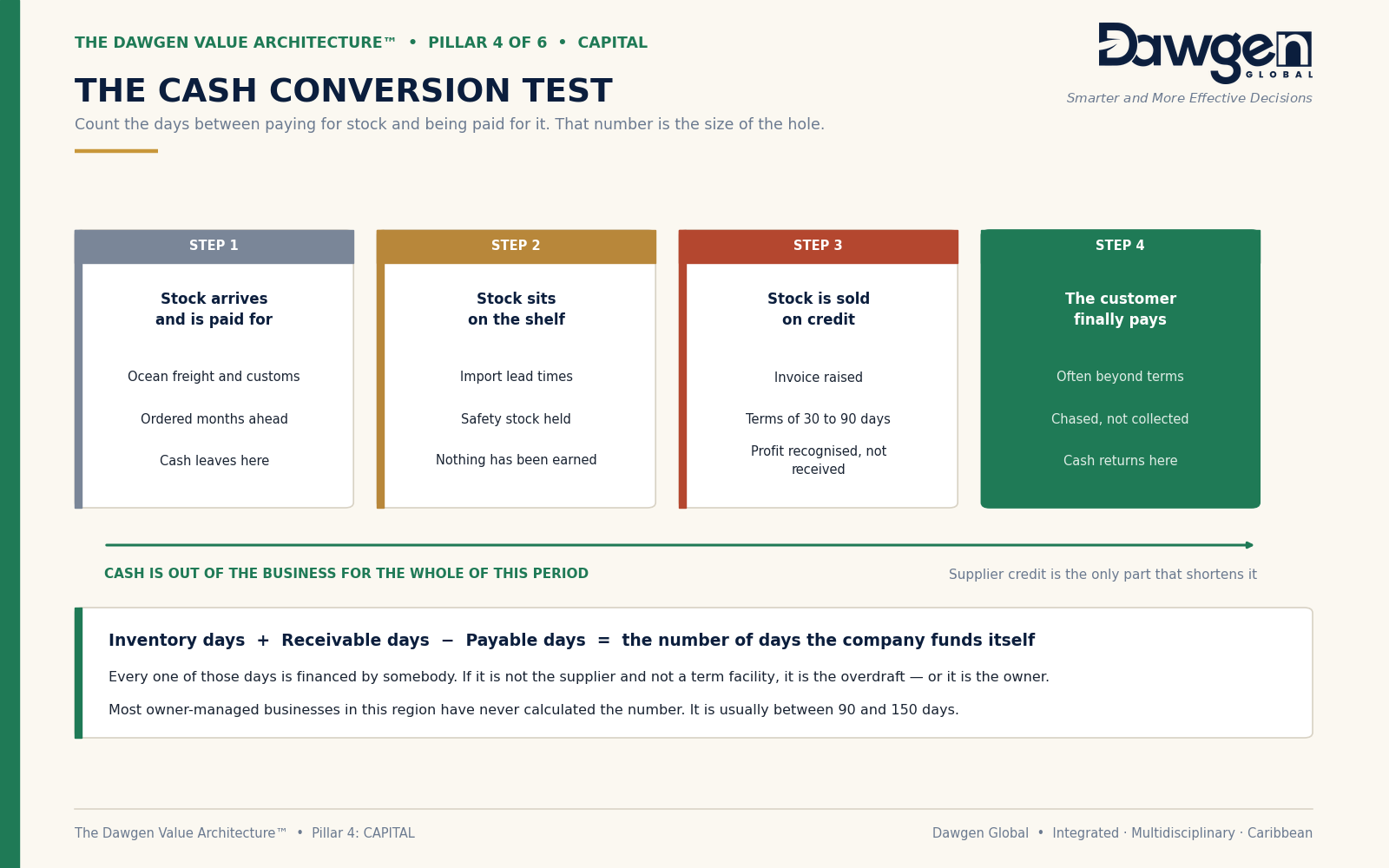
Inventory days plus receivable days, less the days of credit the supplier extends, is the number of days the company finances itself. In this region the answer is commonly between ninety and a hundred and fifty days, and most owner-managed businesses have never calculated it. Every one of those days is funded by somebody — and if it is not the supplier and not a term facility, it is the overdraft or it is the owner’s own money.
The number also explains the thing that puzzles owners most. A business with a hundred-day cycle consumes cash faster the better it trades, because every additional sale must be funded for a hundred days before it returns. Growth does not relieve the pressure. Growth is the pressure.
SECTION 2
The Caribbean Variant
Capital structure is badly managed in private companies everywhere. What is regional is the particular shape it takes here, and why the standard advice — term out your debt, release working capital, hold less stock — is harder to follow in this market than in a mainland one. Six conditions recur with enough regularity to be treated as structural.
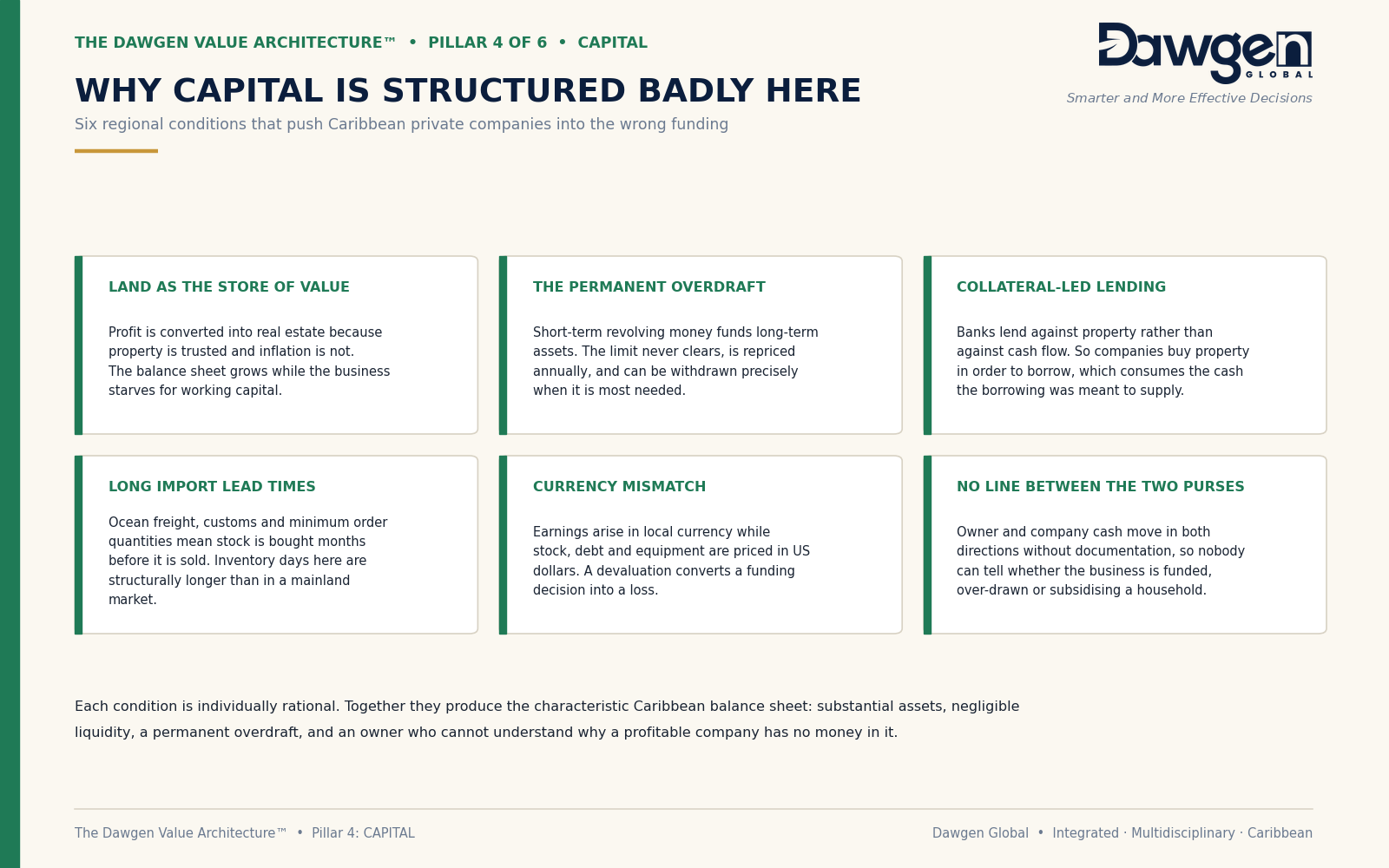
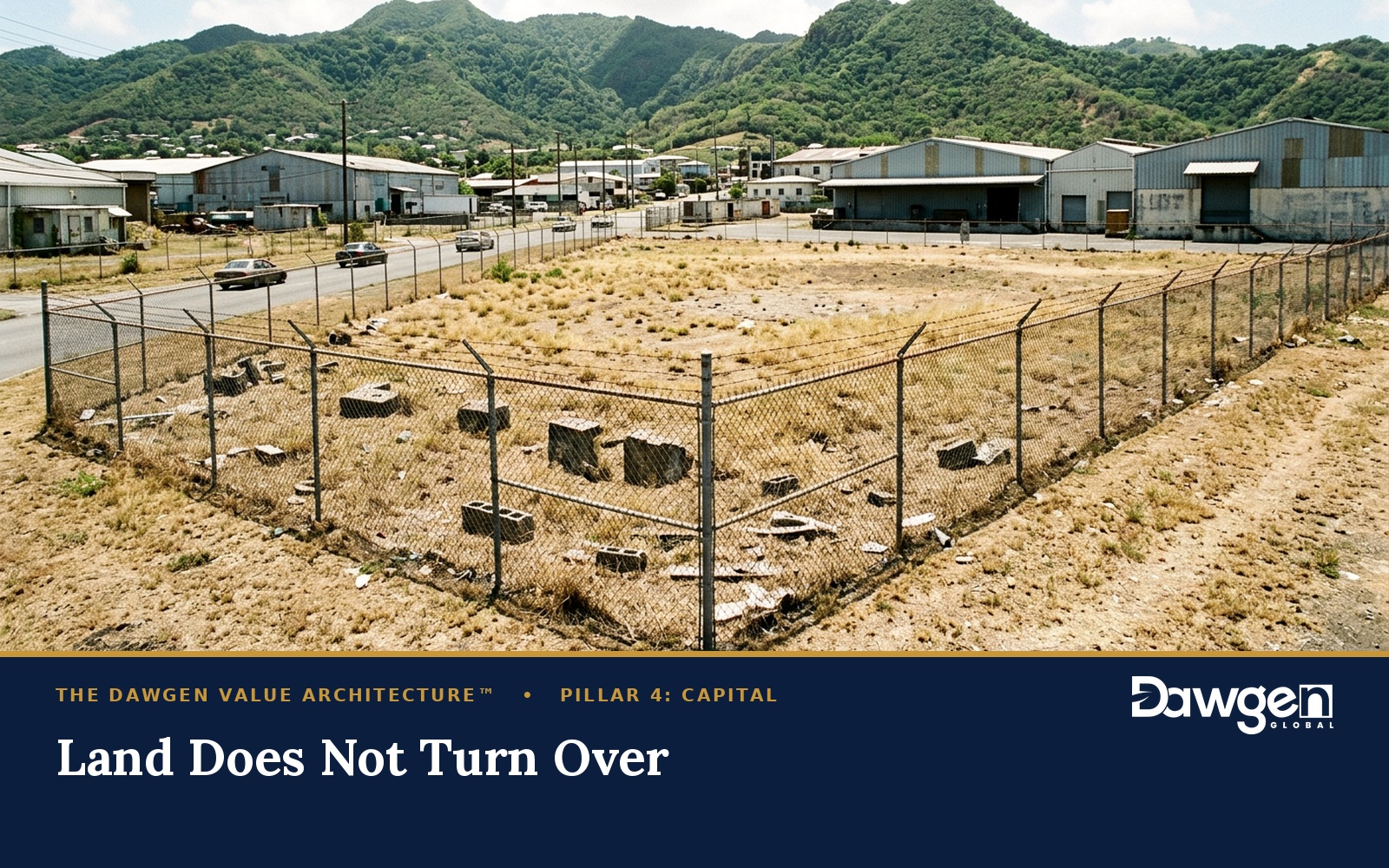
The first is land as the store of value. In economies that have experienced devaluation and inflation, real estate is trusted in a way that bank balances are not, and generations of owners have converted trading profit into property as a matter of prudence. The instinct is sound and the consequence is severe: the balance sheet grows while the business starves. Assets that do not turn over produce no cash, and a company holding substantial property with no liquidity is one bad quarter from an emergency.
The second is the permanent overdraft. It is the most common funding instrument in Caribbean private business and the least suitable for what it is usually doing. Short-term revolving money is used to fund long-term assets, the limit never clears, and the facility is repriced annually and repayable on demand. A lender reviewing that account sees term debt disguised as working capital, prices it accordingly, and retains the right to withdraw it at the moment the business is least able to replace it.
The third is collateral-led lending. Where credit is advanced against pledged property rather than against demonstrated cash flow, a rational owner buys property in order to borrow. The result is circular: the company acquires an asset it does not need, consuming the cash the borrowing was intended to provide, in order to obtain access to borrowing it would not otherwise get.
The fourth is import lead time. Ocean freight, customs clearance and minimum order quantities mean stock is bought months before it can be sold. Inventory days in a Caribbean importing business are structurally longer than in a market served overland, and advice to reduce stock levels frequently ignores that the alternative is a stock-out lasting six weeks.
The fifth is currency mismatch. Earnings arise in local currency while stock, equipment and often the borrowing itself are priced in United States dollars. A devaluation that a business cannot influence converts an ordinary funding decision into a loss, and the exposure is rarely quantified before it is realised.
The sixth is the absence of a line between the two purses. Where owner and company cash move in both directions without documentation, nobody can say whether the business is funded, over-drawn, or quietly subsidising a household. This is also a Pillar 1 problem, and it is the single item on which the two pillars most often meet.
| Why the standard prescription fails here
International guidance on working capital assumes short supply chains, cash-flow lending and a currency that matches the market. None of those hold. The sequence therefore has to change: measure the cycle first, recover the cash already trapped inside the business second, and approach a lender only third — because most of the liquidity a growing Caribbean company needs is already in its own inventory and receivables. |
SECTION 3
What It Costs
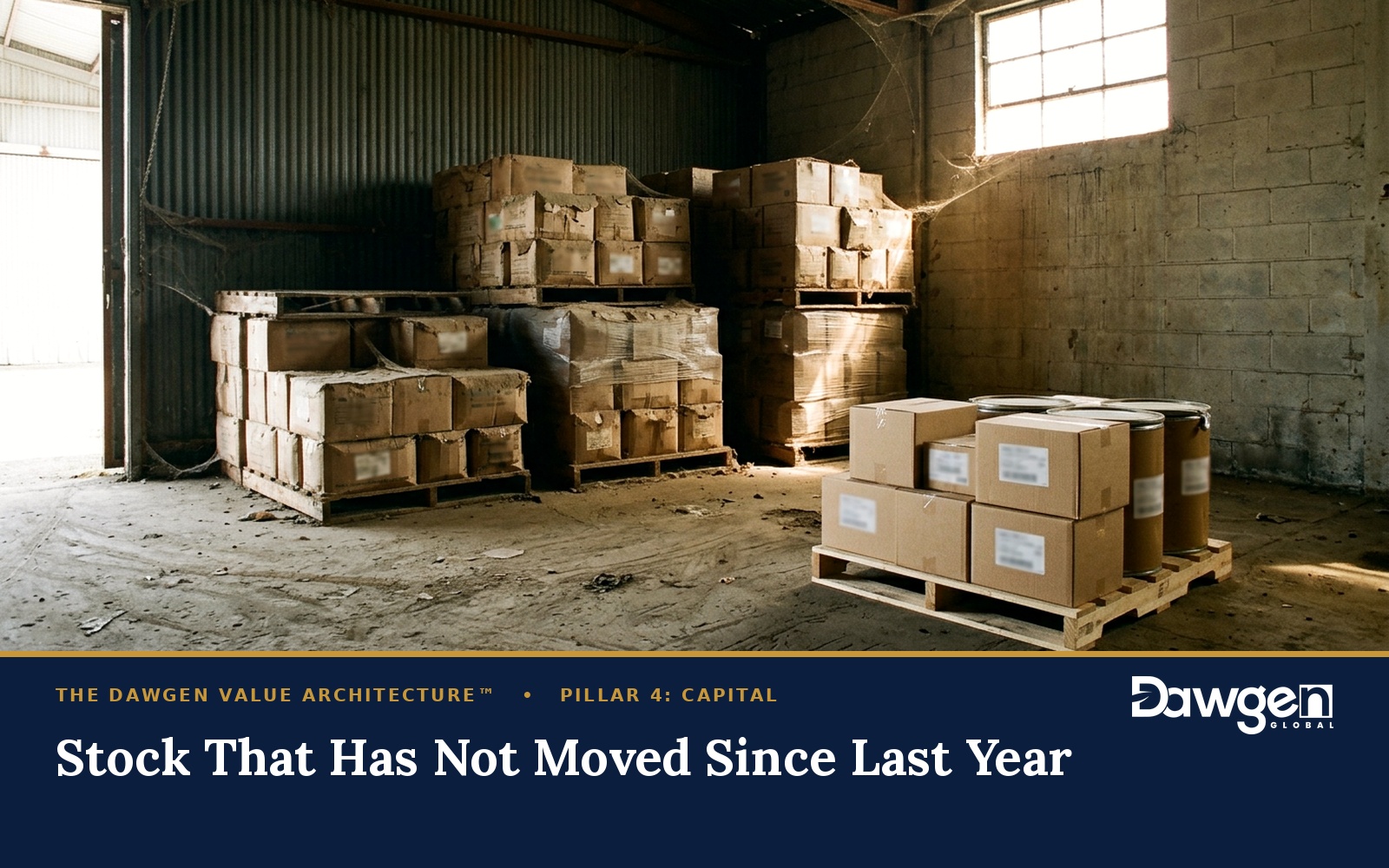
The cost of poor capital structure is paid continuously and never invoiced. The ranges below are indicative of what we observe in practice and in the published international literature. They are not the output of a survey, and they should be read as orders of magnitude.
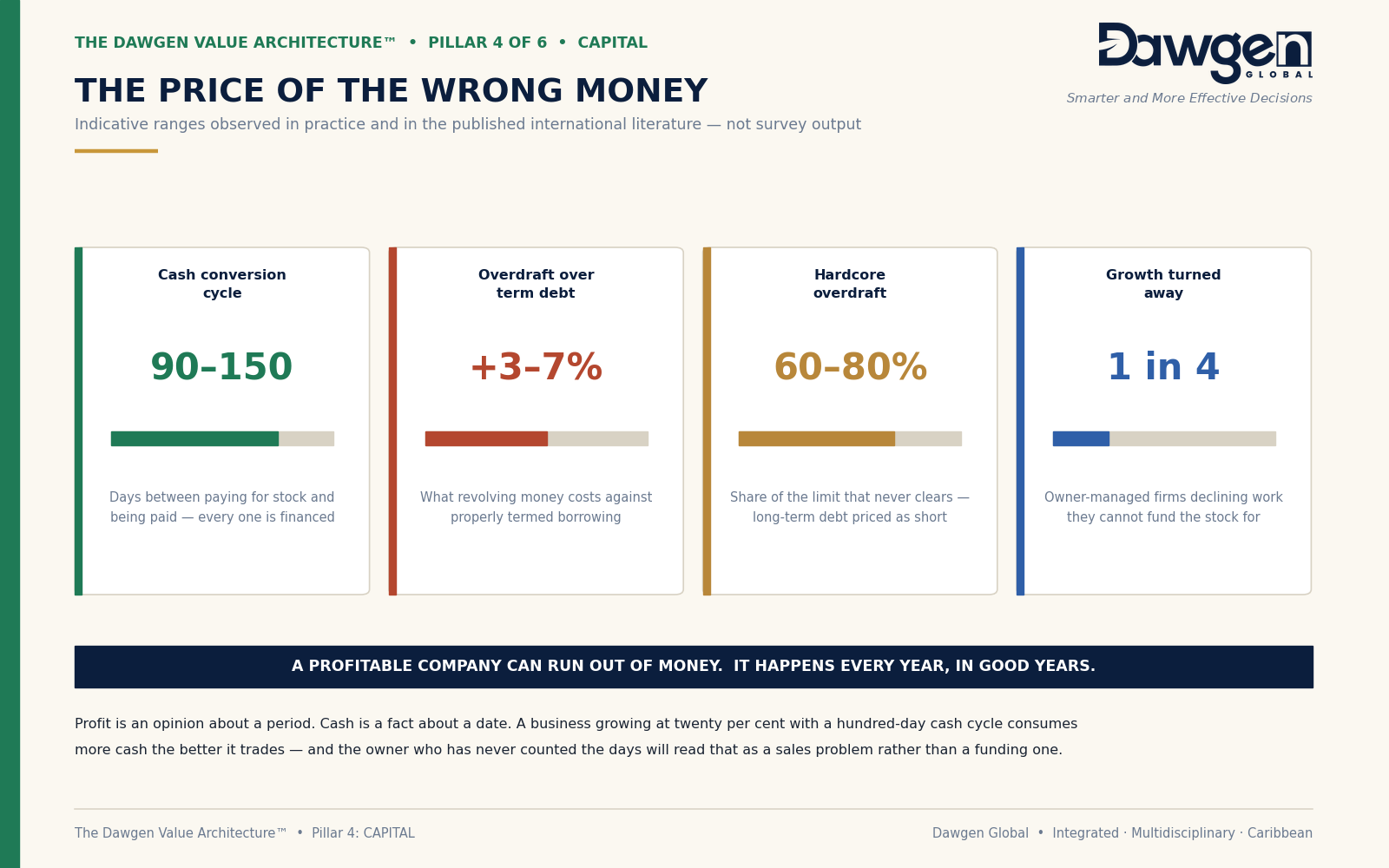
It is paid in the spread
Revolving money costs more than termed money, commonly by several percentage points, and it is repriced whenever the lender chooses. A business carrying a hardcore overdraft — the portion of the limit that never clears — is paying short-term pricing on what is, in substance, long-term debt. The difference is charged every month, and it compounds silently for years.
It is paid in growth not taken
The larger cost is invisible because it never appears in the accounts at all. It is the order declined because the stock could not be funded, the contract not tendered for because the performance bond would have consumed the limit, the branch not opened. A company at the limit of its overdraft cannot accept opportunity, and the opportunities it refuses do not show up anywhere except in the growth rate of a competitor.
It is paid when the facility is reviewed
Demand money is withdrawn at the least convenient moment, because the conditions that make a lender nervous are the same conditions that make a business need the facility. A structure that survives a good year comfortably can fail in a single bad quarter, and the failure is one of tenor rather than of trading.
The cheapest capital in the business is the cash already trapped inside it. Almost nobody goes looking there first.
SECTION 4
Why Owners Do Not Fix It

The reasons are consistent, and most of them are the shadow side of a virtue.
The first is that property feels safe. An owner who converted profit into land was not being careless; he was protecting the family against a currency he had watched lose value twice. The difficulty is that the protection is bought with the liquidity the trading business needs, and the trade-off has never been stated as a trade-off.
The second is that the overdraft is already there. It requires no application, no board paper and no explanation. Terming out the hardcore requires a conversation with the bank, a set of projections and a decision — and the facility that is already in place will fund tomorrow’s purchase without any of that. The path of least resistance is always the wrong instrument.
The third is that nobody has counted the days. The cash conversion cycle is not in the management accounts, is not mentioned by the auditor, and is not something most owners were ever taught to look for. A condition that has never been measured cannot be managed, and its symptoms are consistently attributed to sales, to collections staff, or to the season.
The fourth is that releasing working capital feels like shrinking. Holding less stock reads as losing the ability to serve customers; enforcing credit terms reads as antagonising them. In a small market where relationships carry weight, both fears are real, and both are usually overstated — the customer who pays at ninety days rarely leaves over a conversation about sixty.
The fifth is that the balance sheet flatters. A company with substantial property and no cash looks solid on the statement of financial position, and the owner reads that page rather than the cash flow statement. Net worth is comfortable to look at. Liquidity is not, which is precisely why it is the page that matters.
| The correct diagnosis
This is a matching problem, not a profitability problem and rarely an extravagance problem. In most cases the business earns enough; the money behind it was simply arranged one facility at a time, over many years, by people solving that week’s difficulty. Nobody ever sat down and asked how long each pound of funding needed to last. That single question, asked once, is the whole of Phase One. |
SECTION 5
The Remedy

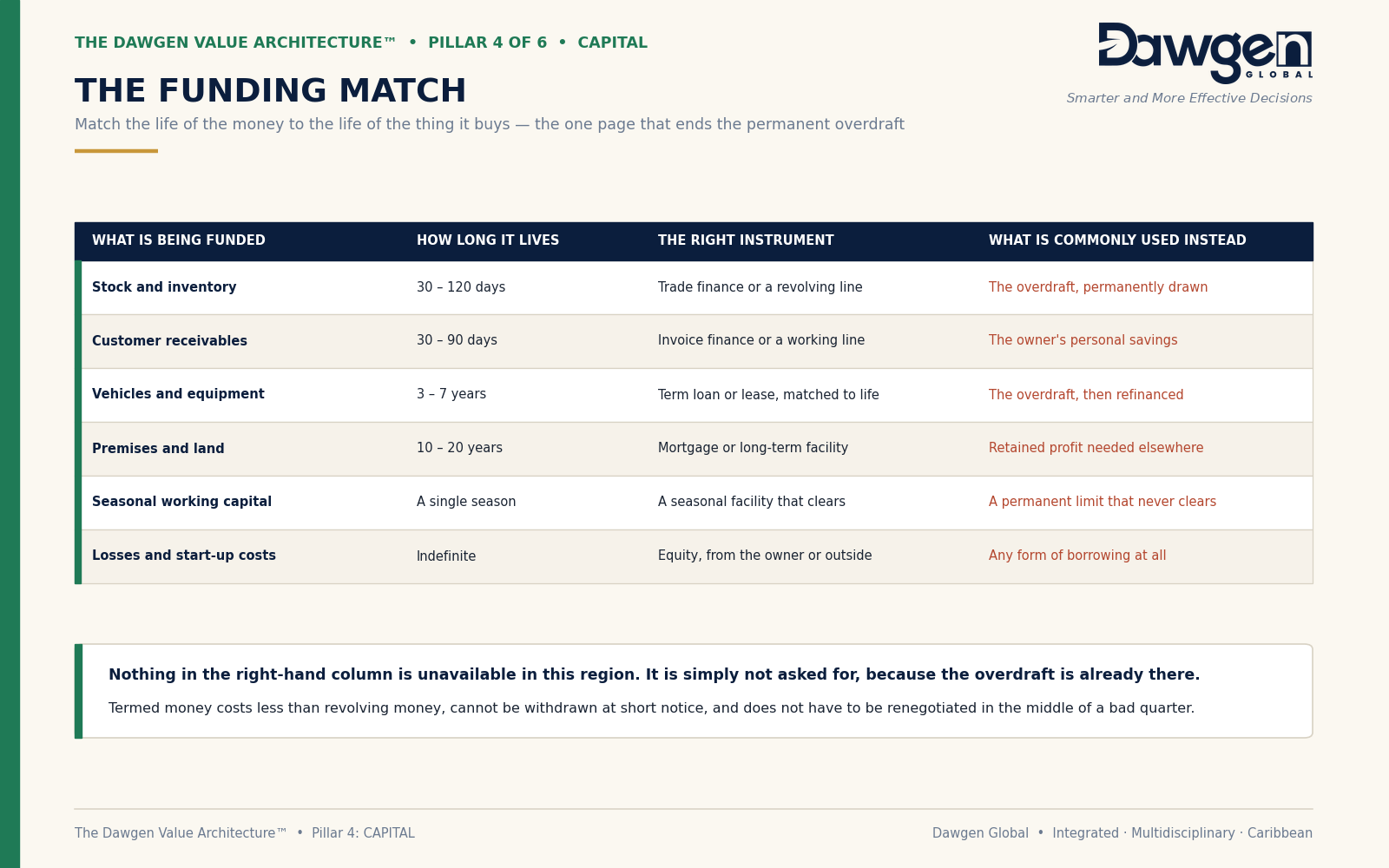
The instrument that does most of the work is a single page setting each thing the business funds against the life of that thing, the instrument that properly matches it, and what is being used instead. It is the capital counterpart to the delegation register of Pillar 2 and the reserved matters schedule of Pillar 3: one page, written once, reviewed by the board.
Phase one: the first ninety days
The objective of the first ninety days is not new funding. It is knowing the position. Nothing in this phase requires a bank, a raise or a refinancing.
- Calculate the cash conversion cycle and write the number down where the management team can see it.
- List every facility on one page: limit, rate, tenor, security, expiry and what it is actually funding.
- Separate owner and company cash, and document in both directions what is owed.
- Build a thirteen-week rolling cash forecast and update it weekly — this is the single highest-value habit in the guide.
- Stop buying fixed assets out of the overdraft, from today.
Phase two: months three to twelve
The second phase recovers the cash already inside the business and corrects the instruments. Order matters: release trapped liquidity before approaching a lender, because the request is smaller and the answer is better.
- Term out the hardcore of the overdraft into a matched loan, so the revolving facility can do the job it was designed for.
- Set written credit terms and enforce them against a weekly ageing report — collections is a discipline, not a personality.
- Reduce inventory days on the slowest-moving lines specifically, rather than cutting stock across the board.
- Match the currency of borrowing to the currency of the earnings that will service it.
- Put funding decisions on the board’s reserved matters schedule, so tenor is chosen rather than inherited.
Phase three: beyond twelve months
The third phase turns funding from a reaction into a decision.
- Agree a target capital structure with the board and report against it quarterly.
- Arrange facilities before they are needed — the best terms are always available to the business that does not yet need them.
- Identify and separately report assets that do not earn, so their cost is visible against the return they produce.
- Put a dividend and drawings policy in writing, so distributions stop competing with working capital by default.
- Move to Pillar 5, RESILIENCE — a business that is properly funded can now be protected against shock.
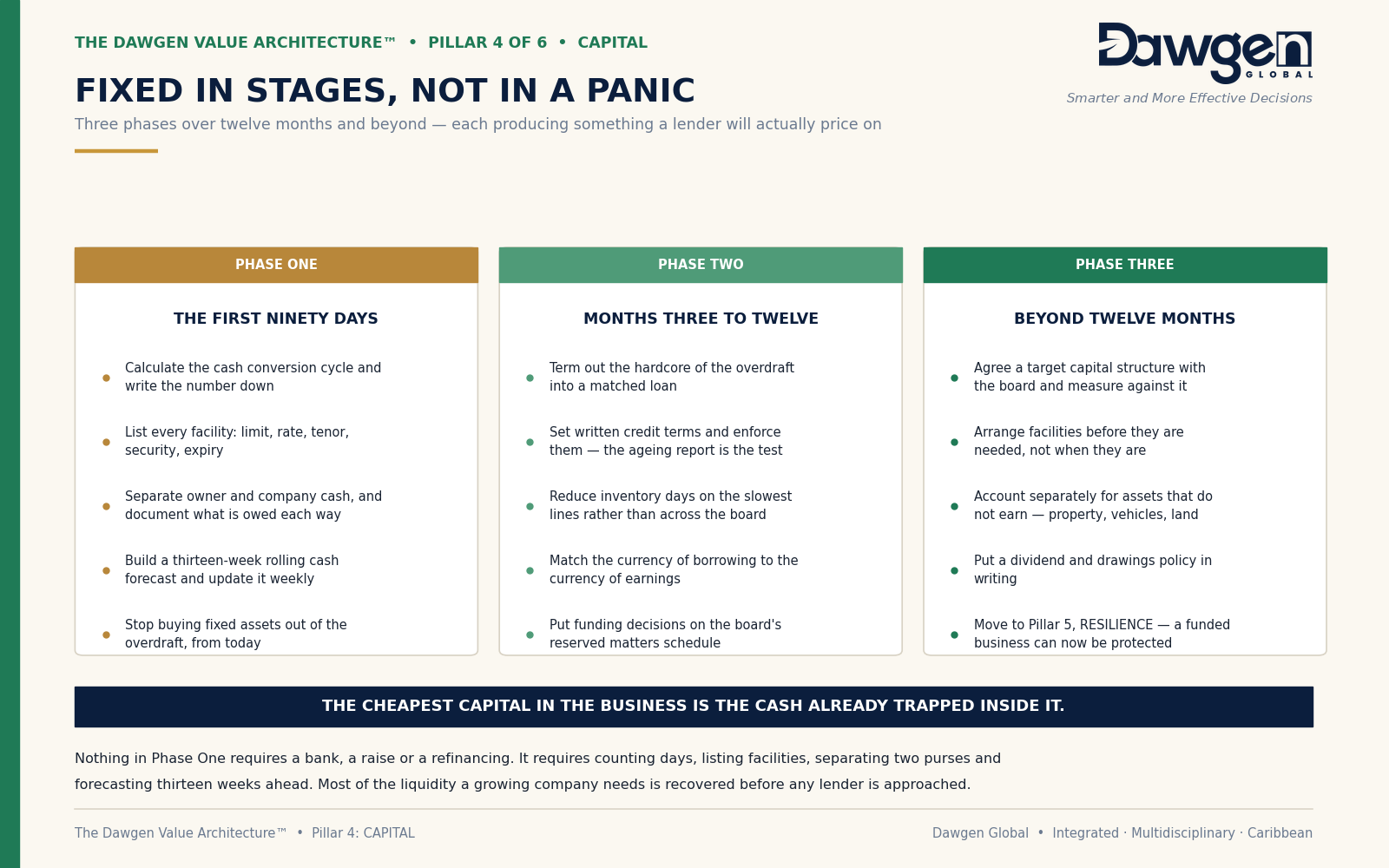
Nothing in the first ninety days requires a lender. It requires counting days, listing facilities, and separating two purses.
SECTION 6
The Diagnostic
Locate the business honestly on the capital ladder before deciding where to begin. Most Caribbean owner-managed companies sit at Stage 1 or Stage 2, and the move from Stage 2 to Stage 3 accounts for most of the benefit available.
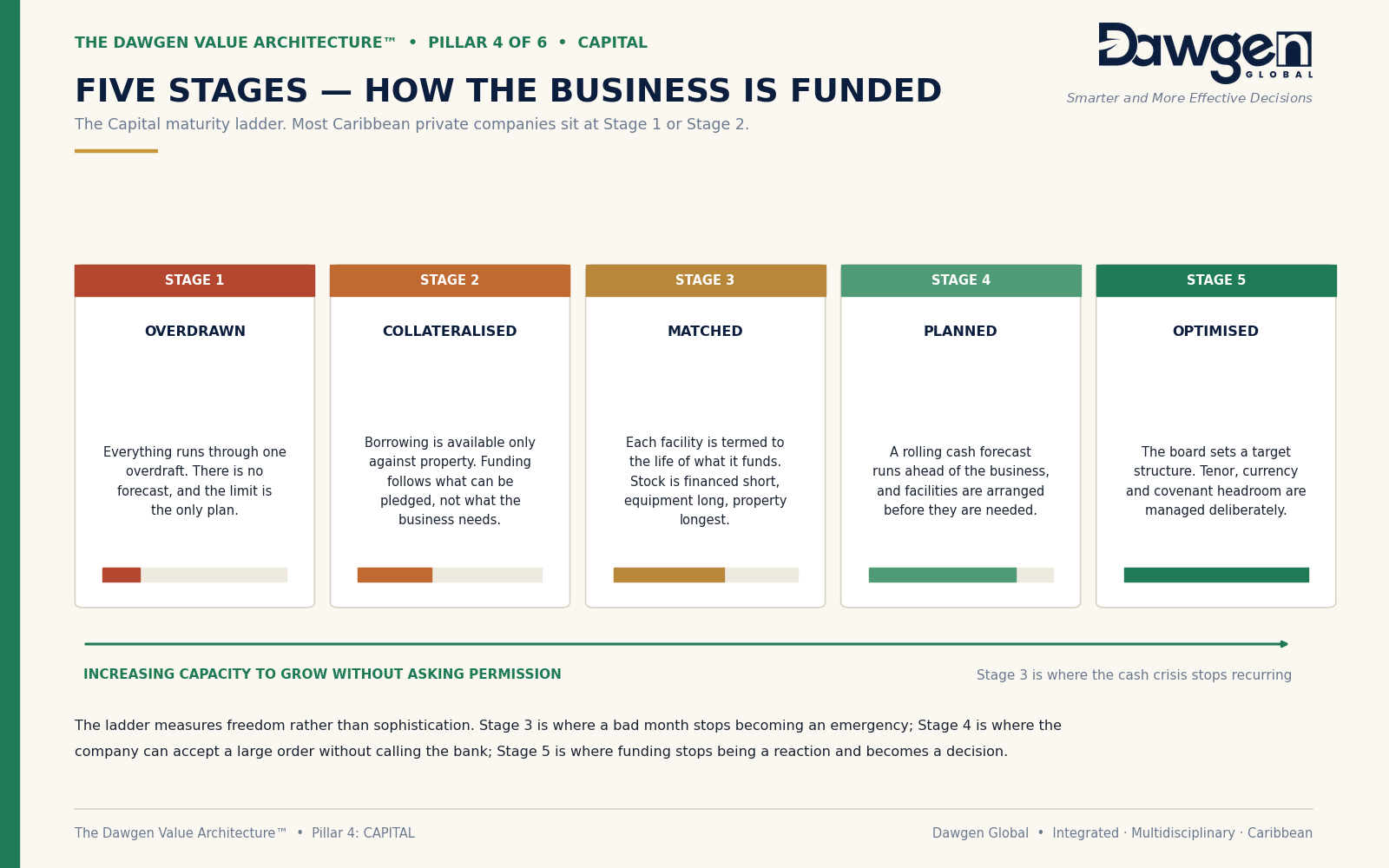
The scorecard converts that judgement into a number. Twelve questions, scored zero for no, one for partly, and two for yes and evidenced. Score against the last twelve months rather than against intention.
| The test that matters
Apply one question to the result: if the bank withdrew the overdraft on thirty days’ notice, what would the business do? If the honest answer is that it could not continue trading, then the facility is not working capital — it is permanent capital held on demand terms, and the company is one credit committee away from a crisis it did not cause. That question is also the bridge to Pillar 5, which asks what else could arrive without warning. |
SECTION 7
Where to Start

If you scored between zero and six, do one thing before anything else: calculate the cash conversion cycle and build the thirteen-week forecast. Do not approach a lender first. A request made without those two numbers is answered on the lender’s terms rather than on yours.
If you scored between seven and eleven, the position is known and the instruments are wrong. Term out the hardcore of the overdraft. It is a single conversation with the bank, it usually reduces the monthly cost, and it converts money that can be withdrawn into money that cannot.
If you scored between twelve and sixteen, the structure is sound and the cycle is the constraint. The work is operational: the slowest inventory lines, the oldest receivables, and the supplier terms nobody has renegotiated in five years.
If you scored above seventeen, the remaining work belongs to the board. A target capital structure, a written drawings policy, and facilities arranged a year before they are needed. That is also the point at which the business stops being funded and starts being financed.
| The one number to calculate this week
If nothing else in this guide is acted on, calculate the cash conversion cycle. Inventory days plus receivable days less payable days, from figures the business already produces. It takes an hour, it requires no adviser, and it converts a vague sense that money is tight into a number that can be managed, reported and reduced. |
ABOUT THIS SERIES
The Dawgen Value Architecture™ is a proprietary Dawgen Global framework addressing the six conditions that determine what a private company is actually worth. Each pillar is published as a standing guide: VISIBILITY, DEPENDENCE, GOVERNANCE, CAPITAL, RESILIENCE and REALISATION. The guides are written for Caribbean owner-managed businesses, their boards and their advisers, and are intended to be used without engaging anyone at all.
This series addresses patterns observed across private company advisory engagements and published international evidence. It does not comment on any listed issuer or any specific client, and no company referred to or resembled in these guides is intended to be identifiable.
Next in the series
Pillar 5 — RESILIENCE: Can It Survive a Shock? Cyber and data, tax exposure, and continuity when the event that was never going to happen happens.
Take the diagnostic further
The Dawgen Working Capital and Funding Structure Review applies this scorecard inside your business, measures the cash conversion cycle against your own ledgers, and delivers a maturity rating, a drafted funding match and a board-ready summary.
At Dawgen Global, we help you make Smarter and More Effective Decisions.
About Dawgen Global
Dawgen Global is an independent, integrated multidisciplinary professional services firm headquartered at 47 Trinidad Terrace, New Kingston, Jamaica, serving more than 15 territories across the Caribbean. Founded and led by Dr. Dawkins Brown, Executive Chairman, the firm is independent and not affiliated with any international network. It delivers a full suite of professional services under one roof: audit and assurance; tax advisory; IT and digital transformation; risk management; cybersecurity; actuarial and insurance regulatory advisory; HR advisory; mergers and acquisitions; corporate recovery; business advisory and strategy; accounting BPO and virtual CFO services; and legal process outsourcing.
The proposition is simple: big-firm capability without the big-firm price. Dawgen Global’s integrated approach is built for the specific complexities and opportunities of the Caribbean market, helping organizations make sharper, better-informed decisions that drive measurable progress.
To explore a partnership, reach out:
- Website: dawgen.global
- Email: [email protected]
- WhatsApp (Global): +1 555-795-9071
- Caribbean offices: +1 876-665-5926 | +1 876-929-3670 | +1 876-926-5210


