
| IN BRIEF
Most trustee and board discussion of a pension plan begins and ends with the funding ratio. It is the wrong number to end on — not because it is inaccurate, but because it describes one day and says nothing about whether the plan recovers from it. Three questions matter more. How mature is the plan, and when does it start selling assets to pay pensions? How sensitive is the deficit to the two or three assumptions carrying it? And can the sponsor actually afford the contribution that fixing it requires? This article works through one plan: assets of US$48 million, liabilities of US$60 million, a sponsor with payroll of US$22 million. A one-point movement in the discount rate takes the annual contribution from 15% of payroll to 22%, and from 37% of the sponsor’s earnings to 54%. That is the sustainability question. Not whether the plan is in deficit, but whether the organisation behind it can carry the deficit under conditions that are entirely plausible. |
Why the Funding Ratio Is the Wrong Place to Stop
A funding ratio compares the value of a plan’s assets with the value of its liabilities at a single date, on a single set of assumptions. It is a necessary calculation and a poor summary. Two plans can report the same ratio and be in entirely different positions.
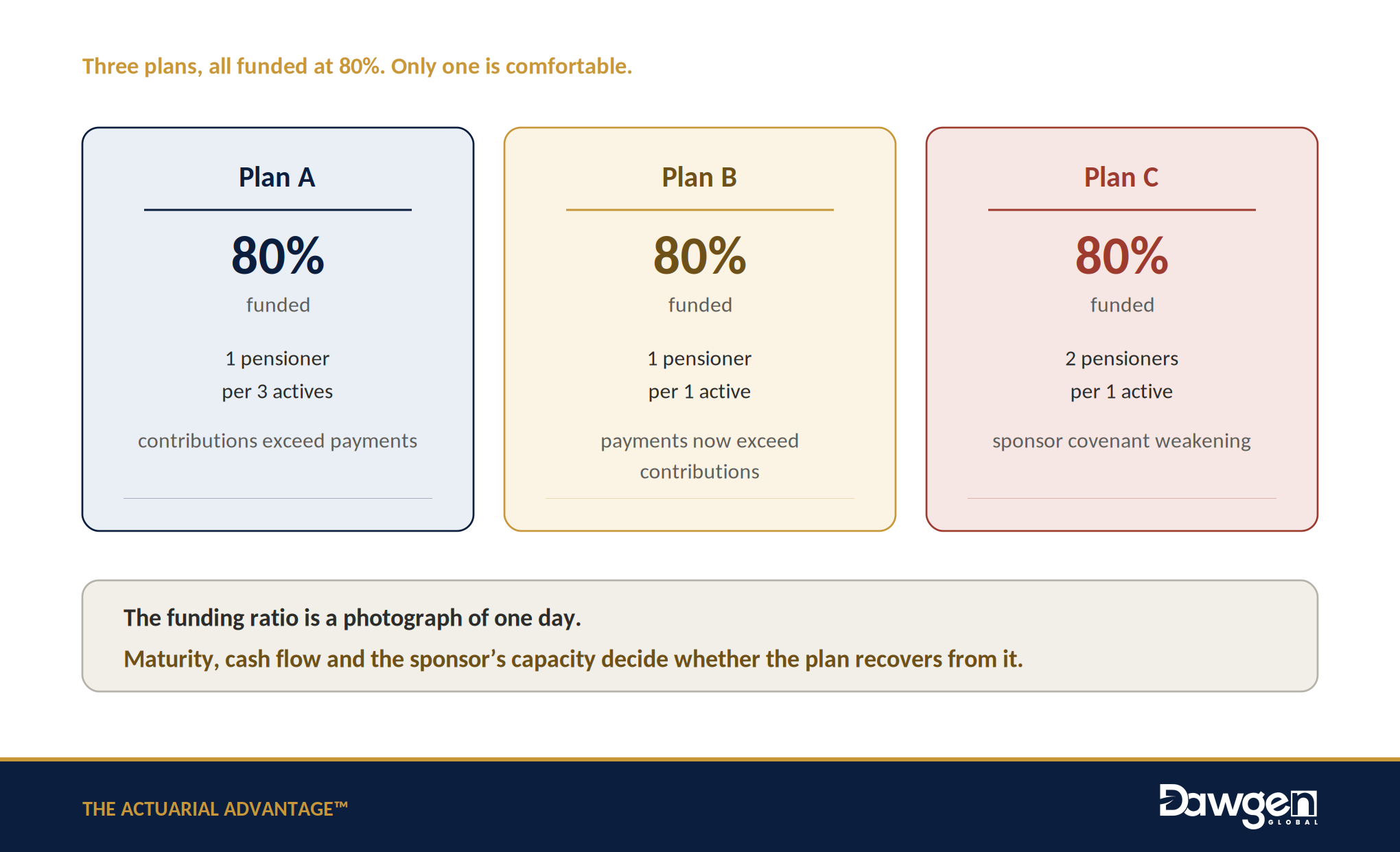
The funding ratio is a photograph of one day. Maturity, cash flow and sponsor capacity decide whether the plan recovers from it.
The difference between these plans is not the ratio. It is time and support. A young plan with contributions flowing in has decades for investment returns and contributions to close a gap. A mature plan paying out more than it receives is a forced seller of assets, and a forced seller cannot wait for markets to recover. A plan whose sponsor is under pressure has neither time nor the covenant to draw on.
| The ratio tells you where the plan is. It does not tell you whether the plan can get anywhere else. |
Which Assumptions Actually Carry the Deficit?
Take a plan with US$48 million of assets and US$60 million of liabilities — a funding ratio of 80 per cent and a deficit of US$12 million — with a liability duration of about sixteen years. The trustees have agreed a ten-year recovery plan, and the sponsor is contributing accordingly.
A pension liability is unusually sensitive to its inputs, because it is a long stream of payments discounted back to today. Move the discount rate by one percentage point and the liability moves by roughly the duration in per cent — here about sixteen.
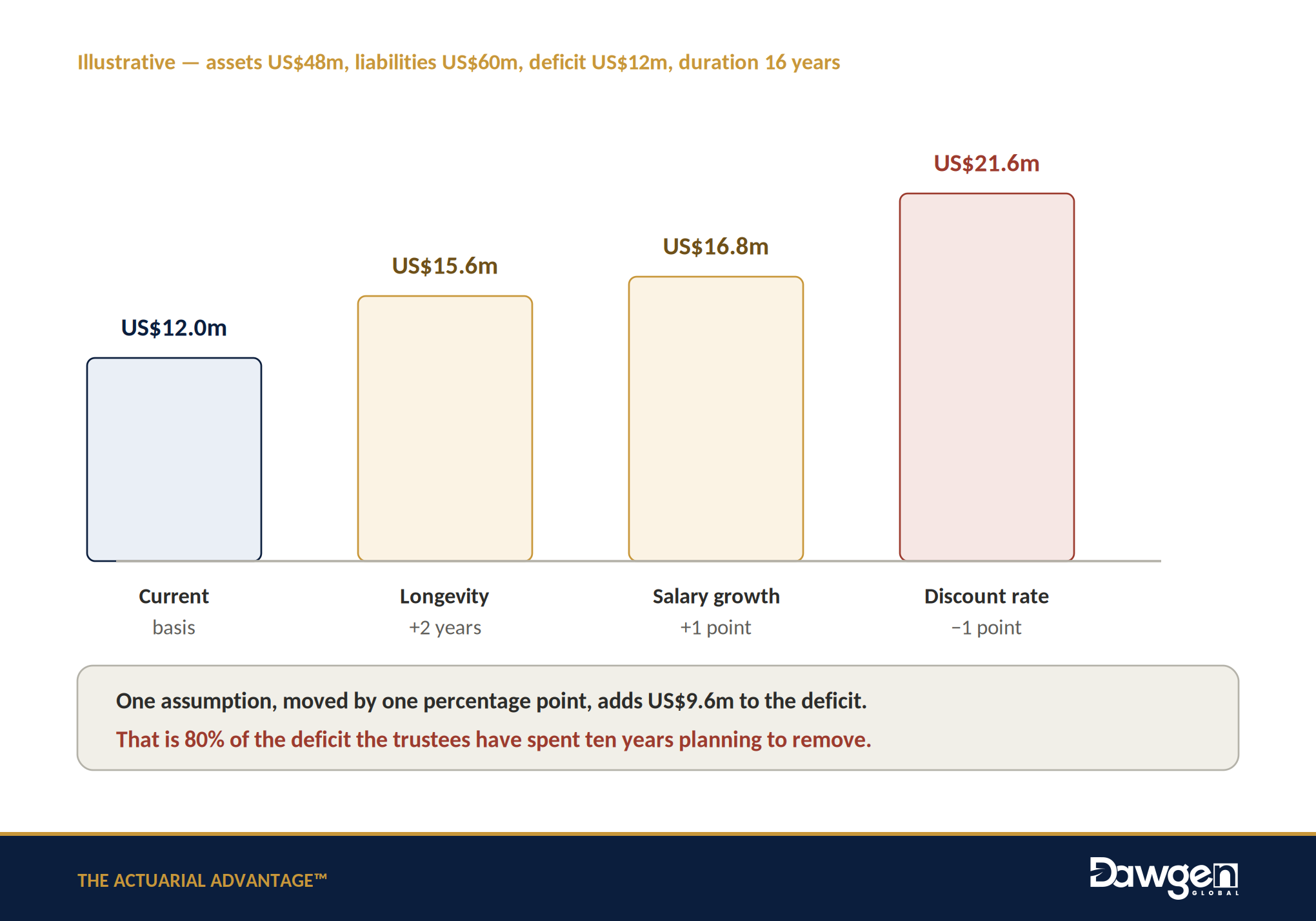
One assumption, moved by one point, adds US$9.6m to the deficit. Figures illustrative.
Two extra years of life expectancy at retirement add about US$3.6 million. A salary growth assumption one point higher adds about US$4.8 million. A discount rate one point lower adds US$9.6 million — which is eighty per cent of the entire deficit the trustees have spent ten years planning to eliminate.
None of those movements is extreme. Discount rates derived from bond yields move by more than a point across a cycle routinely. Longevity improvements of two years have occurred within a single generation. The point is not that these will happen; it is that the recovery plan was built as though they would not, and nobody stated that assumption out loud.
Can the Sponsor Actually Pay for It?
A recovery plan is a promise by the employer, and the relevant test is not whether the deficit is large but whether the contribution required to remove it is affordable out of what the business earns.
On payroll of US$22 million, the ongoing service cost of benefits being earned is about US$1.76 million. Recovering a US$12 million deficit over ten years costs about US$1.55 million a year. Total contribution: US$3.31 million, or 15 per cent of payroll. Against earnings before interest, tax, depreciation and amortisation of US$9 million, that is 37 per cent of the sponsor’s operating earnings — already a substantial claim.
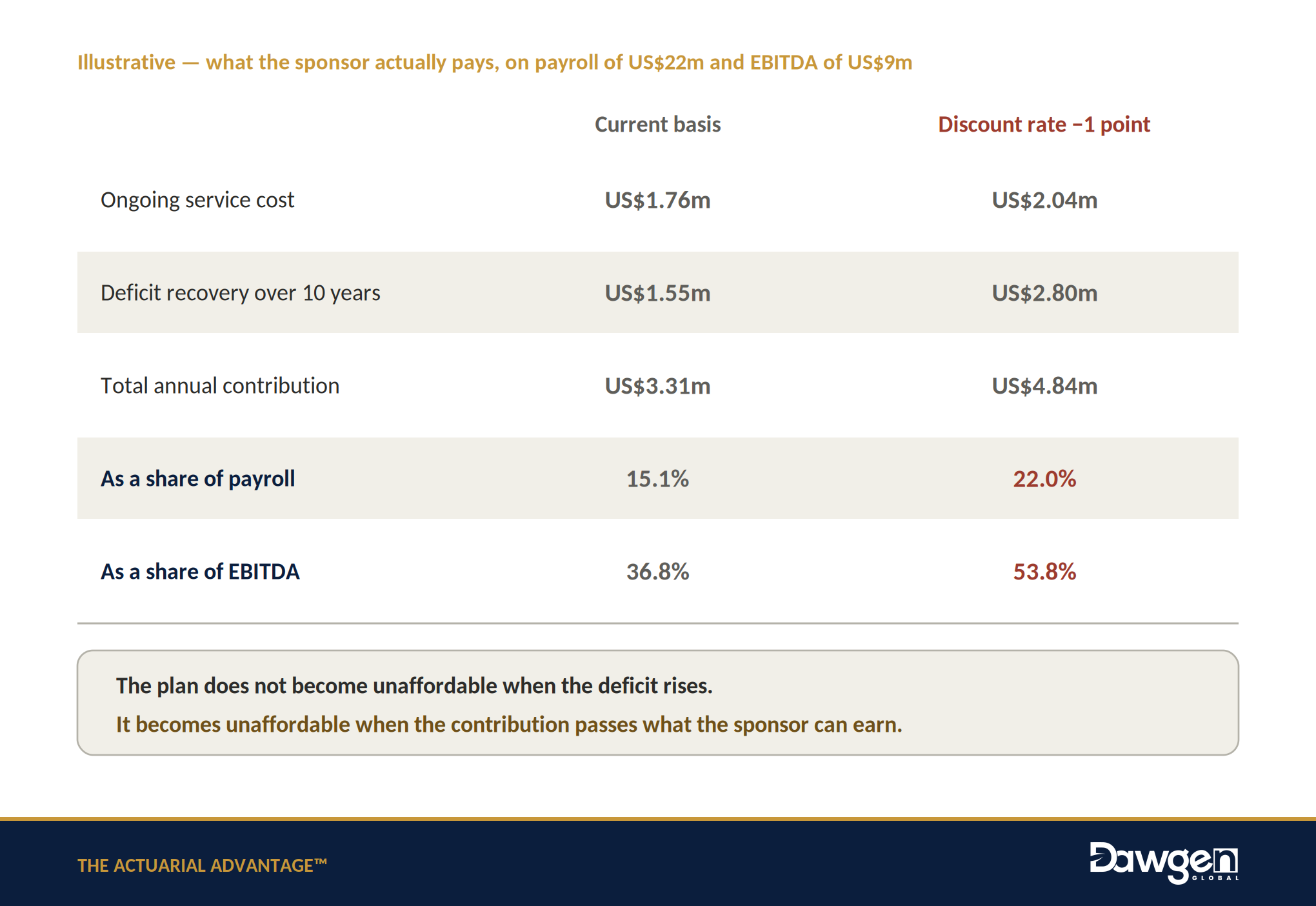
The plan becomes unaffordable when the contribution passes what the sponsor can earn. Figures illustrative.
Now apply the discount rate movement from the previous section. The deficit rises to US$21.6 million and the service cost rises with it, because both are calculated on the same rate. The required contribution becomes US$4.84 million — 22 per cent of payroll and 54 per cent of EBITDA.
At that level the plan is no longer a line in the accounts. It is competing directly with capital expenditure, debt service and dividends for the same cash, and the outcome of that competition determines the sponsor’s future — which in turn determines the security of the benefits. The covenant and the funding position are not two separate risks. They are one risk observed from two directions.
When Does the Plan Start Selling Assets?
Every closed or maturing plan reaches a point at which benefit payments exceed contributions received. Before it, the plan is a net buyer of assets and volatility is largely an accounting matter. After it, the plan must sell assets every year to meet payments, and it must do so whatever the market is doing at the time.
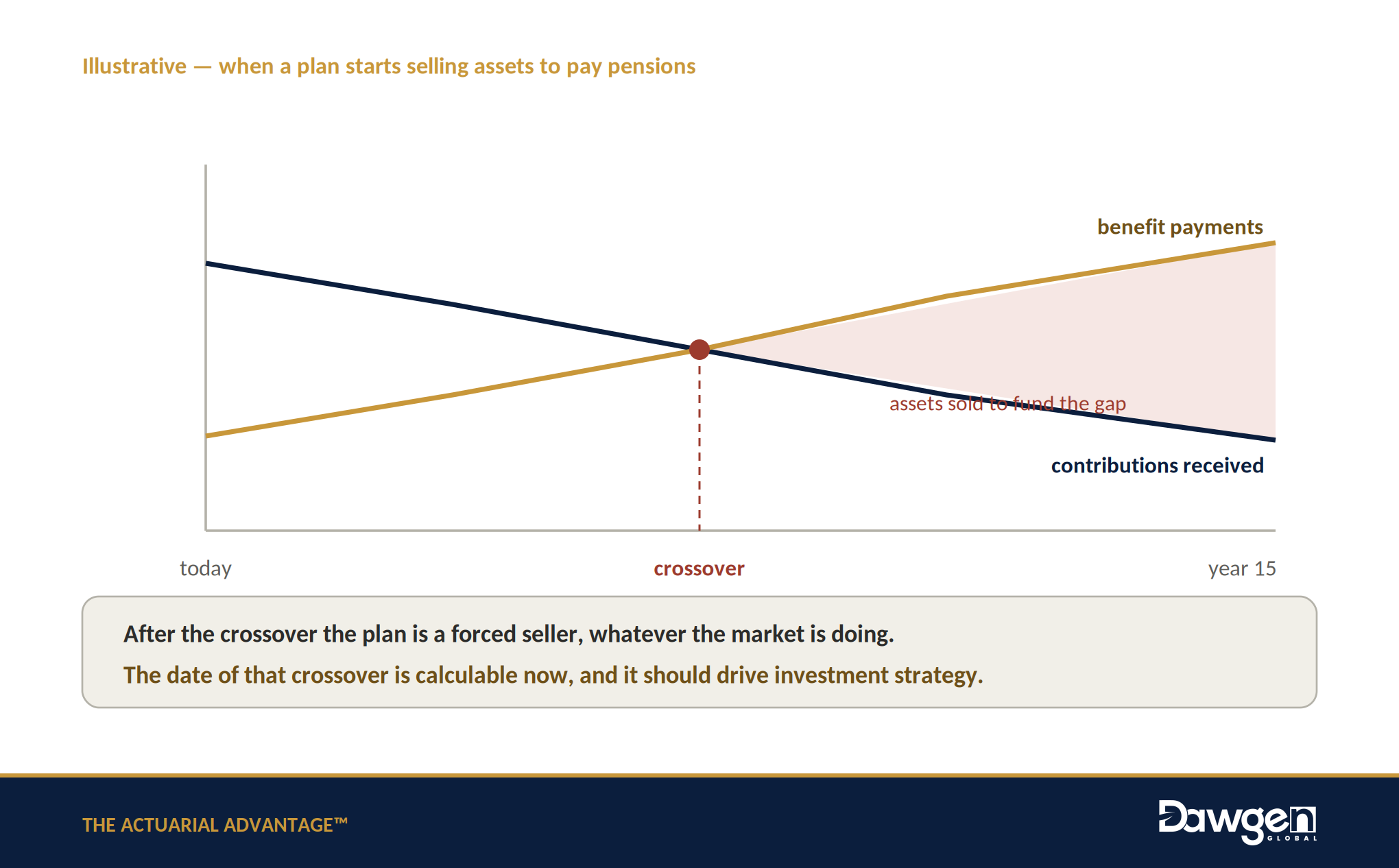
After the crossover the plan is a forced seller. The date is calculable now, and it should drive investment strategy.
This changes what a sensible investment strategy looks like. A plan fifteen years from crossover can hold growth assets and tolerate drawdowns, because it has time to recover and no need to realise losses. A plan already past crossover cannot: a poor year now converts a paper loss into a permanent one, because assets are sold at the bottom to pay pensions that fall due regardless.
The crossover date is arithmetic. It follows from the membership data, the benefit structure and the contribution schedule, all of which the plan already holds. Very few Caribbean plans have calculated it, and fewer still use it to set investment strategy — which means asset allocation is frequently being decided without reference to the one date that should constrain it.
The Regional Constraint
Caribbean plans face a structural problem that plans in larger markets do not, and it deserves stating plainly rather than being treated as an unfortunate detail.
Matching long-dated pension liabilities normally requires long-dated bonds in the currency of the benefits. In most Caribbean markets those instruments exist in limited quantity, at limited maturities, from a small number of issuers. A plan that wishes to reduce risk by matching its liabilities frequently cannot buy enough of the right instrument to do so, and a plan that invests overseas to obtain duration and diversification introduces currency risk against liabilities payable locally.
There is no clean solution to this, and any adviser claiming otherwise should be treated with suspicion. What is available is honest quantification: how much of the liability can realistically be matched, what residual mismatch remains, what that mismatch is likely to cost in a bad scenario, and whether the sponsor covenant is strong enough to carry it. A plan that has quantified its unavoidable mismatch is in a materially better position than one that has assumed the problem away.
The Warning Signs, in Order of Seriousness
Not all deterioration matters equally, and plans frequently monitor the visible signs while missing the structural ones.
| Signal | Why it matters | Seriousness |
| The sponsor’s ability to contribute is weakening | Every recovery plan depends on the covenant. If it fails, nothing else in the plan works. | Most serious |
| Contributions have passed a large share of operating earnings | The plan is now competing with investment and debt service for the same cash. | Most serious |
| Benefit payments exceed contributions | The plan is a forced seller and has lost the ability to wait out a poor market. | Serious |
| The recovery plan has been extended more than once | The deficit is being deferred rather than funded, and the cost compounds. | Serious |
| Assumptions have been revised in a consistently favourable direction | The measured position is improving without the underlying position improving. | Serious |
| Member data is incomplete or unreconciled | Every figure in the valuation rests on it, and errors are usually adverse. | Underrated |
| The funding ratio has fallen | Real, but it is the symptom rather than the diagnosis. | Visible but least diagnostic |
The signals boards watch most closely tend to sit at the bottom of this list.
Eight Questions for Trustees and Sponsors
- What is our funding ratio, and what would it be on a discount rate one point lower?
- Which two assumptions carry most of our deficit, and who set them?
- What does the recovery plan cost as a share of the sponsor’s operating earnings, not just as a figure?
- In which year do benefit payments exceed contributions, and does our investment strategy reflect that date?
- How much of our liability can realistically be matched in available local instruments, and what mismatch remains?
- How many times has the recovery plan been extended, and what did each extension cost?
- When was our member data last reconciled, and by whom?
- What would happen to the plan if the sponsor could not contribute for two years?
| IF SEVERAL CANNOT BE ANSWERED
That is the ordinary position rather than a failure of trusteeship. None of these figures appears in a standard actuarial valuation report, and most valuations are not commissioned to produce them. Each is calculable from data the plan already holds. |
Where This Work Leads
A pension sustainability finding rarely stays with the actuary. A covenant concern leads to the sponsor’s financial reporting and, at times, to corporate finance. A crossover date leads to investment strategy and the investment manager’s mandate. A benefit redesign leads to human resources, employment law and member communication. A data reconciliation leads to systems, records and internal audit. An affordability finding leads to the sponsor’s own accounts under IAS 19.
Dawgen Global’s Caribbean Integrated Borderless Delivery model exists so that the analysis and what follows from it sit within one engagement, across multiple Caribbean jurisdictions. Capability is held by the firm and delivered by a team rather than vested in an individual — which matters for work revisited at every triennial valuation.
The Point of All This
A pension promise is one of the longest commitments an organisation makes. It is measured once a year and lived with every day, and the gap between those two facts is where most pension difficulty originates.
| A plan does not become unsustainable on the day the deficit appears. It becomes unsustainable on the day the sponsor can no longer fund it — and that day is forecastable. |
The plan in this article is not in crisis. It is 80 per cent funded, it has a recovery plan, and its sponsor is meeting the contributions. What it does not have is an answer to what happens if one ordinary assumption moves by one ordinary amount — and the answer is that its cost to the sponsor rises by half.
Knowing that in advance does not make it less likely. It makes it possible to decide, now and calmly, what the trustees and the sponsor will do about it if it happens.
How Dawgen Global Can Help
Pension and employee-benefit valuation is a distinct actuarial specialism. We resource it through our associate network of credentialed pension actuaries, and coordinate delivery within a single Dawgen Global engagement — so the client retains one relationship and one point of accountability across the valuation and everything that follows from it.
The work that follows a valuation is where our multidisciplinary platform contributes directly:
- Sponsor covenant assessment and affordability analysis against the employer’s financial position
- IAS 19 reporting, disclosure and audit-readiness support for the sponsoring employer
- Member data quality review, reconciliation and records remediation
- Pension governance, trustee training and decision-support frameworks
- Benefit redesign support across tax, employment and human resources implications
- Member communication strategy and documentation
- Pension exposure in mergers, acquisitions and restructuring
- Enterprise risk quantification and stress testing of the sponsor’s wider position
| REQUEST AN ACTUARIAL RISK DISCOVERY SESSION
A structured half-day session with your board, trustees or executive team, followed by a short written output: which of your exposures can be quantified, what data each would require, and what a first quantification would involve and cost. Where the work calls for pension valuation specialism, we identify that in the output and set out how it would be resourced. Fixed scope. Fixed fee. Delivered within three weeks. Email: [email protected] · Telephone: 876-929-3670 or 876-665-5926 · US toll free: 855-354-2447 Contact form: www.dawgen.global/contact-us/ |
| This article is published as part of The Actuarial Advantage™, a Dawgen Global editorial series on risk quantification, insurance and long-term financial decision-making in the Caribbean. It is general commentary and does not constitute actuarial, accounting, legal or investment advice, and it is not a substitute for a formal actuarial valuation. All figures are illustrative and are used to demonstrate method; they are not estimates of any plan’s position. Pension regulation and funding requirements differ by territory and should be confirmed against the applicable legislation. |
About Dawgen Global
Dawgen Global is an independent, integrated multidisciplinary professional services firm headquartered at 47 Trinidad Terrace, New Kingston, Jamaica, serving more than 15 territories across the Caribbean. Founded and led by Dr. Dawkins Brown, Executive Chairman, the firm is independent and not affiliated with any international network. It delivers a full suite of professional services under one roof: audit and assurance; tax advisory; IT and digital transformation; risk management; cybersecurity; actuarial and insurance regulatory advisory; HR advisory; mergers and acquisitions; corporate recovery; business advisory and strategy; accounting BPO and virtual CFO services; and legal process outsourcing.
The proposition is simple: big-firm capability without the big-firm price. Dawgen Global’s integrated approach is built for the specific complexities and opportunities of the Caribbean market, helping organizations make sharper, better-informed decisions that drive measurable progress.
To explore a partnership, reach out:
- Website: dawgen.global
- Email: [email protected]
- WhatsApp (Global): +1 555-795-9071
- Caribbean offices: +1 876-665-5926 | +1 876-929-3670 | +1 876-926-5210


