
Executive Summary
Across nine articles, this series has argued for independent evidence: assessments that examine, tests that prove, boards that verify. This tenth article confronts the uncomfortable place where most of that good work goes to die — the findings tracker. Every organisation that has ever commissioned an assessment owns one: a spreadsheet or register of identified weaknesses, opened with resolve, updated with decreasing frequency, and quietly carrying the same items year after year. The Caribbean’s assurance graveyard is not the unassessed organisation; it is the assessed organisation that never finished.
The argument of this article is simple and demanding: the report is the midpoint of assurance, not its destination — and a finding is worth nothing until it is closed, with closure verified by retest and evidenced to a standard someone independent could examine. The article dissects why findings die — the anatomy of remediation failure is remarkably consistent across sectors — defines what “closed” must actually mean, sets out the governance system that keeps remediation alive, explains the retesting discipline that separates assurance from paperwork, and shows how repeat findings point to root causes that instance-by-instance fixing never touches. It closes with the five steps that build a closure engine, and ten signs — a diagnostic any executive can run this afternoon — that your findings are dying in the tracker.
Why Findings Die: The Anatomy of Remediation Failure
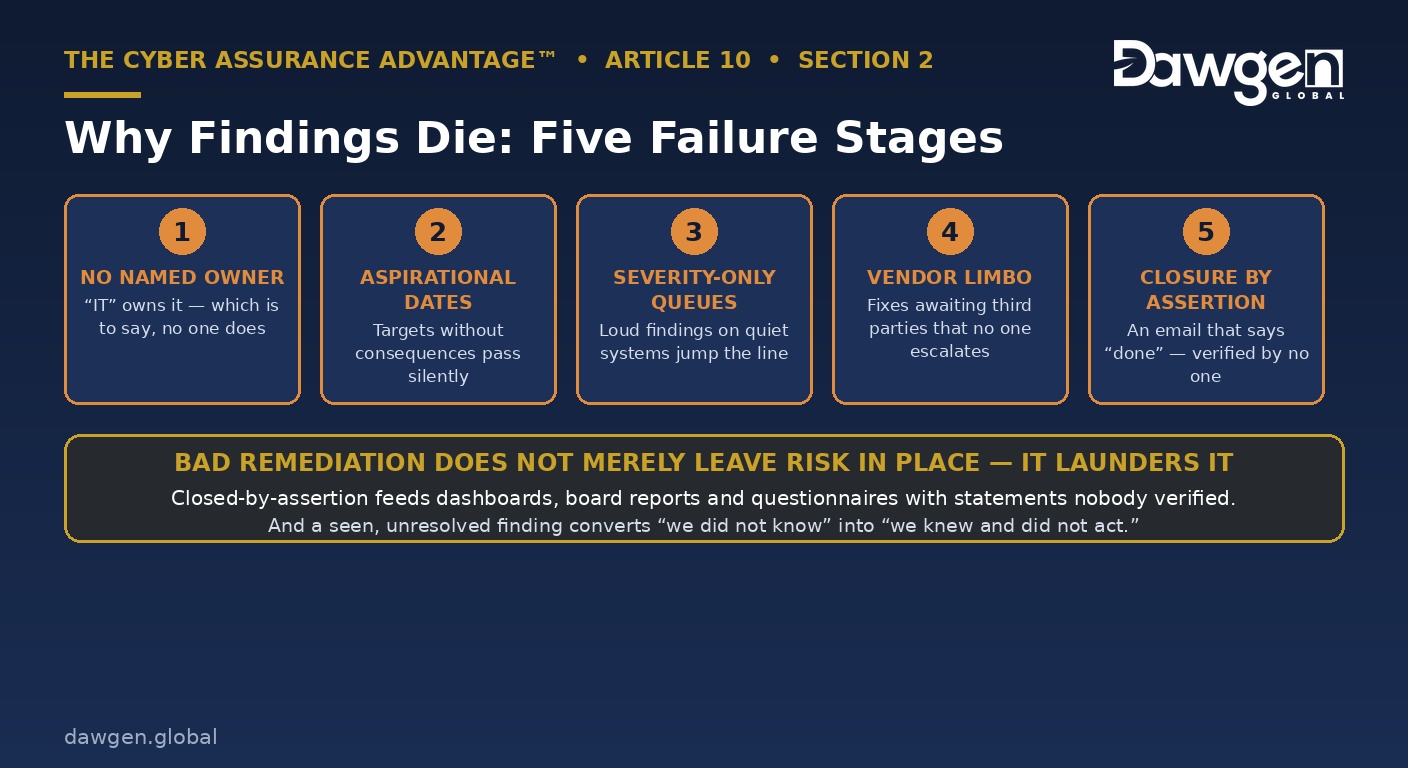
The pattern repeats so reliably that it deserves to be named stage by stage. The report lands with energy: meetings are held, a tracker is created, early items are fixed — usually the easy ones, which flatters the statistics. Then the machinery seizes. Findings carry no named owner, so they belong to “IT” — which is to say, to no one. Dates are aspirations rather than commitments, so they pass silently. The queue is sorted by raw technical severity — the misallocation Article 6 dissected — so effort pours into loud findings on quiet systems while the moderate weakness on the payments pathway waits. Fixes that require vendor action enter a correspondence limbo no one escalates. And closure is declared by assertion: an email that says “done,” a ticket marked resolved, a status changed in the tracker — with no one independent ever confirming that the environment, as opposed to the paperwork, actually changed.
Two features make this failure mode uniquely dangerous rather than merely wasteful. First, documented exposure: as earlier articles observed, an unresolved finding the organisation has seen is the most dangerous document in the building — it converts “we did not know” into “we knew and did not act,” a sentence with legal, regulatory and insurance consequences that outlast the vulnerability itself. Second, false assurance: a tracker full of items marked closed-by-assertion feeds dashboards, board reports and questionnaire answers — the entire evidence chain this series has built — with statements nobody has verified. Bad remediation does not merely leave risk in place; it launders it into apparent comfort.
What “Closed” Must Actually Mean: The Closure Standard
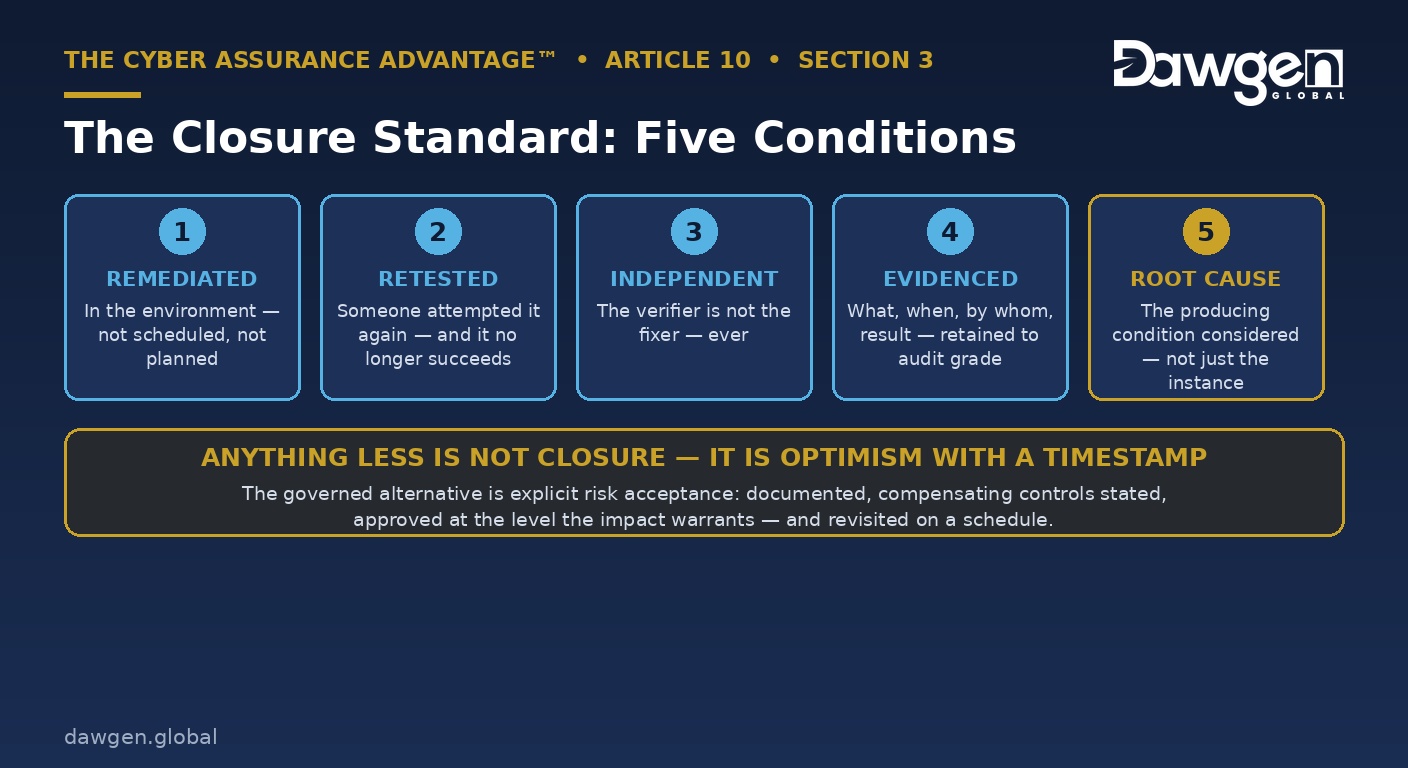
A finding is closed when five statements are simultaneously true. The weakness is remediated in the environment — not scheduled, not planned, not fixed in a change request awaiting a window. The remediation has been verified by retest — someone has attempted what the original finding demonstrated and confirmed it no longer succeeds. The verifier is independent of the fixer — the discipline this series has applied everywhere else applies here with full force, because self-certified closure is self-review, however sincere. The evidence is retained — what was retested, when, by whom, with what result — to the audit-grade standard of Article 4, ready for the quality assessor, the regulator or the insurer. And the root cause has been considered — the difference, explored below, between patching an instance and fixing the condition that produced it.
One further status deserves first-class treatment rather than embarrassment: risk acceptance. There are findings an organisation rationally chooses not to remediate — the cost outweighs the exposure, a system is being retired, a compensating control genuinely covers the gap. The failure is not the acceptance; it is the silent acceptance — the finding that simply ages in the tracker until everyone stops mentioning it. Governed risk acceptance is explicit: documented, compensating controls stated, approved at the level the dual rating warrants — board level where enterprise impact is high — and revisited on a schedule, because the system that was “being retired” in 2024 has a way of still running in 2026.
| THE CLOSURE STANDARD
Remediated in the environment • verified by retest • by someone independent of the fixer • with evidence retained • and root cause considered. Anything less is not closure — it is optimism with a timestamp. |
The Governance That Keeps Remediation Alive
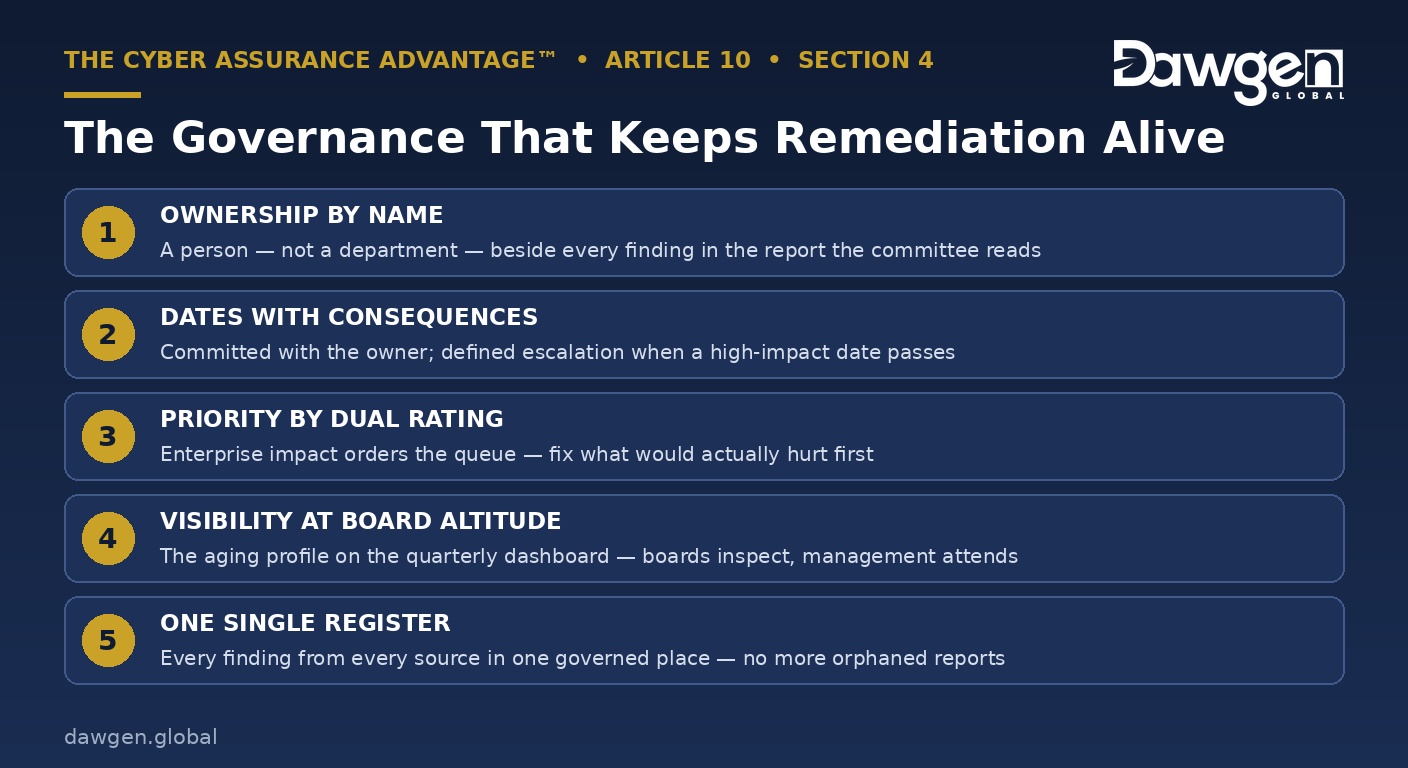
Remediation survives on structure, not enthusiasm, and the structure has five load-bearing parts. Ownership by name: every finding carries a person — not a department — whose name appears next to it in the report the committee reads; accountability that specific has a remarkable effect on velocity. Dates with consequences: target dates set with the owner, and a defined escalation when a high-impact finding passes its date — to the executive first, to the audit committee when it ages further, per the escalation instincts of Article 3. Priority by dual rating: the queue ordered by enterprise impact as well as technical severity, so the organisation fixes what would actually hurt first. Visibility at the right altitude: the aging profile — what is open, how old, how impactful, trend against last quarter — as a standing element of the board dashboard from Article 3, because management attends to what the board reliably inspects. And a single register: every finding from every source — internal audit, penetration tests, regulator observations, insurer requirements — in one governed place, ending the orphaned-report problem Article 4 described.
Retesting: The Discipline That Separates Assurance from Paperwork
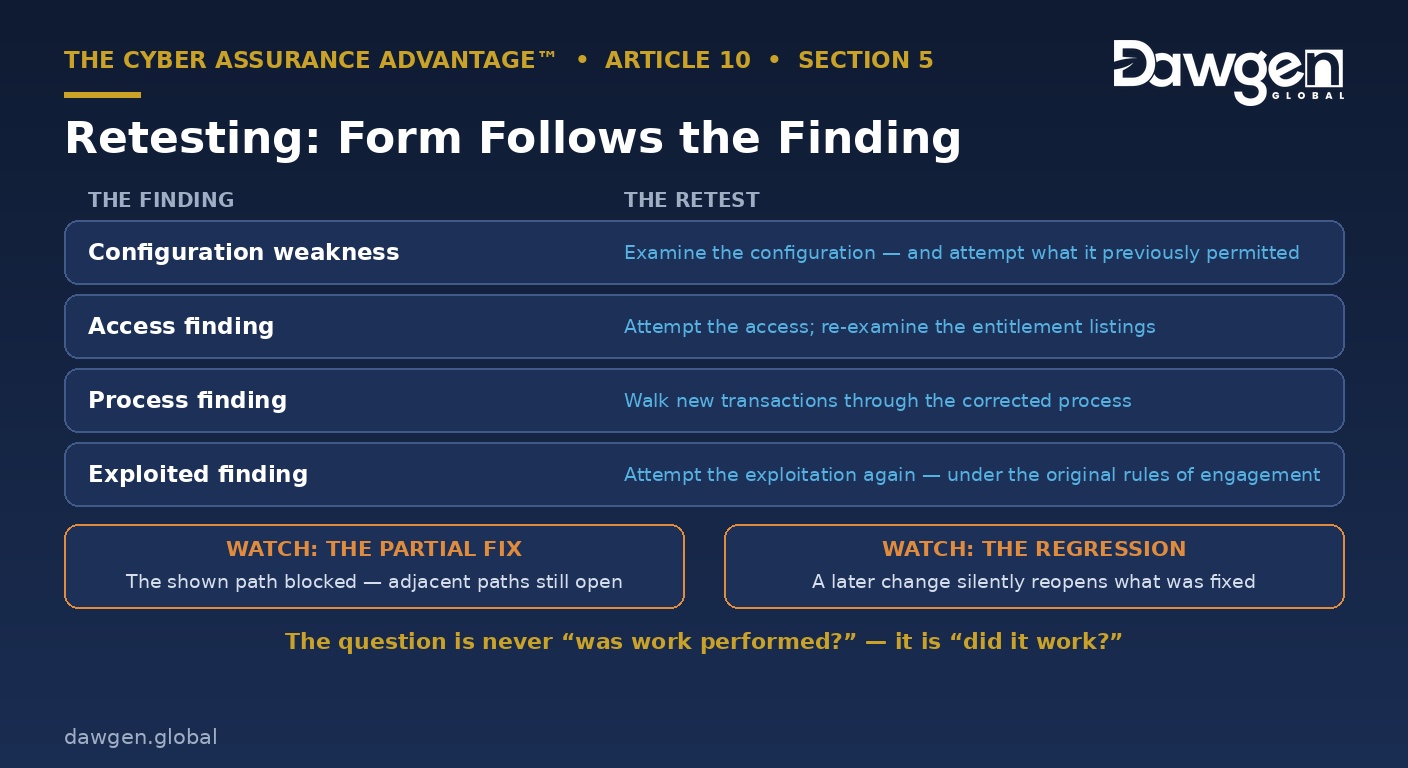
Retesting is where closure earns its name, and its form should follow the finding. A configuration weakness is retested by examining the configuration and attempting what it previously permitted. An access finding is retested by attempting the access and re-examining the entitlement listings. A process finding — the approval that was not enforced, the review that did not happen — is retested by walking new transactions through the corrected process. A technically exploited finding, per Article 6, is retested by attempting the exploitation again under the same rules of engagement that governed the original test. In every case the question is identical to the one that opened this series: not “was work performed?” but “did it work?”
Practical cadence matters. Retesting bundled quarterly is efficient and creates a rhythm the organisation can plan around; critical findings warrant retest on closure rather than waiting for the bundle. Verifiers should watch for two quiet failure modes: the partial fix, where the specific path demonstrated was blocked while adjacent paths remain open, and the regression, where a later change silently reopens what was genuinely fixed — the reason closed findings on the highest-impact systems belong in the recurring scope of continuous assurance rather than being archived and forgotten. The output of all this is itself an asset: a closure evidence file — finding, fix, retest, result, date — that slots directly into the annual evidence file Article 8 described, and answers the question every external audience now asks: not whether you were assessed, but what happened next.
The Finding That Keeps Coming Back: Root Cause and Repeat Findings
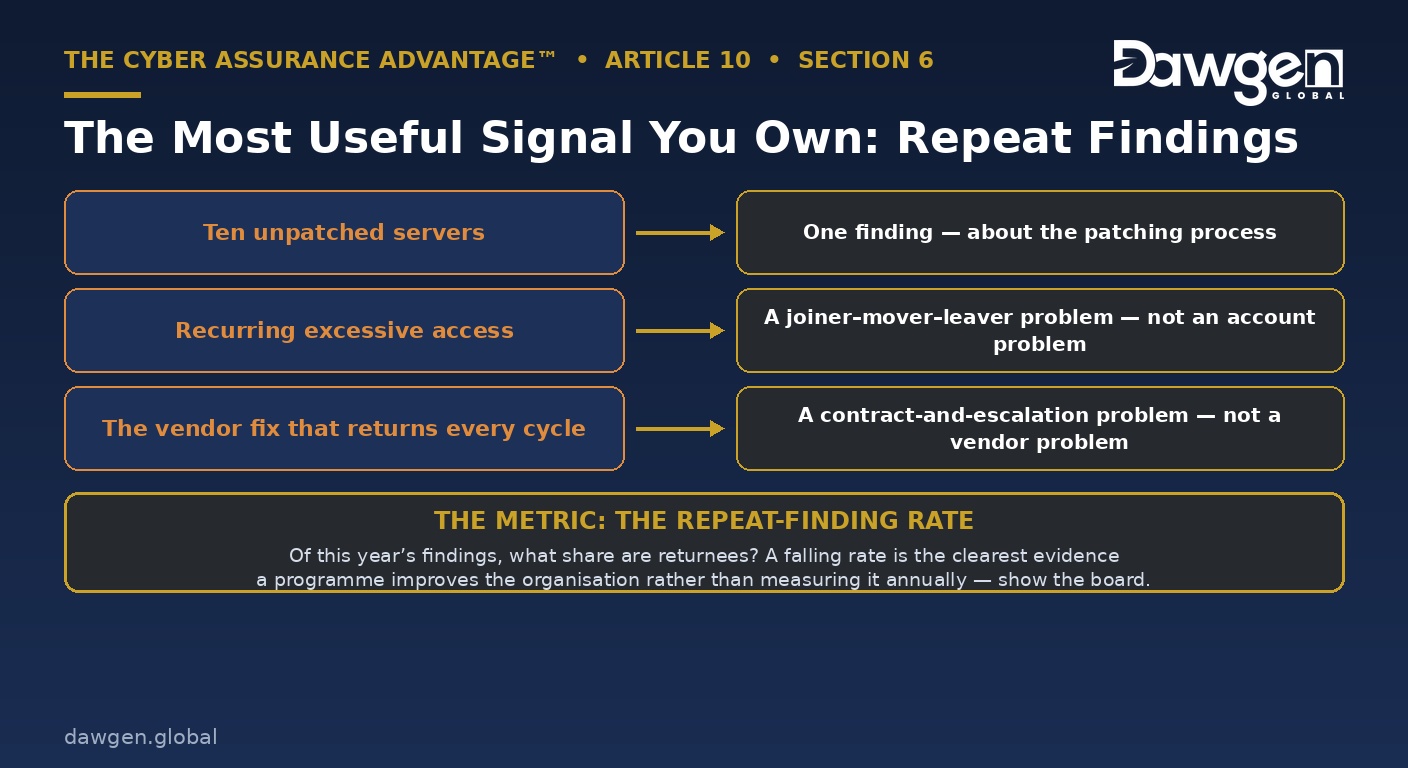
Every assurance professional knows the déjà vu of the repeat finding: the same weakness, the same system class, a different year. Repeat findings are not evidence that assessments fail; they are the single most useful signal an assurance programme produces, because they mark the places where the organisation has been fixing instances while the producing condition survives. Ten unpatched servers are not ten findings; they are one finding about the patching process. Recurring excessive-access findings are not an access problem; they are a joiner-mover-leaver problem. The overdue vendor fix that reappears every cycle is not a vendor problem; it is a contract-and-escalation problem. Closing the instance while leaving the condition guarantees a reunion.
The discipline is to treat any repeat finding — and any cluster of similar findings — as a mandatory root-cause question, answered in writing: what process, capability or accountability gap produced this, and what changes so it stops being produced? The metric that keeps the discipline honest is the repeat-finding rate: of this year’s findings, what proportion are returnees? A falling rate is the clearest evidence an assurance programme is actually improving the organisation rather than measuring it annually — and it is a number worth showing the board.
Building the Closure Engine: Five Steps
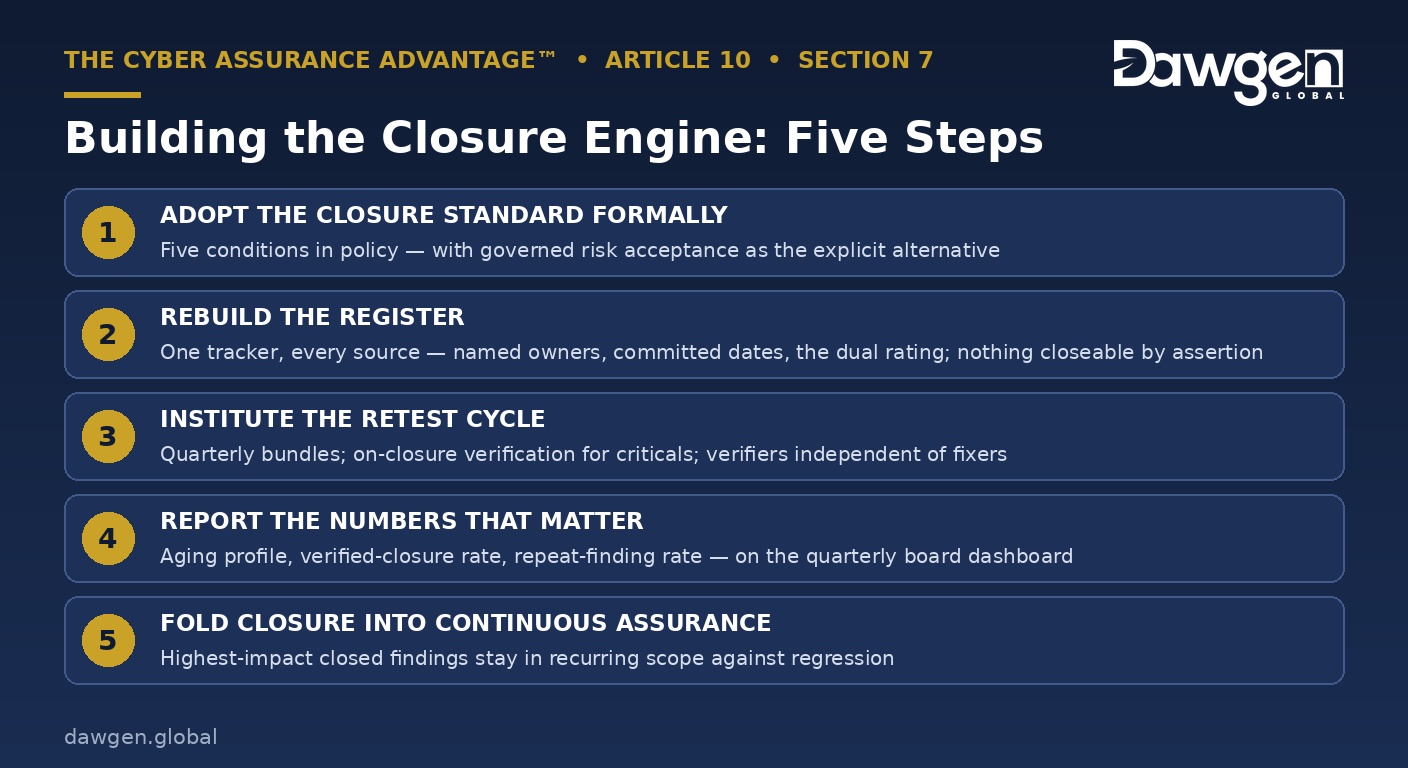
- Adopt the closure standard formally. Five conditions, written into policy: remediated in the environment, verified by retest, independent verifier, evidence retained, root cause considered — with governed risk acceptance as the explicit alternative.
- Rebuild the register. One consolidated tracker for findings from every source, each carrying a named owner, a committed date, the dual rating — and nothing closeable by assertion.
- Institute the retest cycle. Quarterly bundled retesting with on-closure verification for criticals, performed by parties independent of the fixers — internal audit, or the assurance partner under audit’s direction.
- Report the numbers that matter. Aging profile, verified-closure rate and repeat-finding rate on the quarterly board dashboard — replacing the activity noise Article 3 retired.
- Fold closure into continuous assurance. Highest-impact closed findings stay in recurring scope against regression — the bridge to the discipline this series turns to next.
The Dawgen Global Perspective
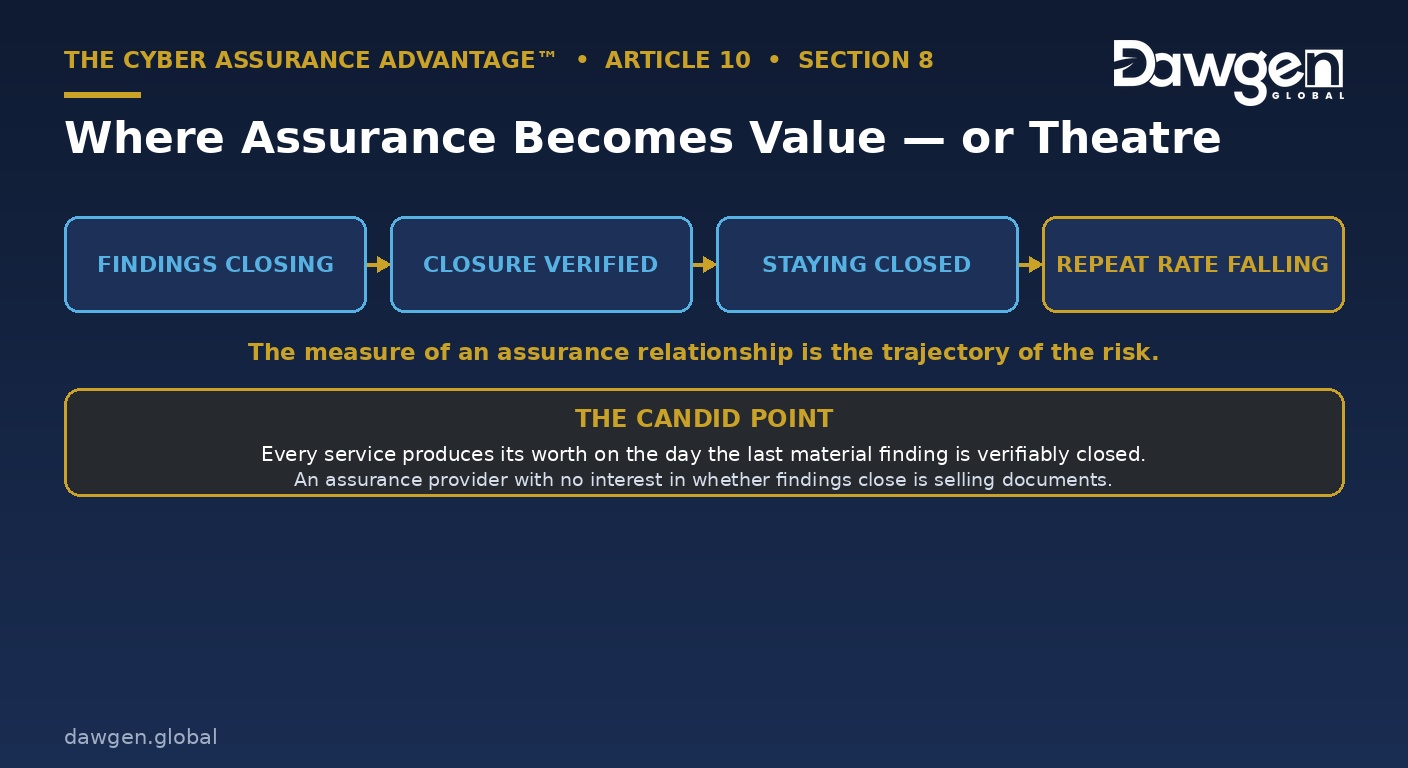
Dawgen Global regards remediation as the point where assurance either becomes value or becomes theatre. Every service this series has described — the diagnostic, the integrated audit, the penetration test, the resilience assessment — produces its worth not on the day the report is delivered but on the day the last material finding is verifiably closed. That is why remediation assurance is a first-class discipline in the firm’s practice rather than an afterthought: independent retesting and closure verification, remediation governance design — the register, the escalations, the committee reporting — root-cause analysis on repeat findings, and closure evidence files built to the standard regulators, insurers and correspondents now expect.
There is also a candid commercial point Caribbean organisations deserve to hear: an assurance provider with no interest in whether findings close is selling documents. The measure of an assurance relationship is the trajectory of the risk — findings closing, verified, staying closed, repeat rates falling. The next article in this series completes the arc that this one begins: from the annual assessment to continuous assurance — the operating rhythm that makes cyber confidence a permanent condition rather than a yearly photograph.
Ten Signs Your Findings Are Dying in the Tracker
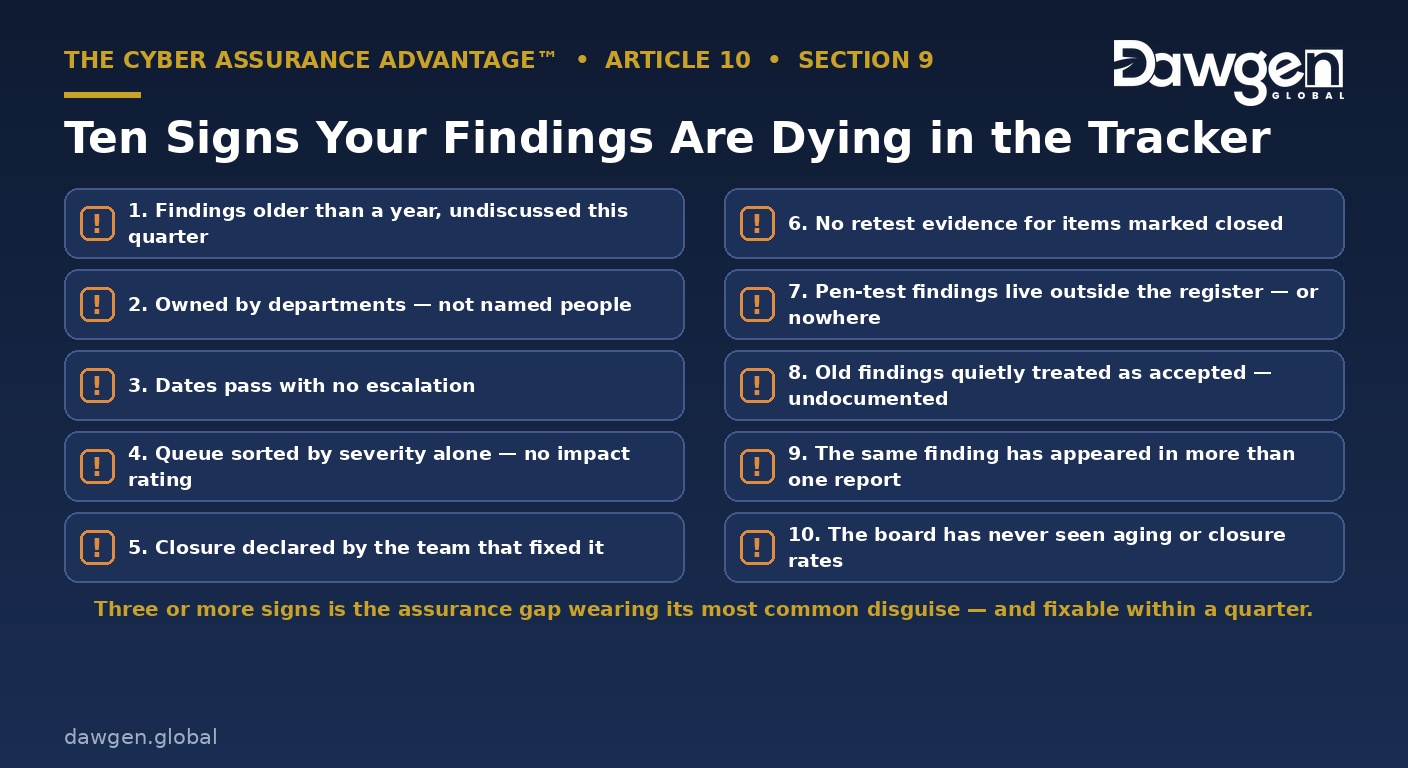
- The tracker contains findings older than a year that no one has discussed this quarter.
- Findings are owned by departments — “IT,” “Operations” — rather than named people.
- Target dates pass without any defined escalation occurring.
- The queue is sorted by technical severity alone, with no enterprise-impact rating.
- Closure is declared by the team that performed the fix.
- No retest evidence exists for items marked closed.
- Findings from penetration tests live in a different place from audit findings — or in no place at all.
- Risk acceptances are nowhere documented, yet several old findings are quietly treated as accepted.
- The same finding — or its siblings — has appeared in more than one annual report.
- The board has never seen an aging profile, a verified-closure rate or a repeat-finding rate.
Three or more signs is not an administrative untidiness; it is the assurance gap of Article 1 wearing its most common disguise — and it is fixable within a quarter.
Frequently Asked Questions
Can the team that fixed a finding also verify its closure?
They should confirm their own work as good practice — but that confirmation is management assertion, not closure. Verification requires someone independent of the fix: internal audit, a co-sourced specialist under audit’s direction, or the original assessor retesting. The principle is the same one that runs through this entire series — the builder is never the checker.
How long should remediation reasonably take?
It should be committed per finding rather than governed by one blanket rule: dated with the owner, prioritised by the dual rating, and escalated when passed. As working discipline, high-enterprise-impact findings deserve dates measured in days and weeks, not quarters — and anything that genuinely requires longer deserves an interim compensating control, documented and governed.
Is accepting a risk instead of fixing it ever legitimate?
Yes — when it is explicit, documented, approved at the level the impact warrants, supported by stated compensating controls, and revisited on a schedule. Governed acceptance is a rational instrument of risk management. Silent acceptance — the finding that simply ages until everyone stops mentioning it — is the failure this article exists to end.
What verified-closure rate should we aim for?
Direction matters more than a universal number: material findings verifiably closed within their committed dates, a closure rate that rises quarter on quarter, and a repeat-finding rate that falls year on year. An organisation that can show those three trends holds better evidence of improvement than any point-in-time score — and external audiences increasingly know it.
Move From Cybersecurity Assumptions to Independent Cyber Assurance
Dawgen Global combines cyber governance, risk-based internal audit, penetration testing, resilience assessment and remediation validation to help Caribbean organisations determine whether their cybersecurity controls are properly designed and operating effectively. To find out what your tracker would say under independent examination — and to build the closure engine that ends the cycle — request a confidential remediation and verified-closure review.
About Dawgen Global
Dawgen Global is an independent, integrated multidisciplinary professional services firm headquartered at 47 Trinidad Terrace, New Kingston, Jamaica, serving more than 15 territories across the Caribbean. Founded and led by Dr. Dawkins Brown, Executive Chairman, the firm is independent and not affiliated with any international network. It delivers a full suite of professional services under one roof: audit and assurance; tax advisory; IT and digital transformation; risk management; cybersecurity; actuarial and insurance regulatory advisory; HR advisory; mergers and acquisitions; corporate recovery; business advisory and strategy; accounting BPO and virtual CFO services; and legal process outsourcing.
The proposition is simple: big-firm capability without the big-firm price. Dawgen Global’s integrated approach is built for the specific complexities and opportunities of the Caribbean market, helping organizations make sharper, better-informed decisions that drive measurable progress.
To explore a partnership, reach out:
- Website: dawgen.global
- Email: [email protected]
- WhatsApp (Global): +1 555-795-9071
- Caribbean offices: +1 876-665-5926 | +1 876-929-3670 | +1 876-926-5210


