The trust that built your family business is real. But trust without structure is not governance — it is luck, and luck runs out at the worst possible moments.
The Problem, Lived
Consider “the Grants,” whose building-supplies business has fed three households for twenty-two years. The founder still signs every cheque. His daughter runs operations brilliantly but holds no title that says so. A son-in-law was brought in during a difficult season and now occupies a role no one can quite define — or question. Sunday dinner doubles as the board meeting, except nothing is minuted, nothing is voted, and the loudest voice usually wins.
Then comes the argument that changes everything: a disagreement over buying two new delivery trucks. It should have been a business decision — payback period, financing cost, utilization. Instead it becomes a referendum on respect, on who sacrificed most in the early years, on a promotion promised in 2019 and never delivered. The trucks are eventually bought, but something in the family is dented. And everyone quietly understands that the real collision — the one about what happens when the founder steps back — is still ahead, unplanned and undiscussed.
None of this reflects a bad family or a bad business. It reflects a good family and a good business running without the structures that let the two coexist. That is what governance actually is — not bureaucracy, but the architecture that protects the family from the business and the business from the family.
Why It Happens Here
Family firms are the backbone of Caribbean enterprise — the hardware stores, distributors, farms, guesthouses and professional practices that anchor every parish and every island. But the same intimacy that makes them resilient makes governance feel unnatural. Proposing a written charter to your own father can feel like an accusation. Suggesting a defined role for your brother reads as distrust. So the structures never get built, and every issue that structure would have absorbed lands instead on the family’s emotional ledger.
Three regional realities sharpen the problem. First, the founder-centric authority model: businesses built by force of one personality rarely develop decision-making systems, because for decades the system was the founder. Second, the succession taboo — in many Caribbean families, raising succession feels like discussing the founder’s mortality, so the most consequential transition the business will ever face is the one thing that cannot be mentioned. Third, blurred money: household and business finances intertwine over the years until dividends, salaries and family support become indistinguishable — a quiet source of both tax risk and sibling resentment.
| The Statistic Every Family Business Should Know
Research on family enterprises worldwide consistently finds that only a minority survive into the second generation, and far fewer into the third — and the leading causes are rarely market failure. They are succession conflict, role ambiguity and the absence of governance structures: precisely the failures that are preventable, and precisely the ones no competitor can inflict on you. Only the family can. |
Why Generic Advice Fails
Look up “corporate governance” and you will find codes written for listed companies: independent non-executive directors, audit and remuneration committees, disclosure frameworks. Presented to a twelve-person family firm, this apparatus is absurd — and its absurdity becomes the excuse to do nothing. At the other extreme, imported family-office content assumes dynastic wealth, trusts and investment committees that have little to do with a distribution business in May Pen or a guesthouse in Portland.
What a Caribbean family business needs is right-sized governance: a small set of instruments, proportionate to the firm’s scale, that separate three things that family firms chronically merge — family matters, ownership matters, and management matters. When those three tables are separated, most family-business conflict simply loses its fuel.
The Framework: The Six Structures of Family Governance™, Step by Step
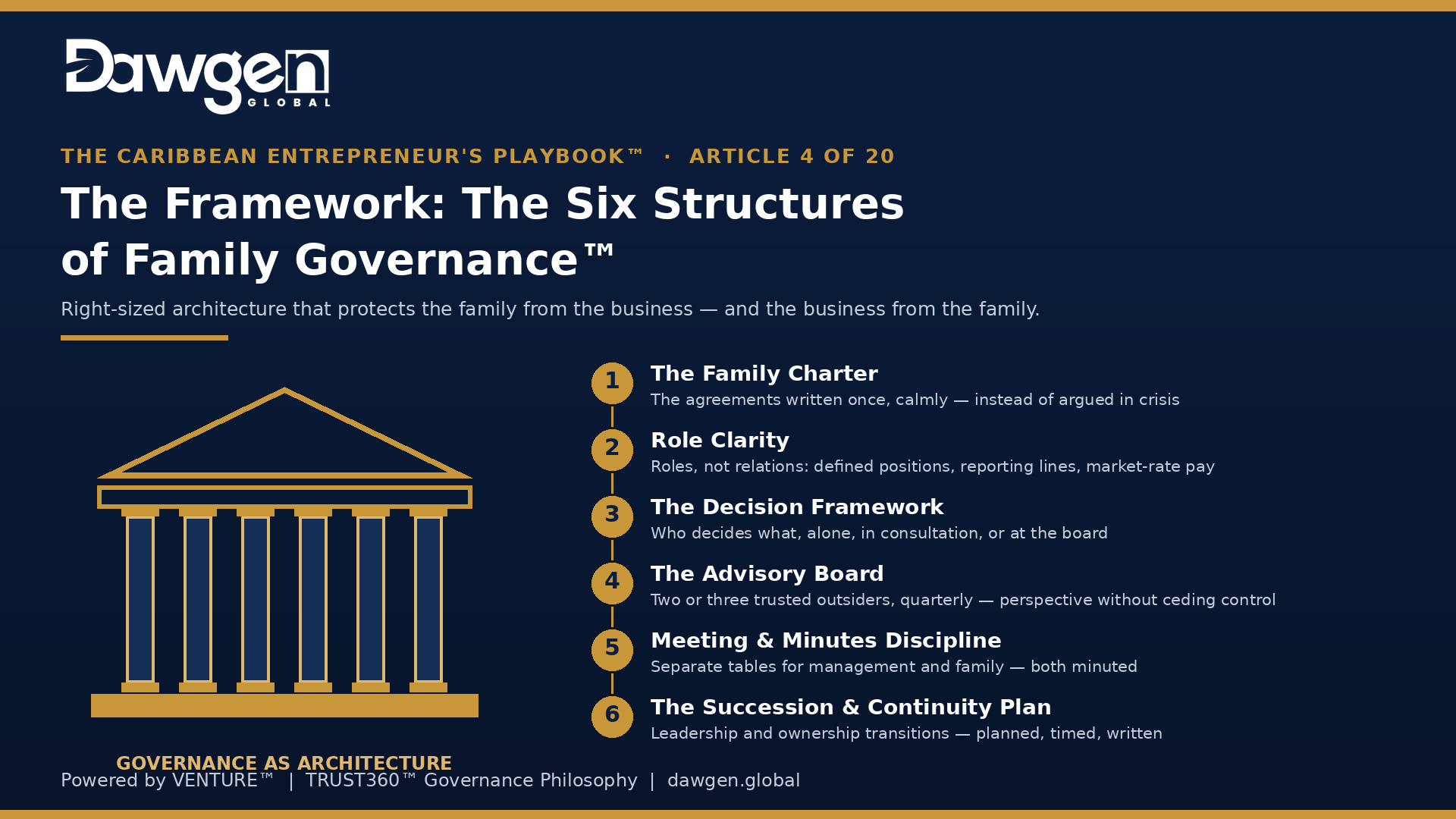
Drawing on the governance philosophy of Dawgen Global’s TRUST360™ framework — governance as a continuous, living discipline rather than a one-time document — here are the six right-sized structures, in the order a family firm should build them:
- Structure 1 · The Family Charter — A written statement — a few pages, not a legal tome — of what the family agrees on: the values of the business, the policy for employing family members (qualifications required, market-rate pay, who they report to), how profits are shared versus reinvested, and how disagreements will be handled. The charter’s power is not legal enforcement; it is that the arguments get had once, calmly and in advance, instead of repeatedly in crisis.
- Structure 2 · Role Clarity — An organization chart built on roles, not relations — every person in the business, family or not, holds a defined position with a written description, clear reporting lines and compensation set by the role’s market value. Family status is an ownership fact, not a job title. This is the single structure that most quickly drains resentment from a family firm — in both directions.
- Structure 3 · The Decision Framework — A simple written schedule of who decides what: decisions the managing director makes alone, decisions requiring consultation, and decisions — above a money threshold or of strategic weight — that go to the board or family council. The truck argument in our opening scenario happens because no such schedule exists; with one, it is a fifteen-minute agenda item.
- Structure 4 · The Advisory Board — Two or three trusted outsiders — perhaps a retired banker, an experienced operator from another industry, a professional advisor — meeting quarterly with the leadership. They hold no legal power and take nothing from the family’s control; what they add is the independent perspective family firms structurally lack, and a respected neutral voice when family members disagree. It is the highest-leverage governance investment available to a small firm.
- Structure 5 · Meeting & Minutes Discipline — Separate the tables: a management meeting for running the business, and a family council — a few times a year — for family and ownership matters. Both minuted. Sunday dinner is returned, permanently, to being dinner. Minutes are not bureaucracy; they are the institutional memory that ends the “that’s not what we agreed” wars.
- Structure 6 · The Succession & Continuity Plan — The structure everyone defers and no business survives without. It distinguishes leadership succession (who will run the business, on what timeline, with what development plan) from ownership succession (how shares pass, aligned with wills and estate planning), and it includes the contingency no one likes to write: what happens if the founder is suddenly unable to serve. A succession plan is not a retirement notice — it is the founder’s final and greatest act of leadership.
The Framework in Action: A Worked Scenario
The following scenario is a fictional composite created for this series to illustrate the framework. It does not depict any actual business or client of the firm.
Return to the Grants, eighteen months later — in this illustration. The process began, as it usually must, with a facilitated conversation no one in the family could have chaired: two half-day sessions producing a four-page Family Charter. The employment policy it contains gave the son-in-law’s situation a dignified resolution — a defined commercial role with targets he has since exceeded, to everyone’s quiet relief, his own included.
The daughter now carries the title her work had long earned — General Manager — with a decision schedule that lets her run daily operations without ritual reference to her father. Purchases above an agreed threshold go to the quarterly advisory board: a retired credit union executive and a logistics operator from a non-competing industry, whose first meeting resolved a warehouse question that had circulated unresolved for two years. And the succession plan exists: a three-year leadership transition naming the daughter as managing director designate, with the founder moving to a chairman’s role he is — to his own surprise — beginning to enjoy. The business did not lose its family character. It kept the family, by giving the business its own architecture.
Self-Diagnostic: How Exposed Is Your Family Business?
One point for every “no”:
- Is there a written agreement on how family members are employed, paid and promoted?
- Does every person in the business — family included — have a defined role and reporting line?
- Is it clear, in writing, which decisions need consultation and which do not?
- Does anyone from outside the family regularly review the business’s direction with you?
- Is there a written succession plan covering both leadership and ownership?
Two or more points means the business is running on relational goodwill alone — and goodwill, unlike governance, depletes with every undocumented disagreement.
When to Call In Help
Some structures a family can build alone. But there are moments when an experienced outside facilitator is not a luxury but the only realistic path: when conflict is already visible and family members have stopped raising issues; when a generational transition is within five years; when a bank, investor or major customer has started asking governance questions; or when the founder is over sixty and the succession conversation has still never been had. The pattern in every case is the same — the people who most need to have the conversation are the ones who cannot start it. A neutral professional can, and the conversation lands differently when it does not come from inside the family.
The economics deserve stating plainly: a governance engagement costs a fraction of what a single serious family dispute consumes in legal fees, lost focus and business value — and none of what it costs in relationships. Governance is cheaper than conflict. It always has been.
| REQUEST A FAMILY BUSINESS GOVERNANCE DIAGNOSTIC
Dawgen Global’s Risk & Governance Advisory team, applying the TRUST360™ continuous governance philosophy, offers a structured Family Business Governance Diagnostic: we assess your current exposure across the six structures, facilitate the family conversations that cannot be chaired from inside, and build the right-sized charter, roles, decision framework, advisory board and succession plan for your firm’s scale. Contact us today — confidentially — to request your diagnostic. 📩 [email protected] | 📞 876-929-3670 / 876-665-5926 | 🇺🇸 855-354-2447 | 🌐 dawgen.global GET THE FULL PLAYBOOK This is Article 4 of The Caribbean Entrepreneur’s Playbook™ — 20 problems, 20 how-to frameworks, one system. Pre-register at dawgen.global to receive the complete Playbook e-book on release, free. About Dawgen GlobalDawgen Global is an independent, integrated multidisciplinary professional services firm headquartered at 47 Trinidad Terrace, New Kingston, Jamaica, serving more than 15 territories across the Caribbean. Founded and led by Dr. Dawkins Brown, Executive Chairman, the firm is independent and not affiliated with any international network. It delivers a full suite of professional services under one roof: audit and assurance; tax advisory; IT and digital transformation; risk management; cybersecurity; actuarial and insurance regulatory advisory; HR advisory; mergers and acquisitions; corporate recovery; business advisory and strategy; accounting BPO and virtual CFO services; and legal process outsourcing. The proposition is simple: big-firm capability without the big-firm price. Dawgen Global’s integrated approach is built for the specific complexities and opportunities of the Caribbean market, helping organizations make sharper, better-informed decisions that drive measurable progress. To explore a partnership, reach out:
|


