The practitioner’s toolkit — vendor questions, contract clauses, and the five-step program
EXECUTIVE SUMMARY
Many organizations believe they are not yet exposed to AI risk because they have not deployed an internal AI model. That assumption is becoming dangerous: AI is now embedded in cloud platforms, CRM systems, accounting software, HR applications, cybersecurity tools, and managed services — often switched on by a vendor update before anyone has reviewed the risk. In article six of this series we asked who is accountable when the model is not yours. This article — the tenth in Dawgen Global’s AI Governance & Assurance Series — is the practitioner’s companion: the working toolkit for the procurement, legal, cybersecurity, and internal audit teams who must answer. It provides the eight key risks in third-party AI platforms, the fifteen questions to ask every AI vendor, the sixteen contract provisions that must evolve, the internal audit test scope, and Dawgen Global’s five-step AI Vendor Risk Framework.
AI may already be inside your organization — through your vendors
Many organizations believe they are not yet exposed to artificial intelligence risk because they have not formally deployed an internal AI model, chatbot, or autonomous agent. That assumption is becoming increasingly dangerous.
AI is no longer confined to standalone tools. It is now embedded in cloud platforms, customer relationship systems, accounting software, HR applications, cybersecurity tools, marketing platforms, legal technology, productivity suites, analytics dashboards, procurement systems, and managed services.
This means an organization may already be using AI through its vendors, even if management has not approved a formal AI strategy. The hidden exposure is clear: third-party platforms are becoming one of the fastest-growing sources of AI risk.
AI vendor risk management must therefore become a core part of cybersecurity, data governance, procurement, legal review, compliance, internal audit, and board oversight.
In article six of this series, we made the boardroom case: the model may be external, but the accountability remains internal. This tenth article is that argument turned into a toolkit — the questions, clauses, tests, and program steps for the teams who must operationalize it.
The new vendor risk reality
Traditional vendor risk management usually focuses on cost, service delivery, financial stability, confidentiality, cybersecurity, data protection, business continuity, regulatory compliance, and contract performance. Those areas remain important. However, AI adds new questions:
- Does the vendor use AI to process organizational data, and is AI embedded by default?
- Can the vendor’s AI access customer, employee, financial, legal, or confidential data?
- Is the organization’s data used to train or improve AI models?
- Can AI outputs influence decisions, workflows, alerts, recommendations, or customer communication?
- How are model updates managed, and what audit evidence can the vendor provide?
- What happens if the AI produces a harmful or inaccurate output?
These questions are not optional. They are now part of responsible third-party risk management.
AI may already be inside your software stack
AI is increasingly built into systems that organizations already use. A finance system may include AI-enabled forecasting. An HR platform may include AI-supported screening or workforce analytics. A cybersecurity platform may use AI to prioritize alerts. A marketing platform may generate campaign content. A customer service platform may include AI chatbots. A legal tool may summarize contracts. A productivity suite may generate text, presentations, or meeting summaries.
The business unit may view these as ordinary software upgrades. But from a risk perspective, they may represent a material change in how data is processed, how recommendations are generated, and how decisions are supported.
This creates a governance challenge. AI functionality may be switched on through a vendor update before the organization has reviewed the risk. Vendor AI exposure can therefore enter the business quietly.
For Caribbean organizations, the exposure carries a regional edge. Where vendor AI processes or trains on regulated personal data, the client organization’s accountability under Jamaica’s Data Protection Act is engaged regardless of where the vendor sits. Vendor contracts are often governed by foreign law, AI features are enabled by default from abroad, and the update that changes the control environment arrives overnight — usually before local governance is ready.
Why AI vendor risk is different
AI vendor risk is different from ordinary software risk because AI systems may be probabilistic, dynamic, data-dependent, and difficult to explain. Their outputs may change over time, and their behavior may be influenced by prompts, training data, model updates, integrations, and user interactions.
The organization may not fully control the underlying model. It may not know when the model changes. It may not understand how outputs are generated. It may not have access to sufficient logs or audit evidence. It may not be able to validate the vendor’s claims.
That creates a serious governance problem: management may remain accountable for outcomes produced by systems it does not fully understand or control.
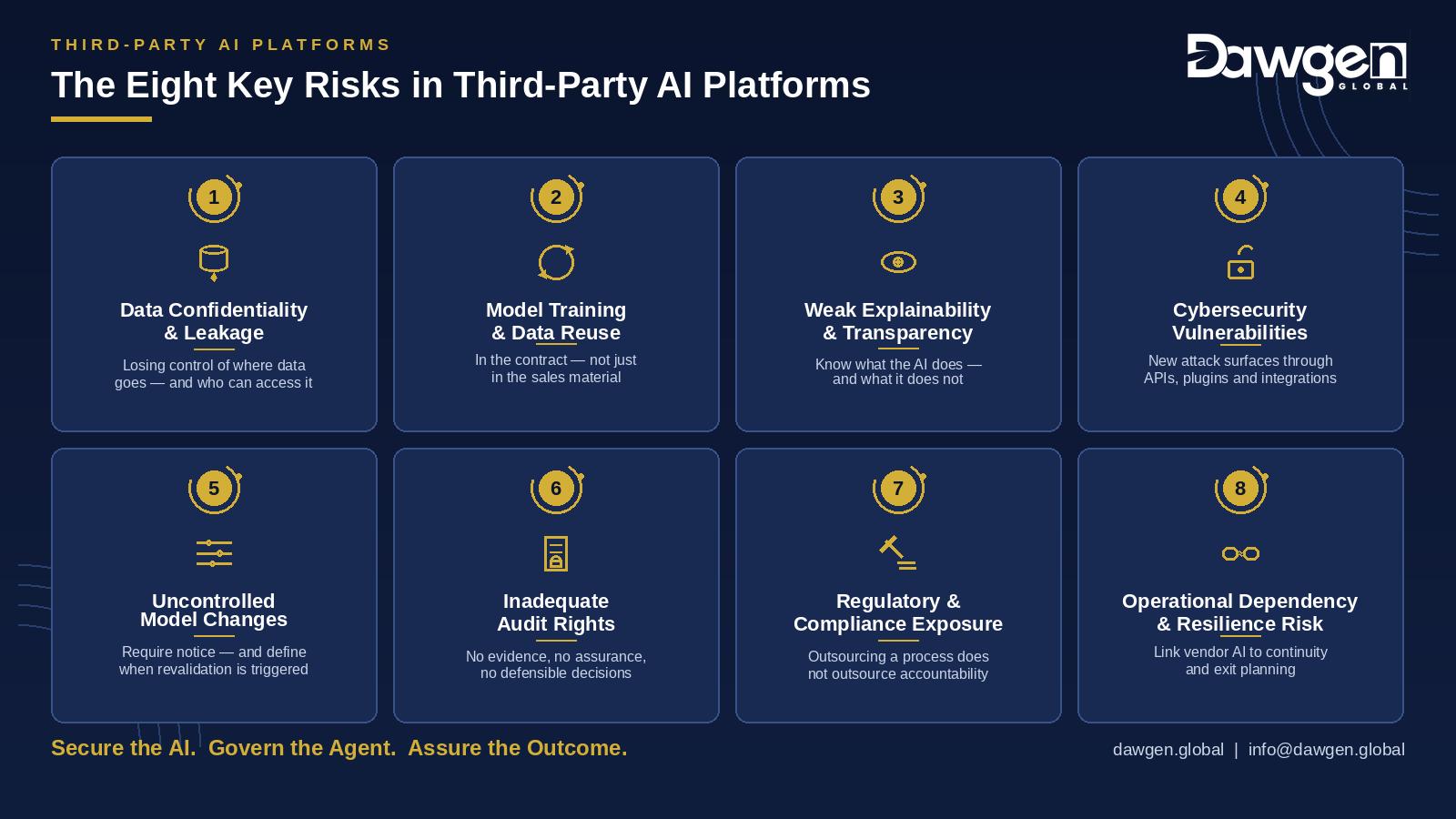
The eight key risks in third-party AI platforms
1. Data confidentiality and leakage
AI vendors may process sensitive data, including customer records, employee information, financial data, contracts, board papers, operational data, intellectual property, audit evidence, legal documents, tax information, and regulated personal data. If contractual and technical controls are weak, the organization may lose control over where data is stored, who can access it, whether it is retained, and whether it is used to train models.
2. Model training and data reuse
Organizations must understand whether their data is used to train, fine-tune, improve, or evaluate AI models. This is especially important when the data includes confidential business information, personal data, regulated information, or proprietary material. A vendor’s assurances must be clearly documented in the contract, not merely presented in sales material.
3. Weak explainability and transparency
Some AI-enabled platforms may generate recommendations, alerts, classifications, summaries, or scores without sufficient explanation. This can create problems where outputs influence financial reporting, compliance decisions, lending, hiring, customer treatment, legal interpretation, cybersecurity response, or regulated processes. The organization should know what the AI does, what it does not do, and how outputs should be used.
4. Cybersecurity vulnerabilities
AI platforms may introduce new attack surfaces through APIs, plugins, connectors, cloud integrations, prompt injection risks, access permissions, third-party dependencies, and model manipulation. If an AI tool is connected to enterprise systems, it should be reviewed as part of the cybersecurity control environment.
5. Uncontrolled model changes
Vendors may update models, algorithms, prompts, workflows, or features without giving the client full visibility. These changes may affect performance, accuracy, bias, security, compliance, or auditability. Organizations should require notification of material AI changes and should define when revalidation is required.
6. Inadequate audit rights
Many vendor contracts do not provide sufficient audit rights over AI-related processes. This can limit the organization’s ability to assess controls, review evidence, investigate incidents, or satisfy regulators and auditors. As we argued in article five, if an AI-supported decision is challenged, management must be able to reconstruct it — and where the model is a vendor’s, that reconstruction depends on evidence only the vendor holds. AI vendor contracts should include rights to receive relevant control reports, security documentation, audit evidence, incident notifications, and assurance information.
7. Regulatory and compliance exposure
AI vendor failures can create compliance issues for the client organization. Data protection, financial services regulation, consumer protection, employment law, cybersecurity obligations, sector-specific rules, and records management requirements may all be affected. Outsourcing a process does not outsource accountability.
8. Operational dependency and resilience risk
As AI becomes embedded in platforms, organizations may become dependent on vendor AI functionality. If the vendor changes service terms, suffers an outage, degrades model performance, restricts access, or changes pricing, the organization may face operational disruption. AI vendor risk should therefore be linked to business continuity and exit planning.
The procurement problem
Many organizations still treat AI-enabled software as ordinary procurement. A department identifies a tool, negotiates pricing, obtains approval, and proceeds with implementation. Cybersecurity, legal, privacy, compliance, risk management, and internal audit may become involved too late, or not at all. This creates avoidable exposure.
AI procurement should include a mandatory risk review before implementation. The review should assess data use, security, privacy, model behavior, auditability, contractual protections, vendor governance, and operational resilience. Where AI may affect high-risk decisions or sensitive data, procurement should not proceed without multidisciplinary review.
Fifteen questions every organization should ask AI vendors
Before approving an AI-enabled vendor, organizations should ask:
- What AI capabilities are included in the product or service?
- Are AI features optional or enabled by default?
- What data does the AI access, process, store, or transmit?
- Is client data used to train, fine-tune, or improve models?
- Where is data processed and retained?
- Who has access to prompts, inputs, outputs, logs, and metadata?
- How are AI outputs generated, validated, and monitored?
- How does the vendor test for accuracy, bias, drift, hallucination, and harmful outputs?
- How are model changes communicated?
- What cybersecurity controls protect the AI environment?
- How are prompt injection, data leakage, and unauthorized access risks managed?
- What incident notification obligations apply?
- What audit rights or assurance reports are available?
- Can the organization disable AI features?
- What happens to client data at termination?
These questions should form part of an AI vendor due diligence checklist.
Contract clauses must evolve
AI risk should be reflected in vendor contracts. Standard confidentiality and data protection clauses may not be enough. Organizations should consider contract provisions covering sixteen areas:
- Data and use: permitted AI use; prohibition or limitation of data training; data ownership and retention; prompt, input, and output confidentiality
- Security and privacy: security controls; privacy obligations; subcontractor restrictions; model-change notification
- Accountability and evidence: incident reporting; audit rights; regulatory cooperation; performance commitments
- Continuity and exit: service continuity; liability and indemnity; termination and data return; right to disable AI features
The contract should clearly define what the vendor can and cannot do with the organization’s data.
The role of cybersecurity
Cybersecurity teams should be involved in AI vendor review because AI platforms may connect directly to enterprise systems and sensitive data. Cybersecurity review should assess identity and access management, encryption, secure APIs, vulnerability management, logging, monitoring, incident response, penetration testing, data loss prevention, cloud security, and integration architecture.
For AI agents and AI-enabled automation, cybersecurity teams should also assess permissions, system actions, approval gates, abnormal behavior detection, and kill-switch capability — the guardrail disciplines of Dawgen Global’s D-AGENTICA™ methodology, applied to agents the organization does not own. AI vendor risk is now cyber risk.
The role of internal audit and assurance
Internal audit should evaluate whether AI vendor risk management is operating effectively. This includes assessing whether the organization has a complete inventory of AI-enabled vendors, whether due diligence is performed before approval, whether contracts contain adequate protections, and whether ongoing monitoring is in place.
An internal audit review may test: AI vendor inventory completeness, AI due diligence procedures, procurement compliance, data protection review, cybersecurity assessment, legal contract review, business owner accountability, model-change monitoring, incident reporting, audit rights, and board reporting.
Independent assurance can help management and the board identify hidden AI exposure before it becomes a control failure.
The board oversight issue
Boards and audit committees should not assume that AI risk only arises from internal AI projects. Vendor-embedded AI may be just as important. Board-level questions should include:
- Which vendors use AI to process our data, and which support critical operations?
- Are AI vendor risks included in our third-party risk program?
- Do contracts restrict data training and unauthorized use?
- Are vendors required to notify us of model changes and incidents?
- Do we receive assurance over vendor AI controls?
- Can we disable AI functionality if needed — and what is our exit plan if a critical AI vendor fails?
These questions help ensure that AI vendor risk receives appropriate governance attention.
The Dawgen Global five-step AI Vendor Risk Framework
Dawgen Global recommends a five-step approach:
- Identify AI-enabled vendors across the organization.
- Classify vendors by data sensitivity, business criticality, autonomy, regulatory exposure, and decision impact.
- Perform AI-specific due diligence and contract review.
- Implement ongoing monitoring for high-risk vendors — a living control under the TRUST360™ continuous-governance approach.
- Provide periodic assurance and board reporting.
This approach allows organizations to bring hidden AI exposure into the formal control environment. For deeper assessment of each vendor, the five steps operationalize the ten dimensions of the third-party AI risk framework set out in article six of this series.
A Dawgen Global perspective
AI vendor risk is one of the most underestimated governance challenges facing organizations. Many businesses may already be exposed through tools they use every day.
“Organizations may believe they are waiting to adopt AI, while AI is already entering through their vendors. The control question is no longer only what AI we build, but what AI we allow into our ecosystem.”
— Dr. Dawkins Brown, Executive Chairman, Dawgen Global
How Dawgen Global can help
Dawgen Global supports organizations across the Caribbean and globally in assessing and managing AI vendor risk. Our multidisciplinary approach brings together cybersecurity, IT audit, internal audit, data protection, legal and compliance, procurement, risk advisory, and board governance expertise — big firm capabilities, Caribbean understanding.
A practical engagement pathway:
- Assess — AI Vendor Risk Assessment; AI-Enabled Vendor Inventory Review; AI Contract Risk Review; AI Cybersecurity and Integration Review; AI Data Protection and Privacy Control Review
- Design — AI Procurement Due Diligence Framework; AI Vendor Assurance and Audit Rights Review; AI Incident Response and Vendor Escalation Protocols; Board and Executive AI Vendor Risk Briefings
- Assure continuously — Third-Party AI Risk Monitoring under TRUST360™; Independent AI Assurance Review; internal audit co-sourcing for vendor AI controls
Take the first step
Do you know which of your vendors are using AI to process your organization’s data, influence decisions, or automate workflows? Dawgen Global can help you identify hidden AI vendor exposure, strengthen contracts, assess cybersecurity risks, protect sensitive data, and build an assurance-ready third-party AI governance framework.
Secure the AI. Govern the Agent. Assure the Outcome.
Contact Dawgen Global today to request an AI Vendor Risk Assessment.
Email: [email protected] | Web: dawgen.global
About Dawgen Global
Dawgen Global is an independent, integrated multidisciplinary professional services firm headquartered at 47 Trinidad Terrace, New Kingston, Jamaica, serving more than 15 territories across the Caribbean. Founded and led by Dr. Dawkins Brown, Executive Chairman, the firm is independent and not affiliated with any international network. It delivers a full suite of professional services under one roof: audit and assurance; tax advisory; IT and digital transformation; risk management; cybersecurity; actuarial and insurance regulatory advisory; HR advisory; mergers and acquisitions; corporate recovery; business advisory and strategy; accounting BPO and virtual CFO services; and legal process outsourcing.
The proposition is simple: big-firm capability without the big-firm price. Dawgen Global’s integrated approach is built for the specific complexities and opportunities of the Caribbean market, helping organizations make sharper, better-informed decisions that drive measurable progress.
To explore a partnership, reach out:
- Website: dawgen.global
- Email: [email protected]
- WhatsApp (Global): +1 555-795-9071
- Caribbean offices: +1 876-665-5926 | +1 876-929-3670 | +1 876-926-5210


