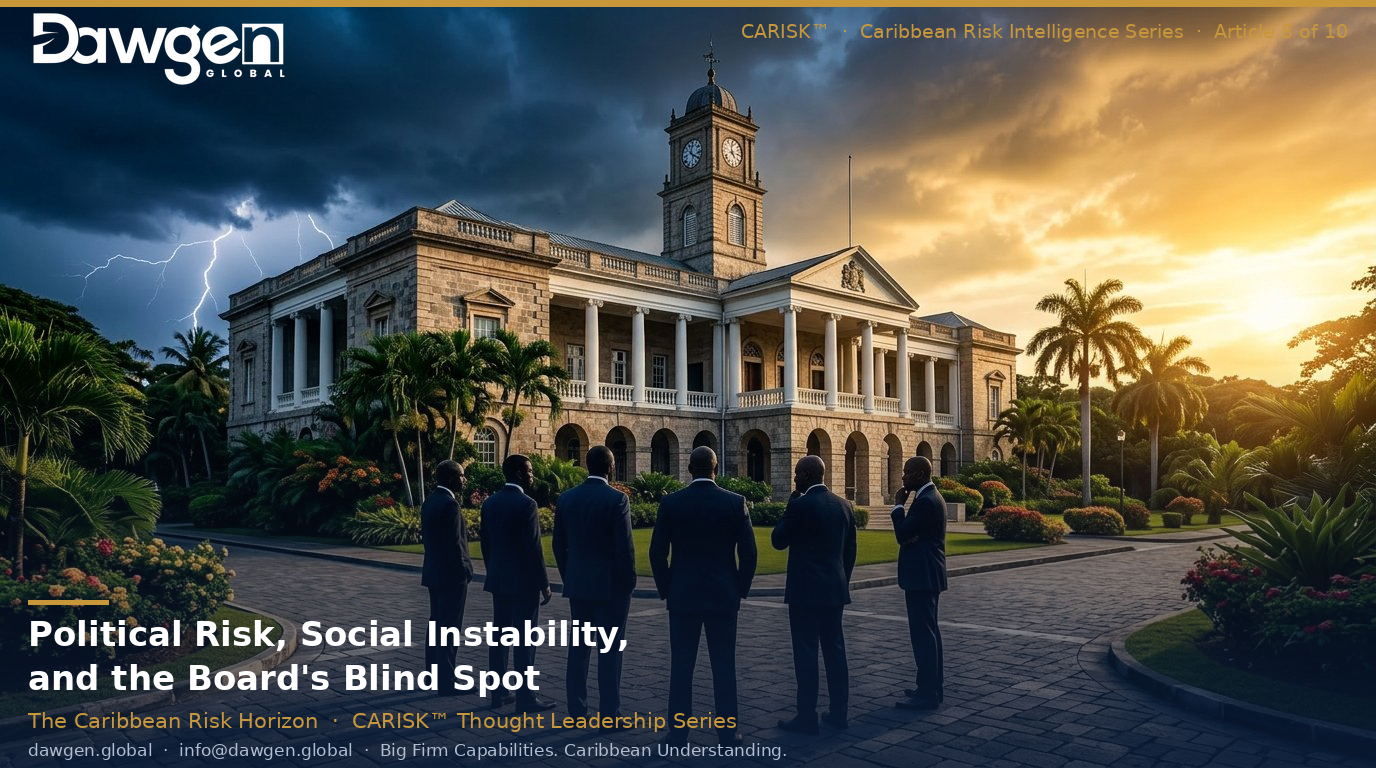
Caribbean political stability is real — and Caribbean boards have become so accustomed to that stability that they have stopped rigorously assessing the political and social risks that operate within it. Governance failures, institutional capture, social polarisation, youth unemployment, and the normalisation of informal power are risks that Caribbean boards systematically underestimate because they do not produce the dramatic disruptions that trigger formal risk reviews. They produce slow, structural erosion — and the organisations that do not see it coming pay the highest price when it arrives.
CARISK™ CARIBBEAN POLITICAL & SOCIAL RISK ASSESSMENT — DOMAIN 1 & 4 DEEP DIVE
| Political & Social Risk Driver | Prevalence | Enterprise Impact | Most Affected Territories / Sectors |
| Electoral Volatility & Policy Reversal | MODERATE | HIGH | All territories; particularly sectors dependent on government contracts, licences, or incentive frameworks |
| Governance Quality & Institutional Integrity | HIGH | HIGH | All territories; most acute in Haiti, Guyana, Jamaica; patronage dynamics in T&T, Jamaica |
| Organised Crime & Gang Territorial Control | HIGH | CRITICAL | Jamaica (social/security HIGH), T&T; construction, logistics, retail in affected parishes |
| Narco-Trafficking Penetration | HIGH | HIGH | T&T, Belize, Jamaica, Eastern Caribbean transshipment routes; financial services AML risk |
| Youth Unemployment & Social Exclusion | HIGH | MODERATE | All territories; talent pipeline risk, labour market tightness in skilled categories, social unrest latency |
| Social Polarisation & Identity Politics | MODERATE | MODERATE | T&T (race/ethnicity), Guyana (ethnopolitics), Jamaica (class); consumer brand and employer reputation risk |
| State of Public Emergency / Civil Unrest | MODERATE | HIGH | Jamaica (SOPE-affected parishes), T&T; logistics, retail, construction, hospitality disruption |
| Judicial Capacity & Contract Enforceability | HIGH | HIGH | All territories; commercial dispute resolution timelines; investor protection confidence |
| Brain Drain & Skilled Labour Emigration | VERY HIGH | HIGH | All territories; finance, technology, healthcare, engineering; competitive disadvantage in talent acquisition |
There is a particular kind of political and social risk that Caribbean boards are least equipped to assess — not because they lack the intelligence to recognise it, but because they have lived within it for so long that it has become background noise. It is the risk that arises not from dramatic political events — coups, contested elections, constitutional crises — but from the slow, structural erosion of governance quality, institutional integrity, and social cohesion that creates the conditions in which more dramatic disruptions eventually become possible.
Caribbean boards are, in the main, attuned to the dramatic political risk signals. They notice when an election outcome is uncertain, when a key regulatory official changes, or when a government announces a policy shift affecting their sector. What they are significantly less attuned to is the quieter, structural political and social risk that operates continuously in the background of the Caribbean operating environment: the patronage dynamics that shape regulatory decisions in ways that are difficult to predict and harder to challenge; the normalisation of informal power networks that create commercial advantages and disadvantages that bear no relationship to operational merit; the social polarisation that shapes consumer behaviour, labour relations, and community dynamics in ways that affect the operating environment without producing the discrete events that trigger formal risk assessments.
This article, the eighth in the CARISK™ series, examines the political and social risk domain that most consistently surprises Caribbean boards — not because the risks are invisible, but because they are so embedded in the operating environment that they are treated as conditions rather than risks. CARISK™ treats them as both: conditions that must be understood as the context of every Caribbean enterprise risk assessment, and risks that must be systematically assessed, scored, and managed with the same discipline applied to financial and operational risk.
The Paradox of Caribbean Political Stability
The starting point for any honest Caribbean political risk assessment is an acknowledgment of the genuine achievement that Caribbean democratic governance represents. The English-speaking Caribbean has maintained uninterrupted democratic governance across virtually all of its independent territories since independence — a record that compares favourably not only with the broader Latin American and Caribbean region but with many parts of the developed world. Elections are regular, credible, and peaceful. Transfers of power occur without violence. Constitutional frameworks are respected. Judiciaries maintain formal independence. This is not a trivial achievement, and it provides a genuine risk management foundation that investors, businesses, and institutions operating in the Caribbean can rely upon.
The paradox is that this genuine political stability has produced, over time, a governance complacency in which Caribbean boards and executives treat the absence of dramatic political disruption as evidence that political risk is low and manageable. It is not. The Caribbean’s political risk does not primarily manifest as instability in the conventional sense — regime change, constitutional breakdown, expropriation of assets, or sudden reversal of market access. It manifests as governance quality risk: the risk that decisions affecting businesses and institutions are made through processes that are influenced by political, personal, and informal relationships in ways that create unpredictability, inequity, and exposure for organisations that are not embedded in the relevant networks.
“The Caribbean’s political risk is not the risk of instability. It is the risk of governance quality — the gap between the formal rules of the operating environment and the informal rules that actually govern how decisions are made.”
Governance Quality Risk: The Informal Rules of the Caribbean Operating Environment
Every Caribbean business professional understands — though few will articulate it in a board risk discussion — that the formal regulatory and institutional framework of their territory is supplemented by an informal operating environment in which relationships, political connections, and social networks influence outcomes in ways that the formal framework does not capture. This is not unique to the Caribbean; it is a feature of operating environments across the world, including in advanced economies. What distinguishes the Caribbean is the degree to which the informal operating environment can substitute for the formal one, and the degree to which that substitution creates risk for organisations that either rely on it or are excluded from it.
Procurement and Contracting Risk
Government contracting represents one of the most material political risk exposure points for Caribbean enterprises across multiple sectors — construction, technology, professional services, healthcare, education, and utilities. In many Caribbean jurisdictions, the public procurement process — which formally operates through competitive tendering, evaluation criteria, and independent oversight — is in practice influenced by political and personal considerations that can determine outcomes independently of technical merit or price competitiveness.
For businesses that depend significantly on government contracts, this creates a specific and often underappreciated risk: concentration of revenue in a relationship that is politically contingent rather than commercially grounded. When governments change — as they do with regularity in competitive Caribbean democracies — the political relationships that underpinned contract awards may change simultaneously. Organisations that built their revenue base on government relationships rather than technical capability and documented delivery track records face revenue discontinuity risk that their financial models have not fully accounted for.
The compliance dimension of government contracting risk has also intensified in the post-FATF environment. Caribbean businesses operating as government contractors are subject to increasing scrutiny from anti-corruption investigators, auditors-general, and international oversight bodies. Engagement in procurement processes that involve undisclosed facilitation payments — whether characterised as commissions, consultancy fees, or relationship management costs — creates anti-bribery and corruption liability under domestic law and, for organisations with international connections, under the UK Bribery Act, the US Foreign Corrupt Practices Act, and similar extraterritorial frameworks.
Regulatory Decision-Making and the Political Variable
Licensing decisions, regulatory approvals, import permits, tax rulings, and planning permissions are all administrative decisions that, in principle, are governed by established criteria and transparent processes. In practice, across Caribbean jurisdictions, the political variable — the degree to which a decision-maker’s political affiliations, personal relationships, or awareness of political priorities influences their administrative decisions — creates an unpredictability in the regulatory environment that formal risk assessments rarely capture.
This unpredictability operates in both directions. An organisation with the right political relationships may receive regulatory decisions that are favourable, timely, and generous in their interpretation of applicable rules. An organisation without those relationships — or, more problematically, with relationships that are unfavourable to the current administration — may experience regulatory decisions that are adverse, delayed, or applied with unusual strictness. For international businesses operating in the Caribbean, this political variable in regulatory decision-making is a material consideration in market entry assessment and ongoing operating strategy.
The governance quality risk is most acute at inflection points: when governments change, when key regulatory officials are replaced, when an organisation’s existing relationships shift in relevance or value. Organisations that have invested in building technical capability, documented compliance, and genuine regulatory relationships — rather than simply political relationships — are better positioned to navigate these inflection points than those whose regulatory standing depends primarily on who they know rather than what they do.
Social Risk: The Structural Fault Lines That Caribbean Boards Underestimate
Caribbean social risk is as structurally embedded as Caribbean political risk — and equally likely to be treated as background noise rather than an active risk requiring systematic assessment and management. The following social risk dimensions are the ones that CARISK™ consistently identifies as most material and most underassessed in Caribbean enterprise risk frameworks.
Youth Unemployment and the Talent Paradox
Caribbean youth unemployment rates — which in many territories exceed 25 percent for the 15-24 age group — create a paradox that every Caribbean enterprise experiences but few formally assess as a risk: simultaneously, there is a surplus of young people without formal employment, and a shortage of the specific skilled talent that enterprises need to grow. This is not a contradiction; it is a structural mismatch between the skills produced by Caribbean education systems and the skills demanded by Caribbean businesses — a mismatch that has been documented for decades without being structurally resolved.
For enterprises, the talent paradox creates two distinct risk categories. The first is a direct operational risk: the inability to recruit, retain, and develop the skilled workforce required to deliver the organisation’s strategy. In technology, finance, engineering, healthcare, and management, Caribbean enterprises face a talent market in which the most capable individuals have options — emigration, remote work for international employers, or competition from better-resourced regional employers — that constrain their availability and elevate their compensation expectations. The organisations that invest in workforce development, learning culture, and career progression manage this risk best; those that rely on the market to provide ready-skilled talent at competitive costs are facing a labour market reality that does not match that assumption.
The second risk is a social stability risk that is more diffuse but no less real. Caribbean territories with large concentrations of unemployed and disengaged young men — particularly in urban areas with limited economic opportunity and strong gang recruitment pressures — face elevated risks of social instability, crime, and community disruption that affect the operating environment for all businesses in those areas. The garrison community dynamics that drive Jamaica’s security risk rating, and the narco-trafficking recruitment channels that contribute to T&T’s security deterioration, both draw directly from the pool of young men who see no legitimate path to economic participation.
Social Polarisation: Race, Class, and the Political Economy of Identity
Caribbean societies are characterised by social fault lines — along racial, ethnic, class, and political lines — that shape economic behaviour, consumer attitudes, labour relations, and community dynamics in ways that enterprise risk frameworks rarely account for. These fault lines are not new; they are the legacies of Caribbean history — colonialism, slavery, indenture, and the political economies that emerged from them. But they are not simply historical: they are actively present in the operating environment of every Caribbean enterprise.
In Trinidad and Tobago, the Afro-Trinidadian and Indo-Trinidadian ethnic communities have historically been associated with different political parties, different economic sectors, and different social networks. For businesses operating in T&T — particularly those that depend on both government relationships and broad consumer acceptance — navigating this ethnic political economy requires sensitivity and self-awareness that is rarely captured in formal risk assessments. In Guyana, the ethnic political economy is even more structurally determinative: the AfroGuyanese-PPP and IndoGuyanese-PNCR alignment has shaped the country’s political history and continues to influence economic opportunity distribution in ways that affect business operating conditions.
Class and colour dynamics — which in the Caribbean carry the specific historical weight of colonial social hierarchies — influence consumer behaviour, employer-employee relationships, and community engagement in ways that create both risk and opportunity for Caribbean enterprises. Brands and employers that are perceived as aligned with elite, light-complexioned, or internationally oriented identity face specific dynamics with mass-market consumers and workers that businesses founded or led by people of different social positioning do not face in the same way. These dynamics are rarely discussed in board risk sessions — but they shape the operating environment continuously.
The Brain Drain: A Strategic Risk with No Easy Answer
The emigration of Caribbean skilled professionals — to the United States, United Kingdom, Canada, and increasingly to remote work arrangements for international employers — is the single most structurally damaging social risk facing Caribbean economies and enterprises. The Caribbean brain drain is not a new phenomenon. It has been occurring for decades. What has changed in the past five years is the acceleration of digital remote work, which has fundamentally lowered the barrier to Caribbean skilled professionals accessing international employment opportunities without physically emigrating.
A Caribbean accountant, software developer, financial analyst, nurse, or engineer can now access job opportunities with US, UK, and Canadian employers from their home — at compensation levels that are multiples of what Caribbean employers can typically offer — without the visa, relocation, and social costs that traditionally constrained emigration. This has materially increased the effective competition for Caribbean skilled talent: Caribbean employers are no longer simply competing with each other for talent; they are competing with the global market.
For Caribbean enterprises, this creates both a talent acquisition risk and a strategic risk. The talent acquisition risk is operational: the difficulty of recruiting and retaining the skills required to execute strategy in an environment where the best candidates have globally competitive alternatives. The strategic risk is existential at the sector level: financial services, technology, healthcare, and professional services all depend on deep human capital pools that the brain drain is steadily depleting. The organisations and sectors that do not develop deliberate, funded strategies to build, retain, and attract Caribbean talent — including by competing on dimensions beyond compensation, such as career development, social mission, and quality of leadership — will face a structural talent deficit that no amount of operational excellence can fully compensate.
“The Caribbean brain drain is not a social welfare concern with incidental business implications. It is a strategic risk that is reshaping the competitive landscape of every knowledge-intensive industry across the region.”
State of Public Emergency: The Operational Disruption Risk
The use of States of Public Emergency (SOPEs) — and their equivalent, Zones of Special Operations (ZOSOs) in Jamaica — as tools for managing acute crime and security situations has become a recurring feature of the Caribbean governance landscape, particularly in Jamaica and Trinidad and Tobago. While SOPEs are temporary and constitutionally bounded, their frequency of use and geographic scope have increased over the past decade, making them a planning scenario that Caribbean enterprises must formally incorporate into their operational risk and business continuity frameworks.
The operational consequences of a SOPE or ZOSO declaration include: movement restrictions that affect employee mobility and customer access; curfews that disrupt shift patterns, delivery schedules, and retail operations; enhanced security force presence that changes the character of commercial districts; and in some cases, temporary suspension of specific commercial activities. For logistics businesses, retailers, manufacturers, and hospitality operators in parishes that have been subject to SOPE declarations — Clarendon, St. Catherine, St. James, and Westmoreland in Jamaica; East Port of Spain in T&T — the operational disruption risk is not theoretical. It is a recurring operational condition that requires documented contingency planning.
The CARISK™ Caribbean Political & Social Risk: Territory Highlights
| Territory | Political Risk | Social Risk | Key Political & Social Risk Characteristics |
| Jamaica | MODERATE | HIGH | Garrison dynamics; SOPE frequency; patronage in contracting; brain drain most acute in region; class/colour social dynamics |
| Trinidad & Tobago | LOW-MOD | HIGH | Ethnic political economy (Afro/Indo-Trinidadian); narco-trafficking penetration; gang infiltration of construction; brain drain |
| Barbados | LOW | LOW-MOD | Strongest governance institutions in Caribbean; low crime; some youth unemployment risk; IBC sector political management |
| Guyana | MODERATE | MODERATE | Ethnic political economy (Afro/Indo-Guyanese); oil revenue governance risk; rapid social change from oil wealth |
| Belize | MODERATE | MODERATE | Narco-trafficking influence; patronage dynamics; small population amplifies political relationship risk |
| OECS States | LOW-MOD | MODERATE | Democratic stability but limited institutional capacity; CBI governance risk; youth unemployment; emigration pressure |
| Haiti | VERY HIGH | VERY HIGH | State collapse; gang control of significant territory; no functioning central government; regional contagion risk for trade flows |
Haiti: The Regional Political Risk Outlier
No Caribbean political risk assessment is complete without a frank examination of Haiti — which represents not simply a high-risk operating environment but a case of state failure that has regional implications for all Caribbean territories. Haiti’s political crisis — which has moved from chronic governmental instability to a situation in which gangs control significant portions of the capital Port-au-Prince and much of the country’s logistics infrastructure, and in which no functioning elected government has been in place since the assassination of President Jovenel Moïse in 2021 — represents a category of political risk that is qualitatively different from anything else in the Caribbean.
For Caribbean enterprises, Haiti’s state collapse creates several indirect risk channels. Trade flows through Haiti — including remittances, agricultural exports, and goods trade across the Haiti-Dominican Republic border — have been severely disrupted, affecting supply chains and trading relationships across the region. Haiti’s humanitarian crisis creates migration pressure that affects Caribbean territories along migration routes. And the demonstration effect of state failure — however distinct Haiti’s historical trajectory is from other Caribbean territories — creates reputational and perceptual risks for the broader Caribbean region that affect investor and tourist decision-making in ways that are not always rationally calibrated.
Governing Political and Social Risk: The Board Disciplines
Translating the CARISK™ political and social risk assessment into governance disciplines requires Caribbean boards to do something that is culturally uncomfortable in most Caribbean professional contexts: to name and formally assess risks that are embedded in personal and social relationships, to acknowledge governance quality gaps that implicate people and institutions that board members may know personally, and to build risk management frameworks that operate on the basis of documented evidence rather than social trust.
- Formal political risk scenario planning: The board should conduct a formal political risk scenario exercise at least once per election cycle — examining the implications for the organisation of the two or three most plausible political outcomes, including changes in government. The exercise should assess how each scenario affects the organisation’s regulatory relationships, government contract portfolio, incentive framework access, and key approvals pipeline. The output should be a documented scenario plan with identified vulnerabilities and contingency actions for each scenario.
- Government contract concentration assessment: Boards should formally assess the proportion of organisational revenue that is dependent on government contracts, licences, or approvals — and evaluate the political contingency of each significant government relationship. Revenue streams that are contingent on political relationships rather than documented service delivery should be identified and diversified over time. The goal is not to eliminate government relationships but to ensure they are grounded in genuine value delivery rather than political access alone.
- Anti-corruption and anti-bribery compliance programme: Every Caribbean enterprise operating in the government contracting or regulatory approval environment should have a documented anti-corruption and anti-bribery compliance programme that sets clear standards for permissible relationship management, prohibits facilitation payments, establishes a confidential reporting mechanism for compliance concerns, and provides regular training to staff involved in government engagement. This is both a legal protection and a governance standard that increasingly distinguishes credible Caribbean enterprises from those operating in the informal compliance zone.
- Talent strategy as a strategic risk response: The board should formally adopt a talent strategy that addresses the brain drain risk — not simply as a human resources plan but as a strategic risk response. The talent strategy should identify the critical skill categories most exposed to emigration risk, define the organisation’s value proposition for Caribbean talent beyond compensation, establish career development pathways that create retention incentives, and identify talent development partnerships with educational institutions that build pipeline depth over time.
- Social licence assessment: Boards of enterprises operating in or near communities affected by social exclusion, gang dynamics, or social polarisation should conduct periodic assessments of the organisation’s social licence to operate — the degree to which the community in which the organisation operates regards its presence as legitimate and beneficial. Social licence is not simply a CSR consideration; it is a security risk management tool, an employee engagement factor, and a community relations discipline that reduces the probability of the community-level disruptions that operational risk frameworks often miss.
Political and social risk in the Caribbean will not resolve itself. The governance quality gaps, the social fault lines, the brain drain pressures, and the security dynamics that this article has examined are structural conditions that have been building over decades and will require sustained, deliberate effort — by governments, institutions, civil society, and the private sector — to address. Caribbean boards cannot wait for that resolution before building risk frameworks adequate to the current environment. The organisations that govern political and social risk with rigour, honesty, and strategic discipline will navigate the Caribbean operating environment better than those that treat these risks as unchangeable background conditions.
In Article 9 of this series — the penultimate article — we move from domain-by-domain risk assessment to integration: building the CARISK™ Enterprise Operational Risk Matrix for your organisation. We walk through the full methodology, from context-setting to risk scoring to the mitigation roadmap, providing the practical guidance that turns CARISK™ from a framework into a functioning enterprise risk management instrument.
| REQUEST YOUR CARISK™ POLITICAL & SOCIAL RISK BRIEFING
Plan effectively with Dawgen Global’s expert analysis on the political and social risk factors affecting your Caribbean strategy. From government contract concentration assessments and political scenario planning to social licence evaluations, anti-corruption programme design, and talent strategy advisory, our Operational Risk service provides the tools to anticipate and manage the risks that Caribbean boards most often underestimate. Request a complimentary CARISK™ Political & Social Risk Briefing today.
|
Next in the Series
Article 9 — Building Your Enterprise Risk Matrix: The CARISK™ Methodology. The full, practical walk-through of the CARISK™ Enterprise Operational Risk Matrix — from context-setting and risk identification through scoring, control evaluation, and mitigation roadmap construction. The article that turns the framework into an instrument your board can implement. Follow Dr. Dawkins Brown on LinkedIn or contact [email protected] to receive each article as published.
About Dawgen Global
“Embrace BIG FIRM capabilities without the big firm price at Dawgen Global, your committed partner in carving a pathway to continual progress in the vibrant Caribbean region. Our integrated, multidisciplinary approach is finely tuned to address the unique intricacies and lucrative prospects that the region has to offer. Offering a rich array of services, including audit, accounting, tax, IT, HR, risk management, and more, we facilitate smarter and more effective decisions that set the stage for unprecedented triumphs. Let’s collaborate and craft a future where every decision is a steppingstone to greater success. Reach out to explore a partnership that promises not just growth but a future beaming with opportunities and achievements.
 Email: [email protected]
  Visit: Dawgen Global Website

 WhatsApp Global Number : +1 555-795-9071
Caribbean Office: +1876-6655926 / 876-9293670/876-9265210  WhatsApp Global: +1 5557959071
USA Office: 855-354-2447
Join hands with Dawgen Global. Together, let’s venture into a future brimming with opportunities and achievements


