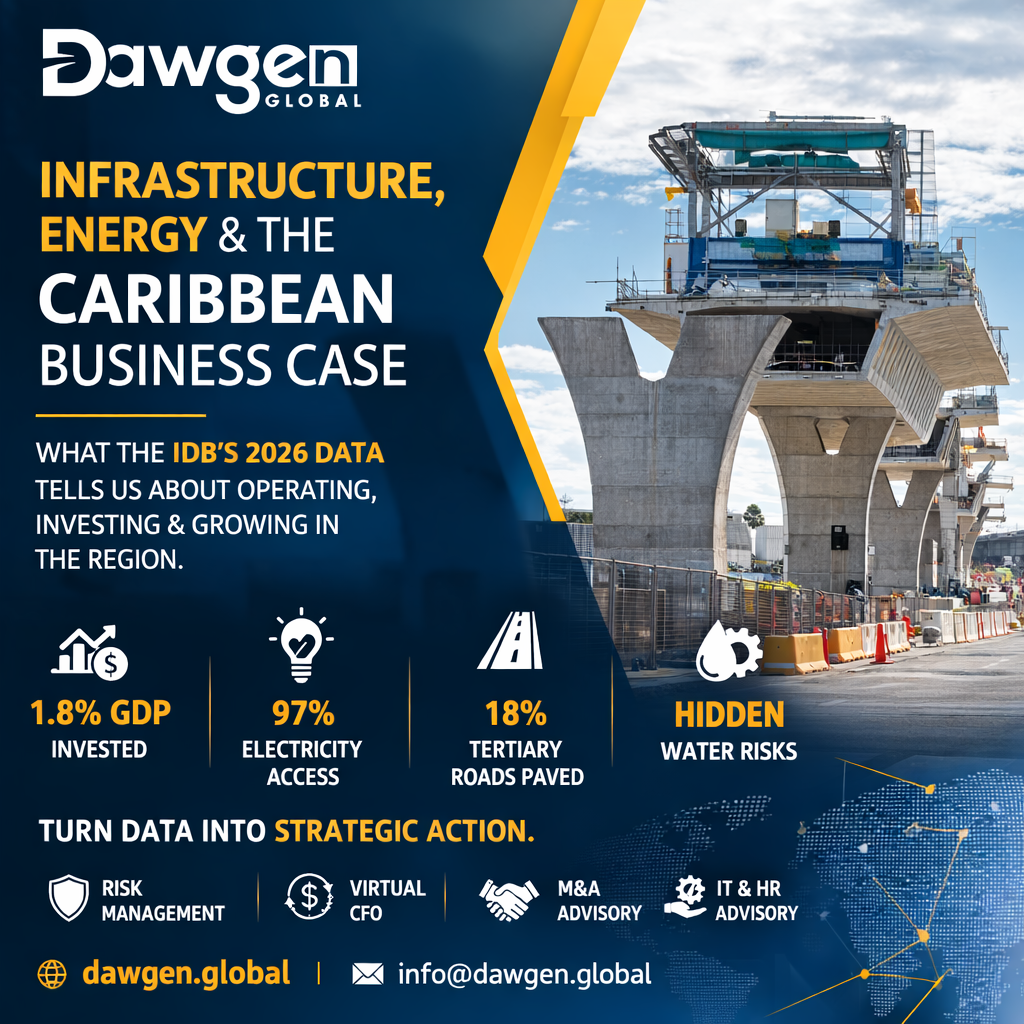
What the IDB’s 2026 data tells us about operating, investing and growing in the region
The Infrastructure Gap Is a Business Strategy Problem
The Inter-American Development Bank’s 2026 Data Wall confirms what Caribbean executives already feel in their operating costs, their supply chains, and their capital plans: the region is under-invested in infrastructure by a wide and widening margin. The data demands a strategic response.
| “The region invests 1.8% of GDP in infrastructure annually. It needs 3.1% to reach key development milestones by 2030. That 1.3 percentage point shortfall is not a statistic. It is the competitive headroom that every Caribbean business operates within.”
— IDB Group Data Wall 2026 |
Reading the Numbers Honestly
The IDB’s 2026 Data Wall, presented at the Annual Meetings in Asunción, Paraguay, is one of the most comprehensive compilations of regional evidence published this year. For those of us who advise Caribbean boards, it provides both a diagnostic and a directional signal. The infrastructure chapter is where I want to begin, because it connects most directly to the operating reality of businesses across our 15 territories.
The headline finding is stark. Against an annual investment requirement of 3.1% of regional GDP needed to meet the Sustainable Development Goals by 2030, the region has averaged only 1.8% of GDP in infrastructure investment over the period 2015 to 2023. That gap, compounding year on year, translates into deferred capacity, elevated operating costs, and constrained competitive positioning for the businesses that depend on regional infrastructure.
Disaggregating the investment need by sector reveals where the pressure is sharpest. Transportation requires the largest share — 1.4% of GDP in combined new investment and maintenance spending — followed by electricity at 0.8%, water and sanitation at 0.5%, and telecommunications at 0.4%. For Caribbean businesses, every one of these sectors is both a cost driver and a constraint on growth.
The Energy Story: Progress and Persistent Risk
On electricity, the IDB data tells a story of genuine achievement alongside continuing structural risk. Regional electricity access has risen from 80% of households in 1990 to 97% by 2023 — a significant development dividend. The generation mix across Latin America and the Caribbean is notably diverse: 62% of electricity comes from hydropower and other renewables, compared to just 29% in North America and 25% in Africa. That is a genuine competitive asset for the region in a world increasingly pricing carbon.
However, the supply picture masks an important demand-side challenge. Transport accounts for 37% of end-use energy demand, and industry for a further 29%. These two sectors together represent over two-thirds of the region’s energy consumption. For Caribbean businesses, particularly those in manufacturing, logistics, and tourism — sectors that are transport-intensive by nature — energy cost management is not a marginal concern. It is a central element of competitiveness strategy.
The critical minerals data adds another dimension that boards should be watching. Latin America and the Caribbean holds globally significant reserves and production shares across silver, copper, lithium, tin, zinc, nickel, bauxite, and graphite. Under the IEA’s Announced Pledges Scenario, demand for lithium could increase by over 1,000% and for nickel by over 600% by mid-century. Policy choices made in the next five years will determine whether the region captures that value or exports it raw.
| “Caribbean businesses that position early around the energy transition — whether in critical minerals, renewable infrastructure, or electrified logistics — will find themselves on the right side of a structural shift that the IDB data makes unambiguous.” |
The Roads Problem and What It Costs
The data on road quality is sobering for any business that moves goods or people across the region. While 85% of primary roads in Latin America and the Caribbean are paved — close to the 97% in developed countries — the gap widens dramatically as you move down the road hierarchy. Only 42% of secondary roads are paved, compared to 84% in developed economies. At the tertiary level, the contrast is stark: 18% in the LAC region against 78% in developed countries.
For Caribbean SMEs, this gap is not an abstraction. It adds cost, time, and uncertainty to every supply chain that extends beyond major urban corridors. It inflates logistics costs, depresses agricultural productivity in rural areas, and constrains tourism access in markets where the quality of the journey is itself part of the product. The IDB data also reveals that public transport commutes in the region involve similar distances to European cities but take significantly longer — and in several major cities, a monthly transport pass for a low-income worker can consume up to 20% of their earnings. That is a labour market and productivity issue as much as an infrastructure one.
Water and Sanitation: The Hidden Operating Risk
Two additional infrastructure findings deserve direct boardroom attention. Safe water access in Latin America and the Caribbean has effectively stagnated over the past two decades, hovering around 75% of the population while OECD countries have maintained rates near 95%. Safe sanitation coverage, while improving, remains at roughly 50% in the region compared to around 90% in OECD economies.
For businesses operating in food production, hospitality, healthcare, or any sector with water-intensive processes, the structural inadequacy of water infrastructure is a material operating risk. It also represents a cost that is unevenly distributed — businesses in better-served urban cores may not feel it directly, but their supply chains, their workforce, and their communities do.
What the Board Should Be Asking
The infrastructure gap identified in the IDB data is not a government problem that businesses can simply wait for governments to solve. It is a strategic environment that boards and executive teams must actively navigate. The following questions are worth raising in your next strategy session.
- Supply chain resilience. How exposed is our supply chain to tertiary and secondary road quality, and have we quantified that exposure in logistics cost terms?
- Energy strategy. What is our energy cost as a share of total operating cost, and do we have a transition plan that accounts for the energy mix shift and critical minerals opportunity?
- Capital planning. Are our capital investment plans stress-tested against infrastructure delays and cost escalation scenarios consistent with the regional investment gap?
- PPP and co-investment. Have we considered strategic infrastructure co-investment — either directly or through public-private partnership structures — as a way to reduce dependency on underinvested public assets?
- Risk and resilience. Does our risk management framework explicitly account for water, sanitation, and energy supply disruption across our operating territories?
The Advisory Implication
At Dawgen Global, we work with clients across all 15 Caribbean territories on exactly these strategic and operational dimensions. Infrastructure gaps create advisory demand across risk management, capital planning, M&A due diligence for infrastructure-adjacent assets, energy transition advisory, and Virtual CFO services where the cost of infrastructure is a significant line item requiring active management.
The IDB data gives us — and you — a rigorous, current, and regionally specific foundation for those conversations. In the articles that follow in this series, we will extend the analysis into health and workforce capacity, climate and disaster risk, labour market informality, productivity and competitiveness, taxation, and the 2026 economic outlook. Taken together, the seven articles constitute a data-driven map of the Caribbean advisory landscape for the year ahead.
The infrastructure gap is real. The strategic response to it is the work.
| ABOUT THIS SERIES
The Caribbean in Numbers is a seven-part thought leadership series produced by Dawgen Global, drawing on the IDB Group Data Wall 2026 — From Evidence to Impact: Latin America and the Caribbean in Numbers. Each article applies the IDB’s regional data to Caribbean advisory practice, serving boards, CFOs, and leadership teams across Dawgen Global’s 15-territory footprint.
|
About Dawgen Global
“Embrace BIG FIRM capabilities without the big firm price at Dawgen Global, your committed partner in carving a pathway to continual progress in the vibrant Caribbean region. Our integrated, multidisciplinary approach is finely tuned to address the unique intricacies and lucrative prospects that the region has to offer. Offering a rich array of services, including audit, accounting, tax, IT, HR, risk management, and more, we facilitate smarter and more effective decisions that set the stage for unprecedented triumphs. Let’s collaborate and craft a future where every decision is a steppingstone to greater success. Reach out to explore a partnership that promises not just growth but a future beaming with opportunities and achievements.
 Email: [email protected]
  Visit: Dawgen Global Website

 WhatsApp Global Number : +1 555-795-9071
Caribbean Office: +1876-6655926 / 876-9293670/876-9265210  WhatsApp Global: +1 5557959071
USA Office: 855-354-2447
Join hands with Dawgen Global. Together, let’s venture into a future brimming with opportunities and achievements


