
Executive Summary
Organizations across industries are racing to decouple growth from virgin material use while strengthening resilience, margins, and brand trust. Yet many circular economy conversations stall at aspiration—lofty sustainability targets without a practical operating model that delivers measured business value. LoopWorks™ is Dawgen Global’s answer: a pragmatic, investable playbook that turns circular principles into enterprise performance through three integrated phases—LoopSight™ (see and learn), BetForge™ (choose and fund), and ScaleGrid™ (build and run). This article introduces the model, explains how value is created in both technical and biological cycles, and outlines a 90‑day path to tangible results.
Promise: With LoopWorks™, leaders can convert waste into working capital, transform by‑products into revenue, reduce exposure to volatile input prices, and earn durable customer loyalty—without compromising on reliability or cost.
Why Linear No Longer Works
The traditional “take–make–dispose” model was optimized for speed, not longevity. Rising input price volatility, policy shifts (EPR, right‑to‑repair, landfill restrictions), supply chain fragility, and customer expectations for responsible brands have exposed its weaknesses. Linear systems treat end‑of‑use as a cost center; circular systems treat it as a value center—a source of feedstock, customer retention, and design intelligence.
In practice, circularity extends product life and captures materials through loops such as repair, reuse, refurbishment, remanufacturing, recycling, and composting. On the technical side, we recover components and materials; on the biological side, we safely return organic matter to regenerate ecosystems. The result is higher asset productivity and lower lifecycle impact.
But to move beyond pilots and press releases, organizations need discipline: clear economics, staged decision gates, accountable charters, and enterprise‑grade processes. That is what LoopWorks™ operationalizes.
The Dawgen LoopWorks™ System at a Glance
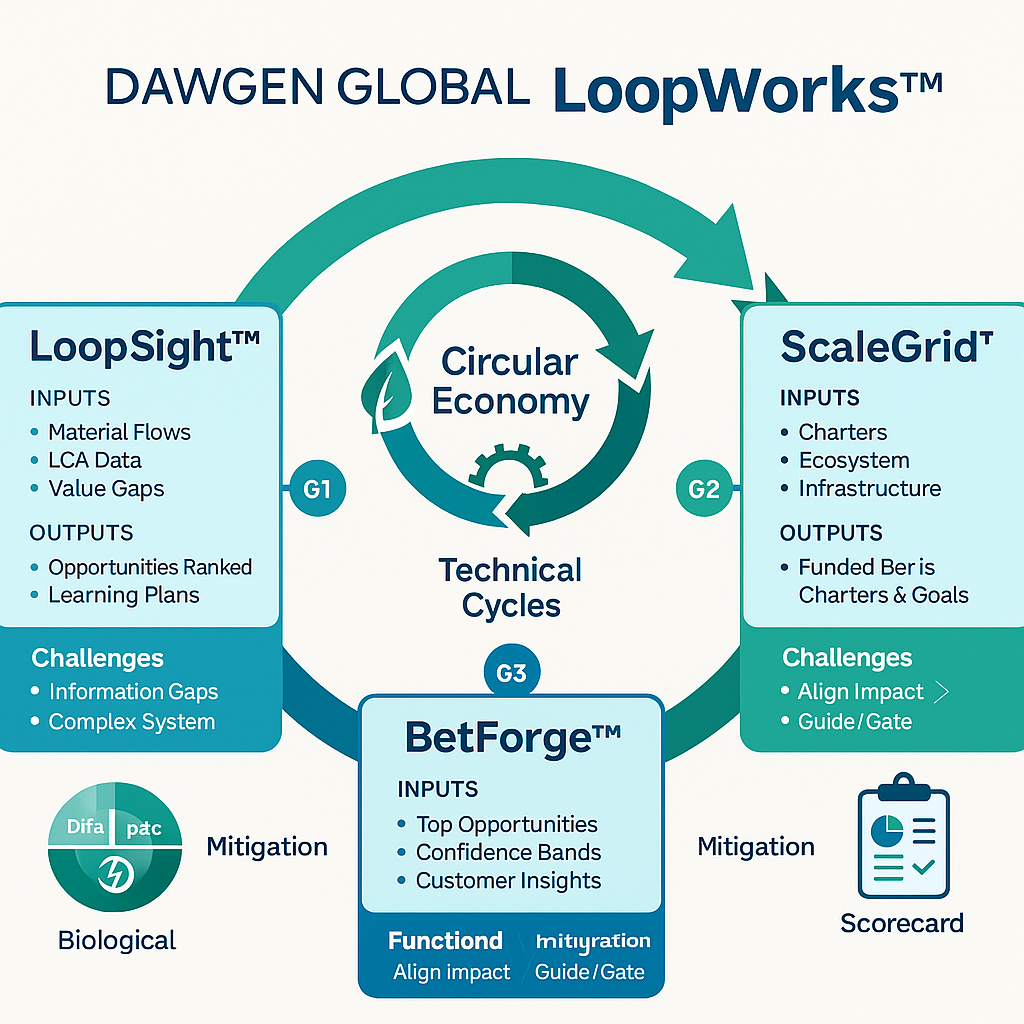
LoopWorks™ is built on three branded phases that create a through‑line from discovery to scale:
- LoopSight™ — Opportunity Scanning & Learning
- Map material flows, identify leakage, and create evidence‑based Opportunity Cards.
- Rank options using LoopScore™, a transparent rubric that blends economics, feasibility, impact, and risk.
- Attach Learning Plans to close the key unknowns before money is committed.
- BetForge™ — Segment Selection & Investment Charters
- Convert the best opportunities into funded bets with clear charters, OKRs, budgets, and exit criteria.
- Design business models (PaaS, take‑back, certified pre‑owned, by‑product exchanges) and partner stacks.
- Launch pilots with defined measurement and verification (M&V) protocols.
- ScaleGrid™ — Enterprise‑Scale Delivery & Economics
- Industrialize what works: SOPs, quality systems, network design for reverse logistics, and IT/OT integration.
- Embed governance (G1–G3 decision gates), dashboards, financing, and compliance.
- Achieve reliable unit economics and resilience at enterprise thresholds.
Together, these phases build a portfolio of circular value streams—each with its own economics—while ensuring the organization scales only what is proven to work.
Where the Value Comes From (Technical & Biological Cycles)
Technical cycle levers:
- Design for Disassembly/Repair (DfX) to extract components quickly and safely.
- Certified Pre‑Owned & Remanufacture to create high‑margin revenue lines.
- Spare‑parts harvesting to reduce lead times and working capital.
- Recycling with material passports to elevate yield and trace traceability.
Biological cycle levers:
- Composting and anaerobic digestion to return nutrients and capture energy.
- Biobased material substitution to reduce fossil dependence and toxicity.
- Regenerative sourcing agreements to stabilize supply and enhance brand.
Across both cycles, data and design are the multipliers. Material passports, IoT‑enabled products, and interoperable ERP/PLM/CRM stacks improve recovery rates and decision speed, while product‑as‑a‑service (PaaS) models align incentives to maintain assets longer and recapture them at end‑of‑use.
Phase 1 — LoopSight™: See the System, Learn Fast
Objective: Produce a ranked, evidence‑based opportunity portfolio and the learning plans to de‑risk it.
How it works:
- Map the flows. We conduct Material Flow Analysis (MFA), LCAs, and warranty/field‑service mining to locate hotspots and leakage—what’s wasted, why, and at what cost.
- Generate Opportunity Cards. For each product line, we draft a card with a loop hypothesis, addressable volumes, likely yields, economics (range‑based), carbon/material benefits, and the top unknowns.
- Attach Learning Plans. Each card gets 3–5 critical unknowns and the tests/MVPs that will resolve them quickly (e.g., a 6‑week refurbishment pop‑up, a targeted take‑back in one channel, or a parts harvesting trial).
- Rank with LoopScore™. Our weighted rubric combines Economic Value, Material Impact, Feasibility, Customer Fit, Regulatory & Risk, Ecosystem Leverage, Data Readiness, and Learning Potential. We explicitly capture confidence bands to avoid false precision.
Outputs: A Loop Atlas (flows + hotspots), a portfolio of Opportunity Cards with learning plans, and a short‑list (Top 5) prepared for funding discussion.
What leaders like: LoopSight™ makes early choices transparent and evidence‑based. It reveals fast wins (e.g., refurb of high‑failure modules) while surfacing longer‑cycle bets (e.g., product redesign for modularity) and the data work required to unlock them.
Risks & Guardrails:
- Risk: Data gaps skew ranking → Guardrail: declare confidence, bound scenarios, design tests to close the gaps.
- Risk: Over‑indexing on impact without economics → Guardrail: every card shows unit‑level economics and payback ranges.
- Risk: Supplier lock‑in → Guardrail: dual‑source strategy and open standards for passports and grading.
Phase 2 — BetForge™: Choose, Fund, and Design for Proof
Objective: Turn the top opportunities into funded, accountable bets with pilots designed to prove or kill quickly.
How it works:
- Bet Charters. We specify scope, thesis, OKRs, unit‑of‑one metrics (e.g., recovery yield per SKU, turnaround time, refurbished margin), budget, timeline, and exit criteria.
- Business Model Architecture. We align offerings (PaaS, take‑back, certified pre‑owned), pricing, and warranties with channel strategy to avoid cannibalization and to lift lifetime value (LTV).
- Partner Stack & SLAs. From repair networks to logistics hubs and recyclers, we define the ecosystem with service levels and shared economics.
- Pilot Design & M&V. We choose the geography, cohort size, channels, and data integrations, and codify measurement protocols for yield, carbon, and unit margins.
Outputs: 2–5 Bet Charters with budgets, partner MOUs/SLAs, pilot playbooks, and the data model for dashboards.
What leaders like: BetForge™ makes investment choices explicit and comparable; pilots are large enough to be credible but small enough to learn quickly. Sales incentives and channel strategies are addressed up front.
Risks & Guardrails:
- Risk: Channel conflict → Guardrail: redesign incentives (attach/retention metrics), create distinct channels for refurbished, and educate sales on LTV.
- Risk: Quality variance in returns → Guardrail: intake grading standards, triage cells, preventive maintenance packs.
- Risk: Capex creep → Guardrail: stage‑gated capital with vendor benchmarks; lease options for early phases.
Phase 3 — ScaleGrid™: Industrialize and Embed
Objective: Achieve repeatable performance and resilient economics at enterprise scale.
How it works:
- Industrialization. Build or co‑build refurbishment/remanufacturing lines, establish quality systems, and stand up reverse logistics hubs. Standardize SOPs and embed compliance.
- IT/OT Integration. Connect material passports with ERP/PLM/CRM, enable IoT tracking for returns, and implement dashboards for circular KPIs.
- Network Optimization. Use carbon‑aware routing, hub‑and‑spoke configurations, and inventory policies to balance cost, speed, and impact.
- Governance & Finance. Run a Circular PMO, value councils, quarterly portfolio re‑rank, and integrate green financing, EPR credits, and carbon accounting.
Outputs: SOPs, commercial agreements and pricing, a live Circular Performance Dashboard, and portfolio cadence for continuous improvement.
What leaders like: ScaleGrid™ isn’t just “more of the pilot.” It’s a disciplined scale‑up that hits enterprise thresholds for reliability, cost, and compliance—so circularity becomes core business, not a side project.
Risks & Guardrails:
- Risk: Rebound effects (increased use due to lower price) → Guardrail: set absolute impact targets and pricing floors.
- Risk: Network fragility → Guardrail: multi‑sourcing, buffer stocks, scenario stress‑tests.
- Risk: Compliance drift → Guardrail: audit cadence, traceability, third‑party assurance.
Measuring What Matters: The Circular Performance Scorecard
Boards and CFOs need clear visibility into value creation. LoopWorks™ standardizes metrics across Financial & Operating, Materials & Impact, Customer & Market, and Governance & Risk dimensions:
- Financial & Operating: circular revenue %, refurbished/reman contribution margin, unit economics by segment, capex intensity, reverse logistics cost per unit, processing cycle time.
- Materials & Impact: virgin material intensity (kg per revenue), material recovery yield, landfill diversion, carbon intensity per functional unit, % products with material passports and recycled/biobased content.
- Customer & Market: NPS for circular offers, attach/retention rates, turnaround time for repair, SLA adherence.
- Governance & Risk: audit pass rate, supplier ESG scores, data completeness/accuracy, traceability coverage.
Because circular value streams can mature at different paces, the dashboard enables portfolio decisions—shifting capital toward the loops with proven economics and strategic relevance.
Culture, Incentives, and Change Management
Circularity fails as a “project.” It succeeds as an operating system. LoopWorks™ embeds roles and cadence:
- Circular PMO to manage the portfolio, enforce gates (G1–G3), and maintain standards.
- Product & Design to adopt DfX (modularity, fasteners, material choices) and embed passports.
- Supply & Reverse Logistics to build the recovery network and manage partners.
- IT/Data to integrate systems and deliver reliable dashboards.
- Finance to adapt hurdle rates and manage green financing and credits.
- Legal/Compliance to interpret EPR/repair rules and warranty implications.
- Marketing/Sales/Service to design offers and customer education that lift return and repair rates.
Incentives move the culture: OKRs on circular revenue %, return capture rates, and virgin material intensity; recognition for teams that close learning loops fastest; procurement policies that favor recyclable/biobased inputs and disassembly‑friendly design.
Common Obstacles—and How LoopWorks™ Mitigates Them
- Fragmented Data & Traceability
- Problem: Incomplete visibility into material composition, return rates, and yields.
- Solution: Adopt material passports from design, implement QR/RFID at intake, unify data models, and secure third‑party verification.
- Economics at Low Volume
- Problem: Unit costs are unattractive in early stages.
- Solution: Shared hubs, partnerships with refurbishers, dynamic pricing, and staged capex (lease before buy) until volume stabilizes.
- Channel Cannibalization
- Problem: Sales teams fear refurbished offerings will erode new product sales.
- Solution: Redesign incentives to reward attach and retention, separate channels for certified pre‑owned, and educate on higher LTV.
- Quality Variability of Returns
- Problem: Unpredictable condition creates rework and waste.
- Solution: Intake grading standards, triage cells, supplier specifications, and predictive screening based on failure modes.
- Customer Participation
- Problem: Low repair/return participation dampens yields.
- Solution: Frictionless take‑back, deposits/rewards, convenient drop‑off, reminders, and transparent impact reporting.
- Regulatory Complexity
- Problem: Divergent EPR and right‑to‑repair rules across markets.
- Solution: Policy watchlists, adaptable designs, local compliance partners, and sandbox pilots to learn before scaling.
- Supply Risk for Secondary Materials
- Problem: Inconsistent feedstock jeopardizes remanufacturing schedules.
- Solution: Multi‑sourcing, inventory buffers, flexible contracts with volume floors/ceilings, and by‑product marketplaces.
A 90‑Day Quick Start
Weeks 1–3: LoopSight™ Discovery
- Build the Loop Atlas for 1–2 priority product lines.
- Draft 25+ Opportunity Cards; identify top unknowns and data gaps.
Weeks 4–6: Rank & Plan
- Apply LoopScore™; select Top 5 opportunities.
- Create Learning Plans; assign owners and budgets.
Weeks 7–9: BetForge™
- Write 2–3 Bet Charters; form the partner stack and SLAs.
- Design pilots with M&V; prep data integrations.
Weeks 10–13: Launch & Decide
- Run pilots, track scorecard metrics in a dashboard MVP.
- Enter Gate G2 with real economics, reliability, and NPS data.
By the end of 90 days, leadership has the evidence to double down on what works and gracefully exit what doesn’t—before heavy capital is committed.
What Makes Dawgen Different
- End‑to‑End Ownership. From mapping flows to building industrial‑scale operations, we stay with you through G3.
- Economics First. Every opportunity includes unit‑level economics, payback ranges, and sensitivity to return rates and yields.
- Ecosystem Savvy. We orchestrate partners across repair, logistics, and recycling to accelerate scale and de‑risk investment.
- Governance that Sticks. Gate criteria, dashboards, and audit trails keep circularity from drifting off strategy.
- Caribbean Roots, Global Standards. We bring a resilient, resource‑savvy mindset shaped by our region, with world‑class methods and tools.
Turn Circular Ambition into Measured Results
If you’re ready to convert circular ambition into enterprise performance, we’d love to collaborate.
Request a proposal today:
Email: info@dawgen.global
WhatsApp: +1 555 795 9071
Let’s design profitable loops—not waste.
Dawgen Global is an integrated multidisciplinary professional services firm in the Caribbean with global reach. Our LoopWorks™ methodology helps clients build resilient, high‑performing businesses by uniting circular design, disciplined execution, and enterprise governance.
About Dawgen Global
“Embrace BIG FIRM capabilities without the big firm price at Dawgen Global, your committed partner in carving a pathway to continual progress in the vibrant Caribbean region. Our integrated, multidisciplinary approach is finely tuned to address the unique intricacies and lucrative prospects that the region has to offer. Offering a rich array of services, including audit, accounting, tax, IT, HR, risk management, and more, we facilitate smarter and more effective decisions that set the stage for unprecedented triumphs. Let’s collaborate and craft a future where every decision is a steppingstone to greater success. Reach out to explore a partnership that promises not just growth but a future beaming with opportunities and achievements.
✉️ Email: info@dawgen.global ? Visit: Dawgen Global Website
? ? WhatsApp Global Number : +1 555-795-9071
? Caribbean Office: +1876-6655926 / 876-9293670/876-9265210 ? WhatsApp Global: +1 5557959071
? USA Office: 855-354-2447
Join hands with Dawgen Global. Together, let’s venture into a future brimming with opportunities and achievements
Related service: Explore how we can help →



