
Technology is not coming for the apex first. It is dissolving the base — and how a base disappears determines whether a firm becomes a diamond or an hourglass.
ISOLATE & AUGMENT · THE SECOND AND THIRD DIMENSIONS
Disruption from the bottom up
There is a comforting story that technology comes for the routine and leaves the senior expert untouched. The comfort is misplaced, but the direction is real: intelligent systems are reaching the organization from the bottom up. They are not, for now, replacing the partner’s judgment or the principal’s client relationships. They are dissolving the foundation those roles were built on — the wide base of routine, leverageable work that fed the pyramid and trained its people.
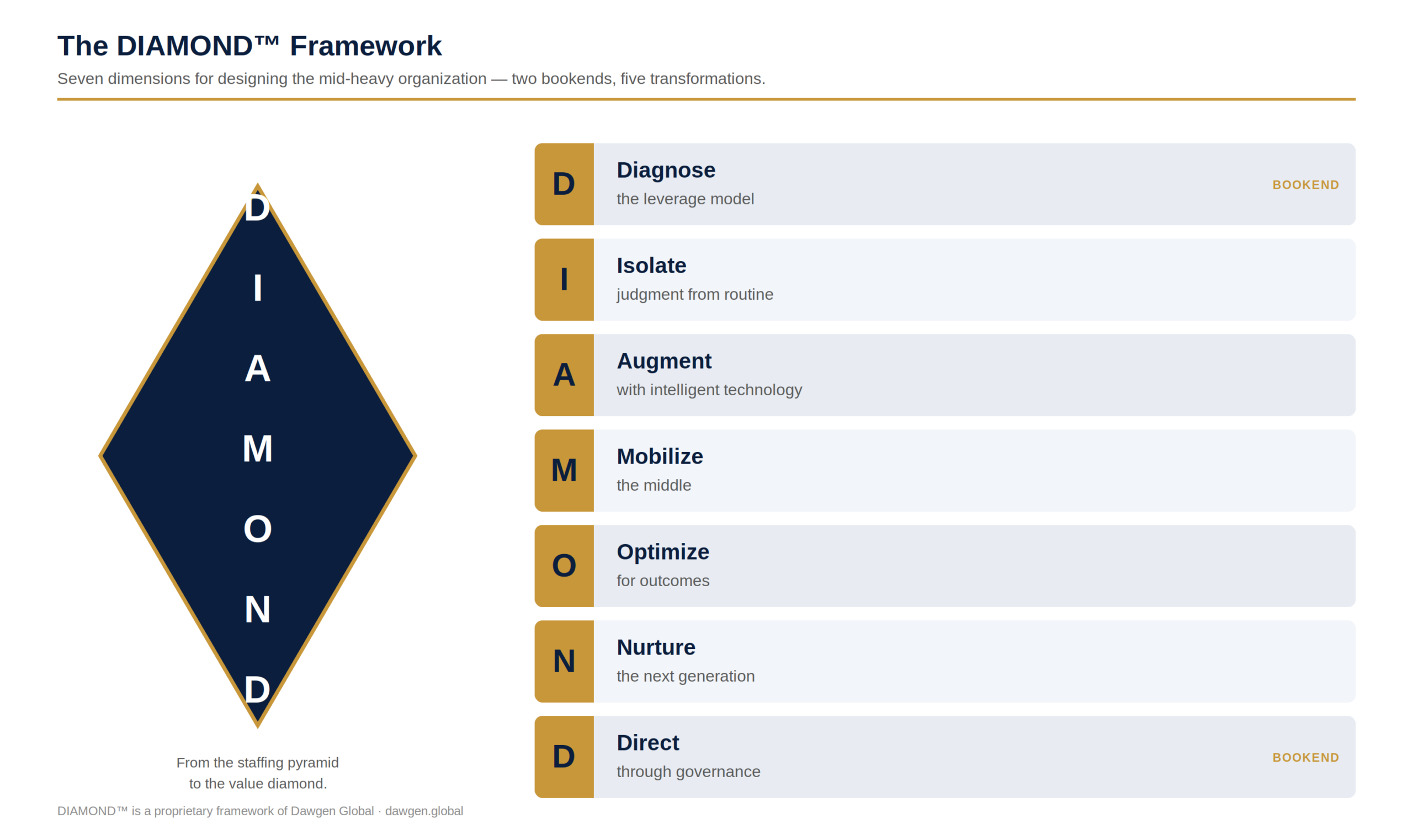
This is why the second and third dimensions of the DIAMOND™ Framework — Isolate and Augment — belong together. Isolate asks which work is routine enough to be absorbed. Augment asks how technology should absorb it and what the entry layer becomes as a result. Get this pairing wrong and the base does not transform; it simply vanishes.
What the technology is actually taking
It helps to be concrete about the work in question. Across professional disciplines, intelligent systems are now performing a recognizable category of entry-level tasks: gathering and reconciling data, reviewing documents for standard issues, producing first drafts of routine analysis and correspondence, populating templates, performing standard calculations and checks. None of this is the judgment work that defines a profession. All of it is the work that historically filled the timesheets of first- and second-year staff.
That is the heart of the matter. The technology is not taking the hardest work; it is taking the entry work. And the entry work was never only production — it was also the curriculum. A junior learned judgment by doing volumes of routine tasks under a senior’s correction. Remove the tasks and you remove the curriculum along with the cost.
Technology is taking the entry work — which was never only production. It was the curriculum.
Isolate: separating judgment from routine, honestly
The discipline of the Isolate dimension is to examine work task by task rather than role by role. Few jobs are purely routine or purely judgment; most blend the two. A first-year analyst spends part of the week on work a machine can now do and part on early-stage judgment that should be protected and developed. Isolation means resisting two opposite errors: pretending nothing can be automated (which the market will punish) and pretending everything can (which destroys the apprenticeship hidden inside the routine).
Done honestly, isolation is uncomfortable. It forces a firm to admit how much of its billable base was never really judgment. Done well, it is clarifying: it draws a sharp line around where irreplaceable human value now concentrates, and that line becomes the blueprint for the redesigned organization.
Augment: rebuilding the base, not just removing it
Augmentation is where leaders most often go wrong, because there are two very different ways to respond once routine work is isolated. The first is subtraction: let the technology do the routine work, stop hiring the juniors who used to do it, and book the savings. The second is redesign: use the technology as the new foundation, and reshape the entry layer around supervising, validating and directing intelligent systems from an earlier point in a career.
The difference is everything. Subtraction removes the base and leaves a void. Redesign rebuilds the base in a new form — smaller in headcount, higher in capability, oriented toward judgment sooner. In a well-augmented organization, the entry layer does less production and more direction; people reach real judgment work earlier rather than after years of routine grind. The base does not disappear. It is rebuilt around the machine.
The hourglass: how a base disappears badly
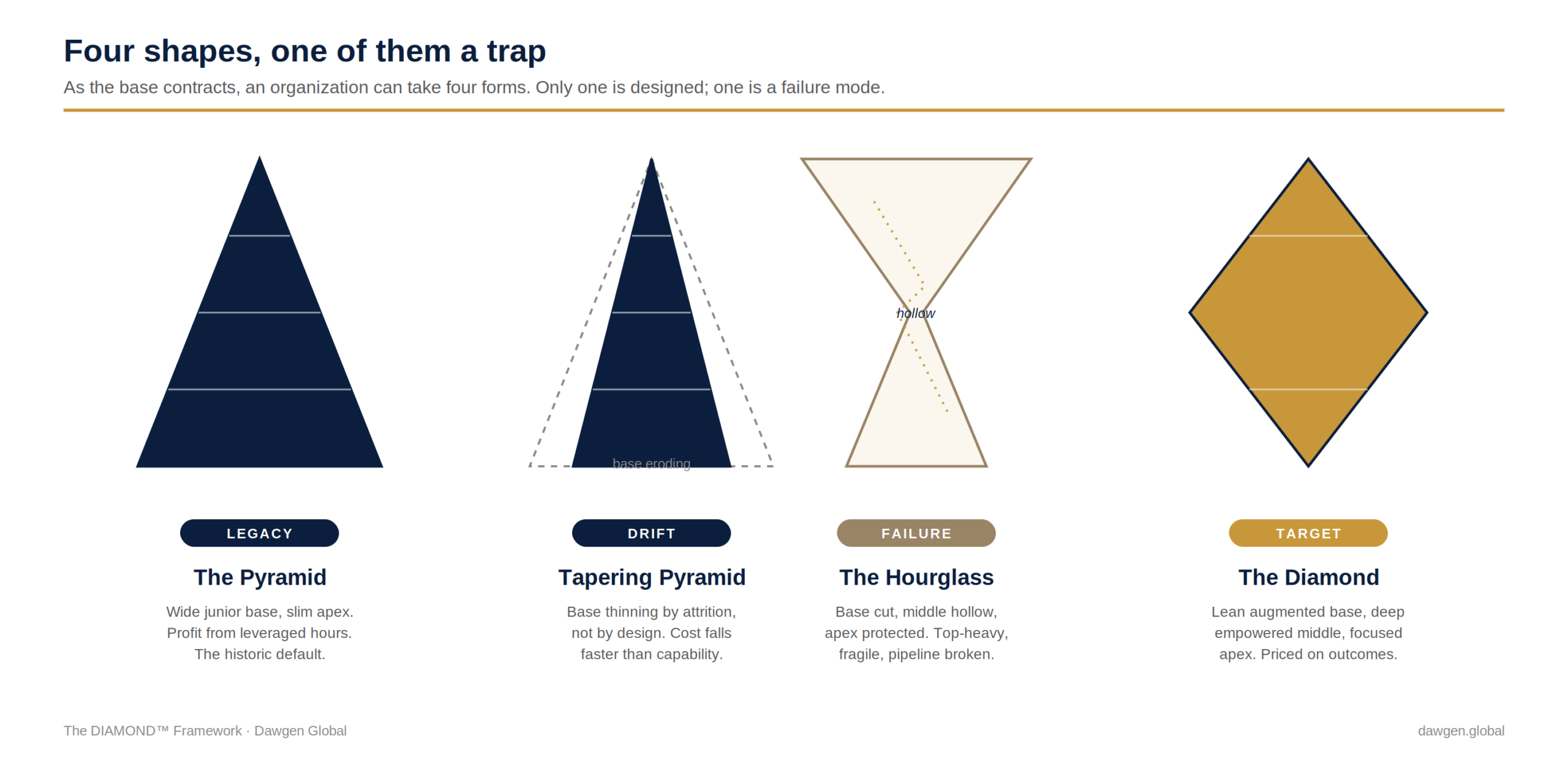
Subtract rather than redesign, and the pyramid becomes an hourglass — not a diamond.
This brings us to the central warning of the entire series. When a firm subtracts rather than redesigns — cutting the base, protecting the senior ranks, and neglecting the middle and the pipeline — it does not become a diamond. It becomes an hourglass.
The hourglass is top-heavy and hollow in the centre. It has a protected apex, a thin and overstretched middle, and a base too lean to develop anyone. It can look efficient for a year or two: costs are down, the technology is working, the quarterly numbers improve. Then the cracks appear. There is no one ready to step into the middle, because the pipeline that fed it was quietly severed. The senior ranks become irreplaceable and overloaded. Capability concentrates in a handful of people whose departure would be catastrophic. The organization is more fragile than it has ever been, precisely when it believed it was becoming more efficient.
Cut the base without rebuilding the middle and the pipeline, and you do not get a diamond. You get an hourglass — efficient on this year’s costs, fragile on next decade’s capability.
The Caribbean dimension
For regional organizations, the hourglass risk is acute and the opportunity is equally real. Acute, because our talent pipelines are already thin and our developing experts already prone to migrate; a severed base here is harder to regrow than in a deep, mobile labour market. We can ill afford to hollow our own middle.
But the opportunity is genuine. The Caribbean has long exported its most capable people and imported senior expertise at premium cost. A deliberately augmented, mid-heavy organization offers a different path: use technology to handle routine work that scarce people should not be spending their careers on, and redirect that scarce human capacity toward judgment, clients and the development of the next generation. Approached as redesign rather than subtraction, the vanishing base is not only a threat to manage. It is a chance to build the kind of deep regional capability the pyramid never allowed us to keep.
Part I has diagnosed the problem: a cracking pyramid, a stalling leverage engine, and a base vanishing from beneath us. Part II turns to the answer — the shape of the diamond itself, and what a mid-heavy, technology-augmented organization actually looks like in practice.
This article is part of “From Pyramid to Diamond,” a Dawgen Global thought leadership series built on the proprietary DIAMOND™ Framework. Dr. Dawkins Brown is Executive Chairman and Founder of Dawgen Global.
© 2026 Dawgen Global. DIAMOND™ is a proprietary framework of Dawgen Global. dawgen.global | info@dawgen.global
About Dawgen Global
Dawgen Global is an independent, integrated multidisciplinary professional services firm headquartered at Dawgen Towers, 47-49 Trinidad Terrace, Kingston 5, Jamaica, serving more than 15 territories across the Caribbean. Founded and led by Dr. Dawkins Brown, Executive Chairman, the firm is independent and not affiliated with any international network. It delivers a full suite of professional services under one roof: audit and assurance; tax advisory; IT and digital transformation; risk management; cybersecurity; actuarial and insurance regulatory advisory; HR advisory; mergers and acquisitions; corporate recovery; business advisory and strategy; accounting BPO and virtual CFO services; and legal process outsourcing.
The proposition is simple: big-firm capability without the big-firm price. Dawgen Global’s integrated approach is built for the specific complexities and opportunities of the Caribbean market, helping organizations make sharper, better-informed decisions that drive measurable progress.
To explore a partnership, reach out:
- Website: dawgen.global
- Email: info@dawgen.global
- WhatsApp (Global): +1 555-795-9071
- Caribbean offices: +1 876-929-3670 | +1 876-926-5210


