
From Knowledge to Action
Over the past ten articles, we have explored every dimension of Internal Audit transformation: the expectation gap and its causes, the maturity journey from compliance function to strategic partner, the seven pillars that define audit value, the business case that secures investment, the technology roadmap that enables capability, the leadership that drives change, dynamic risk-based planning, integrated governance, talent development, and emerging risk navigation.
The knowledge is now complete. What remains is the hardest part: implementation.
This article synthesises the entire IAVANTAGE™ series into a single, month-by-month transformation playbook. It is designed for the CAE who is ready to move from aspiration to action – who has absorbed the framework, completed the self-assessment, secured the business case, and obtained Board endorsement to transform. It assumes a starting point at IAVANTAGE™ Level 1 or 2 and a target of achieving Level 3 (Integrated) within twelve months.
Level 3 is the critical inflection point where Internal Audit transitions from a compliance function to a valued contributor. It is achievable within twelve months for most organisations, and it creates the foundation for further advancement to Levels 4 and 5. Attempting to leap directly to Level 4 or 5 from Level 1 is not realistic and not recommended.
| “Transformation is not a single event. It is a sequence of deliberate actions, each building on the previous one, sustained over time by disciplined execution and visible leadership. The playbook that follows provides the sequence. Your commitment provides the momentum.” — Dawgen Global |
Pre-Launch: The Four Prerequisites
Before the twelve-month clock starts, four prerequisites must be in place. Without these, the transformation will stall:
- Completed IAVANTAGE™ Self-Assessment. You must know your starting point. Complete the Pillar Self-Assessment Toolkit (Article 3 / downloadable resource) to establish your baseline score across all seven pillars. This becomes the benchmark against which progress is measured.
- Board-Endorsed Business Case. The transformation must be funded and supported. Use the methodology from Article 4 to build your business case, secure Audit Committee endorsement, and obtain the necessary budget allocation. The investment required for a Level 3 transformation is typically fifteen to twenty-five percent above current audit budget for two years.
- Audit Committee Sponsorship. The Audit Committee Chair must be an active sponsor, not just a passive approver. Brief the Chair on the transformation plan, agree on reporting milestones, and establish a quarterly transformation progress review.
- Team Communication. The audit team must understand what is about to happen and why. Conduct a team briefing that communicates the vision, the twelve-month plan, the expected changes to ways of working, and the opportunities for professional development. Transformation requires buy-in, not just compliance.
The 12-Month Playbook: Four Phases
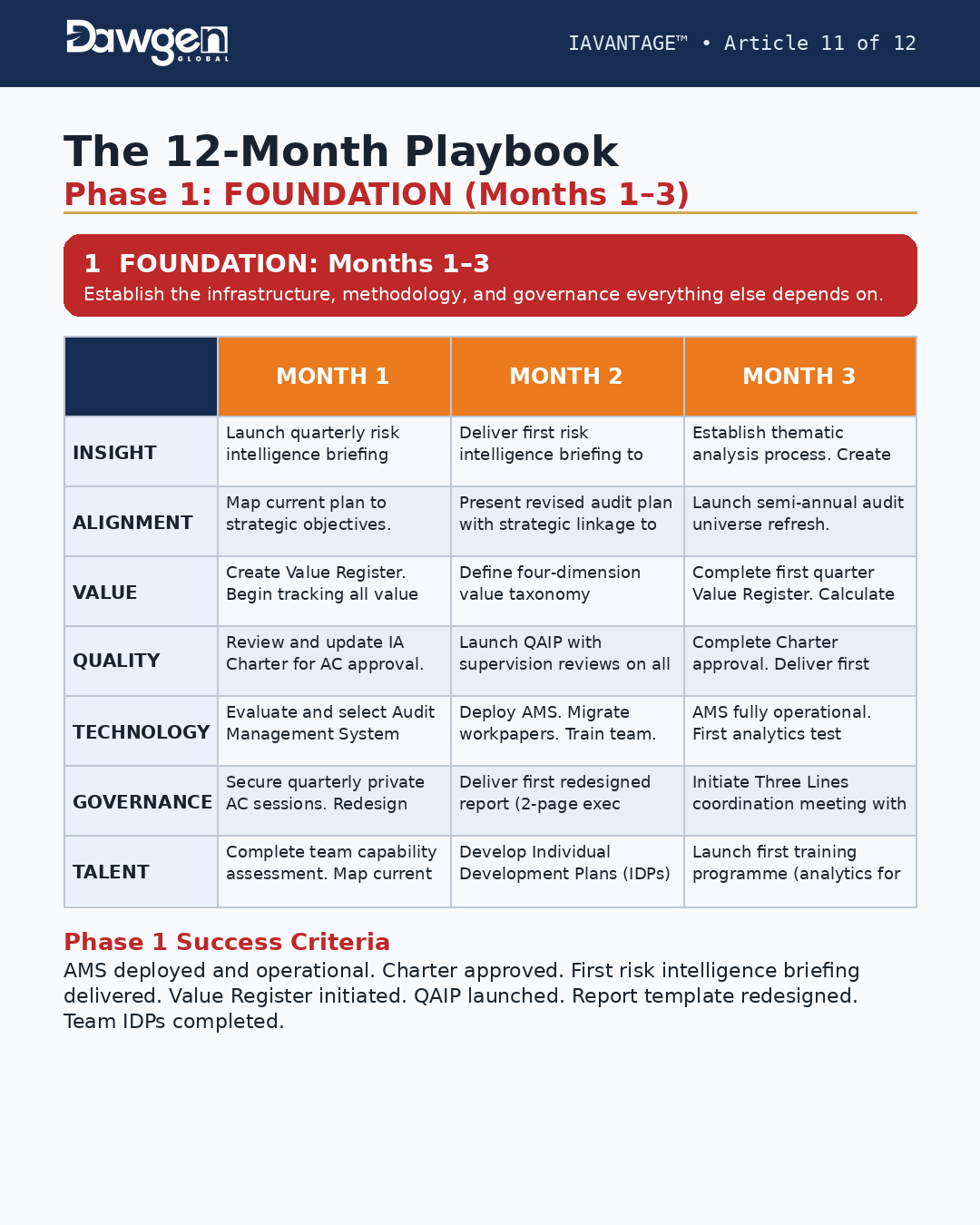
| 1 | FOUNDATION: Months 1–3
Establish the infrastructure, methodology, and governance that everything else depends on. |
| PILLAR | MONTH 1 | MONTH 2 | MONTH 3 |
| INSIGHT | Launch quarterly risk intelligence briefing format. Identify data sources for top 10 risks. | Deliver first risk intelligence briefing to AC. Begin root cause analysis on all findings. | Establish thematic analysis process. Create first cross-engagement theme report. |
| ALIGNMENT | Map current plan to strategic objectives. Identify gaps. Begin stakeholder consultation. | Present revised audit plan with strategic linkage to AC. Build 15–20% flexibility reserve. | Launch semi-annual audit universe refresh process. Document risk-engagement matrix. |
| VALUE | Create Value Register. Begin tracking all value contributions from current engagements. | Define four-dimension value taxonomy (Protective, Operational, Strategic, Stakeholder). | Complete first quarter Value Register. Calculate preliminary ROI. |
| QUALITY | Review and update IA Charter for AC approval. Document standard methodology. | Launch QAIP with supervision reviews on all engagements. Set certification targets. | Complete Charter approval. Deliver first QAIP results. Identify CPD priorities. |
| TECHNOLOGY | Evaluate and select audit management system. Begin deployment. | Deploy AMS. Migrate workpapers. Train team. Establish top 5 data source connections. | AMS fully operational. First analytics test (duplicate payments or Benford’s Law). |
| GOVERNANCE | Secure quarterly private AC sessions. Redesign report template. | Deliver first redesigned report (2-page exec summary, visual, impact-focused). | Initiate Three Lines coordination meeting with Risk and Compliance. |
| TALENT | Complete team capability assessment. Map current vs. required profiles. | Develop Individual Development Plans for all team members. | Launch first training programme (analytics for 2+ team members). |
Phase 1 Success Criteria: AMS deployed and operational. Charter approved. First risk intelligence briefing delivered. Value Register initiated. QAIP launched. Report template redesigned. Team IDPs completed.
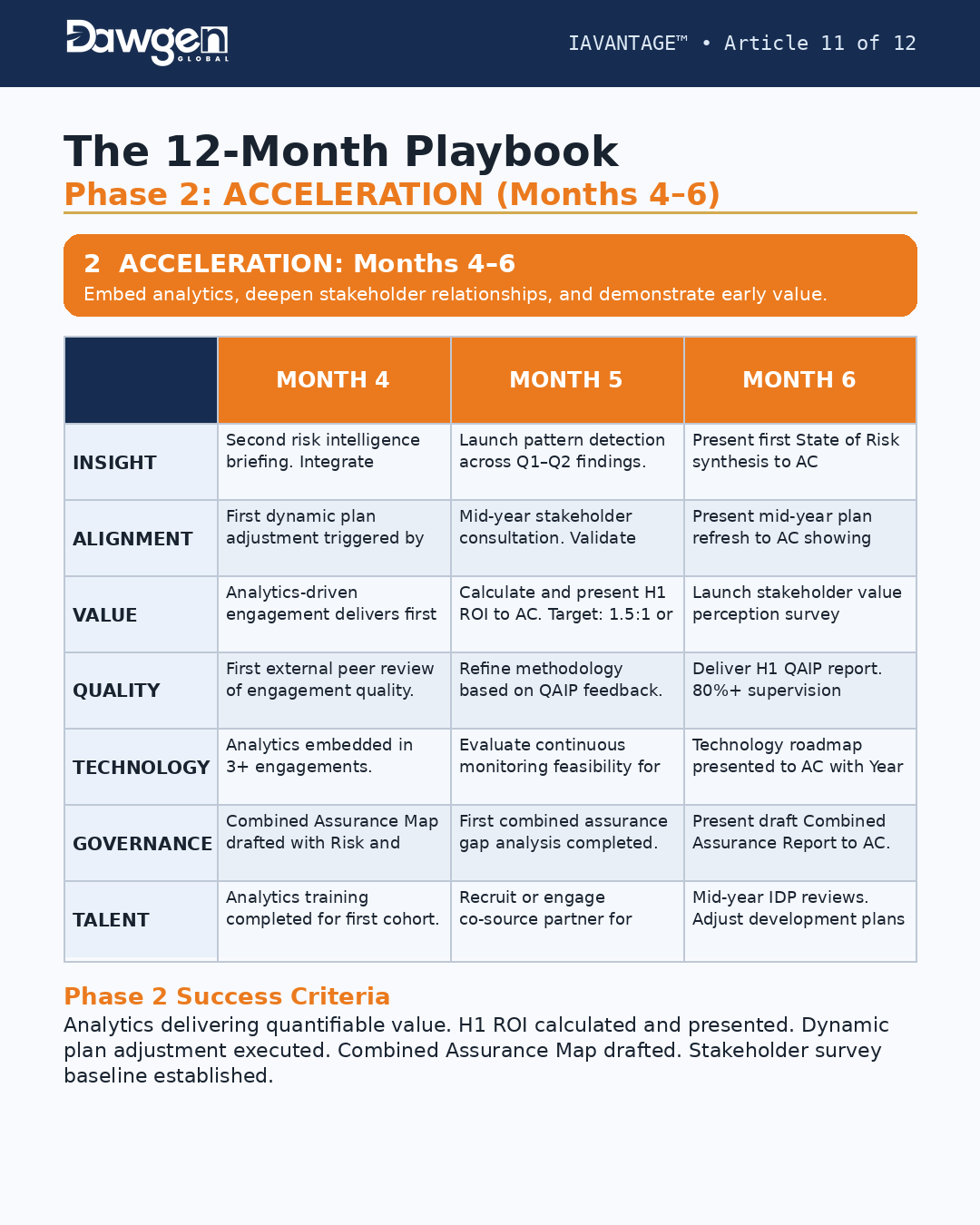
| 2 | ACCELERATION: Months 4–6
Embed analytics, deepen stakeholder relationships, and demonstrate early value. |
| PILLAR | MONTH 4 | MONTH 5 | MONTH 6 |
| INSIGHT | Second risk intelligence briefing. Integrate external data (regulatory updates, peer incidents). | Launch pattern detection across all Q1–Q2 findings. Identify first enterprise-wide theme. | Present first State of Risk synthesis to AC combining internal and external intelligence. |
| ALIGNMENT | First dynamic plan adjustment triggered by emerging risk. Document trigger and rationale. | Mid-year stakeholder consultation. Validate plan relevance against current strategic priorities. | Present mid-year plan refresh to AC showing dynamic adjustments and flexibility reserve usage. |
| VALUE | Analytics-driven engagement delivers first quantifiable value (e.g., duplicate payments identified). | Calculate and present H1 ROI to AC. Target: 1.5:1 or better. | Launch stakeholder value perception survey (baseline measurement). |
| QUALITY | First external peer review of engagement quality. Identify improvement areas. | Refine methodology based on QAIP feedback. Standardise analytics integration into methodology. | Deliver H1 QAIP report. 80%+ supervision completion rate achieved. |
| TECHNOLOGY | Analytics embedded in 3+ engagements. Full-population testing replacing sampling in key areas. | Evaluate continuous monitoring feasibility for highest-risk process. | Technology roadmap presented to AC with Year 2 investment case. |
| GOVERNANCE | Combined Assurance Map drafted with Risk and Compliance input. | First combined assurance gap analysis completed. Coverage gaps documented. | Present draft Combined Assurance Report to AC. Gather feedback. |
| TALENT | Analytics training completed for first cohort. Second cohort identified. | Recruit or engage co-source partner for specialist capability (cyber/ESG). | Mid-year IDP reviews. Adjust development plans based on progress. |
Phase 2 Success Criteria: Analytics delivering quantifiable value. H1 ROI calculated and presented. Dynamic plan adjustment executed. Combined Assurance Map drafted. Stakeholder survey baseline established.
| 3 | INTEGRATION: Months 7–9
Connect all pillars into a cohesive operating model and demonstrate sustained impact. |
| PILLAR | MONTH 7 | MONTH 8 | MONTH 9 |
| INSIGHT | Risk intelligence briefings now include predictive indicators. External feeds automated. | Cross-pillar insight: analytics findings informing risk intelligence. Themes driving plan adjustments. | Annual State of Risk report drafted for Board with forward-looking risk perspective. |
| ALIGNMENT | Q3 plan refresh fully operational. Flexibility reserve actively managed. All engagements strategy-linked. | Begin planning for Year 2 audit plan using dynamic methodology. | Year 2 plan development begins with full multi-source risk assessment. |
| VALUE | Value Register shows cumulative ROI trajectory. Marketing value internally to all stakeholders. | Advisory engagement delivered on a strategic initiative. Value captured and documented. | Full-year ROI projection prepared. Target: 3:1 for Year 2 presentation. |
| QUALITY | EQA planning initiated (to be completed within 5 years per standards). | Methodology formally documented as comprehensive procedures manual. | Q3 QAIP results show continuous improvement trend. Quality KPIs on track. |
| TECHNOLOGY | Continuous monitoring pilot launched for highest-risk process. | Analytics playbook documented covering standard tests for all major process areas. | Evaluate AI tool pilot opportunity for Year 2 (risk assessment or report generation). |
| GOVERNANCE | Combined Assurance Report delivered quarterly to AC. Format refined based on feedback. | Three Lines coordination meetings now routine (quarterly). Reliance protocols documented. | First annual overall opinion on governance, risk, and controls being drafted. |
| TALENT | First emerging risk engagement delivered (cyber, ESG, or AI). Capability demonstrated. | Team engagement survey conducted. Results benchmarked. Retention actions identified. | Year 2 talent plan developed. Recruitment needs identified. Budget requested. |
Phase 3 Success Criteria: Combined Assurance Report operational. Continuous monitoring piloted. Advisory capability demonstrated. Annual opinion being developed. All pillars showing measurable progress.
| 4 | CONSOLIDATION: Months 10–12
Lock in Level 3 achievement. Measure, celebrate, and plan the next horizon. |
| PILLAR | MONTH 10 | MONTH 11 | MONTH 12 |
| INSIGHT | Annual State of Risk report finalised. Presented to Board as strategic document. | Risk intelligence recognised by Board as valued input to strategic discussions. | Year 1 insight capability formally assessed against Level 3 criteria. Gaps addressed. |
| ALIGNMENT | Year 2 dynamic audit plan completed with full strategic alignment and flexibility reserve. | Plan presented to AC with clear linkage to strategy, emerging risks, and resource allocation. | Year 2 plan approved. Dynamic planning methodology fully embedded. |
| VALUE | Full-year Value Register completed. Annual ROI calculated and presented. | Value communication package prepared for CEO, CFO, and AC. ROI story documented. | Transformation ROI presented to Board. Investment case for Year 2 approved. |
| QUALITY | Year 1 QAIP annual report completed. Improvement trajectory documented. | All team certification targets on track. CPD hours met or exceeded. | Annual overall opinion on governance, risk, and controls delivered to AC. |
| TECHNOLOGY | Year 1 technology outcomes documented. Continuous monitoring results quantified. | Year 2 technology roadmap finalised with AI pilot, expanded analytics, and enhanced monitoring. | Technology investment approved. Vendor selections completed for Year 2 tools. |
| GOVERNANCE | Integrated assurance model fully operational. Combined report praised by AC. | Annual governance effectiveness assessment completed. Improvements documented. | Year 1 governance transformation outcomes presented. Year 2 objectives agreed. |
| TALENT | Year-end IDP reviews completed. Promotions and recognitions delivered. | Year 2 talent plan finalised. New hires and development programmes confirmed. | Team celebration. Transformation achievements recognised. Culture of excellence embedded. |
Phase 4 Success Criteria: IAVANTAGE™ Level 3 achieved across all pillars. Annual opinion delivered. ROI exceeds 3:1. Stakeholder satisfaction improved. Year 2 plan approved and funded. Team capability measurably enhanced.
The Transformation Dashboard: Tracking Progress
Throughout the twelve months, progress should be tracked and reported using a Transformation Dashboard. This dashboard should be presented to the Audit Committee quarterly alongside the regular audit report. It communicates that the transformation is structured, measured, and accountable.
| METRIC | BASELINE | Q2 TARGET | Q4 TARGET | LEVEL 3 STANDARD |
| IAVANTAGE™ Overall Score (/200) | 80–120 | 100–135 | 130–160 | 121–160 |
| Audit Plan Strategic Alignment (%) | 20–40% | 60–70% | 90–100% | 90%+ |
| Analytics Coverage (% of engagements) | 0–10% | 30–40% | 60–70% | 50%+ |
| Quantifiable ROI (value:cost) | 0.5–1.0:1 | 1.5–2.0:1 | 2.5–3.5:1 | 3:1+ |
| AC Report Quality (AC feedback score /5) | 2.5–3.0 | 3.5–4.0 | 4.0–4.5 | 4.0+ |
| Team Certification Rate (%) | 30–50% | 50–65% | 70–85% | 80%+ |
| Stakeholder Satisfaction (survey /5) | 2.5–3.0 | 3.0–3.5 | 3.5–4.5 | 3.5+ |
| Flexibility Reserve Usage (%) | 0% | 10–15% | 15–25% | 20–30% |
Five Common Derailments and How to Avoid Them
- Losing momentum after the first quarter. The energy and excitement of launch naturally fades. Combat this by celebrating quick wins visibly, maintaining the quarterly AC transformation review, and ensuring the team sees tangible improvements in their daily work (better tools, clearer methodology, more impactful engagements).
- Trying to transform everything simultaneously. The playbook is deliberately sequenced. Foundation before acceleration. Infrastructure before analytics. Methodology before advisory. Resist the temptation to skip ahead. Each phase depends on the previous one.
- Underinvesting in communication. Transformation that is invisible to stakeholders generates no support. Every quarter, communicate progress to the AC, the CEO, management, and the team. Make the transformation visible through improved reports, analytics-driven findings, and advisory value.
- Neglecting the team’s experience. Transformation is stressful. New tools, new methods, new expectations – the team is absorbing significant change. Invest in change management: listen to concerns, provide training before expecting new performance, and recognise effort as well as results.
- Declaring victory too early. Reaching Level 3 is a milestone, not a destination. The function must sustain and embed the changes, or regression is inevitable. Plan for Year 2 before Year 1 is complete, and ensure the transformation becomes the new normal rather than a temporary initiative.
Your Transformation Starts Now
The playbook is in your hands. The knowledge is complete. The tools are available. The only remaining variable is your decision to act.
| YOUR NEXT STEP
Engage Dawgen Global as Your Transformation Partner Dawgen Global offers a complete IAVANTAGE™ Transformation Partnership that provides expert facilitation through all four phases of the playbook. Our engagement includes: diagnostic assessment, transformation roadmap customisation, monthly progress coaching, quarterly AC presentations support, tool and template implementation, and a 12-month guarantee of measurable maturity improvement. ↓ SCHEDULE YOUR TRANSFORMATION DISCOVERY CALL ↓ Email: [email protected] | Call: +1 (876) 926-5210 |
Coming Next: The Series Finale
Article 12: “The Future of Internal Audit: A Manifesto for the Profession” – The concluding article in the IAVANTAGE™ series. A forward-looking vision for where the profession is heading, what the audit function of 2030 will look like, and why the transformation you begin today will determine whether your function leads or follows.
About Dawgen Global
“Embrace BIG FIRM capabilities without the big firm price at Dawgen Global, your committed partner in carving a pathway to continual progress in the vibrant Caribbean region. Our integrated, multidisciplinary approach is finely tuned to address the unique intricacies and lucrative prospects that the region has to offer. Offering a rich array of services, including audit, accounting, tax, IT, HR, risk management, and more, we facilitate smarter and more effective decisions that set the stage for unprecedented triumphs. Let’s collaborate and craft a future where every decision is a steppingstone to greater success. Reach out to explore a partnership that promises not just growth but a future beaming with opportunities and achievements.
 Email: [email protected]
  Visit: Dawgen Global Website

 WhatsApp Global Number : +1 555-795-9071
Caribbean Office: +1876-6655926 / 876-9293670/876-9265210  WhatsApp Global: +1 5557959071
USA Office: 855-354-2447
Join hands with Dawgen Global. Together, let’s venture into a future brimming with opportunities and achievements


