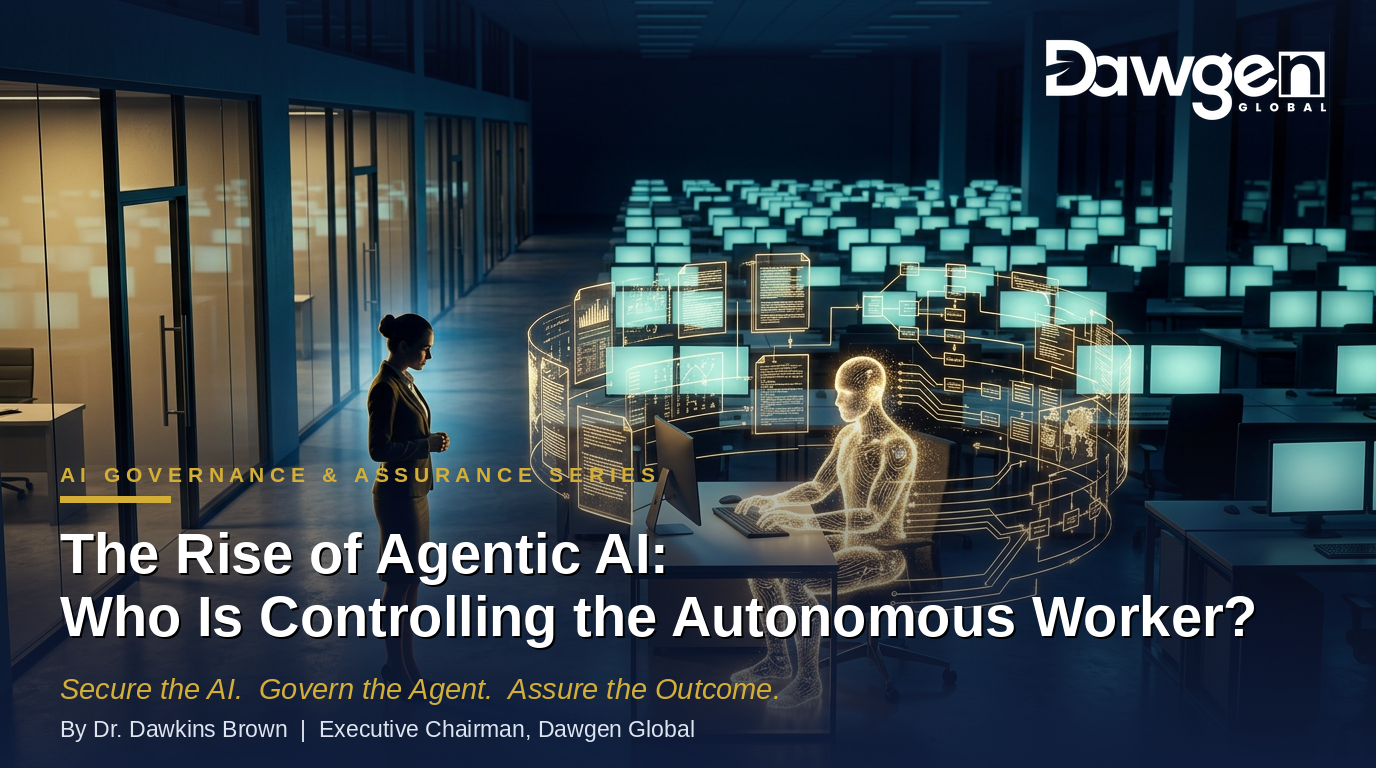
Why Caribbean organizations need guardrails before AI agents enter core business operations
EXECUTIVE SUMMARY
A new type of worker is entering the enterprise — one that does not sit at a desk or appear on an organization chart, yet can read documents, analyze transactions, interact with systems, and trigger workflows. The AI agent is the enterprise’s first true non-human digital worker, and it raises a governance question most organizations cannot yet answer: who is controlling the autonomous worker? This article — a companion to “Cybersecurity and AI Governance Are Becoming One Control Narrative” — argues that AI agents must be governed as privileged digital workers, sets out the ten-element AI Agent Control Framework at the heart of Dawgen Global’s D-AGENTICA™ methodology, and outlines the questions boards, CISOs, and internal audit leaders across the Caribbean should be asking before autonomous systems reach core business operations.
A new worker has entered the enterprise
A new type of worker is entering the enterprise. It does not sit at a desk, attend staff meetings, or appear on an organization chart. Yet it can read documents, retrieve data, summarize contracts, draft emails, generate reports, analyze transactions, interact with systems, trigger workflows, and support decision-making.
This worker is the AI agent.
Unlike traditional software, which generally waits for a user to perform a defined action, agentic AI systems can interpret goals, plan steps, call tools, access data, and execute tasks with varying levels of autonomy. This is why agentic AI is attracting major attention across finance, audit, customer service, procurement, compliance, cybersecurity, human resources, legal operations, and executive decision support.
However, as AI agents become more capable, organizations must confront a critical governance question: who is controlling the autonomous worker?
The answer cannot be left to technology teams alone. AI agents create enterprise-wide implications for cybersecurity, internal control, risk management, regulatory compliance, auditability, accountability, and board oversight.
From automation to autonomy
Organizations are familiar with automation. Robotic process automation, workflow tools, macros, scripts, and enterprise systems have long been used to improve efficiency. These tools typically follow predefined rules and operate within narrow process boundaries.
Agentic AI is different. An AI agent may be given an objective rather than a fixed instruction. For example:
- Prepare a monthly financial variance analysis.
- Review customer complaints and identify recurring issues.
- Draft a procurement summary based on supplier quotations.
- Analyze contracts for unusual clauses.
- Monitor cybersecurity alerts and recommend response actions.
- Summarize audit evidence and highlight exceptions.
To complete such tasks, the agent may retrieve documents, search databases, interact with applications, call APIs, generate outputs, and recommend or initiate next steps. This creates new operational leverage — but also new risk.
The question is no longer simply whether a system is functioning. The question is whether the autonomous system is acting within approved boundaries.
The new risk: non-human actors inside the enterprise
Every organization already manages human users, system users, privileged accounts, service accounts, vendors, contractors, administrators, and third-party platforms. Agentic AI now introduces another category: the non-human digital actor that can reason, request, retrieve, recommend, and sometimes act.
An AI agent may access sensitive information. It may combine data from multiple systems. It may generate output that appears authoritative. It may make recommendations that influence management decisions. It may interact with customers, employees, suppliers, regulators, or internal systems. It may operate faster than a human reviewer can monitor.
Without proper governance, organizations may not know:
- What the agent accessed
- Why the agent made a recommendation
- Whether the agent followed policy
- Whether the agent used approved data
- Whether confidential information was exposed
- Whether the output was validated
- Whether a human approved the final action
- Whether the agent exceeded its authority
This is not only a technology risk. It is an accountability risk — and in jurisdictions such as Jamaica, where the Data Protection Act places accountability for personal data squarely on the data controller, an AI agent’s unmonitored access to customer or employee records is a compliance exposure, not merely a technical event.
Why cybersecurity must evolve for AI agents
Traditional cybersecurity controls focus heavily on protecting users, devices, networks, systems, applications, data, and infrastructure. These controls remain essential, but agentic AI requires additional control logic. Cybersecurity leaders must now ask:
- Does each AI agent have a defined identity?
- Is the agent’s access limited to approved systems and data?
- Can the agent perform only authorized actions?
- Are high-risk actions subject to human approval?
- Are agent activities logged and monitored?
- Can the organization detect abnormal agent behavior?
- Can the agent be suspended or disabled quickly?
- Are prompts, instructions, outputs, and tool calls retained where appropriate?
- Are third-party AI services governed through vendor risk management?
The cybersecurity perimeter is no longer only around infrastructure. It must also surround autonomous decision pathways. As we argued in the companion article, “Cybersecurity and AI Governance Are Becoming One Control Narrative,” the defining enterprise risk is shifting from unauthorized access to unauthorized action — and nowhere is that shift more visible than in agentic AI.
The control principle: treat AI agents like privileged digital workers
A practical starting point is to treat AI agents as privileged digital workers. This does not mean every AI agent should receive broad access. It means the organization should apply disciplined identity, access, authorization, monitoring, and review controls similar to those used for high-impact human or system accounts.
Each AI agent should have:
- A clear business purpose and a named business owner
- A defined risk classification
- Approved data sources and approved system access
- Defined permissions and human oversight requirements
- Logging and monitoring rules with escalation procedures
- Performance and output validation
- Periodic access review and decommissioning procedures
The test is simple: if an organization would not allow an employee, contractor, or vendor to perform a task without oversight, it should not allow an AI agent to perform that task without controls.
The board and executive oversight issue
Boards and executive teams should not view agentic AI as a technical experiment hidden inside departments. Once AI agents interact with sensitive data, core systems, regulated processes, customers, or financial decisions, they become part of the organization’s control environment.
For boards and audit committees, oversight should focus on practical questions: Where are AI agents being used? Which agents operate in high-risk areas? Who owns each agent? What data and systems can each agent access? What actions can each agent perform, and what decisions require human approval? How are exceptions reported, and what is the incident response plan if an agent causes harm?
For CISOs and technology leaders, the question is whether agents sit inside or outside the security architecture — with managed identities, monitored behavior, and a tested ability to contain them.
For internal audit, the question is whether the audit universe has caught up with where agents are actually operating: has the risk assessment been refreshed, and can the function evidence agent activity end-to-end?
If management cannot answer these questions, the organization may be deploying autonomous capability faster than it is building governance capacity.
The AI Agent Control Framework — a core discipline of D-AGENTICA™
Dawgen Global recommends that organizations develop an AI Agent Control Framework before deploying autonomous systems at scale. The framework — a core discipline within Dawgen Global’s D-AGENTICA™ methodology for responsible agentic AI adoption — comprises ten elements:
1. Agent inventory
Maintain a central inventory of AI agents, including purpose, owner, vendor, data sources, system access, risk rating, deployment status, and review date. Without an inventory, management cannot govern what it cannot see.
2. Agent risk classification
Not all agents carry the same risk. A low-risk internal summarization assistant is different from an agent that interacts with customer data, financial systems, legal documents, payroll records, cybersecurity alerts, or regulatory reporting. Classification should consider data sensitivity, business impact, regulatory exposure, decision influence, autonomy level, and potential harm.
3. Identity and access management
Each AI agent should have a unique identity. Shared credentials, unmanaged API keys, excessive permissions, and unclear access rights create control weaknesses. Access should be role-based, purpose-limited, reviewed periodically, and removed when no longer required.
4. Data boundary controls
AI agents should access only the data necessary to perform approved tasks. Organizations should apply data classification, privacy rules, confidentiality restrictions, and data loss prevention controls. Agents should not freely retrieve, combine, or transmit sensitive information without defined controls.
5. Human-in-the-loop approval
High-impact decisions should not be fully delegated to AI agents without human oversight. Approval gates should be mandatory for actions involving payments, contracts, hiring decisions, customer communication, regulatory submissions, legal conclusions, financial reporting, and cybersecurity response. Human oversight must be meaningful, not symbolic.
6. Audit logging and evidence trails
Organizations must be able to reconstruct agent activity. Logs should capture relevant instructions, data access, tool calls, outputs, approvals, exceptions, and final actions. If an AI agent influences a decision and no evidence trail exists, the organization may struggle to defend the decision — to a regulator, an auditor, a court, or its own board.
7. Output validation
Agent outputs should be tested for accuracy, completeness, relevance, bias, policy compliance, and reliability. Validation requirements should increase as the risk of the use case increases. For critical workflows, management should establish accuracy thresholds, exception review procedures, and quality assurance routines.
8. Cybersecurity monitoring
AI agents should be included in security monitoring. Unusual access patterns, abnormal data retrieval, repeated failed actions, unexpected system interactions, or suspicious prompts should trigger alerts. Security teams must be able to detect and respond to compromised, misused, or malfunctioning agents.
9. Incident response and kill-switch protocols
Organizations need response plans for AI-agent failures: escalation paths, containment procedures, disabling mechanisms, communication protocols, evidence preservation, and post-incident review. A kill switch should not be theoretical. It should be tested.
10. Independent assurance
Internal audit, IT audit, risk advisory, compliance, or external assurance providers should periodically assess whether AI agents are operating within approved governance, cybersecurity, privacy, and control expectations. Under Dawgen Global’s TRUST360™ continuous-governance philosophy, this assurance is not a one-time review but an ongoing cycle — because agents, data, prompts, vendors, and use cases change continuously.
Why speed without control is dangerous
AI agents can create impressive efficiency gains. They can reduce manual effort, improve response times, enhance analysis, and help organizations scale knowledge work. But speed without control can magnify errors, accelerate data leakage, embed bias, create unauthorized decisions, and expose organizations to regulatory, legal, financial, and reputational harm.
The goal is not to stop AI adoption. The goal is to ensure that AI adoption is responsible, secure, auditable, and aligned with business objectives. In the age of agentic AI, governance is not a barrier to innovation. Governance is what makes innovation scalable.
A Caribbean and global business imperative
For organizations across the Caribbean and globally, the implications are immediate. Financial institutions, public sector entities, healthcare providers, utilities, telecoms, professional service firms, manufacturers, distributors, and SMEs are all exploring AI-enabled productivity — and many are already using AI tools informally, often before policies, controls, and oversight mechanisms are fully developed.
The regional stakes are specific. Banks, credit unions, and insurers deploying agents near customer data and transaction systems will face regulator questions about technology risk, operational resilience, and outsourcing. Public bodies experimenting with AI in citizen services must be able to evidence lawful, controlled processing under data protection law. BPO and shared-services operators — a pillar of the regional economy — will increasingly find international clients auditing AI controls down the supply chain. And every organization processing personal data in Jamaica already carries accountability obligations under the Data Protection Act that extend to what its AI agents access and do.
This creates a window of opportunity. Organizations that build AI guardrails early will be better positioned to innovate confidently, satisfy stakeholders, protect sensitive data, and respond to regulatory scrutiny.
“AI agents may become powerful digital workers, but every worker needs supervision, accountability, and boundaries. The future of AI leadership belongs to organizations that can combine autonomy with control.”
— Dr. Dawkins Brown, Executive Chairman, Dawgen Global
How Dawgen Global can help
Dawgen Global helps organizations design, assess, and implement practical control frameworks for agentic AI. Our integrated multidisciplinary model brings together cybersecurity, IT audit, internal audit, risk advisory, data protection, governance, compliance, technology, and board advisory expertise — big firm capabilities, Caribbean understanding.
A practical engagement pathway:
- Assess — Agentic AI Guardrails Assessment; AI Agent Inventory and Risk Assessment; AI Vendor and Platform Risk Assessment; AI Agent Identity and Access Control Review
- Design — Agentic AI Guardrails Design; Human-in-the-Loop Workflow Design; AI Incident Response and Kill-Switch Protocol Design; Board and Executive AI Risk Briefings
- Assure continuously — Independent AI Assurance Reviews; AI Audit Logging and Evidence Trail Reviews; continuous agent control monitoring under the TRUST360™ approach
Take the first step
Is your organization deploying AI agents, copilots, chatbots, workflow automation, or generative AI tools without clear governance and cyber guardrails? Dawgen Global can help you design the controls required to manage autonomous systems safely and effectively.
Secure the AI. Govern the Agent. Assure the Outcome.
Contact Dawgen Global today to request an Agentic AI Guardrails Assessment.
Email: [email protected] | Web: dawgen.global
About Dawgen Global
Dawgen Global is an independent, integrated multidisciplinary professional services firm headquartered at 47 Trinidad Terrace, New Kingston, Jamaica, serving more than 15 territories across the Caribbean. Founded and led by Dr. Dawkins Brown, Executive Chairman, the firm is independent and not affiliated with any international network. It delivers a full suite of professional services under one roof: audit and assurance; tax advisory; IT and digital transformation; risk management; cybersecurity; actuarial and insurance regulatory advisory; HR advisory; mergers and acquisitions; corporate recovery; business advisory and strategy; accounting BPO and virtual CFO services; and legal process outsourcing.
The proposition is simple: big-firm capability without the big-firm price. Dawgen Global’s integrated approach is built for the specific complexities and opportunities of the Caribbean market, helping organizations make sharper, better-informed decisions that drive measurable progress.
To explore a partnership, reach out:
- Website: dawgen.global
- Email: [email protected]
- WhatsApp (Global): +1 555-795-9071
- Caribbean offices: +1 876-665-5926 | +1 876-929-3670 | +1 876-926-5210


