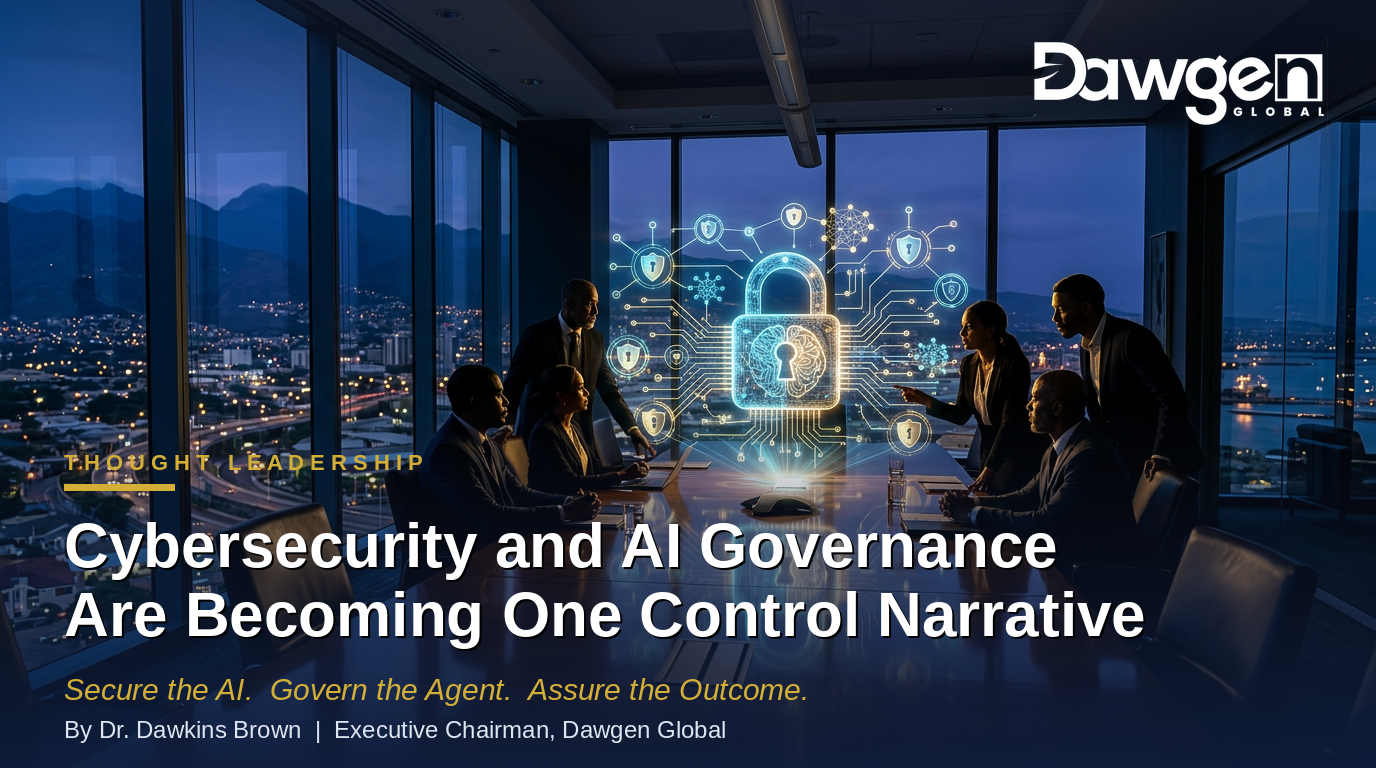
Why Caribbean organizations must secure the AI, govern the agent, and assure the outcome
EXECUTIVE SUMMARY
Artificial intelligence has moved from pilot projects into the operational core of Caribbean enterprises — into finance, customer engagement, compliance, procurement, and decision-making itself. As it does, the traditional boundary between cybersecurity and AI governance is disappearing. The defining enterprise risk is no longer only unauthorized access; it is unauthorized action — an AI system or autonomous agent operating in ways the organization cannot control, explain, or defend. Global frameworks (NIST AI RMF, NIST CSF 2.0, ISO/IEC 42001, the EU AI Act) and regional obligations such as Jamaica’s Data Protection Act are converging on a single expectation: AI must be governed, secured, validated, monitored, and assured — continuously. This article sets out an integrated ten-pillar control framework and a practical pathway for boards, executives, and assurance leaders to move from informal AI adoption to controlled, assurance-ready AI transformation.
AI is now embedded in the enterprise — and so is the risk
Artificial intelligence is no longer a future-facing technology discussion. It is embedded in business operations, customer engagement, finance, audit, compliance, cybersecurity, human resources, procurement, and strategic decision-making. As organizations adopt generative AI, machine-learning models, automated workflows, and autonomous AI agents, the traditional boundaries between cybersecurity, data governance, risk management, compliance, and assurance are rapidly disappearing.
The new reality is clear: cybersecurity and AI governance are becoming one control narrative.
For decades, cybersecurity focused on protecting systems, networks, applications, endpoints, identities, and data from unauthorized access, misuse, disruption, or theft. That remains essential. But AI introduces a new layer of enterprise risk. Organizations must now also ask: Who trained the model? What data was used? What decision did the AI influence? Was the output validated? Did the AI agent act within approved authority? Can management explain, evidence, and audit what happened?
This is why boards, executives, CIOs, CISOs, audit committees, internal auditors, regulators, and risk leaders must begin treating AI governance as an extension of cybersecurity governance — not as a separate innovation project.
The risk has changed: from unauthorized access to unauthorized action
In the pre-AI enterprise, a cybersecurity breach typically meant that a malicious actor gained access to a system, stole data, disrupted operations, or compromised infrastructure. In the AI-enabled enterprise, the risk surface expands:
- An AI system may expose confidential data through poor prompt controls.
- A model may generate inaccurate recommendations that influence business decisions.
- An AI agent may trigger a workflow, retrieve sensitive documents, communicate with customers, or act on system instructions without sufficient human oversight.
- A third-party AI vendor may process organizational data in ways that are not fully understood.
- A model may drift over time as data, prompts, users, and operating conditions change.
In other words, the issue is no longer only whether someone entered the system. The issue is whether an AI system or AI agent acted in a way the organization cannot control, explain, validate, or defend. This is why AI governance must include cybersecurity controls — and cybersecurity must now include AI-specific governance controls.
Global frameworks — and Caribbean obligations — are converging
The direction of global standards confirms this convergence. The NIST AI Risk Management Framework is organized around the functions of govern, map, measure, and manage, giving organizations a structured way to identify, assess, monitor, and manage AI risks across the AI lifecycle. The NIST Cybersecurity Framework 2.0 provides a widely used structure for managing cybersecurity risk across organizations of different sizes, sectors, and maturity levels. ISO/IEC 42001 establishes an international standard for an Artificial Intelligence Management System, designed for organizations that provide or use AI-based products or services. And the EU AI Act places particular obligations on high-risk AI systems, including risk management, governance, documentation, transparency, and human oversight.
Caribbean organizations should not treat this as a distant conversation. Regional data protection regimes — including Jamaica’s Data Protection Act — already impose accountability, security, and lawful-processing obligations that apply squarely to AI systems handling personal data. Financial-sector regulators across the region are sharpening expectations around technology risk, operational resilience, outsourcing, and cyber governance. Caribbean businesses serving EU customers or embedded in international supply chains will increasingly find AI Act-style obligations flowing down through contracts and vendor due diligence.
The message for Caribbean business leaders is unmistakable: AI must be governed, secured, validated, monitored, and assured — and regulators, customers, and auditors will expect evidence.
Why traditional cybersecurity controls are not enough
Traditional cybersecurity controls remain foundational. Organizations still need identity and access management, network security, endpoint protection, vulnerability management, incident response, data loss prevention, secure cloud configurations, and third-party risk management. However, AI requires additional control questions:
- Can the organization maintain an inventory of AI systems and AI use cases?
- Has each AI system been classified by risk level?
- Are data inputs approved, classified, and protected?
- Are prompts, outputs, and model interactions logged where appropriate?
- Are human approval gates built into high-impact decisions?
- Are AI agents restricted by role, authority, and business context?
- Is there a process for testing model performance, bias, drift, hallucination, and misuse?
- Can the organization produce evidence for regulators, auditors, customers, or its board?
If the answers are unclear, the organization does not merely have an AI innovation gap. It has a control gap.
Autonomous agents: the rise of the non-human digital worker
AI agents represent a major turning point. Unlike traditional software tools that wait for user commands, AI agents can interpret instructions, plan tasks, call tools, interact with systems, and execute workflows. This creates a new type of enterprise actor: the non-human digital worker.
That digital worker may operate across finance systems, customer relationship platforms, document repositories, email environments, procurement workflows, compliance tools, and analytics platforms. Without proper guardrails, the organization may struggle to determine whether an AI action was authorized, appropriate, accurate, compliant, and aligned with policy.
Effective AI agent governance — the discipline at the heart of Dawgen Global’s D-AGENTICA™ framework for responsible agentic AI adoption — must include:
- Agent identity and access controls
- Role-based permissions and segregation of duties
- Human-in-the-loop approval and escalation rules
- Activity logging and data boundary controls
- Exception monitoring and kill-switch capability
- Independent review and assurance
This is where the cybersecurity control narrative naturally extends into AI assurance.
AI assurance: the next boardroom priority
AI assurance is the process of giving stakeholders confidence that AI systems are properly governed, secure, reliable, transparent, compliant, and aligned with business objectives. It brings together cybersecurity, IT audit, internal audit, data governance, privacy, enterprise risk management, legal and compliance, ethics, operational resilience, and board reporting.
For boards and audit committees, AI assurance answers practical questions:
- Do we know where AI is being used in the organization?
- Are we comfortable with the level of control around AI systems?
- Have we assessed the risks of AI vendors and AI-enabled platforms?
- Can management evidence the accuracy, security, and reliability of critical AI systems?
- Are we prepared for regulatory, customer, or auditor scrutiny?
- Do we have a response plan if an AI system causes operational, legal, financial, or reputational harm?
Organizations that cannot answer these questions are exposed. For CISOs and technology leaders, the parallel question is whether AI systems and agents sit inside — or outside — the security architecture. For internal audit, it is whether the audit universe, risk assessment, and audit plan have caught up with where AI is actually operating in the business.
Continuous validation must replace one-time review
AI risk cannot be managed through a single annual assessment. AI systems evolve. Data changes. Business rules change. Threat actors adapt. Prompts are modified. Vendors update models. Employees find new use cases. Agents gain access to new tools.
This means organizations require continuous validation: ongoing monitoring of AI performance, security events, model drift, access rights, output quality, exceptions, user behavior, data exposure, vendor changes, and control effectiveness — with clear reporting to management and the board. This is the same continuous-governance philosophy that underpins Dawgen Global’s TRUST360™ approach: governance as a living operating model, not a static policy document, supported by controls, dashboards, evidence trails, accountability, and independent assurance.
The Dawgen Global view: an integrated ten-pillar AI control framework
Dawgen Global believes organizations should approach AI governance and cybersecurity through an integrated control framework built around ten pillars:
- AI inventory and use-case mapping
- AI risk classification
- Data governance and privacy controls
- Cybersecurity and access controls
- Model and output validation
- Human oversight and approval workflows
- AI agent permissions and guardrails
- Audit logging and evidence trails
- Incident response and continuous monitoring
- Independent AI assurance and board reporting
This framework allows organizations to move from informal AI adoption to controlled, scalable, assurance-ready AI transformation — and it applies with particular force in the sectors that define the Caribbean economy: banks, credit unions, and insurers deploying AI in underwriting and customer service; hospitality groups automating guest engagement and revenue management; public bodies exploring AI in citizen services; and BPO operators whose international clients will demand demonstrable AI control.
The strategic opportunity
AI will create significant productivity, insight, automation, and innovation opportunities. However, organizations that deploy AI without proper governance create unmanaged exposure. The winners will not be those that simply adopt AI fastest. The winners will be those that adopt AI responsibly, securely, and with evidence-based assurance.
“AI adoption without governance is not transformation; it is unmanaged risk. The organizations that will lead in the AI era are those that can secure the technology, govern the agent, and assure the outcome.”
— Dr. Dawkins Brown, Executive Chairman, Dawgen Global
How Dawgen Global can help
Dawgen Global supports organizations across the Caribbean and globally in building practical, secure, and assurance-ready AI governance frameworks. Our multidisciplinary approach brings together cybersecurity, IT audit, internal audit, risk advisory, data protection, compliance, technology, and board advisory expertise under one integrated team — big firm capabilities, Caribbean understanding.
A practical engagement pathway:
- Assess — AI Governance & Cyber Risk Readiness Assessment; Generative AI Cyber Risk Assessment; Third-Party AI Vendor Risk Assessment
- Design — AI Policy, Procedure, and Control Framework Development; Agentic AI Guardrails Design; Board and Executive AI Risk Briefings
- Assure continuously — AI Assurance Reviews; Continuous AI Control Monitoring Framework; independent reporting to boards and audit committees
Take the first step
Is your organization using AI, generative AI, or AI agents without a clear control framework? Dawgen Global can help you identify exposure, design practical guardrails, strengthen cybersecurity controls, and build an AI assurance framework that gives confidence to management, boards, regulators, customers, and stakeholders.
Secure the AI. Govern the Agent. Assure the Outcome.
Contact Dawgen Global today to request an AI Governance & Cyber Risk Readiness Assessment.
Email: [email protected] | Web: dawgen.global
About Dawgen Global
Dawgen Global is an independent, integrated multidisciplinary professional services firm headquartered at 47 Trinidad Terrace, New Kingston, Jamaica, serving more than 15 territories across the Caribbean. Founded and led by Dr. Dawkins Brown, Executive Chairman, the firm is independent and not affiliated with any international network. It delivers a full suite of professional services under one roof: audit and assurance; tax advisory; IT and digital transformation; risk management; cybersecurity; actuarial and insurance regulatory advisory; HR advisory; mergers and acquisitions; corporate recovery; business advisory and strategy; accounting BPO and virtual CFO services; and legal process outsourcing.
The proposition is simple: big-firm capability without the big-firm price. Dawgen Global’s integrated approach is built for the specific complexities and opportunities of the Caribbean market, helping organizations make sharper, better-informed decisions that drive measurable progress.
To explore a partnership, reach out:
- Website: dawgen.global
- Email: [email protected]
- WhatsApp (Global): +1 555-795-9071
- Caribbean offices: +1 876-665-5926 | +1 876-929-3670 | +1 876-926-5210


