Why responsible AI adoption requires independent confidence, not just innovation ambition
EXECUTIVE SUMMARY
Artificial intelligence has moved from experimentation into core business operations — and once AI influences decisions, processes transactions, or touches sensitive data, it becomes part of the organization’s control environment. The question for boards and audit committees is no longer “should we adopt AI?” but “can we trust the AI we are using — and can we evidence that trust?” That is the role of AI assurance: independent confidence that AI systems are governed, secure, reliable, explainable, compliant, and monitored. This article — the third in Dawgen Global’s AI Governance & Assurance Series — distinguishes assurance from governance, sets out the nine dimensions of Dawgen Global’s AI assurance model, gives audit committees a practical oversight agenda, and identifies the five questions every Caribbean board should ask at its next meeting.
Trust cannot be assumed — it must be evidenced
Artificial intelligence is now moving from experimentation into core business operations. Organizations are using AI to support customer service, financial analysis, fraud detection, procurement, audit, compliance, marketing, legal review, cybersecurity, human resources, and executive decision-making.
This creates a powerful opportunity. AI can improve productivity, accelerate insight, reduce manual work, and strengthen competitiveness. But it also introduces a new governance question for boards, audit committees, CEOs, CFOs, CIOs, CISOs, internal auditors, and risk leaders: can we trust the AI systems we are using?
Trust cannot be assumed. It must be evidenced. That is the role of AI assurance — independent confidence that AI systems are properly governed, secure, reliable, explainable, compliant, ethical, monitored, and aligned with business objectives. It is becoming the critical bridge between innovation and accountability.
In the first article of this series, we argued that cybersecurity and AI governance are becoming one control narrative. In the second, we examined who is controlling the autonomous worker as agentic AI enters core operations. This third article closes the loop: once the controls exist, someone independent must test whether they are actually working — and report that answer to the board.
AI is now part of the control environment
For many organizations, AI began as a productivity tool used informally by employees. Teams used generative AI to draft documents, summarize content, support research, prepare presentations, analyze data, and automate routine tasks.
That phase is quickly changing. AI is now being embedded into enterprise platforms, customer-facing systems, finance processes, cybersecurity operations, risk monitoring, procurement workflows, and audit tools. In some cases, AI agents can retrieve data, call applications, generate outputs, trigger workflows, and recommend actions.
Once AI influences business decisions, processes transactions, handles sensitive data, or affects customers, employees, suppliers, regulators, or financial reporting, it becomes part of the organization’s control environment. At that point, management must move beyond asking “can AI make us more efficient?” and begin asking “can we evidence that AI is operating within acceptable risk boundaries?”
Why boards should care
Boards and audit committees are responsible for oversight. They do not need to become AI engineers, but they must understand whether AI is creating unmanaged exposure. AI risk can appear in several forms:
- Data privacy breaches and cybersecurity vulnerabilities
- Inaccurate or misleading outputs; biased or unfair decisions
- Weak vendor oversight and lack of documentation
- Unclear accountability and model drift
- Regulatory non-compliance and poor audit trails
- Overreliance by employees and reputational harm
These risks can affect strategy, operations, compliance, financial reporting, internal control, customer trust, and enterprise value.
For Caribbean directors, the exposure is not hypothetical. Jamaica’s Data Protection Act places accountability for personal data on the data controller — accountability that ultimately reaches the boardroom when AI systems process customer or employee data. Financial-sector regulators across the region are sharpening expectations on technology risk, operational resilience, and outsourcing. Public bodies in Jamaica carry audit-committee obligations under the Public Bodies Management and Accountability Act, and directors of BPO and shared-services operators are already seeing international clients audit AI controls down the supply chain.
The boardroom issue is not whether the organization should adopt AI. The issue is whether AI adoption is governed, controlled, monitored, and independently assured.
What AI assurance means in practical terms
AI assurance is not a single technical test. It is a structured review of the governance, design, operation, security, performance, and control environment surrounding AI systems. A practical AI assurance engagement should answer questions such as:
- Where is AI being used across the organization, and who owns each system or use case?
- What data does the AI use, and how sensitive is it?
- What decisions or outputs does the AI influence, and what risks arise?
- What controls exist — and are outputs validated, users trained, vendors assessed?
- Are logs and evidence trails maintained, with human oversight for high-impact decisions?
- Is there a process for incident response, and is management reporting AI risk to the board?
The objective is to provide confidence that AI is not operating as an uncontrolled black box.
AI assurance versus AI governance
AI governance and AI assurance are closely related, but they are not the same. AI governance establishes the policies, responsibilities, decision rights, controls, standards, and oversight mechanisms for AI adoption. AI assurance evaluates whether those governance arrangements are properly designed and operating effectively.
In simple terms: governance defines what should happen. Assurance tests whether it is actually happening.
An organization may have an AI policy, but that does not mean employees are following it. It may have approved AI tools, but that does not mean sensitive data is protected. It may have a vendor contract, but that does not mean model risk, cybersecurity, privacy, and audit rights are adequately addressed. It may have human review requirements, but that does not mean reviewers have enough information to challenge AI outputs.
AI assurance closes the gap between policy intent and operational reality.
The nine dimensions of Dawgen Global’s AI assurance model
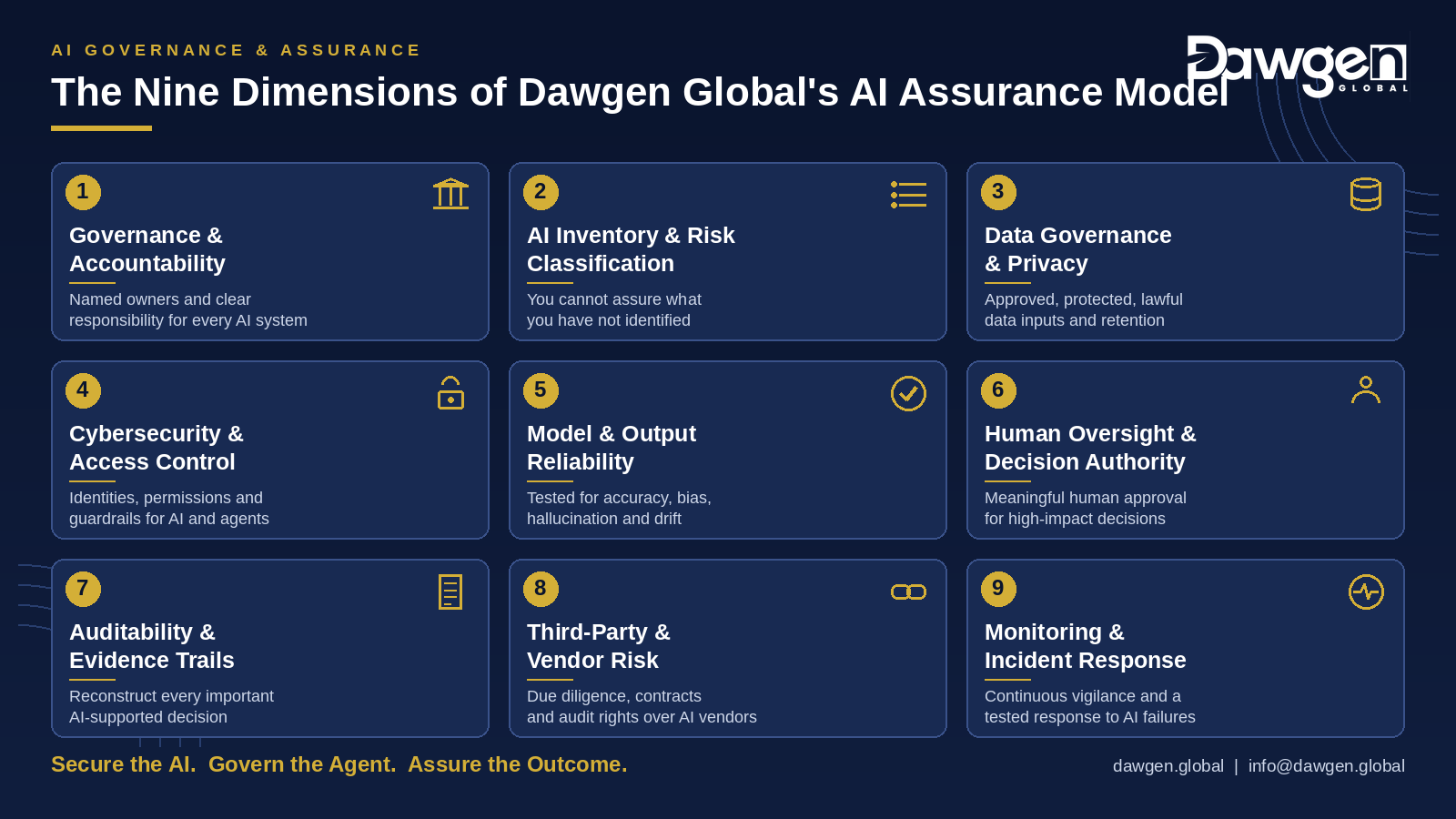
Dawgen Global recommends that organizations structure AI assurance around nine key dimensions:
1. Governance and accountability
Every AI system should have a clear business owner, risk owner, technical owner, and oversight structure. Accountability cannot be vague. If an AI system fails, produces harmful output, exposes confidential data, or triggers an unauthorized action, management must know who is responsible for response and remediation.
2. AI inventory and risk classification
Organizations cannot assure what they have not identified. A central AI inventory should capture all AI tools, models, agents, vendors, use cases, data sources, users, and risk ratings. High-risk AI systems should receive deeper review and stronger controls.
3. Data governance and privacy
AI systems depend on data. Assurance must evaluate whether data inputs are accurate, authorized, classified, protected, and aligned with privacy obligations — including, for organizations processing personal data in Jamaica, the accountability and security requirements of the Data Protection Act. Key questions include whether sensitive data is being used, whether personal data is protected, whether retention rules are defined, and whether third-party AI tools are processing data in acceptable ways.
4. Cybersecurity and access control
AI systems must be protected from misuse, manipulation, unauthorized access, prompt injection, data leakage, compromised credentials, insecure APIs, and weak integration controls. For AI agents, assurance should also examine identity management, permissions, segregation of duties, tool access, and kill-switch protocols — the disciplines at the heart of Dawgen Global’s D-AGENTICA™ methodology for responsible agentic AI adoption.
5. Model and output reliability
AI outputs should be tested for accuracy, completeness, consistency, relevance, bias, hallucination, and performance deterioration. This is particularly important when AI supports financial analysis, customer communication, compliance review, risk scoring, legal interpretation, hiring, lending, fraud detection, medical support, or cybersecurity response.
6. Human oversight and decision authority
AI should not silently replace human accountability in high-impact areas. Assurance should confirm that human-in-the-loop controls are meaningful, documented, and appropriate to the level of risk. A human reviewer must understand the AI output, the basis for the recommendation, and the consequences of accepting or rejecting it.
7. Auditability and evidence trails
Management must be able to reconstruct important AI-supported decisions. Assurance should assess whether the organization maintains appropriate logs, prompts, inputs, outputs, approvals, exceptions, user actions, system activity, and version history. Without auditability, AI decisions may be difficult to explain, defend, or improve.
8. Third-party and vendor risk
Many organizations use AI through cloud platforms, software vendors, APIs, managed service providers, and embedded enterprise applications. Assurance should assess vendor due diligence, data protection terms, security certifications, service commitments, model-change notifications, incident reporting, subcontractor risks, and audit rights.
9. Monitoring and incident response
AI assurance should evaluate whether the organization continuously monitors AI risks and has response procedures for AI failures, cyber incidents, data breaches, harmful outputs, regulatory issues, and reputational events. AI risk is dynamic — assurance cannot be limited to a one-time implementation review. This is the continuous-governance philosophy of Dawgen Global’s TRUST360™ approach: assurance as an ongoing cycle of monitoring, evidence, and board reporting, not an annual snapshot.
The audit committee’s AI assurance agenda
Audit committees should begin incorporating AI into their oversight calendars. A practical agenda may include:
- Management’s AI inventory and adoption roadmap
- AI risk assessment results and high-risk use cases
- Cybersecurity implications of AI deployment
- Data privacy and regulatory exposure
- Third-party AI vendor risk
- AI policy compliance and internal audit coverage of AI systems
- Incident reporting and escalation protocols
- Independent AI assurance findings
The audit committee should also ask whether AI is affecting financial reporting, internal controls, fraud risk, compliance monitoring, or management reporting. The greater the reliance on AI, the greater the need for assurance.
Five questions for your next audit committee meeting
If your committee asks nothing else about AI this quarter, ask these five questions:
- Do we have a complete inventory of where AI — including AI agents — is operating in this organization?
- Which AI systems touch personal data, financial reporting, or customers, and who owns each one?
- Can management show us evidence — not assurances — that AI outputs are validated and high-impact decisions have human approval?
- When did we last assess our AI vendors, and do our contracts give us audit rights?
- Who would tell us, and how quickly, if an AI system caused harm?
If management cannot answer these questions with evidence, the organization has an assurance gap — and the committee now knows exactly where to direct it.
Internal audit’s expanding role
Internal audit has a natural role in AI assurance. It understands governance, risk, controls, testing, evidence, and reporting. However, AI assurance requires multidisciplinary capability. Internal audit teams may need support from cybersecurity specialists, data scientists, IT auditors, privacy professionals, legal and compliance advisers, risk consultants, and external assurance providers.
The most effective model is collaborative. Internal audit should help the organization identify AI risks, evaluate controls, test governance arrangements, and provide independent reporting to the audit committee. This creates a major opportunity to modernize internal audit and align it with digital transformation — including through co-sourced arrangements that bring specialist AI, cyber, and data skills alongside the in-house team.
AI assurance is not anti-innovation
Some executives may fear that AI assurance will slow innovation. That is a misunderstanding. AI assurance enables responsible innovation. It helps organizations adopt AI with confidence, scale successful use cases, protect stakeholders, reduce avoidable failures, and satisfy board and regulatory expectations.
Without assurance, AI adoption may remain fragmented, informal, and risky. With assurance, AI can become a trusted enterprise capability. The question is not whether controls will limit AI. The real question is whether unmanaged AI risk will limit trust, adoption, and value creation.
“Boards do not need to understand every line of AI code, but they must understand the risk, the controls, and the assurance evidence. Trust in AI must be earned through governance, validation, and accountability.”
— Dr. Dawkins Brown, Executive Chairman, Dawgen Global
How Dawgen Global can help
Dawgen Global supports organizations across the Caribbean and globally in designing, assessing, and strengthening AI governance and assurance frameworks. Our integrated multidisciplinary model brings together cybersecurity, IT audit, internal audit, risk advisory, data protection, governance, compliance, technology, and board advisory expertise — big firm capabilities, Caribbean understanding.
A practical engagement pathway:
- Assess — AI Assurance Readiness Review; AI Inventory and Risk Classification; AI Vendor Risk Assessment; AI Governance & Cyber Risk Readiness Assessment
- Design — AI Policy and Control Framework Development; Agentic AI Guardrails Design; AI Auditability and Evidence Trail Design; Board and Audit Committee AI Risk Briefings
- Assure continuously — Independent AI Assurance Reviews; Continuous AI Control Monitoring under the TRUST360™ approach; Internal Audit Support and Co-Sourcing for AI Systems
Take the first step
Is your board or audit committee receiving enough assurance over how AI is being used in your organization? Dawgen Global can help you identify AI risks, assess controls, strengthen governance, and provide independent confidence that your AI systems are secure, reliable, auditable, and aligned with business objectives.
Secure the AI. Govern the Agent. Assure the Outcome.
Contact Dawgen Global today to request an AI Assurance Readiness Review.
Email: [email protected] | Web: dawgen.global
About Dawgen Global
Dawgen Global is an independent, integrated multidisciplinary professional services firm headquartered at 47 Trinidad Terrace, New Kingston, Jamaica, serving more than 15 territories across the Caribbean. Founded and led by Dr. Dawkins Brown, Executive Chairman, the firm is independent and not affiliated with any international network. It delivers a full suite of professional services under one roof: audit and assurance; tax advisory; IT and digital transformation; risk management; cybersecurity; actuarial and insurance regulatory advisory; HR advisory; mergers and acquisitions; corporate recovery; business advisory and strategy; accounting BPO and virtual CFO services; and legal process outsourcing.
The proposition is simple: big-firm capability without the big-firm price. Dawgen Global’s integrated approach is built for the specific complexities and opportunities of the Caribbean market, helping organizations make sharper, better-informed decisions that drive measurable progress.
To explore a partnership, reach out:
- Website: dawgen.global
- Email: [email protected]
- WhatsApp (Global): +1 555-795-9071
- Caribbean offices: +1 876-665-5926 | +1 876-929-3670 | +1 876-926-5210


