Performance management fails in many Caribbean organisations for one simple reason: it is treated as an annual HR event instead of a year-round management system. When expectations are unclear, feedback is irregular, documentation is weak, and rewards feel inconsistent, performance conversations become tense—and leaders end up managing problems too late. This article outlines a practical, Caribbean-ready performance management operating model: clear standards, role-based KPIs, manager coaching routines, documentation discipline, and calibrated decision-making—so performance improves, conflict drops, and talent becomes more productive and retainable.
In many Caribbean workplaces, “performance management” is synonymous with one thing: the appraisal form. Once per year, employees complete a self-assessment, managers scramble to remember what happened over the past twelve months, scores are assigned, and the process ends—often with more frustration than clarity.
But performance management was never meant to be an annual paperwork exercise. It is supposed to be a management system that helps organisations answer critical questions continuously:
-
What does good performance look like in each role?
-
Are people meeting expectations—consistently and fairly?
-
What should be coached, what should be developed, and what should be corrected?
-
Who is ready for more responsibility?
-
Where are we carrying performance risk that will become business risk?
When these questions aren’t answered throughout the year, the organisation pays for it in predictable ways: inconsistent standards, rising grievances, disengagement, manager fatigue, avoidable turnover, and weak accountability.
A strong performance management system does not make the workplace harsh. It makes it fair. It gives employees clarity. It gives managers structure. It gives leadership confidence that decisions about pay, promotion, training, and discipline are defensible and consistent.
This article provides a practical performance management playbook built for a mixed Caribbean audience—SMEs, mid-market organisations, and larger employers—designed to work in real operations, not just in policy documents.
Why performance management breaks down in the Caribbean context
Caribbean organisations share several common constraints that make performance management difficult:
1) “We’re too busy to do performance properly”
In service businesses and operational environments, managers are often overloaded. When performance management isn’t designed as a simple routine, it becomes the first thing dropped.
2) Promotion without management training
Many supervisors are promoted because they are good technicians—not because they are trained people leaders. Without coaching and tools, performance conversations become inconsistent or avoided.
3) Informal culture and fear of conflict
In smaller societies and close teams, managers often avoid “hard conversations” to preserve harmony. Unfortunately, avoided feedback becomes bigger conflict later.
4) Documentation gaps
Even where managers try to act fairly, weak documentation undermines consistency and exposes the business when disputes arise.
5) Misalignment between performance and rewards
If pay increases, bonuses, promotions, and recognition are not linked to performance standards, employees conclude that performance is optional—or political.
These challenges don’t mean performance management is impossible. They mean the system must be practical, lightweight, and built around manager routines—not HR forms.
The goal: performance management as an operating model
A performance management system must do five things well:
-
Clarify expectations (what “good” means)
-
Create visibility (how performance is trending)
-
Drive development (coaching and capability building)
-
Enable accountability (correction when needed)
-
Support decisions (pay, promotion, succession, retention)
If any of these are missing, the system becomes either “nice” (development-only) or “punitive” (accountability-only). High-performing organisations build both.
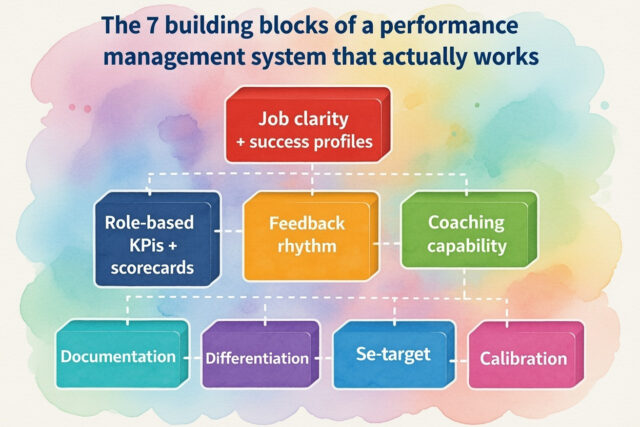
The 7 building blocks of a performance management system that actually works
Block 1: Job clarity and success profiles
Performance management begins before the first day of work—with role clarity.
Every role should have a simple “success profile” that includes:
-
purpose of the role (why it exists)
-
key outcomes (what it must deliver)
-
core responsibilities (what it does)
-
quality standards (how outcomes are measured)
-
behavioural expectations (how work is done)
Without a success profile, performance conversations become subjective. Employees feel judged rather than guided.
Practical tip: Start with your top 10 roles. Build success profiles for them first. Expand from there.
Block 2: Role-based KPIs and practical scorecards
Caribbean businesses often fail here by choosing KPIs that are either:
-
too financial (and outside employee control), or
-
too complex (so managers don’t use them).
A role scorecard should be short and relevant. Ideally, each role has 4–8 measures that are a mix of:
-
Output measures (volume, completion, delivery)
-
Quality measures (error rate, rework, customer complaints)
-
Timeliness measures (response time, deadlines, attendance)
-
Behavioural standards (teamwork, integrity, safety compliance)
-
Capability growth (skill building, certification progress)
Example (Customer service role)
-
average response time
-
first-contact resolution rate
-
customer satisfaction score (or complaints trend)
-
accuracy of records
-
attendance and punctuality
-
teamwork/communication behaviour
The power of a scorecard is not perfection—it is consistency.
Block 3: A feedback rhythm (weekly, monthly, quarterly)
If feedback only occurs annually, performance management becomes a memory game.
A practical rhythm is:
-
Weekly (10–15 minutes): quick check-in on priorities and blockers
-
Monthly (30–45 minutes): review scorecard trends, coaching, and workload
-
Quarterly (60 minutes): formal review of outcomes, development plan, and role alignment
This isn’t bureaucracy. It is a discipline that reduces surprises and makes appraisals straightforward.
Key principle: The annual review should never contain new information.
Block 4: Coaching as a manager capability, not an HR activity
Coaching is the engine of performance improvement. But most managers coach inconsistently because they were never taught a framework.
A simple coaching model managers can use is SBI + Next Step:
-
Situation: “In yesterday’s client meeting…”
-
Behaviour: “You interrupted twice and did not confirm requirements.”
-
Impact: “The client looked uncertain and asked for a follow-up email.”
-
Next step: “In the next meeting, summarise requirements and ask for confirmation before closing.”
This makes feedback specific and less emotional.
Caribbean reality: People accept feedback more readily when it is clear, specific, and connected to outcomes—without personal attacks.
Block 5: Documentation that protects fairness and decisions
Documentation is not about building a case against an employee. It is about clarity and fairness—so everyone understands what happened, what was expected, and what improvement looks like.
A practical documentation standard includes:
-
date of conversation
-
issue or performance gap
-
standard expected
-
support offered (training/coaching/resources)
-
agreed actions and timeline
-
next review date
This documentation can be brief—but it must exist.
Why it matters: When disputes arise, documentation often determines whether decisions are perceived as fair and defensible.
Block 6: Differentiation—stop rating everyone “average”
Many organisations flatten performance because managers fear conflict. But if everyone is rated the same, high performers feel unrewarded and leave.
A healthy performance distribution doesn’t have to be harsh. It can be simple:
-
Exceeds expectations: consistently delivers above standard; ready for more
-
Meets expectations: reliable performance at required standard
-
Developing: meets some standards but needs structured improvement
-
Not meeting expectations: sustained underperformance requiring corrective action
The most important part is that “Developing” includes a plan—not punishment. And “Not meeting expectations” includes a structured, time-bound improvement process.
Block 7: Calibration—ensuring fairness across managers and departments
A common retention killer is inconsistency: one manager is strict, another is lenient; one department rewards performance, another ignores it.
Calibration is a simple quarterly leadership review where managers discuss:
-
performance standards and examples
-
ratings consistency
-
promotion readiness
-
development priorities
-
compensation alignment principles
This protects fairness and reduces bias.
The performance improvement pathway: how to fix performance without drama
When performance dips, managers often jump to extremes: ignore it, or punish it. A better approach is a staged pathway:
Stage 1: Clarify expectations
Sometimes performance dips because expectations were never clear. Fix the success profile and scorecard first.
Stage 2: Coach and support
Provide coaching, training, and resources. Identify blockers: tools, workload, clarity, motivation.
Stage 3: Formal improvement plan (when needed)
If performance is still below standard, introduce a time-bound plan:
-
goals and standards
-
support actions
-
weekly check-ins
-
documentation
-
consequences if no improvement
This is not hostile. It is a structured chance to recover.
Stage 4: Corrective action (only when improvement does not occur)
When support and clarity have been provided, accountability becomes fair and defensible.
Linking performance to compensation, recognition, and retention
Performance management fails if it doesn’t connect to the outcomes employees care about:
-
pay progression
-
bonuses or incentives
-
promotion opportunities
-
recognition and visibility
-
training sponsorship
-
career pathways
If employees perceive that outcomes are unrelated to performance, performance conversations lose credibility.
Practical approach:
-
define what “Exceeds” earns (bonus %, promotion readiness, accelerated pay band movement)
-
define what “Meets” earns (standard increase, development pathway)
-
define what “Developing” earns (conditional increase tied to improvement plan)
-
define consequences for “Not meeting expectations” (formal plan and review)
You don’t need unlimited budgets to do this. You need clarity and consistency.
Performance management for different organisation sizes
SMEs (1–50 staff): keep it lightweight and consistent
What works:
-
role success profiles for top 10 roles
-
monthly performance check-ins (simple)
-
quarterly formal reviews for key staff
-
a basic documentation habit
-
recognition tied to outcomes
Avoid:
-
complex scoring systems that nobody uses
Mid-market (50–250 staff): standardise across managers
What works:
-
role scorecards for core functions
-
supervisor training in feedback and documentation
-
quarterly calibration meetings
-
formal performance improvement pathway
-
alignment to pay bands and progression
Larger/regulatory-heavy employers (250+): governance and evidence
What works:
-
formal policy and documentation standards
-
structured goal cascading (strategy → department → team → individual)
-
training compliance and role certification pathways
-
performance analytics (turnover vs performance, training impact)
-
stronger investigation and escalation protocols when needed
The manager’s toolkit: practical templates that change behaviour
If you want managers to implement performance management, give them tools that make it easy:
-
1-page role success profile template
-
role scorecard template (4–8 KPIs)
-
monthly check-in guide (agenda + questions)
-
coaching note template (SBI + next step)
-
performance improvement plan template
-
quarterly review template (outcomes, behaviours, development)
-
calibration meeting guide (standards and examples)
Tools reduce anxiety. They also drive consistency.
A 90-day roadmap to rebuild performance management
Days 1–15: Diagnose and reset
-
identify top performance pain points (turnover, service issues, rework, grievances)
-
choose priority roles (top 10–15)
-
confirm leadership expectations and accountability
Days 16–45: Build the system
-
develop success profiles and scorecards
-
train managers on coaching and documentation
-
launch monthly check-in rhythm
-
create performance improvement pathway
Days 46–75: Implement and stabilise
-
run first monthly check-ins
-
begin quarterly reviews for priority teams
-
introduce calibration meeting rhythm
-
link performance categories to development actions
Days 76–90: Align rewards and measure
-
connect outcomes to recognition and pay progression principles
-
review early results: quality, service, attendance, manager compliance
-
refine templates and training as needed
The goal is not perfection in 90 days. The goal is a working system that makes improvement continuous.
Appraisals don’t manage performance—managers do
A strong performance management system is not about forms. It is about clarity, coaching, documentation, consistency, and fair decisions.
When performance management works, organisations experience:
-
higher productivity and quality
-
fewer disputes and grievances
-
stronger manager capability
-
better retention of top performers
-
clearer promotion and succession decisions
-
a culture where accountability feels fair
In a competitive Caribbean talent environment, that advantage compounds.
Next Step!
If your performance appraisal process feels stressful, inconsistent, or ineffective, Dawgen Global can help you design a year-round performance management system that managers can actually run—built around practical tools, coaching routines, fair documentation, and calibrated decision-making.
Start with a Performance Management Diagnostic, and receive:
-
role success profile + scorecard templates,
-
a manager coaching and documentation toolkit,
-
a 90-day implementation roadmap, and
-
a calibration and improvement pathway aligned to your culture and operations.
🔗 Contact form: https://www.dawgen.global/contact-us/
📧 Email: [email protected]
📞 Telephone Contact Centre (Caribbean): 876-9293670 | 876-9293870
📞 USA: 855-354-2447
WhatsApp Global: +1 555 795 9071
About Dawgen Global
“Embrace BIG FIRM capabilities without the big firm price at Dawgen Global, your committed partner in carving a pathway to continual progress in the vibrant Caribbean region. Our integrated, multidisciplinary approach is finely tuned to address the unique intricacies and lucrative prospects that the region has to offer. Offering a rich array of services, including audit, accounting, tax, IT, HR, risk management, and more, we facilitate smarter and more effective decisions that set the stage for unprecedented triumphs. Let’s collaborate and craft a future where every decision is a steppingstone to greater success. Reach out to explore a partnership that promises not just growth but a future beaming with opportunities and achievements.
 Email: [email protected]
  Visit: Dawgen Global Website

 WhatsApp Global Number : +1 555-795-9071
Caribbean Office: +1876-6655926 / 876-9293670/876-9265210  WhatsApp Global: +1 5557959071
USA Office: 855-354-2447
Join hands with Dawgen Global. Together, let’s venture into a future brimming with opportunities and achievements


