
Trouble is not what kills businesses. Untreated trouble is. Most firms do not die of their problems — they die of the year spent not facing them. A turnaround is a sequence, and it begins with a phone call most owners make twelve months too late.
The Problem, Lived
“Carlton” has run a manufacturing and distribution business in Kingston for twenty-two years — thirty-five staff, a name that once meant something on three islands, and, for the past three years, losses. Not dramatic ones; survivable-looking ones, each masked in its turn: an asset sold here, a personal loan injected there, a pension of pride quietly liquidated to make payroll. The receivables have bloated, the prices have not moved, the debt is all short-term and all personal-guaranteed, and the obligations that must never fall behind have begun, unspeakably, to fall behind. The bank has started using a new tone. Two suppliers have him on stop.
But the ledger is not where Carlton’s crisis lives. It lives in the performance: the confident face at the Rotary lunch, the ‘busy, thank God’ at church, the full picture his wife has never been given — and the sleep that ends at 3 a.m. with arithmetic. Last Tuesday, his longest-serving employee — nineteen years, three children through school on his payroll — asked him quietly whether her job was safe. He said yes. He drove home knowing it was the first time in twenty-two years he had looked one of his people in the eye and lied.
That lie is Carlton’s bottom — and this article exists for the morning after it. Because here is what he cannot see from inside the shame: his business is almost certainly not dead. Somewhere inside the struggling whole there is usually a viable core, and there is a disciplined, walkable path back to it. What is killing him is not the trouble. It is the silence — and silence, unlike insolvency, can be ended today.
Why It Happens Here
Small societies punish visible failure, so owners hide invisible failure — long past the point where hiding costs more than the truth. The shame architecture is regional and specific: everyone will know; the name is the family’s name; the church, the school gate, the sector — all one audience. So the denial machinery engages: doubling down on the failing line like a gambler chasing a loss, feeding the business assets and personal borrowings that convert a company problem into a family catastrophe, and treating advisors as the people you call at the morgue rather than the ICU.
Beneath the psychology sits a structural gap: the region has a thin rescue culture. Trouble is assumed to be a death sentence rather than a treatable condition, so the treatable months are wasted preparing for a funeral. And the great counterintuitive truth goes unlearned: creditors — banks, suppliers, statutory bodies — respond better to early, honest engagement with a credible plan than to silence, almost universally. Silence is read as death approaching; a plan is read as life fighting. The bank that turns cold at unanswered calls will often restructure for a client who arrives early, informed and advised. The supplier who put you on stop wants, above almost everything, a living customer. Nobody in the room profits from your funeral. Most owners discover this eighteen months later than they needed to.
| The Cost of the Quiet Year
Turnaround is a race against option-decay. The problem that a conversation can solve in month one needs a restructuring by month twelve and an insolvency practitioner by month twenty-four. Every quiet month closes doors that honesty would have kept open: the bank’s patience, the supplier’s flexibility, the statutory arrangement, the buyer for the division, the key employee who is still here. Time is the turnaround’s real currency — and denial spends it at the worst exchange rate in business. If part of you is reading this article for a friend, be kinder to yourself than that. The earliest version of the call is the cheapest. |
Why Generic Advice Fails
The global turnaround canon is built on other machinery: court-supervised reorganization regimes with their own case law, deep distressed-debt markets, private-equity rescue capital circling every sector. The startup literature’s cheerful ‘pivot’ vocabulary is worse than useless to a twenty-two-year-old manufacturer with payroll on Friday. A regional turnaround runs on different terrain — smaller markets where every stakeholder knows every other, banking relationships that are personal, statutory bodies with their own procedures, and courts to be avoided by early action rather than relied upon after late action. What works here is a method built for here — disciplined, staged, and executed with people the creditors already trust across the table.
The Framework: The TRANSCEND™ Turnaround Sequence — Five Stages, Step by Step
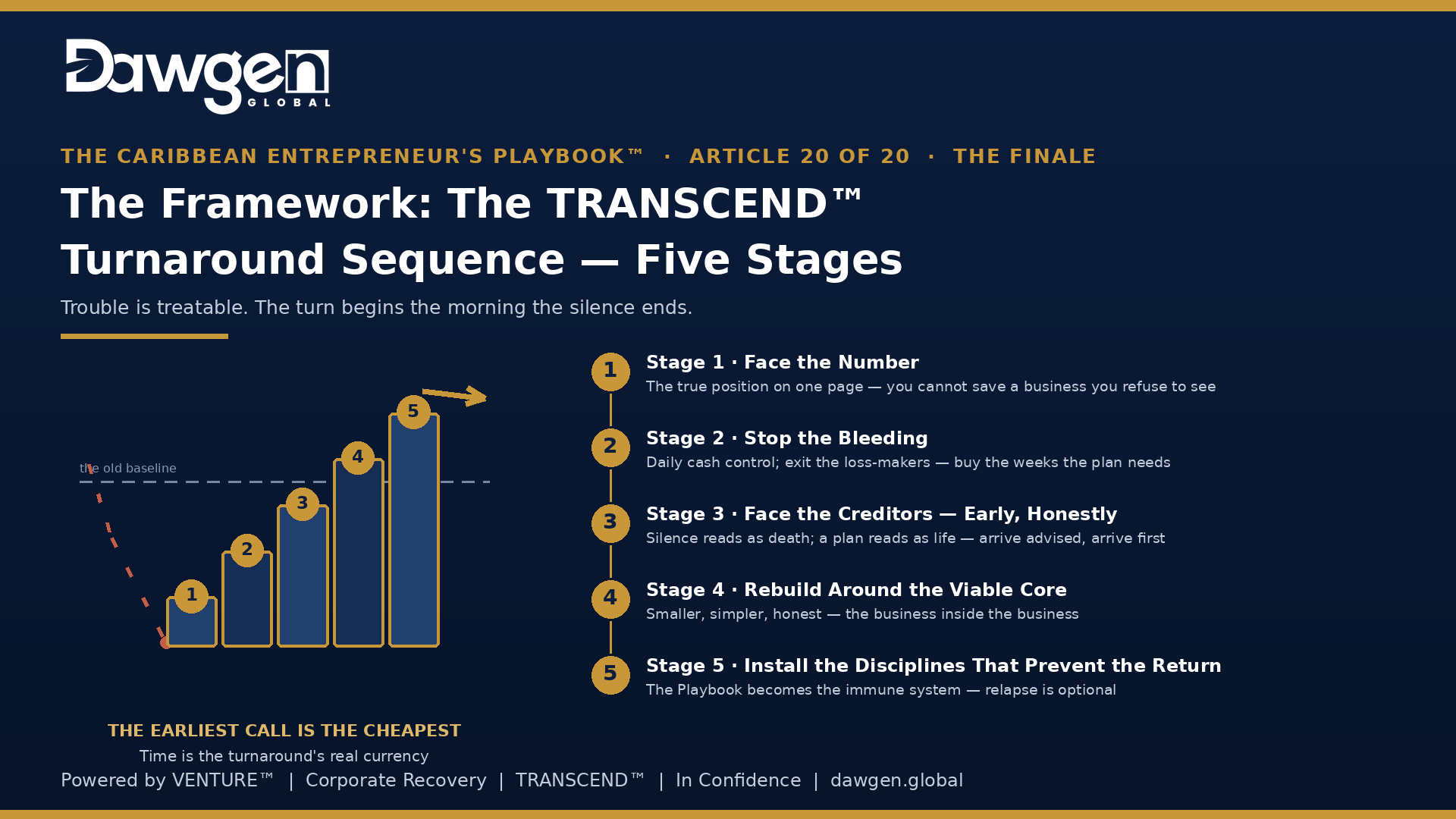
Distilled from Dawgen Global’s TRANSCEND™ corporate restructuring framework, sized for the owner who needs to start this week:
- Stage 1 · Face the Number — The turnaround begins the moment the true position is written on one page: real cash, all debts by creditor and age, and — the revelation — honest profitability by product and customer, at true costs (Article 7’s discipline, now urgent). Most owners in trouble have never seen their whole position in one place; the fog was the denial’s habitat. The number is almost always frightening and almost never as hopeless as the 3 a.m. arithmetic — and inside it, the diagnosis: which activities are the viable core, and which have been eating it alive. You cannot save a business you refuse to see.
- Stage 2 · Stop the Bleeding — Cash control goes to crisis footing: Article 5’s thirteen-week forecast, now maintained daily; every non-essential outflow paused; collections pursued with Article 6’s full machinery and none of its patience; and the loss-making products and customers identified in Stage 1 exited fast — in a turnaround, the courage to shrink is the courage to survive. The goal of this stage is measured in weeks: buy the time the next stage needs. Nothing strategic can be built by a business that might not clear Friday.
- Stage 3 · Face the Creditors — Early, Honestly, Together — Now the counterintuitive stage: approach the bank, the key suppliers and the statutory bodies before they conclude the worst — with the Stage 1 truth, the Stage 2 controls, and a credible plan. Sequenced properly and presented professionally, these conversations convert enemies into stakeholders: debts restructured onto terms the business can carry (Article 8’s term-matching, finally applied), supply resumed against honored schedules, formal arrangements replacing accumulating silence. A professional intermediary changes the reception entirely — the same facts, arriving with an advisor and a plan, read as recovery rather than collapse. This is the stage owners fear most and the stage that saves the company.
- Stage 4 · Rebuild Around the Viable Core — Shrink to the business inside the business: the profitable center Stage 1 found, freed of everything that was bleeding it. Renegotiate the structure around it — leases, terms, the debt now sized and shaped to the smaller, truer firm. And have the team conversation with the honesty the crisis was owed all along: Article 14’s accountability-as-care at its hardest setting — departures handled with severance honored and references given, dignity preserved on both sides of the desk, and the remaining team told the truth they always sensed. A turnaround business is almost always smaller. Done right, it is also simpler, faster and honest — which is why it can grow again.
- Stage 5 · Install the Disciplines That Prevent the Return — The crisis ends; the turnaround ends later — when the habits that caused it are gone. This is where the sequence hands back to the Playbook itself: the weekly cash ritual (Article 5), the pricing rhythm (7), the receivables machine (6), the data and intelligence (10, 17), the governance and the scoreboard (4, 14), the risk ledger (19). Relapse is the turnaround’s most common ending, and it is entirely optional. The nineteen articles before this one were never really separate topics. They were the immune system — and Stage 5 is where it gets installed, permanently, in a business that now knows exactly why it matters.
The Framework in Action: A Worked Scenario
The following scenario is a fictional composite created for this series to illustrate the framework. It does not depict any actual business or client of the firm.
Carlton makes the call on the morning after the lie — and the first surprise is the tone on the other end: procedural, unshocked, kind. The diagnosis weekend produces the page: one of his three product lines has quietly earned money every year; the other two have been consuming it, along with the asset sales and the loans. Daily cash control begins Monday. Within three weeks, the bleeding lines are in managed exit and the thirteen-week forecast shows something he has not seen in years: a version of the future with margin in it.
The creditor round is the fortnight he dreaded for two years and survives in ten days. The bank — arriving early, advised, with a plan — restructures the debt onto terms the core business can actually carry. The two key suppliers accept a payment schedule and resume supply the same week; one of them says the sentence that reframes everything: ‘We just needed to know you were alive.’ The statutory position is formalized into an arrangement and kept. The company that emerges is smaller — one strong line, twenty-four staff, eleven departures handled with honored severance and personally written references — and the hardest conversation of all happens at his own dinner table, where the full picture is finally shared and the marriage, it turns out, survives the truth far better than it had been surviving the silence.
In this illustration, eighteen months later the business is modestly profitable, cash-positive, and running the Monday ritual like liturgy. His longest-serving employee is still there. He never lied to her again — he didn’t need to, because now there is a scoreboard on the wall that tells her the truth weekly, and the truth has become tellable. Carlton will say, to the few people he now talks to openly about that year, that the turnaround did not really begin with the diagnosis or the bank meeting. It began the morning he decided the silence was the only thing in the business that truly had to die.
Self-Diagnostic: How Early Is Your Warning?
One point for every “yes” — and note the difference: this time, earlier is everything:
- Have losses or cash shortfalls been covered by asset sales or personal money more than once?
- Are any obligations that must never fall behind, falling behind?
- Are you managing creditors by avoidance — the unreturned call, the unopened letter?
- Is there a version of the business’s true position that key people — including at home — have not seen?
- Is the 3 a.m. arithmetic now a routine?
Even one point deserves the diagnosis weekend. Two or more means the quiet year has already begun — and every month of it is spending options you will want back. The earliest version of the call is the cheapest. It is also, veterans of it will tell you, the moment the sleep comes back.
When to Call In Help
This is the one article in the Playbook where the answer to ‘when?’ is simply: now, and in confidence. Turnaround is structurally professional work — the diagnosis needs accounting rigor, the creditor round needs standing and sequence, the restructuring needs legal and tax architecture, the statutory conversations need experienced hands — and it is emotionally impossible to run alone from inside the shame. Dawgen Global’s Corporate Recovery team, operating under the TRANSCEND™ framework with our Legal, Tax and Audit teams in the same room, has sat on the calm side of this table many times. The conversation is confidential. The judgment you fear is not in the room. And the difference between the ICU and the morgue is, almost always, simply the date on the phone call.
| REQUEST A CONFIDENTIAL TURNAROUND CONSULTATION
Dawgen Global’s Corporate Recovery team, through the TRANSCEND™ framework, walks distressed businesses through the full sequence: the honest diagnosis, emergency cash control, the creditor engagement round with our professionals beside you, the rebuild around your viable core, and the permanent installation of the disciplines that prevent the return — with Legal, Tax and Audit expertise integrated throughout. Every conversation is strictly confidential. Contact us today — because the earliest version of this call is the cheapest, and the sleep comes back sooner than you think. 📩 [email protected] | 📞 876-929-3670 / 876-665-5926 | 🇺🇸 855-354-2447 | 🌐 dawgen.global GET THE FULL PLAYBOOK This is the final article of The Caribbean Entrepreneur’s Playbook™ — 20 problems, 20 how-to frameworks, one system, complete. Pre-register at dawgen.global to receive the full Playbook e-book on release, free — every framework, every diagnostic, in one volume. |
About Dawgen Global
Dawgen Global is an independent, integrated multidisciplinary professional services firm headquartered at 47 Trinidad Terrace, New Kingston, Jamaica, serving more than 15 territories across the Caribbean. Founded and led by Dr. Dawkins Brown, Executive Chairman, the firm is independent and not affiliated with any international network. It delivers a full suite of professional services under one roof: audit and assurance; tax advisory; IT and digital transformation; risk management; cybersecurity; actuarial and insurance regulatory advisory; HR advisory; mergers and acquisitions; corporate recovery; business advisory and strategy; accounting BPO and virtual CFO services; and legal process outsourcing.
The proposition is simple: big-firm capability without the big-firm price. Dawgen Global’s integrated approach is built for the specific complexities and opportunities of the Caribbean market, helping organizations make sharper, better-informed decisions that drive measurable progress.
To explore a partnership, reach out:
- Website: dawgen.global
- Email: [email protected]
- WhatsApp (Global): +1 555-795-9071
- Caribbean offices: +1 876-665-5926 | +1 876-929-3670 | +1 876-926-5210


