Executive Summary
The global venture capital industry is undergoing a structural reset. Venture-backed companies are staying private for longer, exits are slowing, liquidity is becoming harder to achieve, secondary markets are emerging as an important private-market tool, and artificial intelligence is reshaping how companies are built, valued, funded, and scaled.
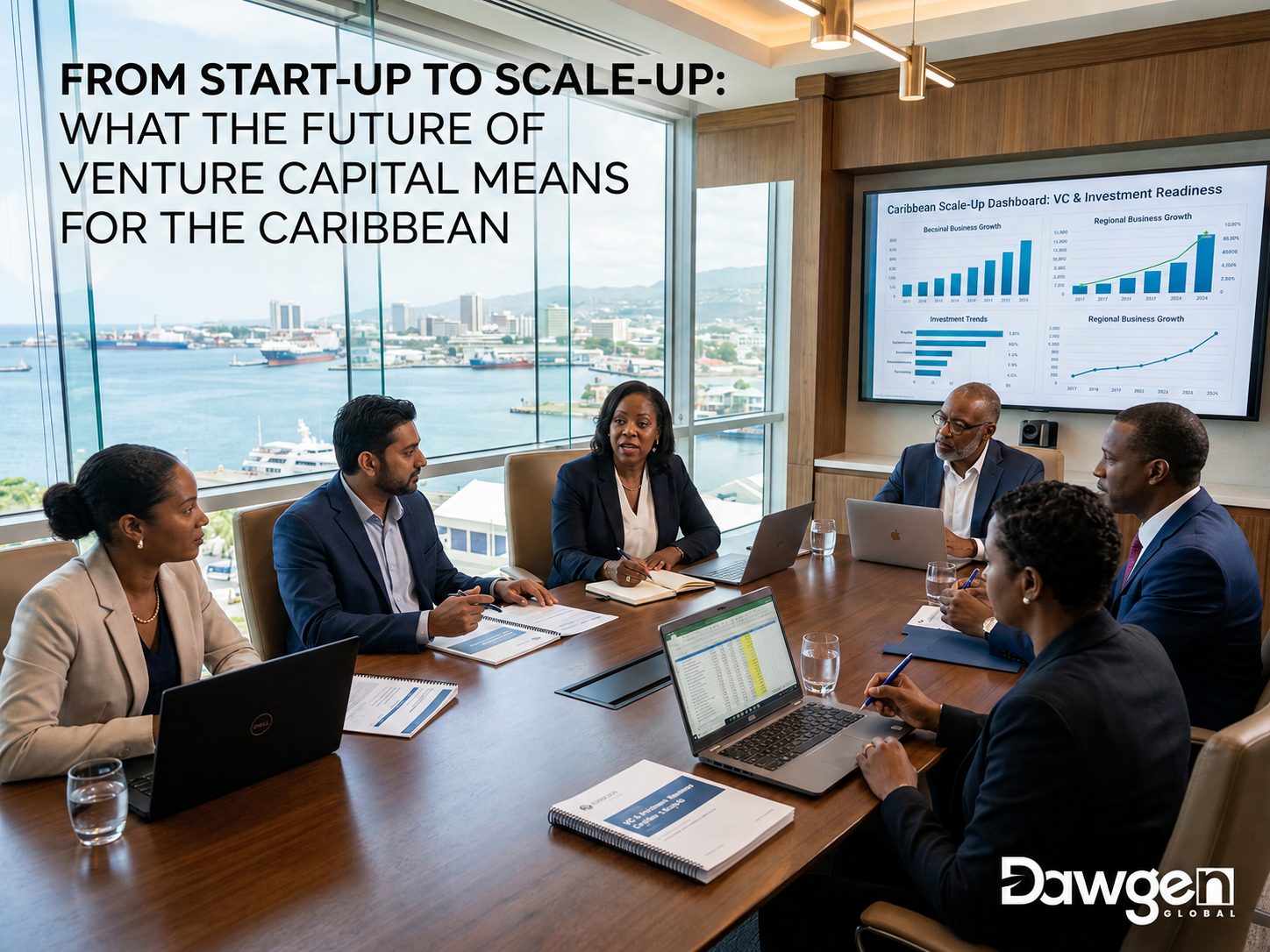
For the Caribbean, the lesson is clear: building a start-up culture is no longer enough. The region must now develop a scale-up architecture—a coordinated ecosystem that supports high-growth companies from idea to regional expansion, international competitiveness, investor readiness, liquidity, and long-term value creation.
A recent World Economic Forum report, produced in collaboration with the Stanford Graduate School of Business Venture Capital Initiative, highlights five major priorities for strengthening venture capital globally: improving secondary-market infrastructure, mobilizing institutional capital, reducing regulatory friction, strengthening talent ecosystems, and enabling strategic government participation.
These priorities are highly relevant to Jamaica and the wider Caribbean. The region has entrepreneurs, creativity, sectoral opportunities, digital talent, and access to diaspora capital. However, it still faces major barriers: fragmented markets, limited venture funding, weak exit pathways, shallow private capital markets, regulatory complexity, and insufficient mechanisms for converting successful entrepreneurs into repeat founders, angel investors, and ecosystem builders.
Dawgen Global believes the Caribbean must now move from entrepreneurship promotion to innovation finance infrastructure. This requires stronger governance, better valuation discipline, investor-ready financial reporting, regional capital formation, private-market liquidity mechanisms, AI-enabled business transformation, and policy frameworks that help companies scale beyond national borders.
1. Venture Capital Is More Than Start-Up Funding
Venture capital is often misunderstood as simply “money for start-ups.” In reality, it is a specialized form of risk capital designed to finance companies with high growth potential, uncertain early-stage economics, limited collateral, and long development cycles.
Traditional bank lending is usually not well suited to these businesses. Banks generally prefer borrowers with stable cash flows, collateral, repayment history, and predictable earnings. Many innovative companies, especially those built around software, platforms, artificial intelligence, intellectual property, biotechnology, fintech, digital services, and new business models, may not meet those traditional lending criteria in their early stages.
This is where venture capital plays a distinctive role. It provides patient capital, accepts higher failure risk, and supports companies through multiple stages of growth. The WEF report notes that venture capital has helped produce many of the world’s most consequential businesses, including firms in technology, semiconductors, software, biotechnology, and clean energy.
For the Caribbean, this distinction matters. If the region wants to build globally competitive businesses, it cannot rely exclusively on commercial bank lending. It must cultivate broader forms of capital, including:
- Angel investment
- Venture capital
- Growth equity
- Private equity
- Family office capital
- Pension fund participation where appropriate
- Development finance
- Corporate venture partnerships
- Diaspora investment
- Strategic government-backed catalytic funds
The goal is not to replace traditional finance. The goal is to create a more complete capital ecosystem.
2. The Caribbean’s Challenge: Many Start-Ups, Too Few Scale-Ups
Across the Caribbean, entrepreneurship is widely encouraged. Governments, universities, accelerators, business associations, and development agencies have all promoted start-up activity. This is important, but it is only the first stage.
The more difficult question is:
How many Caribbean start-ups can become scalable, regionally integrated, export-capable, investment-ready enterprises?
This is where the Caribbean faces a structural challenge. Many promising businesses remain small, undercapitalized, founder-dependent, and locally confined. They may have good products or services, but lack the financial systems, governance, strategic planning, technology infrastructure, management depth, and capital access needed to scale.
The WEF report describes a global “scale-up gap”: start-ups now emerge in many regions, but only a small number of ecosystems can consistently scale companies into global champions.
This is directly applicable to the Caribbean. The region does not lack ambition. It lacks sufficient scale-up infrastructure.
Key barriers include:
- Small domestic markets
- Fragmented regional regulations
- Limited access to growth capital
- Weak regional exit markets
- Limited merger and acquisition activity
- Insufficient investor-ready financial reporting
- Underdeveloped private-company valuation practices
- Limited use of employee stock options
- Talent migration
- Low participation by institutional investors in venture-type assets
- Limited secondary-market infrastructure
- Inadequate founder-to-founder reinvestment networks
The result is that many entrepreneurs build viable businesses, but few build companies capable of attracting significant institutional capital or scaling across the region and beyond.
3. Liquidity Is the Missing Link in Caribbean Private Markets
One of the most important themes in the WEF report is liquidity. Globally, venture-backed companies are staying private for longer, delaying IPOs and acquisitions. This slows the recycling of capital back to investors and limits the ability of those investors to fund the next generation of companies.
In the Caribbean, the liquidity challenge is even more pronounced.
Many private businesses have no clear pathway for shareholders to partially exit, diversify wealth, or bring in new investors. Founders may spend decades building a business but have limited options beyond:
- Selling the entire company
- Passing it to family members
- Borrowing against assets
- Bringing in a private investor on bespoke terms
- Attempting a listing, where feasible
- Continuing indefinitely without a formal liquidity event
This creates several problems. Investors may hesitate to invest if they cannot see a credible exit pathway. Founders may be reluctant to give up equity if valuation and liquidity mechanisms are unclear. Employees may not benefit meaningfully from value creation. Family-owned businesses may struggle with succession. Pension funds and family offices may avoid private growth investments because of illiquidity concerns.
The global rise of secondary markets offers an important lesson. Secondary transactions allow existing shareholders to sell some or all of their interests to new investors without requiring a full company sale or IPO. The WEF report identifies secondary markets as an increasingly important mechanism for restoring capital recycling in venture ecosystems.
For the Caribbean, this does not mean copying advanced secondary markets immediately. It means beginning the groundwork:
- Better private-company valuation standards
- Stronger shareholder agreements
- Improved financial reporting
- Transparent governance structures
- Investor disclosure practices
- Regulatory clarity
- Mechanisms for partial liquidity
- Platforms or networks for private capital transactions
- Professional due diligence support
Liquidity is not only a market function. It is also a governance and confidence function.
4. Institutional Capital Must Be Mobilized Carefully and Strategically
The WEF report highlights the importance of institutional capital, including pension funds, endowments, sovereign wealth funds, and family offices. It notes that the ability of venture ecosystems to grow is closely linked to the depth and structure of their investor base.
This issue is highly relevant to the Caribbean. Pension funds, insurance companies, credit unions, family offices, and high-net-worth investors represent significant pools of long-term capital. However, much of this capital is traditionally allocated to government securities, real estate, listed equities, deposits, and conservative fixed-income instruments.
There are valid reasons for caution. Venture capital and private equity involve higher risk, longer time horizons, valuation uncertainty, illiquidity, and governance complexity. Pension trustees and fiduciaries must act prudently and in the best interests of beneficiaries.
However, the question is not whether all institutional investors should rush into venture capital. They should not.
The better question is:
Can a small, carefully governed, professionally managed allocation to innovation finance support diversification, economic development, and long-term value creation?
This requires:
- Clear investment policy statements
- Fiduciary education
- Proper risk classification
- Independent due diligence
- Diversified fund structures
- Strong governance
- Professional valuation
- Transparent reporting
- Regulatory guidance
- Alignment with long-term liabilities
- Avoidance of politically directed investment decisions
Dawgen Global’s view is that institutional capital can play a catalytic role in Caribbean innovation finance, but only if supported by strong governance, appropriate regulation, and disciplined investment processes.
5. Regulatory Fragmentation Is a Scaling Tax
The Caribbean is not one single market. It is a collection of jurisdictions with different legal systems, tax rules, company laws, securities regulations, employment frameworks, exchange control considerations, and licensing requirements.
For a start-up or growth company, this fragmentation creates a “scaling tax.” Expanding from one Caribbean market to another can involve legal restructuring, tax review, regulatory approvals, new employment arrangements, banking complexity, and compliance duplication.
The WEF report identifies regulatory fragmentation as one of the most persistent barriers to scaling innovation globally.
For Caribbean policymakers, this should be a priority area. If the region wants to create companies that can scale across CARICOM and beyond, it must reduce unnecessary friction. This does not mean eliminating national regulatory authority. It means improving coordination, mutual recognition, digital incorporation processes, securities market cooperation, tax clarity, and cross-border business facilitation.
Potential areas for reform include:
- Regional start-up incorporation frameworks
- Harmonized investment documentation
- Simplified cross-border fundraising rules
- Improved treatment of employee stock options
- Regional digital business identity systems
- Streamlined work permits for specialized talent
- Coordinated fintech and AI regulatory sandboxes
- Mutual recognition of certain professional and business registrations
- More efficient mechanisms for cross-border mergers and acquisitions
The Caribbean needs a regional scale-up agenda, not only national start-up policies.
6. AI Changes the Economics of Scaling
Artificial intelligence is no longer only a technology issue. It is now a capital allocation, valuation, workforce, productivity, governance, and strategy issue.
The WEF report emphasizes that AI is changing what venture-backed companies look like, how they scale, and how investors evaluate them. AI-native companies may reach revenue milestones faster and with smaller teams, but they may also require major investment in data, infrastructure, compute, cybersecurity, and specialized talent.
For Caribbean businesses, AI creates both opportunity and risk.
The opportunity is that smaller companies may be able to scale more efficiently using AI-enabled tools for:
- Financial analysis
- Customer service
- Marketing
- Legal document review
- Risk monitoring
- Accounting automation
- Business intelligence
- Cybersecurity detection
- Process automation
- Product development
- Training and knowledge management
The risk is that businesses that fail to adopt AI may become structurally less competitive. AI could widen the gap between firms that modernize and firms that remain dependent on manual, slow, paper-based, or fragmented operating models.
For investors and lenders, AI also complicates valuation. Traditional metrics may not fully capture the value or risk of AI-enabled businesses. Advisors will need to assess:
- Revenue quality
- Customer concentration
- Data rights
- Intellectual property ownership
- Model dependency
- Cybersecurity exposure
- Regulatory risk
- Scalability
- Unit economics
- Human capital resilience
- Technology governance
Dawgen Global believes AI readiness will become a core component of investor readiness.
7. Founder Factories: The Caribbean Needs Entrepreneurial Recycling
One of the most powerful ideas in the WEF report is the “founder factory” concept. Successful companies do not only create revenue and shareholder value. They also create experienced operators, future founders, angel investors, mentors, board members, and ecosystem leaders.
The Caribbean needs this kind of entrepreneurial recycling.
When successful founders exit or mature, they should be encouraged to reinvest not only money, but also knowledge, networks, governance experience, and strategic discipline into the next generation of businesses.
This requires a cultural shift. Successful entrepreneurs should be seen not only as individual business owners, but as ecosystem assets.
The region needs more:
- Angel investor networks
- Founder mentorship circles
- Entrepreneur-in-residence programmes
- University-founder partnerships
- Business coaching for scale-ups
- Advisory boards for growth companies
- Diaspora founder networks
- Sector-focused accelerators
- Private capital clubs
- Women-led and youth-led investment networks
A start-up ecosystem becomes powerful when success compounds. Capital recycling and talent recycling must reinforce each other.
8. What Caribbean Businesses Must Do Now
Entrepreneurs cannot wait for the perfect ecosystem. Businesses seeking capital must begin preparing now.
A Caribbean company that wants to attract serious investors should focus on the following:
1. Governance readiness
Investors want transparency, accountability, and decision-making discipline. Companies should establish proper boards or advisory boards, documented policies, shareholder agreements, and clear authority structures.
2. Financial reporting discipline
Reliable financial statements are essential. Growth companies should improve accounting systems, management reporting, cash-flow forecasting, budgeting, and audit readiness.
3. Valuation preparedness
Companies should understand what drives value in their business: revenue quality, margins, growth rate, customer retention, intellectual property, market size, scalability, and risk profile.
4. Tax and legal structuring
Poor structuring can destroy value. Businesses should review corporate structure, shareholder arrangements, tax exposure, intellectual property ownership, and employee incentive plans.
5. AI and digital readiness
Investors increasingly want to understand whether a company can scale efficiently. AI-enabled operations, cybersecurity readiness, and digital systems can improve both performance and investor confidence.
6. Exit and liquidity planning
Founders should think early about future liquidity. This may include strategic sale, management buyout, partial secondary sale, private equity investment, regional expansion, or eventual listing.
7. Regional scalability
Companies should design their business models for regional expansion, not only domestic survival.
9. How Dawgen Global Can Help
Dawgen Global is well positioned to support the Caribbean’s transition from start-up activity to scale-up architecture. As an integrated multidisciplinary professional services firm, Dawgen Global can assist entrepreneurs, private companies, investors, family offices, pension funds, boards, and policymakers with the advisory infrastructure needed to build investor-ready and scalable enterprises.
Our services include:
- Business valuation
- Financial modelling
- Investor readiness assessments
- Corporate finance advisory
- Mergers and acquisitions support
- Due diligence
- Audit and assurance
- Accounting and financial reporting
- Tax structuring
- Legal and compliance advisory
- Governance advisory
- Risk assurance
- AI and digital transformation advisory
- Business coaching
- Strategic planning
- Private capital and transaction support
The Caribbean’s next phase of growth will require more than entrepreneurial energy. It will require trusted advisors, disciplined governance, credible financial information, smart capital, and regional strategic thinking.
Conclusion: The Caribbean Must Build the Infrastructure of Scale
The future of venture capital offers an important lesson for the Caribbean: innovation does not scale automatically. It requires capital, governance, liquidity, talent, regulation, technology, and trust.
The Caribbean has the creativity and entrepreneurial ambition to build high-growth companies. But to unlock that potential, the region must shift from celebrating start-ups to building scale-ups. That means mobilizing institutional and private capital, strengthening governance, improving valuation discipline, enabling liquidity, adopting AI, reducing regulatory friction, and encouraging successful founders to reinvest in the next generation.
Dawgen Global believes this is a defining opportunity for the region. The Caribbean can build a more dynamic innovation finance ecosystem—one that supports entrepreneurs, creates jobs, attracts capital, retains talent, and produces companies capable of competing beyond national borders.
Call to Action
Is your organization seeking to raise capital, improve governance, prepare for investors, assess valuation, explore private equity, develop an AI strategy, or build a scalable regional business model?
Request a proposal from Dawgen Global today.
📧 Email: [email protected]
🌐 Website: https://www.dawgen.global/contact-us/
📞 Caribbean: 876-9293670 | 876-9293870
📞 USA: 855-354-2447
💬 WhatsApp Global: +1 555 795 9071
At Dawgen Global, we help you make smarter and more effective decisions. Let’s have a conversation.
About Dawgen Global
“Embrace BIG FIRM capabilities without the big firm price at Dawgen Global, your committed partner in carving a pathway to continual progress in the vibrant Caribbean region. Our integrated, multidisciplinary approach is finely tuned to address the unique intricacies and lucrative prospects that the region has to offer. Offering a rich array of services, including audit, accounting, tax, IT, HR, risk management, and more, we facilitate smarter and more effective decisions that set the stage for unprecedented triumphs. Let’s collaborate and craft a future where every decision is a steppingstone to greater success. Reach out to explore a partnership that promises not just growth but a future beaming with opportunities and achievements.
 Email: [email protected]
  Visit: Dawgen Global Website

 WhatsApp Global Number : +1 555-795-9071
Caribbean Office: +1876-6655926 / 876-9293670/876-9265210  WhatsApp Global: +1 5557959071
USA Office: 855-354-2447
Join hands with Dawgen Global. Together, let’s venture into a future brimming with opportunities and achievements


