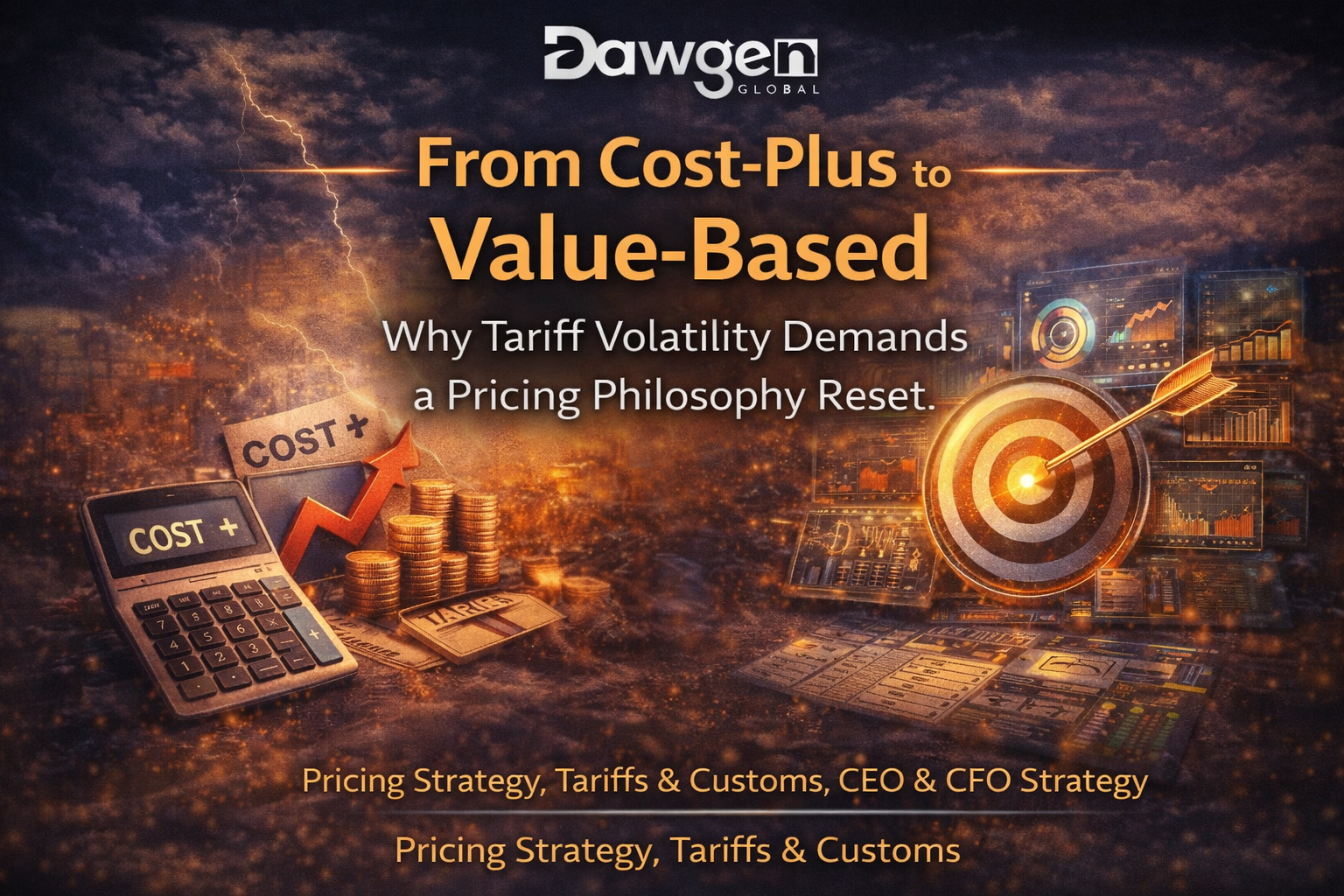
A Dawgen Global Advisory Perspective on Transitioning to Pricing Models That Absorb External Shocks and Unlock Margin
The Philosophy That Breaks Under Pressure
In the first two articles of this series, we established the scale of the global tariff disruption and examined the tariff mechanics every CFO needs to understand. We now turn to what may be the most consequential question facing pricing leaders in the current environment: not how to calculate the tariff impact on cost, but how to think about pricing itself.
For most companies, pricing is built on a single foundational assumption: calculate what it costs to make and deliver a product, add a target margin, and that is the price. This is cost-plus pricing, and it has been the dominant pricing methodology in global business for the better part of a century. It is intuitive, defensible, and straightforward to administer. It is also, in an era of tariff volatility, a strategic liability that is actively destroying value in companies that cling to it.
This article makes the case for a fundamental pricing philosophy reset—a migration from cost-plus to value-based pricing—and provides the strategic framework for making that transition without destabilizing customer relationships or undermining margin performance. For CEOs and CFOs navigating the tariff storm, this shift is not a theoretical refinement. It is a survival imperative.
The Cost-Plus Model: Understanding Why It Worked and Why It No Longer Does
Before we can prescribe a new approach, we must understand why the old one persists and where it fails.
The Appeal of Cost-Plus Pricing
Cost-plus pricing endures because it offers several compelling advantages in stable environments. It is easy to calculate: total costs plus a percentage margin equals the price. It is easy to justify: prices are anchored to verifiable costs, which provides a defensible narrative for customers, sales teams, and internal stakeholders. It scales cleanly across large product portfolios: apply the same margin formula to thousands of SKUs and the pricing is done. And it provides predictable margins, at least on paper, because every product carries the same target markup.
In a world where costs changed slowly and predictably, these were genuine strengths. Annual raw material price negotiations, stable exchange rates, and gradual regulatory shifts could all be incorporated into cost-plus models with reasonable accuracy. The pricing function could operate on an annual cycle, and the margin variance between plan and actual was manageable.
The Five Fatal Flaws in a Tariff-Volatile World
The tariff era exposes five fundamental weaknesses in cost-plus pricing that transform it from a convenient methodology into an active threat to competitiveness.
Flaw 1: The Amplification Effect
Cost-plus pricing mechanically amplifies external cost shocks. When tariffs increase input costs by 20 percent, a cost-plus model with a 30 percent margin does not simply add 20 percent to the price—it adds 20 percent to the cost base and then applies the 30 percent margin to the inflated cost, resulting in a price increase that exceeds the tariff impact itself. This amplification means that cost-plus pricing transmits tariff volatility to customers in an exaggerated form, accelerating customer defection and demand destruction at precisely the moment when the company can least afford to lose volume.
Flaw 2: The One-Way Ratchet
In practice, cost-plus pricing operates as a one-way ratchet. When tariffs increase, prices go up rapidly. When tariffs decrease or supply chains are restructured to reduce tariff exposure, prices rarely come down with the same speed or magnitude. Over time, this creates a credibility gap with customers, who correctly perceive that cost-plus pricing is invoked to justify increases but abandoned when costs decline. This erodes trust and makes every future price increase harder to sustain.
Flaw 3: Competitive Blindness
Cost-plus pricing is entirely inward-looking. It tells you what price you need to charge based on your costs. It tells you nothing about what price the market will bear, what your competitors are charging, or what value your product delivers relative to alternatives. In a tariff-disrupted market, where competitors may have fundamentally different cost structures based on their sourcing decisions, a cost-plus price may be dramatically above or below the competitive equilibrium—and the company operating on cost-plus has no mechanism to detect this misalignment until revenue starts declining.
Flaw 4: Value Ignorance
The most damaging flaw of cost-plus pricing is that it ignores the value a product creates for the customer. A component that represents a critical, difficult-to-replace input in a customer’s manufacturing process may support a price far above cost-plus, because the customer’s switching cost and the value of supply continuity justify a premium. Conversely, a commodity product with readily available alternatives may not support cost-plus pricing at all, regardless of the company’s cost structure. Cost-plus pricing leaves money on the table on high-value products and prices the company out of the market on low-value ones—simultaneously underpricing and overpricing across the portfolio.
Flaw 5: Speed Mismatch
Cost-plus pricing requires accurate, current cost data to produce accurate prices. In a tariff-volatile environment, cost data becomes stale rapidly. The lag between a tariff change, the recalculation of costs, the approval of new pricing, and the implementation of those prices in contracts and systems can span weeks or months. During this lag, the company is either absorbing costs it should be recovering or charging prices that are out of step with current market conditions. The speed of tariff change simply outpaces the administrative machinery of cost-plus pricing.
Value-Based Pricing: The Strategic Alternative
Value-based pricing starts from a fundamentally different premise. Rather than asking “What does it cost to deliver this product?” it asks “What is this product worth to the customer?” The price is anchored to the value the product creates in the customer’s context, not to the cost of producing it.
The Core Principles of Value-Based Pricing
Value-based pricing rests on several interconnected principles that, taken together, create a pricing methodology far more resilient to external shocks than cost-plus.
Customer value is the pricing anchor. The maximum price a customer will pay for a product is determined by the economic value that product creates in their operations—measured in terms of revenue enabled, costs avoided, risks mitigated, or performance improved. This value ceiling exists independently of the supplier’s cost structure. Whether it costs you $50 or $75 to produce a product, if it creates $200 of measurable value for the customer, the value-based pricing range is the same.
Differentiation drives pricing power. Value-based pricing rewards differentiation. The more unique your product’s value proposition—in performance, reliability, service, integration, or any other dimension the customer values—the wider the gap between your price and the next-best alternative, and the more insulated your pricing becomes from cost fluctuations, including tariff-driven cost changes.
Segmentation enables precision. Different customers derive different value from the same product. A precision component that is merely convenient for one customer may be mission-critical for another. Value-based pricing embraces this heterogeneity, setting prices that reflect the value delivered to each customer segment rather than applying a uniform markup.
Cost is a floor, not a formula. In a value-based model, cost still matters—it defines the minimum viable price below which the product should not be sold. But cost does not determine the price. The gap between cost and value represents the total value created by the transaction, and value-based pricing is the discipline of determining how that value should be shared between supplier and customer.
Why Value-Based Pricing Is Superior in the Tariff Era
The advantages of value-based pricing become especially pronounced in a tariff-volatile environment, for several critical reasons.
Shock Absorption
When tariffs increase costs, a value-based price does not automatically increase because the price was never derived from cost in the first place. The price is anchored to customer value, which tariffs do not directly change. What tariffs change is the margin between the value-based price and the cost floor. This means that moderate tariff increases can be absorbed within the existing price without any customer-facing action, preserving relationships and competitive position. Only when tariff-driven costs approach or exceed the value-based price does the company need to reassess—and at that point, the strategic question becomes whether the product should continue to be sold at all, not simply what the markup should be.
Margin Protection on Differentiated Products
For products that deliver unique, difficult-to-replicate value, value-based pricing protects margins even in the face of significant tariff increases. If your product creates $500 of value for the customer and you price it at $300, a $30 tariff-driven cost increase does not change the customer’s willingness to pay $300. Your margin compresses, but your price and customer relationship remain intact. Under cost-plus, the same cost increase would drive an automatic price increase that may trigger customer defection—destroying more value through lost volume than the tariff itself would have cost.
Strategic Repricing Flexibility
Value-based pricing gives companies the strategic flexibility to choose when and how to pass tariff costs through to customers. Because the price is not algorithmically tied to cost, the company can make deliberate, strategic decisions about which costs to absorb, which to pass through, and which to offset through value engineering. This contrasts sharply with cost-plus pricing, where every cost change mechanically demands a price change, leaving no room for strategic judgment.
Competitive Advantage Through Customer Focus
In a tariff-disrupted market, customers are facing their own cost pressures. A supplier whose pricing conversations focus on the value being delivered rather than the costs being incurred positions itself as a strategic partner rather than a cost-pass-through entity. This relational advantage becomes a durable competitive moat that is far more defensible than a cost-plus calculation.
The Transition Framework: Moving from Cost-Plus to Value-Based
Acknowledging that value-based pricing is strategically superior is the easy part. Actually making the transition is where most companies struggle. The shift requires changes in mindset, analytics, organizational structure, and commercial processes. The following framework outlines the essential steps.
Phase 1: Value Discovery and Quantification
The foundation of value-based pricing is a rigorous understanding of the value your products create for customers. This requires systematic research to answer three fundamental questions for each product-segment combination in your portfolio.
First, what is the customer’s next-best alternative? This establishes the reference price against which your product’s value will be measured. In a tariff-disrupted market, the next-best alternative may have changed dramatically—a domestic competitor who was previously more expensive may now be cost-competitive or even cheaper than your tariff-burdened import.
Second, what are the differentiation value drivers? These are the measurable ways in which your product outperforms (or underperforms) the next-best alternative—in performance, reliability, total cost of ownership, supply chain risk, service, integration, or any other dimension the customer values. Each differentiation driver should be quantified in economic terms wherever possible.
Third, what is the total economic value? This is the reference price plus the net differentiation value. It represents the theoretical maximum price a fully informed, rational customer would pay for your product over the next-best alternative. The actual price will be set somewhere between your cost floor and this value ceiling, with the exact positioning determined by competitive intensity, strategic objectives, and relationship considerations.
Phase 2: Portfolio Segmentation and Tiering
Not every product in your portfolio is suited for value-based pricing, at least not immediately. A practical transition begins by segmenting the portfolio into tiers based on pricing methodology readiness.
Tier 1: Value-Based Candidates. These are differentiated products where you can identify and quantify clear value drivers. They typically have limited direct substitutes, high switching costs, or measurable performance advantages. These products should be transitioned to value-based pricing first, as they represent the greatest opportunity for margin improvement and tariff resilience.
Tier 2: Hybrid Candidates. These are products with moderate differentiation that compete in markets with several viable alternatives. For these products, a hybrid approach may be optimal—a cost-informed base price adjusted by quantified value premiums or discounts relative to specific alternatives. This hybrid model provides more tariff resilience than pure cost-plus while being pragmatic about competitive realities.
Tier 3: Competitive-Parity Products. These are true commodity products where differentiation is minimal and market prices are well-established. For these products, the pricing objective shifts from value capture to cost leadership. Here, the tariff-era strategy is not to reprice based on value but to restructure costs—through supply chain optimization, tariff engineering, or duty mitigation—to maintain competitiveness at market-determined prices.
Phase 3: Building the Analytical Infrastructure
Value-based pricing requires analytical capabilities that most organizations built for cost-plus pricing simply do not possess. At minimum, the transition demands investment in three areas.
Customer value models. Structured, quantitative models that calculate the economic value of your products in different customer contexts. These models must be dynamic—capable of being updated as customer operations change, as competitive alternatives evolve, and as tariff-driven cost shifts alter the economics of substitution.
Competitive intelligence systems. Value-based pricing requires continuous visibility into what competitors are charging, what alternatives are available, and how competitive positioning is shifting in response to tariff changes. This is a more demanding intelligence requirement than cost-plus pricing, which needs only internal cost data.
Price realization analytics. The ability to track the gap between list prices and actual realized prices (after discounts, rebates, allowances, and other concessions) is critical for value-based pricing governance. Without this visibility, value-based prices set at the strategic level can be undermined by ad hoc discounting at the point of sale.
Phase 4: Organizational Alignment and Capability Building
The transition from cost-plus to value-based pricing is as much an organizational change as an analytical one. It requires shifts in how pricing decisions are made, who is involved, and how commercial teams engage with customers.
Sales teams must be trained and equipped to sell on value rather than on price. This means equipping them with value calculators, customer-specific business cases, and the confidence to defend prices that are higher than cost-plus would suggest for differentiated products. It also means giving them the authority and framework to offer competitive pricing on commodity products without the stigma of “discounting.”
Finance teams must accept that margin percentages will vary across products and customer segments—sometimes dramatically—and that this variance is a feature of value-based pricing, not a flaw. A product that earns a 60 percent margin because it delivers exceptional value is not “overpriced,” and a product that earns a 10 percent margin because it competes in a commoditized segment is not “underperforming.” Finance’s role shifts from enforcing uniform margin targets to ensuring that every product earns a margin commensurate with the value it delivers and the competitive position it holds.
Leadership must sponsor the transition with visible, sustained commitment. The gravitational pull of cost-plus pricing is strong—it is familiar, easy to administer, and culturally embedded in most organizations. Without active executive sponsorship, the organization will default back to cost-plus at the first sign of complexity or resistance.
Dynamic Pricing Elements: Adapting Value-Based Pricing to Tariff Volatility
Pure value-based pricing sets prices based on customer value. But in a tariff-volatile environment, both the cost floor and the competitive landscape can shift rapidly, requiring mechanisms to adapt value-based prices without abandoning the underlying philosophy.
Tariff Adjustment Clauses
For longer-term contracts, tariff adjustment clauses provide a transparent mechanism for adjusting prices when tariff rates change beyond a specified threshold. Unlike general price escalation clauses, tariff adjustment clauses are specifically linked to verifiable government actions, making them more acceptable to customers because they are objective, predictable, and outside either party’s control. The key design consideration is ensuring that the clause works in both directions—providing for price reductions when tariffs decrease as well as increases when tariffs rise. This bidirectional structure builds customer trust and prevents the one-way ratchet problem that plagues cost-plus models.
Value-Based Surcharge Structures
When tariff-driven costs increase significantly, a tariff surcharge that is separate from the base price can be an effective mechanism for maintaining pricing transparency while recovering costs. The distinction from a simple cost-plus price increase is important: the surcharge is explicitly identified as a tariff-related charge, it is presented alongside the value-based base price rather than embedded in it, and it can be removed or adjusted as tariff conditions change. This structure preserves the integrity of the value-based price while providing a flexible mechanism for managing tariff volatility.
Periodic Value Reassessment
Tariff changes alter the competitive landscape, which in turn can change the value your products deliver relative to alternatives. A domestic competitor who gains a cost advantage due to tariffs on your imported product may attract customers you previously held easily, changing the effective value of your offering. Value-based pricing requires periodic reassessment of the value equation—not just the cost equation—to ensure that prices remain aligned with the value customers actually perceive and receive in the current competitive context.
Common Objections and How to Address Them
In our advisory work, Dawgen Global encounters several recurring objections to the value-based pricing transition. Addressing these candidly is essential for building organizational commitment.
“Our customers will never accept prices above cost-plus.”
This objection confuses pricing methodology with pricing outcome. In many cases, value-based prices for differentiated products will be higher than cost-plus prices—but the conversation shifts from defending costs to demonstrating value, which is a far stronger commercial position. For commodity products, value-based analysis may actually suggest lower prices than cost-plus, enabling the company to be more competitive where it matters. The customer does not know or care what methodology you use. They care whether the price reflects the value they receive.
“We don’t have the data to quantify customer value.”
This is a valid concern but not a valid reason for inaction. Value quantification begins with what you know: customer applications, competitive alternatives, switching costs, and performance metrics. Initial value estimates can be refined over time through customer interviews, win-loss analysis, and commercial testing. The alternative—continuing with cost-plus pricing in a tariff-volatile environment—does not require less data. It simply uses the wrong data.
“Our sales team cannot sell on value.”
This is an investment problem, not a structural barrier. Sales teams can be trained, equipped with value-selling tools, and incentivized to sell on value rather than on price. The transition takes time and requires sustained investment in commercial capability, but the companies that make this investment consistently outperform those that do not—in margin, in customer retention, and in competitive resilience.
“Value-based pricing is too complex for our product portfolio.”
Complexity is managed through the tiered approach outlined in Phase 2. Not every product needs a bespoke value model on day one. Start with your most differentiated products, where the value case is clearest and the margin opportunity is largest. Build capability and confidence, then extend to more of the portfolio over time. The perfect should not be the enemy of the significantly better.
The Tariff-Era Pricing Philosophy: A Synthesis
The transition from cost-plus to value-based pricing is not merely a tactical adjustment. It represents a fundamental shift in how a company thinks about its relationship with the market. In a cost-plus world, pricing is a mathematical exercise—a function of inputs and formulas. In a value-based world, pricing is a strategic discipline—a continuous process of understanding, quantifying, and capturing the value you create.
In the tariff era, this distinction becomes existential. Companies that cling to cost-plus pricing will find themselves trapped in a reactive cycle: tariffs change, costs change, prices change, customers complain, sales teams discount, and margins erode. Companies that embrace value-based pricing will operate from a position of strategic clarity: they know what their products are worth, they price accordingly, they absorb cost fluctuations within the value margin, and they focus their competitive energy on delivering and communicating value rather than defending costs.
The next article in this series will apply these pricing philosophy principles to one of the most pressing tactical challenges in the tariff era: the pass-through dilemma. How much of a tariff-driven cost increase should you pass to customers, and how do you make that decision without losing either margin or market share? The value-based framework introduced here provides the conceptual foundation for answering that question with strategic precision.
PARTNER WITH DAWGEN GLOBAL
Is your pricing philosophy equipped for the tariff era—or is it anchored to a model designed for a world that no longer exists?
Dawgen Global’s Advisory team has guided organizations across industries through the transition from cost-plus to value-based pricing, delivering measurable improvements in margin performance, customer retention, and competitive resilience. We bring a structured, proven methodology that addresses the analytical, organizational, and commercial dimensions of the pricing transformation—tailored to each client’s portfolio complexity, competitive context, and organizational readiness.
Our Pricing Philosophy Assessment is a complimentary executive engagement designed to evaluate your current pricing methodology against the demands of the tariff era. We assess your portfolio’s readiness for value-based pricing, identify the highest-impact transition opportunities, and outline a phased roadmap for building the pricing capability your organization needs. The assessment typically reveals pricing power that companies did not know they had—and tariff resilience they urgently need.
Request Your Complimentary Pricing Philosophy Assessment Today
Stop pricing from cost. Start pricing from value. Let Dawgen Global show you how
About Dawgen Global
“Embrace BIG FIRM capabilities without the big firm price at Dawgen Global, your committed partner in carving a pathway to continual progress in the vibrant Caribbean region. Our integrated, multidisciplinary approach is finely tuned to address the unique intricacies and lucrative prospects that the region has to offer. Offering a rich array of services, including audit, accounting, tax, IT, HR, risk management, and more, we facilitate smarter and more effective decisions that set the stage for unprecedented triumphs. Let’s collaborate and craft a future where every decision is a steppingstone to greater success. Reach out to explore a partnership that promises not just growth but a future beaming with opportunities and achievements.
 Email: [email protected]
  Visit: Dawgen Global Website

 WhatsApp Global Number : +1 555-795-9071
Caribbean Office: +1876-6655926 / 876-9293670/876-9265210  WhatsApp Global: +1 5557959071
USA Office: 855-354-2447
Join hands with Dawgen Global. Together, let’s venture into a future brimming with opportunities and achievements


