
A Dawgen Global Advisory Perspective on Mastering Tariff Mechanics for Smarter Pricing Decisions
The Costly Ignorance Gap
In conversations with C-suite leaders across industries, Dawgen Global’s Advisory team encounters a recurring and troubling pattern: senior executives who are making consequential pricing decisions based on an incomplete, and often inaccurate, understanding of how tariffs actually work. The pricing response is typically straightforward in concept—tariffs went up, so raise prices—but the mechanics beneath that simple narrative are far more complex, and the gaps in understanding are costing companies millions.
A CFO who does not understand the difference between ad valorem and specific duties may miscalculate the true cost impact by an order of magnitude. A CEO who has never examined their company’s Harmonized System code classifications may not realize that a minor product modification could shift the applicable tariff rate from 25 percent to 3 percent. A procurement leader who has never explored duty drawback provisions may be paying tariffs on re-exported goods that are fully refundable.
This article, the second in Dawgen Global’s twelve-part “Pricing Through the Storm” series, is a deliberate investment in closing that knowledge gap. Before any organization can build a tariff-resilient pricing strategy, its leadership must command a working fluency in tariff mechanics. What follows is the essential foundation every CFO needs before repricing a single product.
How Tariffs Actually Work: The Mechanics That Matter
Tariffs are taxes imposed by governments on goods crossing international borders. That simple definition, however, conceals a remarkable degree of mechanical complexity that directly affects how tariffs translate into business costs and, ultimately, into pricing decisions.
Types of Tariffs and Their Pricing Implications
Ad Valorem Tariffs. The most common type, ad valorem tariffs are assessed as a percentage of the declared customs value of imported goods. A 25 percent ad valorem tariff on a product with a declared value of $100 generates a duty of $25. The critical nuance for CFOs is the definition of “customs value.” In most jurisdictions, customs value includes the cost of the goods, insurance, and freight (CIF) to the port of entry. This means that rising shipping costs or insurance premiums directly increase the tariff amount, even when the product’s factory-gate price has not changed. A ten percent increase in freight costs on a product subject to a 25 percent ad valorem tariff effectively increases the tariff-driven cost by 2.5 percent of the freight increase—a compounding effect that many cost models miss entirely.
Specific Tariffs. These are assessed as a fixed monetary amount per unit of quantity—per kilogram, per liter, per piece. A specific tariff of $2.50 per kilogram affects low-value bulk goods far more heavily on a percentage basis than high-value specialty products. For companies with diverse product portfolios that span a range of unit values, specific tariffs create dramatically uneven cost impacts that require differentiated pricing responses rather than uniform percentage adjustments.
Compound and Mixed Tariffs. Some tariff lines combine ad valorem and specific components, such as “10 percent ad valorem plus $1.50 per kilogram.” Others specify “the greater of” two calculation methods. These compound structures require careful modeling to understand the true cost impact at different product values and volumes, and they can produce non-linear pricing effects that simple percentage pass-through calculations cannot capture.
Tariff-Rate Quotas (TRQs). These are perhaps the most strategically complex tariff mechanism. A TRQ allows a specified quantity of imports at a lower tariff rate (the “in-quota” rate), with imports above that quantity subject to a much higher rate (the “over-quota” rate). For companies importing goods subject to TRQs, the timing of imports relative to quota fill rates can mean the difference between a 5 percent duty and a 50 percent duty on the same product. This has profound implications for procurement timing, inventory strategy, and pricing.
The Harmonized System: Your Product’s Tariff DNA
Every product that crosses an international border is classified under the Harmonized System (HS), a standardized numerical coding system maintained by the World Customs Organization. The HS code assigned to a product determines the tariff rate it faces. Understanding this system is not an academic exercise—it is a pricing lever that most companies have never pulled.
How HS Classification Drives Cost
The Harmonized System uses a hierarchical structure. The first six digits are internationally standardized, while individual countries add additional digits for national specificity. The United States uses a ten-digit Harmonized Tariff Schedule (HTSUS) code. The European Union uses an eight-digit Combined Nomenclature (CN) code. The specific digits at the end of these codes can determine dramatically different tariff rates for products that, to a layperson, appear nearly identical.
Consider a practical example. A company imports a device that could plausibly be classified under two different HS headings. Under one classification, the product faces a 2.5 percent duty rate. Under the other, the rate is 17.5 percent. For a company importing $50 million of this product annually, the difference between these two classifications represents $7.5 million in annual duty costs—a figure that flows directly to the bottom line and fundamentally changes the economics of pricing that product in the destination market.
Yet in Dawgen Global’s experience, the majority of companies have never conducted a rigorous review of their HS classifications. They rely on classifications assigned years or decades ago by customs brokers who may have used the most conservative interpretation, or on classifications copied from suppliers without independent verification. The result is that many companies are paying more in tariffs than they need to, and their pricing strategies are built on an inflated cost base.
Tariff Engineering: The Legal Art of Reclassification
Tariff engineering is the strategic practice of modifying a product’s design, composition, packaging, or assembly sequence to qualify for a more favorable HS classification and, therefore, a lower tariff rate. This is entirely legal, widely practiced by sophisticated importers, and one of the most direct levers available for reducing tariff-driven cost increases before they ever reach the pricing equation.
The opportunities are often remarkably straightforward. A garment with a particular fiber composition might face a 32 percent duty, while a nearly identical garment with a slightly different fiber blend might qualify at 12 percent. An electronic assembly imported as a complete unit might face a higher tariff than the same components imported separately and assembled domestically. A food product packaged in containers above a certain size might qualify under a different tariff heading than the same product in retail-sized packaging.
The key insight for CFOs is that tariff engineering can reduce or eliminate the cost pressure that drives pricing increases in the first place. Before raising a single price, every company should ask: have we exhausted every legitimate opportunity to reduce the tariff cost itself?
Landed Cost Modeling: The True Foundation of Tariff-Era Pricing
If there is one analytical capability that separates companies with effective tariff-era pricing from those that are merely reacting, it is the ability to calculate and track fully landed costs with precision and speed.
What Landed Cost Actually Includes
The landed cost of an imported product is the total cost of getting that product from its point of manufacture to the point where it is available for sale or use. It includes, at minimum, the following components: the purchase price of the goods, international freight and logistics, marine or cargo insurance, customs duties and tariffs, port handling and terminal charges, customs brokerage fees, domestic transportation from the port to the warehouse or facility, warehousing costs, applicable taxes (including anti-dumping or countervailing duties), compliance costs (testing, labeling, certification), and the cost of capital tied up in transit and inventory.
In practice, tariffs represent only one component of landed cost, but their volatility and magnitude make them the most strategically important variable. A comprehensive landed cost model allows CFOs to understand exactly how a tariff change flows through the full cost stack and, critically, to identify where other cost components can be optimized to offset part or all of the tariff impact.
The Common Mistakes in Landed Cost Calculation
Even companies that attempt landed cost modeling frequently make errors that compromise the accuracy of their pricing decisions. The most common include the following.
Using FOB rather than CIF values for duty calculation. As noted above, most jurisdictions assess duties on the CIF value, which includes freight and insurance. Companies that calculate duties on the FOB (factory-gate) price understate their true tariff cost, sometimes significantly, particularly for bulky or heavy goods with high freight costs relative to product value.
Ignoring anti-dumping and countervailing duties. Standard tariff rates are only part of the picture. Many products from specific origin countries are subject to additional anti-dumping duties (ADDs) or countervailing duties (CVDs) that can add 20, 50, or even 200 percent to the standard duty rate. These additional duties are assessed on top of regular tariffs and can transform the economics of a sourcing relationship overnight. CFOs who are tracking only standard tariff rates are seeing an incomplete cost picture.
Failing to account for tariff compounding. When a product incorporates imported components that themselves faced tariffs, and then the finished product faces its own tariff when shipped to a third country, the cumulative tariff burden can far exceed what a surface-level analysis suggests. This “tariff-on-tariff” compounding is particularly acute in complex manufacturing supply chains where components cross borders multiple times during the production process.
Static rather than dynamic modeling. A landed cost model built on a single set of assumptions—one tariff rate, one freight rate, one exchange rate—provides a snapshot that may be obsolete within weeks. Effective landed cost modeling in the tariff era requires the ability to run multiple scenarios rapidly and to update assumptions in near real time as conditions change.
Duty Mitigation Strategies Every CFO Should Know
Before adjusting a single price, astute finance leaders exhaust every available mechanism for reducing or recovering the tariff cost itself. The following duty mitigation strategies represent opportunities that, in aggregate, can significantly reduce the cost pressure that drives tariff-related pricing increases.
Duty Drawback
Duty drawback is a customs provision that allows companies to recover up to 99 percent of duties paid on imported goods that are subsequently exported, either in their original form or as part of a manufactured product. For companies with any meaningful export volume, duty drawback represents potentially millions of dollars in recoverable costs. Yet an astonishing number of eligible companies never file drawback claims, either because they are unaware of the provision or because they perceive the administrative burden as prohibitive. Modern drawback service providers and software have dramatically simplified the claims process, making this one of the highest-return tariff mitigation strategies available.
Foreign Trade Zones
Foreign Trade Zones (FTZs) are designated areas within a country’s borders where goods can be imported, stored, processed, and re-exported without paying customs duties until the goods enter the domestic commerce of the host country. FTZs offer several pricing-relevant benefits. Duties can be deferred until goods are actually sold into the domestic market, improving cash flow. Goods can be classified under the HS code that applies to the finished product rather than to the individual imported components, which may result in a lower duty rate (a concept known as “inverted tariff” benefits). Goods that are imported into an FTZ and subsequently re-exported incur no duty at all. For companies with complex supply chains and significant import volumes, FTZ utilization can reduce effective duty rates by 20 to 40 percent or more.
Free Trade Agreements and Preferential Origin
A web of bilateral and multilateral free trade agreements (FTAs) provides preferential tariff rates—often zero—for goods that qualify under rules of origin provisions. The operative phrase is “that qualify.” Many companies fail to claim FTA preferences because they cannot demonstrate that their products meet the required rules of origin, which typically specify minimum levels of local content, substantial transformation, or tariff-shift requirements. Investing in origin documentation and compliance can unlock duty savings that fundamentally change the cost basis for pricing.
Temporary Import Provisions and Bonded Warehousing
For goods that are imported temporarily—for exhibition, testing, repair, or processing and re-export—most countries offer temporary import provisions (such as ATA Carnets or Temporary Import Bonds) that eliminate or defer duty obligations. Bonded warehousing allows goods to be stored in customs-supervised facilities without duty payment until withdrawal for domestic consumption. Both mechanisms offer cash flow advantages and, in some cases, permanent duty avoidance that should be factored into pricing models.
The Hidden Cost Multipliers: What Your Cost Model Is Missing
Beyond the direct duty cost, tariffs generate a series of indirect and often invisible cost multipliers that erode margins in ways that standard cost models fail to capture.
Administrative and Compliance Costs
Navigating the tariff landscape requires specialized expertise in customs classification, origin determination, FTA compliance, drawback administration, and ongoing monitoring of regulatory changes. These compliance functions—whether performed internally or outsourced—represent real costs that grow in proportion to tariff complexity. Companies that do not account for compliance costs in their pricing models are understating the true cost of tariff-affected goods.
Working Capital Impact
Tariff payments increase the cash outlay required to bring goods to market, directly affecting working capital requirements. A 25 percent tariff on $100 million in annual imports represents $25 million in additional cash that must be funded through the working capital cycle. The financing cost of this additional capital—whether through higher inventory financing, extended payment terms from suppliers, or increased borrowing—is a real cost that should be reflected in pricing.
Supply Chain Restructuring Costs
When tariffs make existing supply chains uneconomic, companies incur significant costs to shift sourcing, qualify new suppliers, establish new logistics routes, and manage the transition period. These restructuring costs may be substantial and may take two to five years to fully amortize. A pricing strategy that ignores these transition costs either overestimates the speed at which tariff mitigation will improve margins or fails to recover these investments through pricing.
Demand Destruction and Volume Effects
Tariff-driven price increases can reduce demand volumes, which in turn affects unit economics through reduced scale, lower capacity utilization, and diminished purchasing leverage with suppliers. This negative feedback loop means that the true cost of a tariff often exceeds the direct duty amount because the downstream volume effects amplify the per-unit cost impact. Sophisticated pricing models must account for price elasticity and its effect on volumes to avoid a destructive spiral of rising prices and falling volumes.
Building a CFO’s Tariff Intelligence Framework
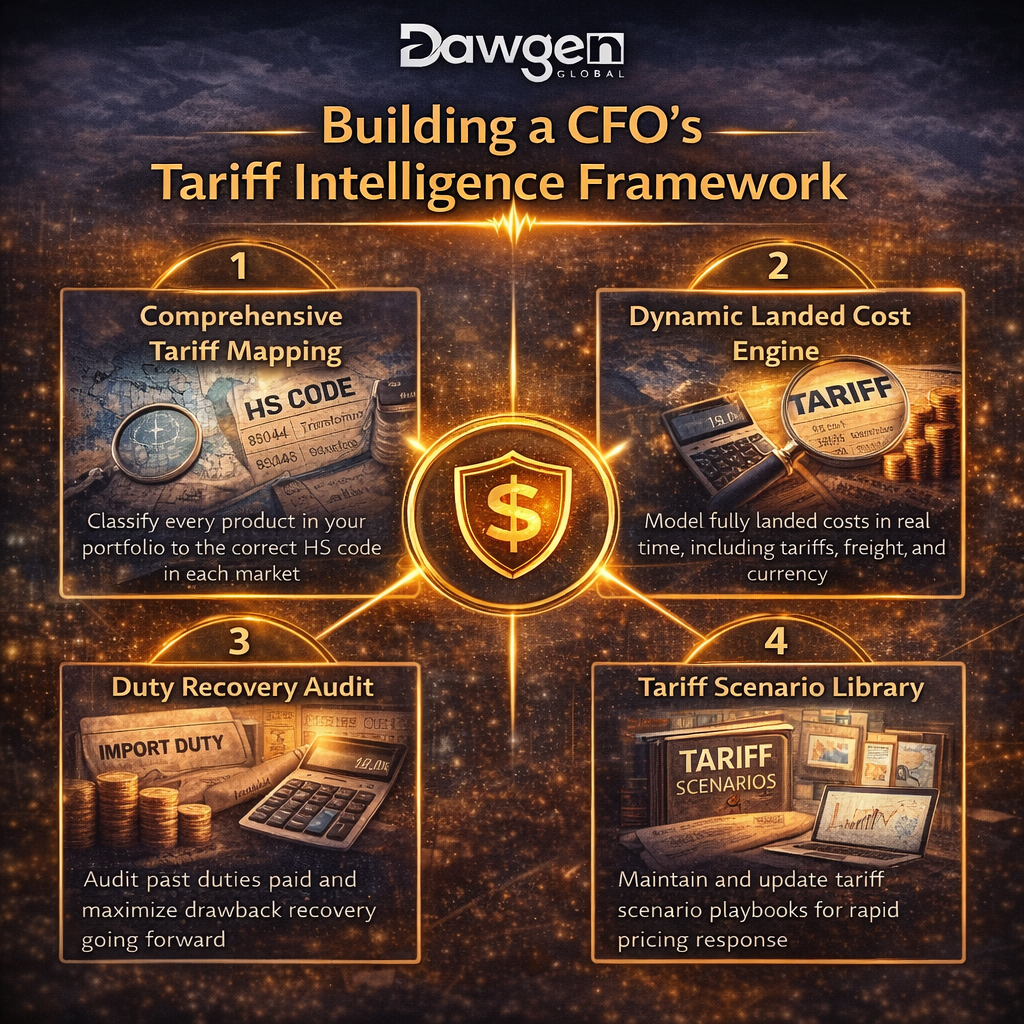
The knowledge outlined in this article is not merely academic. It forms the operational foundation for every pricing decision a company makes in the tariff era. To translate this knowledge into organizational capability, CFOs should build what Dawgen Global calls a Tariff Intelligence Framework encompassing the following elements.
Comprehensive Tariff Mapping
Document every HS code classification across your product portfolio and validate each one against current tariff schedules in every market where you import or export. Identify products at risk of reclassification, products eligible for tariff engineering, and products with available FTA preferences that are not currently being claimed.
Dynamic Landed Cost Engine
Invest in the analytical infrastructure to calculate fully landed costs in real time, with the ability to toggle tariff rates, freight costs, exchange rates, and sourcing scenarios rapidly. This engine becomes the quantitative backbone of all pricing decisions.
Duty Recovery Audit
Commission a retrospective audit of all duties paid over the past three to five years (the typical statute of limitations for drawback claims) to identify recoverable duties. Use the audit findings to establish ongoing duty recovery processes for future imports.
Tariff Scenario Library
Develop a maintained library of tariff scenarios—covering potential tariff increases, reductions, new trade agreements, and retaliatory actions—with pre-calculated cost and margin impacts. This library enables rapid pricing response when scenarios materialize, eliminating the weeks or months of analysis that currently delay pricing adjustments.
Cross-Functional Tariff Team
Establish a standing cross-functional team that includes finance, procurement, supply chain, legal, and commercial leadership. This team should meet regularly to review tariff developments, assess cost impacts, evaluate mitigation options, and coordinate pricing responses. Tariff management is too complex and too consequential to remain siloed in the customs compliance function.
Connecting Tariff Mechanics to Pricing Strategy
Understanding tariff mechanics is necessary but not sufficient. The strategic value of this knowledge lies in its application to pricing decisions. When a CFO commands a fluent understanding of how tariffs work, several strategic options that were previously invisible become available.
You can price differently across trade lanes because you understand that the same product faces different effective tariff rates depending on origin and destination. You can time pricing changes to align with anticipated tariff developments rather than reacting after the fact. You can identify products where tariff engineering can eliminate the cost pressure entirely, avoiding unnecessary pricing increases. You can negotiate with customers using precise, credible data on tariff-driven cost changes rather than vague references to “increased costs.” You can evaluate make-versus-buy and source-switching decisions with full visibility into the duty implications of each alternative.
In the next article in this series, we will build on this mechanical foundation to explore the fundamental question of pricing philosophy: why the tariff era demands a shift from cost-plus to value-based pricing, and how to make that transition without destabilizing your customer relationships or your margin structure.
PARTNER WITH DAWGEN GLOBAL
How confident are you that your organization truly understands its tariff exposure—down to the HS code, the landed cost, and the recoverable duty dollar?
Dawgen Global’s Advisory team specializes in helping CFOs and finance leaders build the tariff intelligence infrastructure that underpins resilient pricing. Our Tariff Diagnostic and Landed Cost Assessment provides a comprehensive review of your product classifications, duty mitigation opportunities, landed cost accuracy, and tariff scenario preparedness. We have helped clients identify millions of dollars in duty savings, reclassification opportunities, and recoverable drawback claims that directly improve pricing flexibility and margin performance.
Our Tariff Diagnostic and Landed Cost Assessment is available as a complimentary executive briefing for qualified organizations. In a focused engagement, our team will evaluate your tariff exposure, identify your highest-value duty mitigation opportunities, and provide a prioritized action plan for building the tariff intelligence capability your pricing strategy demands.
Request Your Complimentary Tariff Diagnostic Today ! Email: [email protected]
About Dawgen Global
“Embrace BIG FIRM capabilities without the big firm price at Dawgen Global, your committed partner in carving a pathway to continual progress in the vibrant Caribbean region. Our integrated, multidisciplinary approach is finely tuned to address the unique intricacies and lucrative prospects that the region has to offer. Offering a rich array of services, including audit, accounting, tax, IT, HR, risk management, and more, we facilitate smarter and more effective decisions that set the stage for unprecedented triumphs. Let’s collaborate and craft a future where every decision is a steppingstone to greater success. Reach out to explore a partnership that promises not just growth but a future beaming with opportunities and achievements.
 Email: [email protected]
  Visit: Dawgen Global Website

 WhatsApp Global Number : +1 555-795-9071
Caribbean Office: +1876-6655926 / 876-9293670/876-9265210  WhatsApp Global: +1 5557959071
USA Office: 855-354-2447
Join hands with Dawgen Global. Together, let’s venture into a future brimming with opportunities and achievements


