A Dawgen Global Advisory Perspective on Navigating Tariff-Driven Pricing Disruption
The Ground Has Shifted
For decades, pricing strategy has been treated as a largely internal discipline. Companies would analyze their cost structures, assess competitive dynamics, layer in margin targets, and arrive at price points that balanced profitability with market share. The external environment certainly mattered, but it changed slowly enough that annual pricing reviews felt sufficient. Raw material fluctuations, currency movements, and regulatory shifts were manageable variables within well-understood frameworks.
That era is over.
The global tariff landscape has undergone a seismic transformation. What began as targeted trade actions between the United States and China has metastasized into a complex web of retaliatory duties, regional trade bloc realignments, carbon border adjustment mechanisms, and digital services levies that touch virtually every industry and geography. For CEOs and CFOs, pricing strategy can no longer be a once-a-year conversation delegated to middle management. It has become a boardroom-level strategic imperative that directly determines whether a company thrives, survives, or slowly bleeds margin until it is too late to recover.
This article, the first in Dawgen Global’s twelve-part advisory series “Pricing Through the Storm,” provides the essential context every senior executive needs to understand the new tariff-driven pricing reality and lays the foundation for the strategic frameworks that will follow in subsequent installments.
The Scale of the Tariff Shift: Understanding What Has Changed
To appreciate why pricing strategy must be fundamentally rethought, it is important to understand the magnitude and complexity of what has changed in the global trade environment.
The Proliferation of Tariff Actions
Global trade restrictions have multiplied at an unprecedented pace. Between 2017 and 2025, major economies implemented more new trade barriers than in the preceding two decades combined. The United States alone imposed tariffs affecting hundreds of billions of dollars in imports across steel, aluminum, technology components, consumer goods, and agricultural products. The European Union responded with its own measures, while simultaneously introducing the Carbon Border Adjustment Mechanism (CBAM), which effectively creates environmental tariffs on imported goods with high carbon footprints. China, India, Brazil, and other major economies have all implemented retaliatory or defensive tariff measures of their own.
The result is not a simple bilateral trade war. It is a multi-dimensional tariff environment where a single product may face different duty rates depending on its country of origin, its destination market, its HS code classification, and even the carbon intensity of its production process. For companies operating across borders, the pricing implications are staggering.
The End of Predictability
Perhaps more disruptive than the tariffs themselves is the pace and unpredictability with which they change. Executive orders can impose or modify tariff rates with little warning. Retaliatory measures follow within weeks. Exemptions are granted and revoked. Trade agreements are renegotiated or abandoned. This volatility means that a pricing model built on last quarter’s tariff assumptions may already be obsolete.
For CFOs accustomed to building annual budgets with reasonably stable cost assumptions, this represents a fundamental challenge to financial planning. For CEOs making strategic decisions about market entry, product portfolio, and competitive positioning, it means the rules of engagement are being rewritten in real time.
Why Legacy Pricing Models Are Failing
Most companies’ pricing strategies were designed for a different era. Understanding why these legacy approaches are failing is the first step toward building something better.
The Cost-Plus Trap
Cost-plus pricing, where companies calculate their total cost and add a standard margin, remains the most common pricing methodology worldwide. In a stable cost environment, it provides a straightforward and defensible approach. In a tariff-volatile environment, however, cost-plus pricing becomes a dangerous liability.
When tariffs spike input costs by 10, 15, or 25 percent, cost-plus pricing mechanically passes those increases to customers. This sounds logical in theory, but in practice it creates a cascade of problems. Customers face sudden, sharp price increases that may push them to competitors who have found ways to absorb or mitigate the tariff impact. Sales teams, caught between corporate pricing directives and customer resistance, begin offering unauthorized discounts and concessions that erode margin even further. Meanwhile, if tariffs are later reduced or eliminated, the company’s pricing rarely adjusts downward with the same speed, creating a credibility gap with customers.
Cost-plus pricing treats tariffs as just another input cost. But tariffs are fundamentally different from raw material prices or labor costs. They are policy instruments that can change overnight, vary by trade route, and be strategically mitigated through supply chain redesign. Treating them the same as any other cost line item is a strategic error that leaves money on the table and competitive advantage unexploited.
The Annual Pricing Cycle Problem
Many companies still operate on annual or semi-annual pricing cycles. Price lists are published, contracts are set, and adjustments are made at the next scheduled review. This cadence was perfectly adequate when the external environment changed slowly. In the current tariff climate, it is woefully insufficient.
A company that sets prices in January based on prevailing tariff rates may find those rates dramatically altered by March. If its contracts lock in prices for twelve months, the company absorbs the full impact of any tariff increase for the remainder of the year. Conversely, if tariffs decrease, competitors with more agile pricing mechanisms capture the benefit while the legacy-priced company remains stuck at its higher price point.
The gap between the speed of tariff change and the speed of corporate pricing response is where margin goes to die.
Ignoring the Second and Third-Order Effects
Most pricing models account for the direct impact of tariffs on input costs. Far fewer capture the second and third-order effects that often matter more. When tariffs are imposed on a key component, the entire competitive landscape shifts. Domestic manufacturers gain a cost advantage they did not earn through efficiency. Import-dependent competitors may exit segments entirely, changing supply-demand dynamics. Customer purchasing behavior shifts as end-market prices change. New substitute products become viable.
A pricing strategy that accounts only for the direct cost impact of tariffs while ignoring these competitive dynamics is like navigating a storm by watching only the waves directly in front of the ship, oblivious to the changing currents and shifting winds that will determine whether you reach port safely.
The Strategic Dimensions of Tariff-Era Pricing
Effective pricing in the tariff era requires a fundamentally more strategic approach. It demands that pricing be integrated with supply chain strategy, competitive intelligence, customer relationship management, and financial planning in ways that most organizations have never attempted.
Pricing as Competitive Weapon
In a tariff-disrupted market, pricing becomes one of the most powerful competitive weapons available. Companies that can absorb tariff impacts better than their competitors—through superior supply chain design, strategic sourcing, or operational efficiency—can use pricing to capture market share precisely when competitors are most vulnerable. This requires pricing decisions to be made with full visibility into competitive cost structures, not just internal costs.
Conversely, companies that raise prices reflexively in response to tariff increases, without understanding how competitors are responding, risk losing customers permanently. The tariff era rewards pricing courage informed by competitive intelligence and punishes pricing cowardice driven by spreadsheet reflex.
The Supply Chain-Pricing Nexus
One of the most important strategic insights of the tariff era is that supply chain strategy and pricing strategy are no longer separate disciplines. They are two sides of the same coin. A company that redesigns its supply chain to source from tariff-advantaged countries does not just reduce costs—it creates pricing flexibility that competitors without that supply chain agility cannot match.
Tariff engineering, the practice of structuring products, components, or supply chains to qualify for lower duty classifications, can yield significant cost advantages that flow directly into pricing power. Free trade zone utilization, strategic warehousing, and origin management are all supply chain tactics with direct pricing implications. CEOs and CFOs who treat supply chain optimization and pricing strategy as separate workstreams are leaving their most powerful tool unused.
Customer Segmentation in a Tariff Context
Tariffs do not affect all customers equally. A customer who depends on your product as a critical input has very different price sensitivity than one who can easily switch to a domestic alternative or a substitute product. A customer in a market where end-consumer demand is strong can absorb price increases more readily than one in a margin-squeezed, commoditized segment.
Effective tariff-era pricing requires granular customer segmentation that goes beyond traditional demographic or volume-based categories. It must incorporate tariff exposure analysis: how much of the tariff impact can be passed through to each customer segment without triggering switching behavior? Which segments offer pricing power, and which require strategic absorption to retain? This level of analytical sophistication is new territory for most pricing functions.
What World-Class Companies Are Doing Differently
While many companies are still reacting to tariff-driven cost increases with ad hoc price adjustments, a growing cohort of market leaders has recognized that the tariff era demands a fundamentally different approach. Their strategies share several common characteristics.
Real-Time Cost-to-Serve Visibility
Leading companies have invested in systems that provide real-time visibility into their fully landed cost-to-serve by product, by customer, by trade lane. This means they know, at any given moment, exactly how tariff changes affect their cost structure at a granular level. This visibility enables rapid, informed pricing decisions rather than the delayed, aggregate responses that characterize most organizations.
Scenario-Based Pricing Frameworks
Rather than building pricing models on a single set of tariff assumptions, leading companies develop scenario-based frameworks that model pricing outcomes across a range of tariff scenarios. They have pre-approved pricing responses for likely tariff changes, enabling the organization to respond within days rather than months when changes occur. This “pricing war room” approach transforms tariff volatility from a threat into a manageable variable.
Integrated Commercial Strategy
The most sophisticated companies have broken down the traditional silos between procurement, supply chain, pricing, and sales. Their pricing decisions are informed by real-time supply chain data, competitive intelligence, and customer behavior analytics. When a tariff changes, the response is not simply a price adjustment but a coordinated commercial strategy that may include supply chain shifts, contract renegotiations, product modifications, and targeted promotional activity.
Strategic Tariff Absorption
Perhaps counter-intuitively, some of the most successful tariff-era strategies involve absorbing tariff costs rather than passing them through. Companies with strong balance sheets and long-term strategic vision are using tariff disruptions as opportunities to capture market share from competitors who reflexively raise prices. By absorbing costs in the short term while simultaneously restructuring supply chains to reduce tariff exposure, these companies emerge from tariff episodes with stronger market positions and healthier margins than they had before the disruption began.
The CEO and CFO Imperative: Five Actions to Take Now
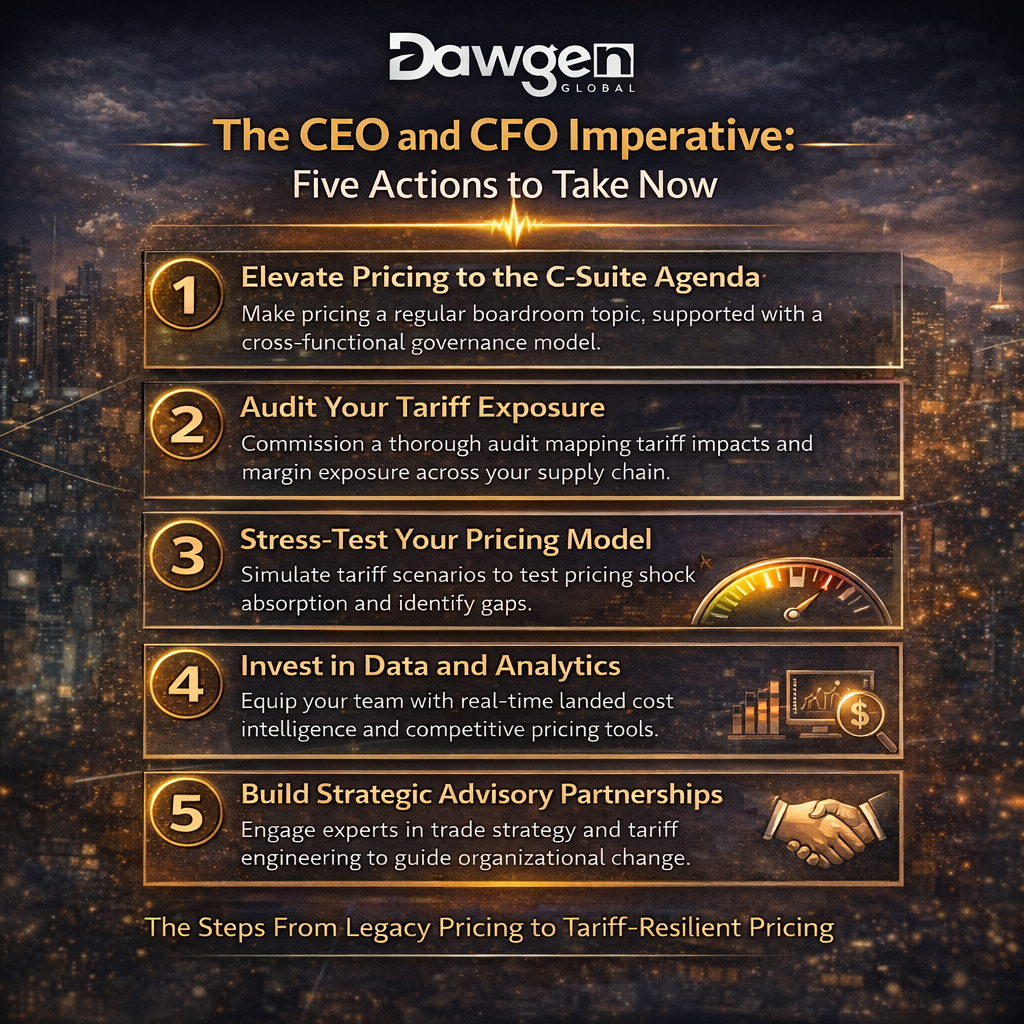
The transformation from legacy pricing to tariff-resilient pricing does not happen overnight. However, there are five immediate actions that CEOs and CFOs should prioritize to begin building organizational readiness.
- Elevate Pricing to the C-Suite Agenda
Pricing can no longer be delegated to product managers or finance analysts working in isolation. In the tariff era, pricing decisions carry strategic weight that demands C-suite attention and cross-functional coordination. Establish a pricing governance structure that brings together finance, supply chain, sales, and strategy leadership on a regular cadence.
- Audit Your Tariff Exposure
Most companies lack a comprehensive, current understanding of their tariff exposure across products, supply chains, and markets. Commission a thorough tariff audit that maps every point of tariff impact in your value chain and quantifies the margin exposure under multiple scenarios. This is the diagnostic foundation upon which all subsequent pricing strategy will be built.
- Stress-Test Your Pricing Model
Subject your current pricing methodology to rigorous stress testing under realistic tariff scenarios. How does your pricing respond to a sudden 15 percent tariff increase on a key input? What happens if a competitor absorbs the tariff while you pass it through? How quickly can your organization adjust prices in response to a tariff change? The answers to these questions will reveal the gaps in your current approach and prioritize where investment in pricing capability is needed most.
- Invest in Data and Analytics
Tariff-resilient pricing requires real-time data on landed costs, competitive pricing, customer price sensitivity, and trade policy developments. If your organization is making pricing decisions based on quarterly cost reports and annual competitive benchmarks, you are operating with dangerous information latency. Prioritize investments in pricing analytics, cost-to-serve tracking, and competitive intelligence capabilities.
- Build Strategic Advisory Partnerships
The complexity of tariff-era pricing exceeds the internal capabilities of most organizations. The interplay of trade policy, supply chain optimization, financial modeling, and competitive strategy requires specialized expertise that few companies maintain in-house. Building relationships with advisory partners who bring deep cross-functional expertise in tariff-resilient pricing is not a luxury. It is a strategic necessity.
Looking Ahead: What This Series Will Cover
This article has established the context and urgency for rethinking pricing strategy in the era of global tariffs. The remaining eleven articles in this series will provide the practical frameworks, analytical tools, and strategic playbooks that CEOs and CFOs need to transform their pricing from a liability into a competitive advantage.
In the next installment, we will conduct a deep dive into tariff mechanics that every CFO needs to understand before making any pricing changes, covering landed cost modeling, duty drawback opportunities, tariff classification strategies, and the hidden cost multipliers that silently erode margins. Subsequent articles will address the transition from cost-plus to value-based pricing, the tariff pass-through dilemma, supply chain repricing strategies, dynamic pricing systems, multi-currency and multi-tariff pricing architectures, sector-specific strategies, scenario-based modeling, customer communication, and how market leaders are turning tariffs into competitive advantage.
The tariff storm is not passing. It is intensifying. The question is not whether your pricing strategy will be tested but whether it will hold.
PARTNER WITH DAWGEN GLOBAL
Is your pricing strategy built to withstand the next tariff shock, or just the last one?
At Dawgen Global, our Advisory team works alongside CEOs, CFOs, and senior leadership teams to build tariff-resilient pricing strategies that protect margins, preserve customer relationships, and transform trade disruption into lasting competitive advantage. We bring deep cross-functional expertise spanning trade policy analysis, landed cost modeling, supply chain optimization, competitive pricing intelligence, and scenario-based financial modeling.
Our Pricing Strategy Diagnostic is a complimentary, executive-level assessment designed to identify your organization’s most critical tariff-related pricing vulnerabilities and outline a prioritized roadmap for building pricing resilience. In a single engagement, our advisory team will evaluate your current pricing methodology, map your tariff exposure, benchmark your approach against industry best practices, and deliver actionable recommendations tailored to your specific competitive context.
Schedule Your Complimentary Pricing Strategy Diagnostic Today
 Email: [email protected]
 WhatsApp Global Number : +1 555-795-9071
About Dawgen Global
“Embrace BIG FIRM capabilities without the big firm price at Dawgen Global, your committed partner in carving a pathway to continual progress in the vibrant Caribbean region. Our integrated, multidisciplinary approach is finely tuned to address the unique intricacies and lucrative prospects that the region has to offer. Offering a rich array of services, including audit, accounting, tax, IT, HR, risk management, and more, we facilitate smarter and more effective decisions that set the stage for unprecedented triumphs. Let’s collaborate and craft a future where every decision is a steppingstone to greater success. Reach out to explore a partnership that promises not just growth but a future beaming with opportunities and achievements.
Email: [email protected]  Visit: Dawgen Global Website
WhatsApp Global Number : +1 555-795-9071
Caribbean Office: +1876-6655926 / 876-9293670/876-9265210  WhatsApp Global: +1 5557959071
USA Office: 855-354-2447
Join hands with Dawgen Global. Together, let’s venture into a future brimming with opportunities and achievements


