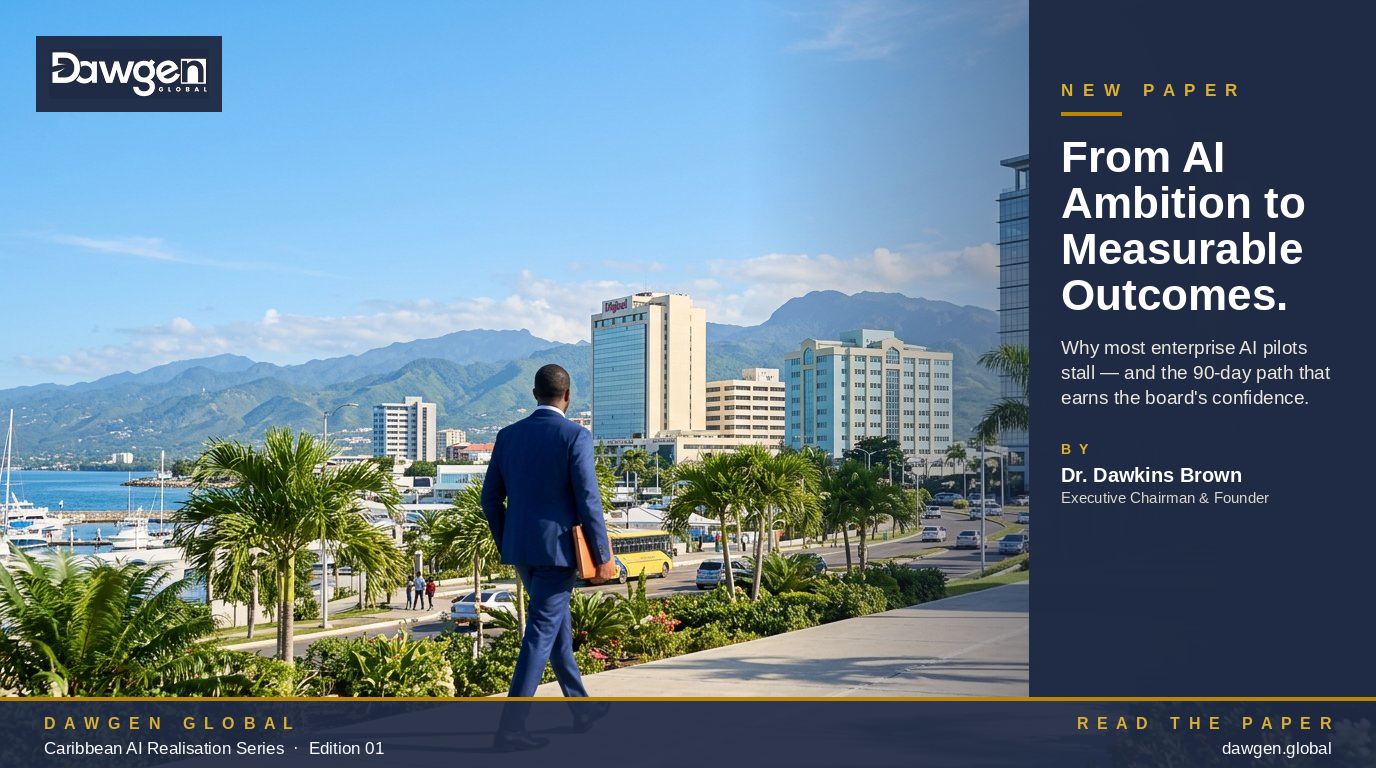
Why most enterprise AI pilots stall — and how Caribbean boards can build a 90‑day path from idea to validated business value, with global partner discipline and local execution.
Where boardroom AI conversations are stuck — and how to move them forward
Across the Caribbean, every executive committee I sit in front of is asking a variation of the same question: “How do we move from talking about AI to actually getting value from it?” The interest is no longer in dispute. The hesitation is. Leaders are weighing how to invest credibly, how to govern responsibly, and how to demonstrate measurable returns to shareholders, regulators, and customers — all at the same time.
This paper sets out the position Dawgen Global takes when we advise our clients on enterprise AI adoption. It is deliberately practical. It is also vendor‑neutral by design: Dawgen Global is an independent, integrated firm that works with a curated network of global technology partners and vendors to design, develop, and implement client technology solutions. Which platform a client ultimately deploys is a downstream decision — one we make together, after the business case is clear, the governance is in place, and the risk has been priced honestly.
| “AI does not fail in the Caribbean because the technology is unavailable. It fails because the business case was never sharpened, the data was never made decision‑ready, and the governance was never written down before the build began.”
— Dr. Dawkins Brown, Executive Chairman, Dawgen Global |
- The state of the boardroom: ambition is high, conviction is uneven
In our recent advisory engagements across financial services, hospitality, manufacturing, and the public sector, three patterns recur with uncomfortable consistency.
First, AI ambition is genuine. Boards have signed off on AI strategies, and senior executives can describe — in broad terms — what they would like AI to do for their organisation. Customer service automation, fraud detection, internal‑audit acceleration, document review, predictive maintenance, agentic workflows in finance and operations: the wish list is long and largely sensible.
Second, conviction is uneven. The same boards that approved the strategy will, six months later, ask why no pilot has reached production. The honest answer is rarely a technology answer. It is almost always an alignment answer: the use case was too broad, the success metric was never defined, the data was scattered, the responsibility for governance was unclear, and the change‑management plan did not exist.
Third — and this is the pattern that should most concern Caribbean directors — organisations that have started AI work without an independent, integrated advisor often find themselves with a portfolio of disconnected experiments that are individually interesting but collectively untrustworthy. There is no consolidated view of risk, no common governance baseline, and no shared definition of “done”. That is not an AI problem. That is an enterprise architecture and governance problem dressed in AI clothing.
| 90
DAYS to a validated pilot is a realistic target for a focused, governed engagement |
1 in 3
boards we engage with cannot point to a single AI initiative with a defined ROI metric |
3+
core controls every Caribbean AI pilot needs: data, model risk, and ethical use |
2. Why most pilots stall: five honest reasons
When Dawgen Global is invited into an AI programme that has lost momentum, we typically find one or more of the following at the root of the problem. They are not glamorous. They are also entirely solvable.
2.1 The use case was chosen for novelty, not for value
Selecting an AI use case because it is interesting is a fast route to a stalled pilot. The right starting point is the intersection of three lines: a real business pain, data that already exists in a usable form, and a measurable outcome the executive sponsor will personally defend in a board paper. If any one of those three lines is missing, the pilot will struggle to graduate.
2.2 Success was never defined in numbers
“Improve customer experience” is not a success metric. “Reduce average first‑contact resolution time by 25% for retail banking enquiries within ninety days, while holding customer satisfaction at or above current levels” is. The discipline of writing the target down — with numerator, denominator, and time horizon — changes the conversation. It also changes who needs to be in the room: suddenly Finance, Operations, Risk, and Internal Audit all have a legitimate seat.
2.3 Data was assumed to be ready
Almost every AI engagement we run begins with an unpleasant discovery: the data the pilot depends on lives in three systems, two spreadsheets, and one person’s head. The remediation is rarely difficult, but it must happen before — not during — model build. A short data‑readiness sprint at the front of the engagement is the single highest‑leverage investment in any AI pilot.
2.4 Governance was treated as an afterthought
For Caribbean institutions — particularly those regulated by central banks, financial services commissions, data‑protection commissioners, and sectoral regulators — a pilot without an explicit responsible‑AI control framework is a future enforcement problem in waiting. Model documentation, human‑in‑the‑loop checkpoints, bias testing, audit trails, vendor due diligence, and data‑residency decisions are not optional features. They are part of the minimum viable pilot.
2.5 The organisation was never prepared to adopt the result
The most painful failure mode is the technically successful pilot that no one uses. A copilot that nobody trusts. An agent that staff route around. The remedy is operating‑model work running in parallel with the build: workflow redesign, training, role redefinition, and clear communication of what the AI does and does not decide.
| Boardroom takeaway
If your AI programme has produced more decks than deployments, the issue is almost never the model. It is the discipline around the model. Independent assurance — of use case, data, governance, and operating model — is what converts AI ambition into AI realisation. |
3.The Dawgen Global view: a 90‑day path from idea to validated value
Dawgen Global advises clients to treat the first ninety days of any serious AI initiative as a structured engagement with four distinct phases, each with a defined boardroom question and a defined deliverable. The phases are not novel. The discipline of running them in sequence, with independent challenge at each gate, is what differentiates an engagement that lands from one that drifts.
| Phase | Focus | Boardroom Question Answered | Deliverable |
| 01 | Discover & Define | Where is the highest-value, lowest-risk place to begin? | Prioritised use case, success metrics, ROI hypothesis, data readiness assessment |
| 02 | Design & Govern | How do we build this safely, ethically, and in line with regulation? | Solution architecture, responsible-AI controls, data pipelines, integration plan |
| 03 | Build & Pilot | Can we prove the value before we commit at scale? | Working pilot — application, copilot, or agent — integrated to live data |
| 04 | Validate & Scale | Does this earn its place on the production roadmap? | Independent performance review, ROI confirmation, scale-up roadmap, change-management plan |
Each phase ends with a written sign‑off. Each sign‑off is the basis on which the next phase is funded. That cadence — short, evidenced, and reversible — is what allows boards to authorise AI investment with confidence rather than with hope.
| “A pilot only earns the right to scale when it has been validated against the metrics the board agreed to at the start — not the metrics the project team finds convenient at the end.”
— The Dawgen Global Assurance Principle |
4.Governance: the non‑negotiable layer
Caribbean institutions operate in an increasingly demanding compliance environment. Twin‑peaks supervisory reform, sharper data‑protection enforcement, evolving expectations from international correspondent banks, and growing sectoral interest in algorithmic accountability all converge on the same conclusion: AI is now a governed activity, not an experimental one. We advise every client to put the following six controls in place before — not after — the first pilot goes live.
- A documented AI policy approved at board level, defining permitted use cases, prohibited use cases, and the escalation path for novel ones.
- A model inventory with risk tiering, owner accountability, and review cadence, modelled on the discipline of financial‑institution model‑risk management.
- A data classification and residency framework that maps to applicable data‑protection law and to any cross‑border processing the pilot will require.
- Human‑in‑the‑loop checkpoints for any AI output that affects a customer, employee, financial transaction, or regulatory filing.
- Bias, robustness, and explainability testing appropriate to the use case, with results retained as audit evidence.
- Vendor and third‑party due diligence covering the underlying model provider, the integration partner, and the hosting jurisdiction — with contractual rights to audit and to exit.
| Independence matters here
Governance designed by the same party that builds and operates the AI solution is structurally compromised. Boards should insist on an independent advisor — distinct from the implementation vendor — to sign off on the responsible‑AI control framework. This is the assurance discipline Dawgen Global brings to every engagement. |
5.How Dawgen Global delivers: integrated firm, curated partner ecosystem
Dawgen Global is an independent, integrated multidisciplinary professional services firm. Our eleven service disciplines — spanning Audit & Assurance, Tax Advisory, IT & Digital Transformation, Risk Management, Cybersecurity, HR Advisory, M&A, Corporate Recovery, Business Advisory, Accounting BPO/Virtual CFO, and Legal Process Outsourcing — mean that an AI engagement is never run as an isolated technology project. It is run as a business engagement, with the right disciplines in the room from day one.
For the technology layer itself, Dawgen Global works with a curated network of global partners and vendors. We do not build hardware. We do not author large language models. What we do is design, develop, and implement effective client technology solutions — selecting and orchestrating the right combination of platforms, infrastructure, models, and integration partners for each client’s circumstances. Which platform a client ultimately deploys is a decision we make together, in the proposal phase, after the business case and governance baseline are agreed.
This separation — between the advisor who shapes the business case and assures the governance, and the vendor who supplies the underlying technology — is, in our view, the single most important structural choice a board can make when authorising AI investment. It preserves independence. It preserves choice. And it preserves the board’s ability to change vendors over time without having to change the strategy.
6.Who should be reading this — and what to do next
This paper is written for three audiences in particular.
Boards and audit committees
If your organisation has approved an AI strategy and you cannot, today, point to a written board paper that records the use case priority, the success metrics, the responsible‑AI controls, and the independent sign‑off plan, you are carrying more risk than your minutes suggest. We can help you close that gap in a single facilitated session.
CEOs and executive committees
If your team has produced strategy documents and pilots but has not yet produced a validated, board‑ready business case backed by evidence from a live pilot, you are at the stage where most programmes lose momentum. A 90‑day structured engagement — from use case to validated pilot — is designed to break that pattern.
CIOs, CTOs, and Chief Data Officers
If you have already selected a technology direction and need an independent advisor to stand alongside you, sharpen the use case, harden the governance, and translate technical results into board‑grade ROI, that is the role Dawgen Global is built for. We do not compete with your platform decisions. We strengthen them.
| Talk to us
Dawgen Global offers a complimentary, 60‑minute Discovery Session for boards and executive teams considering enterprise AI investment. The session is delivered under our independent advisor mandate and is not tied to any specific technology platform. To arrange a session, write to [email protected] or contact our New Kingston office at 47 Trinidad Terrace. |
About the author
Dr. Dawkins Brown is the Executive Chairman and Founder of Dawgen Global, an independent, integrated multidisciplinary professional services firm headquartered in New Kingston, Jamaica and operating across the Caribbean region. He is the author of the Caribbean Boardroom Perspectives newsletter, the D·AGENTICA™ series on Caribbean AI adoption, and the DAGAF™ series on digital asset governance and assurance.
This thought leadership paper is published for general information only and does not constitute legal, tax, audit, regulatory, or investment advice. The frameworks, phases, and control recommendations described above are illustrative of Dawgen Global’s advisory methodology and should be adapted to the specific circumstances, regulatory environment, and risk appetite of each client. Independent professional advice should be obtained before acting on any matter discussed in this paper. © 2026 Dawgen Global. All rights reserved.
About Dawgen Global
“Embrace BIG FIRM capabilities without the big firm price at Dawgen Global, your committed partner in carving a pathway to continual progress in the vibrant Caribbean region. Our integrated, multidisciplinary approach is finely tuned to address the unique intricacies and lucrative prospects that the region has to offer. Offering a rich array of services, including audit, accounting, tax, IT, HR, risk management, and more, we facilitate smarter and more effective decisions that set the stage for unprecedented triumphs. Let’s collaborate and craft a future where every decision is a steppingstone to greater success. Reach out to explore a partnership that promises not just growth but a future beaming with opportunities and achievements.
 Email: [email protected]
  Visit: Dawgen Global Website

 WhatsApp Global Number : +1 555-795-9071
Caribbean Office: +1876-6655926 / 876-9293670/876-9265210  WhatsApp Global: +1 5557959071
USA Office: 855-354-2447
Join hands with Dawgen Global. Together, let’s venture into a future brimming with opportunities and achievements


