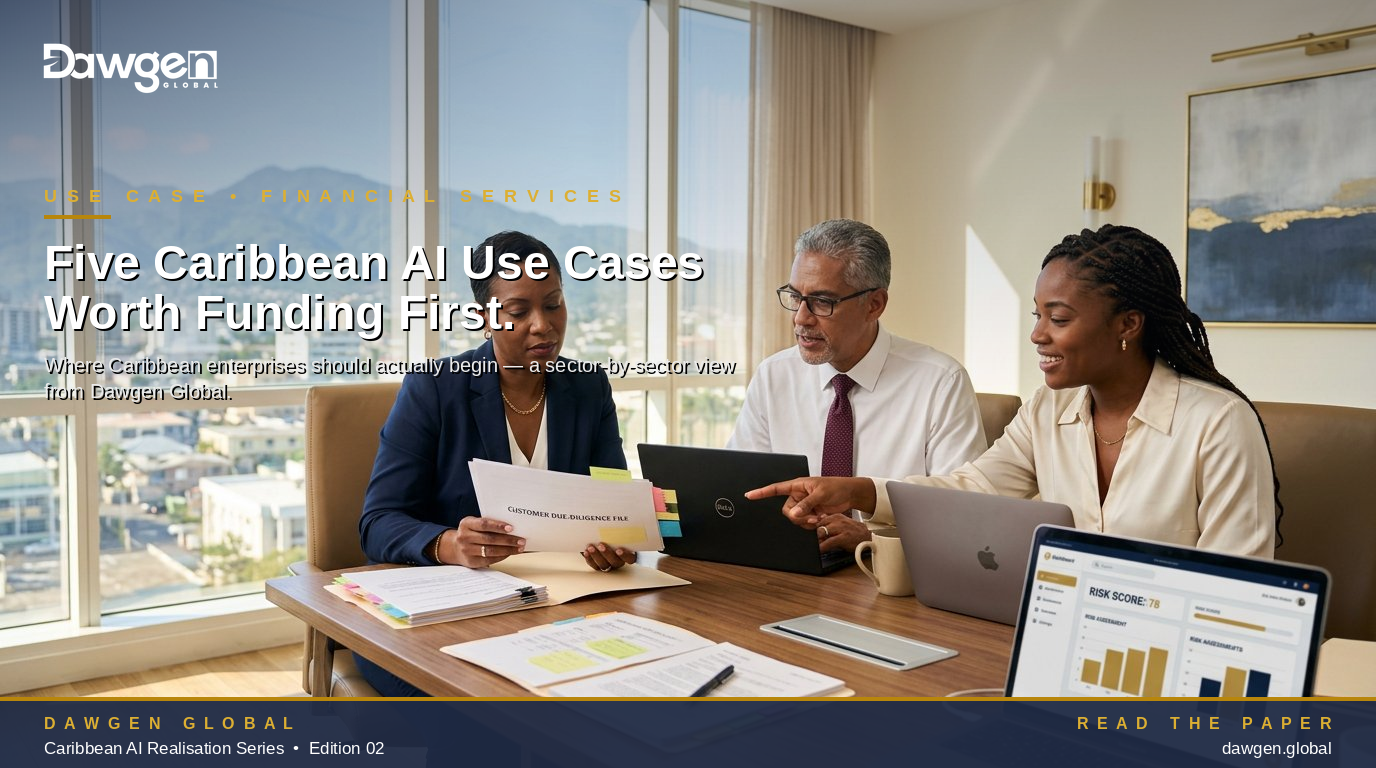
Edition 01 ended with a question. This one answers it.
In Edition 01 of this series, I argued that the single most common reason Caribbean enterprise AI pilots stall is not the technology. It is the failure to choose the right use case in the first place. The discipline of starting where data exists, where value is measurable, and where governance is achievable separates programmes that land from programmes that drift.
This edition takes the next step. It identifies the five AI use cases Dawgen Global believes Caribbean enterprises should fund first — ahead of more exotic experiments, ahead of the agentic systems generating most of the conference talk, and ahead of the broad “AI transformation” mandates that rarely survive contact with a board paper. Each use case is paired with the questions a director should ask, the data the pilot will actually need, and the ROI hypothesis worth testing in the first ninety days.
As in Edition 01, this paper is deliberately vendor‑neutral. The right platform, model, and infrastructure mix is a downstream decision — one Dawgen Global makes with each client, through our curated network of global partners and vendors, after the business case and governance baseline are agreed. What follows is about the use cases themselves and the discipline of choosing well.
| “Caribbean enterprises do not need more AI ideas. They need fewer, better‑chosen ones — each with a written business case, ready data, and a governance model the board can defend.”
— Dr. Dawkins Brown, Executive Chairman, Dawgen Global |
- How we choose what to fund first
Before naming the five, it is worth being explicit about the criteria. Use cases that earn a place on the first‑wave funding list share four characteristics.
Measurable value
The pilot must produce a result that finance, operations, or risk can quantify in a way the board will accept. A 20% reduction in average handling time, a 30% acceleration in document review, a 15% lift in revenue per available room, a 25% reduction in regulatory breach exposure — these are answers a board can act on. “Improved customer experience” is not.
Data that already exists
The pilot draws on data the organisation already collects in the normal course of business. We deliberately exclude, for the first wave, use cases that require entirely new data capture, sensor rollouts, or substantial third‑party data acquisition before the pilot can run. Those use cases can come in wave two. Wave one is about converting existing information into measurable advantage.
Governance that is achievable, not aspirational
The control framework needed to run the pilot responsibly must be implementable within the engagement — not dependent on a future regulatory framework, future board training, or future enterprise governance reform. Where regional regulators have already signalled their expectations, the use case must respect those signals from day one.
A clean route from pilot to production
A pilot that cannot graduate is a research project, not a pilot. Each use case below has a viable production path: the technology stack, integration approach, and operating‑model change are all within reach for a mid‑sized Caribbean enterprise. None of them require a Silicon Valley research budget.
| Boardroom takeaway
If a proposed AI pilot fails any one of these four tests, the right answer is not to weaken the test. The right answer is to find a better use case. The five that follow are the ones we keep coming back to in Caribbean engagements because they pass all four. |
- The five use cases worth funding first
Each use case below is presented in the same format: why it works in the Caribbean context, the data and systems it depends on, the ROI hypothesis worth testing in a ninety‑day pilot, and the Caribbean‑specific risk and governance considerations a board should expect to see addressed.
USE CASE 1 • FINANCIAL SERVICESKYC, AML, and Sanctions Screening Acceleration
|
| WHY IT WORKS
Caribbean financial institutions carry a disproportionate compliance burden relative to their balance sheets. Correspondent banking expectations, FATF‑aligned reviews, and domestic financial‑services oversight all converge on the same operational function: know‑your‑customer onboarding, transaction monitoring, and sanctions screening. These are document‑heavy, rules‑heavy, and review‑heavy workflows — exactly the conditions under which well‑governed AI assistance produces measurable improvement without displacing human judgement. DATA & SYSTEM READINESS The data already exists — in core banking systems, in onboarding files, in transaction logs, and in case‑management platforms. Most institutions can stand up a pilot using six to twelve months of historical case data without acquiring anything new. Integration is straightforward where the institution has a modern case‑management system; more involved where it does not. ROI HYPOTHESIS TO TEST A focused pilot should target a 30–40% reduction in average review time on a defined customer‑risk segment, while holding or improving the false‑positive rate and maintaining full human sign‑off on every escalation. Secondary metrics: reduction in queue ageing, reduction in compliance overtime, and improved consistency across reviewers. CARIBBEAN RISK & GOVERNANCE NOTE Every output must be explainable to a regulator. Model decisions are advisory, not determinative. Human‑in‑the‑loop is mandatory for any customer‑affecting outcome. Audit trails, model documentation, and bias testing across customer segments must be in place before the pilot goes live, not retrofitted afterwards. |
USE CASE 2 • HOSPITALITY & TOURISMRevenue Management and Yield Optimisation
|
| WHY IT WORKS
Caribbean hospitality is shaped by seasonality, channel complexity, and intense competition for the same regional and international demand pools. Most properties already collect detailed booking, rate, and channel performance data — but few exploit it systematically. A focused AI‑assisted revenue‑management pilot can sharpen pricing decisions, channel allocation, and inventory release timing without disrupting the property’s existing operating rhythm. DATA & SYSTEM READINESS Property‑management system bookings, channel‑manager data, competitor rate intelligence, historical occupancy by segment, and event‑driven demand signals. Most established properties already collect all of this; the work is in consolidating it into a clean, model‑ready format. ROI HYPOTHESIS TO TEST A ninety‑day pilot focused on a defined room‑type and a defined booking window should target a 5–10% improvement in revenue per available room against a comparable prior period, with full human override retained at every pricing decision. Properties already strong in revenue management should test for consistency improvement and faster reaction to demand shifts; properties starting from a less mature base should test for absolute revenue lift. CARIBBEAN RISK & GOVERNANCE NOTE Pricing decisions must remain auditable and defensible — particularly where pricing affects protected guest categories, group bookings, or contractual rate agreements. Avoid models that learn from competitor data in ways that could create anti‑competitive exposure. Establish clear human override authority before the pilot launches. |

USE CASE 3 • PUBLIC SECTOR & STATUTORY BODIESCitizen Service Automation and Case Triage
|
| WHY IT WORKS
Ministries, statutory bodies, and service‑delivery agencies across the region handle high volumes of repetitive citizen enquiries, application reviews, and case routing. Much of that volume is governed by published rules and standard procedures — conditions under which AI‑assisted triage, document classification, and first‑line response can deliver substantial improvement in citizen experience while freeing scarce professional staff for higher‑value work. DATA & SYSTEM READINESS Existing case‑management systems, published service‑standard rules, historical case outcomes, and frequently asked enquiries. Where these exist in structured digital form, the pilot is straightforward; where they live in paper or fragmented systems, a short data‑readiness sprint must precede the build. ROI HYPOTHESIS TO TEST A pilot scoped to a single service line should target a 40–60% reduction in average response time for first‑line enquiries, a 25–35% reduction in cases reaching senior officers without proper triage, and a measurable improvement in citizen satisfaction scores where these are tracked. Secondary metrics: backlog reduction and consistency of treatment across applicants. CARIBBEAN RISK & GOVERNANCE NOTE Public‑sector AI carries elevated transparency expectations. Every automated touchpoint must be clearly identified as such to the citizen. Appeal and human‑review pathways must be visible from the first interaction. Data‑protection compliance, bias testing across demographic categories, and procurement transparency are non‑negotiable. Engagement with the relevant oversight body should precede, not follow, the pilot launch. |

USE CASE 4 • UTILITIES, MANUFACTURING & INFRASTRUCTUREPredictive Maintenance and Asset Optimisation
|
| WHY IT WORKS
Caribbean utilities, manufacturers, and infrastructure operators run capital‑intensive equipment in demanding climatic conditions. Unplanned downtime is expensive, and the data needed to predict it — sensor readings, maintenance logs, failure histories — is already being captured in most modern operating environments. AI‑assisted predictive maintenance is among the most mature, lowest‑risk industrial AI applications available today. DATA & SYSTEM READINESS Existing SCADA data, maintenance management system records, work‑order histories, and equipment telemetry. Where digital sensor coverage is established, the pilot can begin immediately; where coverage is partial, the use case may be staged on a defined asset class first. ROI HYPOTHESIS TO TEST A pilot scoped to a defined asset class should target a 15–25% reduction in unplanned downtime, a 10–20% reduction in emergency maintenance spend, and improved spare‑parts inventory forecasting. Secondary metrics: extension of mean time between failures and reduction in catastrophic‑failure incidents. CARIBBEAN RISK & GOVERNANCE NOTE Safety‑critical systems require additional governance. AI outputs should inform, not override, established maintenance protocols. Where the asset class is regulated — power generation, water, telecommunications — engagement with the relevant regulator on the use of predictive models should precede deployment. Independent validation of model performance against safety thresholds is essential. |

USE CASE 5 • PROFESSIONAL SERVICES & CORPORATE FUNCTIONSInternal Audit, Document Review, and Contract Analysis
|
| WHY IT WORKS
Across every sector, the internal audit function, the legal review function, and the finance close‑review function share a common shape: large volumes of structured and semi‑structured documents reviewed against established criteria. This is exactly the shape AI handles well. Done with the right governance, AI‑assisted review extends the reach of scarce senior professionals without displacing their judgement — a meaningful gain for Caribbean enterprises that compete for the same limited expert talent pool. DATA & SYSTEM READINESS Existing document repositories, prior‑year audit working papers, established review templates, and historical exception data. Almost every mid‑sized Caribbean enterprise has all of this in place. The work is in selecting a defined review category for the pilot and in standardising the criteria the model will apply. ROI HYPOTHESIS TO TEST A pilot scoped to a single review category — contract review, journal‑entry testing, expense‑policy compliance, vendor‑onboarding checks — should target a 40–60% reduction in first‑pass review time, a measurable improvement in exception detection rates, and full senior sign‑off retained on every material finding. Secondary metrics: consistency improvement across reviewers and reduction in audit cycle time. CARIBBEAN RISK & GOVERNANCE NOTE Independence of the review function must be preserved. Where the AI tool is used in statutory audit, regulatory audit, or internal‑audit functions, the firm’s professional and ethical obligations apply in full. Confidentiality of client and internal data must be assured by the platform architecture, not by policy alone. Model outputs are advisory inputs to professional judgement, never substitutes for it. |

- A directors’ view of the five at a glance
For boards weighing where to begin, the relative profile of the five use cases matters. The matrix below summarises how Dawgen Global typically scores each option against the criteria that determine pilot success. Individual organisations will weight these differently — a heavily regulated bank will treat governance risk differently from a hotel group — but the relative shape of the trade‑offs holds across most Caribbean engagements we run.
| Use Case | Value | Data Ready | Risk | Time to Pilot |
| 1. KYC/AML acceleration | High | High | Medium | 60–90 days |
| 2. Revenue & yield optimisation | High | Medium | Low | 60–90 days |
| 3. Citizen service automation | High | Medium | High | 90‑120 days |
| 4. Predictive maintenance & utilities | Medium | High | Low | 60–90 days |
| 5. Internal audit & document review | Medium | High | Low | 45–60 days |
A reasonable starting heuristic: an organisation with no prior AI pilot experience should begin with Use Case 4 (predictive maintenance) or Use Case 5 (internal audit and document review). Both score well on data readiness and low on governance risk, both produce clearly quantifiable results, and both can be in pilot within sixty days. An organisation that has already run a successful first pilot and is ready for a more visible second initiative should look at Use Case 1 or Use Case 2.
| “The most successful Caribbean AI programmes we have advised did not begin with the most ambitious idea. They began with the most learnable one — and built credibility from there.”
— Dr. Dawkins Brown, Executive Chairman, Dawgen Global |
- Five questions a director should ask before funding any AI pilot
Whichever of the five use cases an organisation chooses to fund first, the discipline of approving the pilot is the same. The five questions below are the ones Dawgen Global recommends every Caribbean board ask before authorising the first dollar of AI pilot investment.
- What is the measurable outcome this pilot is being funded to produce, expressed with a numerator, denominator, and time horizon — and who has signed their name to it?
- Does the pilot use data the organisation already has, or does it depend on data we still need to acquire, clean, or capture? If the latter, has that work been scoped and funded before the build begins?
- Which regulator, supervisor, or oversight body has an interest in this use case, and has the responsible‑AI control framework been designed with that interest in mind from the start?
- Who, by name and role, is accountable for the pilot’s outcome — distinct from the implementation vendor, distinct from the IT function, and capable of being held to account by the board?
- If the pilot succeeds, do we know what the production version looks like, what it will cost to run at scale, and which part of the business will own it operationally?
| If the answers are not in writing, the pilot is not yet ready to fund
Each of these five questions has a one‑paragraph answer. If those five paragraphs cannot be written today, the pilot is not yet ready for board approval — not because the technology is wrong, but because the discipline around it is incomplete. Dawgen Global helps clients write those five paragraphs as the first deliverable of any AI engagement. |
- What about agentic AI, generative tools, and everything else?
A fair question, and one we are asked in nearly every board engagement: if these five are the use cases to fund first, what about the more ambitious agentic AI systems, the generative tools every employee is already using, and the broader transformation conversations happening at every executive committee?
The short answer is that those questions are real, and they deserve serious attention — but they are wave two, not wave one. An organisation that has not yet completed a single successful, governed, board‑validated AI pilot is not yet equipped to authorise an agentic system that acts autonomously on the enterprise’s behalf. The governance muscle, the data discipline, the operating‑model literacy, and the board‑level confidence required for wave two are precisely what wave one is designed to build.
Dawgen Global’s view is that the organisations best positioned to capture value from agentic AI, generative tools, and longer‑horizon transformation programmes will be the organisations that did the unglamorous first‑wave work properly. Edition 03 of this series will take up the question of what wave two looks like — and how to know when an organisation is ready for it.
- How Dawgen Global delivers the first‑wave engagement
Each of the five use cases above sits comfortably inside the ninety‑day phased engagement set out in Edition 01: discover and define, design and govern, build and pilot, validate and scale. The discipline does not change between use cases — only the subject‑matter expertise required at each phase changes.
Because Dawgen Global is an independent, integrated multidisciplinary professional services firm, the right combination of disciplines is in the room from day one. A KYC/AML acceleration engagement draws on our Risk Management, Audit & Assurance, and IT & Digital Transformation practices. A hospitality revenue‑management engagement draws on Business Advisory, IT & Digital Transformation, and Accounting BPO support. A predictive‑maintenance engagement draws on Business Advisory, IT & Digital Transformation, and where relevant, our Cybersecurity practice. The technology layer in every case is delivered through our curated network of global partners and vendors, selected to fit each client’s circumstances — not the other way around.
That structural separation — the integrated advisor on one side, the curated technology partner on the other — is what allows Dawgen Global to recommend the right first‑wave use case, the right governance posture, and the right path to scale without prejudice toward any particular platform or vendor. It is the position from which we believe Caribbean enterprises should be advised.
| Talk to us
Dawgen Global offers a complimentary, 90‑minute Use Case Prioritisation Workshop for Caribbean enterprises considering their first‑wave AI investment. The workshop is delivered under our independent advisor mandate and concludes with a written recommendation on which of the five use cases is the right starting point for your organisation. To arrange a workshop, write to [email protected] or contact our New Kingston office at 47 Trinidad Terrace. |
About the author
Dr. Dawkins Brown is the Executive Chairman and Founder of Dawgen Global, an independent, integrated multidisciplinary professional services firm headquartered in New Kingston, Jamaica and operating across the Caribbean region. He is the author of the Caribbean Boardroom Perspectives newsletter, the D·AGENTICA™ series on Caribbean AI adoption, and the DAGAF™ series on digital asset governance and assurance.
This thought leadership paper is published for general information only and does not constitute legal, tax, audit, regulatory, or investment advice. The use cases, ROI hypotheses, and control recommendations described above are illustrative of Dawgen Global’s advisory methodology and should be adapted to the specific circumstances, regulatory environment, and risk appetite of each client. Independent professional advice should be obtained before acting on any matter discussed in this paper. © 2026 Dawgen Global. All rights reserved.
About Dawgen Global
“Embrace BIG FIRM capabilities without the big firm price at Dawgen Global, your committed partner in carving a pathway to continual progress in the vibrant Caribbean region. Our integrated, multidisciplinary approach is finely tuned to address the unique intricacies and lucrative prospects that the region has to offer. Offering a rich array of services, including audit, accounting, tax, IT, HR, risk management, and more, we facilitate smarter and more effective decisions that set the stage for unprecedented triumphs. Let’s collaborate and craft a future where every decision is a steppingstone to greater success. Reach out to explore a partnership that promises not just growth but a future beaming with opportunities and achievements.
 Email: [email protected]
  Visit: Dawgen Global Website

 WhatsApp Global Number : +1 555-795-9071
Caribbean Office: +1876-6655926 / 876-9293670/876-9265210  WhatsApp Global: +1 5557959071
USA Office: 855-354-2447
Join hands with Dawgen Global. Together, let’s venture into a future brimming with opportunities and achievements


