ESG has graduated from glossy narrative to accounting-grade disclosure. The risk is no longer that your story sounds unconvincing — it is that, when challenged, you cannot prove it. The fix is evidence, captured continuously.
This is the last of the four domain deep-dives in this series. We have examined artificial intelligence, the vendors your operations rest on, and the cyber risk the board must own. We close the set with the domain most often misunderstood as a communications exercise and most quietly exposed as a data one: ESG. And I want to be precise about where the real risk lies, because it is not where most people assume.
Greenwashing is not (usually) a lie
When people hear “greenwashing,” they picture deliberate deception — a company knowingly overstating its environmental credentials. That happens, but it is not the common case, and it is not the one that catches well-run organisations. The far more frequent exposure is subtler and almost accidental: a company makes a genuine commitment, states it publicly in good faith, and simply cannot produce the evidence to support it when someone asks. The claim was sincere. The evidence was never built. That gap — between what is asserted and what can be proven — is where reputational and regulatory risk actually accumulates.
Greenwashing is rarely a lie. It is a claim that has outrun its evidence.
ESG has become an accounting problem
To understand why this matters now, you have to see how far ESG has travelled. It began as narrative — the sustainability report as a glossy brochure, written by communications teams and judged on its story. That era is ending. ESG disclosure is rapidly becoming accounting-grade: standardised, comparable, auditable, and increasingly subject to assurance. The same expectations that have always governed financial figures — that every number trace to a verifiable source, that estimates be documented, that claims withstand independent challenge — are now arriving for ESG data. The discipline of the finance function is being asked of information that, in most organisations, has never been held to it.
The standards shift
This shift has a name and an architecture. The ISSB — the International Sustainability Standards Board — has issued IFRS S1 and IFRS S2, the first covering general sustainability-related financial disclosures and the second focused on climate. They are designed as a global baseline, and across jurisdictions, capital markets, lenders and investors are converging on them. For many Caribbean organisations, formal local adoption may still be developing — but that is not where the pressure first arrives. It arrives through your international investors, your lenders, your development-finance partners, your tourism markets and your supply-chain customers, all of whom increasingly ask for ISSB-aligned, evidence-backed disclosure regardless of what local rules yet require.
Three places the evidence gap hides
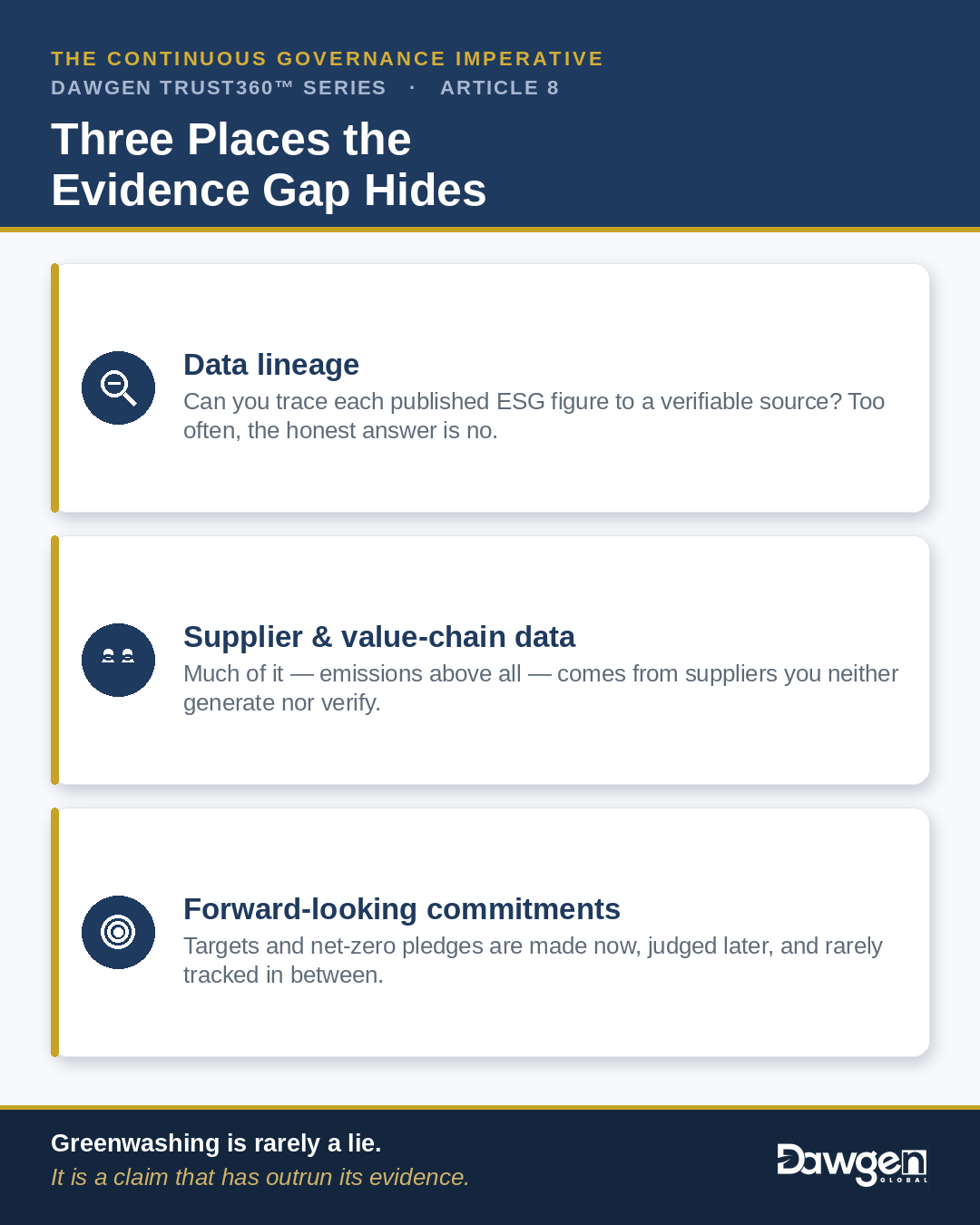
If the risk is the gap between claim and evidence, it is worth knowing where that gap most often opens.
Data lineage. Ask, of any ESG figure you publish, the question you would ask of a financial one: where exactly did this number come from, and can we trace it to a verifiable source? For a great deal of ESG data — scattered across spreadsheets, manual estimates and one-off calculations — the honest answer is no. Numbers that cannot be traced cannot be defended.
Supplier and value-chain data. A large share of ESG information, emissions data above all, originates not inside your organisation but with your suppliers — the very third parties whose risk we examined two articles ago. Claims built on data you neither generate nor verify are claims built on someone else’s word.
Forward-looking commitments. Targets, net-zero pledges and transition plans are promises made now and judged later. Without a documented plan and continuous evidence of progress against it, a target announced with conviction today becomes a greenwashing exposure tomorrow — not because the intention was false, but because the follow-through was never tracked.
Why annual fails ESG completely
Here is the structural reason the annual model fails ESG more decisively than almost anywhere else: ESG evidence cannot be reconstructed retroactively. A control test can, at a pinch, be re-performed. But if you did not capture the data when the activity actually happened — the energy consumed, the waste diverted, the supplier attestation obtained, the decision documented — you cannot credibly recreate it the week before the report is due. The annual scramble to assemble an ESG report from whatever records happen to exist produces exactly the kind of thin, contestable evidence that does not survive scrutiny. Continuous capture produces evidence that does. The difference is not effort; it is timing.
The CFO inherits this
There is a reason ESG responsibility is migrating, in organisation after organisation, toward the CFO and the finance function. It is becoming accounting-grade work, and the finance function is where the discipline to handle accounting-grade data already lives. The CFO who recognises this early — who insists that ESG data be governed with the same rigour as financial data, with traceable lineage and assurance-readiness built in — protects the organisation. The CFO who leaves ESG as a communications project, disconnected from financial controls, simply inherits the liability when the claims are eventually tested.
What good looks like
This is why ESG is one of the six domains Dawgen TRUST360™ monitors continuously — keeping evidence packs current rather than reconstructed; tracing the lineage of ESG data back to source; watching supplier and value-chain data; flagging the public claims running ahead of their support; and maintaining ISSB readiness against IFRS S1 and S2, so that disclosure, when required, rests on evidence already in hand rather than evidence hastily assembled.
The Caribbean stake
For the Caribbean, this carries particular weight, because ESG here is not only a reporting question — it is a survival one. Our region sits on the front line of climate risk, which means the “E” in ESG is, for us, a matter of genuine resilience rather than abstract disclosure. At the same time, our access to international capital, tourism and trade increasingly depends on credible, evidence-backed sustainability claims. Caribbean organisations that build sound ESG evidence early will find it an advantage in raising capital and winning markets; those that rely on narrative will find the gap exposed at precisely the wrong moment.
A test you can apply now
So here, as ever, is a test you can apply now. Take any ESG claim your organisation has made publicly — a target, a percentage, a commitment — and ask your team to produce, today, the evidence trail behind it: traced to source, documented, and robust enough to survive an auditor or a regulator. Do this for three or four of your most prominent claims. Where the evidence arrives cleanly, you are on solid ground. Where it does not, you have just measured the distance between your story and your proof. That distance is your greenwashing exposure — and the only reliable way to close it is to capture the evidence continuously, long before anyone asks to see it.
About the author
Dr. Dawkins Brown is Executive Chairman and Founder of Dawgen Global, an independent, integrated multidisciplinary professional services firm operating across the Caribbean, and Founding Editor of Caribbean Boardroom Perspectives.
Continue the conversation: dawgen.global · [email protected]
Next in the series — Article 9: “Evidence on Demand: Why Audit-Ready Is the New Always-Ready.”
About Dawgen Global
Dawgen Global is an independent, integrated multidisciplinary professional services firm headquartered at 47 Trinidad Terrace, New Kingston, Jamaica, serving more than 15 territories across the Caribbean. Founded and led by Dr. Dawkins Brown, Executive Chairman, the firm is independent and not affiliated with any international network. It delivers a full suite of professional services under one roof: audit and assurance; tax advisory; IT and digital transformation; risk management; cybersecurity; actuarial and insurance regulatory advisory; HR advisory; mergers and acquisitions; corporate recovery; business advisory and strategy; accounting BPO and virtual CFO services; and legal process outsourcing.
The proposition is simple: big-firm capability without the big-firm price. Dawgen Global’s integrated approach is built for the specific complexities and opportunities of the Caribbean market, helping organizations make sharper, better-informed decisions that drive measurable progress.
To explore a partnership, reach out:
- Website: dawgen.global
- Email: [email protected]
- WhatsApp (Global): +1 555-795-9071
- Caribbean offices: +1 876-665-5926 | +1 876-929-3670 | +1 876-926-5210


