
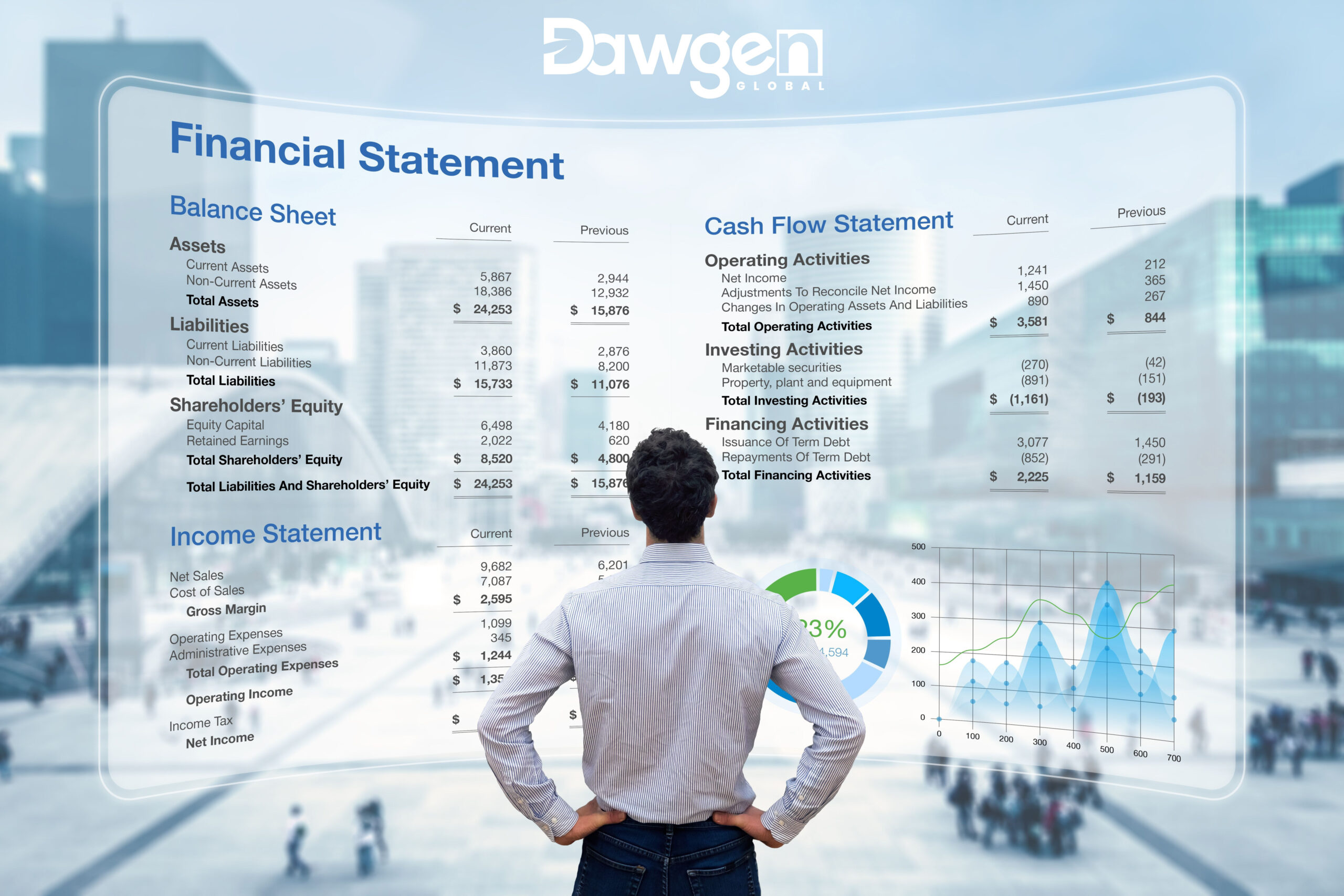
Setting the Scene: Financial Statements Need Translators, Not Just Technicians
Every year, organisations publish thick volumes of financial statements prepared in full compliance with IFRS. Yet, despite the technical rigour behind these documents, many decision-makers still ask the same questions:
-
What does this really mean for our business?
-
Are we genuinely creating value – or just reporting profit?
-
How much can I trust these numbers, given the estimates and judgements involved?
Traditional financial analysis often stops at ratios and trends. Helpful, yes – but incomplete. In today’s environment of rapid change, complex standards, and heightened stakeholder expectations, leaders need more than a checklist. They need a structured way to convert IFRS-compliant financial statements into insight, foresight, and action.
At Dawgen Global, our purpose is simple and consistent:
We help you make Smarter and More Effective Decisions.
To support this purpose, we have developed a practical, branded methodology that brings clarity and structure to financial statement interpretation:
The SMARTEST™ Financial Statement Interpretation Framework
By Dawgen Global
This article introduces the SMARTEST™ framework and sets the stage for our upcoming thought leadership series, “Dawgen Decodes”, where we walk through each element in depth.
Why Traditional Financial Analysis Often Falls Short
Before we introduce the model, it is useful to understand why many financial reviews under-deliver.
-
Ratios without context
Analysts often compute long lists of ratios – liquidity, profitability, leverage – but fail to tie them back to the business model, industry dynamics, or strategy. Numbers are presented, but the story is missing. -
Compliance, not interpretation
Financial statements prepared under IFRS are designed for fair presentation and comparability. But compliance alone does not equal understanding. Users still need to interpret estimates, policies, and disclosures through a commercial lens. -
Fragmented perspectives
One group focuses on profit and loss, another on cash flows, another on covenants. Without an integrated framework, stakeholders look at the same entity through different windows and reach conflicting conclusions. -
Insufficient focus on sustainability of performance
A strong year may be driven by one-off items, favourable accounting estimates, or temporary market conditions. Without a structured assessment of earnings quality and trends, decision-makers may misjudge the true trajectory of the business.
Dawgen Global’s SMARTEST™ Framework addresses these gaps by providing a clear, repeatable way to read IFRS financial statements that is:
-
Strategic – anchored in the business model
-
Holistic – spanning performance, position, cash flows and risk
-
Forward-looking – linking history to scenarios and valuation
Introducing the SMARTEST™ Framework
SMARTEST™ is an eight-lens framework designed to guide a full review and understanding of IFRS financial statements. Each letter represents a critical dimension of interpretation:
-
S – Strategy & Business Model
-
M – Measurement & IFRS Policies
-
A – Activity & Operating Performance
-
R – Returns & Profitability
-
T – Treasury, Liquidity & Working Capital
-
E – Earnings Quality & Cash Flows
-
S – Structure, Capital & Solvency
-
T – Trends, Scenarios & Valuation
The logic is simple: you should not rely on any single lens. A strong profit number with weak cash generation, or robust growth accompanied by rising leverage, tells a different story once you walk through all eight dimensions.
In this introductory article, we provide an overview of each lens. Subsequent articles in our Dawgen Decodes series will devote a full deep-dive to each component.
The Eight Lenses of SMARTEST™
1. S – Strategy & Business Model
Every financial statement is a reflection of choices – markets entered, customers served, products delivered, and risks accepted. The Strategy & Business Model lens asks:
“What is this business really trying to do, and how should that shape my reading of the numbers?”
Key questions include:
-
What is the entity’s core value proposition?
-
How does it generate revenue – transactional, subscription, long-term contracts, financing?
-
What are the main cost drivers and scalability levers?
-
How does the business compete and differentiate in its sector?
Under this lens, the statement of profit or loss, balance sheet and notes are re-read through a strategic lens. For example, revenue recognition policies under IFRS 15 or lease accounting under IFRS 16 are not just technical points – they are expressions of how the business operates.
At Dawgen Global, we start with a Strategy Snapshot: a concise overview of the business model that frames all subsequent analysis. Without this, ratios and trends float in isolation.
2. M – Measurement & IFRS Policies
IFRS provides principles that often require significant judgement. The Measurement & IFRS Policies lens focuses on how and when the economic reality of the business is translated into numbers.
Key areas of focus:
-
Revenue recognition methods (IFRS 15) and performance obligations
-
Lease classification and measurement (IFRS 16)
-
Financial instruments classification and impairment (IFRS 9)
-
Recognition of goodwill and intangible assets (IFRS 3 and related standards)
-
Provisions, contingencies, and other high-judgement estimates
Here, we build a Measurement & Judgement Map:
-
Where are the most material assumptions applied?
-
Have there been changes in policies or estimates over time?
-
Do the chosen policies align with the business model and industry norms?
By understanding the measurement foundations, users can better assess comparability, risk, and the potential impact of alternative assumptions.
3. A – Activity & Operating Performance
Once the strategic and measurement context is clear, we examine Activity & Operating Performance – the “engine room” of the business.
Core questions:
-
How is the entity generating revenue, and at what pace is it growing?
-
What is happening to gross margins and operating margins over time?
-
Are operating expenses aligned with growth, or growing faster than revenue?
-
What do segment disclosures reveal about which products, regions or lines are truly driving results?
Under this lens, we link:
-
Revenue and cost of sales to volume, pricing, and mix effects
-
Operating expenses to efficiency, productivity, and investment in capabilities
-
Segment information to the portfolio of businesses within the group
The outcome is an Operating Engine View that highlights which components of the business are performing, underperforming, or consuming disproportionate resources.
4. R – Returns & Profitability
Profit in isolation tells only part of the story. The Returns & Profitability lens asks:
“Is the business generating sufficient returns for the capital employed and risks taken?”
Key metrics may include:
-
Return on Equity (ROE)
-
Return on Assets (ROA)
-
Return on Invested Capital (ROIC)
-
Net profit margins and EBITDA margins
We adjust for non-recurring items, restructuring charges, impairment losses, or one-off gains identified earlier. The goal is to separate underlying performance from accounting noise.
Through this lens, Dawgen Global analyses whether the returns:
-
Cover the cost of capital
-
Are improving or deteriorating over time
-
Are consistent with peers and industry benchmarks
The result is a Returns Scorecard, forming the basis for assessing value creation versus value erosion.
5. T – Treasury, Liquidity & Working Capital
Strong profits do not automatically mean strong liquidity. The Treasury, Liquidity & Working Capital lens focuses on short-term financial resilience and cash management.
Questions we explore:
-
Does the entity have sufficient liquid resources to meet obligations as they fall due?
-
How is working capital managed – inventory days, receivable days, payable days?
-
Are there significant short-term borrowings, overdrafts or covenant pressures?
-
How dependent is the business on external financing?
We examine the statement of financial position, notes on borrowings, and relevant disclosures to build a Liquidity & Treasury Heatmap that highlights:
-
Immediate pressure points
-
Refinancing risks
-
Opportunities to unlock cash through working capital optimisation
This lens is particularly important for lenders, suppliers and other creditors.
6. E – Earnings Quality & Cash Flows
The Earnings Quality & Cash Flows lens bridges the gap between profit and cash.
Core focus areas:
-
Reconciliation of profit to cash flow from operating activities
-
Identification of non-cash items and timing differences
-
Distinction between recurring and non-recurring cash flows
-
Assessment of whether growth is self-funded or dependent on external capital
We critically ask:
-
How much of the reported profit is supported by cash?
-
Is the entity consistently generating positive operating cash flows?
-
Are large working capital movements masking underlying issues?
Dawgen Global typically produces an Earnings Quality Index – a narrative and quantitative assessment of how much reliance stakeholders can place on the reported results.
7. S – Structure, Capital & Solvency
The Structure, Capital & Solvency lens examines the robustness of the balance sheet.
Key questions:
-
What is the mix between debt, equity, and other financing instruments?
-
How significant are lease liabilities and off-balance sheet exposures?
-
What is the quality of assets – including goodwill, intangibles, and receivables?
-
How leveraged is the entity, and what is its ability to withstand shocks?
We focus on:
-
Debt-to-equity and other leverage ratios
-
Interest cover and debt service capacity
-
Concentration of assets in high-risk categories
-
Group structures and intercompany balances
The output is a Balance Sheet Resilience Profile indicating how well the entity can absorb adverse events, regulatory changes, or market downturns.
8. T – Trends, Scenarios & Valuation
The final lens, Trends, Scenarios & Valuation, is where interpretation becomes action.
This dimension connects historical analysis to future-oriented questions:
-
What are the 3–5 year trends in growth, margins, leverage, and cash generation?
-
What are plausible base, upside, and downside scenarios?
-
How do these scenarios impact valuation metrics, capital requirements, or covenant headroom?
-
What decisions should management and stakeholders consider today?
Here, Dawgen Global synthesises all prior lenses into a Decision & Valuation Brief, tailored to the user:
-
For boards and audit committees – questions to pose to management and auditors
-
For lenders – implications for credit risk and covenant structures
-
For investors – signals for valuation, entry, exit, or portfolio rebalancing
-
For owners and entrepreneurs – priorities for performance improvement and risk mitigation
How Dawgen Global Uses SMARTEST™ in Practice
The SMARTEST™ Framework is not a theoretical construct. It is designed to be embedded into our work across the Caribbean and beyond:
-
Audit and Assurance
We use SMARTEST™ to structure post-audit debriefs, helping boards understand not just what the financial statements say, but what they mean for strategy, risk, and future performance. -
Advisory and Consulting
When advising clients on performance improvement, restructuring, or capital raising, SMARTEST™ provides a disciplined way to diagnose issues and prioritise interventions. -
Business Valuation and Transactions
In valuations, due diligence, and transaction support, SMARTEST™ helps ensure that pricing and structuring decisions are grounded in a holistic view of the entity’s financial reality. -
Training and Capacity Building
We also use SMARTEST™ as a teaching tool – training finance teams, directors, and entrepreneurs to read IFRS financial statements more confidently and critically.
In short, SMARTEST™ is the Dawgen Global way of interpreting financial statements: consistent, structured, and decision-focused.
Looking Ahead: The “Dawgen Decodes” Series
This article is the first in our “Dawgen Decodes” thought leadership series on financial statement interpretation. In the coming instalments, we will dive deeper into each lens of the SMARTEST™ framework, including:
-
S is for Strategy: Reading the Business Model Behind the Numbers
-
M is for Measurement: Why IFRS Policies and Estimates Can Change the Whole Story
-
A is for Activity: Decoding Revenue, Costs and Operational Efficiency
-
R is for Returns: Assessing Whether the Business Truly Creates Value
-
T is for Treasury: Liquidity, Working Capital and the Art of Staying Solvent
-
E is for Earnings Quality: Separating Sustainable Performance from One-Off Noise
-
S is for Structure: Capital, Solvency and Balance Sheet Resilience
-
T is for Trends: Using History, Scenarios and Valuation to Make Smarter Decisions
Each article will provide practical checklists, illustrative examples, and insights tailored to boards, lenders, investors, and entrepreneurs – with specific relevance to the Caribbean business environment.
A Closing Thought – From Statements to Smarter Decisions
IFRS financial statements are powerful tools. But without the right framework, they can feel complex, intimidating, or disconnected from day-to-day decisions.
The SMARTEST™ Financial Statement Interpretation Framework is Dawgen Global’s response to this challenge – a structured, branded approach that translates compliance into clarity and numbers into narrative.
At Dawgen Global, we stand by our commitment:
We help you make Smarter and More Effective Decisions.
Through Dawgen Decodes and the SMARTEST™ framework, we invite you to see your financial statements not just as a regulatory requirement, but as a strategic asset.
About Dawgen Global
“Embrace BIG FIRM capabilities without the big firm price at Dawgen Global, your committed partner in carving a pathway to continual progress in the vibrant Caribbean region. Our integrated, multidisciplinary approach is finely tuned to address the unique intricacies and lucrative prospects that the region has to offer. Offering a rich array of services, including audit, accounting, tax, IT, HR, risk management, and more, we facilitate smarter and more effective decisions that set the stage for unprecedented triumphs. Let’s collaborate and craft a future where every decision is a steppingstone to greater success. Reach out to explore a partnership that promises not just growth but a future beaming with opportunities and achievements.
 Email: info@dawgen.global
  Visit: Dawgen Global Website

 WhatsApp Global Number : +1 555-795-9071
Caribbean Office: +1876-6655926 / 876-9293670/876-9265210  WhatsApp Global: +1 5557959071
USA Office: 855-354-2447
Join hands with Dawgen Global. Together, let’s venture into a future brimming with opportunities and achievements


