
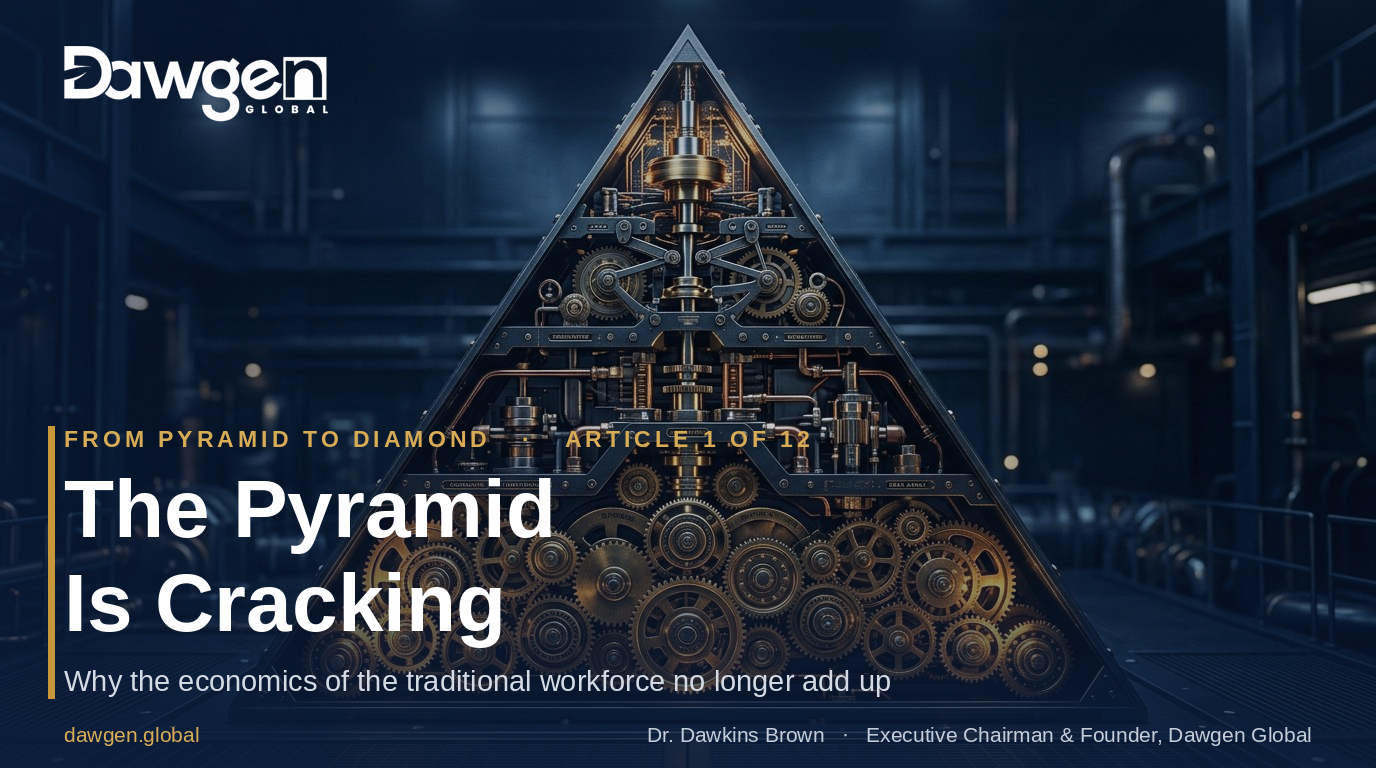
The staffing pyramid was never just an org chart. It was an economic engine — and three forces are now pulling that engine apart.
THE SHAPE WE INHERITED
A structure we stopped questioning
Walk into almost any professional firm, bank, or large institution and you will find the same silhouette. A broad base of junior people doing the volume work. A narrower band of managers checking, correcting and directing it. A slim apex of partners, principals or executives who own the clients, carry the risk and take the largest share of the reward. We call it the organizational pyramid, and for most of a century we treated it as simply the way work is structured.
It was never simply that. The pyramid was an economic engine in disguise. Its shape encoded a business model so successful that we stopped noticing it was a model at all. Today that model is under visible strain, and leaders across industries are reaching for a new metaphor — the diamond. Before we can move to a new shape, we have to be honest about why the old one is cracking.
How the pyramid actually made money
Strip away the language of careers and culture, and the pyramid was a leverage machine. A partner could only personally bill so many hours. But by surrounding that partner with a wide base of junior staff — whose time was billed to clients at a healthy markup over what they were paid — the firm multiplied the partner’s reach and captured the spread. The wider the base relative to the apex, the more profit the structure generated. Leverage, in the precise financial sense, was the engine.
This worked because the pyramid quietly solved three problems at the same time. It generated profit, through that markup on junior time. It trained people, because juniors learned the craft by grinding through volumes of routine work under supervision. And it priced the work, because clients accepted being billed by the hour for the hours consumed. One shape, three jobs. That triple function is exactly why the pyramid was so durable — and why its unwinding is so disruptive.

The three assumptions that are now failing
The pyramid rested on three assumptions. Each held for decades. Each is now contested at the same time.
Assumption one: routine work is abundant
The wide base only makes sense if there is enough routine, leverageable work to keep it busy and billable — reconciliations, first-pass document review, data gathering, standard analysis, basic drafting. Intelligent technology is now absorbing precisely this category of work, and doing it faster and at a fraction of the cost. The abundant routine work that justified a wide base is thinning out. When the work that fills the base disappears, the base has no economic reason to stay wide.
Assumption two: the base trains the next generation
The same routine work that generated profit also generated expertise. Juniors became seniors by doing thousands of small tasks and slowly absorbing judgment from the people reviewing them. Remove the routine work, and you do not just remove a cost line — you remove the training ground. This is the most dangerous crack of all, because its effects are invisible for years and then suddenly structural. We will return to this “broken rung” throughout the series.
Assumption three: clients pay for hours
The whole markup model depended on clients accepting input-based pricing — paying for hours, and tolerating that part of those hours was junior staff learning on their work. But clients can see the same technology their advisors can. They are increasingly unwilling to pay hourly rates for output that a machine now produces in seconds, and increasingly insistent on paying for results instead. When the buyer rejects the pricing model, the engine loses its fuel.
Why this is sharper in the Caribbean
These pressures are global, but they bite harder in small markets. Caribbean firms and institutions have long faced a thin talent pool and a persistent outflow of their most capable young professionals. The pyramid’s training-ground function was already strained here before any of this began — we invested in juniors and then watched many of them migrate. Now technology is eroding the base from below at the same time. The region cannot afford to treat a thinning base as a quiet cost saving. For us, the stakes are the retention and compounding of regional expertise itself.
The choice in front of leaders
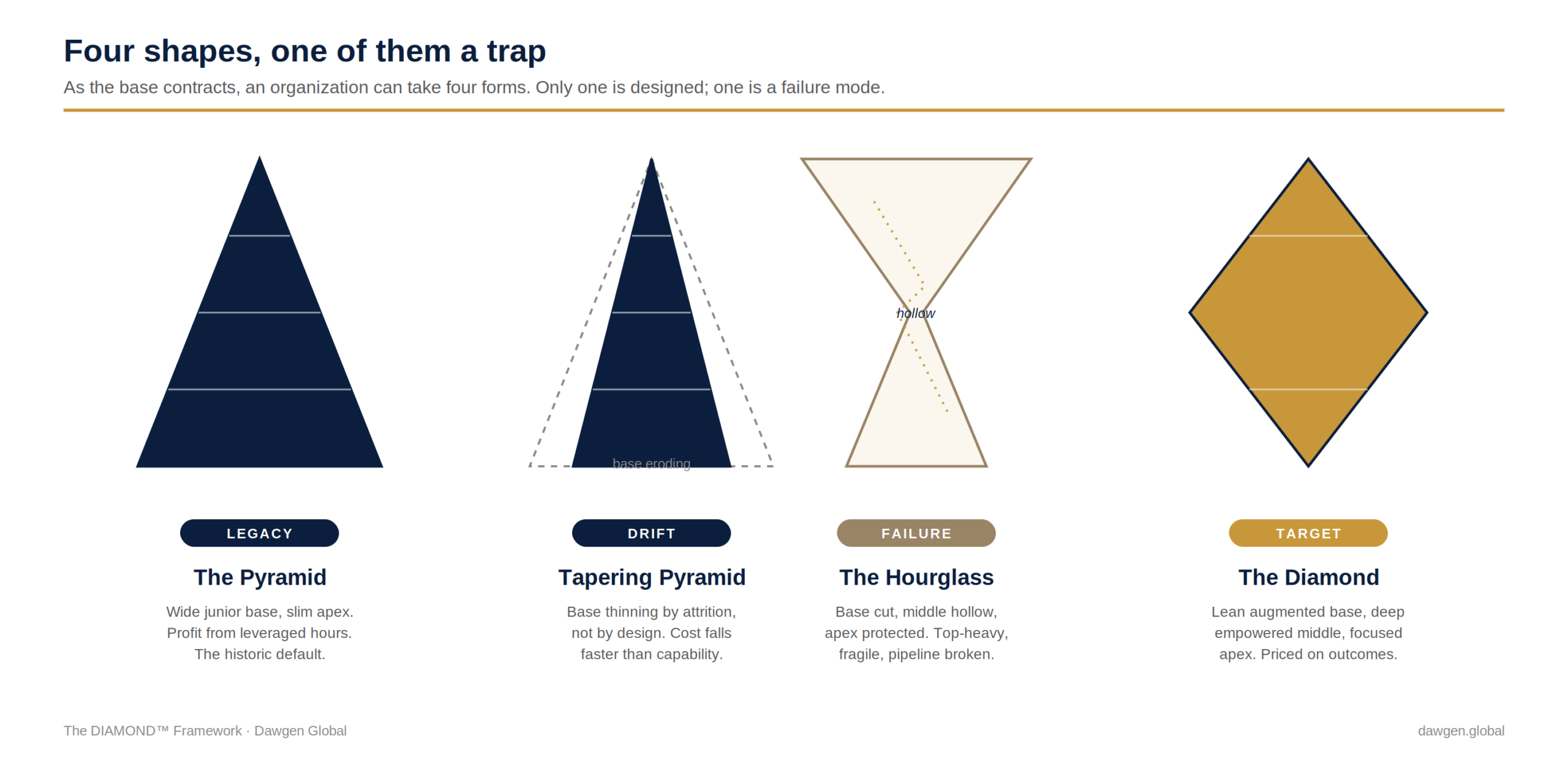
As the base contracts, an organization takes one of four shapes — only one is designed.
Here is the uncomfortable truth. The base is going to narrow whether or not leadership has a plan. Technology will keep absorbing routine work, clients will keep resisting hourly pricing, and the junior layer will keep getting harder to justify on the old terms. The only real decision is whether the narrowing happens by design or by drift.
Drift is seductive because it shows up as savings. Stop replacing departing juniors, let the technology do their work, protect the senior ranks and partner profit — and the quarterly numbers improve. But drift does not produce the diamond that leaders say they want. It produces something far more fragile, which the next articles in this series will name and dissect.
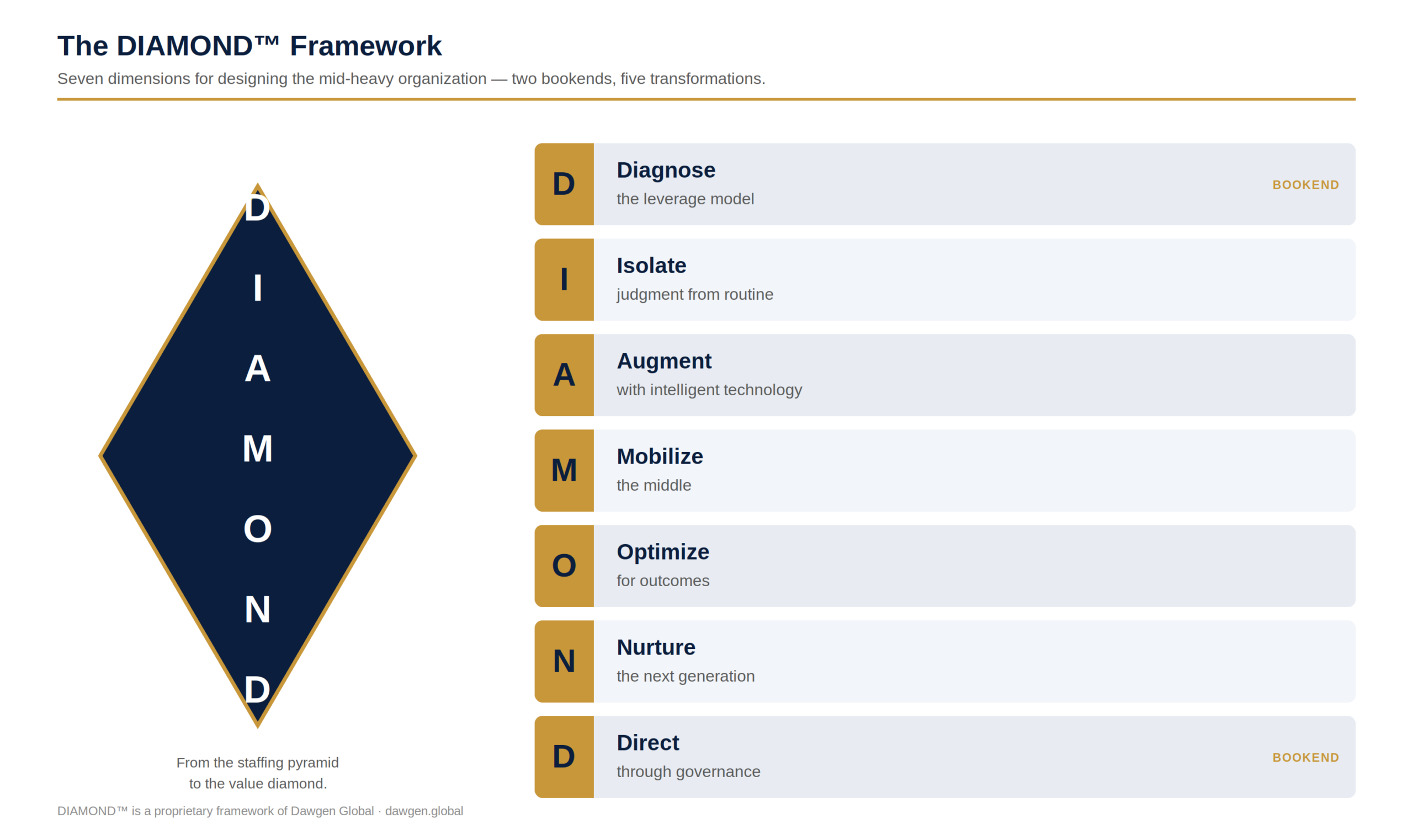
The alternative is to treat the shape of the organization as a strategic design problem — to ask, deliberately, what a leaner base, a thicker experienced middle and a focused apex should look like, and how to build it without breaking the pipeline of talent in the process. That deliberate redesign is the subject of the DIAMOND™ Framework that anchors this series, and the work begins where all honest redesign begins: with a clear-eyed diagnosis of how the current engine really runs.

In the next article, we open the engine itself — the mathematics of leverage — to understand exactly why the model that built the modern firm is now stalling.
This article is part of “From Pyramid to Diamond,” a Dawgen Global thought leadership series built on the proprietary DIAMOND™ Framework. Dr. Dawkins Brown is Executive Chairman and Founder of Dawgen Global.
© 2026 Dawgen Global. DIAMOND™ is a proprietary framework of Dawgen Global. dawgen.global | [email protected]
About Dawgen Global
Dawgen Global is an independent, integrated multidisciplinary professional services firm headquartered at Dawgen Towers, 47-49 Trinidad Terrace, Kingston 5, Jamaica, serving more than 15 territories across the Caribbean. Founded and led by Dr. Dawkins Brown, Executive Chairman, the firm is independent and not affiliated with any international network. It delivers a full suite of professional services under one roof: audit and assurance; tax advisory; IT and digital transformation; risk management; cybersecurity; actuarial and insurance regulatory advisory; HR advisory; mergers and acquisitions; corporate recovery; business advisory and strategy; accounting BPO and virtual CFO services; and legal process outsourcing.
The proposition is simple: big-firm capability without the big-firm price. Dawgen Global’s integrated approach is built for the specific complexities and opportunities of the Caribbean market, helping organizations make sharper, better-informed decisions that drive measurable progress.
To explore a partnership, reach out:
- Website: dawgen.global
- Email: [email protected]
- WhatsApp (Global): +1 555-795-9071
- Caribbean offices: +1 876-929-3670 | +1 876-926-5210


